Do you crave a story so side-splitting, funny and unbelievably wild that it doesn’t matter if it’s true? We all do. We’ve all been there, laughing hysterically until someone chimes in with, “That story you’ve been telling,” they whisper to us in confidence. “Yeah, it’s been thoroughly debunked.” We all probably know at least one debunker. They might spare us the embarrassment of debunking us in public, but that doesn’t change the fact that they love debunking us. They study our face and smile at us with compassion that borders on condescending glee. I don’t know if it’s jealousy, but they obviously cannot stand the laughter we receive telling a side-splitting tale that is so wild and funny that it almost doesn’t matter if it’s true. Yet, the storyteller and the debunker both know that it does matter in the sense that the difference between true and it kind of doesn’t matter if it’s true is the difference between hilarious and “It’s still funny, regardless,” and the debunker enjoys dragging our side-splitting story into the latter category.
It’s our fault, we should fact check these stories to see if they’re true, but when a storyteller gets ahold of a great, side-splitting story, we get all jacked up, and we can’t wait to share them. It’s in our blood, and it’s such a part of our identity that we end up laughing harder than anyone else, because it appeals to our storytelling nature.
Most of these stories, just to be clear, are so dumb and inconsequential that we don’t really care if they’re true, and they’re so funny that a part of us doesn’t want to check, because we hope that they’re true. That’s when the “truth trolls” come marching in to destroy our story’s comedic value. Why do they do it, they probably don’t even know the finer, psychological motivations behind it. It’s just something they’ve done for so long that it’s just kind of what they do.
Fact-checkers love to tell us that these fun stories just happen to be false, debunked, or an urban legend. If this is you, you might just want to consider moving along, because we find you exhausting. About three beats after we unleash our side-splitting yarns, their faces get hued by smartphones. “Umm, not true,” they say when they manage to become unhued, “according to (fill in the blank.com) that story has been debunked as an urban legend.” To put an exclamation point on their attempts to suck the fun out of our story, they show us their phone.
Some of us enjoy hearing, and reading, a great story almost as much as we enjoy telling them and writing them, and it’s not a gift given at birth. It’s a methodical process fraught with failure, but those who love it, learn it, and learn to love it. It’s not something that we learn so well that we never make mistakes either. It’s an ongoing process. As much as we storytellers enjoy that process, fact-checkers enjoy their end of it almost as much, as they’ve found it to be an excellent way to discredit, delegitimize, and unfunny, storytellers they just don’t like.
“I just get so tired of their BS,” they add after sucking the smiles off everyone’s face.
Feature Story #1
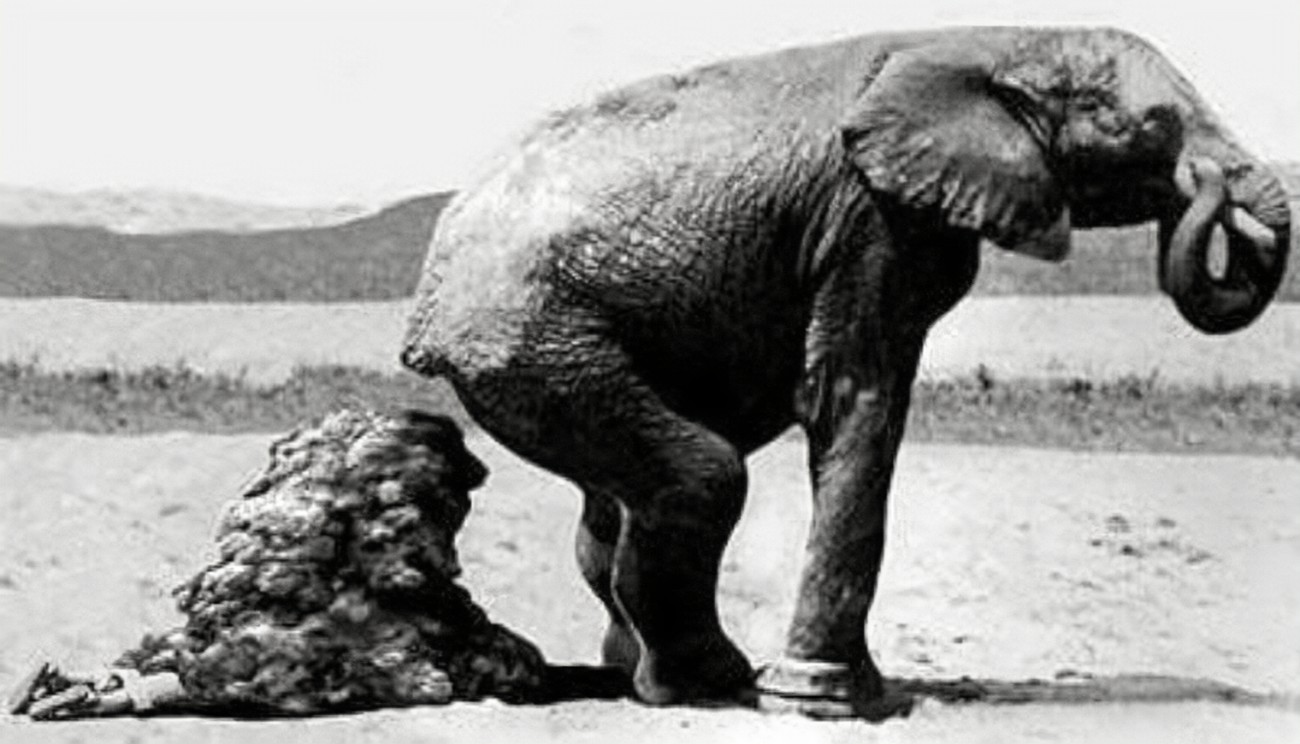
A zoo keeper grows concerned with how constipated his beloved elephant is. He and his fellow zoo keepers, management, and the zoo community try everything to provide her some relief. In total desperation, the man learns of an effective, all-natural cure of herbs and oils. He places it on a wire brush and inserts it, and it works. It works so well that the elephant unloads on the zoo keeper. The zoo keeper is hit by the violent discharge so perfectly that it knocks him down, and he hits his head so hard that he unfortunately experiences a temporary and fatal moment of unconsciousness, as two hundred pounds of dung suffocates him.
What we’re talking about here are silly, inconsequential stories that we share in employee cafeteria. We’re talking about those stupid stories that no one will remember thirty seconds after they’re told. We’re talking about telling stories that might cause some to smile, others laugh, and still others to roll around with hysterical laughter, and the minute the truth trollers pull out their phones, everyone groans. The truth trolls cannot abide by all that laughter. They need to thoroughly vet a story before they can even smile, and they won’t even smile if they happen to find out it’s actually true. “Well, it turns out that one is true,” they say with same look they have when eating a sandwich. If they find out one of your stories doesn’t pass the test, they have a smug, “I’m just calling you out on your BS!” look on their face. That appears to be the only source of satisfaction they gain from their otherwise joyless existence.
Feature Story #2
A man in Oklahoma, enters the highway, and after a couple of miles, he clicks his Recreation Vehicle (RV) into cruise control. Nothing different than anything any of us have done over a hundred times. Except, this driver, allegedly unaware of the full functionality of the cruise control feature on his RV, walks into the kitchen area of his RV to make himself a sandwich. We have to imagine that the man didn’t have enough time to get the meat between the slices of bread when all hell broke loose, as the RV drove off the road and into the ditch. Some versions of this story suggest that the man died as a result of the ensuing accident. Others claim that he not only survived, but he won a settlement with the manufacturer $1,750,000 and a new RV, because the manufacturer did not specifically document for him the full functionality of the RV’s cruise control. This story isn’t half as funny as it once was, based on the current technology that allows some cars self-driving functionality, but back when I first heard this tale, it seemed impossibly hilarious that a grown man (or woman, depending on the version of the story) could think that they could make a sandwich (or cup of coffee) in the back while the car was in cruise control.
Some great stories combine fiction and non in a manner we call creative non-fiction. I remember mentally toying around with the concept of the total capacity of cruise control, soon after I bought a car that had a working one. I thought the possibilities of a fella over-estimating its capacity could be funny, and I’ll be damned if someone didn’t consider the same plotline, either fictionally or in non-fiction. Is this story 100% true, tough to know 100%, but does it have enough truth in it to be funny? At some point, I think we should all hit that “off” switch in our cranium that analyzes, deconstructs, and refutes such stories. Just laugh or don’t laugh, but they can’t. They love pretending that they’re a reporter, and that they’re taking a story, or its storyteller, down.
Feature Story #3
Elvis Painting in Cheese
Elvis Presley had a soft spot for cheese. His favorite sandwich, according to sources, was the grilled cheese sandwich. Elvis was from the deep south, and the home he grew up in an environment that was anything but rich. After achieving a level of fame and fortune those who were never a Beatle or the primary singer on the album Thriller would never understand, he probably enjoyed the finest delicacies in the world, but he couldn’t kick his love for the grilled cheese sandwich. Elvis ingested so many drugs, and so many different kinds of drugs, that we cannot dismiss them as a contributor to his eventual demise, but what does cheese do? It stops us up, and among the numerous other things Elvis poured into his body was a truckload of cheese. As Dan Warlick, chief investigator for the Tennessee Office of the State Chief Medical Examiner, stated, Elvis’s death was brought on by something called the Valsalva’s maneuver. “Put simply, the strain of attempting to defecate compressed the singer’s abdominal aorta, shutting down his heart.” The coroners found that Elvis had “Compacted stool that was four months old sitting in his bowels.”
Did cheese take The King down? These stories are snowball stories. As they roll from one storyteller to another they gather facts, details, jokes, and out and out fabrications, until they arrive at some finished form of funny. I don’t want to know most of the time, because most of these stories are so dumb that I honestly don’t care, and the primary reason I’m writing this article is that I don’t understand why those with a dreaded and incurable hued nose disease do.
I just want to laugh, but I’ve been fact-checked me so often that I now wonder if what I’m being told is 100% true. I want to laugh, but more than that, when I hear a great story, I want to repeat that story so often that it becomes mine. If it’s going to be mine now, I have this newfound urge to fact-check it, so I don’t get fact-checked, and I so want to go back to “Who cares, as long as it’s funny!” mindset.
“The idea that you loathe fact-checkers so much only makes them seem a little more legitimate to me,” third parties say when we complain about truth trolls checking our stories.
I don’t know if it has anything to do with the fact that I’m Irish, but there are few things I enjoy more than sitting in a circle of friends, all with beer in hand, telling a story that has but one agenda, to make them laugh. “There’s no way that’s true,” they say between laughs, and I have no problem with that because I know that for most people that line gives them license to be free from naiveté, and it also frees them to laugh harder. We all know that that story is so sensational that it can’t be true, but we don’t care in that small space in time where all we can do is laugh about it. “That guy is so full of crap, it’s not even funny,” we might say to a third party after the storyteller leaves the room, but the next time he enters, we’ll be all over it when he tells us he has another story to tell.
Truth trolls won’t go through any of this with us. They might want to, but they can’t. They have some odd belief, probably born of some childhood experience that left them vulnerable to the charge of naiveté, that if they believe that, they’ll believe anything. They believe that if they believe our silly, stupid story, their credibility is on the line. Their noses contract a blue hue, and they come out, “Not true!” Now I will grant you that if a story is 100% true, it might slide it a little higher on the funny scale, but by how much? Does it lift such a story from funny to knee-slapping hilarious? If we add, “It’s true, all the fact-checkers checked it and sourced it out, and they found that it’s 100% factual.” How much does that truly add to the entertainment value? If you’re a hue-faced truth troller who has neck problems, because your head is permanently fixed in the 45-degree position, will you go back to 90-degrees with an “It’s true” and laugh? No, and you might even be a little disappointed by your findings, right? Yeah, I’m looking at you.
Feature Story #4
A raging alcoholic was informed by his doctor that he had a form of throat cancer that would end his life quickly if he chose to continue to drink alcohol. The alcoholic peppered the doctor with questions, “Cut back, wean myself off of it over time?”
“I don’t think you understand the severity of this,” the doctor said going over the biopsy and the image test results with the alcoholic. “This is what we call stage four cancer, and if you quit now, cold turkey, you have a chance, about a 39.1 percent chance to live five years. Keep drinking, even a little amount, and you’re likely dead in months.”
This scared the alcoholic. He did not want to die, but he couldn’t imagine going weeks and months without a small swig of alcohol here and there. In some respects, it was psychological torture to him to see everyone around him drink so casually, and have so much fun, but he kept coming back to the idea that he didn’t want to die.
It hurt to drink alcohol too, and that was really one of saddest things in this alcoholic’s life. It was the only reason he went to see that doctor. Once the doctor took alcohol away from him, he realized that he never learned how to live. He didn’t have any hobbies, friends, and he didn’t know how to fix things. He had family, but they distanced themselves from him a long time ago. He was a man who worked his tail off and came home to drink alcohol with his beloved wife while the two of them watched TV together, and he couldn’t even enjoy that. In short order, this man became depressed and desperate to live the only life he knew. He did some research on his computer and discovered something called butt-chugging, or boofing.
“We’ll be using this device,” he informed his wife, “to deliver alcohol to my system by enema. It won’t touch my throat and exacerbate my condition.” His wife was hesitant, but the alcoholic broke her down. “What most people don’t know is we all have enzymes in our stomach and liver that break alcohol down and dilute it. Regular butt-chuggers say that it stings a little, initially, but after a while some say that they start to enjoy the sensation. They even have a term for those people. They’re called klismaphiliacs. Due to the fact that you’re essentially bypassing all of the biological protections our body has in place by going the enema route, they say there’s no hangovers and no puking involved.”
Some dispute whether or not the wife obliged the alcoholic, but she was charged with negligent homicide for delivering what turned out to be a lethal and fatal dose of two 1.5-liter bottles of sherry into her husband’s system. In her defense, the wife claimed innocence by declaring that he did it himself. “He did it all the time,” she pled. “He was always giving himself enemas. Coffee enemas, alcohol enemas, and even soap enemas. He even had enema recipes.” The case against the wife was dropped due to insufficient evidence.
One of the primary lessons this alcoholic-turned-butt-chugger didn’t consider is that puking, while uncomfortable, disgusting, and painful, it serves a biological purpose as important as coughing, sneezing, and bumps on our arms. It is the body attempting to push what it cannot dilute, absorb, or handle out. While we’re puking, it’s difficult to consider that this is probably our body protecting us from the damage of what we do to it, and that it’s actually a good thing that our body knows how to protect us from the debilitating and at times, fatal things we do it.
I am not a regular patron of the sites and shows that feast on the misfortunes of others in this manner, but I used to occasionally enjoy an episode of Thousand Ways to Die, and The Darwin Awards email lists we used to pass around the office. Their entertainment value, while short and limited, can produce a guilty smile or a laugh behind a hand. There’s really no sense in trying to deny that we love stories involving the misfortune of others, “You mean he died?” we say with an oh-my-gosh face on, and we experience a hybrid of laughter and horror. It’s a part of us.
In researching some of the new ‘believe it or not’ sites for this article, I found some new sites I never heard of that preyed on our misfortunate few, and they had “100 percent true” stamps all over them, as if that’s the primary purpose of their existence. The administrators, and authors, of the stories on these sites are careful to properly source each story with links, footnotes, and various other forms of attributions to perpetuate this idea that they’ve learned from those past publications we all enjoyed that focused on sensational stories that had little-to-no foundation of truth in them. Thus, we can gather that the older sites and publications probably got fact-checked to irrelevance, which, in essence, opened up a niche for these new guys to prosper, but the problem is their stories, while guaranteed and certified to be 100% true, are actually kind of blah and mundane. Their stories amount to, “There was this one guy, from some town in a state who made an unwise decision,” and we un huh them with some excitement as we read on, “and well, no one was hurt or anything, and no one died, but wasn’t that a foolish decision?” Well, yeah, it was, but I was kind of looking for some entertainment here. These sites learned from the past, and they decided to forego the sensational for the factual. As much as it pains me to see this need to have certified 100% guarantees, I understand it’s now the price of doing business in this arena, because in this incarnation of the Information Age, everyone has a phone, and everyone has a site to help them bunk, debunk, or take the bunk out of things, and in this case, it’s better to give than receive, because it can be embarrassing and even a little intimidating at times when fact-checkers discredit, delegitimize, and unfunny every stupid, silly, and inconsequential story we tell, but that’s just what they do, they’re fact-checkers.
Jerry Seinfeld’s Unfrosted was … not bad. Screech! Spit coffee! Swear word! Screams! Car Crash! It is shocking, I know, to hear that coming from a Jerry Seinfeld fanatic. If you’ve read any of the articles on this site, you know how often I source him as one of the greatest comedic minds alive today. I consider him one of the best standup comedians of his generation, and his observations on what makes us weird have had a huge influence on this site. The show Seinfeld was my favorite sitcom of all time, I loved Comedians in Cars Getting Coffee, and I even enjoyed his Bee Movie. I didn’t love it, but I really liked it for what it was. Oh, and I laughed so hard during one of his standup shows that Jerry Seinfeld looked over at me with a look that suggested he was comedically concerned about my health. If the difference between fanatic and fan is excessive and intense, uncritical devotion, I am a fanatic. I never wrote to him, collected dolls, scripts, or took tours, but if there’s a hip term I don’t know for a passive fanatic, that’s me. I’m probably his idea of the perfect fan, a guy who quietly buys and watches anything to which he attaches his name. Which is why it pains me to write these five words: “Unfrosted is not as funny as I thought it would be.”
Watching the movie reminded me how we all want more of everything we love. We want more from our favorite artists, athletes, politicians, and plumbers, until they give us so much that we realize it probably would’ve been better if they left us in a state of wanting more. That’s the advice seasoned entertainers often leave young upstarts, “Always leave them wanting more.”
And Seinfeld warned us, numerous times, that more is not always better. He’s said it in relation to why he decided to prematurely end his show Seinfeld, but he’s applied that principle to his career too. He’s informed us on so many days, and in so many ways, in the numerous interviews he’s done throughout his career, that he’s learned that he’s best when he stays in his lane, his lane being standup. He’s learned what he’s good at, and what he’s not, and he has proven to be the opposite of what makes some comedians so great, in the sense that he’s not daring, risky, or experimental.
If I were to pitch him a project, I would say he and Larry David should develop a sketch comedy in the Mr. Show vein, but we can only guess that he’s had hundreds of similar pitches from friends, fellow writers, and corporate execs, and he’s turned them all down. Some of those projects may have proved embarrassing, some may have been so far out of his lane that he didn’t even consider them, but we have to guess that some projects that were so close that he had a tough time turning them down. He did it all, because he knows who he is, what he’s good at and what he’s not, and he’s learned how to stay in his own lane.
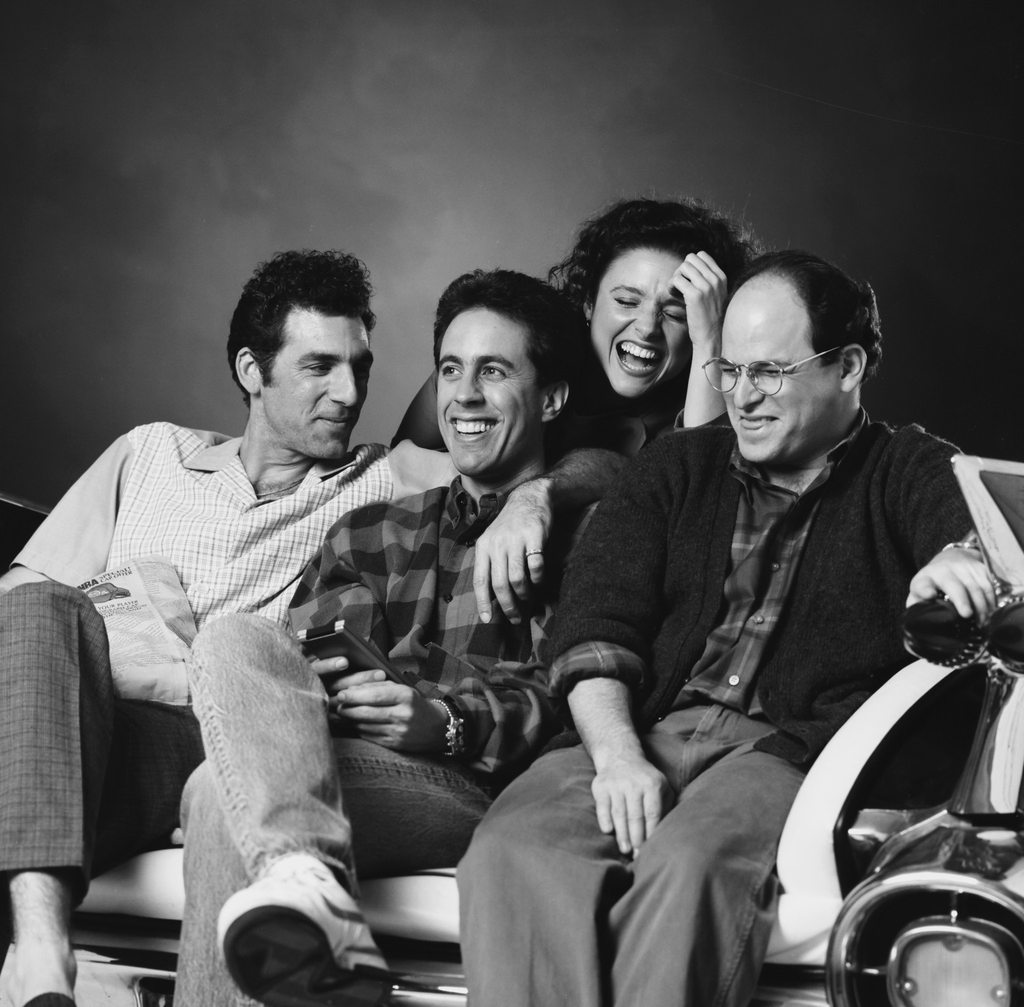
On the greatest sitcom of all time, Jerry Seinfeld surprisingly (to me anyway) credited the three actors (Julia Louis-Dreyfuss, Michael Richards, and Jason Alexander) for making the show so brilliant. He does not shy away from the idea that the writing on the show, of which he played a huge role, was great, but he admits that the actors brought that writing to the next level.
“I did get caught in a beautiful, cyclonic weather event,” he said in an interview. “The actors, Larry David, the thirteen phenomenal comedy writers, and everyone on both sides of the camera was a killer. You know when you’re a part of it, but you know it’s not you. You’re a part of it, but if you’re smart, you know it’s not you. It’s not all you.”
On Seinfeld, Jerry played the Alex Rieger of Taxi, the Sam Malone of Cheers, the center of the storm. He’s always been great at adding that final comment, lifting that eyebrow to exaggerated levels, and saying, “ALL RIGHT!” at the end of another character’s hilarious rant. He knows how to put a cherry atop the pie in other words. As long as that pie, or the acting required to nuance it, was filled in by someone else. He can write funny, he can deliver a short, crisp line deliver as well as anyone, but the nuances in the acting craft required to build to Seinfeld’s punctuation were always best left to others. I heard him say this so many times that I saw it, until I accepted it, but I always thought there was a bit of humility attached to it. Some of us were so blinded by enthusiasm that we never learned how to curb it completely.
When he decided to end Seinfeld after the ninth season, it felt similar to an athlete retiring at the downside of their peak, not the prolonged, sad tail end, just the other side of the peak. There were hints in seasons eight and nine, after Larry David left, that the show was on the downside of its peak, but it was still the best show on TV. Why would an athlete, or a successful showrunner, quit prematurely? I understand not wanting to outstay your welcome, or allowing us to see glaring levels of diminishment and not wanting to go out like that, but if you’re lucky, you might still have forty years on this planet. What are you going to do in the rest of your life to top that? Some of them, I think, are too worried about what we think. They don’t want us to see their downside, or because they love the game so much that they can’t bear playing at anything less than their peak. They can’t bear someone saying, “If you just called it quits after season nine, it would’ve been a great show beginning to end. Season ten was probably one season too many.” They, some of them, don’t want us to remember them as someone who stayed around too long.
When we were kids, we ached for another Star Wars movie, then we got one later, much later, and it ruined the legacy of Star Wars. After the second trilogy was complete, the almost unanimous opinion among those I know is they probably should’ve left us wanting. As Led Zeppelin did. Zeppelin broke up after the untimely death of their drummer John Bonham, in 1980. We spent our teens and early twenties talking about the possibility of a reunion and another Zep album. I understand they said it wouldn’t feel the same without Bonham, but the remaining band members were still in their early-to-mid thirties when they broke up. How do you leave a juggernaut like Led Zeppelin in your early thirties? The Beatles were in their twenties when they broke up. As Theodore Roosevelt said of being president so young, “The worst thing about being president of the United States so young, is that there’s nothing you can do to top that for the rest of your life.” Led Zeppelin left us wanting, and it was probably for the best. What could they have done to top those first six albums? They most likely, and in all probability, would’ve only disappointed.
In a career studded with comedy gold, Gold Jerry! Gold! Unfrosted has the feel of a sequel. It’s not a sequel, but how many of us walked out of a killer comedy, talking about how that movie just screams out for a sequel. We didn’t talk about how great that comedy was, we instantly wanted more. Then, when the sequel came out, it was, “That wasn’t bad, but it wasn’t as good as the first one.” That was the impression Unfrosted left on me. It felt like all the players were trying to recapture something that used to be really funny, and we were all prepared with our preparatory smiles on our faces, until the smiles slowly faded away.
The characters have this feel of trying to repeat something that worked before, but it just doesn’t for all the mysterious reasons that some movies work and some just don’t. The jokes have a feel about them that suggests to us that they’re brilliant, but they’ve been done so many times before that we no longer need to figure them out. As someone who doesn’t know one-one hundredths of the knowledge Jerry Seinfeld has about comedy, I think the figuring out part is the reward of comedy.
Unfrosted seeks the opposite tact. It goes for familiarity, and we all love familiarity. Familiarity with actors, themes, concepts, and all that.Unfrosted displays this level of familiarity in the beginning, to establish a through line to the audience, but it never branches out into that unique spin that kind of shocks us into laughter. The setting of the movie is the 60s, and what a foolish time that was, and even though this has been a million times before, we still think it could be great in the minds of geniuses.
It’s a mystery to us why some movies don’t work, because we don’t make movies, but you’ll often hear moviemakers, actors, and all the other players say, in interviews, that they don’t know why either. “We thought it was funny, but we had no idea how huge it would get.” We don’t often hear the players involved say, “We thought it would be huge, but we had no idea people would consider it a little boring.” What works and what doesn’t is a mystery to us, and it’s a mystery to them. Generally speaking, dramas and action movies are probably a lot easier to predict for those involved, especially when the star actor signs on to the vehicle. Comedies and horror have a super secret formula that even those involved in the finer details of the production involved don’t know whether it will hit or not.
Unfrosted gave us all a be-careful-what-you-wish-for feel, because you just might get it. As much as we cried out for a movie, or any project, from Jerry Seinfeld, we walked away from it thinking that Unfrosted, unfortunately, should never have been made. What could they have done to make you feel better about it? “I don’t know, I don’t make movies, but they probably should’ve left me wanting more instead of giving it to me.”
Watching Unfrosted, reminds us of that elite athlete who retired on the downside of a peak, not the bottom, just the downside, and we clamored for his return. How can he retire at 37? He still had what two-to-three years left? If he lives to eighty, he’ll spend the next 43 years reminiscing and thinking he should’ve played two-to-three more years at least. Then he comes back, and we see how much his skills have declined. He didn’t do it for the money, I can tell you that much. He did it, because he loves the game, and what’s wrong with that?
The point some people make on various websites is that athletes and entertainers run the risk of ruining their legacy by staying too long. This line right here makes me almost fighting mad. So, you’re telling me that the athlete who made so much money for the league, the city, and the franchise shouldn’t be able to sell his wares to anyone who will take them? He shouldn’t try to get another paycheck for the punishment he put his body through for your entertainment, because you want to remember him the way you want to remember him? Isn’t that a bit myopic, even selfish? He wanted to get paid for his efforts, of course, but he didn’t necessarily do it for the money? Seinfeld, and most modern athletes, have so much money that that’s not why they’re doing it. They’re doing it for the love the game so much that they want to play at least two more years? What’s wrong with that, and what’s wrong with you for wanting to deny him that?
Did Seinfeld ruin his legacy by doing Unfrosted? No, first of all, it wasn’t that bad, but, then again, I never expected to say that a Seinfeld project “wasn’t that bad”. I don’t remember any of the elite athletes who “stayed one year too long” for those latter years, and I don’t begrudge them for taking as many paychecks as they could before they called it a career. I also don’t begrudge them the idea that they loved the game so much that they couldn’t walk away, until it was obvious to them that they truly couldn’t play the game anymore. I actually respect it, as I say it was for the love of the game. I respect the fact that Seinfeld’s friend pitched him on the idea of Unfrosted, and not only did he like the idea, but he didn’t think he was done yet. He thought he had one more big project in him, because he loves doing the things he does so much that he wanted to try it at least one more time. Good for you, Mr. Seinfeld, I say, and if he feels like doing another project, or projects, I’ll be there on the first day it’s released.
Jerry Seinfeld has admitted that he doesn’t expect to be remembered after he’s gone, and he’s even gone so far as to say he doesn’t care, or that’s not his driving force. I’ll remember Jerry Seinfeld as a great, almost perfect standup comedian, the cocreator of one of the greatest sitcoms in TV history, and as a gifted natural when it comes to observational humor, but Unfrosted doesn’t do much to either lift or damage his legacy. It was just a marginally entertaining movie that they probably won’t list in his very lengthy resume when that final wave off arrives.
“Listen Daphne,” the character Frasier Crane said, in an episode called We Two Kings, episode ten of season ten, “is your mom partial to a traditional Cornwall dressing, you see I’m thinking it would go splendidly with the twelve-pound Hungarian goose that I’m serving,” he adds the latter with a excited survey of the room to encourage joy.
Niles and Daphne counter that they are planning on celebrating Christmas at their apartment to celebrate their first Christmas as a married couple, and they invite Frasier to partake in their celebration. Frasier argued that it’s been a Crane family tradition to have Christmas at his place. To which, Niles responds:
“Frasier you’ve had Christmas for the past nine years.”
“Yes, but we agreed we’d have Christmas here in its traditional setting.”
“Yeah, well, maybe it’s time to start a new tradition,” Niles says.
“But I’ve had new stockings loomed for everyone,” Frasier says. “Now there you see, you made me spoil the surprise, and did no one hear me say that I have ordered an Hungarian goose?”
As is typical of Kelsey Grammer, he delivers a pitch perfect line. He stresses the word (‘an’), and he punctuates the word goose with a pleading tone that asks his audience (Niles and Daphne) to recognize the import of what he’s saying. We don’t know how many takes Grammer used to hit that line that perfect, but the finished product will live on in television history as far as I’m concerned, as one of the best one-liners Grammer ever delivered.
Some proper grammar enthusiasts might argue that Grammer used improper grammar when he issued this historically hysterical line in the situation comedy Frasier. The grammatically correct use of definitive articles states that we use (‘a’) before vowels and an (‘an’) before consonants, but as with everything in the English language, there are exceptions. The letter (‘H’) is just such an exception. When the (‘H’) is silent, as it is in the word hour, we use (‘an’) even though (‘H’) is a consonant. “It will only take me an hour to complete this article.” If the (‘H’) is pronounced, as in “I always wear a hat when I write”, (‘a’) is the proper definite article to use. The exception to the (‘H’) exception occurs when the accent is not on the first syllable of a word, because the pronunciation of the (‘H’) is downplayed in words where the accentuation occurs after the first syllable, and it renders it closer to the silent (‘H’) rule. Unless, they argue, we’re using some words like historian or habitual, in which (‘a’) is the preferred variant.
We also have other exceptions regarding the sound in certain other words. We don’t say “He has a MBA”, for example, because it sounds like a (‘E’) exists before the (‘M’), or (em-bee-ay). It just sounds wrong to say a MBA, even though the initials begin with an (‘M’). So, the rule states that if it sounds like a vowel precedes the consonant, then we use the definitive article (’an’).
One rule of thumb on the use of definitive articles, says June Casagrande, from The Glendale Newspress, “[I]t’s a mistake to choose based on anything but sound.” So, if it sounds wrong, it probably is? Well, (‘an’) Hungarian goose doesn’t sound correct, even if the stress is found on the second syllable, and if we extend Ms. Casagrande’s quote out to other strict to casual rules of usage, so many of them just don’t sound correct.
Anytime I sort through the rules of grammar and spelling as it pertains to the English language, I think of two people: a foreigner I knew well who told me that English might be the hardest language in the world to speak on a casual level. “I did well in my ESL (English as a Second Language) class,” she said, “but talking to English speakers in this country is so confusing. There are so many exceptions and rules, even in casual conversation, that I just want to pull my hair out. Talking to you, a writer who obsesses over such rules, is even more nerve-wracking. I don’t think I’ll ever get it,” the woman, who speaks seven other languages to near fluency, told me. The other person I think of is Norm MacDonald who, when confronted with the idea that the English language might be one of the hardest languages to learn, he said, “Really, because I think it’s pretty easy.”
Was Kelsey Grammer grammatically correct when he said the line, “An Hungarian Goose”? The Word check program I’m using to write this article suggests that the definitive article (‘an’) is incorrect in this case. Yet it allows me to write both ‘a historian’ and ‘an historian’ without notification of error. “Correct me if I’m wrong, but the stress on Hungarian falls on the second (gar) syllable, and if that’s the case doesn’t it render the (‘H’) equivalent to silent in the phrase and an (‘an’) is more correct in this case?” signed Confused.
On the surface, it appears that only skilled comedians and comedic actors can explain why some words are funnier than others. They don’t know squat, I suggest, until they try it out. Standup comedians test their material constantly, and comedic actors sort through their numerous takes, with directors and writers, to find the right sentence, the perfect pitch, and everything else that produces a finished product to which we marvel. We can only wonder how many takes it took Grammer to try to hit that line perfect, but when he hit a hard (‘an’) in the line and punctuated the word goose with a distinct plea in his voice, I think it was as close to comedic perfection as the skilled comedic actor ever achieved. Steve Martin suggests that comedy is similar to music in that what works in comedy is often based on rhythms and beats. In this frame, the syllables involved in the words an Hungarian goose are funnier than Danish hen ever could be, even if Grammer dropped the line in the exact same manner. So, if anyone who wants to debate whether Grammer should’ve said (‘a’) Hungarian goose, I would introduce them to another exception to the rule, and I regard this an exception to all rules of usage in the English language, “If it works, and it’s that funny, you can go ahead and throw all of your rules of usage right out the window.
Feature Story #1
A man in Oklahoma, enters the highway, and after a couple of miles, he clicks his Recreation Vehicle (RV) into cruise control. Nothing different than anything any of us have done over a hundred times. Except, this driver, allegedly unaware of the full functionality of the cruise control feature on his RV, walks into the kitchen area of his RV to make himself a sandwich. We have to imagine that the man didn’t have enough time to get the meat between the slices of bread when all hell broke loose, as the RV drove off the road and into the ditch. Some versions of this story suggest that the man died as a result of the ensuing accident. Others claim that he not only survived, but he won a settlement with the manufacturer $1,750,000 and a new RV, because the manufacturer did not specifically document for him the full functionality of the RV’s cruise control. This story isn’t half as funny as it once was, based on the current technology that allows some cars self-driving functionality, but back when I first heard this tale, it seemed impossibly hilarious that a grown man (or woman, depending on the version of the story) could think that they could make a sandwich (or cup of coffee) in the back while the car was in cruise control.


“I don’t think you understand the severity of this,” the doctor said going over the biopsy and the image test results with the alcoholic. “This is what we call stage four cancer, and if you quit now, cold turkey, you have a chance, about a 39.1 percent chance to live five years. Keep drinking, even a little amount, and you’re likely dead in months.”





 Rilaly