Napoleon vs. The Bunnies


France was one of the most powerful countries in the world between 1805 and 1812, largely thanks to a military leader who many historians rank among the greatest of all time: Napoleon Bonaparte. Some historians still place him alongside Alexander the Great, Julius Caesar, and Genghis Khan in that regard. In 1806, Napoleon Bonaparte led a mighty French military, back when no one dared laugh at putting those two words in the same sentence. What happened? Some cite war fatigue among the soldiers and citizenry, some suggest coalitions against French rule, economic problems, the Battle at Waterloo, and various other reasons, but no esteemed historian cites The Battle of the Bunnies.  
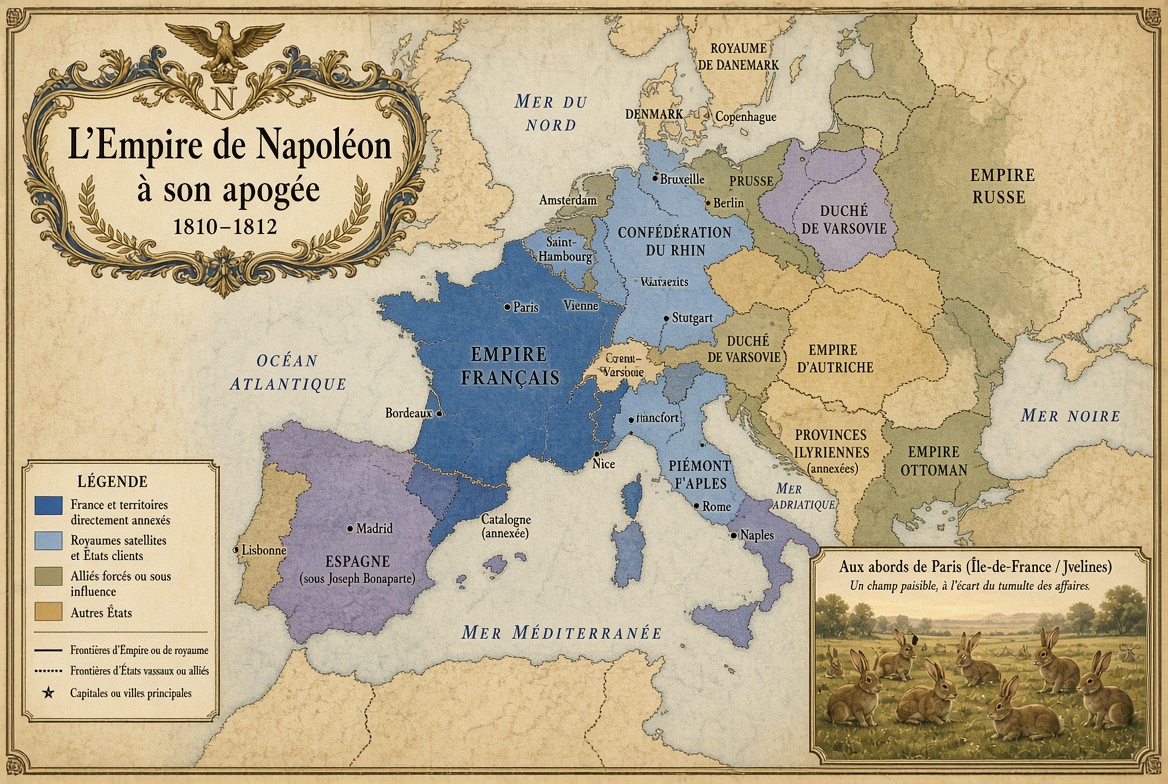
In his on-again, off-again leadership of France from 1799 to 1815 under various titles, Napoleon fought roughly eighty battles, and he won nearly all of them. France encountered most of their defeats in the final years (1812–1815) of Napoleon’s rule when French forces experienced battle fatigue.

Among the greatest conquests of French history, was Napoleon’s defeat of Prussia and Russia between (October 1806 – July 1807), that occurred over the course of roughly nine months. By all historical accounts, Bonaparte crushed Prussia and Russia. He brought them to the negotiating table at what was called the Treaty of Tilsit to discuss the terms of their surrender. Those treaties left Napoleon in control of most of western and central Europe and temporarily turned Russia into an ally.  

Napoleon considered the Prussian and Russian victories the greatest of his tenure, and he considered the territory gained by the Treaty of Tilsit such a huge victory for France and his regime that he wanted to celebrate it. He probably said something like, “Victories like these don’t come around but once in a lifetime, and I want a party that commemorates them!” The problem for this military mastermind was hew couldn’t figure out a perfect celebration.
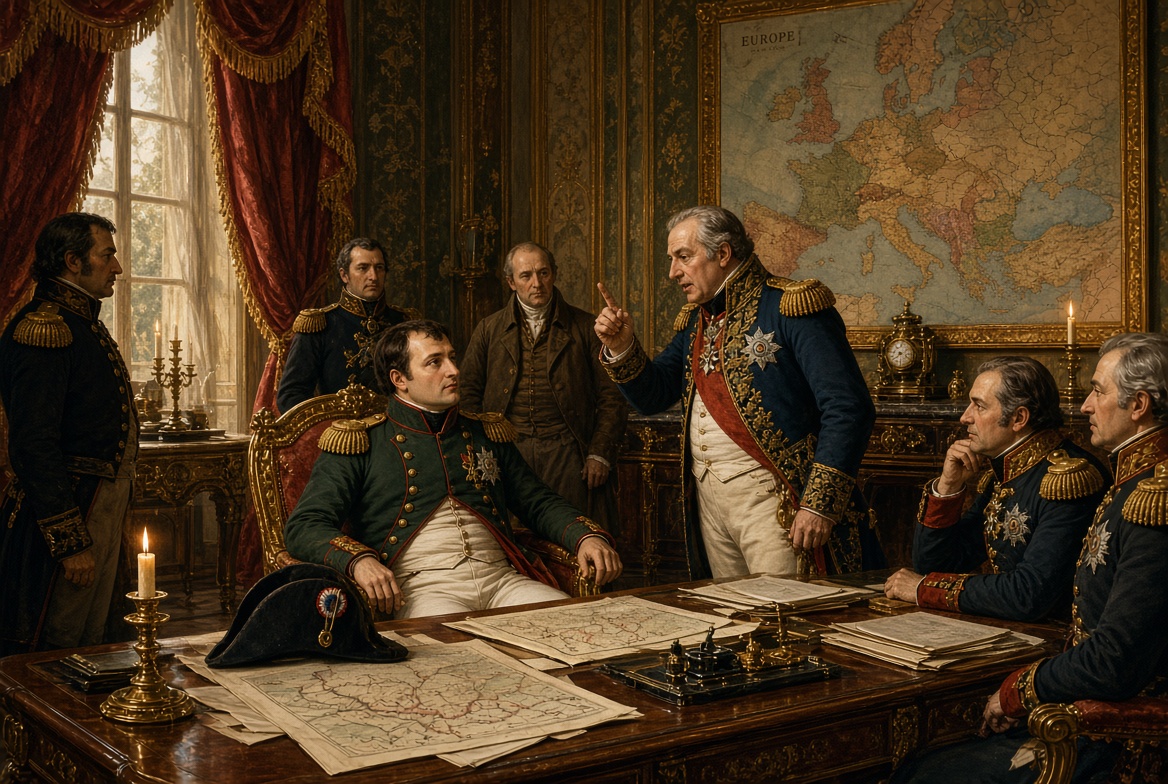
After discussing this with his administration, reports state that Napoleon’s chief of staff, Marshal Louis-Alexandre Berthier, came up with an idea, “How about we put together a huge hunting expedition on my estate?” Napoleon loved the idea. Buoyed by Napoleon’s approval, Berthier invited Napoleon’s most loyal and members of his imperial entourage, plus local beaters. 

After securing the R.S.V.P.s, necessary for this gathering, Berthier put together a lavish outdoor banquet for all involved. He wanted everyone to celebrate and have fun, but his primary goal was to impress Napoleon with a gala befitting his victories. We might assume that such a party would involve alcohol, but Napoleon was not a big fan of adult beverages. The lone source of these events, the memoirs from a General named Paul Thiébault’s state that Berthier’s goal was to conduct a huge formal, imperial outing as opposed to a wild, drunken celebration.    

To complete this celebration, Berthier ordered his subordinate to find a bunch of rabbits for the hunting expedition that was to follow the outdoor banquet. We don’t know how much time his subordinate had to find and trap these rabbits, but he chose to purchase these rabbits from local farmers. Thus, the rabbits the subordinate purchased rabbit for this celebratory hunt that were largely domesticated “hutch” rabbits that the subordinate found to forego all the time and effort required to trap wild ones. We can also speculate that the subordinate who was put in charge of securing enough rabbits for a celebratory hunting expedition wanted to impress Berthier with the number of rabbits he was able to find in the limited time frame he was given. We also don’t have any firsthand accounts of this from General Thiébault’s memoir or any other sources, but we can speculate that the subordinate worried that these domesticated rabbits might be too tame, and they might not provide much in the way of a sporting hunt. To remedy this, he probably instructed the local farmers to deprive the rabbits of food in the days leading up to the hunting expedition. The subordinate’s hope was that this might lead the rabbits to be extra lively, crazy, and eager. 
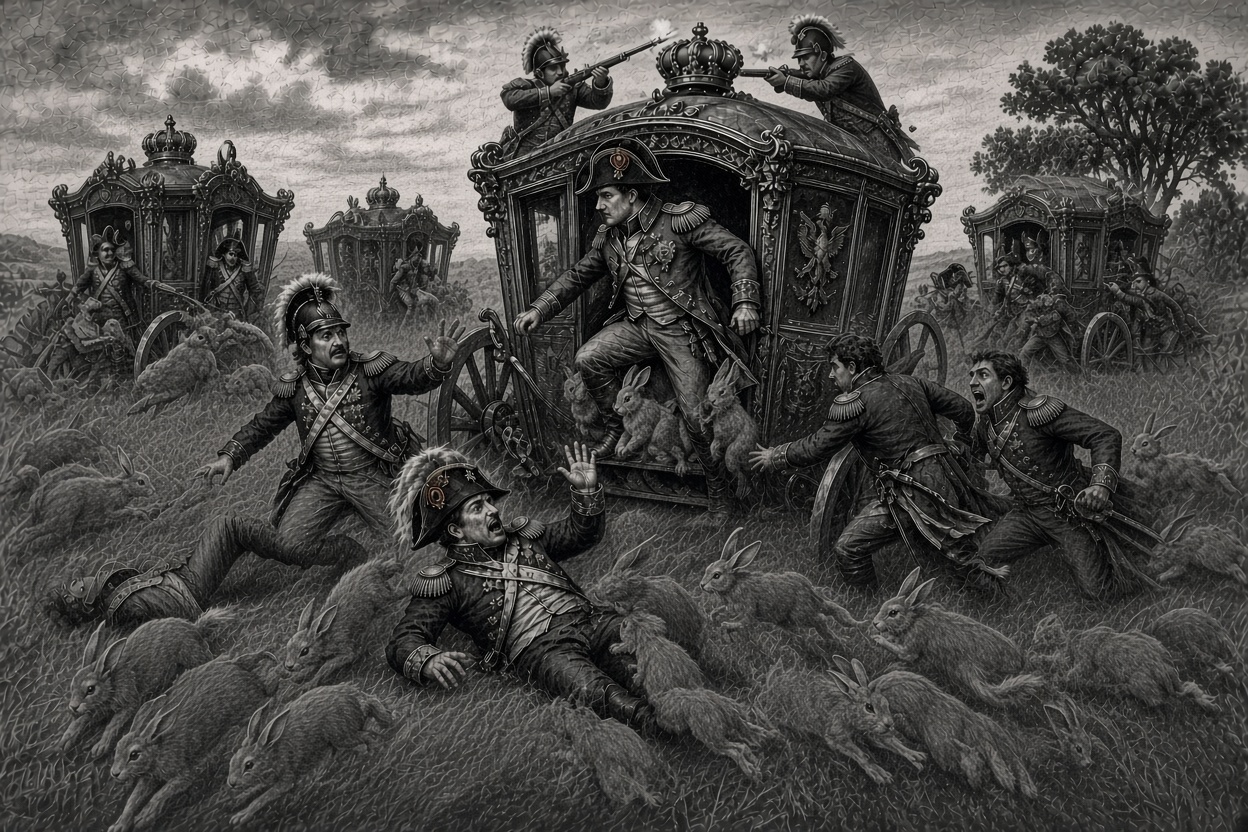
The problem with that order was the 2,000 (a rough estimate by General Thiébault’s account) domesticated, tame rabbits that arrived on chief of staff, Marshal Louis-Alexandre Berthier’s property arrived incredibly hungry, and they associated humans they met there with food. Much to Berthier and his subordinate’s chagrin, when all of the carriages carrying Napoleon, his best soldiers, and the most loyal members of his administration arrived, the 2,000 rabbits began swarming them. The rabbits were so hungry and pursuing the prospect of food so aggressively that Napoleon and his entourage were overwhelmed by them.

As the rabbits began clamoring all over one another around the soldiers’ legs, and they even began aggressively climbing up on their legs, the first thing that went out the window was the idea of a sporting hunt. The rabbits obviously weren’t running away. They were running to, and onto the men. They were clamoring all over one another to be closer to the nearest human, to be first in line for food. 

The whole scene was embarrassing of course, but Berthier had to be mortified when the rabbits did the same to Napoleon. The hunting party and Napoleon began trying to fight the rabbits off with sticks, rifle butts, and riding crops, but they could not deter these rabbits. There were just too many of them, and they were so hungry and aggressive. These mighty soldiers eventually had to do something no Napoleonic force had to at that point in his reign. They had to retreat and basically surrender to an overwhelming force. They ran back to their carriages, but the rabbits continued pursuing them. The rabbits even, according to Thiébault’s memoir, began breaking into groups and flanking the fleeing party. A few even managed to scramble aboard Napoleon’s Imperial Carriage before he could get away. 

Anytime I read a crazy story like this, my sense of creativity goes to the beginning, the ending and everything in between to what we’re not told. Who was the first member of the hunting expedition retreat, and did the other members of the party in attendance laugh at him, before they eventually realized that was the only course of action? With the rabbits clamoring all over one another so aggressively, my bet is one of the rabbits’ nails scratched one of the soldiers. “OW!” Martin screamed mistaking that scratch for a bite. “He bit me. One of these blasted things bit me!” Was there an incident of this nature that led the others to say, “One of those things bit Martin. I’ve survived countless battles with humans. There’s no way I’m going down over some disease these things probably carry on them. I’m outta here!” What did they say to another, in their carriages, in retreat? I’m sure Bonaparte ranted and raved about what a disaster this expedition was to Berthier, if Berthier rode away in the carriage with him. If Berthier rode with his subordinate, we can guess that some physical admonishment followed the Q&A regarding the details of what the subordinate did to set this day up. “All right,” Berthier probably said before striking the man, “but did you have to get 2,000 of them?” Those strike me as more typical reactions. What intrigues me more are the conversations that probably occurred on the carriages that carried the soldiers. In the immediate aftermath of the incident, they were embarrassed, and they needed to talk it out to get it out of their minds. 
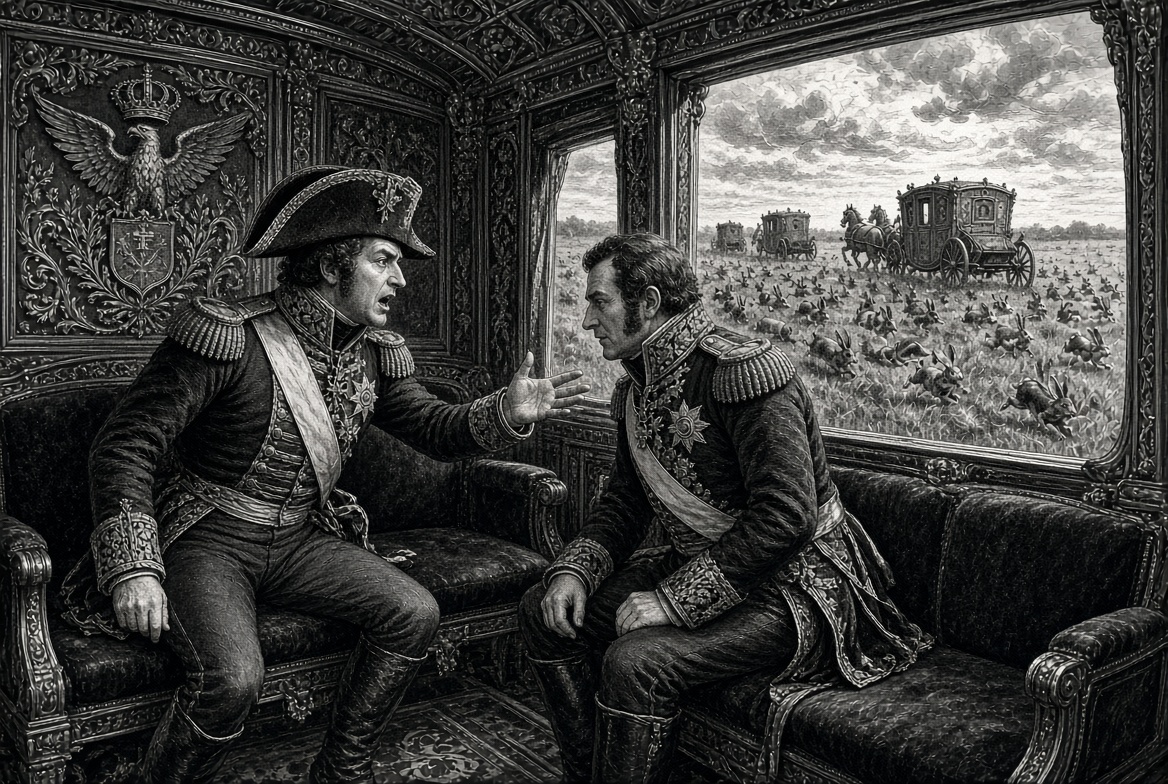
“What was that?” First Officer Dubois asked Officer Petit, as the two of them ride away from the field of bunnies. 

“I don’t know,” Petit responded. “There were so many of them. I’ve never seen so many rabbits in one place before. There had to be thousands of them. After Martin got bit, it was a little scary out there.” 

“We’re the most powerful military in the world,” Dubois said. “If word gets out about this-” 

“The lesser said the better,” Petit interjected before Dubois could complete that sentence. 

“But people will talk.” 

“Why would they?” Petit asked. “Why would anyone say anything about this to anyone? Even if they’re drunk, trying to be funny, and trying to tell the wildest tale at the bar, why would they admit to any of this?” 

“You’re right,” Dubois said.  

“You watch, we’ll have some unofficial decree that comes down about how we’re not to say a word about this to anyone.” 

“Agree.” 

 “I’m talking wives, daughters, and drinking buddies,” Petit said. “I’m talking about burying this so deep we won’t even talk about this in our sleep.” 

“Agreed.” 

We don’t know what happened before, after, or any of the other details that happened between, but one of the greatest military minds of his generation, a man many still rank among the greatest military leaders of all time, and the conqueror of conquerors was forced into an undignified retreat —not by a coalition of kings, but by a few thousand hungry domestic rabbits that mistook him for their feeder. These bunnies didn’t require a grand strategy, a coalition, and they didn’t need Allied and Prussian support. They just needed to be bunnies that don’t act according to plan. This loss in the Battle with the Bunnies was considered so embarrassing that those involved decided the only course of action was to “expect” everyone involved to avoid talking about this day. There is no record of an official decree of silence on this topic, and we know of no unofficial decrees either. This expectation was obviously successful, because no one did talk about this incident, until a General named Paul Thiébault mentioned it in his memoirs that were published after his death in the 1890s, roughly 50 years after it happened.

The Paris Syndrome


Casinos want to help you find ways to help you part ways with more of your money. They will spare no expense to accomplish this. Some would go so far to say that anytime that a person steps into a modern day casino, they’re stepping into the finished product of think tanks, and well-paid psychological studies. These casinos want to create an exciting, yet soothing experience that distracts the gambler from the levels of stress they might normally associate with losing all of their money, but there is no psychological tactic more endemic to the ultimate success of a modern casino than the psychological manipulations of expectations.

“We’ll always have Paris.”

Some think the slot machine is a game of chance, and it is, but long gone are the days of pure chance. Technology permits casinos to manipulate the slot machine now that it is no longer a game of pure chance. The breakdown between pure games of chance and technological manipulation of the games is a long and intricate explanation that is loaded with jargon and terminology that is available to interested parties. The gist of this breakdown is that various legislative bodies were required to step in and regulate the industries so casinos don’t make too much of your money.

One vital ingredient the think tanks and psychological studies submitted to casinos creating was that the most successful slot machines the expectation of winning can be more powerful than the psychological thrill of actually winning. When a player sees a triple bar drop into the first slot, only to be followed by another triple bar, that brief moment of expectation has been determined to provide the player a psychological boost that gives an incentive to keep playing more than the reality that would occur if that third slot were filled with another third triple bar.

When that king eventually drops, with strategic slowness, into that third slot, we’re disappointed when we look up at the menu list of winnings atop the slot machine and realize we’ve actually won nothing, but the thrill that occurred before that third slot was filled, and the idea that we came so close is more powerful, and more conducive to us continuing on that machine, than winning would actually be. Without drawing on that exact scenario, Rosecrans Baldwin, author of the book Paris, I Love You, but You’re Bringing me Down, suggests that this powerful thrill of expectation drives vacation plans to a place some call the capital of love Paris, France.

Paris has been called the capital of love for as long as most of us have been alive. Paris is the setting of some of the most famous, romantic movies, books, and songs. Many people we know list visiting Paris on their bucket list. If, for no other reason, than to find out what everyone is going on about. There’s an air of mystery about the city that we all need to experience for ourselves. As is normally the case, the narrative, and the expectation derived from that narrative, is much more powerful than the reality. Some, who have vacationed in Paris, are often so distressed by the reality of what they experience that it can cause a psychological disorder called The Paris Syndrome.

“Japanese visitors are particularly susceptible to this,” writes Rosecrans Baldwin. “This is possibly due to the uber-romantic image that Paris holds for the Japanese.” This can get so bad, for some Japanese travelers, Baldwin writes, that “The Japanese embassy used to repatriate sufferers of The Paris Syndrome with a doctor or nurse aboard the plane ride back to Japan.”

NBC News also had a report on this subject that stated that:

“Around a dozen Japanese tourists a year need psychological treatment after visiting Paris as the reality of unfriendly locals and scruffy streets clashes with their expectations, a newspaper reported on Sunday.”

That Sunday newspaper also quoted psychologist Herve Benhamou saying:

“Fragile travelers can lose their bearings. When the idea they have of (a place like Paris) meets the reality of what they discover, it can provoke a crisis.”

Bernard Delage, from an association called Jeunes Japon, that helps Japanese families settle in France, is also quoted as saying:

“In Japanese shops, the customer is king, whereas (in places like Paris) assistants hardly look at them … People using public transport all look stern, and handbag snatchers increase the ill feeling.”

A Japanese woman, Aimi, who had some experience with this disorder, told the paper:

“For us, Paris is a dream city. All the French are beautiful and elegant … And then, when they arrive, the Japanese find the French character is the complete opposite of their own.” {1}

After deciding to take up residence in Paris, author Rosecrans Baldwin found that:

“Smiling is discouraged for Parisians posing for documentation like Metro passes or tennis-court permits.”

Most citizens, the world around, can identify with this procedure. We’ve all had experience with employees in legal departments, and DMVs, telling us that smiling is discouraged when posing for head shots that will appear in legal documentation. It’s not illegal to smile in those situations, just as it, presumably, is not illegal to smile when posing for Parisian documentation head shots, but it may have something to do with the idea that smiling changes our appearance a bit, and for official documentation, a smile might make a photo appear less official. With regards to this practice in Paris, writes Baldwin:

“The discouragement of smiling for various legal documents gets to an elemental fact about living in France’s capital. That for a madly sentimental and Japanese tourist, visiting Paris is mostly about light, beauty, and fun with berets. Living in Paris is different. Living in Paris is business, and nothing to smile about.”{2}

Though this particular Paris Syndrome is obviously indigenous to Paris, the tenets of it could just as easily be applied to any popular tourist destination the world around. Midwestern Americans, for example, live under a similar “customer is king” mentality, and they have for so long that they begin to take it for granted. Midwest Americans know that the hotels and restaurants of their locale, are so competitive that they won’t tolerate even an ambivalent employee. Those of us who have worked in the service industry know that customer service is paramount. We’re trained to believe that one dissatisfied customer tells ten people, and those ten people tell ten other people, until it could damage the reputation of business for which we are employed. Customer service trainers in the Midwest, suggest that those who do not offer customers a pleasing smile, or a pleasant disposition, in the Midwest, will be confined to backroom work. There are exceptions to the rule of course, but most people who travel to the Midwest, are shocked by the Midwestern hospitality.

“We expected it from you guys,” a hotel resident once said of the hospitality she experienced from Midwestern hotel employees. “You’re paid to be pleasant, but wandering around your city, we’ve discovered that you’re all like this,” she said as if she believed she had stepped into some alternate universe. “You’re all so nice.”

Thus, when a Midwesterner grows accustomed to their locale’s common pleasantries —like the Japanese traveler, traveling to Paris— travels to preferred travel destinations, they are shocked by the contradictions they encounter on their vacation. They probably assume that the top-notch customer service they’ve come to expect would be a given in their chosen destination, if not amplified with the kind of money they’re spending. They probably consider it such a given that they focused most of their attention on the other aspects of their dream vacation. Once they’ve come to terms with the reality of the situation, they’re so shocked that not only is their dream vacation ruined, but some become physically ill as a result.

This degree of ambivalence, directed at tourists, in some popular tourist locations, can occur in some of the first steps tourists make from the airplane to the terminal. Those wondering why this happens, should ask themselves what they thought of the thirty-second ant they watched leave an anthill. If they confess that they didn’t take the time to pick that ant out, and that they didn’t spend more than two seconds looking at that ant, they may expound upon the idea that seeing ants leave an anthill is such a common experience that they don’t even look at ant hills anymore, such is the plight of the service industry worker watching tourists disembark at popular tourist destinations.

You’re not an ant, you say? You’re a human being, and you’re not just any human being, you’re a human being with money to spend, money that helps pays the wages of service industry employees. The problem is that you’re probably not the thirty-second tourist that service industry worker has seen disembark that day, or even the 132nd. By the time you’ve stepped up to their counter, they’re probably so burnt out on tourists, that the tourist becomes a lower life form than the ant. At least ants are self-sufficient, they might say, and ants don’t complain about their lot in life, and they don’t live with the mindset that their existence should somehow be catered to in a manner that makes the ant feel special. Ants know their role, and on a less conscious level, they know their station in life. The harmony in that ant universe works so well that most service industry workers, in popular tourist destinations, probably believe that tourists could learn a lot from ants.

Some tourists are objective enough to acknowledge that poor service industry employees exist everywhere, even in their small town, yokel community, and they try to view this one ambivalent-to-hostile employee in that light. They also try to view their one bad experience, with this one ambivalent-to-hostile employee, as an aberration, so that they can go about enjoying the rest of their trip. Some Midwestern tourists also attempt to reconcile their indignation by convincing themselves of the fact that they’re small town yokels, unfamiliar with the ways of the big city, but they can’t shake the idea that their appearance should be considered somewhat special by these employees.

Before long the tourist comes to the realization that every counter the tourist approaches has ten special tourists looking to have a special time behind them in line, and those tourists just want the special transaction in front of them to end, so they can finally get to the front of the line, to finish their transaction and get back to the craps table.

That “customer is king” mentality that these tourists live with is usually gone within hours, and the pattern of how things are done in this popular tourist destination becomes so apparent that by the time the tourist reaches the employee that dutifully hands them change without smiling, or even looking at them, and possibly trying to shortchange them, they’ve come to terms with the fact that those first few rude service industry employees were not, in fact, aberrations. Those who do not recognize these patterns think that if they were that thirty-second ant, they might have a better chance of receiving more courteous treatment, if for no other reason than the idea that they might be considered something different from the lowest form of life on earth that service industry employees have deal with hour after hour, day after day: tourists.

Time; personal experiences published in online, travel forums; stories about mafia versus corporate ownership of Vegas; tales of prostitution and pickpockets; and the unsettling, almost weekly, appearances on the show Cops have done some damage to the mystique of Las Vegas, but the mystique of Paris has not undergone such storms.

Living in Paris, Rosecrans Baldwin writes, does do some damage to that mystique however. Those who believe that Paris is the home of cutting edge artistic exploration are not wrong, in the greater sense, but they also have to explain how Britney Spears’ song Toxic, remains a staple of Parisian parties years after its release. Those who believe Parisians have analytical palates far superior to the American one, have to explain Paris’s culinary fascination with the food from a chain of American restaurants called McDonald’s. These quirks may be no different than any popular travel destination around the globe, but it takes traveling to the destination, and living there, to find all this out.

“I enjoy the French Roast flavor,” I tell friends, “but I know that the term French Roast simply means robust. I have no illusions that the beans I use have actually spent any time in France. I know that some Americans make attachments to the term French in the same manner some French make American attachments to the food of McDonald’s, but I’m not so silly that I believe that the French Roast bean I enjoy is anything less than an Americanized version of this robust bean, but” and here’s where the wrinkle will form on the nose of the listener, “I actually prefer this Americanized version.”

That wrinkle will form on the nose of our fellow Americans, because most of those blessed with analytical palates believe that that ‘A’ word, Americanized, should never be used in conjunction with the exotic flavorings of the products that they deign worthy of purchase. Their use of the word French entails exotic styling in the chain of production, transportation, that might involve some slow crossing of the Seine River on some French version of a Gondola before being docked in an elegant port with a beautiful French name that we cannot pronounce, and that those individual workers involved in the chain of production might have, at one point, sang a French sea chantey in striped shirts and handlebar mustaches. Those who wrinkle their nose believe that they are able to sniff out any ‘A’ word that may have wormed its way into the process that ended with them purchasing a French Roast product.

When one reads the descriptions from those who have actually walked the streets of Paris, and dined in her cafes, and tasted the true French Roasted bean, they learn that those cafés actually use old, over-roasted beans, and second-rate machines. We read that Parisians so prefer the robust flavoring that we term French Roasted, that their cafés actually use a low-cost, low quality bean to please their customer base. This actual un-Americanized, French Roasted bean would leave the unsuspecting, and truly analytical palates, with a thin and harsh taste in their mouth.

Paris is not about the taste of the coffee, some might argue, and no trip to Las Vegas should be ruined by the fact that a towel boy didn’t smile at us and welcome us to his city sufficiently. All of these complaints seem so trivial, and inconsequential, in lieu of everything these two, popular travel destinations have to offer. Taken one by one, these complaints may seem trivial, and inconsequential, but when a romanticized, excited traveler sits down to complete their dream of having a lunch in an elegant, little Parisian café, only to have an ambivalent-to-rude waiter deliver a cup of coffee that is so shockingly –and perhaps to them insultingly– inferior, that might only be one cup of coffee, and one waiter to the rest of us, but it might also be only one incident in a series of incidents, that leads to a pattern of behavior that shatters all of the illusions and dreams the starry eyed tourist may have had about that vacation they saved for so long for, that their country finds it necessary to have a doctor, or nurse, on board the plane home to help them deal with the fact that so many of their expectations, and so much of what they once believed in, were wrong.

{1}http://www.nbcnews.com/id/15391010/ns/travel-news/t/paris-syndrome-leaves-tourists-shock/#.Uys8r6hdWSo

{2} Baldwin, Rosecrans.  Things you didn’t know about Life in Paris.  Mental Floss.  May 2014.  Page 40-41. Magazine.