Falling for Fraud


This article is not a self-help, tips guide. I considered summing this article up with a long list of the tips I’ve learned over the years to help you avoid falling prey to internet fraud. My next thought was that I’m not smart enough to write a comprehensive list that could help you avoid falling prey to everything out there. Those lists are out there, and I encourage everyone to seek out, but I’m not brave, bold or brilliant enough to write one. This article will simply detail my personal and anecdotal experiences in this world. 
June 22, 2026: “Florida couple loses $141,000.00 to sweepstakes scam. The couple loses their car, their income, and their home after the dementia-suffering husband fell for a scam that informed him he won $4 million in a lottery.” Yahoo!news 

“The stupid things dumb people do,” was how one Yahoo commenter summed up their reaction to this story. I wouldve loved that reaction in my teens and twenties. “They’re just saying what we’re all thinking,” I wouldve said in-between giggles. Working as a fraud agent at a Fortune 500 company changed me. I talked to these dumb people, and if they’re dumb, then we’re all a lot dumber than we think.  

“I cannot believe this happened to me,” was the most common thing we heard from victims. They would tell us how intelligent and experienced they were. They would talk about how difficult their jobs were, and how their job required a high level of intellect that should never fall for something like this. “I thought I knew enough to know how to avoid something like this, but here we are,” they would add. 

Does that sound like you, and the shocked, embarrassed, and somewhat ashamed reactions you might have for falling for “The stupid things that dumb people do.” If you insist that only morons fall for online fraud, consider this: industry experts suggest that the total figures we have for cybercriminal activity skew low, because most victims are so embarrassed and humiliated that they fell for something so stupid that they won’t even report it to a fraud agent who is as low on the law enforcement totem pole as one could get. They’ll never meet me, so why would they care what I think? They do not want to go through the details, because they cannot bear having one person know how dumb they were. They just want to forget it ever happened. 

The fraud agents I worked with rarely characterized victims as dumb or stupid, because we heard from so many victims a day. We heard so many different stories that we knew the victims we were talking to weren’t in the minority. We usually spent the first couple minutes of every phone call talking these victims down. I may have considered these victims dumb or stupid when I first started working there, but I heard so much since that point that I knew I was as vulnerable as they were.  

I’ve heard from the prototypical little old ladies living on a pension, who had a little money set aside for a more comfortable living. I talked to hard-working joes who worked so hard their whole life and saved their 10% a year to allow their family to just barely escape lower middle class. I heard from so many representatives of age and economic demographic backgrounds that I progressed through a variety of emotional reactions that ended with sympathy and moved to empathy after I heard the wide array of schemes that our customers fell for. If I were to draw up a pie representing the typical victim, old people on a pension would represent the largest section, but that cut wouldn’t be as large as you might think. If you’re one of those who refuse to accept the idea that you’re a lot more vulnerable than you imagine, let me say that I was you, and you are me.   

Other than the ‘I’m too smart to fall for something so stupid,’ the greatest vulnerability I saw among victims was greed. The victims talked about how losing this money meant losing their comfortable lifestyle, which naturally led me to wonder why they would sacrifice that relatively comfortable lifestyle for the prospect of more. Is it an American characteristic, or is it human nature that we’re willing to sacrifice everything we have for the promise of something more? I don’t know the answer to that question, but I saw a wide array of victims put skepticism aside when they thought someone was offering them a pot of gold. The idea that something is too good to be true should require us to do our homework and use the tips that corporations provide to educate ourselves, or perform any checks of verification we can to reduce our risk. 

The theme of this article is that the moment after you think you’re general sense of judgement will prevent you from falling prey to one of their schemes will probably leave you vulnerable, but we saw some victims exhibit such poor judgement that it exacerbated what could’ve been a minor incident.

When we read, watch, and hear exposés about criminals, we often hear investigators characterize the criminal in their case as ingenious or brilliant. In my limited experience in this world, I haven’t found cybercriminals ingenious or brilliant. Most often than not, they just kept trying no matter how many times they fail. They exhibit some ingenuity and temerity, but I never saw one scheme that I considered brilliant or ingenious. 

If their first scheme does not convince us to part with the money we earned, these cybercriminals have a “no harm no foul” attitude. There was no crime committed, and thus no evidence of wrongdoing. Depending on the nature of their activity, we fraud agents might be able to restrict the cybercriminal’s access to their account, until they can prove their activity is not suspicious. If they can’t, they just open another account, and another, until they complete a fraudulent transaction. At that point, we can link up their accounts and activity to build a narrative. Long story short, most cybercriminals change, adapt, and tinker with their approach, until they can find a victim. The key word in that sentence is tinker. They might add a little something here or delete something there, “They are going to try hundreds of different approaches,” a fraud trainer once told us, “Because they only need one successful scheme to qualify as successful.” For example, professional fraud operations often use botnets, compromised servers, or spam-as-a-service tools that blast out millions of emails per day. Success rates are extremely low (often 0.01% to 0.1% click/open rates), so high volume is essential to generate enough victims to be profitable. How is that brilliant? My guess is that the investigators on the TV exposés on crime are the ones who cracked the case, so calling their case’s criminal brilliant enhances their profile for the audience. We should also note that I base my characterization of cybercriminals on the cases I investigated, and we could say I base my personal profile of them on anecdotal information. In my experience, cybercriminals aren’t ingenious or brilliant, they just tinker, adapt, and change their approach until they find the best way to prey on our vulnerabilities. 

Some fraudsters aren’t piece of junk who manage to distance themselves from empathy and sympathy, because their victim is some anonymous, faceless entity on the internet. (Their victims often have online nicknames, like rugrat, as opposed Peter J. Hansen, the electrician, who has spent his whole life saving this money.) This anonymous, faceless designation also permits us to characterize victims as “The stupid things that dumb people do,” because we don’t talk to them, see them, or feel their pain. Other cybercriminals are desperate people living in no hope situations, until they are employed by a shady outfit in their home country that exists to defraud victims out of our money. Their employees have quotas, and if they fail to hit their employers’ numbers, be they quantitative or qualitative, the employees are back out on their country’s desperate streets of abject poverty. These shady outfits provide their employees with tight scripts, but they also reward employees for creative improvising.   

When the shady enterprises from other countries are ‘caught’ engaging in fraudulent activity, some of the countries make it known they “don’t encourage such activity”, but the employees and the shady outfits receive little more than a slap on the wrist. The countries “don’t encourage it”, but the countries receive a Gross Domestic Product boost from the amount of money that the shady enterprises generate. We can only guess this doesn’t result in greater taxable revenue for the country, as most of the activity is “undetected” by the government, but we can guess that kickbacks are appreciated.  

One vulnerability we all share to ploys generated by cybercriminals is the ‘I’m too smart to fall for all that’ mentality. This is also where “The stupid things that dumb people do” line comes into play. In a manner somewhat similar to the original reason man created fictional monsters (vampires, werewolves, and mummies) to essentially zoomorphise the inhuman acts of sadistic murder that gives good men and women some comfortable distance between those who would commit mass murder. I think we label victims of cybercrimes as dumb and stupid to try to create a comfortable distance from the horrific possibility that this could happen to us too. The one thing I would tell people who scoff at the possibility that this could happen to them is I’ve talked to people like you every day. I talked to Midwesterners who appeared to know everything about the internet, fast-talking New Yorkers, Surfer dudes, and individuals with a pleasant, Southern Drawl. I talked to little old ladies on a pension, fathers with kids in private schools, and mothers who thought they could supplement the family’s finances. I talked to people who would remind you of your family members, your neighbors, and people who would remind you of you. The one thing they all had in common is they never thought they would fall for something like this. “I thought I’d be able to spot something like this,” they’d often say through tears. “I can’t believe I fell for it.” 

“This was my life savings,” was such a common phrase we fraud agents became numb to it. I loathe writing that all these years later, but it happens to us when we hear the same complaint, working on a phone line, forty hours a week. At lunch and on breaks, we would talk about the calls we took, and in the beginning, we talked about the heartbreak and devastation we heard, but it happened so often that our conversations switched to a callous competition about the dollar figures we witnessed. “I took a call today where a guy lost $50,000.” “That’s nothing, I took a call last week, where a guy lost $200,000.” It was our way of dealing with all of the sadness we heard.  

These victims called us to fix the devastation they put their proverbial foot in, and we could help them at times...if those victims called in in time. I wrote out a detailed description of process involved in our calls with customers, but I just … deleted it, because my guess is you don’t want to read the particulars the processes involved in these calls. Suffice it to say, I was able to help some of these victims, and I wasn’t able to help others.   

When these worst-case scenarios occurred, the resultant desperation I heard on the other end of the line still haunts me. “This was my life’s savings, my child’s tuition to a better life,” or “my family will be ruined by this,” were things I heard.  

When I first started taking these calls, I felt sympathy for the poor saps that fell for “Something like this.” It didn’t take long for that sympathy to evolve into empathy, as I began to see falling for these fraud schemes did not involve just the prototypical victims I imagined. I realized it could happen to anyone, including those I knew and loved, and a couple hundred more calls convinced me that this could happen to me. It wasn’t every call, of course, as some people did fall for some dumb tactics, but there were others, usually a couple calls a month, when I’d receive a call from someone who reminded me of myself, falling for something that I knew played on my vulnerabilities. I’d go back and investigate the history of the cybercriminal, through linked accounts, and I’d spot their tinkering.

Those of us who worked in this department also received death threats, but the more common reactions involved customers threatening to harm themselves. We heard these desperate people threaten to take their own life so often that our company developed a policy that instructed us to immediately contact their local law enforcement to do a wellness check on them, regardless if we felt we talked them down or not.   

To avoid hyperbole, most of the calls I received involved customers who got “A little ticked that they got got.” They got swindled, cheated, or tricked into paying for an item that was priced so low it was too good to be true. Most of the people I talked to paid twenty to thirty bucks for a product that should’ve cost four hundred to five hundred bucks. They were a little ticked, but “I should’ve known it was too good to be true”was their reaction. I took more than my share of calls from victims who were absolutely devastated by the amount of money these fraudsters tricked them into submitting, however, and “I really thought this was legit,” was their reaction. “I thought I was on the road to a better life.” What do we say to that? That guy probably couldn’t wipe the smile off his face one week, thinking about how he was going to spend all that money, and he then probably had trouble finding reasons to smile for a long time after this. 

When I was able to stop the money, the potential victims celebrated my name, and we laughed for a couple minutes, and they cried tears of joy at the end of our call. They said I was “Their hero.” One old woman wasn’t laughing or weeping with joy, she was bawling uncontrollably. She was so choked up that she couldn’t even speak. Her daughter took the phone from her mother and made me feel like the most special person in the world for one day of my life. 

There were times when the money was gone, out of our system, and the fraudster’s bank account. I instructed them that they would need to contact their local authorities. I instructed them what they should say, what evidence they should provide, and how I was going to provide notes on their account to detail the transaction(s) in a way that would bolster their case.   

These worst-case scenario calls would inevitably end with the victim saying, “Thank you, but let me ask you, based on your experience.” I would close my eyes with a lump in my throat, because I knew the back half of this question. “What do you think are my chances of getting my money back?” Im in so deep at this point that I’m almost incapable of answering this question. I should add here that I was forbidden by my company from offering my opinion on a case that reached this point (This was for my protection and the company’s). Yet, even if my company hadn’t protected me in this way, I still would’ve felt so bad for them that I would’ve found it difficult to find the right words to say. How do you tell a little old woman that her worst fears of losing her home, her car, and the independent lifestyle she’s enjoyed her whole life are likely gone.

“Your chances of recovering the funds increase substantially if you follow the standard procedures I’ve outlined for you,” is what I would say. This would start a back and forth that would involve them trying to break me down for my opinion. “I’m just asking you, based on what you see and what you’ve seen, what are my chances?” I understood their need to badger me of course, because I was their only point of contact at this point, and they were imagining a bleak future. Before they allowed me off the phone, they wanted to know if they should have some small nugget of hope, or if they should concede to the idea that some criminal managed to not only steal their money, but the life they knew, and the future they planned. These people were devastated, and they wanted some low-level employee on the phone to give them some hope. I froze up on more than one occasion when they made the full breadth of their devastation apparent to me. I was incapable of telling them that the hopeless nature of their situation was probably just beginning.     

We’re smart enough to spot a fraudster, and we know we wouldn’t fall for some piece of junk’s little games. We know how to spot a fraudster, because we’ve seen them on TV, and we’ve met them at our local, neighborhood liquor store. My experience as a fraud agent has informed me that I don’t know what to look for or how to spot a cybercriminal. There have no bullet point characteristics, and AND there are no bullet point characteristics of a victim either. Neither of them are more “worldly,” “street smart,” and it doesn’t matter if you “know how to play the game, because you’ve dealt with pieces of junk your whole life.” After dealing with both ends of the spectrum, receiving calls from victims and calling fraudsters, I didn’t grow more confident in my ability to spot a fraudster, I grew less confident. I became so uncomfortable with these situations that I became paranoid. I wouldn’t answer the phone from anyone I didn’t know, and on the rare occasion when I answered a call, I didn’t try to showcase my decade’s long experience. I hung up on them, or delete the email, or text as quickly as I could to avoid learning how vulnerable and susceptible I am. (I also avoid signing up for Customer Plus programs, petitions for local bills, and I now run from anyone associated with sales.) I provided a list of tips in the original draft of this article and I deleted it as I wrote earlier, but the best piece of advice I could provide anyone seeking how to avoid falling prey to internet fraud from cybercriminals is get paranoid. I write that knowing the cinematic phrase, “You’re not paranoid if they’re really after you,” and in my experience they’re all after you. Get paranoid!

Is Elizabeth Holmes the Face of Fraud or Failure?


If Elizabeth Holmes could’ve had an idea that worked, she could’ve been a contender, she could’ve been something real, and oh, the places she could’ve gone. The idea that we’re fascinated with this woman is obvious with all of the bios, documentaries, and news segments devoted to her. There are probably hundreds of different answers as to why, but I think it has something to do with the idea that her story is not a simple ‘person perpetuates fraud’ story. 


Elizabeth Holmes was found guilty by a jury of her peers of perpetuating fraud. That’s a fact, and the glaring headline, and it might influence everything we learn about her story. Her story is just the latest in the ever-present, not-going-to-end-anytime-soon Cringe-TV. We love to laugh, cry, and scream in horror, but we also love to cringe. There’s probably something wrong with it, as we shouldn’t love it this much, but when someone gives all their money to a con artist, and then they convince their friends and family to give their money to them too, we cringe with excitement. Do we think we’re better than the victims? If we did, we wouldn’t develop crinkles (cringe wrinkles) during our obsessive binges. Our motive, when watching these shows is not to find out if the fraudsters did anything illegal, but how they did it. 


After watching all of these shows, the viewing audience should ask themselves two questions. Did the 19-year-old sophomore at Stanford drop out of college to commit fraud, and if not, what did she know and when did she know it? Did Elizabeth Holmes want to become the next Steve Jobs so bad that she was willing to do anything to make that happen? Or, did that just kind of happen in the course of her troubled venture? Even though she was eventually deceitful, the idea that Elizabeth Holmes won over some of the intellectual glitterati of our nation is a testament to her talent, intelligence, and charm. She professionally seduced George Shultz, Henry Kissinger, David Boies, James Mattis, and, of course, Theranos Chief Operating Officer Ramesh “Sunny” Balwani. She also managed to secure $700 million in funding from the likes of Larry Ellison and Tim Draper. At its peak, her company Theranos, was valued at $9 billion. 


Watching Hulu’s bio Dropout, HBO’s Inventor, the 20/20 news segment, or reading any of the web articles devoted to her story involves a battle between cringes and knee-jerk reactions. One knee jerk reaction we have is to now say Elizabeth Holmes was a con artist who engaged in fraudulent activity to secure funds from investors. We then dismiss her on that basis, but how many world leaders, politicians, and other charismatic, skilled, and deceptive people have attempted to pull the wool over the eyes of those luminaries listed above? Another knee-jerk reaction is to say that Elizabeth Holmes was a young, blonde woman who had obvious appeal to old, grey men. They might have enjoyed meeting with her. They might have enjoyed her attempts to professionally seduce them, but what happened when those meetings ended? A cadre of advisors probably sat down with the old, grey men and poured through her books, and they had a pro and con discussion with a George Shultz. He took their advice under consideration, and he ended up believing her. At one point in the story, Shultz even believed Holmes over his own grandson. How many years of experience did George Shultz, and all of the names listed above, have dealing with con artists and fraudsters? What does that say about them that they fell for Elizabeth Holmes’ deception, and what does it say about her? If she had a product that actually worked, imagine how real her success could’ve been. 


The Theranos Corporation had a machine called the Edison, so named because lightbulb inventor Thomas Edison said, “I didn’t fail 10,000 times. The lightbulb was an invention with 10,000 steps.” How many careers were built out of try, try, and try again? Thomas Edison wasn’t excusing his failures. He was saying that he had to learn from the 10,000 misfires he made. Did Holmes’ Edison machine fail 10,000 times? “Who cares?” Holmes, Balwani, and all of the engineers and scientists could’ve answered. “Who cares if it fails 100,000 times. Imagine if we keep failing, and we learn everything there is to learn from those failures? Imagine if, one day, it works. We could transform the landscape.” The central question in this fiasco, to my uninformed mind, is is it possible that the Edison would have ever worked? If not, then we have beginning-to-end, no excuses, and full-fledged fraud on our hands, but what if Walgreen’s didn’t push for its arrival in their stores? What if Holmes and Balwani hadn’t pushed the engineers to make the Edison happen to satisfy Walgreen’s? Was it ever possible? Were the talented engineers and all of the employees they had on the payroll at Theranos for the money, or did they believe in Holmes’ dream? 


The Hulu bio Dropout depicts biochemist Ian Gibbons, who served as the chief scientist of Theranos, complaining that the Edison “is just not ready” for Walgreen’s. He was the first experienced scientist Holmes hired, his name was on all of the patents, and from everything we read about Gibbons, he was more than a believer. He was one of the chief architects of Holmes’ vision. The portrayals of Gibbons on the 20/20 story, the Hulu bio, and the HBO documentary The Inventor, suggest he was never a naysayer. They suggest that he just set rigorous benchmarks for the product. He doesn’t say, at any point, that this was a fictional dream that Holmes concocted (as a Stanford professor did), that it’s a fraud perpetuated on investors and the public, or that it will never happen. With all of his experience in the field of biochemistry, Ian Gibbons believed in the product, but he said it was just not ready to meet Walgreen’s timeline. There was a certain duality to Gibbon’s pleas however. He needed a job. He was in poor health, and he needed the health insurance that Theranos provided.  


What if they waited? Could they have waited? Would the money dry up if they delayed yet again? The stories of Elizabeth Holmes depict her as someone who had a natural gift for raising money. Could she continue to raise money at such a blinding pace, or were her chickens coming home to roost?  


Now that we know Elizabeth Holmes was successfully convicted of fraud, our knee-jerk reaction is to believe that the whole venture, from beginning to end, involved a years-long series of deceitful acts. Suggesting otherwise insults our intelligence. The details of her ambition suggest this whole venture was narcissism as opposed to altruism. Now that we all know this was a fraud, we tint our rose-colored glasses with such a heavy dark tint that we can’t see anything else. Did Holmes believe in this idea, at one point, or was she so desirous of her own Steve Jobs image that she would do anything to get it? In that light, she’s rightly depicted as a narcissist, but did she wear black turtle necks and lower her voice to become the next Steve Jobs, or were these façades her attempts to have the world take a 19-year-old (or however old she was at the time) blonde seriously, so she could sell an altruistic product to the masses, to save lives?   


In a fascinating, possible explanation of Elizabeth Holmes’ motivation for continuing “the lie”, behavioral economist Dan Ariely discusses a psychological experiment using a standard, six-sided die in the HBO documentary on this story The Inventor. In this experiment, the subject of the test is encouraged to predict the number of pips that will appear when the research scientist rolls the dice. One of the twists in this experiment is that the subject gets to pick the top or the bottom of the die, after the roll is complete. They keep that prediction, whether top or bottom, in their head. They don’t say it aloud. The scientists will give them a dollar for every pip on the die that appears with a correct prediction. If the number is one, they get one dollar, two for two, and six dollars if the number appears, top or bottom. In some cases, the die displayed one pip on the top and six on the bottom. “Which one did you pick?” the scientists ask, “The top or the bottom?”  


“The bottom,” they said, when the six was on the bottom.  


“Are you sure?”  


“Yes, I picked the bottom that time.” Boom, six dollars went into the subject’s pocket. In the next stage of the experiment, they are hooked up to a lie-detector to find that they lie some of the time to get the most money they can. The third part of their experiment involved charity. “All of the proceeds from a correct guess go to charity,” they informed the subjects. The scientists found that the subjects’ lies went up dramatically when the reward for their correct guesses went to charity.  


If Elizabeth Holmes genuinely believe Theranos was an altruistic venture that would eventually help save lives, then what was the harm of a few lies here and there? We all lie, and most of us lie for narcissistic reasons. What if we genuinely believed we could revolutionize the world, and as Holmes continually suggested we could spare our proverbial brothers and sisters from having to say goodbye to the world too soon? Would we fudge the numbers, lie to investors, and treat obnoxious employee questions the way Theranos did if it could buy a little time to see our dream actually come true?  


Elizabeth Holmes was told that this will never work by one of the Stanford professors she approached with her the idea. Our knee-jerk reaction, knowing what we know now is, why didn’t she listen? How many ingenious minds are told such things at the outset? Then we learn that another esteemed Stanford professor compared her to Mozart, Beethoven, Newton, Einstein, and da Vinci. Others said she might be the next Archimedes.  


Elizabeth Holmes had a childhood fear of needles, and she thought the products she and her team created at Theranos could spare future sufferers of this fear. She also thought that she could transform the medical industry. At some point, her dream ran into reality, which begs the old Watergate question: “What did she know, and when did she know it?” When she encountered Edison’s 10,000 failures with the Edison machine, she pushed on. Why did she push on? Did she believe in this machine, and this dream, that much? Or, was she in too deep? The cringe takes hold when the main character not only continues to lie, but she doubles down. “Why would you do that?” our cringe asks. “When it’s plainly obvious that you’re trying to swim out of a sand hole.”


How much pressure was Holmes under at this point? She had 800 employees counting on her, numerous investors, and friends and family counting on her to make this happen? She appeared on the cover of Forbes, Fortune, Bloomberg, and Inc. Magazine. She appeared on CNBC a number of times, spreading her gospel. How many of us could experience this level of adulation, coupled with the pressure that it entails, and say, “All right, well, we’ve failed ten thousand times, over the course of ten some odd years, and well, it looks like this thing doesn’t work, and it never will. Everyone can go home now. There’s nothing more to see here. We’re folding up shop folks, it’s now time to go home.” 


In the midst of our knee-jerk reactions and hours-long cringes, we turn to our wives and say, “At that point, right there, I would’ve been more forthcoming.” To which, our wife should’ve said, “And then what?” And then, after you’ve cleared your name of any fraud by declaring the dream over, everything is over. Everyone you know and love realizes that you’re not the golden child they thought you were yesterday. You’ll become a punchline, as everyone you know will begin to mimic and mock your forthcoming statement, and the life you knew for ten-plus years is over as you spend the rest of your life realizing that you peaked at thirty-years-old.   


Among the top CEOs of Fortune 500 companies, there is one characteristic common among them an uncommon belief in self. If Holmes shared this enviable trait, as many suggest she did, she believed she could overcome any obstacle before her, and to do so there are times when we might have to fudge and fib a little to encourage the skeptical and skittish around to trust our unwavering vision just a little bit longer? An edited number here and there to encourage the legions of media members and employees who worshipped you will mean nothing when this product finally reaches completion. When Theranos employees on the ground floor begin to ask questions, it’s fine, as long as they don’t discourage their fellow employees and spread poor morale. As long as they don’t violate their NDAs and speak to the press or their family and friends, we’ll be fine. Plus, forcing employees to sign NDAs is a common practice in Silicon Valley and the rest of the business world. Furthermore, the best CEOs learn to lean on some level of obfuscation to sidestep deep, penetrating questions regarding initial results of products during their gestational period. Did Elizabeth Holmes have an unwavering and uncommon belief in herself or her products, in a manner those in sales will say are one and the same?


*** 


“I’m not going to fall for this,” we say when we click on the app to watch an episode of Cringe-TV. We know the perpetrator has been convicted, and we know some of the details of the case, but we want to see the suffering. We want to see the faces of the people who were duped, and we want to laugh at them when they confess the extent of the betrayal went from hundreds to hundreds of thousands, and if we’re really lucky, we’ll see the face of that poor sap who dumped millions. We might see something wrong with us for enjoying it so much, but we keep watching.  


I just can’t wrap my arms around Elizabeth Holmes being a fraudster from beginning to end. As a former fraud investigator, I know she’s been convicted of fraud by a jury of her peers, but I can’t help but think Elizabeth Holmes believed in her idea for a majority of those twelve years and presumed 10,000 failures. I know many of the facts of the case, but I would love to know what happened to her when it became obvious that her products were never going to work. Did she and her team switch to Siemans’ products, and all of the other measures she used to allegedly defraud victims, or was she desperately seeking more time. Or did she fear that “What then?” question if she was totally forthcoming at some point.    

Fraud is perpetuated throughout our country on a daily basis from Silicon Valley to Bangor, Maine. How many of these acts are committed for purely narcissistic reasons, and how many of these paths are paved with altruistic intentions? We might never know what was going on in Elizabeth’s head throughout the trials and tribulations she experienced, and our knee-jerk reaction is to shut down all discussion on the matter with the fraud conviction, but think about what an incredible person Elizabeth Holmes could’ve been if she devoted all of the energy, talent, and intelligence that impressed so many luminaries of our society into something that actually worked.   

The other side of the coin, the elephant in the room that no one wants to discuss is that Elizabeth Holmes was a woman. Going through all the interviews of her investors, and all the luminaries who invested in her company, I couldn’t get that fact out of my head. Elizabeth Holmes was obviously charismatic, she had a excellent work ethic, oodles of talent, and she had unwavering belief, but would all these people, including the financial magazines who had her image on the cover of all of their magazines, have fallen for her claims if she was a regular forty-something male CEO making substantial and exciting claims? We can only speculate, of course, but I think the idea that she was a woman relaxed some concerns. They wanted her to succeed, and they wanted to be the ones who were so open-minded that they didn’t want to be the type to speculate that her claims were just unrealistic, because that might subject them to the “Are you saying all this, because she’s a woman?” charge. We’ll never know, of course, but I have to think that a regular fella wouldn’t have received the benefit of doubt.

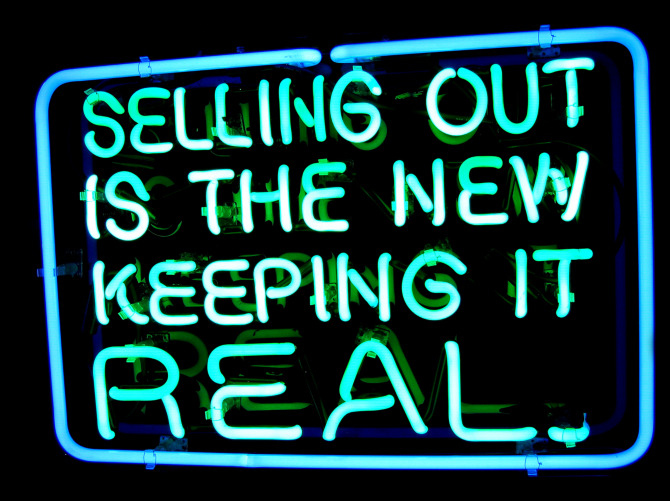
The Sellout, Fraud, Fake, Phoniness of Keeping it Real


“You’re a sellout!” We would say when we wanted our fellow teens to cower. It’s what we did in the 1990’s. Back then, sellout, and its various derivatives, were the most powerful words in the English language. No one could pinpoint what those relative and arbitrary terms meant, but everyone could. Everyone knew how to move the couch to suit their situation, but no one knew where the grooves in the carpet were. We didn’t know what keeping it real meant either, but to paraphrase a Supreme Court Justice’s statement on porn, “We knew it when we saw it.” The only thing we knew for sure was that our favorite musicians, actors and writers were all about keeping it real.  

The term sellout was not as ubiquitous in the halls of our high school, but its derivatives haunted us. Calling someone a suck ass, kiss ass or phony was as damaging to us as calling a punk rocker a sellout. We did everything we could to avoid someone dropping these terms on us. It was our equivalent to the cinematic portrayals of the red scare from the 1950’s in which everyone did everything they could to avoid being called red. We avoided superficial conversation, for example, fearing that someone somewhere might unload a derivative on us.  

There were several shows and movies that taught us how to be real. We had iconic figures who could teach us how to be real, and the prototypes also lived among us. It was up to us to find our role models, but they were out there, keeping it real. If you haven’t spotted the flaws inherent in our system, we didn’t either. We were were scared, confused young people in the 90’s, and just like every kid of every other era, we sought some form of identity to escape that confusion that we hoped others might accept.

Jennie and I worked for an online company. She informed me that she had utter disdain for our boss. I found her screed funny, righteous, and all that. Then that boss (who was actually a nice fella, but he was the man) walked by our desk and dropped a polite, somewhat humorous anecdote on us. Jennie nearly fell out of her chair laughing. What a fraud, I thought. I maintain that she failed to act in a consistent manner, but who cares? Jennie was constantly getting in trouble for falling asleep at her desk. She probably feared losing her job, and she probably thought a little laughter would ingratiate her to the man, or she might have thought the polite, somewhat humorous joke was a lot funnier than I did. Who cares? To my mind Jennie was a sellout, a phony, and a fraud for sucking up to the man. Her laughter shaped what I thought of her forever after, because I thought she wasn’t being real. I thought her laughter was for sale, and she was commodity.  

One of the job duties of my new job as a front desk employee at a hotel was to engage our guests in polite, superficial conversations. I was to make them laugh, feel comfortable, and make them feel at home. “I’m not going to talk to every guest,” I said, believing the boss was shredding my integrity.  

“Well then, you’re fired,” she said.  

“What?”  

“It’s one of your job duties,” she said. “When a guest tells you a story, you are to respond in a way that makes them feel interesting. If they tell a joke, it’s the funniest damn thing you ever heard. If you’re not willing to make an effort in this regard, tell me now, and we’ll start looking for someone who is.”  

It was difficult to shed the artistic personae I spent so much time manufacturing, but I learned to tap into the superficial side of my personality for eight hours a day, five days a week. No one was paying me for my artistic personae anyway, so why was I clinging to whatever arbitrary definition of what it means to be real? No one really cares either. No one dropped to a knee when they heard me pontificate the virtues of the real. They probably considered me a scared little kid who was looking for pointers on how to be a cool individual in an otherwise dark, unmapped location of my life. The breadth of that took me a while to fully appreciate. I thought they appreciated my ability to stay true to the Keeping it Real commandments. They didn’t. When we were sitting at a breakroom table of real people, and someone expressed real virtues, people yawned and moved the conversation forward. If we dared express a view that they might view as the fraudulent, phony view of a sellout, all conversation stopped. We could hear the clinking of glasses and the sizzle of a griddle in the wake of such comments, but no one knew why it was so important that a service employee at a restaurant keep it real during the Sunday breakfast rush.  

I learned to start chit chatting up every hotel guest about every stupid thing I could dream up, and it wasn’t that hard. In some dark recesses of my mind, I would never reveal in closed locations, I actually enjoyed it. My high school buddies probably would’ve turned seven different shades of red if they witnessed it. They would’ve been embarrassed for me, and angry that I sold my soul for a buck, or they might not have noticed it at all. It’s possible that no one was paying half as much attention to me as I thought, and I dreamed up all these elements and definitions of those elements in my head.  

I initially refused to take this newly manufactured ability to tap into the “chat chat, chit chat!” part of my personality out into the real world. My initial vow was to “keep ‘em separated”, until I saw my friends engage in superficial conversation with strangers who weren’t female. They just enjoyed superficial chit chat, talking about nonsense, and they appeared to be having a whale of a good time. “Wait a second!” I wanted to scream. “Didn’t you guys see that one movie, with that real, cool one who refused to chat nonsense? He said that Americans talk too much, and he said that we should all learn to shut up for a minute. Who cares?! What are you talking about? You are in violation my friend!”   

That composite character of our movies, shows, and songs removed himself from pedantic concerns, and he was the quiet, cool prototype dragon we all chased. He effortlessly managed the center of attention by letting his supporting actors fill in the blanks for him and fluff his image. We wanted one person, somewhere, to confuse us with this archetype.  

There was no specific actor, movie, or show we consciously mimicked, but if we built a pyramid, Matt Dillon’s role in The Outsiders might have sat somewhere near the top. It might have been the initial spark, but we didn’t consciously mimic him or any of the other actors who played similar roles. We absorbed these undefined, intangible qualities, however, movie and movie, show after show, song after song, and book after book, until we thought we created something others might buy. When no one did, we probably should’ve put together a different sales strategy, but what would Matt Dillon, Kurt Cobain, and Johnny Depp think? We were brooding shoegazers who didn’t care what anyone else thought, and we repeated that so often that we revealed ourselves as composite caricatures.   

One of the most famous quotes of all time from the Old Testament of the Keeping it Real bible occurred in the movie The Wild One. In that John Paxton, Ben Maddow script, the Mildred character reads the line: “What are you rebelling against Johnny?”  

The Johnny character reads the line: “Whaddya Got?”  

In the real world Mildred would not say anything to preserve Johnny’s reply in a cool liquid that real worlders might want to bathe in. In the real-world Mildred says, “I’m sorry to say I got nothing Johnny.” 

“If you got nothing, don’t say anything Mildred,” the real-world Johnny might say. “You saying something just killed my whole mystique. Imagine if you said nothing. Imagine how powerful that line would’ve been.”   

“I’m sorry Johnny,” Mildred says, clearly shaken. “I’m just a bit actress in this scene.”  

“You don’t understand! I coulda had class. I coulda been a contender, I coulda been real, instead of a service industry worker, which is what I am.”

Tag lines such as keeping it real, selling your soul to the highest bidder, and the more concise sellout are evergreen, of course, but those of us who were hit with them way back when now see the illustrative and inconsistent dichotomy of trying to become real.