“How can you not hear that?” Abram asked his wife after Princess woke him from another evening nap with all of her barking, yipping, or whatever we call the sound that spirals into our thoracic vertebrae.
“I guess I hear it so often that I just don’t hear it anymore,” she said. “It’s like white noise to me.”
“It’s like nails on a chalkboard to me,” he said. “How in the world can you get used to that?”
Princess didn’t bark at anything in particular. She just enjoyed hearing herself bark. Abram was done with it. Princess just tapped his last nerve. Waking him from this evening’s nap was the straw that broke the camel’s back.
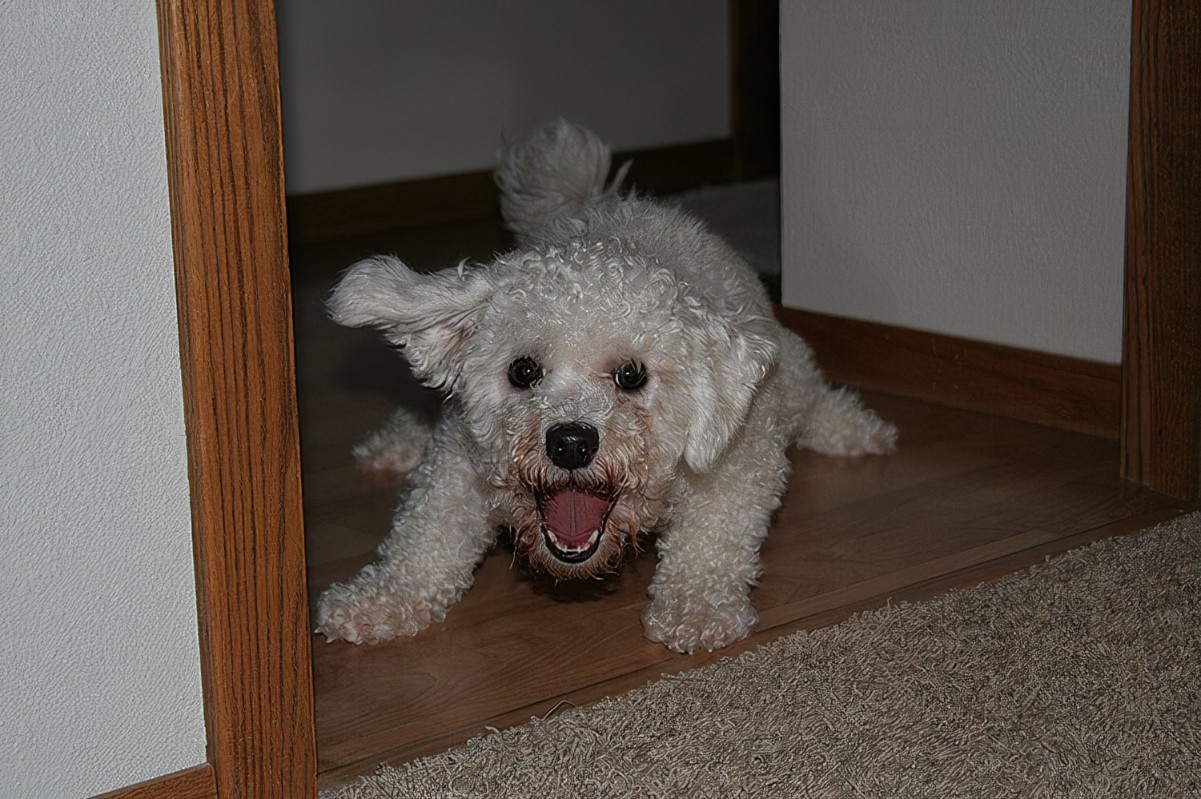 Everyone has a threshold, and Princess just met his. He couldn’t nap with her around, he couldn’t watch his shows without that sound drowning out punchlines, and he couldn’t even enjoy a pizza roll. Once he began eating one, she’d start in, and he’d throw a three-quarters full box of pizza into the waste receptacle. He couldn’t even enjoy a peaceful moment of solitude in the waste removal room without hearing that yip. “I can’t enjoy a good BM anymore,” he told his wife after a particularly obnoxious night of yipping. “How can you not hear that?” He worked hard, and the otherwise uneventful evenings were his rewards for hard work, but Princess would have none of it.
Abram had a word with them over the fence, the neighbor’s, the owners of Princess, and it was a nice word, because he was a very nice man, good man. They said they would do something about it. And they did, for about two nights.
Princess had a regular bark that she yipped throughout the night, but she let you know when someone was approaching with a more shrill and rapid yip. When that person reached a point where they were close enough to pet her, Princess stopped barking. The yip was replaced by a soft, earnest whine. The ten seconds or so that person spent petting her were the only breaks Abram had from her barking throughout the night.
Everybody loved Princess, and Princess loved everybody. She didn’t care for Abram though. Even though he never did a damned thing to her, Princess refused to let him pet her. He reached over to pet her a number of times, while speaking with her owner, because that’s what a very nice, good man does when they’re talking to a neighbor, and their dog is present. When Abram reached over to pet Princess, however, she growled her cute, little Poodle growl and backed away barking with her teeth showing. Every time she did it, and she did it every time, why her owners were just aghast. “Princess?!” the owner said with shocked dismay. “I’m sorry, she’s never done that before.” They said that every time.
Nightly evidence bolstered that characterization. Abram was seemingly the only person on the planet Princess didn’t like. It humiliated and embarrassed him. She sidled up to his wife, the kid, and every stranger who happened to pass by, but she didn’t like Abram, and he hated her all the more for it.
He was used to it though. When his manager needed to fire someone, and it happened. It happens in every business. The manager slash owner (his nickname was Slash) of the local Lube Your Lube scheduled that person to work with Abram.
“He was in on it,” Charlie “Slash” Hyde said. “Abram enjoyed being that guy. It all started when he was new, about six months into his job, and he started to get real comfortable with the fellas at Lube Your Lube. He started becoming more comfortable being himself, which we learned was the worst thing for the business. I know that sounds harsh, and I apologize to Abram if he ever reads this, but full on Abram is a disagreeable sort. He had an ability to get under people’s skin. The problem for me, as an owner slash manager was Abram outworked every single person on our staff. He was dependable and willing to sacrifice whatever it took for the business. He’d work weekends, overtime, and if someone called in sick, he’d be there for me within the half hour. No matter if it was his day off, or if he just clocked out less than thirty minutes ago. The problem I had was that if I wanted to keep a full staff, Abram couldn’t be comfortable being himself, because no one wanted to work with him. So, he and I devised a six-point plan to keep him employed. I won’t provide the details of that confidential plan, but Abram followed it to the letter for me.
“Flash forward about three months, and I had to fire someone,” Slash continued. “The problem for me was that I wanted Lube Your Lube to be a family. We all got along at The Lube and we had numerous get-togethers, holiday parties, and after work bar nights. I never had a big family, so the fellas at The Lube were my extended family. They were my brothers, cousins and nephews. I got to know their wives, their kids, and their dogs. So, when it came time to fire one of them, I pictured their kids, and a crying, desperate wife, and I just couldn’t do it. I should’ve never got that close to them to begin with. ‘Remember that six-point plan we developed months ago,’ I told Abram in a one-on-one. ‘Yeah, turn that off for about two weeks. Open the spigot, be full-on Abram with this guy I put in the pit with you.’ Long story short, I didn’t have to fire anyone for about three and a half years, thanks to Abram.”
***
 When the yipping drowned out his favorite sitcom, he cranked the volume, when he tasted it on his pizza roll, he threw three-fourths of a box into the garbage, but when he dreamed about Princess sitting at the bottom of a tower, yipping at him while he tried to climb Rapunzel’s hair, he knew something had to be done.
“How does a cute, fluffy little dog’s bark drive someone so crazy?” was the question put to Abram by one of the Lube Your Lube fellas.
“You ever hear about how the Chinese water torture technique can drive a person insane?” he said. “It’s like that. Except Princess’s version of the insanity-inducing drip, drip, drip is yip, yip, yip.”
He knew he got a little too hot and bothered by it at times, but who wouldn’t be at least a little ticked? After the patterned barking established itself, he shared a kind word with the owners. They didn’t do anything about it. They did in the beginning, for a couple days, and then they forgot. He thought about stressing the point angrily, but he wasn’t a confrontational guy. The city had noise ordinances that specifically addressed dog barking, a three-step plan that could lead to the owners losing the dog if they didn’t address the issue properly. The problem was that noise ordinance dealt with dogs barking after 10 p.m., but Princess didn’t bark until 10 P.M. She stopped barking, or her owners brought her back in at 8 P.M. He wouldn’t have initiated that process anyway. He was no snitch.
They don’t know who they’re messing with, he thought watching Princess bark at nothing from behind the drapes. They don’t think I’ll do anything. They don’t know me. I’m fixing to do something. I’ll take matters into my own hands. It’s what a man does, he takes care of matters. He takes care of matters himself. There are extremes, of course, but a very nice, good man, doesn’t take matters involving a snowy white, ten-pound little puppy to extremes. A man handles matters in such a way that is impossible to prove or trace, and everyone knows that there will come a day when Princess will no longer able to control her bowels. It happens, maybe it’s age, and maybe she got into something. No one knows why it happens, but it happens. It even happens to cute, snowy white Poodles named Princess.
***
“We’re moving,” the neighbor told Abram’s wife over the backyard fence, weeks later.
“Are you serious?” she said. “You haven’t been here that long? You’re such nice neighbors. What happened?”
“I don’t know if something around here is making Princess sick,” the neighbor said, “but she’s such a big part of our family now, and we can’t just get rid of her for pooping. Who gets rid of a family member who can’t control her bowels?”
“She’s pooping?” his wife asked, confused.
“It’s diarrhea,” the neighbor said, “and it’s bad. Every time she barks, it comes out. She doesn’t just poop either. It’s projectile pooping.” The neighbor paused here. “You can laugh. We did, at first. We thought it was kind of cute and funny, her pooping every time she barked. We could tell she was a developing a bit of a complex about it, and that kind of made it more cute and funny, but it’s been going on for so long now, for weeks. It’s not funny to us anymore, but you can laugh if you want to. I know it’s funny to everyone else, but there’s poop stains on our carpet, in our carpet, that we’ll never be able to get out, and it’s all over our walls too. She’s so tired now that she never wants to do play anymore or do much of anything, and she’s still, technically, a puppy. And when you pick her up, you have to be careful not to touch her tummy, because she screams and tries to bite you. Whatever is wrong with her has caused stains, and a smell in that house that is so bad that the owner is probably going to have to hire professional cleaners to get it all out. It’s bad.”
“I am so sorry,” Abram’s wife told her.
“It might seem silly to move over a dog,” she said, “but we’ve tried everything. We took her to the vet, we tried to change her diet, but she’s not eating much anymore, and well, we can’t just get rid of her. We had a big blowout about it, Stan and I, but we can’t get rid of Princess. She’s part of our family now, and you can’t just put your family dog in the pound, or give her up for adoption. Who does that? Right? What kind of people would get rid of a dog because she’s sick? I’m thinking a move will do her some good. I don’t know. Plus, we’re only renters, so we’ll just rent somewhere else. The owner was kind enough to let us out of our lease, minus our deposit, so it was nice chatting with you over these last couple of months.”
When the wife told Abram about that conversation, she was broken-hearted. “Can you believe that?” she said. “It’s so bad that it’s just so sad, and it’s almost painful to me. It’s such a mystery too.”
“The only mystery to me is why anyone would go to the expense and the pain in the butt of moving over a dumb dog with diarrhea.”
“They said it’s been going on for weeks Abram,” she said, and when she went into more detail about how the dog was pooping every time she barked, and how it was projectile poop that stained their walls, and was probably deep in their floorboards now, Abram couldn’t help but giggle. When she relayed the fact that the dilemma was such that it was actually causing the couple marital strife, Abram lost it. When she looked at him with confusion and some disgust, he almost fell to the floor in laughter.
“Why is this so funny?” she said. “I don’t find this one bit funny. I think it’s kind of sad actually, really sad.”
“I’m sorry,” he said, wiping away the tears. “It’s just that, well, I may have played a bit of a role in all of this.”
“You played a ..?” she asked. “What?”
“I might have cooked up some of my delicious burgers for Princess over the last few weeks, and it could be alleged that I might have crushed some Ex-Lax in it,” he said, and he expected her to smile a little at that. If nothing else, he thought his presentation of that information might make her laugh. She didn’t. She just looked more confused.
“You might have what?” she asked. “I don’t know what you’re saying?” She mouthed the words he said when he repeated them. It was an unusual tic of hers to ask someone to repeat what she obviously heard, and she mouthed the words when person repeated them. This was her way of trying to grasp what the other party was saying.
“That dog was driving me absolutely crazy,” he said, “and you knew that. I told about my anger. I told you all about it, and you did nothing. I told you about it numerous times, for months. Hell, I even told them about it, and when they wouldn’t do anything about it, I took control of the situation. Why didn’t you do anything about it?”
“You didn’t do anything of the sort,” she said. “You’re messing with me. Tell me that you’re kidding.”
“We finally bonded Princess and I,” he said pumping his eyebrows. “Did I tell you that? Yeah, she loved these burgers so much that she actually looked forward to seeing me. You remember how she hated me, and she wouldn’t come near me, no matter what I did. Well, when I had a burger in hand, she was all hopping and yipping her excited, little yip when I approached, and her tails wagging about a hundred miles an hour. We were the best of buddies there for a while.”
He thought she might laugh at that too, but she didn’t. Her face went through so many contortions, as she tried to grapple with this information, that he began to feel bad. He thought of backtracking and saying, I’m just kidding, but it was too late now.
“You poisoned a dog, because it wouldn’t stop barking?” she asked him. “Who does that? That’s like David Berkowitz, Ted Kaczynski stuff.”
“I didn’t poison the dog,” Abram said. “I gave it Ex-Lax, and Ex-Lax is not poison.”
“Not to us,” she said, “but it could be to a dog? Plus, you caused her a severe case of diarrhea, which could cause severe dehydration. What if you permanently ruined the lining of her stomach or intestines? Dogs can’t handle our medications Abram. What if you killed that dog, Abram? Did you ever think of that?”
“I didn’t kill her.”
“You have never done anything that disgusted me before,” she said after a pause. “I’ve been disappointed with you before, and I said nothing. I’ve experienced some unhappiness with some of the decisions you’ve made, and the things you’ve done, the normal things a husband and wife go through, but I’ve never been disgusted before. This disgusts me. Those were some good people and they were good neighbors.”
“No, they weren’t,” he said. “They had a dog who barked for hours on end at nothing, at nothing, and they did nothing about it, nothing. She just barked to hear herself bark, and no one did a damn thing about it. You did nothing. If you think about it, you’re partly to blame for this.”
“They were nice people Abram,” she said, all but spitting at him. “They were nice, young, and polite people. I liked them. You liked them. Everyone liked them, and you ruined their lives so much that you caused them to move. Don’t give me this, I’m partly to blame. You did this Abram.”
“Who moves over a dog with a case of diarrhea?” he asked, trying to change the subject.



 Rilaly