Jerry Seinfeld’s Unfrosted was … not bad. Screech! Spit coffee! Swear word! Screams! Car Crash! It is shocking, I know, to hear that coming from a Jerry Seinfeld fanatic. If you’ve read any of the articles on this site, you know how often I source him as one of the greatest comedic minds alive today. I consider him one of the best standup comedians of his generation, and his observations on what makes us weird have had a huge influence on this site. The show Seinfeld was my favorite sitcom of all time, I loved Comedians in Cars Getting Coffee, and I even enjoyed his Bee Movie. I didn’t love it, but I really liked it for what it was. Oh, and I laughed so hard during one of his standup shows that Jerry Seinfeld looked over at me with a look that suggested he was comedically concerned about my health. If the difference between fanatic and fan is excessive and intense, uncritical devotion, I am a fanatic. I never wrote to him, collected dolls, scripts, or took tours, but if there’s a hip term I don’t know for a passive fanatic, that’s me. I’m probably his idea of the perfect fan, a guy who quietly buys and watches anything to which he attaches his name. Which is why it pains me to write these five words: “Unfrosted is not as funny as I thought it would be.”
 Watching the movie reminded me how we all want more of everything we love. We want more from our favorite artists, athletes, politicians, and plumbers, until they give us so much that we realize it probably would’ve been better if they left us in a state of wanting more. That’s the advice seasoned entertainers often leave young upstarts, “Always leave them wanting more.”
And Seinfeld warned us, numerous times, that more is not always better. He’s said it in relation to why he decided to prematurely end his show Seinfeld, but he’s applied that principle to his career too. He’s informed us on so many days, and in so many ways, in the numerous interviews he’s done throughout his career, that he’s learned that he’s best when he stays in his lane, his lane being standup. He’s learned what he’s good at, and what he’s not, and he has proven to be the opposite of what makes some comedians so great, in the sense that he’s not daring, risky, or experimental.
If I were to pitch him a project, I would say he and Larry David should develop a sketch comedy in the Mr. Show vein, but we can only guess that he’s had hundreds of similar pitches from friends, fellow writers, and corporate execs, and he’s turned them all down. Some of those projects may have proved embarrassing, some may have been so far out of his lane that he didn’t even consider them, but we have to guess that some projects that were so close that he had a tough time turning them down. He did it all, because he knows who he is, what he’s good at and what he’s not, and he’s learned how to stay in his own lane.
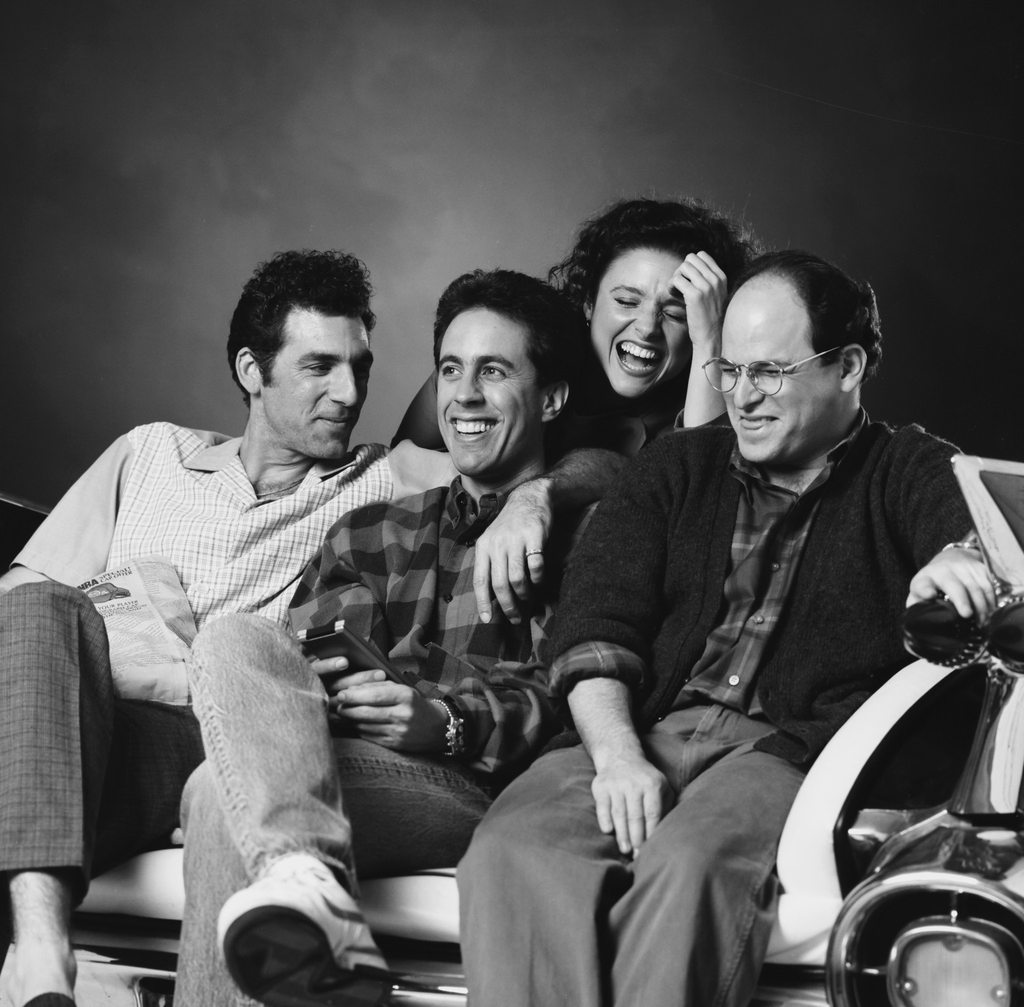 On the greatest sitcom of all time, Jerry Seinfeld surprisingly (to me anyway) credited the three actors (Julia Louis-Dreyfuss, Michael Richards, and Jason Alexander) for making the show so brilliant. He does not shy away from the idea that the writing on the show, of which he played a huge role, was great, but he admits that the actors brought that writing to the next level.
“I did get caught in a beautiful, cyclonic weather event,” he said in an interview. “The actors, Larry David, the thirteen phenomenal comedy writers, and everyone on both sides of the camera was a killer. You know when you’re a part of it, but you know it’s not you. You’re a part of it, but if you’re smart, you know it’s not you. It’s not all you.”
On Seinfeld, Jerry played the Alex Rieger of Taxi, the Sam Malone of Cheers, the center of the storm. He’s always been great at adding that final comment, lifting that eyebrow to exaggerated levels, and saying, “ALL RIGHT!” at the end of another character’s hilarious rant. He knows how to put a cherry atop the pie in other words. As long as that pie, or the acting required to nuance it, was filled in by someone else. He can write funny, he can deliver a short, crisp line deliver as well as anyone, but the nuances in the acting craft required to build to Seinfeld’s punctuation were always best left to others. I heard him say this so many times that I saw it, until I accepted it, but I always thought there was a bit of humility attached to it. Some of us were so blinded by enthusiasm that we never learned how to curb it completely.
 When he decided to end Seinfeld after the ninth season, it felt similar to an athlete retiring at the downside of their peak, not the prolonged, sad tail end, just the other side of the peak. There were hints in seasons eight and nine, after Larry David left, that the show was on the downside of its peak, but it was still the best show on TV. Why would an athlete, or a successful showrunner, quit prematurely? I understand not wanting to outstay your welcome, or allowing us to see glaring levels of diminishment and not wanting to go out like that, but if you’re lucky, you might still have forty years on this planet. What are you going to do in the rest of your life to top that? Some of them, I think, are too worried about what we think. They don’t want us to see their downside, or because they love the game so much that they can’t bear playing at anything less than their peak. They can’t bear someone saying, “If you just called it quits after season nine, it would’ve been a great show beginning to end. Season ten was probably one season too many.” They, some of them, don’t want us to remember them as someone who stayed around too long.
When we were kids, we ached for another Star Wars movie, then we got one later, much later, and it ruined the legacy of Star Wars. After the second trilogy was complete, the almost unanimous opinion among those I know is they probably should’ve left us wanting. As Led Zeppelin did. Zeppelin broke up after the untimely death of their drummer John Bonham, in 1980. We spent our teens and early twenties talking about the possibility of a reunion and another Zep album. I understand they said it wouldn’t feel the same without Bonham, but the remaining band members were still in their early-to-mid thirties when they broke up. How do you leave a juggernaut like Led Zeppelin in your early thirties? The Beatles were in their twenties when they broke up. As Theodore Roosevelt said of being president so young, “The worst thing about being president of the United States so young, is that there’s nothing you can do to top that for the rest of your life.” Led Zeppelin left us wanting, and it was probably for the best. What could they have done to top those first six albums? They most likely, and in all probability, would’ve only disappointed.
In a career studded with comedy gold, Gold Jerry! Gold! Unfrosted has the feel of a sequel. It’s not a sequel, but how many of us walked out of a killer comedy, talking about how that movie just screams out for a sequel. We didn’t talk about how great that comedy was, we instantly wanted more. Then, when the sequel came out, it was, “That wasn’t bad, but it wasn’t as good as the first one.” That was the impression Unfrosted left on me. It felt like all the players were trying to recapture something that used to be really funny, and we were all prepared with our preparatory smiles on our faces, until the smiles slowly faded away.
The characters have this feel of trying to repeat something that worked before, but it just doesn’t for all the mysterious reasons that some movies work and some just don’t. The jokes have a feel about them that suggests to us that they’re brilliant, but they’ve been done so many times before that we no longer need to figure them out. As someone who doesn’t know one-one hundredths of the knowledge Jerry Seinfeld has about comedy, I think the figuring out part is the reward of comedy.
Unfrosted seeks the opposite tact. It goes for familiarity, and we all love familiarity. Familiarity with actors, themes, concepts, and all that. Unfrosted displays this level of familiarity in the beginning, to establish a through line to the audience, but it never branches out into that unique spin that kind of shocks us into laughter. The setting of the movie is the 60s, and what a foolish time that was, and even though this has been a million times before, we still think it could be great in the minds of geniuses.
It’s a mystery to us why some movies don’t work, because we don’t make movies, but you’ll often hear moviemakers, actors, and all the other players say, in interviews, that they don’t know why either. “We thought it was funny, but we had no idea how huge it would get.” We don’t often hear the players involved say, “We thought it would be huge, but we had no idea people would consider it a little boring.” What works and what doesn’t is a mystery to us, and it’s a mystery to them. Generally speaking, dramas and action movies are probably a lot easier to predict for those involved, especially when the star actor signs on to the vehicle. Comedies and horror have a super secret formula that even those involved in the finer details of the production involved don’t know whether it will hit or not.
Unfrosted gave us all a be-careful-what-you-wish-for feel, because you just might get it. As much as we cried out for a movie, or any project, from Jerry Seinfeld, we walked away from it thinking that Unfrosted, unfortunately, should never have been made. What could they have done to make you feel better about it? “I don’t know, I don’t make movies, but they probably should’ve left me wanting more instead of giving it to me.”
Watching Unfrosted, reminds us of that elite athlete who retired on the downside of a peak, not the bottom, just the downside, and we clamored for his return. How can he retire at 37? He still had what two-to-three years left? If he lives to eighty, he’ll spend the next 43 years reminiscing and thinking he should’ve played two-to-three more years at least. Then he comes back, and we see how much his skills have declined. He didn’t do it for the money, I can tell you that much. He did it, because he loves the game, and what’s wrong with that?
The point some people make on various websites is that athletes and entertainers run the risk of ruining their legacy by staying too long. This line right here makes me almost fighting mad. So, you’re telling me that the athlete who made so much money for the league, the city, and the franchise shouldn’t be able to sell his wares to anyone who will take them? He shouldn’t try to get another paycheck for the punishment he put his body through for your entertainment, because you want to remember him the way you want to remember him? Isn’t that a bit myopic, even selfish? He wanted to get paid for his efforts, of course, but he didn’t necessarily do it for the money? Seinfeld, and most modern athletes, have so much money that that’s not why they’re doing it. They’re doing it for the love the game so much that they want to play at least two more years? What’s wrong with that, and what’s wrong with you for wanting to deny him that?
Did Seinfeld ruin his legacy by doing Unfrosted? No, first of all, it wasn’t that bad, but, then again, I never expected to say that a Seinfeld project “wasn’t that bad”. I don’t remember any of the elite athletes who “stayed one year too long” for those latter years, and I don’t begrudge them for taking as many paychecks as they could before they called it a career. I also don’t begrudge them the idea that they loved the game so much that they couldn’t walk away, until it was obvious to them that they truly couldn’t play the game anymore. I actually respect it, as I say it was for the love of the game. I respect the fact that Seinfeld’s friend pitched him on the idea of Unfrosted, and not only did he like the idea, but he didn’t think he was done yet. He thought he had one more big project in him, because he loves doing the things he does so much that he wanted to try it at least one more time. Good for you, Mr. Seinfeld, I say, and if he feels like doing another project, or projects, I’ll be there on the first day it’s released.
Jerry Seinfeld has admitted that he doesn’t expect to be remembered after he’s gone, and he’s even gone so far as to say he doesn’t care, or that’s not his driving force. I’ll remember Jerry Seinfeld as a great, almost perfect standup comedian, the cocreator of one of the greatest sitcoms in TV history, and as a gifted natural when it comes to observational humor, but Unfrosted doesn’t do much to either lift or damage his legacy. It was just a marginally entertaining movie that they probably won’t list in his very lengthy resume when that final wave off arrives.
 Rilaly