Jack McKinney: The Forgotten Man


“He created “Showtime!” Norm Nixon said. “That should never be forgotten. You can talk about me, Kareem, Earvin, and Pat Riley all you want. But Jack McKinney created “Showtime!”

If you were paying any attention at all in the 1980’s, you knew the Lakers, Earvin “Magic” Johnson, Pat Riley, Kareem Abdul-Jabbar, and “Showtime!” A fella didn’t have to watch the NBA to know the names Magic Johnson or “Showtime!” We didn’t even have to enjoy watching sports to know these names. They were in the news, on the news, and the news. Decades later, the names “Showtime!” and Magic Johnson still resonate so well that networks like HBO and Apple+ are willing to pay top dollar for retrospective broadcasts that recall how special this era was in sports and entertainment. 

Lakers former head coach Jack McKinney on the sidelines cheering on the team from sidelines in first quarter action.

The term “Showtime!” is still so flashy that this writer feels compelled to surround it with quotes and follow it up with an exclamation point. Even though we weren’t yet teenagers, we knew the names Kareem Abdul-Jabbar, Norm Nixon, Byron Scott, Michael Cooper, Jamal Wilkes, James Worthy, Kurt Rambis, Pat Riley and Earvin “Magic” Johnson. We knew the big names, we couldn’t escape them, but as with all sports franchises, title runs, and dynasties, those names not in lights often contributed far more than we ever knew. The name almost criminally absent from this list was the architect of the “Showtime!” game plan of the run the Lakers enjoyed in the 1980’s: Jack McKinney.

Jack McKinney might be the last name we think of from this era, but the first name that comes to mind when talking about the Lakers 1980’s “Showtime!” run is Magic Johnson. He was the superstar, the smile, the face of the franchise, and a celebrity on and off the court. He was one of the few athletes of his era who lived up to such over-the-top billing. Prior to the ’79-’80 Laker season, Magic lead his college basketball team, the Michigan State Spartans to a college basketball championship, then he was the number one pick out of college. In his rookie season with the Lakers, Magic was one of the few to prove the hype machine correct when he awarded the Lakers for using a number one draft pick on him by winning an NBA Championship in his rookie season. He had some help, of course, including a man named Kareem Abdul-Jabbar, who many argue was the best basketball player of all time, and if statistics matter, Jabbar still has the most points ever scored by an individual over the course of his career.* In the 1979-1980 season, however, the 21-year-old rookie from Michigan State had every spotlight the national media owned on him, and he succeeded beyond all expectations. 

Just about every highlight of the Lakers in the 80’s contains something Magic did. Whether it was some crucial shot, powerful dunk, or one of his highlight reel passes. Magic Johnson could get anyone the ball at any time, at just about anywhere on the court.  

Was Magic the best fastbreak point guard of all time, perhaps, but we might also ask the question was Magic Johnson so great because he fit McKinney’s scheme so well, or did owner Jerry Buss hire McKinney, because he wanted the scheme, and he knew his first draft pick would flourish in it?

As Jeff Pearlman wrote in the book Showtime, the Lakers’ strategy prior to the arrival of Magic and McKinney, was “See Kareem, wait for Kareem, pass to Kareem, watch Kareem shoot and hope ball goes in.” 
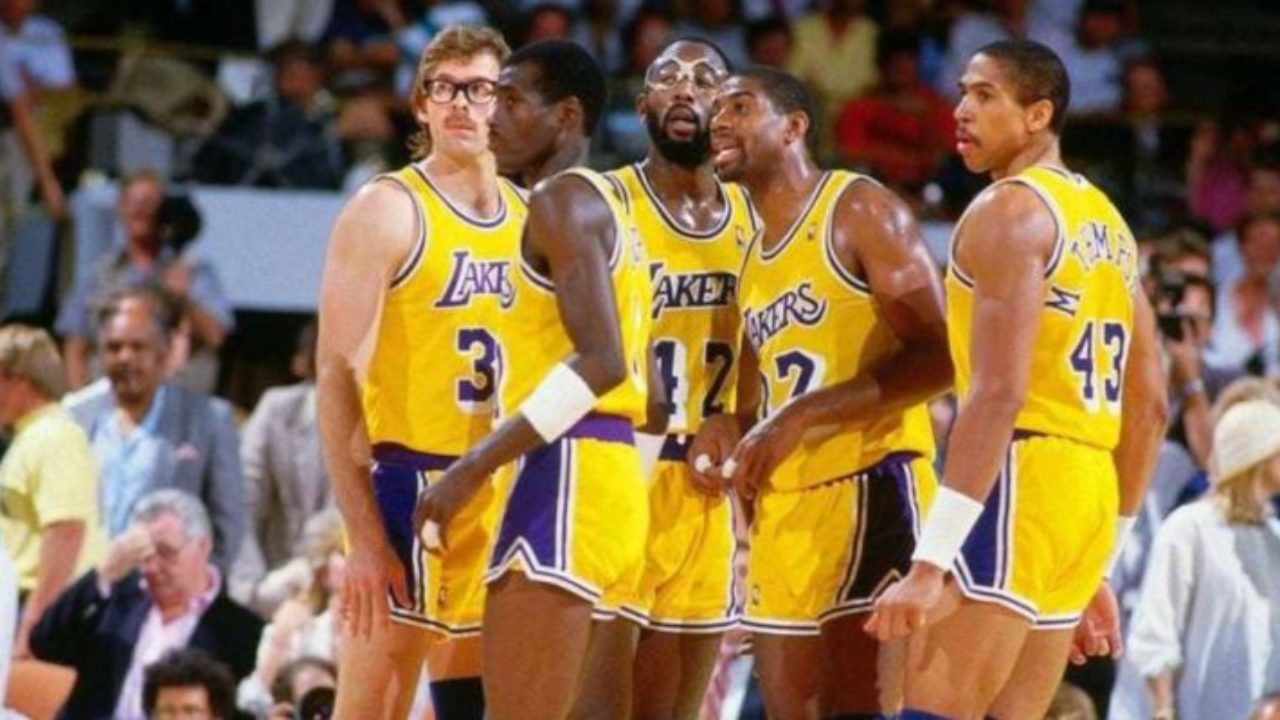
Was Magic better in McKinney’s scheme than he would’ve been in Jerry Sloan’s with the Chicago Bulls? (The Bulls lost a famous coin flip for the rights to draft Magic Johnson in 1979.) Was Magic so great that he would’ve been great wher eever he played, or did the “Showtime!” game plan play to his strengths? If McKinney didn’t fall prey to the accident, and he coached a different team, with all of his facilities intact, would he have succeeded regardless? Or was the Magic/McKinney gameplan a marriage made in heaven? 

Would Joe Montana have succeeded regardless when and where he played? Was he so driven to be great that it would’ve happened no matter where he played, or did he fit the scheme the coaches implemented? We could ask this of any coach, scheme, and player marriage, but while most of the credit is given to the player, most sports nuts divide the credit more equally. How many sports nuts, the freaks of sports knowledge, know enough to know the name Jack McKinney. 

Prior to being hired by the Lakers, Jack McKinney was a basketball lifer who lived and breathed basketball. He was a college basketball assistant coach and a head coach, then he was an assistant coach for five years in the NBA. At the age of 44, he was hired to coach his first NBA team, the Los Angeles Lakers. It’s not an exaggeration to say his whole life had been leading up to that moment. How many hours, months, and years of his life did he sacrifice to one day see his dream to fruition? How many dark, quiet rooms did he sit in all alone, watching tape, learning the game, developing game plans, and correcting and perfecting it when others were out living a life? He sacrificed his life for basketball, and when all his work finally started to pay off, it was all taken away from him.

If Shakespeare were alive today, he would’ve devoured Jack McKinney’s narrative as a modern tragedy of epic proportions. He probably would’ve started his production with McKinney’s solo bike ride in which his gears locked up. Jack McKinney was thrown off the bike, and he landed in a manner that put him in a coma. The serious injuries he experienced would plague him for the rest of his life. It took him so long to recover that the Lakers named Paul Westhead coach, and then they named Pat Riley, the man credited with the Lakers fast break offense that we would eventually all call “Showtime!” This accident happened 14 games into Jack McKinney’s tenure as coach of the Lakers. He would never coach them again. 

Prior to the accident, Jack McKinney implemented his revolutionary fast break offense, and the Lakers used that game plan to win the ‘79-’80 NBA Championship, their first of that era. When McKinney’s successor Paul Westhead later tried to institute a different gameplan, it didn’t work for the talent on the court. Pat Riley took over, re-instituted McKinney’s gameplan, and the rest is history, Pat Riley’s history. The Jack McKinney story is interesting whether you are a Lakers fan or not, but it also interesting because prior to HBO’s retrospective broadcast Winning Time, based on Jeff Pearlman’s book, this sports aficionado had no idea how instrumental Jack McKinney was. The Jack McKinney story is interesting because it highlights the “forgotten man” in sports history.

“This is the guy who made my career possible,” McKinney said that Lakers’ coach Pat Riley always said when introducing McKinney, “This is the guy.”

The question author Jeff Pearlman put to Lakers’ point guard Norm Nixon decades later was, “Is Jack McKinney universally acknowledged as one of the greatest coaches in the history of the NBA?”

“I have no doubt that he would be [were it not for the accident],” Nixon said. “No doubt whatsoever.”

How many forgotten men and women, like McKinney, have changed the landscape in their world? How many little guys and girls helped the names in lights edit an otherwise flawed premise, or rescued an otherwise flawed scientific finding by disproving it so well that the genius had to go back to the drawing board to find a more perfect resolution? How many little-known advisors instructed world leaders to follow a different plan that resulted in a different outcome that defined history? We all know the names in lights, the names that sell newspapers and collect internet hits, but how many lesser-names who shunned the spotlight defined history as we know it. 

I don’t know these names, and either do you. I didn’t know the name Jack McKinney prior to this year, and unless you’re a die-hard Lakers fan, or you’ve watched the story of the Lakers in the 80’s Winning Time on HBO, you didn’t either. I heard some foggy details about a coach who started out with Magic, but I heard he died weeks into Magic’s rookie season. I didn’t know what role he played, if any, and I had no idea how instrumental he was. I just thought he was hired, and he died shortly into his tenure as coach. Jack McKinney didn’t die. He went onto coach a couple other teams, and he won coach of the year in ’80-’81 coaching for the Indiana Pacers, but after working so hard, as a coach in college and an assistant in college and the NBA, he never achieved the dream he could have with the talent Jerry West, Jerry Buss, and the rest of the Lakers’ brain trust amassed in ’79-’80, and the years that followed. McKinney is recognized by those in the know as one of the great basketball minds of his generation, but how many outside that very small world have even heard his name?     

“McKinney is not a bitter man,” Jeff Pearlman writes to close his intro on the now-deceased McKinney, “but he is human.” 

“Life isn’t always fair,” McKinney said. “I’m OK with how everything has turned out. I’m loved. But, well, it’s not always fair…”

“Jack McKinney is the man more responsible for the birth of the Showtime era of professional basketball,” Pearlman writes, “If only he could remember it.” 

If that doesn’t give you chills on how unfair life can be, then I don’t really know what I’m talking about. We talked about the scheme, player marriage earlier. Magic Johnson might not be “Magic!” today, were it not for Jack McKinney,  James Worthy might have been an all-star and nothing more, Jerry Buss might have been nothing more than an American businessman who tried and failed to resurrect the Lakers franchise, and Pat Riley might’ve ended up nothing more than a failed sports announcer. What if’s, and could’ve been, should’ve beens dot history, but the ’80’s Laker dynasty we know today, probably wouldn’t have happened were it not for one forgotten man in history, the late-great Jack McKinney. 

Chuck Klosterman on who wears the black hat in our society


Chuck Klosterman’s new book I Wear the Black Hat is mostly a list of villains throughout pop culture and History.  The list, at times, is a little kitschy, and at times it’s a little serious, but whether you agree with him or not, Klosterman always has plenty of material to back up his claims.

In one of the passages of his book, Chuck Klosterman informs us that it’s no longer PC (Politically Correct) to call the PC movement PC.  He says that the very term PC is now nothing more than a “quaint distraction” that “no one takes too seriously anymore,” and “it feels like something that only matters to Charles Krauthammer.”  Klosterman says that the last time it was a “correct term to use to describe the linguistic issue in America was (roughly) between 1986 to 1995.”

Klosterman

It drives some of us “really, really crazy” when an individual tells us that a term, or phrase, that we use to describe a movement no longer properly describes that movement.  These people are prone to say, “You should stop using that term,” or something like, “That is so yesterday dude.”

‘Ok,’ I mentally respond, while reading this particular condemnation in the book I Wear the Black Hat (Or should I say African-American Hat). ‘What term, or phrase, would Mr. Klosterman prefer we use to describe the current incarnation of the PC movement?’ The answer, we find by dutifully reading on, is that we don’t replace it, unless you’re Charles Krauthammer.  It’s, apparently, just not a phrase that people should use anymore.  In other words, the cynical would respond, “it drives certain people (like Klosterman’s wife) really, really crazy” to try and defeat the idea that some people are trying inflict speech codes upon our language, so just drop it, and we can all get along a lot better.

If the import of Klosterman’s message on PC speech codes were that I’m not to be considered hip anymore when I use a term like PC, I’ll take that, because I’m admittedly about as far from hip as one person could possibly be.  If he’s telling us that the term PC is no longer an apt description of the attempts to control language, however, he’s going to have to provide us with a substitute.  I wouldn’t use that substitute, of course, but it would strengthen his argument to do so.

I was going to argue that the PC movement may not be as overt as it was between 1986 to 1995, but it is, we’re just more assimilated to it now.  Those of us that railed against PC speech codes in that era, as Klosterman later points out, simply lost the war.  The difference between the culture that existed between 1986 to 1995 and now, is that it’s simply less shocking to us now when someone tries to control how we speak.  It’s one of those sad but true facts that we’ve all learned to accept and a code we now have to lived by.

It used to be shocking to some of us when someone, be they a politician, or an obnoxious member of a particular group, would tell us that we weren’t speaking correctly, and it would elicit rebellion back then.  That rebellion was put forth by many, but in Klosterman’s opinion no one did it more often, or as loudly, as Andrew Dice Clay and 2 Live Crew.  Klosterman states that PC climate of that era provided an historical window in which an Andrew Dice Clay could become a megastar, and that “he would not have been a megastar in any other historical window—if (Dice Clay) had happened at a time when vulgarity somehow felt less important.”

Klosterman declares that that PC era was “painlessly oppressive” and those in that era experienced “low level anxiety” when they argued in public in which “Even casual conversation suddenly had the potential to get someone fired.”  He describes how sexism and racism were given birth, or at least re-birth, during this era, and that the “backlash was stupid and adversarial.”  In other words, if we are to read Klosterman correctly, we presumably should’ve all acquiesced to the PC crowd a lot sooner, so they could’ve won the war a lot quicker and saved us a whole bunch of adversarial exchanges.

I don’t know much about Klosterman’s life, and if he has experienced the hammer of the PC police personally, but those of us that have know that the PC police don’t just go away. They move onto the next thing, whatever that thing is.  To some of us, it is very important, and at the risk of inflating it beyond reason, vital to the the free speech clause that we continue to provide them the “stupid and adversarial” backlash that keeps them somewhat close to being in check.

In the final portion of this chapter, Klosterman does concede that the winners of this war, these advocates of speech-limitation, “Didn’t necessarily make a better argument, they just wore the culture down.  Almost everything that these advocates wanted in 1990, have been adopted by the world at large, in that we now err on the side of caution for the potentially offended.”  So he basically admits that the PC crowd is still on the march, but that it’s just not PC to call them PC anymore.

The Villians

The much ballyhooed (and selling point for the book) chapter on O.J. Simpson doesn’t live up to the hype.  The hype that the publishers used to try to move the book, was that Klosterman was going to tell us O.J.’s second biggest mistake.  The second biggest mistake O.J. made, in Klosterman’s opinion, is that O.J. didn’t go into hiding after the trial exonerated him of the brutal slaying of his wife and Ron Goldman (yawn).  Klosterman advises O.J., as O.J.’s adviser Alan Dershowitz advised O.J., that he should’ve kept a low profile, or move, or do anything but what he did by going out and living the O.J. lifestyle that O.J. knew pre-incarceration.  Klosterman, would’ve advised O.J. against writing that book, or going on talk shows to give his side.  A much more interesting chapter, as if it hasn’t been covered already, would’ve been to focus on our society’s reaction to O.J. post-verdict.  It would’ve been interesting to read Chuck’s analysis of the young kids (who never knew O.J. the running back, announcer, or Naked Gun star) asking for O.J.’s autograph, the manner in which he was fawned over in public, and he could’ve tied this into the culture’s glorification of bad guys dating back to Butch Cassidy and The Sundance Kid, Billy the Kid, and those that wore the black hats.

The most interesting chapter, in my opinion, other than the “Eagles” chapter that was covered in one of my previous blogs, is the chapter concerning how Muhammad Ali is a villain.  Klosterman takes on this icon’s current, glorified status, stating that Muhammad Ali ruined a man’s life (Joe Frazier) for the expressed purpose of getting in the man’s head to win a fight.

I must painfully admit that I have been on Muhammad Ali’s side for much of the history of the Ali/Frazier story.  I was too young to have firsthand knowledge of the fight, or the debate that followed, and much of what I’ve seen, heard, and read has been after the fact analysis.  I was also very young when the debate started springing up around me, so I took the star’s side.  When I later learned that that put me on the same side of this debate as TV personality Bryant Gumbel, I knew I was on the wrong side. I didn’t yet know the specifics of why I was wrong, but I knew that Gumbel was consistently and obnoxiously, on the wrong side of history.  Thanks to Gumbel’s obnoxious takes on the matter, I began to strive for more objectivity on the story.  The productions I watched from that point on, including the one put together by HBO, “The Thilla in Manilla”, convinced me that Ali was a bad guy, and a bully, that would stop at nothing to humiliate Frazier, until it reached what some have termed an historical level of betrayal.

The other illuminating fact Chuck unearths, that I must say I didn’t know, is that Ali met with the KKK to discuss their shared belief on the evils of interracial marriage.  One has to think that even the obnoxious Bryant Gumbel would not have been eager to agree with Ali on this point, as Gumbel’s mother, and his wife are white.  If you have ever watched Gumble interview a subject he sides with, however, you have to think this may have been a possibility.  Gumble is, if nothing else, consistently obnoxious. The likely outcome, if Ali brought this up in a Gumble interview, would’ve been a surreptitious edit.  It is possible that this obnoxious, succumbent to African-American stars may have found a surreptitious way of agreeing with Ali, and he may have found a way of calling those that opposed  an “(effing) idiot” for disagreeing with whatever  “the greatest” had to say on the matter.  Klosterman concludes this piece by asking how many icons, other than Ali, could’ve survived with their image intact after such a meeting with the KKK, and such a shared belief, as that.

Klosterman also states that Kareem Abdul-Jabbar is a villain, because he was once mean to a guy from Pearl Jam.  Klosterman says that the guys from Pearl Jam are nice guys, and they have a history of being appreciative of their fans, and Jabbar purportedly does not.  These facts, when put together, should lead the reader to believe that Jabbar is a villain.  Did Jabbar thump an autograph-seeking child in the forehead, did he push an old lady to the ground, or did he set Mother Teresa on fire after a particularly heated debate on the virtues of altruism?  No, he was mean to a guy from Pearl Jam.  Mean may even be a relative term in Chuck’s description of what happened.  I read dismissive more than mean, but apparently no one can be dismissive of guys in Pearl Jam, or they’ll write a song about them, and Klosterman will like that song so much that he’ll feel enough allegiance to call the one that dismissed them a villain on that basis alone.

Chevy Chase is also a villain in Klosterman’s view, and this is based on the fact that Chase doesn’t take his role in entertainment seriously enough.  Klosterman does lay out the fact that none of Chase’s co-stars in movies or on TV showed up for his roast, and that that pretty much means that those co-stars didn’t care for him.  Chuck revisits a fight scene between Bill Murray and Chevy Chase, where Bill Murray called Chevy a “medium talent”, to suggest that Chase was overrated and underachieving at the same time.  Chuck writes that the book “Live from New York, as oral history of Saturday Night Live” is littered with people taking pot shots at Chevy, and that the creator of the show “Community” called him a bad word, but Klosterman believes the nut of why Chevy is a bad guy exists in the fact that Chevy hates himself.  Klosterman writes that one of Chevy’s most famous lines: “I’m Chevy Chase, and you’re not” is not something he’s happy about.  Klosterman also writes that Chevy “never opted for the serious roles that so many comedians vie for throughout their careers.”

Now I agree with Marlon Brando that it doesn’t take a lot of talent to act in movies, but perhaps Chevy feared some sort of revelation of his “medium talent” in those roles.  From the rare glimpses we’ve seen of Chase’s obnoxiousness, it’s hard to believe he’s a good guy, and as Klosterman writes, we can take some of Chevy’s cohort’s criticism as jealousy, but to suggest that he’s a villain based on the fact that he didn’t take his career serious enough might be a bit of a stretch.

In the “Eagles chapter” that has little to do with the villain premise, except perhaps thematically, Klosterman writes that he doesn’t think certain bands, and singers, are bad guys, he takes a moment to suggest why Mr. Bungle is not as great as some people think.

Mr. Bungle “was way more interesting than it was” writes Chuck Klosterman.  Klosterman claims Mr. Bungle was a “self-indulgent side project”.  He calls it “my real world introduction to The Problem of Overrated Ideas”.  He says that Mike Patton, in particular, was “improvisational and gross.  Musically and otherwise: He (Patton) stated that he would eat huge portions of mashed potatoes and chase it with schnapps,” Patton told MTV News, “Then he would sneak into his local laundromat and vomit into washers and dryers.” The fact that Klosterman does not mention Mike Patton by name, only as the singer, suggests that there may be some personal animus that drives his review of the band, but I could be wrong. Klosterman also basically claims that Patton should’ve stuck with the more mainstream Faith No More.

First of all, a decent study of Mike Patton’s history would show Klosterman that not only was Faith No More Patton’s other band, but it was his side project (not the other way around).  At one point in his career, Patton did give Faith No More his full concentration, but it was mostly viewed as a promotional vehicle for Mr. Bungle.  As evidence of this, Faith No More’s first video “Epic” shows Patton in a Mr. Bungle T-Shirt.

All personal preferences and disagreements aside, it says a lot about Klosterman’s listening habits that they’re, at least in part, dictated by things said in interviews he finds distasteful. Klosterman writes that Patton’s improvisations are “gross musically”, and this leads the informed reader to believe that Klosterman has probably only listened to the first Mr. Bungle album.  I’ve listened to this self-titled debut ad nauseum, and I’ve basically reached a point where I’ve deleted all of the silly and gross improvisations from that album on my iPod, and I used to delete the same portions from the audio tapes I recorded the album onto.  What you’re left with, when you delete the silliness, is a great piece of work from a bunch of teenagers.  (As a side note, Mr. Bungle’s other two albums succeeded without such deletions.  Those albums were tight in their musical structure, and all the silliness lay behind them by this point.)  Perhaps, Klosterman should do more homework on a subject he apparently knows little to nothing about.

Are you telling me, Chuck, that Ozzy Osbourne and Motley Crue never did anything silly and gross (like biting the heads off bats), and they’re never been immature in interviews? How old were your peeps when they snorted a line of ants?  The guys in Mr. Bungle were teenagers when their self-titled, first album came out, and teenagers love bathroom humor and fart jokes, but the members of the group eventually grew up and produced two of the best, most consistent, and serious albums of music I’ve ever heard.

I’ve always thought that the best reviews were those that dissected a book in a negative manner, as opposed to those glowing, sound bite style reviews (“A Tour de Force”) that the reviewer writes, so that he might get his name on the cover of the book.  It may be just me, but I’ve always thought that negative reviews act as an EKG monitor for the heart of a book, and positive reviews usually act as a fawning mechanism for the star status of the author.  I also don’t care what a person’s personal review of the book is, if it’s based on the fact that they like Muhammad Ali, I want to know if it was a good book or not, and I think a thorough dissection of a book, can only be done in a negative manner.  If you do want my opinion, however, I Wear the Black (African American) Hat is an excellent, fun read that dissects our era (Chuck and I are about two years a part) in a manner, it appears, that only Chuck Klosterman can do this well.