Consider the Lobster: A Review


Consider the Lobster starts out as most brilliant, pop psychology books do from an angle we may have never considered before. Since this book is a collection of divergent essays, it should be reviewed chapter by chapter and essay by essay. The first essay Big Red Son involves comedic talk of the porn industry. To be fair to the author, David Foster Wallace, this essay was first written in 1998, and some may conclude it unfair to declare it dated, but I didn’t read this until 2012, so I am forced to say that this material has been mined for all its worth at the time of my reading. (See Chuck Palahniuk’s Snuff.) The second chapter Some Remarks on Kafka’s funniness… whets the appetite. The general theme of this chapter “that humor is not very sophisticated today” has been mined by those of us obsessed with pop culture, but Wallace does get some points for listing the specific problems with the current sense of humor that doesn’t understand the sophisticated and subtle humor of author Franz Kafka. He says: “Kafka’s humor has almost none of the particular forms and codes of contemporary US amusement.” This launches the Wallace into a detailed list of complaints about contemporary humor brought to the homes of TV watchers.
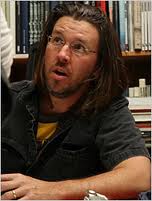
David Foster Wallace

“Kafka’s humor has almost none of the particular forms and codes of contemporary U.S. amusement. There’s no recursive wordplay or verbal stunt-pilotry, little in the way of wisecracks or mordant lampoon. There is no body-function humor, nor sexual entendre, nor stylized attempts to rebel by offending convention. No slapstick with banana peels or rogue adenoids. There are none of the ba-bing ba-bang reversals of modern sitcoms; nor are there precocious children or profane grandparents or cynically insurgent coworkers. Perhaps most alien of all, Kafka’s authority figures are never just hollow buffoons to be ridiculed, but they are always absurd and scary and sad all at once.”

The point that Wallace attempts to make is that his students don’t understand Kafka’s absurdist wit, because they are more accustomed to being spoon-fed their entertainment. They’re not accustomed to having to think through something as complex as Kafka’s central joke:

“That the horrific struggle to establish a human self-results in a self whose humanity is inseparable from that horrific struggle. That our endless and impossible journey toward home is in fact our home.”

The chapter is worth reading not for its “When I was a kid, we had to walk ten miles to school” style of complaining about the youth of the day, but the illustrative manner in which Wallace complains about humor in general. A complaint this author laments may not be generational.

The fourth chapter may be the selling point for this book. In it, Wallace describes a war that has been occurring in the English language for a couple generations now. Wallace calls it a Usage War. The Usage War describes how one side, the more traditional side, AKA the prescriptive side, pleads for a return to traditional English. He talks of the other side, the more modern side that describes itself as a more scientific study of the language, updating our usage on a more inclusive plane. The latter, called the descriptive side, calls for more political correctness in its language. It calls for a more comprehensive list of words and usage that incorporates styles of language such as Ebonics and words that are more commonly used, such as “irregardless”. Previous to this reading, I heard that tired phrase “everything is political”, but I had no idea that that phrase could be extended to dictionaries. The author’s reporting on this subject is excellent. It is informative without being biased, and it is subjective with enough objectivity to present both viewpoints in a manner that allows you to decide which side is more conducive to progress in our language.

Wallace is not as unbiased in his John McCain chapter however. He makes sure, in the opening portions of an article –that was paid for by the unabashedly liberal periodical Rolling Stone— that his colleagues know that he is not a political animal (i.e. he is stridently liberal). He lets them know he voted for Bill Bradley. Other than the requisite need a writer of a Rolling Stone article feels to display their liberal bona fides, it’s not clear why Wallace included his opinion in a piece that purports to cover an election campaign. If I were granted the honor of being paid to cover a Nancy Pelosi campaign, for example, I would not begin this piece with a couple of paragraphs describing how I feel about her politics, but such is the state of journalism in America today…particularly in the halls of the unabashedly liberal Rolling Stone.

To have such an article begin with a political screed that is different than mine, would normally turn me off, but I’ve grown used to it. (I know, I know, there is no bias.) The real turn off occurs after the reader wades through the partisan name-calling, to the languid dissertation on the minutiae involved on a campaign bus. If you’re ever aching to know what goes on in a political campaign, I mean really aching to know, this is the chapter for you. I would say that most are curious about the machinations that occur behind the scenes, but I would say that most of those same people would have their curiosity tested by Wallace’s treatment here. He wrote that the editors at Rolling Stone edited the piece. He wrote that he always wanted to provide his loyal readers a director’s cut. After reading through the first twenty pages of this chapter, I was mentally screaming for that editor to step in and assist me through the piece. It’s not that his writing is poor, of course, nor that it’s entirely without merit, but you REALLY have to be one who aching to know the inner workings of a campaign. You have to want to know bathroom difficulties —such as keeping a bathroom door closed on a tour bus— you have to want to know what reporters eat, why they eat it, and when. You have to want your minutiae wrapped up in minutiae, until your eyes bleed with detail. I have a cardinal rule about never skipping passages. I live with the notion that I can learn something from just about everything an author I deem worthy writes, and I deem Wallace to be a quality writer with an adept and varying intellect, but I had to break my cardinal rule with this chapter. It was a painful slog.

As for the chapter on Tracy Austin, Wallace laments the fact that championship level athletes aren’t capable of achieving a degree of articulation that he wants when he purchases one of their autobiographies. Tracy Austin, for those who don’t know, was a championship level tennis player. Wallace purchased her autobiography hoping that, as an adult long since removed from the game of tennis, Austin would be able to elucidate the heart of a champion. He hoped that Austin would be able to describe for us what went through her mind at the moment when she achieved the pinnacle of her career, and he wanted to know what she thought about the accident that led to her premature retirement. He wasn’t just disappointed, he writes, in the manner that he is disappointed with sideline interviews that are loaded with “we give it 110%, one game at a time, and we rise and fall as a team” style clichés. He sums up his disappointment with the following:

“It may well be that we spectators, who are not divinely gifted as athletes, are the only ones able truly to see, articulate, and animate the experience of the gift we are denied. And that those who receive and act out the gift of athletic genius must (out of necessity) be blind and dumb about it—and not because blindness and dumbness are the price of the gift, but because they are its essence.”
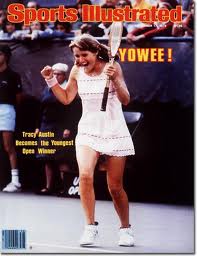
imagesCAY91IXCWe talk about athletic accomplishment. They do it. We analyze and speculate about their prowess. They exhibit prowess. We concentrate on the arena of the mind, and their concentration lies in physical prowess. We, non-athlete types, think about the things they do, we fantasize about them, and they do them. We think about how glorious it would be to sink a championship winning basket over Bryon Russell, Michael Jordan just does it. We wonder what Michael might do if he missed that shot. Michael didn’t think about that. We think about, and write about, that incredibly perfect and physically impossible baseline shot of Tracy Austin just made. She just does it. We see the replays of their exploits endlessly repeated on Sportscenter, and we hear almost as many different analyses of them. We then think about these plays from all these varied angles that are provided, and we project ourselves onto that platform. We don’t think about all the rigorous hours a Jordan and Austin spent preparing for that moment, we simply think about that moment, and what it would mean to us to have conquered such a moment. So, when one of these athletes steps away from that stage to offer us a few words about that moment and those few words center around the “I just did it” meme, we are profoundly disappointed. To paraphrase Yoda, “They don’t think, they do, or they do not.” They use the force granted to them though spending a greater percentage of their lives in gyms, on tennis courts, and in weight rooms. They concentrate on muscle memory to prevent the mind from interfering with their eventual completion of the act. If we, non-athlete types, were in a similar situation, we might think about the significance of the history of the game, the profundity of the moment, and how this moment might affect the rest of our lives. We might also think about how many people are watching us, if Bryon is a better athlete than we are, and if he will block our shot. We think about what our peers are going to say about this play after the game, and we become so immersed in the enormity of the moment that we probably think too much to make the shot. The point is that they’ve made that shot so many times, in so many different ways, in practice and in games, that they simply rely on muscle memory to make the championship shot. They may think about that shot, as long as it takes them to project it, but once they step on the court, they go on auto-pilot and complete the mission. They would probably love to give Hemingway-esque descriptions of their game, that satisfy us all, because they know it might land them an announcer job of some sort, but there is a reason Joe Montana, Michael Jordan, and so many other top-shelf athletes that broadcasters would’ve paid millions for never ended up with a job in a booth. There’s a reason Larry Bird and Magic Johnson were two of the greatest of all time, but they weren’t great coaches. There’s also a reason, and a number of reasons why they could accomplish what we never could.

I used to wonder what announcers were talking about when they said, “He’s too young to understand what this means.” This kid, as you call him, has been playing this game his whole life for this game, and he’s lived the life of the championship level athlete, which means sacrificing the norms of daily life that his peers knew, and he’s done all that for “this” moment. What do you mean he doesn’t know what it means? It dawned on me, after a couple struggles with it, that this kid doesn’t know what this moment would mean to the announcer … and, subsequently, those of us at home watching. In that post-game interview, then, we’re looking for something, some little nugget with which we can identify. When we get phrases from the cliché vault, we’re so disappointed that they didn’t put more effort into helping us identify with their glory, or our sense of their glory. We’re frustrated that they couldn’t reach us on our level. Yet, as Wallace states, it is the essence of a championship level athlete to be “blind and dumb” during the moments that define them, and we all know this to one degree or another. We’ve all seen these championship level athletes being interviewed about their individual moments thousands of times, so why do we continue to be so frustrated with them, and does this continued sense of frustration begin to say more about them or us?

The Usage War


When I first heard the name Noam Chomsky, I learned that some regarded him as the father of modern linguistics, and I learned that he was considered a powerful force in America. How a man whose sole concern was language could have power outside the halls of academe confused me shortly after I dismissed him. The subject of linguistics seemed a narrow conceit with a narrow appeal. As my knowledge of political science grew, and I learned of the power of language, I learned of the power of this seemingly inconsequential subject, and how it has led to the least talked about “war” of our times.

The late author, David Foster Wallace, called it a usage war and he stated that it has been occurring since the late 60’s. Wallace’s primary concern was not the narrow definition of politics. Rather, he was concerned with the use of language, and the interpretation of it. This usage war is a war between two factions that the editor-in-chief of the controversial Webster’s Third New International Dictionary, named Philip Babcock Gove, {1} described as a battle between descriptivists and prescriptivists.

“The descriptivists,” Grove writes, “are concerned with the description of how language is used, and the prescriptivists are concerned with how the language should be used.”

“The late lexicographer Robert Burchfield furthered this description thusly: “A prescriptivist by and large regards (any) changes in the language as dangerous and resistible, and a descriptivist identifies new linguistic habits and records these changes in dictionaries and grammars with no indication that they might be unwelcome or at any rate debatable.” {2}

The descriptivists say that language is elastic, and it should bend to individual interpretations. Language, they say, should largely be without rules.

“Virtually all English language dictionaries today are descriptive. The editors will usually say that they are simply recording the language and how its words are used and spelled. Most Merriam-Webster dictionaries will note if certain words are deemed nonstandard or offensive by most users; however, the words are still included. Of modern dictionaries, only the Funk and Wagnall’s contains a certain amount of prescriptive advice. All the major dictionary publishers – Merriam-Webster, Times-Mirror, World Book, and Funk and Wagnall’s – will tell you that they are primarily descriptive.”{3}

If we were going to succeed in school, we learned that we would have to perfect our spelling and grammar. The successful carried this knowledge onto the real world. Some of us did not. When we entered into the workforce, our skills were such that no high-level employer would consider us for a gig. We had to work our way up. Along the way, we forgot many of the rules of school. We had to re-learn, the rules of grammar. 

We can guess that nearly everyone has learned, at some point in time, the relative machinations of acceptable discourse. We can guess that anyone who has spoken, or written, on a professional level, has learned of the perceptive gains one can accumulate and lose with the use, and misuse, of language. We can also guess that most realize how others manipulate their audience through language. The latter may be the key to the descriptivist movement in linguistics today.

Our introduction to manipulated perceptions often occurs when we enter the workforce. We may see these perceptions parlayed in movies and television, but we don’t experience them firsthand until we enter the workplace and they directly affect us. At that point, it becomes clear how others use language to shift the power of daily life.

If this form of manipulation were limited to the workplace, that would be one thing. It would be powerful, but that power would be limited to that particular environment. As we have all witnessed when one successfully manipulates language, it doesn’t end when we clock out for the day. We accidentally, or incidentally, take these rules of usage, or speech codes, out of the workplace and into our everyday lives. David Foster Wallace catalogued these incremental actions and reactions in the book Consider the Lobster. It details the fact that lexicographers, like Phillip Babcock Gove, have used dictionaries, and other methods, as a foundation for a usage war that has been occurring in America since the late 60’s.

How many of us have used incorrect terminology that violates the current rules of usage? How many of us have used the words “reverse discrimination” as opposed to the more politically correct term “affirmative action”? How many of us have called an illegal immigrant an illegal immigrant, only to be corrected with the term “undocumented worker?” How many of us have had a boss, or members of the Human Resources department tell us, “I understand you have personal beliefs on this topic, but I hope you can see that it has no place in the workplace,” they say in so many words. “You don’t want to offend anyone, I know that. You’re a nice guy.” 

Most of us are nice people, and we don’t seek to offend the people we work with, our neighbors, or anyone else for that matter. To do this, we follow the speech codes handed down from the Human Resources department to help us get along with other people. We then, unconsciously, take those speech codes to the bar, to family functions, and to our home, until we find ourselves assimilated to the point that we’re correcting our friends.

“It’s a peccadillo,” they say, “a very slight sin, or offense, it’s not sexual relations with an intern. It’s a fib,” they say. “It’s not perjury before a grand jury. It’s “environmentalist” not “anti-corporate socialist”. It’s a “feminist” not a “man hating female who can find no other way to succeed”, “multiculturalist” not “racial quota advocate”, “rainforest” not “gathering of trees”, “sexually active” not “promiscuous”, “economic justice” not “socialism”, “fairness” not “socialism”. It’s “giving back” not “class envy”, and it’s “community organizer” not “radical agitator”. This is the war, and these are the little battles within that war that the descriptivists and the liberals have been waging against the “normal” prescriptive America lexicon for generations and they have succeeded beyond their wildest dreams.

This desire to be nice to other people, and understand other cultures, is one of the advantages the descriptivists/liberals have in manipulating the language, and winning the usage wars. When we find a person that may be different from us in some manner, we want to know how best to get along with them. We want to know their sensitivities, in other words, so we do not accidentally violate them. The question that we should bring to the debate more often is how do people learn the sensitivities of others? Are these sensitivities internal, or are they taught to us through repeated messaging? Most people are insecure, and they don’t know how to demand satisfactory treatment, but they can learn. An individual can learn that something is offensive, and they can learn how to communicate that offense.

“What’s wrong with that,” is a common reply to this notion. “What’s wrong with teaching people how they should be treated? We all just want to get along with one another?”        

Prescriptivists would tell you that buried beneath all this “well-intentioned” manipulation of usage is the general loss of language authority. Prescriptivists ache over the inconsistencies brought to our language through slang, dialect, and other purposeful displays of ignorance regarding how the language works. They labor over the loss of standardized language, such as that in the classical works of a Geoffrey Chaucer. Most of them do not necessarily call for a return to Chaucer-era usage, but they are offended when we go to the opposite pole and allow words like “height” and “irregardless” into modern dictionaries. They also grow apoplectic when terms, such as “you is” and “she be” become more acceptable in our descriptivist lexicon. And They hide in a hole when standards of modernity allow sentences to begin with a conjunction, such as “and”, and they weep for the soul of language when casual conversation permits a sentence to end with an infinitive such as to.

Language provides cohesion in a society, and it provides rules that provide like-mindedness to a people that want to get along. It’s fine to celebrate individuality, and some differences inherent in a melting pot as large as America’s, but if you have nothing to bind people together the result can only be a degree of chaos.

A member of the descriptivism movement, on the other hand, celebrates the evolution of language:

“Frank Palmer wrote in Grammar: “What is correct and what is not correct is ultimately only a matter of what is accepted by society, for language is a matter of conventions within society.”

“John Lyons echoed this sentiment in Language and Linguistics: “There are no absolute standards of correctness in language.”

“Henry Sweet said of language that it is “partly rational, partly irrational and arbitrary.”

It may be arbitrary in Sweet’s theoretical world of linguists seeking to either ideologically change the culture, or update it to allow for vernaculars in the current social mores, but in the real world of America today are we doing our students, our language, or our culture any favors by constantly redefining usage? If our primary motivation for teaching arbitrary methods of usage is sensitivity to intellectual capacity, different cultures, and self-esteem is the culture as a whole made better in the long run?

On the ideological front, the descriptivism movement has successfully implemented a requirement that all writers now use the pronouns “they” and “he or she” if that writer is seeking a general description of what a general person may do, or think. Repeated use of the general pronoun “he” without qualifying it with the balanced usage of “she”, “they”, or “he or she” is not only seen as antiquated, but sexist, and incorrect. The reason it is antiquated, those of the descriptivism movement say, is that it harkens back to a patriarchal, White Anglo-Saxon Protestant (WASP) society.

If you work in an office, and you send out any form of communication to a team of people, you know how successful the descriptivism movement has been in infiltrating our language in this regard. Yet, there was a point in our history, a point in the not-so-distant past when no one knew enough to be offended by the repeated use of “he” as a general pronoun. No one that I know of regarded this as improper, much less incorrect. Years of repeated messaging have created ‘gender neutral’ solutions to the point that schools, workplaces, and friends in our daily lives suggest that using “he” as a general pronoun is not just sexist it is incorrect usage. Yet, they deem using the pronoun “she” as an acceptable alternative. If this complaint were limited to the narrow prism of politics, one could dismiss it as a member of the losing team’s hysteria, but we’re talking about the politics of language usage.

A political science professor once told our class that, in his opinion, law breaking became a little more acceptable when the federal government lowered the speed limit to fifty-five in 1974. His theory was that the fifty-five mile per hour speed limit seemed arbitrarily low to most people, and they considered it unreasonable. His theory was that most people were generally more law-abiding in the 50’s, and  –“regardless what you’ve read”– in the 60’s, but in the 70’s more people found the general idea of breaking the law more acceptable, and he deemed this 1974 unreasonable limit on speed to be the antecedent. His theory was that no one person, no matter how powerful their voice is in a society as large as ours, could successfully encourage more people to break the law, and that only the society could do this by creating a law that was seen as not only unreasonable, but a little foolish.

Whether or not his theory is correct, it illustrates the idea that seemingly insignificant issues can change minds en masse. Could one person, no matter how powerful they may be in a society, teach people to be offended more often for more power in that society? Can political linguists dictate a certain form of usage by suggesting that anyone that doesn’t assimilate does so with ulterior motives? Could it be said that Human Resource videos –that anyone that has been employed has spent countless hours watching– are not only being used to teach people how to get along with people different than them, but how those different people should be offended?

“Why does that person continues to use general pronoun “he” instead of “he or she” or “they” continue to do that? Are they trying to offend all the “shes” in the room?” 

Everything stated thus far is common knowledge to those of us who operate in public forums in which we interact with a wide variety of people. What some may not know is that this “usage war” for the hearts and minds of all language users extends to the production of dictionaries.

If this is true, how can a dictionary be ideological? There are prescriptivist dictionaries that call for “proper” interpretations and use of language, and there are descriptivist dictionaries that evolve with common use. “Usage experts”, such as David Foster Wallace, consider the creation of these two decidedly different dictionaries salvos in the Usage Wars “that have been under way ever since an editor named Phillip Babcock Gove first sought to apply the value-neutral principles of structural linguistics to lexicography in the 1971 Webster’s Third New International Dictionary of the English Language.”

“Gove’s response to the outrage expressed by those prescriptivist conservatives who howled at Gove’s inclusion of “OK” and “Ain’t” in his Third Edition of Webster’s Dictionary was: “A dictionary should have no truck with artificial notions of correctness or superiority. It should be descriptive and not prescriptive.” {4}

One of the other reasons that descriptivism eventually took hold is that it allowed for more “free form” writing. Descriptivism allows a writer to get their words down on paper without an overriding concern for proper communication. Descriptivism allows for expression without concern for proper grammar or a more formal, proper lexicon. It allowed a writer to brainstorm, free form, and journal without a “fussbudget” teacher correcting these thoughts into proper usage.

This was a relief to those that enjoyed expression without having to answer to a teacher that informed us we weren’t expressing correctly. How can one “express correctly” those of us that enjoyed expression asked. Without too much fear of refutation, I think we can say that the descriptivism movement won this argument for the reasons those that enjoyed creative expression brought forth. When one of my professors told me to get the expression down, and we’ll correct your spelling and grammar later, I considered myself liberated from what I considered the tyrannical barrier of grammatical dictates. It wasn’t too many professors later that I discovered teachers that went beyond the “correcting the spelling and grammar later” to the belief that the self-esteem of the writer was paramount. If the student doesn’t get discouraged, this theory on usage suggested, they are more apt to express themselves more often. They are more inclined to sign up for a class that doesn’t “badger” a student with constant concerns of systematic grammar, usage, semantics, rhetoric, and etymology. One argument states that colleges based this lowering of standards on economics, as much of what they did encouraged the student. Personal experience with this, along with the other examples listed above, paved the way for the descriptivism movement to move the language, and the culture, away from the prescriptivist rules of usage.

Some have said that the motivation for those in the descriptivism movement is not nearly as nefarious as those in the prescriptivism movement would have one believe. Descriptivists would have one believe that their goal was more an egalitarian attempt at inclusion and assimilation. They would have them believe that the prescriptivists’ grammar requirements, and lexicography, are exclusionary and elitist, but can we take these descriptivist interpretations and nuances into a job interview, a public speech, a formal letter, or even into a conversation among peers that we hope to impress? Can we succeed in the current climate of America today with language usage that is wide-open to a variety of interpretations?

An English as a Second Language (ESL) teacher once informed me that the “impossibly high standards” President George W. Bush, and his librarian wife, placed on her students, made her job more difficult. I conceded the fact that I was an outside looking in, listening to her complaints, and that I didn’t know the standards she had to deal with them on a daily basis. “But I said, “If we’re looking at the intention behind these impossibly high standards, could we say that they were put in place to assist these non-English speakers into learning the language at a level high enough for them to succeed in America?” This ESL teacher then complained that the standards didn’t take into account the varying cultures represented in her classroom. I again conceded to her knowledge of the particulars of these standards, but I added, “You’re theoretical recognition of other cultures is wonderful, and it has its place in our large multi-cultural society, but when one of your students sit for a job interview what chance do they have when competing against someone like the two of us that are well-versed in the “impossibly high prescriptivist, standard white English, and WASP” grammar and usage standards we were forced to learn in our class?”

{1} http://en.wikipedia.org/wiki/Philip_Babcock_Gove

{2}   http://stancarey.wordpress.com/2010/02/16/descriptivism-vs-prescriptivism-war-is-over-if-you-want-it/

{3} http://englishplus.com/news/news1100.htm

{4} Wallace, David Foster. Consider the Lobster. New York, NY. Little Brown and Company, a Hachett Book Group. 2005. eBook.