Leonardo’s Lips and Lines


Hyper-vigilance is not a switch an artist turns on to create. It’s less about what an artist does and more about who they are. If this is true, we could say that the final products of artists, their artistic creations, are less about some supernatural gift and more about a culmination of hyper-natural observations of the minutiae that others often miss that we call hyper-vigilance. Thus, in some cases, the final product of an artist’s vision is less about an artistic vision and more about using that product as a vehicle to reveal their findings. Did Leonardo da Vinci’s obsessions drive him to be an artist, or did he become so obsessed with the small details of life that he become an artist?

What goes on in the mind of an artist? That question has plagued us since Leonardo da Vinci, and before him. Those who don’t understand the complexities and gradations of artistic creation love to think about an “aha moment”, such as an apple falling on Isaac Newton’s head. Others think that brilliant artistic creation often requires one to mix the chemicals of their brain up with artificial enhancements, or that they ripped off the artists who preceded them. These theories combine some elements of truth with a measure of “There’s no way one man is that much more brilliant than I am” envy. As an aspiring artist, I can tell you that nothing informs the process more than failure, or trial and error. There are rarely “aha moments” that rip an artist out of a bathtub to lead them to type a passage half naked and dripping wet. What’s more common in my experience involves the search for an alternative, or a better way. Rather than intro a piece in the manner I’ve always done, maybe I should try introducing another way, maybe I should build to the conclusion a different way, and all of the gradual, almost imperceptible changes an artist makes along the road to their version of the “perfect” artistic creation. 

To the untrained eye, The Mona Lisa is a painting of a woman. The Last Supper is nothing more than a depiction of the apostles having a meal with Jesus. We have some evidence of da Vinci’s process in his notebooks, but we don’t have his early artistic pieces. Due to the idea that they probably weren’t great, either da Vinci trashed them, or they’ve been lost to history in one way or another. These pieces would be interesting if, for no other reason, than to see the progress that led him to his masterpieces. Of the few da Vinci paintings that remain, we see a progression from his first paintings to The Mona Lisa. His paintings became more informed throughout his artistic career. This begs the chicken or the egg question, what came first Leonardo da Vinci’s artistic vision or the science behind the paintings? Put another way, did he pursue his innovative ways of attaining scientific knowledge to enhance his paintings, or did he use the paintings as a vehicle to display the knowledge he attained?

On that note, anytime I read a brilliant line I often wonder if the inspiration for the line dropped in the course of the author’s effort, or if the brilliant line was the whole reason for the book. Was the book an elongated attempt to verbally shade that brilliant line, in the manner da Vinci did his subjects, to make the brilliant line more prominent?  

Whatever the case was, the few works of his we still have are vehicles for the innovative knowledge he attained of science, the mathematics of optics, architecture, chemistry, and the finite details of anatomy. Da Vinci might have started obsessively studying various elements, such as water flow, rock formations, and all of the other natural elements to better inform his art, but he became so obsessed with his initial findings that he pursued them for reasons beyond art. He pursued them for the sake of knowledge.

I don’t think I’ve ever read a book capture an artist’s artistic process as well as Walter Isaacson’s Leonard da Vinci biography has. The thesis of the book is that da Vinci’s artistic creations were not merely the work of a gifted artist, but of an obsessive genius honing in on scientific discoveries to inform the minutiae of his process. Some reviews argue that this bio focuses too much on the minutiae involved in da Vinci’s work, and there are paragraphs, pages, and in some cases entire chapters devoted to the minutiae involved in his process. In some places, I empathize with this charge that the book can be tedious, but after finishing the book, I don’t know how any future biographer on da Vinci could capture the essence of Leonardo da Vinci without the exhaustive detail about the man’s obsessive pursuit of detail. Focusing and obsessing on the finer details is who da Vinci was, and it is what separated him from all of the brilliant artists that preceded and followed him. 

Some have alluded to the idea that da Vinci just happened to capture Lisa Gherardini, or Lisa del Giocondo, in the perfect smile for his famous painting The Mona Lisa. The inference is that da Vinci asked her to do a number of poses, and that his gift was merely in working with the woman to find that perfect pose and then capture it, in the manner a photographer might. Such theories, Isaacson illustrates, shortchange the greatest work of one of history’s greatest artists. It leaves out all of these intricate and tedious details da Vinci used to bring the otherwise one-dimensional painting to life.

Isaacson also discounts the idea that da Vinci’s finished products were the result of a divine gift, and I agree in the sense that suggesting his work was a result of a gift discounts the intense and laborious research da Vinci put into informing his works. There were other artists with similar gifts in da Vinci’s time, and there have been many more since, yet da Vinci’s work maintains a rarefied level of distinction in the art world. 

As an example of Leonardo’s obsessiveness, he dissected cadavers to understand the musculature elements involved in producing a smile. Isaacson provides exhaustive details of Leonardo’s work, but writing a couple of paragraphs about such endeavors cannot properly capture how tedious this research must have been. Writing that da Vinci spent years exploring cadavers to discover all the ways the brain and spine work in conjunction to produce expression, for example, cannot capture the trials and errors da Vinci must have experienced before finding the subtle muscular formations inherent in the famous, ambiguous smile that captured the deliberate effect he was trying to achieve. (Isaacson’s description of all the variables that inform da Vinci’s process regarding The Mona Lisa’s ambiguous smile that historians suggest da Vinci used more than once, is the best paragraph in the book.) We can only guess that da Vinci spent most of his time researching for these artistic truths alone, and that even his most loyal assistants pleaded that he not put them on the insanely tedious lip detail. 

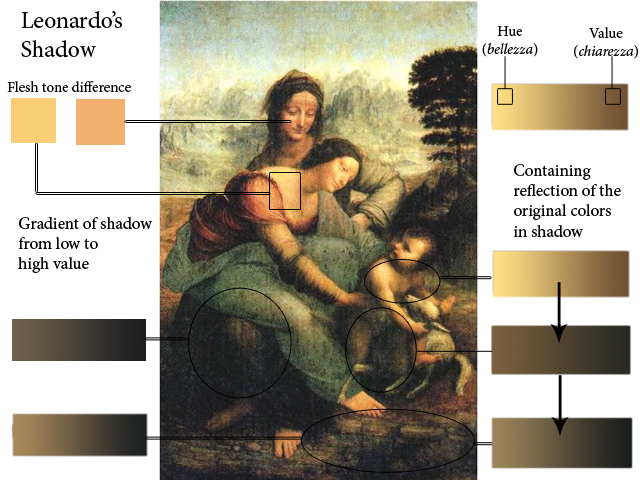
Isaacson also goes to great lengths to reveal Leonardo’s study of lights and shadows, in the sfumato technique, to provide the subjects of his paintings greater dimension and realistic and penetrating eyes. Da Vinci then spent years, sometimes decades, putting changes on his “incomplete projects”. Witnesses say that he could spend hours looking at an incomplete project only to add one little dab of paint. 

The idea that da Vinci’s works were a product of supernatural gift also implies that all an artist has to do is apply that gift to whatever canvas stands before them and that they should do it as often as possible to pay homage to that gift until they achieve a satisfactory result. As Isaacson details, this doesn’t explain what separates da Vinci from other similarly gifted artists in history. The da Vinci works we admire to this day were but a showcase of his ability, his obsessive research on matters similarly gifted artists might consider inconsequential, and the application of that knowledge he attained from the research. This, I believe, suggests da Vinci’s final products were less about anything supernatural and more about an intense obsession to achieve something hyper-natural.  

Why, for example, would one spend months, years, and decades studying the flow of water, and its connections to the flow of blood in the heart? The nature of da Vinci’s obsessive qualities belies the idea that he did it for the sole purpose of fetching a better price for his art. As Isaacson points out, da Vinci turned down more commissions than he accepted. This coupled with the idea that while he might have started an artistic creation on a commissioned basis, he often did not give the finished product to the one paying him for the finished product. As stated with some of his works, da Vinci hesitated to do this because he didn’t consider the piece finished, completed, or perfect. As anyone who experiences artistic impulses understands, the idea that an artistic piece has reached a point where it cannot be improved upon is often more difficult for the artist to achieve for the artist than starting one.

What little we know about da Vinci, suggests that he had the luxury of never having to worry about money. If that’s the case, some might suggest that achieving historical recognition drove him, but da Vinci had no problem achieving recognition in his lifetime, as most connoisseurs of art considered him one of the best painters of his era. We also know that da Vinci published little of what would’ve been revolutionary discoveries in his time, and he carried most of his artwork with him for most of his life, perfecting it, as opposed to selling it, or seeking more fame with it. Due in part to the luxuries afforded him, and the apparent early recognition of his talent, most cynical searches for his motivation do not apply. As Walter Isaacson’s biography of Leonard da Vinci implies, it’s difficult to find a motivation that drove the man to create the few works of his we now have other than the pure, passionate pursuit of artistic perfection. 

After reading through all that informed da Vinci’s process, coupled with the appreciation we have for the finished product, I believe we can now officially replace the meme that uses the Sgt. Pepper’s Lonely Hearts Club Band album to describe an artist’s artistic peak with The Mona Lisa.
https://leonardodavincigallery.com/what-is-leonardo-da-vinci-sfumato-technique/

Da Vinci’s Sfumato and Chekov’s Razor


“Leonardo was so obsessed with using shadows and reflected light that he wrote fifteen thousand words on the topic, and that is probably less than half of what he originally wrote,” Walter Isaacson opined.

Using shadows and reflected light is a technique that doesnt have to be limited to painters or image creators, in my humble opinion. It can be used by article writers, novel writers, and just about every form of writing, if they’re not using it already. This mindset resulted from a technique da Vinci used in his paintings called sfumato, or “gone up in smoke”. I use it so often that I don’t think of it as a technique anymore, but I found it interesting to read the explorations of it by one most famous artists in history. The basic tenet of the sfumato technique, da Vinci made famous, was to avoid using specific and concrete lines in his paintings. This might not sound like a novel technique to the accomplished artist of the day, but it was groundbreaking in its day. Da Vinci did not invent this technique, as some evidence suggests it dates back to the chiaroscuro effects used by ancient Greeks and Romans, but da Vinci took it to another level.

When the writer begins writing a story, they characterize their main character with bold lines through unique, individualistic, and semi-autobiographical lines. The more an author explores that character, the more they chip away at strict characterization and allow their main character to breathe for themselves in a manner that adds dimension. They characterize with shading and reflection, or refraction through supporting characters, until they have done little to characterize the main character except through their interactions with others and events. Their main character becomes more prominent through these literary devices, until the central character becomes the literary equivalent to an eye of the storm.

A perfect example of this occurs in modern situation comedies. Most sitcoms have an “eye of the storm” character, we can characterize as the “us” character. The us character reflects us, but the us character also inadvertently defines the other characters as often as the other characters define him through interactions. The characters interact, and the us character is our way of dealing with all of their zany ideas and acts of the side characters, until we learn more us and all of the characters involved. Defining a character otherwise can leak into a term we want to minimize as much as possible. Think about that in terms of the sitcom. If the main character stood before the camera and told us about his likes, dislikes, and a little bit more about him, how boring would that be? It works in some cases, Larry Sanders, or The Office, but it doesn’t work in most cases. 

In most cases, we want to see characterization in action, we want to see what da Vinci called sfumato technique, or what we call the “show don’t tell” technique. The author uses supporting characters and setting to define their main character, and they use all of this to bring the events involved in their stories to bring them to life. The takeaway might be that the optimum characterizations are those characterizations that appear more organic to the reader. In other words, the author should be working his or her tail off to make the work appear so easy that the reader thinks anyone could do it.

Chekov’s Razor

Checkov’s razor is easy to understand. Write the first three paragraphs, pages, or whatever you need to familiarize yourself (the author) with your material and write the rest of your piece. Once the author is done with that piece, go back and delete the material that you had to write to start and start at the most compelling piece of your article. If you have germane sentences in that intro, save them, and work them into the body of the piece. Delete the chunk of exposition that it turns out was only written for you. Let the reader enjoy the rest. 

“But, wait, what if it’s brilliant,” we say to counter that argument. It could be, it might be, but it likely isn’t. Some of us get so locked in and locked up by the ‘we are a man of golden words’ notion. It’s the whole, ‘there’s no such thing as mistakes,’ philosophy, generated by artists the likes of Pablo Picasso and James Joyce. There are mistakes in writing, and leaving that big chunk of exposition at the beginning of your article is one of them.

“There’s no writer’s block. There’s lazy. There’s scared, but there’s no writer’s block. Just sit down and realize you’re mediocre and you’re going to have to put a lot of effort into this to make it good.” –Jerry Seinfeld

Writer’s block, according to Jerry Seinfeld’s definition, is the desire to start writing brilliantly. It’s the “If you can’t be the best, why do it?” block that inhibits writers from writing a single word, or the writing, deleting, writing, and deleting merry-go-round. It’s the dreaded, blank page, or the blinking cursor syndrome that prevents us from writing a single word. Jerry’s remedy is to accept the idea that you’re probably not half as brilliant as you think you are, and once you reach a point that you might be mediocre, it might be possible to write something that’s actually pretty good. My philosophy is similar, but I no longer think about greatness or mediocre distinctions. I just write until something good poops (and yes, I meant poops!) out.

We might call this the discovery phase. In the discovery phase, the writing is gibberish to everyone but the writer. This is the “all play no work” phase for most writers, as it allows us room away from our aspirations to true creativity. Some of the best room for creativity occurs when we have an ending in mind, as it’s fun to fill in the blanks. Filling in the blanks might also lead to a new ending. 

The takeaway for aspiring writers is to get the idea down before you forget it. Don’t worry about sequencing, chronology, grammar, spelling, or if this story is the base for the next great American novel. Just write it down and worry about all that later. Just write a bunch of gibberish down that only the writer understands, until the subject matter begins to open up to the writer. Once the author is in, the material might have the wherewithal to be in a near proximity to where a story lies, but the real story could take paragraphs, or pages, to develop.

Chekov’s razor focuses on threes, the first three paragraphs, and/or three pages of a manuscript, short story, or essay, but I’ve found this length arbitrary. When I begin a story, I think I have a full-fledged introduction on my hands. I don’t think anyone writes gibberish just to write gibberish, it feels like this could or should be the story at the time. I lock myself up when I try to determine if the writing is up to my standard, or if it’s going anywhere. I unlock myself by writing it all down, all of the important and unimportant that comes to mind, then I delete the unimportant.

Chekov’s razor comes into play when we go back and delete the unimportant. That is rough too, because all writers live with the “Golden words” mentality. Everything I write is not only good, it’s vital, and germane to the story. The writer needs to ask themselves am I a good writer or a good editor? The answer, if you’re going to try to write for others, is you’re going to have to be a little of both. Or, you can have a friend read it, or pay to have someone edit it for you. If you’re as megalomaniacal about your words as I am, you’ll either find a way or you won’t, and your work will suffer for it.  

In the course of writing past the blinking cursor stage, we discover pivot points that take us to the next stages of the story, but we don’t consider them anything more than what they are at the time. In the course of rewriting, however, we discover the pivot point is the story. The frustration falls on two tracks, the first is that we fell in love with that original idea, and it’s tough to just walk away. The other is that we “wasted” so much time writing “the other” story that we loved. When writers achieve the ultimate point of objectivity, when they realize story is sacred, they begin sacrificing all the information they love to leave information you will. 

Thus, I don’t believe there is magic in the power of threes in employing Chekov’s Razor to storytelling. A central idea, or pivot point arrives in the course of writing, but the point of Chekov’s razor is to dump and delete the useless information the writer used to write the story.  

An important note to add here is that if most authors work the same way I do, we do not write for the expressed purpose of finding the core of our story. Our perspective is, we think we already have the story, and that the only chore involves building upon it. The discovery of the core of story often humbles the author and slaps them back to the realization that no matter how many times we write a story, the art of writing involves mining the brain for ideas rather than having a brain loaded with brilliant ideas. That conceit eventually reveals itself to those willing to write a lot of material, and it’s up to the author to recognize the difference for what it is, if they want a quality story.

It happens in the course of writing it, editing it after we’re done, or in the daydreaming stage that can last for days, weeks, or months. I do not enjoy deleting the chunks of material I’ve written, and I don’t think anyone does, but the quality author will develop the ability to recognize what portion of the story is for them and which portion is for the reader, and they will crib note or delete the part of the story that is for them.

I don’t consider the revelation of these techniques a glamorization of my process. I think it demystifies the process by suggesting that anyone can do this, as long as they write as often as they need to discover what should become the central focus for the reader. Every author needs to move past their conceit of their self-defined brilliance to find the story they’re trying to tell, and learn how to work from within it.

As I’ve written elsewhere, the most prominent use of Chekov’s razor can be found in Franz Kafka’s Metamorphosis