“He created “Showtime!” Norm Nixon said. “That should never be forgotten. You can talk about me, Kareem, Earvin, and Pat Riley all you want. But Jack McKinney created “Showtime!”
If you were paying any attention at all in the 1980’s, you knew the Lakers, Earvin “Magic” Johnson, Pat Riley, Kareem Abdul-Jabbar, and “Showtime!” A fella didn’t have to watch the NBA to know the names Magic Johnson or “Showtime!” We didn’t even have to enjoy watching sports to know these names. They were in the news, on the news, and the news. Decades later, the names “Showtime!” and Magic Johnson still resonate so well that networks like HBO and Apple+ are willing to pay top dollar for retrospective broadcasts that recall how special this era was in sports and entertainment.

The term “Showtime!” is still so flashy that this writer feels compelled to surround it with quotes and follow it up with an exclamation point. Even though we weren’t yet teenagers, we knew the names Kareem Abdul-Jabbar, Norm Nixon, Byron Scott, Michael Cooper, Jamal Wilkes, James Worthy, Kurt Rambis, Pat Riley and Earvin “Magic” Johnson. We knew the big names, we couldn’t escape them, but as with all sports franchises, title runs, and dynasties, those names not in lights often contributed far more than we ever knew. The name almost criminally absent from this list was the architect of the “Showtime!” game plan of the run the Lakers enjoyed in the 1980’s: Jack McKinney.
Jack McKinney might be the last name we think of from this era, but the first name that comes to mind when talking about the Lakers 1980’s “Showtime!” run is Magic Johnson. He was the superstar, the smile, the face of the franchise, and a celebrity on and off the court. He was one of the few athletes of his era who lived up to such over-the-top billing. Prior to the ’79-’80 Laker season, Magic lead his college basketball team, the Michigan State Spartans to a college basketball championship, then he was the number one pick out of college. In his rookie season with the Lakers, Magic was one of the few to prove the hype machine correct when he awarded the Lakers for using a number one draft pick on him by winning an NBA Championship in his rookie season. He had some help, of course, including a man named Kareem Abdul-Jabbar, who many argue was the best basketball player of all time, and if statistics matter, Jabbar still has the most points ever scored by an individual over the course of his career.* In the 1979-1980 season, however, the 21-year-old rookie from Michigan State had every spotlight the national media owned on him, and he succeeded beyond all expectations.
Just about every highlight of the Lakers in the 80’s contains something Magic did. Whether it was some crucial shot, powerful dunk, or one of his highlight reel passes. Magic Johnson could get anyone the ball at any time, at just about anywhere on the court.
Was Magic the best fastbreak point guard of all time, perhaps, but we might also ask the question was Magic Johnson so great because he fit McKinney’s scheme so well, or did owner Jerry Buss hire McKinney, because he wanted the scheme, and he knew his first draft pick would flourish in it?
As Jeff Pearlman wrote in the book Showtime, the Lakers’ strategy prior to the arrival of Magic and McKinney, was “See Kareem, wait for Kareem, pass to Kareem, watch Kareem shoot and hope ball goes in.”
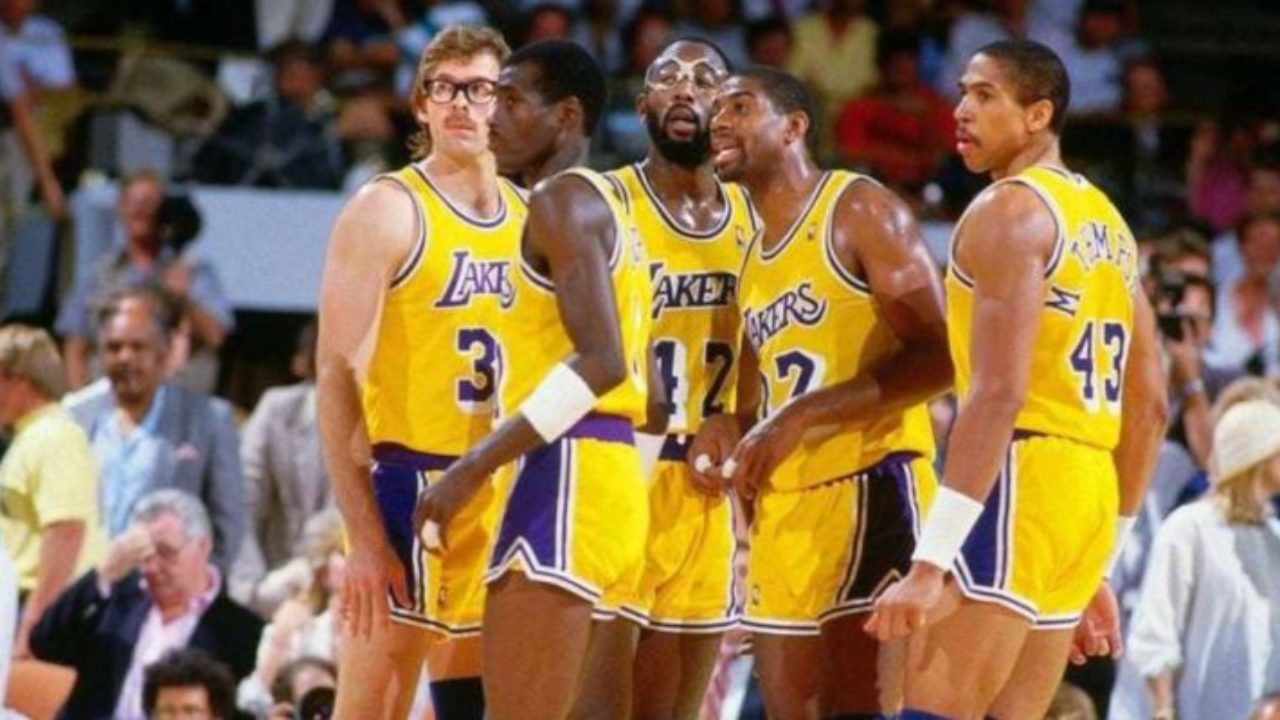 Was Magic better in McKinney’s scheme than he would’ve been in Jerry Sloan’s with the Chicago Bulls? (The Bulls lost a famous coin flip for the rights to draft Magic Johnson in 1979.) Was Magic so great that he would’ve been great wher eever he played, or did the “Showtime!” game plan play to his strengths? If McKinney didn’t fall prey to the accident, and he coached a different team, with all of his facilities intact, would he have succeeded regardless? Or was the Magic/McKinney gameplan a marriage made in heaven?
Would Joe Montana have succeeded regardless when and where he played? Was he so driven to be great that it would’ve happened no matter where he played, or did he fit the scheme the coaches implemented? We could ask this of any coach, scheme, and player marriage, but while most of the credit is given to the player, most sports nuts divide the credit more equally. How many sports nuts, the freaks of sports knowledge, know enough to know the name Jack McKinney.
Prior to being hired by the Lakers, Jack McKinney was a basketball lifer who lived and breathed basketball. He was a college basketball assistant coach and a head coach, then he was an assistant coach for five years in the NBA. At the age of 44, he was hired to coach his first NBA team, the Los Angeles Lakers. It’s not an exaggeration to say his whole life had been leading up to that moment. How many hours, months, and years of his life did he sacrifice to one day see his dream to fruition? How many dark, quiet rooms did he sit in all alone, watching tape, learning the game, developing game plans, and correcting and perfecting it when others were out living a life? He sacrificed his life for basketball, and when all his work finally started to pay off, it was all taken away from him.
If Shakespeare were alive today, he would’ve devoured Jack McKinney’s narrative as a modern tragedy of epic proportions. He probably would’ve started his production with McKinney’s solo bike ride in which his gears locked up. Jack McKinney was thrown off the bike, and he landed in a manner that put him in a coma. The serious injuries he experienced would plague him for the rest of his life. It took him so long to recover that the Lakers named Paul Westhead coach, and then they named Pat Riley, the man credited with the Lakers fast break offense that we would eventually all call “Showtime!” This accident happened 14 games into Jack McKinney’s tenure as coach of the Lakers. He would never coach them again.
Prior to the accident, Jack McKinney implemented his revolutionary fast break offense, and the Lakers used that game plan to win the ‘79-’80 NBA Championship, their first of that era. When McKinney’s successor Paul Westhead later tried to institute a different gameplan, it didn’t work for the talent on the court. Pat Riley took over, re-instituted McKinney’s gameplan, and the rest is history, Pat Riley’s history. The Jack McKinney story is interesting whether you are a Lakers fan or not, but it also interesting because prior to HBO’s retrospective broadcast Winning Time, based on Jeff Pearlman’s book, this sports aficionado had no idea how instrumental Jack McKinney was. The Jack McKinney story is interesting because it highlights the “forgotten man” in sports history.
“This is the guy who made my career possible,” McKinney said that Lakers’ coach Pat Riley always said when introducing McKinney, “This is the guy.”
The question author Jeff Pearlman put to Lakers’ point guard Norm Nixon decades later was, “Is Jack McKinney universally acknowledged as one of the greatest coaches in the history of the NBA?”
“I have no doubt that he would be [were it not for the accident],” Nixon said. “No doubt whatsoever.”
How many forgotten men and women, like McKinney, have changed the landscape in their world? How many little guys and girls helped the names in lights edit an otherwise flawed premise, or rescued an otherwise flawed scientific finding by disproving it so well that the genius had to go back to the drawing board to find a more perfect resolution? How many little-known advisors instructed world leaders to follow a different plan that resulted in a different outcome that defined history? We all know the names in lights, the names that sell newspapers and collect internet hits, but how many lesser-names who shunned the spotlight defined history as we know it.
I don’t know these names, and either do you. I didn’t know the name Jack McKinney prior to this year, and unless you’re a die-hard Lakers fan, or you’ve watched the story of the Lakers in the 80’s Winning Time on HBO, you didn’t either. I heard some foggy details about a coach who started out with Magic, but I heard he died weeks into Magic’s rookie season. I didn’t know what role he played, if any, and I had no idea how instrumental he was. I just thought he was hired, and he died shortly into his tenure as coach. Jack McKinney didn’t die. He went onto coach a couple other teams, and he won coach of the year in ’80-’81 coaching for the Indiana Pacers, but after working so hard, as a coach in college and an assistant in college and the NBA, he never achieved the dream he could have with the talent Jerry West, Jerry Buss, and the rest of the Lakers’ brain trust amassed in ’79-’80, and the years that followed. McKinney is recognized by those in the know as one of the great basketball minds of his generation, but how many outside that very small world have even heard his name?
“McKinney is not a bitter man,” Jeff Pearlman writes to close his intro on the now-deceased McKinney, “but he is human.”
“Life isn’t always fair,” McKinney said. “I’m OK with how everything has turned out. I’m loved. But, well, it’s not always fair…”
“Jack McKinney is the man more responsible for the birth of the Showtime era of professional basketball,” Pearlman writes, “If only he could remember it.”
If that doesn’t give you chills on how unfair life can be, then I don’t really know what I’m talking about. We talked about the scheme, player marriage earlier. Magic Johnson might not be “Magic!” today, were it not for Jack McKinney, James Worthy might have been an all-star and nothing more, Jerry Buss might have been nothing more than an American businessman who tried and failed to resurrect the Lakers franchise, and Pat Riley might’ve ended up nothing more than a failed sports announcer. What if’s, and could’ve been, should’ve beens dot history, but the ’80’s Laker dynasty we know today, probably wouldn’t have happened were it not for one forgotten man in history, the late-great Jack McKinney.
 Rilaly