“I love grilling,” Leonard said. “Absolutely love it. Some people do it, and some just do it, but for some of us, it’s a passion.”
If someone said this from behind one of those sleek, compact, Three-Burner, Liquid Propane grills that feature porcelain-enameled, cast-iron cooking grates, you’d scream, I’d scream, we’d all scream for red meat. Check that, I probably wouldn’t scream, not anymore. I’ve been beat down, brothers and sisters, by all them grill-at-the-parkers hollering about how salvation is near. I’m here to testify that those Willie “the wunderkind” types who man the grill, and who, by all appearances should be the chef du jour, are false prophets.
 You’ll be disappointed too, but you, the patron of the park, the family and/or friend of the chef, keep in mind that you ain’t paid a dime for that meat, the seat, or anything in between. You are to be grateful, always grateful, when someone hands you a plate, telling you to “Dig in!” on what you’ve been smelling and salivating over for the past ten minutes. You go grateful and stay grateful, because they paid for that meat, and they’ve been slaving over the fire, and you ain’t paid a dime.
It’s that smelling that gets us, and it leads us astray, my friends. I’ve been there, you’ve been there. We believed in that smell, and our expectations went sky high. We tried to listen to Niece Maggie talking about her volleyball matches, but we don’t hear her, because of the symphony of sizzles going on behind our back.
When the moment of truth arrives, and I mean that in the most literal sense, we don’t even notice the au gratin potatoes when our plate hits that table. All we see is meat, all we hear is sizzling, and if the Promised Land smells anything like this, we might not mind going there a little sooner than expected. Then we get a taste, our first taste, finally, after all that waiting, and our sky-high expectations hit a gut-destroying, roller coaster dip.
“Is it just me or is this … bad?” we ask ourselves, and we’re all asking ourselves that question. You can see it at the table, especially on Cousin Teddy’s face. Do you have a Cousin Teddy? He can’t hide it? He has an eyebrow raised, but-I-ain’t-saying-a-word look on his face, but that face is just saying what we’re all thinking. Is the meat that bad, or are we all just that picky, and do we have a right to be picky, seeing as how this was all free? “But I had such sky high expectations. Doesn’t that warrant disappointment?”
“No, here’s what you do,” a friend of the family once informed me. “You shut your trap, and you keep it shut. That’s what you do. You open it long enough to put the food in it, then you close it to chew, and you keep closing it, until you’re headed home, whispering it to your wife on the drive home. You wanna be starting something? No, there’s nothing to be gained, at a family picnic, by critiquing another man’s meat.”
And when we talk about meat, we’re not talking about pork, brothers and sisters, because pork is tough to screw up. You know it, we know it, because we all done it, and we know it takes a whole bunch of stupidity to mess pork up. Brats, and all of the other meats that fall under the wiener umbrella, rarely knock our socks off or sadly disappoint, and we’ve had an absolutely horrible piece of chicken, what once? Twice, maybe twice. Red meat is the all-knowing meat. Red meat exposes a man’s under belly. It tells us who we are, who we really are. It tells us something about our attention to detail, the vulnerabilities of our spatula, and the frailties of our fork. Red meat does not forgive and forget, and it’s all about red meat.
Red meat is the reason we just drove thirty minutes to this park. We love our get-togethers, spending time with friends and family, and all that, but red meat is special. Can I get an amen, brothers and sisters? A soft, juicy hamburger is sublime, but a properly prepared steak is divine. I don’t care where they cut it, steak is the meat.
I don’t keep a ledger on my disappointments in life, but when it comes to steak, I’ll throw out a whopping 95%. The fellas with the finest forks have disappointed me 95% of the time. The gas-grilled steak is edible, most of the time anyway, but it’s not Oh!-I-gotta-have-it scrumptious. It’s usually about two notches above edible.
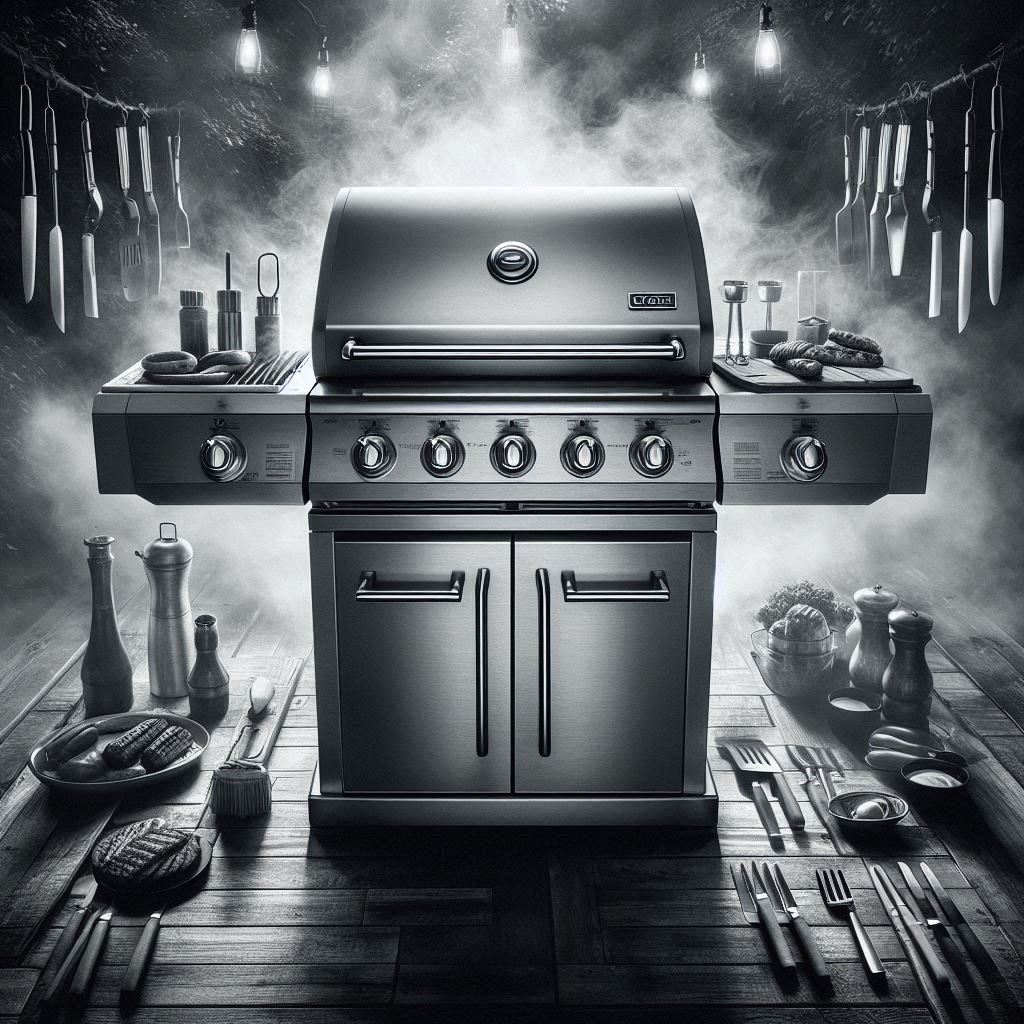 I’ve seen them roll the most beautiful, top-of-the-line, stainless steel, propane gas machines into the park, and I’ve seen who’s ready and who ain’t. I’ve heard the grillers-in-the-park talk about those machines and how their top-of-the-lines can distribute heat so evenly across the grate, and how their four stainless steel burners can produce incredible amounts of BTUs that enhance heat retention so all that cooking “is not only more efficient, it’s convenient and quick.” And I know nothing about their world. I know nothing about all the knowledge they’ve attained from their research. But I’ve done my own research. I’ve researched what they generously produced for me with all their time and effort, between my teeth and gums, and I can’t remember eating a gas-grilled piece of red meat that’s earned those blue-ribbons. It’s quick, your propane grills with all their fixings are quick, but blue-ribbon? What are you smoking son?
So, we all giggle when Terrance rolls in with his $89.00 charcoal grill that he says he bought on sale at Walmart. We join in the giggles with the fellas-in-the-park, with a beer in our hands, because we know that they know, because they’ve been grilling for thirty-some-odd-years, so we trust they know their ins and outs. When the unassuming Terrance reveals his charcoal chimney starter, his flipper, his forker, and some tongs, the very, very basic three-tool set, that he purchased with the grill “all for a little over a hundy,” we join their public chiding, their gentle public shining, and we even join in on their private, and less gentle, scorn.
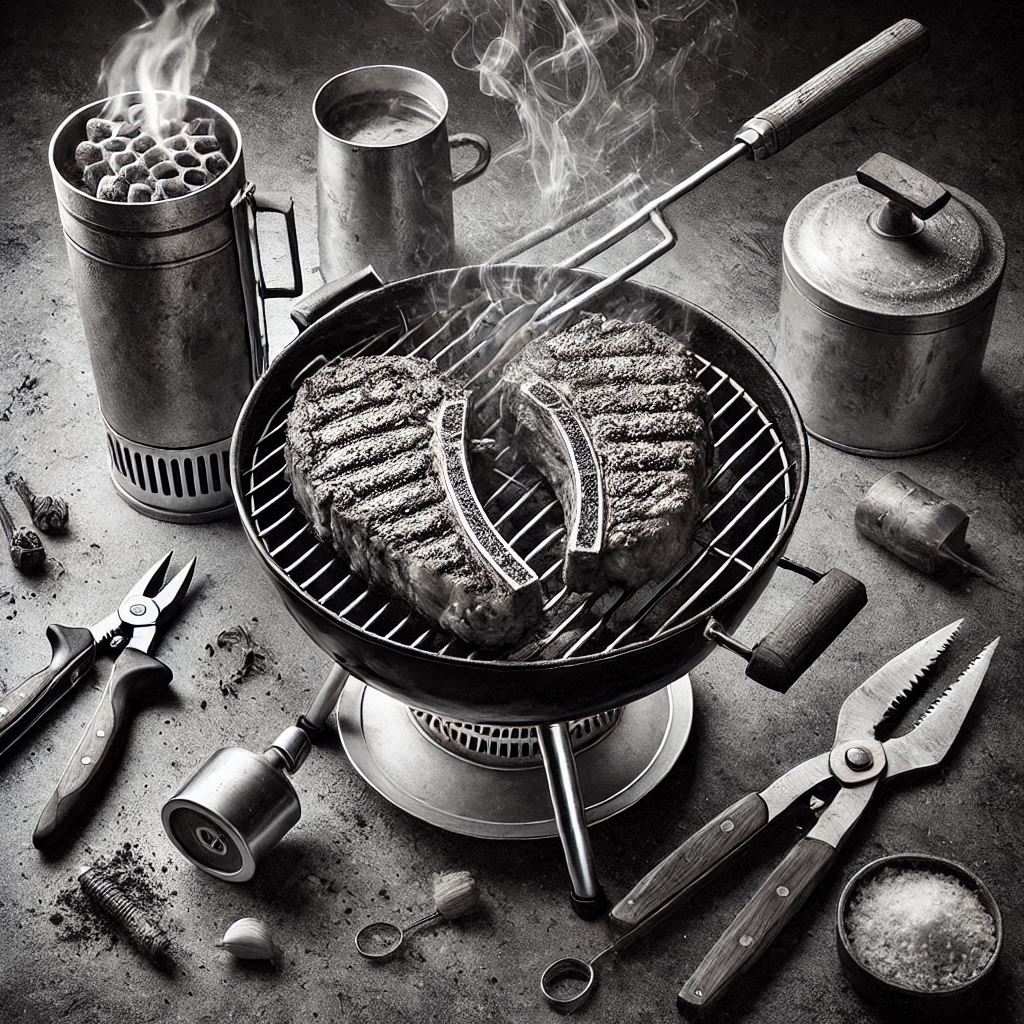 Terrance doesn’t talk the talk or walk the walk, because he don’t know it. He lived in an apartment and worked in an office for most of his life. Terrance is the type who prefers to eat out. He prefers restaurant food, and we all whisper that while he’s cooking, and we do it in the most condescending manner you can imagine. Terrance is the “doesn’t get it, and he probably never will” type of chef, because he started grilling late in life. If we talk about grilling with him, we started the conversation, not him, and we find he’s pretty insecure about his ability to cook a meal for the entire family.
“I let you guys do it for so long, because you love it. You all love doing this far more than I do,” Terrance whispers to me. “But I got a wife, and I got a life, so I decided to what-the-hell it.” So, it was the wife who talked him into grilling for the whole family. She also told him he was pretty good at it.
“But, for the whole family?” he complained.
“You’ll be fine,” she said.
We don’t think he’ll be fine. We wonder what she was smoking. I mean, Terrance doesn’t even own an apron that says something funny about the chef on it. He’s so insecure about his abilities that he doesn’t even join the joke Aunt Pat is telling about the time “Terrance couldn’t find the anus on a trout for cleaning.” He doesn’t know what he’s doing behind a grill, so he ain’t got time for her playtime. He needs to concentrate on trying to cook a fairly decent meal for the whole family. He also doesn’t want to make anyone sick, so he keeps plugging his “Walmart temperature gauge thinger-diller” (a term he uses because he can’t remember the word thermometer!) in the meat, and upon grilling, the verbal kind, we find he isn’t “totally sure what’s the difference between a sirloin and a ribeye”.
The “Oh, boy” we give is not kind. “Oh boy, we might need to get someone else to man the grill Helen,” our brother Jerry says about halfway through. “I’m not sure if Terrance is da man,” he adds, and oh boy do we laugh.
That “Oh, boy” consensus quietly turns kind, about twenty seconds after we sink our teeth and gums into Terrance’s finished product. “Oh, boy!” we want to say, but when no one else says a word, we quietly devour this tender and soft piece of meat that quietly changes everything we thought we knew about grilling-red-meat-in-the-park.
A hint of crisp on the outside is expected, but nothing can prepare us for the soft and chewy 145 degrees of medium-cooked insides that informs us how much dopamine the brain can reward a human being for the sense of taste. Everyone has Aunt Phyllis’s green bean casserole on their plate and Aunt Donna’s au gratin potatoes, but no one has touched any of that yet. There is no talk of trout anuses, fishing trips with our recently-deceased Uncle George, or any of the other great times we’ve had at this park over the years. There’s also no talk about how Terrance and his “under a hundy” arsenal just upended thirty years of grilling research the fellas attained with their top-of-the-line materials. We just quietly devour what Terrance made on his “one healthy sneeze and that thing’s going down” piece of junk, Charcoal grill that he purchased, on sale, from Walmart ten years ago.
 Now that our course has been corrected on grilling at the park, we love hearing Leonard go on about how he knows his way around a grill, and how it’s all about love and passion for him. He has all of the latest and greatest cooking utensils, coupled with his ‘Kiss the Chef!’ apron. His stainless steel, propane gas grill has a brand name with numbers behind it that Leonard spouts as if it’s a limited model Lamborghini, and the aesthetic design of it is an absolute feast for the eyes. His wife further amplifies whatever Leonard says about himself and his new grill, and you watch him to see if there’s anything you can learn from a bona fide master. Leonard has a wide variety of wood chips, and he “ain’t afraid to use them”, and he “ain’t afraid to season neither.”
“Delicate and measured,” he says. “I know it’s verboten among the smoke whisperers, but if you keep it delicate and measured, seasoning enhances as opposed to overwhelming.”
When we finally sink our teeth and gums into the finished product of Leonard’s decades of fine-tuning, through trial and error and research, we find a truth about his marvel of science and engineering. We didn’t want to find it. That’s the most important note I want to leave you with today. When Leonard started going on about his passion for grilling, we thought we were going to be rolling around in it minutes later. Our only concern was that we would love it so much that we might make noises when we eat, and some of them might not be human noises.
We didn’t want him to be wrong. We didn’t want him revealed. We wanted a savory slab of steak between our teeth and gums. When Leonard graciously gave us one of his steaks, we were grateful, but we couldn’t help but notice that it produced a flavor so close to steak that it was edible, but compared to Terrance’s amateur production, Leonard’s steak was anything but we we call a tour-de-force.
“It was actually pretty bland,” we whisper to our wives on the ride home. We don’t say this to Leonard, however. We lie to him, as any respectful guest who just ate the product of another’s effort and generosity will. We whisper that Terrance, and his piece of crap $89.00 cooker, “Actually grilled up a better steak.” We whisper that because we don’t want anyone to know what we don’t.
“I know,” she whispers back, “But shhh!” We’re in the privacy of our own car, and we’re whispering, and she’s shushing me to try to prevent me from carrying on to the point that someone might hear us and know that we don’t know what we’re saying. We don’t know anything. We know so little that we don’t even know what we don’t know, but we know what we know, and we know you don’t critique another man’s meat.

 Rilaly