Drinking Me Under the Table 


“There were only two people I couldn’t drink under the table,” Ozzy Osbourne once said. “(Lead singer of Motorhead) Lemmy Kilmister and Wrestling Great Andre the Giant.”  

“I could so drink you under the table,” Angie said. 

“I’m sure you could,” I said, and I turned away to do whatever I was doing prior to her challenge. That discussion was over … for me, but our friends stared at me, waiting for me to add something to it.

Nat broke the silence, saying, “So, you’re chickening out? You’re chickening out to a drinking contest against a girl who’s … what are you Angie ninety-five pounds?” 

I would love to write, right here, that I had a clever reply or something that put me back in a position of power. I didn’t. I said something along the lines of, “Well, I’m an extremely competitive person, and a light weight. That combination often leads me to drink so much that I’ll probably do something that we will never forget.”

“Isn’t that why we’re here, my brother?” Nat said with a gleam in his eye, “to do unforgettable things?”

I’m talking about embarrassing, sloppy drunk things, like vomiting all over this beautiful carpet of yours. If I don’t vomit, and that alcohol stays in my system, I’ll probably fall into your precious glass table, pass out in your bedroom, or proposition one of your good friends. Depending on what I end up doing, you’ll all probably have a good laugh at my expense, but I will have to live with it. Admitting that a ninety-five pound girl could probably drink me under the table is the least humiliating course for me to take here.” 

If you’ve ever seen those Old West movies where a fella backs down from a shootout, you know the eyes I saw that day, those silent, judgmental eyes. Those eyes tell us that we’re not matching up, fitting in, and we just don’t have what it takes to be a fella. There were probably four people in the room at the time, but in my memory there were at least twenty, condemning me for my weaknesses. Even in the moment I knew that those judgmental eyes were much better than the eyes I would’ve received after that drinking contest, and all the things I would’ve said and done with massive amounts of alcohol unlocking them. “That man cannot handle his alcohol,” would’ve been the refrain they shared at work that Monday.   

I’m one of those guys you hate playing with or against, because I don’t play games to have fun. I play to win, and if I don’t win, I freak out. It’s childish and pathetic, and I’ve learned to control it to a degree. I no longer make a spectacle out of myself anymore, but it’s still such a part of me that if I were involved in a game of Barbies, I might try to find some way to win. 

I grew up playing every major sport except hockey, and I would throw tantrums if I lost. I’ve flipped playing boards, stormed out of rooms, and knocked something off the wall on my way out after losing games of Tiddlywinks and Chutes and Ladders. I know this about myself, and I know that if I entered into a drinking contest, a game I really don’t enjoy, I would have to win. I did it before, and if I felt some level of conquest or glory, I don’t remember it. The one time I did know the glory of victory, it was fleeting, as the embarrassment of blowing chunks across a table that sat before the couch I passed out in superseded it.   

With as much training as I put in, you’d think I would’ve developed a greater tolerance to alcohol eventually. I never did. I don’t know if the ability to drink more than others has something to do with genetics, but if it does, how  did my ancestors do? Alcohol and drinking were important when I was younger, but it was almost mandatory when they were young and kicking it. Did they avoid drinking alcohol? It might have had something to do with the pack my dad decided to run in, but when I was a kid, every adult I knew drank something. We all knew everyone’s drink of choice, because it defined them. 

Our history with alcohol is not recent, as archeologists have found evidence of humans intentionally fermenting beverages as far back as 13,000 years ago. So, somewhere just below our hierarchal need for fire, was our need to get wrecked, and sometime shortly after we experienced the euphoria of killing brain cells for the first time, someone probably challenged someone else to a test of tolerance, and the victor felt vindicated. Did this help our species evolve, or did it inhibit evolution? Who cares brutha, why you always talking such nonsense? Let’s get ripped.  

We tried –the United States, inspired by efforts in other countries tried— to curb our enthusiasm for alcohol, in a temperance movement that culminated in The Prohibition in the U.S. It failed in historic proportions, because “You can’t legislate morality.” That was the takeaway anyway, but the other takeaway might be that we love alcohol so much that we were willing to fight for it. We fought the law, and we won! We then celebrated that victory hard for nearly 100 years. (Recent polls suggest drinking alcohol is now down to 54% among young people, in favor of smoking pot.)  

TIM 

“We have food and beverages for everyone,” one of the primary organizers of our kid’s school event said after stepping to the fore, “but there is no alcohol.” The parents groaned, some sarcastically, others not, and the organizers apologized. I empathized a little, as school functions are almost always so painfully uncomfortable for parents who barely know each other that alcohol lubricates our anxiety.  

I knew that of course, but as I worked my way around the social circles of parents in attendance, I was pretty sure that the “no alcohol” complaints were nothing more than conversation starters. Some were genuinely ticked off, however, and they reminded me of the kids at my friend’s seventh birthday party. We fellow seven-year-olds knew Scott Taylor’s parents were anti-sugar, because Scott was not allowed to eat the desserts on his lunch tray, so we’d trade him for his sugary snacks. Their sugar prohibition never affected us until we attended their son’s birthday party, and we learned that everything from the candy, to the birthday cake, and ice cream at the party would all be sugar free. And it was not surprisingly good, it was gross, and we were as disappointed, angry, and ready to revolt as those adults at the alcohol-free kid’s function, which is fine when viewed through that lens, but when we flip it around and compare the adults’ reaction to the kids’ it’s illustrative.

Amidst our groans and complaints, that guy stepped forward. I’ve now been among parents at a kid functions often enough now to know they all contain that guy. That guy, in this alcohol-free production, was played by a man named Tim, and we began to view Tim as our superhero when he gathered us up and led us to his locked and loaded SUV. I didn’t hear the angels sing others swore they heard when Tim opened his hatchback to reveal three coolers. I also didn’t feel the warm, gold glow wash over me that others did when they saw the wide array of alcoholic drinks he had in them. I did find it hilarious that this forty-year-old man was so prepared for the administrator’s alcohol restriction that he loaded up his car before leaving home. Even though I wasn’t seeking alcohol as much as the other parents, I enjoyed being included in Tim’s select group.

I felt naughty too. I felt like a naughty teen sneaking hootch into the high school dance. I felt twenty years younger, and I must admit that when I mixed Tim’s naughtiness with the organizer’s lime-aid, it tasted so much better for all of those wrong reasons. It felt like we were undermining authority and challenging the establishment. The first sip tasted dangerous, and the second one had a shot of humor in it, but every drink after that tasted a little foolish. We were forty-year-olds at our kid’s function. What were they going to do to us if they caught us? Their best punishment, I decided, would involve them reminding us that we were forty-year-olds at a kid’s function. 

What the administrators didn’t understand was that alcohol was never just a rite of passage for us, it was the reason to get together. Once we got together in that “Event of the week” there was always one party goer who drank responsibly. They drank in moderation. I met one woman who managed to milk a hard seltzer for two hours. When she was “done” she had a fourth of a bottle left. I’m a little embarrassed to write these lines now, but I thought there was something wrong with her. I thought she didn’t know how to live. We were entertaining, healthy, and young people, why wouldn’t she want to maximize all that while it lasts? “Don’t you want to have fun?” I asked her. “I mean c’mon.” She was an attractive, but I could’ve never imagined a relationship with her or anyone else who was alcohol-free.

The Definition of Drinking  

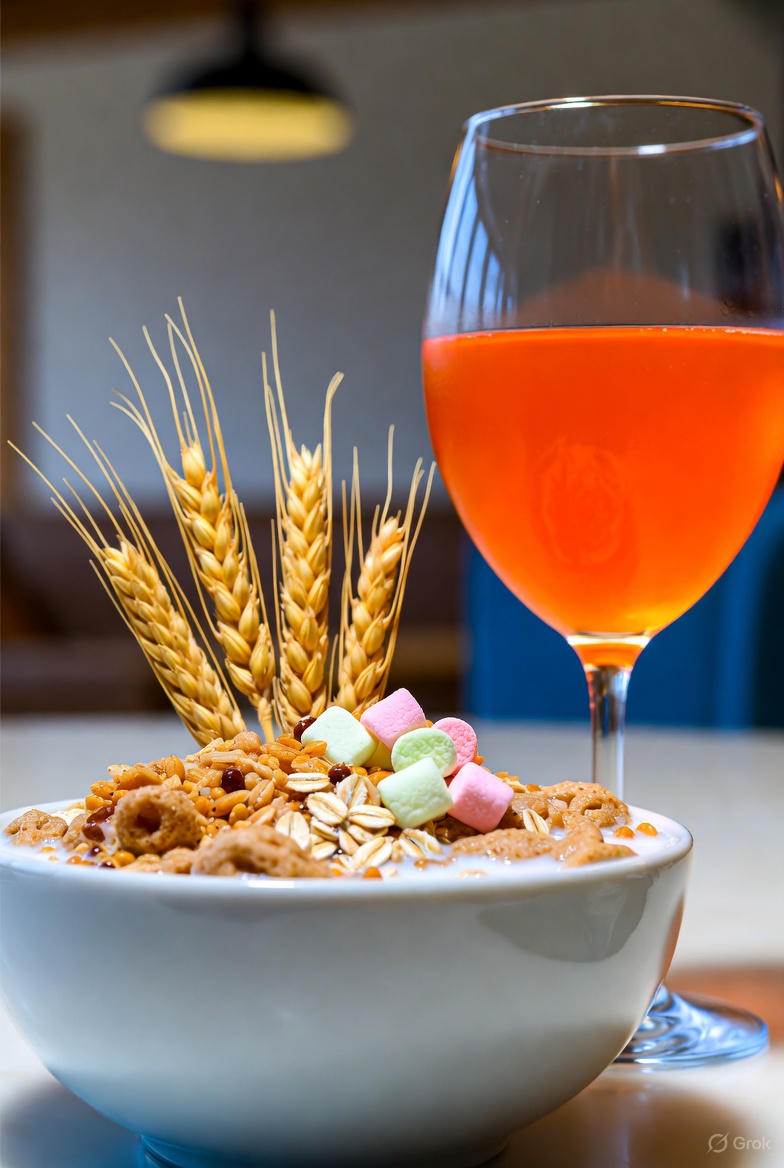
We defined ourselves in drinking contests and games to try to outdo each other in the ancient tests of tolerance. Our definition of victory involved leaving our opponent so incapacitated that they lost control of their functions, fell off a chair, and ended up under the table. “Huzzah!” we shouted in unison, when the defeated vomited little orange pellets across the floor.

“I think it was cereal,” Patrick said.

“Yeah, those little pellets were tiny marshmallows,” Brian responded. “I think the orange coloring was whatever he drank. Wasn’t he drinking orange coolers?”    

The defeated never recovered his reputation, and the victor lived on his victory for months, as if drinking twenty beers in an hour was a physical accomplishment. It was a physical feat, but it was an unnatural one that required training, and no one wanted to watch a montage of his training exercises. No one wanted to see the man sitting quietly in his favorite Barcalounger sipping quietly between tears. We wanted to live the Bachelor Party (the 1984 film starring Tom Hanks) lifestyle, and this is how we imagined we were living.

I can’t remember all of the parties, but there were some killers. The one party I will never forget is my first adult, non-alcohol party. There were probably twenty people there, and no one was drinking. I asked where the beer was, and no one answered. I asked what was going on, and no one answered. Their silence was uncomfortable for both of us. We were in our early thirties, so we were still young enough to recover from whatever damage alcohol inflicted relatively quickly. We had no kids at the time, and a long weekend, so the idea that we were going to spend an evening around other adults talking about our day seemed inhuman to me. I realized that I didn’t like any of these people that much. We drank bottled water and other non-alcoholic refreshments, while talking about our day, as if it were a Thanksgiving Day reunion with the extended family. I hate to sound like an alcoholic, but this party was such an aberration that I talked about it for weeks. I wanted someone to back me up on what an aberration that was. I wasn’t ready to curb my enthusiasm just yet, and I couldn’t believe my friends were. I wanted to ask when the decision to go alcohol-free was made, and how come I wasn’t part of it?  

It didn’t take long for me to recognize that there was something afoot. My friends were implicitly stating that not every get-together had to involve alcohol, and that there was probably something wrong with drinking massive amounts of alcohol. Though I was a little late to this particular party, we began drawing a new demarcation line in the sand. The hilarious hyjinx of the inebriated was becoming a little sad at some point. I should’ve seen that coming, because I saw my dad get wrecked so often that it wrecked our relationship, and most of my friends saw similar things with their parents. It wrecked us to chase our parents out of bars, to hear their alcohol-induced gibberish on the ride home, and it did some lasting damage to our relationship with them when we had to put them, our parents, to bed.  

Now, we drank, and we wrecked our teens and thirties, but by the time we decided to have kids, we decided that we didn’t want to put them through the confusion and the role reversals we experienced. Our kids have never had to spend the precious hours of our childhood in a bar, bored, begging to leave. Our kids see us get together, and they see us drink a beer or two, but they don’t see their guides and role models getting hammered every weekend. 

As we criticize our parents, and their generation, however, we should note that they saw things. We led cushy, comfortable lives because of them and thanks to them. We never knew The Depression, a real war, or any of the other things that they needed to forget, and we were too young to understand the what fors. All we saw was the drinking, the laughing, the absolute blast everyone was having, and all of the connections we made. We also saw the aftereffects, the “Don’t tell anyone about this,” embarrassing aftereffects. The chasing of imaginary windmills, the crying, and their inability to climb the stairs to get into bed. How does an adult ever reclaim their rightful place atop the hierarchy of a home after their kid has to clean up their puke, wipe their tears, and fight to get them into bed? 

I could be off, but I think my generation were the pied pipers in the move away from alcohol. We give younger, twenty-somethings all of the credit for cutting ties to alcohol to 54%. They deserve some of the credit, of course, but we started to see the light and learn our own lessons, inspired by the idea that we didn’t want our kids to see us in weakened, pathetic states. Our kids never had to see us chase imaginary windmills, and they never had to sit in a sad, lonely, and pathetic dive bar begging us to leave. They didn’t have parents whose whole lives centered around alcohol.  

Minimum Weight 

Bob was an elegant drinker. He had fun, but he never made a fool out of himself, and he never had bad hangovers. He was the life of the party that I always wanted to be, but I was a sloppy drunk who could never handle his alcohol. I envied him at the time, but now that it’s all over, and we’re old, I wonder if Bob still has a problem with alcohol? My body informed me, early on, that we didn’t have either the genetic constitution, or the will to do what it took, to become a quality drinker, but he did it so well in the window in time that I knew him that I seriously wonder if he has a tough time quitting, cutting back, or leading a more responsible life?  

Bob was a fun drunk for hours. The man could drink. I was a fun drunk for a little while, but my tolerance was such that I often turned the smiling faces in the room to cringes. Bob almost single-handedly proved that when it came to drinking games and contests, it didn’t matter how much I trained, I would have to artificially reengineer my genetic chromosomes to achieve the term lightweight.

According to BoxBets.com, there are now eight weight classes listed below lightweight, including featherweight, flyweight, light flyweight, and minimum weight. In the drinking and drunk world, I would probably list myself somewhere between light flyweight and minimum weight, because I could probably handle most of the 90lb. females who’ve never had a drink, in the minimum weight class, but after witnessing my performances in those bouts, my manager would probably caution me against challenging for even that meager belt. My competitive spirit, combined with my stupidity, would have me challenging and winning that ignoble belt from a 90lb. female, but I would not do well among the 100lb., light flyweight females.  

If a genie offered me a once-in-lifetime chance to fix 100 of my flaws, moving up in weight classes would not make it on that list. I enjoyed the way alcohol allowed me to shed inhibitions, and the laughing and fun that almost always followed beer consumption, but I never really enjoyed drinking it. I might be rewriting my past, but I don’t remember wanting to become a better drinker who could outdo opponents. I viewed alcohol as a social lubricant, and I considered it an opportunity to become someone else, anyone else, someone like Tom Hanks in the Bachelor Party.

I didn’t want to be a minimum weight of course, as that has connotations to lacking masculinity, but I never wanted to do what was necessary to become a heavy weight either. Even if I wanted to, I don’t think I would’ve been capable of it, as I think our constitutions are relative, based on genetics. Some of us will never be able to competitively run 26 miles, no matter how hard we train, some of us just don’t have the mental acumen necessary to compete in big-time chess matches, or the physical gifts some seem born with to dominate in fencing, and some of us have a genetic disposition that leads us to problems trying to outdrink a parakeet, no matter how hard we train.  

I was a fun drunk, but I didn’t know when to say when, because I always wanted to have more fun, and more alcohol equals more fun when you get that close to having more fun. It made sense to me when I could see the crest of the hill on the horizon, until I looked around to see the sympathetic and horrified faces informing me that I was already careening wildly down the other side of that hill.  

I silenced the room by conceding that Angie could probably drink me under the table. I damaged my man points, and there was a palpable sense that our mutual friends were embarrassed for me. They couldn’t believe that I would admit to such a thing, and they began attempting to impress each other with how much they could drink. I checked out of the conversation, because I fell for various peer pressure tactics so often in a previous life that the accumulation of decades of tiny doses of it inoculated me to immunity.

“I feel bad for people who don’t drink.” Frank Sinatra once said. “When they wake up in the morning, that’s as good as they’ve going to feel all day.” That quote is funny in a cringey sort of way, because we all know that alcohol makes us feel better. It makes us funnier, livelier, and more social. We also become “the drunk,” which can have negative and positive connotations. In this case “the drunk” is our other persona, and who we can become with a couple of belts in our system. The problem, we realize after several attempts, is that we can never become that person. We eventually have to return to that person who isn’t that funny, social, or as lively. We also know that we will never become the celebrated drinker who puts that other guy under the table. At some point, we need to learn to say something along the lines of: “I’m going to say no to your drinking challenge, because I’m just a casual drinker who drinks for fun. I can’t handle massive amounts of alcohol.” 

Ozzy Osbourne said that he only met two guys he couldn’t put under the table, and while I would never belittle anothers’ accomplishments in life, I can’t imagine that being a note I would want that to be one of the things my family remembered about me. I had fun drinking alcohol, and I’m quite sure Ozzy, Lemmy, and The Giant had more fun than I did, but the two rock stars were informed that they wouldn’t continue to live if they continued drinking alcohol (there’s no documented evidence of such a warning issued to Andre). Ozzy eventually achieved sobriety late in life, but Lemmy refused to listen to the men in white coats. When they issued their warning, Lemmy switched from whiskey to vodka), and when they informed him that he needed to drink more water, he put an ice cube in his vodka. It’s funny, and some might raise a fist in solidarity for a man living, even in his last days, on his own terms. He openly bragged about drinking a bottle of Jack Daniels a day, and he died with one in his hand. He never apologized for his drinking habits, never quit, and he never said he regretted it. It’s not only possible it’s likely that that’s all true, and we’ve all known people like that, but I wonder if people like Lemmy, and the aforementioned Bob, knew they couldn’t continue to life with alcohol, but they couldn’t imagine life without it. 

The Happiness of Physical Congruence


“You have some killer calves bra,” Gunther, the gym rat, said at the gym. I can’t remember if I said, ‘thanks’ or ‘SECURITY!’ but Gunther (pronounced Goon~thur as opposed to Gun~thur), sensed my awkwardness. “Seriously bro, you’ve done some good work. I’m thinking of getting mine done. Gonna get me some pumped up calves.” After some back and forth, he confirmed that meant he was thinking about having calf implants surgically inserted into his legs. “I do all of the calf raises, the farmer’s walk, the Box jumps, and jumping jacks, and look at me, I got nothing down there bro. Look at those puny things! Look at them compared to my thighs, they’re incongruent!”

You ever meet this guy, a guy who appears to have it all, and he obsesses over something so trivial that if I told you about it, you might say, “He was joking. He had to be.” I didn’t bother breaking it down with him to see if he was joking, because why would I? I was there, and I knew how serious he was. I did wonder what motivated this obvious obsession with anatomical perfection, and I wondered how deep it went. Did he think everyone was staring at his “puny calves” the minute he walked into a room? Did he refuse to wear shorts, to avoid exposing his humiliation? Did he blame his parents for giving him such awful genes “down there”. I wondered if he thought that by attaining “pumped up” calves, even if by artificial means, that he might be able to improve his perception by eradicating the inadequacies below his leg pits.

“Are you looking to get into a pageant?” I asked.

“First of all, they’re not called pageants,” he said. “They’re called bodybuilding competitions. And no, I’m not looking for any of that. I just think it’s unfair that I work ten to twenty times harder than people like you, no offense, and I get no results.”

Gunther, the gym guy, had so many admirable, and I’ll say it, enviable traits that if he commissioned a poll of a thousand casual observers, my bet is one in a thousand might notice his “puny calves”. If Gunther were asked to predict the outcome of that poll, however, he would probably predict that that figure to be somewhere around 999 out of a thousand who spot them. “How could they miss them?” he might ask.

I told him that if he hadn’t pointed them out to me, I never would’ve noticed them, and I added, “I doubt that anyone else would either.” He acknowledged that and waved it off, basically admitting that he kind of knew it was his issue.

The idea that he moisturized his skin was obvious, as was the idea that he used a wide variety of hair products to color and treat his hair. Gunther, the gym rat, worked hard to perfect every element of his physical presentation, and that included achieving what bodybuilders call the X-frame: broad shoulders, a narrow waist, and well-developed thighs. This shape creates what experts call a striking visual taper, proportion, balance, and a symmetrical emphasis that creates a harmonious and powerful aesthetic that all gym rats strive to achieve.” Yet, Gunther couldn’t do anything about his “puny calves”, so he contemplated letting a surgeon do it for him, because “it wasn’t fair” that he couldn’t.

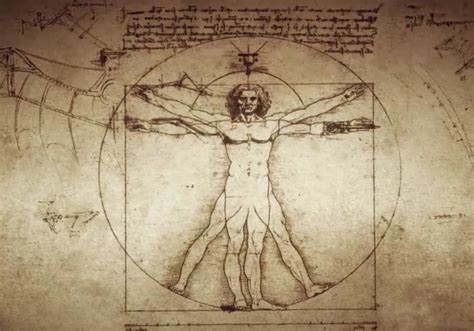
My guess is if another perfectionist, Leonardo da Vinci, decided to give his Vitruvian Man “puny calves”, after studying the ideal proportions of the human form, none of us would notice. Da Vinci would, and Gunther would, because they were far more concerned with achieving anatomical perfection.

We can all understand and appreciate da Vinci’s drive to achieve an artistic representation of perfection, in other words, but there was something almost obnoxious about Gunther’s psychological drive to fix his “incongruity” that when he used that word it stuck with me. I never heard anyone, in the bodybuilding universe, or anywhere else, complain about their incongruity. It was almost as if he thought if he used a different, more creative term, it might exert some special kind of shame for those muscles, and they might finally respond to all of his efforts. And he did speak of these muscles as if they were disembodied entities. Then, he concluded his scorn by saying if they didn’t respond to his wishes, he would find someone (a surgeon) who would.

I don’t know if Gunther eventually purchased that unnecessary, cosmetic surgery, as that would be the last conversation I had with him. If he bought it, I wonder if it helped him feel more congruent. Our immediate guess would be no, as cosmetics only resolve superficial issues. That’s so true it’s almost a fact, but fixing what ails us, or what we think ails us, can have a placebo effect that helps us feel better about ourselves and solves so many other issues. As my science teacher once told me, our initial guesses are often correct, and my initial guess was that Gunther’s feelings of incongruence were so pervasive that the day, the week, or the month after that surgery, he’d find some other incongruity he considered a roadblock to happiness. 

***

Are we happy? Are we happier than we’ve ever been, right here, right now? We’re not as happy as we’ve been, but we’re pretty sure that once forces beyond our control align, we’re going to be happier in the future.

It’s difficult to avoid taking things for granted, but how many of us consider physical congruence an essential element of happiness? Before laughing that off as silly, we need to consider that physical beauty can lead to more confidence, and confidence can lead to greater happiness, and if the congruity of our face equates to beauty, how happy can we be with a big nose? We can get a nose job, but the minute that’s done, it makes our earlobes look flappy. If we lop those off, how congruent are our lips now, and what about our “too narrow” eyes? And, if we have too much forehead, how do we fix that? We often hear that we must accept what our Creator has given or withheld, but to what extent can absolute congruence align with our identity and eventually foster happiness?

We accuse one another of being superficial when we obsess over the physical beauty of others, but what would they think of us if they knew how superficial we are with our own? Good friends and a great family can provide an excellent support system, and making a boatload of money can help even the scales if we love what we’re doing for a living, but none of these elements of life last forever in intangible and tangible ways. Beauty doesn’t last forever either, of course, and we all know that, but instead of appreciating everything we have while we have it, we obsess over the qualities that prevent us from achieving our definition of perfection. 

I know this makes no sense to the healthy, but we should all take a moment to focus our mind’s eye internally, and appreciate how this incredibly efficient machine that we call our body, operates. We’re not talking about the big guys (heart, liver, lungs) that we all know, but the tiny mechanisms in our systems, the cogs, cranks, chains, and linkages that work in conjunction to keep us healthy and happy, because their quiet efficiencies don’t operate at optimum levels forever. And what’s the difference between internal congruence and superficial? Gunther probably wouldn’t even notice his calves if he had trouble breathing, he had heart problems, or some other internal incongruence that cried out for medical attention. His concerns with his calves were as a result of the luxury afforded to those who have achieved so many levels of optimum efficiency that they have to work their way down the list to find one that isn’t.

We’re talking about physical congruence here. We’re talking about how we should factor physical congruence into our huge, multifaceted happiness puzzle. We all know about how reducing stress and achieving emotional stability can lead to happiness, and we’ve all read how diet and exercise can affect mood stability and a general sense of satisfaction, but how many of us look down at our toes and thank our Creator for giving us foot appendages that grew in a congruent manner to provide the typical comfort we enjoy while standing, walking, or just fitting comfortably into a pair of socks?

***

Don Christie had a middle toe that grew too long for the comfort inherent in congruence. An elongated toe might not generate much sympathy from us because, “It’s a long toe! Who cares?” Compared to a person born with a physical abnormality on the face, or any of the truly sad stories we hear about what babies in prenatal units are forced to endure, it’s tough to do anything more than raise an eyebrow at an otherwise healthy man complaining about an abnormally long toe.

Don’s point was that that toe has affected his life in ways most of us take for granted. In order to find comfort standing and walking, Don has had to purchase shoes one size too large to accommodate the space that elongated toe requires. The toe and the shoes he requires, affect his gait pattern, and he has learned to give that toe some slack when he pulls his socks on. It was an annoying attribute when he was a child that grew to a frustration in adulthood, and it’s become a real painful problem, at times, in his senior years. Did it affect his overall sense of happiness? “A little bit, in the ways a toe can affect a day. I’ve adapted, of course, but every once in a while, it becomes a real, painful problem.”  

“If it’s that painful, or that big of a problem, why doesn’t he just have a surgeon lop the elongated portion of it off?” That falls under the “easy answer” umbrella, and the “easier said than done” one. That answer isn’t wrong, of course, but it’s still a toe. It’s an annoying toe at times, and it can prove painful, but it’s still his toe, and he’d obviously much rather deal with it than lop off part of his toe. 

***

Do your ears produce enough wax or too much? The incredibly complex and largely efficient machine we call the human body effectively clears out most excess wax most of the time, but some unlucky few experience a buildup that can lead to an annoying itch, tinnitus, and in some cases, vertigo that can significantly alter an otherwise pleasant Tuesday in June. 

Jack Radamacher was never what we would call a happy person, but he wasn’t miserable, until he started experiencing some hearing loss, a “muffled” sound, and occasional spells of dizziness. The latter was especially concerning to him, and it led him to experience what he considered one of the worst words in the English dictionary, dependent.

“I’d rather die than be dependent on others,” he often said as a younger man, and now, here he was. He didn’t need an arm to hold onto most of the time, but he never knew when a dizzy spell would hit. Prior to his visit to the ear, nose and throat doctor, Jack attributed his hearing loss, and those muffled sounds, to working in a loud machine shop for thirty-eight-years and his age, because he never heard that sometimes the ears neglect to clear out excess wax. Not only did he learn that some ears forget to clear excess wax, he learned that the muffled sounds and dizzy spells he experienced weren’t all age-related.

After the doctor went about cleaning his ears of excessive buildup, Jack experienced what was for him, a revelation.

“I feel cured!” he said when his sense of balance returned, and he no longer experienced muffled sounds. He experienced an odd sense of liberation that led to a greater sense of happiness, until the buildup began again weeks later. When it happened again, he learned about ear wax candles. No one, not even Jack himself, trusted him to do this himself. “The flames generated by the candle can get a little out of control,” his daughter-in-law warned him. So, he was somewhat still dependent on others, but he accepted that if it meant that he could “cure” himself at home on such a regular basis that he achieved a better quality of life as a result.

***

Do you have enough cushion to provide cushion? Some don’t, and we love going after them. “Gil, you got no butt!” we said with laughter. Gil knew that, and he’s known it his whole adult life. It’s why he carries a cushion to the employee cafeteria every day for lunch. “Those chairs are just so uncomfortable,” he said when we ask him about it.

“Huh, I never noticed how uncomfortable these chairs were,” we said. 

“Of course you didn’t,” Gil said in a dismissive manner, “because you have cushion back there.”

We called him “No butt Gil” and one person added, “He’s got back. A long ass back,” but it wasn’t a source of daily conversation.

So, when Gil said that about our biological cushions, seemingly out of nowhere, we didn’t know what he was talking about, until we thought about why he thought the cheap, plastic chairs were so uncomfortable, why he brought that cushion to lunch every day, why he had to wear suspenders, and how he always complained about lower back pain.

Gil thought the jokes were as funny as we did, but the fact remained that Gil had a physical incongruence that diminished his quality of life to some degree. Those of us who have never met a Gil, never placed the sensory delight of comfortable sitting in our happiness equation, because we never considered how the quantity or quality of bun could affect us after a hard day at work where sitting in a relatively comfortable chair provides a reward at the end of the day. Even sitting in cheap, plastic chairs in an employee cafeteria can provide some rewards to the hard worker, if they have sufficient gluteus maximus. We know this now because we know Gil, and we’ve seen him bring that cushion to the lunchroom area.  

Gil’s doctor prescribed that Gil get a gym membership and do certain workouts, with a particular focus on squats, so he could increase the muscle back there, but Gil didn’t have much to work with, and he knew his physical incongruence would prevent him from ever knowing the absolute joy of sitting in a chair, in a manner the rest of us take for granted.

***

“Have you ever had a bad back?” Imelda asked me at the gym. “It goes away, right? What if it didn’t? What if you experienced the worst back pain you’ve ever had, every day, for years? What would you do if you saw every expert, in every field you could think up, and they couldn’t help you? I am not a suicidal person, but I was in such horrible pain, for so long that I thought this was my life now. I just didn’t see how I could go on living like that.”

Imelda and I used to be great friends at our previous place of employment. When we switched jobs, our plan was to always keep in touch and keep connected in some way, but do we ever do that? No, we often leave those people behind. Sometimes, we don’t even remember who we left behind, until we randomly run into them, a decade later, at a gym.

The Imelda I knew back then was such a little thing, and she was someone I considered extremely attractive, because she hit all the bullet points of a small, attractive woman. The woman standing before me now had biceps, triceps, and her shoulders appeared so round and full. She almost looked like a different person, a big sister of the person I once knew. She was ripped, and I thought about all that in all of the complimentary and somewhat insulting ways. She lost all of her beautiful, feminine form, and replaced it with a form that suggested she was rugged and tough looking. She now looked like a person we probably shouldn’t mess with, and I meant that in complimentary and somewhat insulting ways.  

“I was in a car accident, and it really wasn’t even a bad one,” she said. “The woman hit me just right, in a manner that happened to knock me out of alignment.” Imelda went onto to talk about all of the doctors, chiropractors, and massage therapists she visited over the years. “Every time you enter one of these offices, you have hope, and you pray that they are going to be the ones who are going to end it all for you. Then you leave their office, almost in tears, thinking that if you follow their orders it will end it once and for all. They tried, all of them tried, but nothing helped. I was so desperate, at one point, that I accidentally became an addict, addicted to pain meds, the worst of the worst ones,” she said. “They all provided some, limited relief, but the pain, the excruciating pain of not even being able to pick yourself up off the floor, was never far behind the temporary relief those drugs provided.

“When I finally met my Helen Keller, my miracle worker, I thought she was the worst of all. She was a physical therapist who said, ‘There is only so much I can do to help you, and you have to do the rest.’ She was so honest that I considered asking for my money back. What do you mean you can’t help me? What am I doing here, then? Her prescription was working out.  

“Working out?” I said, “I can’t even get off the floor, and you’re telling me to workout?” It made no sense. I thought the massage therapist was an idiot who didn’t understand my level of pain, but I tried it. I did a couple of her low-stress workouts, and I had to admit I felt some relief, some relief as in a little. Then, I worked my way, through her slow, methodical, and prescribed progressions, until I felt even more relief. I told her about it on my next visit, and we cried together, because I thought she saved me, and she did, but it kept coming back. She suggested, after a time, and when she thought I was finally ready, a full-on powerlifting regimen, and I did it,” and here Imelda cried a little, right in front of me, “and she’s my savior now, and I tell her that, and thank her every time I see her.

“I might not be as attractive as I used to be,” she said, and I tried to dispel her of that notion, but she knew. “No, I know that I no longer look cute with all these muscles, but if you knew what I went through for those two long, excruciating years, you’d understand.”

After hearing Imelda’s testimonial, I thought of Gunther’s complaints about his incongruent calves. I thought about how biologists call the human body a marvel of engineering that is also structurally flawed in places, and in various cases. Some people might experience a flaw in their calves ability to respond to specific workouts, but those biologists also direct specific criticism at the structural flaws inherent in the back that make it prone to pain, injury, and dysfunction. Our rush to end our quadrupedal movement and achieve bipedalism is to blame, they say, and some suggest if we never want to have back pain again, we should revert back to the ways of our ancestors and crawl from space to space. Walking is what screwed us all up, because our rush to walk left little time for optimizing the spine’s ability to handle all of the new mechanical stresses bipedal movement caused. Our S-shaped spine enabled balance and flexibility, but it sacrificed some levels of stability when compared to the straighter spines of apes.

So, if Imelda’s testimony taught me nothing else, I learned to appreciate whatever temporary comfort I have, because this marvel of engineering we call our body has structural flaws that are vulnerable to tweaks, and there are no manufacturer’s warranties on these parts either. They’re as is. How was your back today? Good? So good that you didn’t even notice it? Notice it, mentally mark it down as a great day, and be grateful, because it is structurally flawed, and you might learn that one day, the hard way.  

***

“You experienced a vasovagal syncope episode,” the doctor informed AJ Pinter. 

“A vaso what?” AJ asked.

“A vasovagal syncope episode,” the doctor added. “When you were listening to popular podcast, your vagus nerve became overstimulated, causing blood vessels to dilate and pool in the lower body, reducing flow to the brain. Such an episode can also trigger a sudden drop in heart rate and blood pressure, often due to a reflexive response to stress, pain, or fear.”  

There are a number of results that can occur as a result of a vasovagal syncope episode, but in AJ’s experiences, it led him to faint. Most fainting spells are a reflexive response to a high level of stress, pain and fear. These episodes are usually brief, and recovery is quick, but those who study the effect suggest that the best way to experience such an episode, or recover from one, is to do so while lying down. This is impossible to do in most cases, as it’s almost impossible to predict when such episodes will occur.

AJ’s vasovagal syncope episode arrived when he was driving a delivery truck down the road. AJ had a documented history of fainting at the sight of blood, but that’s so common that documented research shows that 15% of the population faint at the sight of blood. What isn’t as common, and something an overwhelming majority of us have never heard of before, is that some hemophobia (the fear of blood) sufferers cannot maintain consciousness after hearing a discussion about blood. AJ’s case is so uncommon that some suggest that sufferers of those who lose consciousness as a result of hearing such a discussion could number under 1% of the population.

AJ experienced just such an episode while listening to a popular podcast containing an in-depth discussion of blood. When AJ felt the symptoms coming on, he tried to pull off to the side of road, while simultaneously trying to turn the podcast off, but he couldn’t manage to do either in time. He lost consciousness while driving and hit an oncoming truck head-on. AJ broke bones in both hips in his pelvic region. If AJ is now able to endure the arduous, lengthy, and painful rehab his doctors prescribed for him, he’ll relearn how to walk but he may never be able to walk without a noticeable limp, and he’ll likely experience moderate to extreme pain for the rest of his life.

“And this happened because he heard a discussion about blood?” we asked the informant detailing for us the catastrophic consequences of AJ’s obscure condition. We asked that a couple times with an ‘Are you sure you have that right?’ tone, because we never heard of a person passing out as a result of hearing another talk about blood. 

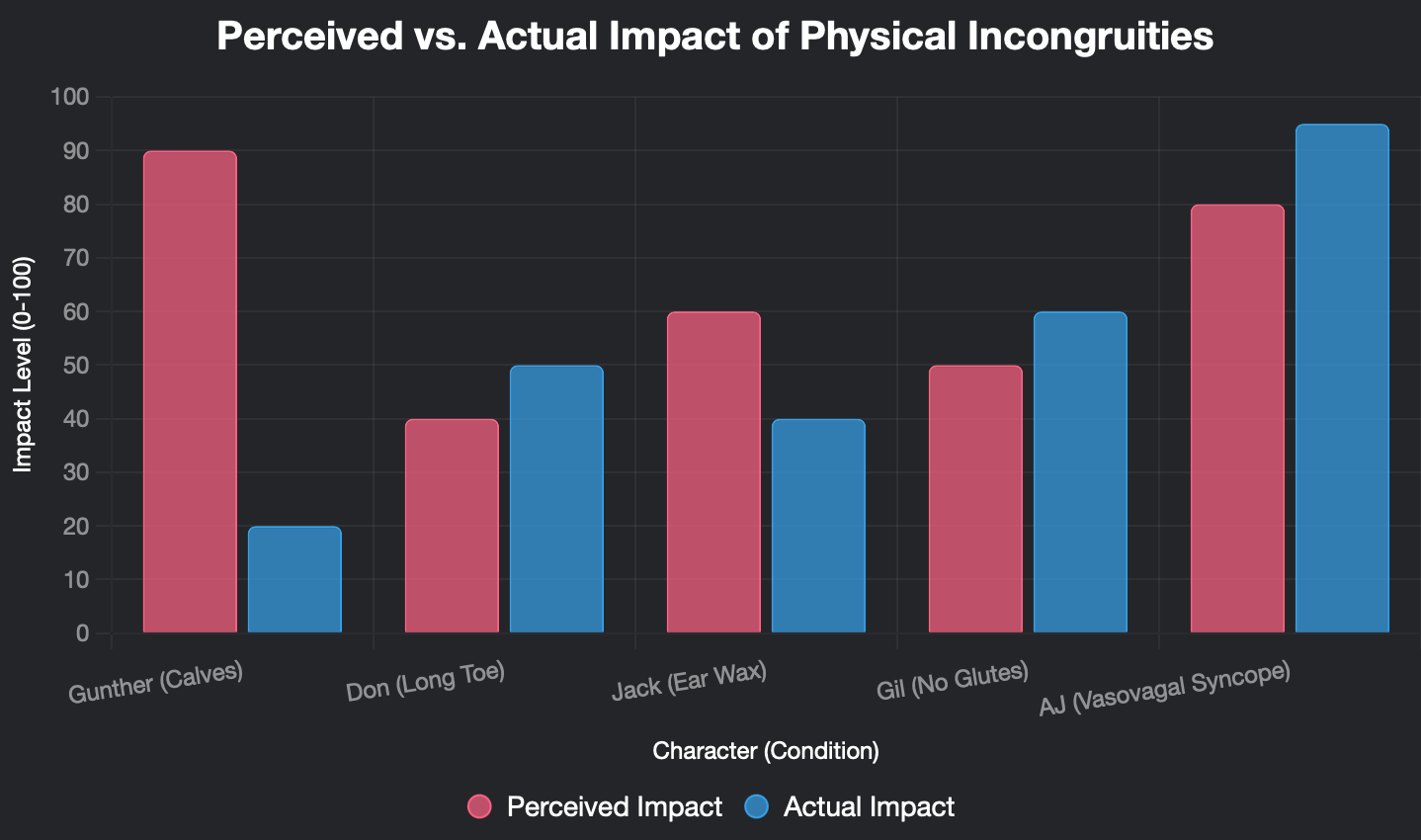
“AJ said it was an in-depth, detail-oriented discussion,” the man informed us, but that didn’t help us understand the matter any better. After working through the particulars of this discussion, we immediately thought about Gunther “the gym rat”, and how Gunther and AJ represented two ends of the spectrum of physical incongruities and their impact on personal happiness. Gunther chose to see an inadequacy that few would notice while failing to recognize the privilege of his otherwise healthy and fully-functional body. He chose to believe that it was “unfair” that he had such “puny calves”. AJ’s story, on the other hand, illustrates true unfairness: a random, obscure condition that upended his life in an instant. Gunther’s fixation is a choice to dwell on an issue most of us consider a non-issue, whereas AJ had no choice in the face of his medical condition. This contrast critiques Gunther’s lack of gratitude and perspective, suggesting that his pursuit of superficial congruence blinds him to the broader, more meaningful aspects of happiness—like the ability to walk, drive, or live without chronic pain. In that light, AJ’s tragedy illustrates the absurdity of Gunther’s self-imposed suffering, framing it as a cautionary tale about the dangers of obsessing over minor flaws at the expense of appreciating one’s overall well-being.

***

Some of us have knee-jerk, impulsive reactions to tales of the incongruent. “They’re weak!” some say. “How can a man survive, or thrive, if he cannot maintain consciousness during a discussion of blood?” Others react with sympathy and/or a sense of appreciation. Some might say that they’re put here, in our lives, to help us gain a renewed sense of appreciation for the idea of physical and mental congruence that we should cherish. 

We rarely think about how our relative levels of congruence produces happiness, until we meet the incongruent. An enlarged heart, prostate, shrunken kidneys, or brain atrophy are more common incongruences that elicit sympathy, but how much sympathy do we have for a man with an elongated toe? If a man was dumb enough to complain about a lack of gluteal muscles, and he did so in manner that suggested he was upset about it, would we be able to restrain our laughter long enough to express sympathy?

“The man can’t sit in most chairs comfortably,” we say to scorn those who cannot control their impulses. “And he experiences chronic back pain as a result.” It’s funny, and it’s not, because most of us don’t consider sitting in a chair or walking on a sidewalk without discomfort one of the luxuries of life, until we have our perspective altered. 

If we hear the terms congruent and incongruent, we often hear them in relation to social, psychological, physiological, philosophical, and spiritual concerns. We rarely talk about the physical, because it just feels so superficial. With all the problems in the world, both in general, and those we learn others experience, it almost feels narcissistic and trivial to complain about an apparent lack of buttocks, an elongated toe, or excessive wax build up. Yet, if we can’t walk or sit without some discomfort, it can affect our quality of life.

When we give thanks for all that we have, we often include good health, but we don’t really mean it. We say it, because that’s just something good people say. A part of us knows that good health can be fleeting, but it’s difficult to appreciate good health, or the incredible machine we have running life for us, until we hear others’ stories. We normally only appreciate such functions when we recover from deficiencies, pain, or some form of tragedy, but when we hear stories of poor health as a result of some odd physical incongruity, it renews our appreciation for even minor functions we currently have operating in peak form, because we know they’re not going to last forever.

The Fragile Flame: When Genius Burns Out 


“He got so smart he went crazy like that!” the regulars at The Family Liquor Store said about a fellow patron named David Hauser, and they always snapped when they said “That!” to punctuate the word. They didn’t just think he was so smart, and he went crazy, they thought there was a direct link between the two. They believed there was an intellectual peak, and that David Hauser accidentally crossed it. I believed them too. I believed them because I was young, extremely naïve, and susceptible to suggestion, especially when it came from adults who knew David Hauser, and his story, far better than I did. The problem for me, decades later when I reevaluated this situation in an article, was that these adults was that they were alcoholics.

“I work hard, and I play hard,” they would say when someone would confront them about their drinking. They did work hard, no one doubted that. When they would go into the details of what they did in a day, we would cringe. As for the playing, I didn’t see much of that. I saw them sit in their chair, and they all had their chair, drinking high-octane alcohol at their favorite watering hole, The Family Liquor Store. Then they’d drink impressive amounts of that high-octane fuel to fuel the stories they all told about one another, and when I write impressive, I’m talking from the perspective of a teenager who considered a tolerance for alcohol impressive.

The article that I wrote nearly a decade ago, A Simplicity Trapped in a Complex Mind, poked fun at how naïve I was to believe so many of the wild stories these people would tell. I also poked fun at their “intellectual peak” theory, in that article, and how it pertained to David Hauser. Now, after all this time, decades after my days in The Family Liquor Store, and nearly a decade after mocking myself for being so naïve as to believe them, I’m going to attempt to execute a very difficult and rather painful 360-degree flip on this matter for your reading pleasure. I’m going to admit that those raging alcoholics, who probably killed a warehouse full of brain cells downing their drink of choice, were almost 100% correct all along.    

Before doing so, I’d like to break down the fourth wall that stands between us, look out at you and ask, doesn’t this idea that there is an intellectual peak, a maximum capacity of knowledge, or some kind of line of demarcation, a “Here, there be Dragons” spot on the mental map of the prefrontal cortex that we dare not cross, seem like something Hans Christian Andersen or the Brothers Grimm would write up? It did to me when I wrote that article on it nearly a decade ago.

I didn’t question them at the time, as I said, because for all the damage they did to their brain with the daily dose of the deadly, they were worldly types who had so many more experiences in life than I had. I think all I said was, “What?” with a scrunched-up face.

“All I can tell you is he had the most brilliant brain anyone who knew him had ever encountered one day, and he was talking to imaginary friends in the corner of our friendly, Family Liquor Store the next, just like that!” they said. “From what I heard, it was almost that immediate.” 

As naïve as I was, I couldn’t shake my skepticism entirely. As much as I liked being around these patrons, they were basically the losers of life, and their goal in life was to try to find some way to even the scales with those who succeeded. “Hey, you want to read Tolstoy, Dostoevsky, or any of the Russian authors, be my guest,” they basically said. “All I can say is be careful, because I knew this guy named David Hauser who got so smart he went nuts, like that! I’m not going to tempt fate like that. If you want to do it, go ahead, fart around and find out.” 

They didn’t say that exactly, but they did warn me about “Trying to get so smart.” These warnings, just on the face of it, sounded like something a Will Farrell dumb guy character might say to someone everyone considered smart. Yet, modern neurologists now suggest there might be a thread between genius and madness. They say a mind diving too deep into truth could slip over the edge. It’s not only possible, they suggest, it’s plausible. 

To be fair to the drunks, they spoke to David Hauser’s ex-wife, when she occasionally came down to The Family Liquor Store to “drag my deadbeat ex-husband out of the store,” and they said she told them “Everything there was to know” about her ex-husband. To be fair to me when I wrote that article, I was questioning why I ever believed the secondhand information from a bunch of alcoholics, whose primary source was an embittered ex-wife. Plus, we were all regular joes who had no medical background, or any other level of expertise to back up what we were discussing. The fact that they were daily drinkers of hard liquor suggests that not only had they already killed off so many brain cells that their assessment of the situation was clouded, but that their fears of contracting some sort of mental illness were probably a little more familiar to them. As the writers at Mental Health Foundation suggest, “Alcohol problems and mental ill health are closely linked.” 

We know that we’re just as susceptible to some form of mental illness as David Hauser. We know that hitting our head just wrong in an accident, or having the wrong genes can lead to some form of mental illness, but can a beautiful mind, a genius, who pushes himself so hard that he crosses some imaginary line, ostensibly called an intellectual peak, fracture “just like that!” and fall to madness? To illustrate this theory, let’s switch the frame to the physical. Is it possible for a pole-vaulter to get injured while trying a jump heretofore considered beyond his capacity. Of course, we can all understand that. Why is it so difficult to imagine the same thing could happen to a man who overtaxes his prefrontal cortex to the point that he gets stuck in overdrive. It’s different but similar, but it’s so hard to wrap our minds around. Observers, familiar with Einstein, claimed he lost his sense of time when obsessing over one of his theories, and those familiar with Newton claim he was known to forget to eat. Would we search medical journals to come up with an apt description of that behavior, or would we just call it tunnel vision? Whatever we call it, we get the image of a piano wire that is tuned too tight, until it snaps “just like that.”

Here’s where we complete the painfully embarrassing 360-degree flip. Those raging alcoholics who “played too hard,” from the comfort of their chair, espousing nonsense about an“intellectual peak,” they were more correct than they probably even knew, and science backs them up. Some now theorize that the genius of John Nash, that led to creative and intellectual breakthroughs, could’ve led to a dopamine overload that could’ve tied into a heightened dopamine sensitive that resulted in a case of schizophrenia. Leonardo da Vinci chased brilliance in hypnagogia, flirting with sleep deprivation’s dark side. Ada Lovelace wrestled numbers and despair in equal measure. We can find examples of anything, anywhere in history, to prove a point, but how anecdotal are they? If we dug deeper, would we find more examples of less heralded minds slipping over the edge? Are these examples of a phenomenon that awaits us all if we dig too deep, or are they evidence of how different each individual mind is? We all have different strengths and vulnerabilities, and some minds might just more susceptible to brief flashes of brilliance followed by a flame out. Perhaps, the examples of this phenomenon suggest that, if nothing else, we might never fully understand the full extents of the complexities of the human brain in our lifetime.

We all envision these geniuses as superheroes, and their insight that reshaped our world as superpowers, but their thoughts, like ours, are tethered to very human brains with all the same frailties, vulnerabilities, and breaking points. Is it possible, or even plausible, that that which fuels extraordinary cognition (intense focus, pattern recognition, relentless curiosity) could also push these geniuses toward collapse. By weaving together cutting-edge neuroscience and the raw, personal stories of brilliant minds, do we uncover a paradox that suggests that the brighter the flame is the faster it could flicker out?

It just seemed so irrational to me, when, nearly a decade ago, I wrote that article that scoffed at the drunken tales of direct links between David Hauser, his intellectual peak, and his roller coaster-like crash into the depths of mental illness. It still seems like dumb people knowledge that we often share at bars to say, “See, see, they’re really not that much better than us. They’re human after all.” After gaining even further distance to comment on me, commenting on me, I will now complete my 360-degree flip with the admission that I probably never should’ve questioned the drunks and their drunken analysis. They were almost 100% right, all along. I’m still not sure what I learned, unlearned, or relearned, but I think I now know enough to know what I don’t know, even though I really don’t know what that means. The one thing I have learned, after chasing the idea of how chasing an idea can lead to madness is that chasing an idea can lead to madness. So, maybe I’ve inadvertently answered my question after all.