Trope-a-Lanche I: The Heist Movie


How do you know when you’ve watched too many movies? Some of us know the patterns and themes so well that the joy of discovery in most films is so gone that we probably won’t be able to thoroughly enjoy another movie until dementia kicks in.

The only thing we love more than puzzles and patterns is being able to figure them out. Our favorite classic and mainstream rock songs follow a A,A,B,A,B,C,B, and B verse-chorus song structure where A = verse, B = chorus, C = guitar solo. Steve Martin once said that three beats are funnier than four. Those of us who are not in these industries usually don’t see these patterns and structures for what they are, but we love knowing what will happen next. When it happens the way we predict, we richly reward those who make us feel smart, so they keep following the patterns that we enjoy following. When we reach a point where we watch too many movies, however, we know those beats, patterns and structures so well that the joy of discovery diminishes.

We all have past times, and I spent my youth trying to watch every movie ever made, and the VHS movie rental stores in just about every strip mall in my big town/small city came very close to helping me achieve that. In the 80s and 90s, we could A) grab our groceries on the way home from work, B) buy a pizza, and C) rent a movie without walking a block. We selected D) all of the above on weekends and some weekdays. It was so convenient that it was a little too convenient. It wasn’t as convenient as clicking a mouse, but you get the point. 

We had cable TV back then, and about forty different channels, but there was “nothing on!” so often that we rented movies to fill the gap. We ended up watching so many movies that we watched too many, and I can now look at the year a movie was made, its genre, and the superficial characteristics of the actors involved to tell you who is going to be the good guy, the most no nonsense, yet incredibly intelligent member of the crew, and who will end up being the bad guy. I can also pretty much tell you what rhetorical devices they’ll use to progress the plot, the tropes (i.e. recurrent themes, literary devices, and cliche) they’ll drop, and its conclusion. When we reach this point of watching too many movies, a genre such as the heist film, becomes so formulaic that our pleasure of discovery evaporates. 

Heist Films

“We don’t do this for the money,” is a trope that the typical, archetype character who masterminds a bank robberies issues to his naive apprentice who doesn’t understand why the money they stole is now a secondary concern.

Heist movies fall under the action genre, so no one expects the complexities inherent in a James Joyce novel, or a plot as rich as Oedipus Rex or The Alchemist. We want action, a whole lot of fun, and some semblance of contextual logic. And that’s where they lose me, the logic, because if I were to rob a bank, I would do it to grab as much money as I could in the precious few moments I have. Then, once I had that money, I would secure it, guard it, and try to find some way to help it mature in the manner a mother might her child. Movie bank robbers take the money, to complete the action sequence, but once the bank robbery scene is over, the money becomes a secondary concern to them for the rest of the film. 

“It’s not about the money,” the Joker said in The Dark Knight (2008) while burning a massive pile of cash. “It’s about sending a message.” Most screenwriters don’t have the characters in their script say this specific line, but they send the message through various scenes.  
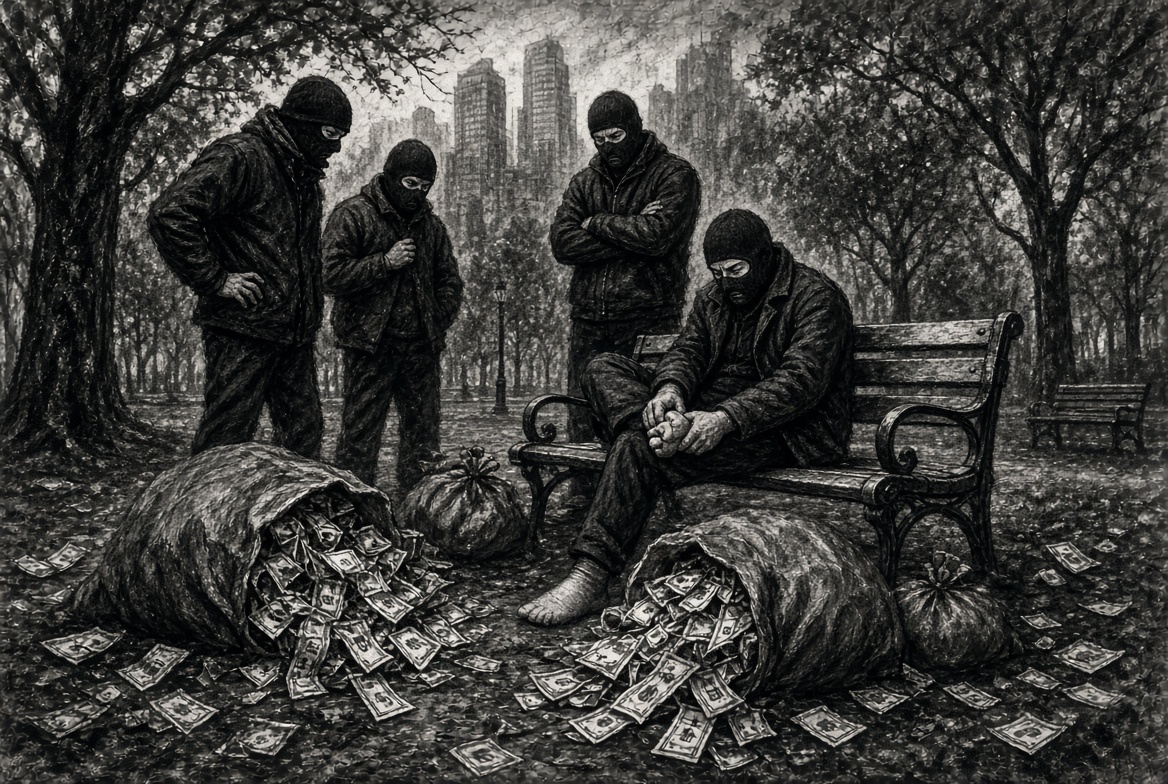
Soon after the bank robbers celebrate their successful theft, they abandon the money when something else happens. If, for example, one of their fellow crew members is wounded or captured, they abandon the money to cater to their crew member’s wounds. “That’s neat and all, but can’t they help their crew member AND keep the money?” I whisper to my fellow movie goers. “It’s not all about the money, Larry,” someone will invariably whisper back. It isn’t, and I get that, but these guys just risked their lives, their livelihood, and their freedom to steal this money. Label me with whatever pejorative you choose, but if one of my crew stubs his toe, I will cater to his needs AFTER placing the money in a very secure place that I can easily access later.

If a romantic interest is endangered, or a personal code is tested, all of that money is left behind without reservation. Just about every movie ever made contains a love interest, and what kind of man would worry about their money when their love interest is in danger? If the filmmaker doesn’t have the mastermind do something, like throw all of his money off a bridge to save her, they’ll lose about 75% of the audience. I get that too, but again, can’t he find a way to save her AND the money?  

The money is a literary device, a MacGuffin, that filmmakers employ to define the character of their characters, and the virtuousness thereof, but the paradox is that real life bank robbers only resort to robbing banks as a desperate effort to get money. The movie depicts these characters as clean cut, intellectual types who have a lot going on in life, and they just happened to choose rob banks on the side. Either that, or we’re asked to believe that instead of choosing to become an electrician, a plumber, or a bus driver, they decided to become bank robbers. Yet, even though they’re not as desperate as the typical bank robber, we’re talking about a lot of money, and my guess is most crews would experience a lot of dissent when the mastermind instructed them to give it all up.   

The primary reason movies about bank robbers are not about money is because we’re not about the money, and we find the pursuit of money icky. Movie bank robberies are about loyalty to our fellow man, the excitement of the plan to defeat a federal bank’s high tech security system, and the chase that follows. The money they make is nice of course, but heist movie filmmakers depict those who seek to quietly enjoy it, or use it to secure a comfortable retirement as suckers, squares, and rubes who believe in the power of the almighty dollar.  

The greater sentiment is that these nuanced and virtuous fellas are not about living materialistic lives, and they find the thought of living like Bill Gates or Mark Zuckerberg repugnant, because Capitalism is soulless. This is made abundantly clear throughout the movie, but the crew could used some of the money they successfully stole to afford themselves a decent lifestyle while planning their next heist. “That’s not what this is all about!”  

These movies are about the slick and smooth mastermind, and his ability to research the details of the bank’s security system and locate its primary weakness. They’re about the mastermind and his crew executing that plan, but it’s mostly about the crew members, and how he assembled them for this one, last big hit. One of the crew members, the getaway driver, knows how to drive cars fast, and when I write fast, I mean fast. Another crew member knows how to handle himself in stressful situations, but he can be a little trigger happy, and the mastermind takes a moment out of the planning stage to virtue signal to the audience that he doesn’t want anyone hurt. He does this by cautioning his trigger-happy friend about controlling his violent impulses during this heist. The final, missing piece is Schmitty the long-since retired safe cracker who is the only one who knows how to crack the otherwise uncrackable safe that this bank has.  
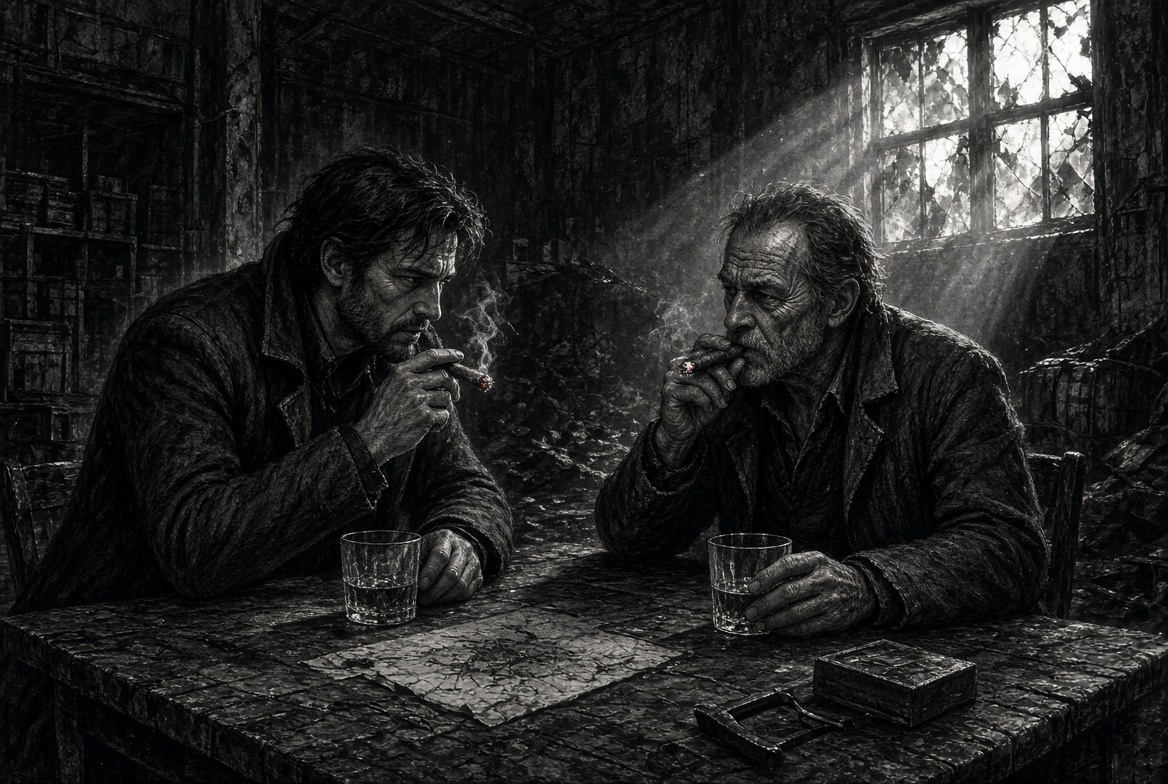
The mastermind and Schmitty sit in an abandoned warehouse smoking cigars, drinking whiskey, and talking and laughing about old times, when the mastermind turns to him, “Do you think you can do Minneapolis again?” the mastermind asks. 

“That was a lifetime ago, MacDavid,” Schmitty confesses. “I’m retired, and I have grandkids. I’m old is what I’m saying, and the ears ain’t what they used to be.” 

“We could really use you here, Schmitty!” the mastermind replies. “If you have one more in you, we could really use you.” The scene closes with no definitive answer from Schmitty, but he reappears later, to dramatically announce his decision with a leather-crackling bro hug.   
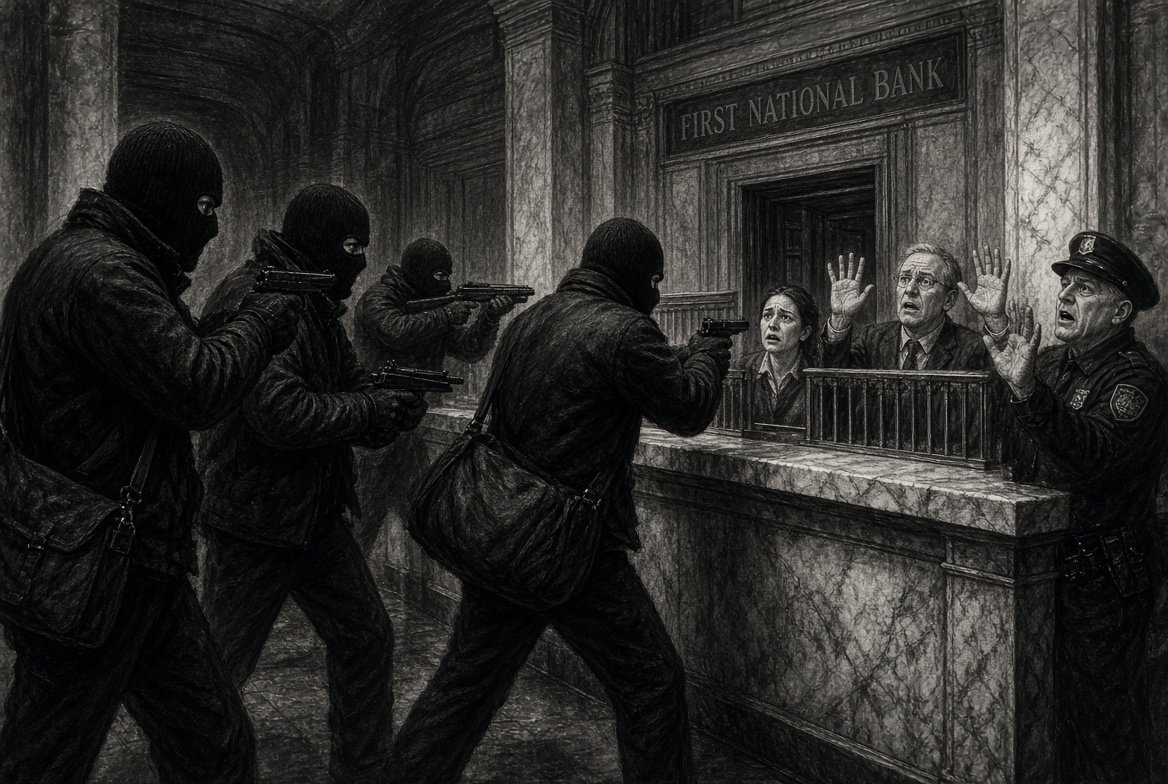
Depending on the gritty nature of the heist film, no one gets hurt during the robbery, and as all heist movie fans know by now, most of the money the bank holds is FDIC insured (It’s not. The Federal Deposit Insurance Corporation insures against various forms of bank failure, not bank robberies.) With that misinformation, those of us in the audience think bank robberies are the perfect crime, and we wonder why we don’t rob banks often. It seems like such a victimless crime.  
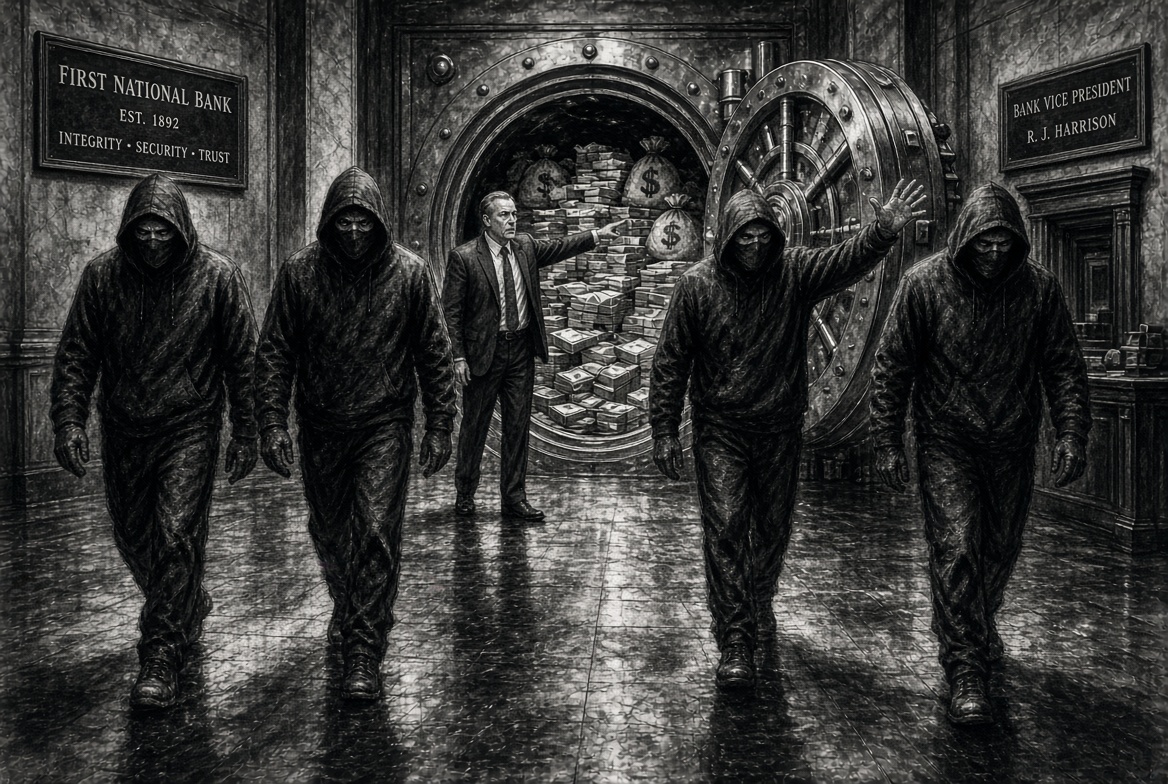
As we’re nearing the close of this heist pic, we’ve spent the last eighty minutes trying to keep our mind in the off position, because we know it’s about action and fun, but that contextual logic keeps nipping at our heels like a Chihuaua. They’ve pounded this idea that it’s not about the money so often that we ask, why did they take it then? Why didn’t they just live their virtuous lives without the distasteful need for money? That’s just snarky, you say, and I agree. How about the movie makers have their characters run into the bank guns-a-blazing, point their guns at people in a menacing manner, and scream, “Everybody down. Everyone on the floor!” If they don’t have a Schmitty, they can find the vice president of the bank and force him to open the vault, and then once they have all of those piles of money sitting right in front of them, they walk away. They walk away without touching that money! Message achieved! Virtue unlocked! Take that! materialistic, greedhead who thinks it’s all about the money! By filming the scene this way, the filmmakers could provide a a culturally relevant statement against the system and the man who tries to convince us that it’s all about the money.

“Why did we go through all that again?” the naive, unsophisticated young lad asks the wily, veteran bank robber who just masterminded a non-monetary robbery. 

“Because it’s not about the money, Chet,” the mastermind says with a squinty-eyed look and a grimace of disdain. “It’s never been about the money, and if you can’t see that at this point, get out of my car!”  

I could see writers and directors creating a character who disabuses the notion that his decision to become an animal husbandman was not about the money. “It’s not about the money, Chet. It’s about them,” he says with a loving gaze sent out to his cattle, “and if you can’t see that, get out of my barn!” I can see movies about individuals in various medical fields, areas of law, and even those involved in selling insurance saying it’s not about the money as much as helping people, but the idea that a bunch of bank robbers are somehow more interested in righting cultural wrongs, civility, and the plight of their fellow man over money just doesn’t square with me. And if you’re going to argue with me about movie makers sending important messages out to the greater culture, I won’t hear it, because I want a contextual alternative delivered by one of the characters in the movie. I don’t want subtext, meaningful omissions, or the slick, cool guy mastermind shaking his head saying, “You just don’t get it, Chet, and you probably never will.” I want an alternative specifically stated, but I know that no movie maker will answer that question, because there is no viable alternative that an audience will buy.  

And that, fellow heist film fans, is the core of the “It’s not about the money” heist film philosophy. We don’t want our heist films to be simplistic, of course, and a dirt bag robbing a bank just for the desperate need for more money would be too simplistic for us to watch and too simplistic for a screenwriter to write. Screenwriters want it complicated, they love twists, complicated, conflicted characters, and a deep, rich plot they consider a reflection of them. The other, less complicated reason is that we don’t want to spend our hard-earned money watching a movie that is all about the money, and the moviemakers want to appeal to our worldview that the simplistic pursuit of money is just plain icky. The final, idealized statement that it’s not about the money is supposed to make us go, “Awww!” with a heartfelt smile. We could call the movie production studio’s writers and directors illogical, ideological, or even pathological for continuing to perpetuate this trope, but we’re the ones who rent, buy, and now click on their movies so often that they continue to create them with this heartfelt premise in it … for the money.       
Framing DeLorean: A Review


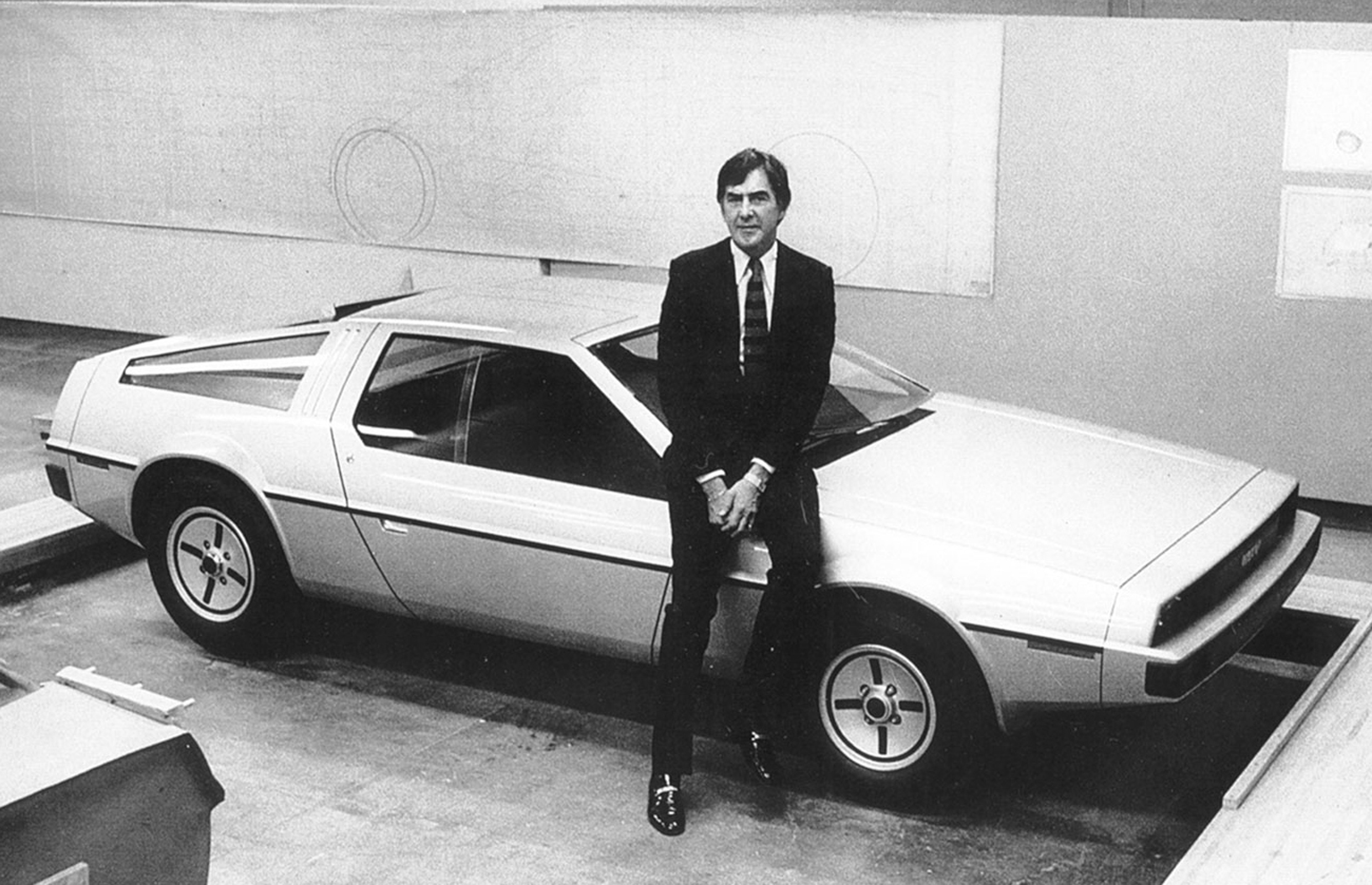
John Zachary DeLorean’s now historic tale has three bullet points, fraud, embezzlement, and an embarrassing cocaine bust. Those of us who knew next to nothing about the story, prior to watching Framing DeLorean, knew John DeLorean built a “car of the future” that few, outside the producers of the movie Back to the Future purchased. We read those “Metoric Rise and Dramatic fall” magazine articles. We heard that story on late-night talk shows, and we repeated the jokes that dropped from it, “The DMC DeLorean looks great … from the outside. If you’re on the inside though, you’re probably not going to think that, because you might not be able to get out.” Bottom line, we thought, the main character depicted in the now historic tale of John DeLorean was a bad guy, on par with Oliver Stone’s bad guy Gordon Gecko. After watching Framing DeLorean, the viewer finds that it’s a lot more complicated than all that. We see an ambitious, talented man who got so caught up in the tent poles of glory and fame that he ended up kicking them all down to bring the tent down on himself? We find ourselves asking the questions was the DMC DeLorean a fraud perpetuated on the public, or did its engineer/CEO fear what others might think of him so much that he allegedly engaged in fraudulent activity to try to prevent others from seeing him for who he really was? Even if he wasn’t what they suspected?

No one cares, you say, because law enforcement officials believed he engaged in fraud, and they gathered enough evidence to successfully indict him on those charges. They also arrested DeLorean after a sting operation, in which they caught him, on tape, taking part in proposal to sell cocaine. A jury found him not guilty in both cases, but no one cares. The charges, alone, damaged his legacy beyond repair. He became a laughing stock, and that was the end of the story as far as we were concerned. As detailed in the documentary Framing DeLorean, the full story is so much more complicated than that. The first two-thirds of the movie, depicts an ambitious, talented man chasing an impossible dream, and the final portions detail what happened when that dream wasn’t realized as flawlessly as the genius thought it should’ve been.  

No one in the film disputes the notion that John DeLorean was an ingenious and wildly successful engineer. After succeeding beyond his dreams as an engineer at General Motors (GM), DeLorean could’ve landed just about any job he wanted in the automotive industry. He decided, instead, to leave the security of his job at GM, and employment altogether, to pursue the impossible dream of beating the Big Three in the automotive industry at their own game. He also left behind the structure that he had at GM (and by the end of the film, some viewers might say this is key), and the system of checks and balances GM exerted on his designs. The final portions of the documentary cover what happens to a dream, when a man hits a series of roadblocks, and he is not as capable as those in the foundational structure at GM, who could’ve helped him solve them.

When DeLorean left a secure job at GM, he took a team of talented, some say brilliant, minds with him. Those brilliant minds thought DeLorean was so brilliant that they left their own secure jobs to make history with him. Private investors considered him such a genius that they scrambled to gather whatever funds they could find to back whatever project John DeLorean chose to pursue. He also received $140 million, in public funds, from Great Britain for the work he proposed to do in Northern Ireland, and he had the sentiments of the entire country of Northern Ireland behind him. A majority of Northern Ireland residents still consider John DeLorean a hero for everything he did to revive the economy of their then war-torn country. The employees he hired in Northern Ireland considered working for DeLorean a “dream job”. All conditions remaining constant, those workers probably would’ve worked for DeLorean for the next twenty to thirty years. DeLorean also convinced what many considered a brilliant engineer, named Bill Collins, to follow him from GM to the DeLorean Motor Company (DMC). Collins was purported to be the kind of genius who could make all of John DeLorean’s dreams come true, and he could augment some of the particulars of DeLorean’s dreams to make the DMC DeLorean a top performer.

Even with all that behind him, we learn that the talking heads interviewed for the documentary considered DeLorean’s dream improbable. During that era, becoming a car manufacturer was near impossible, they said. The Big Three, General Motors, Ford and Chrysler controlled so much market share that everyone involved in the industry considered it laughable, even for a genius on DeLorean’s level to think he could even carve out a small niche. No person, in their right mind, would attempt to go it alone, they said. Against everyone’s advice, John DeLorean tried it, and he nearly did it. He nearly accomplished the impossible dream. 

To accomplish such an impossible dream, one has to have an unusual amount of confidence, and John DeLorean obviously did … in the beginning. When he experienced some roadblocks, and the talking heads in the documentary suggest that most of these roadblocks were manageable, DeLorean’s unusual level of confidence began to waver. Did he begin to see the impossible dream for what it was? 

How many people love to play “poke the genius” in scenarios such as these? “He’s a genius, you say? Did you know that once you close those beautiful gull-wing doors, you can’t get out?” “Did you know that critics suggest that the performance and power of the car are not as advertised? Genius you say? I say piffle.” Americans say that Americans love to build someone up only tear them down, but how many of us truly adore genius? We might use the ingenious products of Apple, for example, but we prefer to gripe about the legendary product’s few, relatively insignificant flaws.   

How many people tell us that our dreams are unrealistic? How many of us can weather those storms no matter what hurdles cross our path? How many of us truly believe we can accomplish that dream? How many of us eventually find ourselves beat down by all of the naysayers telling us that our dreams are unrealistic?

When the DeLorean DMC finally hit the market, after eight grueling years, it hit a major roadblock. People weren’t buying the car. The car hit the market during a recession, and few were buying brand new cars, and critics began slamming the car for a variety of reasons, including the idea that it didn’t test well.

“All John DeLorean had to do, at this point, was halt production of the car and fix the errors [exposed in the tests],” one of the talking heads said in the documentary.

Those words probably haunted John DeLorean for the rest of his life. For a litany of reasons that might forecast the actions of John DeLorean, he didn’t halt production. This is the pivotal part of the story, and I’m quite sure this is the point where the cynical among us began sniffing out the fraud. Why didn’t he just halt production? It might have cost him millions to do so, but those of us who know the end result know that this would prove the ultimate downfall of the DMC DeLorean car. This gap in the story line requires explanation, and when we don’t receive it, we fill it in. When we fill it in, we fill it with information we already know. We know that at the end of the story, John DeLorean will go down for fraud, so this is the first chink in the armor, and the place where the fraud begins.  

Another key point in the documentary involves the suggestion that DeLorean secured enough money from private investors to save the company. His brilliant engineer, Bill Collins, would tell us that a suspicious clause in a contract, led to him to be somewhat suspicious, but no one else saw any telltale signs of possible fraudulent activity. The talking heads in the documentary express their confusion over what DeLorean allegedly did with the investor’s money (again, a jury of his peers found him not guilty), because they suggest he had enough to save the company. The details are either a bit sketchy, or it’s difficult to follow talk of money, but it appears as though DeLorean secured the necessary funds from investors, he embezzled it, and then he agreed to take part in the sale of cocaine to replace the investor’s money he stole. (A jury found DeLorean not guilty of attempting to sell cocaine, but he was caught, on tape, in an FBI sting operation.)

One plus one equals two and a group of accountants found the missing investor money that John DeLorean hid in various accounts. We were right. This man was a fraud. The question we keep coming back to throughout Framing DeLorean is, was he fraudulent all along, or did he get too caught up in being a successful genius and a renegade who decided he was the one to take on the Big Three of the automotive industry? Did he love the fame, fortune, and the accompanying family life he enjoyed so much that his passion for the DMC DeLorean diminished by comparison? Did he love his pep rally presentations so much that he didn’t want to taint the character he created and others adored, and he didn’t want to give any “poke the genius” players material with a production delay to fix the structural errors of the car? We can guess that whole idea of structural errors and production delays are a pain in the tailbone for auto manufacturers. We can guess that testers always find something, because that’s their job, and a big-idea-genius-engineer often mischaracterizes their findings so often that he begins dismissing so many of them that he ends up dismissing all of them.  

Was John DeLorean a victim of big-idea-guy disease? Big idea guys who turn into acclaimed geniuses often have a difficult time dealing with the minutiae of their craft. Big idea guys enjoy stepping on a stage to present their big ideas to their audience. The other guys, guys like Bill Simmons, often prefer to execute their genius in the shadow of the glitz and glamor of the big guys. In DeLorean’s former world, as an engineer in the Pontiac subdivision of GM, he had a number of little guys check and balance his idea on his designs before they rolled off the assembly line. He probably took that part of the process for granted as an engineer, but when he became a CEO he couldn’t ignore that part of the process anymore, and it appears as though he did. We can guess that the star child engineer at GM grew tired of everyone questioning him and diminishing his status, and that that drove him to go it alone. At GM, he probably felt like a Rottweiler in a world of Yorkies nipping at his heels. When he opened the doors to the DeLorean Motor Company, he began building a car of the future, and when those pesky Yorkies began telling him that the car’s performance and power weren’t as advertised and the gall wing doors had a tendency to lock up and prevent exit, he considered these issues small matters in the grand scheme of things. Who cares that the car may not be as powerful as critics would prefer, we’re selling Shangri-La here. When DeLorean was an engineer at GM, he could be a big idea man, because he had a team of engineers and higher ups who would shoulder most of that mindless minutia, and he could be the big idea genius who soaked in all the accolades of the finished product.

Take everything we’ve discussed thus far and add an unbelievable dose of pressure on top. He probably placed most of the pressure on himself to maintain his star status, but we have to imagine that he felt pressure from the family to maintain the lifestyle. Add to that, the pressure of having someone like Johnny Carson as a private investor. Having Carson on board was probably a boon in the beginning, as all DeLorean had to say was, “Carson’s on board,” to entice future investors. That line alone, probably quintupled his investments. When matters go awry, as they did for DeLorean, he likely feared Carson using his late-night show to exact revenge. Coupled with all that, was the idea that Britain invested $140 million, and DeLorean had the economy of Northern Ireland counting on his success. That unbelievable amount of pressure might have played a role in John DeLorean eventually doing what he did. 

The final truth is we’ll never know why DeLorean did what he did, but the otherwise unwatchable movie Game Change served up a quote that sums John DeLorean up well. When speaking of why presidential candidate John McCain does what he does to try to have even his most ardent adversaries love him, his campaign adviser says, “If we could explain why they do the things they do, we’d probably have more of them.”

Is it possible that John Zachary DeLorean was the equivalent of an early 20th Century huckster? Of course it’s possible, but I don’t see how anyone can approach the full story of DeLorean’s career, with an open mind, and walk away thinking it’s probable that he stepped out of the offices of GM set to defraud the world.

When I watched Framing DeLorean, I did not think of Oliver Stone’s malevolent Wall Street character Gordon Gecko, and I did not think about one of the main characters of Back to the Future, the DMC DeLorean. Framing DeLorean reminded me of the Coen Brothers’ Fargo. Like Fargo character Jerry Lundegaard, John DeLorean finds himself falling prey to a series of self-inflicted ramifications based on ramifications that resulted from other ramifications from his prior actions. Like Jerry Lundegaard, if Delorean did that one thing, just one, (halt production and fix the errors) he could’ve solved most of his problems early on, changed his history and his bio, but for whatever reason (ego, he was already in too deep with investors, or he cherished his celebrity stature of his genius too much) he wouldn’t or couldn’t do it.    

A Personal St. Vincent


Everyone has had an experience with a Vincent McKenna (played by Bill Murray), a St. Vincent, and very few of them involve any form of redemption. St. Vincents are St. Vincents as a result of the demons that chase them into being the people they are, and those demons are, often, so powerful that they cannot be thwarted.

st-vincent-movie-reviewsAnyone that has read my personal experiences with Ellis Reddick, knows that I’ve had my own experience with a St. Vincent, and that I’ve been affected by his sociopathic tendencies in a subtle manner that I may never entirely shake. Ellis Reddicks, and St. Vincents, are considered ideal characters for horror movies and coming-of-age style redemptive movies. They are often nice people (in the coming-of-age movies) that require a viewing from a non-traditional lens, and it’s in that scope that they often find the redemption that no one ever afforded them before. Having said all that, St. Vincent is a really good movie for its honesty, and it’s all too realistic (for some of us) portrayal of a demon-ridden, lout that tries to take advantage of everyone around him, but as anyone that has watched a movie made in this century (the 21st century) knows, he’s not going to be such a bad guy at the end of this production, and in the version of reality depicted in this particular movie no one really is.

The demons that chased Ellis Reddick are the same that presumably drove Vincent throughout his life, except for the alcohol and the stripper. The demeanor, the overall outlook, and the need for vices are all the same. Vincent McKenna is an alcoholic that frequents the track, and spends some of his day and most of his nights with a stripper in a seemingly asexual relationship. He tries to take advantage of everyone around him, including a banker, and a recently divorced single mother to fund his loutish behavior. With the banker, Vincent finds out that the money he’s received thus far from the bank, as a result of a reverse mortgage, has been completely tapped. The banker tries to explain the process of a reverse mortgage, and the idea that as far as the process is concerned, the bank can no longer afford to finance Vincent McKenna’s lifestyle. Anyone that understands this process, understands what the banker is saying, but Vincent (and thus the audience) believes that the banker could find a way to continue to fund Vincent’s lifestyle, and the fact that he doesn’t makes the banker a tool. The banker then becomes, in a limited manner that only characterizes Vincent’s current plight further, a bad guy. There is some struggle at this point, however, in totally believing that the banker is a bad guy. He looks at Vincent with confusion in a manner that suggests that his hands are tied, but the sympathy for the main character cannot be shaken. There is no struggle with the story of Vincent taking advantage of the single mother’s situation however. That is more blatant and –in an odd way that makes the audience uncomfortable– kind of funny.

The John Nolte, November 14, 1014 review for Breitbart.com, suggests that the movie, St. Vincent, is basically trope-less, or as he describes it, “It isn’t a tropey-trope.” I’m guessing that Nolte is stating that this movie isn’t so loaded with tropes that it’s totally derivative, and thus unwatchable. If this is what he’s saying, he’s right, but it’s still loaded with so many tropes that any serious review would probably have to mention the word to be taken seriously, even when they are attempting to dismiss the adjective. The primary reason to watch this movie, as with any movie Bill Murray is involved in is Bill Murray.

Bill Murray pulls his role off with the inexplicable, characteristic ease he pulls off every role. As Steve Martin once said of Bill Murray: “It can’t be that easy for him. It just can’t!” Inherent in Martin’s consternation is the consternation that Hollywood, the critics’, and most Americans display with their inability to understand why he is popular, and why they love him too. The consternation also suggests that there has to be some underlying philosophy, or effort to it all, that no one can see. If it were any other actor, most people would accuse Bill Murray of sleepwalking through most of the movies he’s done. He doesn’t appear to care about all that, and we love him for it. I love him for it. It may have something to do with what Bill Murray said, “I knew from the moment I finished reading the script for Ghostbusters that we would all be able to be late for the rest of our lives.” It may have something to do with, as Truman Capote once said, “All an author needs is one truly great book.” It may have been his years on Saturday Night Live, the movies What about Bob? or Groundhog Day, or the stories of “citizen” Bill Murray that have made their way into the zeitgeist, but one gets the feeling that if St. Vincent were his first movie, we would all love his performance without knowing why.

If it’s true, as political philosopher Hannah Arendt says that “To think critically is always to be hostile,” then the reader could regard this review as hostile. Most critical thinkers prefer to think of a critical review as an honest review. Some critical thinkers rip apart commercials and cartoons. They may enjoy these vehicles, but they can’t shut that critical portion of their brain off, no matter how much they enjoy the presentation before them. Some may view critical thinking as negative thinking, or cynical thinking, and some may take critical thinking a step too far. The latter tend to think that the audience of that criticism can’t help but think that they are striving for the cachet that critical thinking can gain a person.

Having said all that, Theodore Melfi’s directorial debut of his screenplay is very good. The primary reason for this, as I’ve stated, is that Melfi and Murray combined to characterize this Vincent McKenna character in a manner that recalled the Vincent McKennas I’ve known throughout my life. That alone, in my opinion, makes the movie worthwhile. As the movie moves through this methodical characterization, we only love to hate Vincent McKenna more. Prior to the redemptive phase of the movie, the trope that we all have to suspect in a modern well-rounded movie, I was reminded of all of the St. Vincents I’ve known, as I worked my way through the confusing aspects of youth –looking for a hero to imitate or emulate– I found them all falling so far short that the St. Vincent redemption eventuality seemed both inevitable and incorrect to my experience with this type of person.

Other than the fact that this curmudgeon, this Vincent McKenna, doesn’t have a tropey-trope-like, Scrooge-style redemption at the end, but all the surrounding characters do, I would point out that just about everything else in this movie has been done, ad nauseum, before. The most pervasive trope in this movie, and that which seems so pervasive in modern cinema, is that “there are no good guys, there are no bad guys. There’s only you and me babe, and we just can’t agree”. And if there are bad guys, they may be bad guys to traditional thinkers, but once viewed through a non-traditional lens, they can be something more, something better. The lens of this movie is, of course, provided by a child, the neighbor’s son, named Oliver. Another “bad guy” Oliver’s bully becomes a good guy after a more traditionally-minded style of beating. The audience’s focus then shifts to the villainous divorced Dad of Oliver. As the movie plays out, the audience realize he’s not such a bad guy after all either.

The St. Vincent’s I’ve known were not Vietnam Veterans, and they weren’t retirees that had already lived a life when I knew them. When I knew them, they were fully immersed in the depths of their failure, so it may be unfair to equate St. Vincent with the curmudgeons and louts I’ve known throughout my life, but (again to the credit of the movie) they reminded me so much of some of the awful characters that have littered my life that I couldn’t help but feel cheated by the happy, redemptive ending. When it involves Bull Murray though, it’s impossible to leave angry.