Sports are an institution in America today. If you are a male, you are almost required to be a sports fan. I’ve seen numerous males try to escape this fact of life in America, but I’ve seen very few pull it off successfully. Those who are able to escape this super sport fan requirement deserve a hat-tip, in some ways, because they don’t have to endure the pain and sorrow watching sports can inflict on a person. It’s too late for me. I’ve had too many teams disappoint me to ever enjoy watching sports in the manner we all should. Super sports fans hate sports as much as we love it, but we’ve found no cure for this ailment other than more sports and other disappointments that help us forget the past ones.
In 2012, The Atlanta Falcons won their first playoff game in four years of unsuccessful attempts. As a fanatic Falcons fan, I’m prepared for the discussions that will follow. I know that the discussions will involve attacks that I’ll deem personal, as a result of my life-long affiliation with this team. If they lose in the next three weeks, I will be guilty by association. If they win, I will be permitted a temporary amount of basking, but I will soon have to reconfigure my psychology in preparation for the next game, and the next season. A super fan’s job is never over.
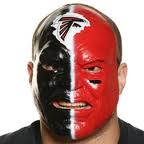 Immersing one’s self in the world of sports’ super fandom can be stressful, for a super fan is required to remain perpetually unsatisfied with their team’s progress, regardless how well they do. A super fan is never happy. A casual sports fan can enjoy a good tussle between two opponents, measuring one another’s physical abilities, but a super fan doesn’t enjoy a good game that involves their team, unless their team blows the other team out. Close games are stressful, as they suggest an obvious deficiency in their team that must be rectified before the next game. Unadulterated blowouts confirm superiority.
A coach says they’re not satisfied with their team’s accomplishments, and the teams’ players echo this sentiment. The two factions echo this sentiment so many times that super fans have now incorporated it into their “we” lexicon. I can understand a player, or a coach, issuing such statements, for they are always on trial, they are always pushing themselves to be better today than they were yesterday. It’s the very essence of sports for the participants to remain unsatisfied. Why does this mentality also have to exist for those of us who are watching them on TV? A super sports fan doesn’t question why they have this mentality, they just have it.
Most normal people regard watching sports as a frivolity, a conversation piece to engage in with friends and family. To them, sporting events provide a simple event, or an excuse, to get together with friends and family. For these people, sports is little more than background noise that cover the lulls that may occur at get-togethers. They may keep up on some sport’s headlines, but they often do so to engage in superficial, meaningless conversations. They also use what little knowledge they have to needle the obnoxious diehards on their team’s loss.
There’s nothing wrong with this needling on the surface. Needling is what super sports fans do to one another, but in the world of super sports fans everyone has something on the line. When you mock a super sports fan’s team, you had better be ready to take as well as you give for a super sports fan will always come back ten times as hard. It’s as much a part of the super sports fan culture as watching the sport itself. For the non-sports fan, for whom sports is but a casual conversation piece, needling a super sports fan is revenge for all the years that super sports fans have ridiculed them for being non-sports fans, or if they haven’t been ridiculed, they have at least been ostracized from the all of the conversations that revolve around sports, and they’ve built up some resentment for sports fans that comes out in these needling sessions. It also gives them great joy, when the conversation turns back on them, and the super fan says, “Who’s your favorite team?” that they don’t have one. The fact that they don’t have one gives them an immunity card against reprisals. It’s what they’ve dreamed of dating back to their pre-pubescent days when their peers ridiculed them for preferring Star Wars and Lego to sports.
In the world of the super fan, it is seen as a testament to their character that they remain unsatisfied with their team’s performance? Even a fan of a traditional doormat, such as the Atlanta Falcons, is informed that the best record in the regular season should mean nothing to them, and their first playoff victory in almost a decade should mean nothing to them. You want that ring. If we’re in any way happy with the progress they’ve made, we’re satisfied, and being satisfied equates to being weak, and soft, and everyone around us knows this, and they won’t have much time for us if we don’t demand perfection of our team.
I once heard that the reason the Chicago Cubs are perennial losers is that their fan base will turn out regardless how they perform. I’ve heard it said that they’re more concerned with beer than baseball, and that they enjoy the confines of Wrigley Field more than they do a winner. There is a certain amount of truth in this when one considers the actual attendance figures in Wrigley Field, of course, but are they saying that a Cubs’ General Manager is apt to forego a prized free agent signing, because he knows that the fans will show up anyway? Is a manager going to inform the organization that he is not going to call up a star prospect, because he knows that the fans will show up regardless if the team is better or not? Their job is on the line every year. Get in the playoffs or get out is the motto in most of professional sports, and I dare say this is no different in Chicago regardless of their team’s ‘lovable loser’ tradition.
The radio show host who said this about the Cubs was making a general point that there isn’t the sense of urgency in the Cubs organization that there is in the Yankee organization. Yankee fans are adamant that their team win the World Series every year, and they’re quite vocal with their displeasure when the organization puts anything less than a championship team on the field. I can’t say that this is without merit, but should this same requirement be made of the fan sitting in a bar discussing sports with a fellow super fan? Why is it elemental to the respect of his peers that the super fan maintain an unsatisfied persona to maintain the respect of his super fan friends?
Super fans who have listened to sports talk radio for far too long, have had it pounded into our head that there’s no glory in meaningless victories … if you don’t have that ring. If you were a Buffalo Bills fan, in the 90’s, and you were happy with an appearance in the Super Bowl for four straight years, you were soft, because those teams lost all of those Super Bowls. The super fan of the Bills would’ve preferred that the Bills failed to make it to the playoffs in the face of all that losing. That was embarrassing. The Bills proved to be historic choke artists. Nothing more. It didn’t matter to the superfan that they were able to do something unprecedented when they made it to the Super Bowl again, after three consecutive losses. They lost the fourth one too! Bunch of choke artists is what they were.
Did it matter to anyone that the Atlanta Braves made it to the playoffs fourteen consecutive years in a span that stretched from the 90s to the 00s? It didn’t to the super fan. They grew tired of all that losing. Did it matter to the super fan that they made the NLCS nine out of ten years? It did not. Did it matter that they made it to the World Series in five of those years? If you’re a loser it did. They won one World Series throughout this stretch, and the super fan remained unsatisfied throughout.
“No one remembers the team that lost in the championship.” “One team wins, and the other team chokes.” These are some of the most common tropes of the language of the super fan that you’ll have to adopt, if you ever hope to garner the type of respect necessary to sit with super fans in bars discussing sports.
If our team loses, but we’re satisfied just to be there, that says something about our character. In these conversations, we are our team, and our team is us. If such conversations make us uncomfortable, the best way for us to retain our identity will be to distance ourselves from our team by informing our friends that we disagreed with a move or a decision that they made, but often times this is not enough to leave us unscathed. Regardless what we say, we cannot avoid having them consider us a choke artist based on the fact that our team “choked” in the championship. We could switch teams, of course, but that is what super fans call a fair weather fan, and a fair weather fan is the lowest form of life in the world of super fandom, save for the needling non-fan. Our best bet is to just sit there and take it. Our friends will enjoy that a lot less than our struggle to stick up for our team.
Even if our team wins it all, we super fans will have no glory. We’re never satisfied, and winning it all for one year, just means that our concentration flips to next year. We don’t just want a championship, back-to-back championships, a three-peat, and then a dynasty. The definition of a dynasty is also perpetually beyond reach, as it is often relative to the individual and often only assigned in the death of the dynasty. By that point, however, we can only reminisce about what once-was, which is a horrible feeling for the superfan.
The true fan is the superfan, always seeking definition of their character through constant calls for perfection. Even if their team wins a championship, they didn’t win by much. Our team should’ve slaughtered that bunch-a-losers. There is always room for improvement, and we’ll scour the draft pool and the free agent list, to find that perfect component for next year’s run. If our team doesn’t do what we think they should do, we gain some distance by proclaiming that the team doesn’t know what they’re doing. We know this because we’re super fans, but most of us have never played the game, or had to deal with team play, salary caps, or prima donnas who generate excellent stats with no regard for the team.
The one thing that every fan, and every super fan, should be required to recite before every game is “You’re just a fan”. I don’t care if you wear your hat inside out and backwards, or you sit on half a cheek for a week, and you don’t speak of your team’s progress for fear of jinxing them, you’re just a fan. I don’t care if you have seven different jerseys for the seven days of the week, that you paint your face, or brave the cold and go shirtless. You’re just a fan. You’re no more instrumental in the way they play the game than the guy at the end of the bar who doesn’t care for sports. So, does this line of thought make it any easier to be a super fan? It does not, because as a super fan, we know that our reputation is on the line every time our team takes the field, court, diamond, or rink. We know that our friends are just dying to call our team (i.e. you) a loser, a choke-artist, and that can make it super stressful to be a super fan.
Are You Competitive?
“I’m sorry I’m just sooo competitive,” Mark said after yelling in anger because our favorite team lost a game on the television set (TV). As men, we’re biologically predisposed to respect competitive men, but Mark was so competitive that he couldn’t control his anger over images on a TV screen. Is that odd? I never thought of it as odd, my whole life, until Mark did it. ‘Who cares if you’re competitive while watching a game on TV?’ I thought in Mark’s general direction. Don’t get me wrong, I’ve said it, and I’ve heard maybe a hundred people say it before Mark, but for some reason it struck me as so odd when he said it. I don’t know if it was how Mark said it, the environment around us, or our respective ages, but this moment opened my mind’s eye to the foolish nonsense I believed about my sense of competitiveness when it came to watching images on the screen wear my favorite laundry.
I’ve recently discovered that it doesn’t matter how competitive I am watching while my favorite teams play sports on TV. I used to think it was a testament to my character that I refuse to accept second place from my teams. “It says a lot about you that you’re willing to accept just being in the championship game,” those who watch sports say. “You should want to win that championship game.”
“You do understand that I’m not playing in that championship game,” I told one friend to try to calm myself. It worked, and I use this line now when someone confronts me about my team losing a game. Of course I want my team to win that championship game, I want my team to win every single game, but what do I do if they don’t? What do I do if they do? It turns out, I’m not playing in that game, and it doesn’t matter what I do, it doesn’t matter what I think, and my emotional investment in my team will not affect how they play. If my team is in a championship game, it’s the team I chose to support that is. What that in mind, we need to mentally rewrite what those who watch sports say, “It says a lot about you that you’re willing to accept that your favorite team is in the championship game,” those who watch sports say. “You should want your favorite team to win that championship game.”
We all know and love the “WE” jokes. A guy watches too much sports for too long, and he accidentally, incidentally becomes a part of that team. “WE” can’t help it. “WE” love them so much that when we watch them on the screen “WE” know when we need to run the ball more often, “WE” know when we need to put the ball in the paint more, and “WE” know what everyone else knows … we really need a hit here.” We want our favorite team to win so badly that we scream out hundreds of miles away from the players, in a bar of unsuspecting customers after “WE” make a horrible mistake, and we apologize after our embarrassing display, “I’m sorry, I am just so competitive.” Does it really matter how competitive we are while watching sports on TV? Does it really matter to anyone that we’re not able to accept second place, a “good” season, a “good” game, or anything less than absolute domination of the opponent in a championship game.
One key component to the fanaticism of the typical fan is the underlying psychology of said fan. I can only use my own embarrassing rage as an anecdotal example. When I was most unsatisfied with my life, I was a raging fan. To my embarrassment, I would have anxiety issues watching another slow progression of my team losing a game. I was miserable to be around. I scared my dog, and my wife no longer enjoyed watching sports with me. Now that I’m more satisfied with the general direction of my life, I’m finally starting to see how foolish it was that I got SO UPSET!!! over some team losing a game on a television program. I love sports, always have, always will, but I don’t know if I really enjoyed watching sports.
I hear what my new friends like Mark say, but I hear it from a newfound perspective, and I cannot believe how foolish I used to be. When one of my teams just barely lost the championship on a last second field goal, I left the party and drove home, “Because I didn’t want to sit there and talk about how close we were to finally winning our first championship in my lifetime.” I didn’t want to talk about the loss, but we probably would’ve spent three minutes talking about it and move on. The thing about my childish temper tantrum was that it was caused by a television program not turning out the way I wanted.
Throughout my life, I’ve thrown remote controls across the room, and I got mad at a fella who said, “Well, it was a good game.” I didn’t want a good game, I told him, I wanted my team to win. Then, after one of my teams finally FINALLY won a championship, I remained purposefully and stubbornly unsatisfied, because I wanted to focus on next year. I thought about the natural attrition of losing some talent, and how we were going to replace them, and if we had a chance at a repeat. When we repeated, I wanted a three-peat, and I was miserable when that didn’t happen. Being a super sports fan should be fun and enjoyable, but it’s not, and if you take it as far as I did, it can actually make you a little miserable.
I’ve recently discovered that it doesn’t matter how competitive I am while watching my favorite teams engage in sporting activities on the television set. It doesn’t will them to win, it doesn’t exert some force on them to do better when I steadfastly refuse to accept a mere winning season, a post-season appearance, or second place from my teams. “It says a lot about you if you’re willing to accept being in the championship game,” we super-sports fans say to establish our bona fides in our group. “WE” want to win that championship game every…single…time!”
Of course I want my team to win that game, I want my team to win every single game, but what do I do if they don’t? What do I do if they do? It turns out, I’m not playing in that game, and it doesn’t matter what I do, it doesn’t matter what I think, and my emotional investment in my team will not affect how they play in any way. If my team is in a championship game, it’s the team I choose to support that is in a championship game. I’m not playing in this game, and their performance is not a reflection on my character, and if we they make a mistake, it is not a statement on our my ability in any way, and the outcome of this game should have no bearing on my emotional stability. What that in mind, we need to mentally rewrite what those who watch sports say, “It says a lot about you that you’re willing to accept that your favorite team is in the championship game. You should want your favorite team to win that championship game.” I know this sounds odd, but some sports fans need to learn to detach themselves from the “WE” mind meld that leads them to say, “I’m sorry, I am just so competitive,” when watching a game on TV.
One key component to the fanaticism of the typical fan is the underlying psychology of said fan. I can only use myself as an anecdotal example. When I was most unsatisfied with my life, I was a raging fan. To my embarrassment, I would have anxiety issues watching another slow progression of my team losing a game. I was miserable to be around. I scared my dog, and my wife lost her love of watching sports with me. Now that I’m more satisfied with the direction of my life, I’m finally starting to see how foolish it was that I got SO UPSET!!! over my team losing a game on a television program. I love sports, always have, always will, but I don’t know if I ever really enjoyed watching sports.
I hear my friends now from my newfound perspective, and I realize how foolish I was. When one of my teams just barely lost the championship on a last second field goal, I left the party and drove home, “Because I didn’t want to sit there and talk about how close we were.” I threw my remote control across the room after we choked another game away, and I got mad at a fella who said, “Well, it was a good game.” I didn’t want a good game, I told him, I wanted my team to win. Then, after one of my teams finally FINALLY won a championship, I remained purposefully and stubbornly unsatisfied, because I wanted to focus on next year. I thought about the natural attrition of losing some talent, and how we were going to replace them, and if we had a chance at a repeat. When we repeated, I wanted a three-peat, and I was miserable when that didn’t happen. Being a super sports fan should be fun and enjoyable, but it’s not, and if you take it as far as I did, it can actually make you a little miserable.

 Rilaly