“You, my friend, are what they call a joker,” I told Shelley Macintosh. “A real joker.”
“A joker?” Shelley asked. “What’s a joker? Did you mean a jokester? Do you mean joker, as in the playing card, or the bad guy from Batman?”
 “A joker,” I said, measuring her reaction to see if she was playing with me. “A joker. A person who jokes around a lot. I don’t know. Everyone says it. It’s a common phrase everyone uses it to describe a person who jokes around a lot. Are you messing with me? You’ve never heard of the term joker before?”
After some back and forth, we established the fact that Shelley never heard the word used in that context before. As incomprehensible as I considered it that a woman who was roughly my age, who grew up in the area I did with all the same colloquialisms, and watched the same shows growing up, never heard the word, I then wondered where I did.
Etymologists trace the historical origins of words, but their professional focus remains on more formal and serious words. There is some less serious research into the history of vulgar vocabulary, but a term that is nestled somewhere in between, like joker, doesn’t receive much focus from either party. Joker might not be a great example of a pejorative, as it doesn’t really belittle anyone, put anyone in their place, offend anyone, or hurt their feelings, but put in a certain context, “You’re a real joker, aren’t you?” it could be confrontational. Those words could be fighting words, but we’d have to frame them up with the right face to get that done.
We know that the Ancient Egyptians had court jesters, that could be called jokers, to entertain their pharaohs dating back to the Fifth Dynasty, and the Romans employed them to provide comic relief for their leaders, but how did the term joker weave its way through the timeline to my mouth in the 20th Century?
How does a word, any word, travel through time? Some are fascinated by this, as evidenced by those who choose professions in various professional language specialist arenas, but to those of us who choose more common professions it’s so boring we don’t want to devote any of the precious time we have left on Earth to it. In principle, it’s interesting to wonder how a word might travel from Ancient Greece to modern English, but the research is not as fascinating as readers might think. I’ve had friends drop words and phrases I found fascinating. “Where did you hear that word?” I wondered aloud thinking that that word was exclusive to the first person I heard use it. I did my research, and I found it personally fascinating to learn that some of these words and phrases predate me by hundreds to thousands of years. Fascinating, right? Wrong, people don’t go so far as to yawn in my face, say “who cares?” or drop a playful characterization of my bookishness on me, but they don’t find the history of words nearly as fascinating as I do.
In my research, I found that a large number of the words and phrases we use every day derive most often from various stages of Latin, English, Ancient Greece, The Bible, and Shakespeare. Look up your favorite word, and you’ll find that most of the words and phrases you use every day are derived from one of those sources, and the reason we stress derived is that as these words travel through time they modify slightly in meaning, totally transform, and on some very rare occasions remain somewhat in tact, in spelling and meaning, for thousands of years.
Most don’t call their peers out on their word choices in the manner Shelley did, because why would we? Unless it involves a swear word, or some unique way of expressing emotions, it’s just not that interesting to us. We also don’t call each other out on the origin of the more common words and phrases we use, because we operate on a certain, unspoken and conditional quid pro quo. “I’ll tell you what, I won’t call you out on these words and phrases you use,” we say without saying, “if you don’t call me out, because I don’t know anything about their origin either.”
One important note, before we continue, is as Etymology.com points out, “etymologies are not definitions; they’re explanations of what words mean, what they they sounded 600 or 2,000 years ago, and how they’ve traveled through time. Etymology is a science that studies the history of a word. It is a subfield of linguistics, philology, and semiotics. Etymology also studies the word’s progressions from one language to another, how it changes from one language to another, its changes in form and meaning, and some semblance of its origins.” The best and most succinct definition of etymology is that it’s the history of a word.
If this entire article is nothing more than retread for you, and you’re not only familiar but intimately knowledgeable about the general idea of etymologies, and if you have an unusual love of language and all of the manipulative power of a clever lexicon, my bet is someone, somewhere has already called you a nerd, a nincompoop, or a total nimrod.
Nimrod: A slightly dim-witted individual, a dolt.
Etymology: There are more professional, professorial, and well-researched theories on the etymological origin of nimrod out there, and their tracings are all over the place, but we prefer the more childish, amateurish word-of-mouth theories that appeal to those who prefer Buggs Bunny to long-since deceased authors monkeying around with a term. The idea that one of our favorite Saturday morning cartoons had some influence on the language we share is just far more entertaining.
The etymology of nimrod begins with The Great Nimrod (a name that can, apparently, only be mentioned with computer-enhanced reverb and some form of trumpet accompaniment). The Nimrod of Biblical lore was either the great-grandson of Noah (a man who built an ark), son of Cush, or Ham (depending on the source?), and the King of Shinar. Nimrod is also reputed to be the leader of the people who built the Tower of Babel in Shinar.
Nimrod was considered “the first on earth to be a mighty man”. He was also considered one of the great hunters of his day and “a mighty hunter before the Lord”. Nimrod was such a mighty character in the book of Genesis 10:8–12 that there are some references that declare subjects of the kingdom of Assyria called it, “The Land of Nimrod” 1 Chronicles 1:10.
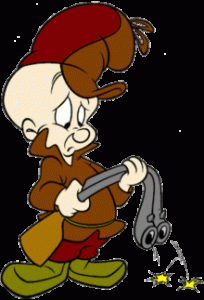 Having said all that, we could assume that most considered Nimrod, the man, the myth, the legend beyond reproach, but anyone who knows anything about Looney Tunes knows that only made him prime for a satirical representation. For them, the rich tradition and folklore surrounding Nimrod made him the perfect analogy for their fumbling, stumbling hunter, Elmer Fudd.
In a 1948 episode called What Makes Daffy Duck, the brilliant and underrated comedic actor Daffy Duck refers to Elmer Fudd as “my little Nimrod”. To show how much the writers loved the characterization, they did it again, in a 1951 episode entitled Rabbit Every Monday in which they had Buggs Bunny refer to Yosemite Sam as “The Little Nimrod”.
A young child, who knows nothing of the King of Shinar, or the first mighty man of Earth, might hear this term and decide to use it against her brother, the next time he he does something foolish. Her erudite parents might overhear this and ask her if she realizes she’s calling her brother a mighty man. To clarify, they might tell the tale of the great Nimrod, and she might pause while soaking all this in. My guess is the next time her brother messes up, however, nimrod will be the first word out of her mouth, because there’s something uniquely satisfying about the sound of the word, and its unique power might derive from its uniqueness. Not many people place nimrod in their regular pejorative rotation, but when they do use it, it just feels deliciously degrading.
Chances are the daughter didn’t know where she heard the term nimrod, but everyone from my era knows that not only did we watch Looney Tunes a lot, but our local programmers ran the cartoon so often, showing so many reruns, that we could almost recite each short in real time, and we all know the conscious and subconscious power of repetition.
The brilliance of these particular Looney Tunes’ shorts lies in the idea anytime a duck or a rabbit are confronted by a human, or a hunter, they should experience fear and intimidation. As animals at the the bottom of the food chain, they know that their lives are always on the line. The humor lies in their mockery of that principle, in general, and Elmer Fudd in particular, for his stature as a mighty hunter before the Lord. Thus, the writers of Looney Tunes almost single-handedly, redefined the term nimrod for an era and beyond as someone who has an unusual belief in oneself in principle, only to show he is actually so bad at it that we question his mental acuity.
So, the next time someone attempts to belittle you with the pejorative nimrod, ask them if they’re referring to “The mighty hunter before the Lord,”, the King of Shinar, or Elmer Fudd. As much as we all loved Elmer Fudd growing up, regardless his foibles, we might not be insulted either way.
 Dunce: A slow-witted or stupid person. A pejorative term that refers to one’s inability to learn. Generations ago, a student who failed to learn, or exhibited a lack of discipline was often forced to sit in a decidedly prominent corner of the room, wearing a dunce cap, or cone. Dunce was, at one time, one of the worst pejoratives one could call another.
Etymology: Once seen as one of the most brilliant philosophical theologians of his day, John Duns Scotus’ philosophies, and teachings, garnered such a substantial following that his followers called themselves Dunsmen, or Dunsers, after the theologian’s middle name. Unfortunate for the Subtle Doctor and his followers, the Renaissance happened. The Renaissance was a cultural movement that sought to render all of the ideas and achievements of classical antiquity obsolete. The Renaissance involved so many changes in so many fields that it evolved into a cultural movement that eventually rendered Scotus’ teachings obsolete by “modern” standards. Those who ascribed to the new theories of the Renaissance developed such loyalty to the “modern” ways of thinking that they derided anyone who refused to modernize. As one of the most prominent adherents to classical modes of thought, John Duns Scotus and his followers, were singled out for ridicule. As such, proponents of the Renaissance called anyone who refused to modernize to the cultural changes happening around them, Dunsers. As anyone who knows about the history of words and pejoratives knows, some words are either purposely or accidentally mispronounced or altered over time for a variety of reasons, and Dunsers became dunces.
Nincompoop: A nincompoop is foolish, an idiot, a bonehead, or a dope. This word is decidedly out-dated, old-fashioned, and rarely used anymore. If you’ve ever had someone call you a nincompoop, chances are that person has been eligible for Social Security for at least ten years. It’s not a compliment, but in the pantheon of pejoratives, it is not a wounding insult either. If you ever decide to use the pejorative on someone, the backlash might prove greater than the intended insult. Some suggest that the more common pejorative ninny derived from nincompoop, because people felt weird saying the complete word nincompoop. Although ninny wields far more power than nincompoop, it should be used judiciously, as the backlash could be just as severe. Although most of us have never heard of these two pejoratives, and even fewer have experimented with them in a pejorative sense, we caution people who might use such terms in the hopes of achieving some sort of retro-feel, because neither of them sound right, and there’s just no way that nincompoop can achieve the desired effect.
Etymology: Some suggest this word is derived from the Latin legal phrase non compos mentis “insane, mentally incompetent” (circa 1600). Others deny this, because the Latin phrase lacks the second “N”. They say that nincompoop was probably derived from Nicodemus, which was used in French for “a fool”. Still others, suggest that it was probably just an invented word at some point.
That’s it, the latter. There’s no solid evidence on the etymology of this one, and the only time I remember hearing nincompoop delivered as an insult is when my great-aunt dropped it on me after I did something stupid. She said it with obvious exclamation points all over her voice, and she made the meanest face she could think of, but all she got out of me was laughter. I don’t know if hearing the last syllable coupled with the mean face drained it of all effectiveness, but it obviously achieved the opposite affect.
 Dolt: 16th century, Old English. Derived from dull, or dol. Middle English word dullen, meaning “to dull, make or become dazed or stupid.”
The progression to modernity has led dolt to mean a person who lacks common sense or the intelligence necessary to make good decisions in life. A dolt is different than a fool, however, as The Content Authority points out, as a fool is often educated and/or wise enough to make quality decisions but continues to do otherwise.
Bedlam: A scene or state of wild uproar and confusion. An outbreak of crazed insanity, that is not a riot. “We went to the concert the other night. A couple fights broke out on the floor, and it evolved into absolute bedlam before the authorities to regain control.” The housing unit of the pejoratives of yesteryear.
 Etymology: Bedlam is a colloquial pronunciation of Bethlehem. Bethlehem, as in the name of the Hospital of Saint Mary of Bethlehem. The hospital began as a priory, in 1247, changed to a hospital by 1402, and ultimately became a civic lunatic asylum by 1547, where it housed the insane. Most of the inmates, as they were called, were starved, shackled, and exhibited to the public in wild and frenzied states. Thus, bedlam became synonymous with frenzied, psychotic behavior.
The proper name might be caught in transition in the title of John Davies’ 1617 publication of humorous poetry, “Wits bedlam —where is had, whipping-cheer, to cure the mad.”
The pejoratives on this list all have interesting, unusual, and noteworthy twists and turns throughout their history. Other pejoratives such as idiot, moron, imbecile and others are noteworthy not for their changes or meaning, but for their consistency through time. Some of these pejoratives existed in the B.C. (Before Christ) era. Think about that for just a second, before you yawn with fatigue, that pejorative you just called your sister was similar, if not the exact same word, a boy called his sister thousands of years ago in Ancient Greece. To my mind, the twists and turns and evolutions of words, through time, are just as interesting as the consistency of the pejoratives through thousands of years.
 Rilaly