When The Great Potato Famine was over in 1852, one million people in Ireland were dead. Most of them were dead from the long, slow, and torturous death of starvation and the epidemics that followed. Roughly 1.5 million Irish residents watched their loved ones, friends, and fellow countrymen die in this manner, and they left, convinced the course their country was on would be irreversible. In those seven years, 1845-1852, twenty percent of Ireland’s 8.175 million people were simply gone, and famine scholars declare it one of the most severe famines of the modern era when measured by mortality rate. It devastated Ireland to such a degree that some argue it took generations for it to “recover” in a relative sense. And according to my stepdad, I compounded our mother country’s tragedy by missing a question about it on a World History test.
“You didn’t even know it happened?” he asked. “It was the worst thing that ever happened to our people, and we probably wouldn’t be here if our ancestors weren’t one of the lucky few to get out.” 
“I’m sorry, but it was just so boring,” I said. “The whole subject of World History is just one long bore.” This further outraged my stepdad, and the fact that I still bring this exchange up shows that I still feel some shame. I feel better about it now, decades later, because I think about the ‘just the facts’ style of writing that occurs in World History textbooks. I understand that a comprehensive collection of the history of man requires a facts first presentation that complies with standards and curriculum, but the core of the word history is story. I think it would be a great idea for the team that puts History textbooks together to commission some creative writers to take the data and create a compelling narrative. I know my history now, because I’ve read some incredibly talented authors who wrote compelling books on the same material, and I’ve listened to podcasters who know how to bring history alive. We didn’t learn World History in the classes I took in high school. We memorized names and dates.
“What was the question you missed?” my stepdad asked after he cooled off a bit.
“It was something along the lines of, ‘This almost destroyed the country of Ireland.’ I guessed revolution, as in Oliver Cromwell, and all that.”
“It wasn’t Cromwell, it was a damned fungus eating up Ireland’s potatoes.”
It wasn’t a microscopic fungus that brought Ireland down. It was Phytophthora infestans—an oomycete, a water mold more closely related to algae than to true fungi.
A biology teacher once told us, “All fungal pathogens are fungi, but not all fungi are pathogens.” What did he say? A guy can’t say that once, and we’re all like, “Okay, got it. Interesting.” We need it repeated and broken down. The distinction sounds like one without a difference, like hair-splitting until you learned what it cost. That distinction, as it turned out, could’ve been everything to Irish potato farmers of 1845, but they only knew the first half of my biology teacher’s description, “All fungal pathogens are fungi.” After suffering the initial blight brought forth by this pathogen, Irish farmers turned to 19th century botanists for advice on how to fight fungi. They followed the botanist’s advice by burning their fields, sprinkling lime, and using sulfur compounds to destroy their harvest to prepare for the next, fungi free one. None of it worked, because fungicides do not reliably kill oomycetes, and that was the distinction.
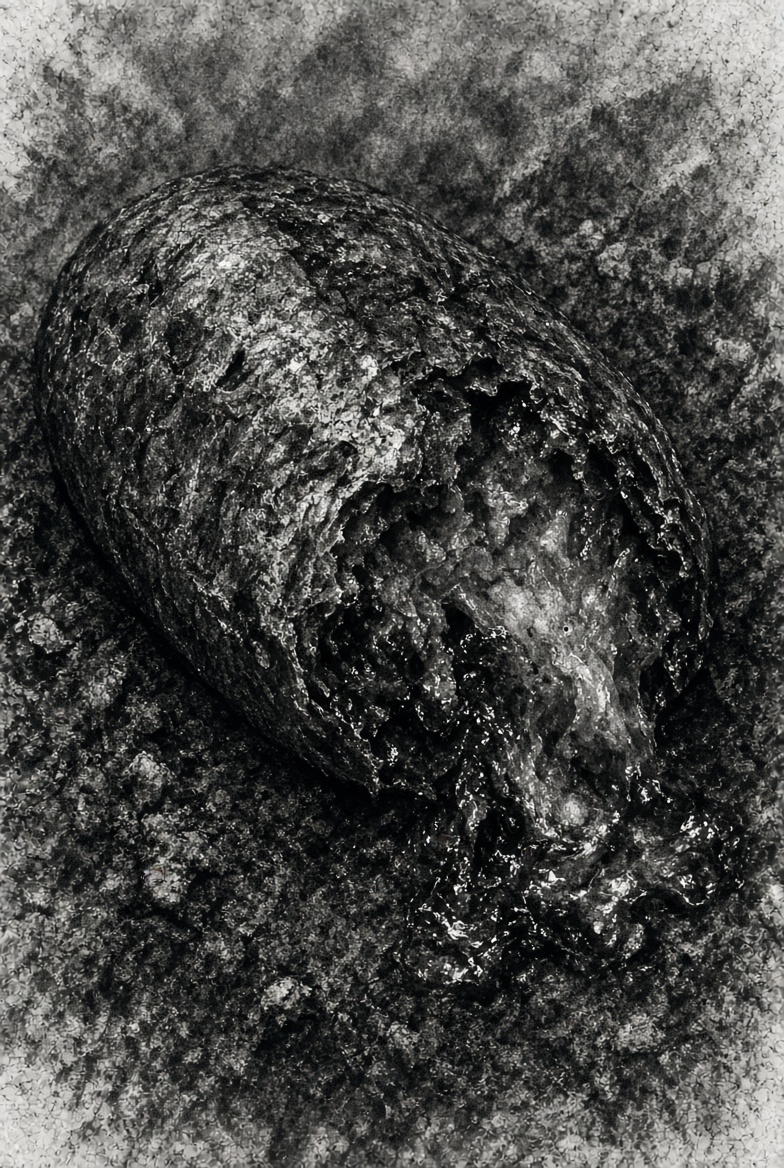
The Great Potato Famine was caused by the phytophthora infestans, a microscopic organism more closely related to algae than true fungi. This tiny organism is called an oomycete, which is a water-mold. The idea that it was a water-mold played a direct role in prolonging the famine, because the 19th century botanists believed that that which ravaged the fields of Ireland was a dry-loving fungus, and they advised the Irish farmers to follow these measures to deprive the fungi of humidity, because humidity feeds a fungus. Water‑molds, such as the phytophthora infestans thrive in wet conditions, so the botanist’s advice proved worse than useless. Yet, modern investigations state that even if the botanists correctly diagnosed the pathogen, and Irish farmers followed their advice to the letter, this nation-wide blight probably would’ve happened anyway. It probably would’ve happened anyway because Ireland’s cool, wet, and humid climate produced long periods of leaf wetness that didn’t just allow the potato blight to spread; it supercharged it and made the resultant disease almost unstoppable.
One million deaths is difficult to grasp, and it’s just as difficult to confirm, because Ireland lacked comprehensive civil registration of deaths at the time. The scholarly estimates are anywhere between 800,000 and 1.5 million, with one million being the central consensus figure. One million is also a round number, and round numbers roll off the tongue so easily that they require perspective. The island nation Fiji, Djibouti, Cyprus, and the Soloman Islands all have populations of roughly one million residents. Fort Worth, Texas, the tenth largest population of the United States has a population of roughly one million citizens. Imagine reading that the entire population of Fort Worth, or Fiji or Djibouti suffered the slow, agonizing death of starvation.
The Great Potato Famine didn’t damage Ireland, it destroyed it, as evidenced by the fact that Ireland’s population was 8.18 million in the 1841 census, 4.2 million in the late 1920s, and 5.35 million in 2026. These more modern numbers include normal migration patterns, and non-famine related issues, but the point is that when a microscopic organism appeared in Ireland, in September 1845, it destroyed a country to the point that it has never fully recovered.
The Horror Story
Another reason I think I missed that question about the potato famine on my World History test was that my people, the Irish, love to tell stories. Ireland has produced some of the most influential storytellers in world literature, and I experienced that love of storytelling in my inner circle. One of primary elements a great storyteller needs is a big bad guy to whom we can all focus our anger, and The Great Potato Famine didn’t really have one. At some point in the grapevine storytelling I heard, a big, bad guy of history, named Oliver Cromwell, made his way into the oral history of The Great Potato Famine. Their “based on a true story” tale suggested that Oliver Cromwell somehow commandeered The Great Potato Famine to destroy Ireland. Only problem is Cromwell was born on the cusp of the 17th Century, and he ruled England and destroyed Ireland 200 years prior to The Great Potato Famine. Now, I’m sure the O.C. would’ve shed no tears over the devastation wrought upon my ancestors in the 19th Century, but he had nothing to do with it.
The Great Potato Famine was the result of an ecological accident amplified by the climate of Ireland and the country’s agricultural reliance on the potato. Yet, with different administrative policies the Brits could’ve prevented that natural disaster from turning into a catastrophe. It is believed that this whole mess began when ships from the Americas brought the phytophthora infestans to the ports of Europe. Some speculate that those ships first landed in Belgium ports, but it soon became irrelevant what exact port introduced the pathogen to Europe as it began reproducing at such a rapid rate that it spread throughout Europe causing some destruction along the way. It wasn’t until phytophthora infestans made its way to the cool, humid weather of Ireland that it experienced what historians call a reproductive explosion.
When Irish farmers planted their potatoes in their normal course of a day, the phytophthora infestans fed off the potato blackening them, liquefying their insides, and leaving them rotted in the ground within days. This, of course, didn’t just ruin some fields, or some portions of the fields. It resulted in a nationwide agricultural collapse of the potato; a vegetable Ireland was too dependent upon.
The population of Ireland was so reliant on the potato that parts of the Irish population experienced almost immediate mass starvation, disease, and death. It was a famine driven by famine-related epidemics: typhus, cholera, dysentery, and tuberculosis that drove Ireland’s mortality figures higher. As high as the death rate was, historians suggest that there was such a wide range of deaths that could’ve been related to the famine that precise counting of actual deaths due to starvation was nearly impossible. Many deaths also went unrecorded, especially in rural districts where entire families perished. One day those isolated, rural homes housed father, mother, daughter, and son families, and the next day those houses rotted with corpses in them, and no one checked in on them for years.
Saving the Bloodline
The World History textbook’s summation of why I exist is that my ancestor, we’ll call him Patrick, witnessed the utter devastation occurring in his homeland, and he left. Patrick packed his bags, walked to the nearest port, jumped on a ship, and made his way to America. End of story. That’s why I’m here today. Horray!
Again, I sympathize with the textbook’s writers need to summarize the history of man, but the textbook version leaves out the harrowing details of the story of Patrick’s travel to America, as illustrated by letters Irish emigrants, who made similar journeys. First, Patrick didn’t just wake up one day and say, “I’m outta here!” This was an agonizing decision that impacted everyone Patrick loved and the rest of his life. Patrick grew up on a family farm, and if you know anything about farmers, you know they don’t give up after a bad year, harsh years, or even punishing cycles. Their difficult lives are such that preparing for the worst of the worst is a part of their daily lives, and leaving the family farm isn’t a last resort; it isn’t even a consideration. For someone to leave a family farm, they must receive incontrovertible proof that they are going to die and end the bloodline with him if they stay.
By the time Patrick finally decided to leave the family farm, starvation and sickness weakened him. Those who were still alive on Patrick’s family farm were ravaged by starvation and disease. His disease-ridden sister, the dying father he revered as a role model, the mother who had sacrificed her own well-being for his happiness, the grandparents he expected to be dead before he reached America were all torn. They urged him to leave so the bloodline might survive, yet they were terrified of what would happen once the last able-bodied member of the family walked away. They all urged him to leave, but that didn’t mean leaving everyone he loved his whole life wasn’t the most difficult decision this young twenty-something had to make.
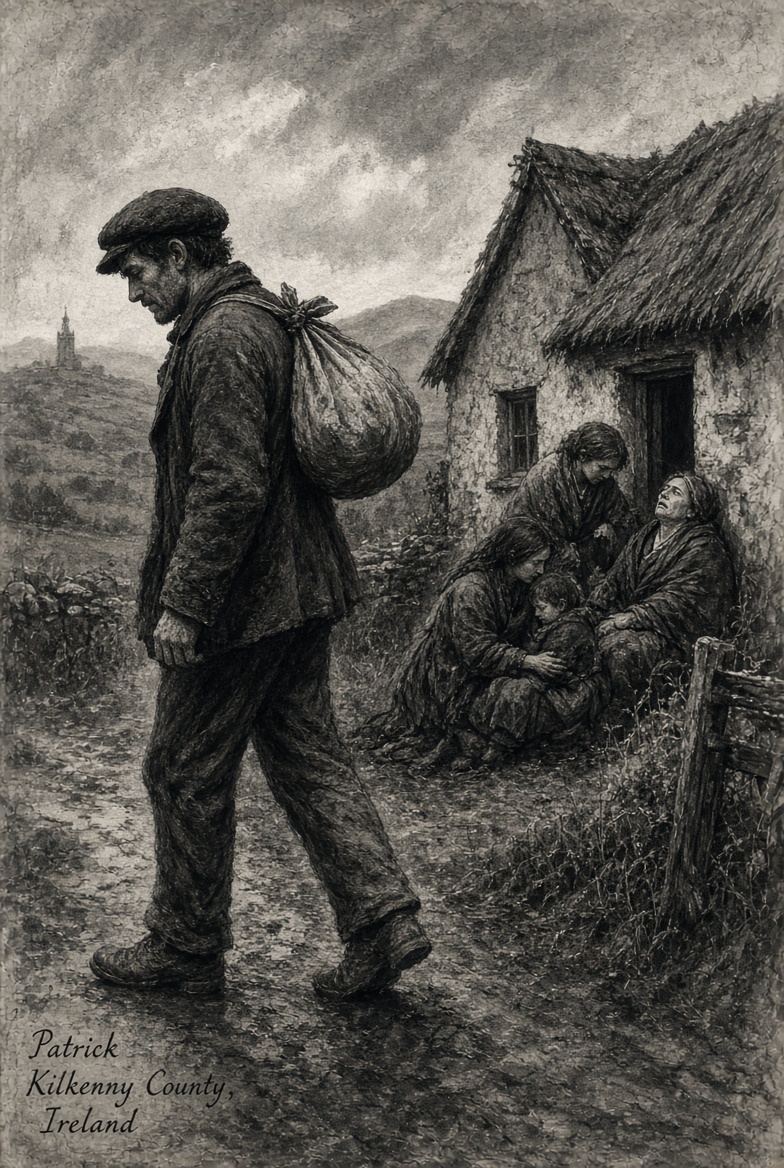
If Patrick had any money, and most of Irish emigrants didn’t, he probably had just enough to board a ship out of Ireland. He didn’t have enough money for food purchases along the way, so he likely carried some bread and cornmeal for a day or two of some nourishment along the way. He also may have traveled with a change of clothes, but that’s about it.
If he walked the average 3.2 miles an hour, it probably took him nine and a half hours to walk from the parish of Callan in Kilkenny County to Waterford, the nearest major port. Considering all the information of this route, in 1845, we can estimate that it was likely a multi-day journey for Patrick.
What Patrick witnessed on this perilous journey comes from letters written by Irish emigrants to America, Kilkenny Poor Law Union reports, and Waterford eyewitness accounts. He would’ve walked alongside “Walking skeletons” assuming he wasn’t one himself, children with swollen legs from edema, adults whose clothes hung off them “like rags on a stick” and people too weak to stand, lying in doorways.
Patrick witnessed so much death and sadness that it broke his heart to turn away from families with small children, desperately crying out for a small portion of whatever money, bread, or cornmeal he carried on his shoulders. Patrick also witnessed the worst of humanity, as starving parents resorted to violence to feed their children. “These people were not villains,” a Kilkenny relief officer later wrote to characterize what he saw. “They were starving.”
When Patrick survived the walk and managed to avoid the violent thieves and those so desperate that violence and murder were a means of survival, he probably walked up to the port of Waterford with just enough money to board the ship. The sight of the ship must have appeared momentarily glorious, as it stood as a symbol of his ability to survive the walk with the necessary money. That relief was short lived when he saw the dilapidated conditions of the ship before him, one that he knew would take anywhere from six to twelve weeks to complete the transatlantic voyage. Patrick knew that the mortality rates on the worst of these ships was between 20% to 30%, because priests read letters to their parishioners from survivors of those voyages. If he didn’t hear those letters on Sundays, he read them in the Irish newspapers. By the time Patrick spotted his vessel to freedom, he probably heard the “coffin ships” characterization of these ships hundreds of times.

Most of these “coffin ships” were almost criminally overcrowded, almost criminally ill-equipped for long transatlantic crossings, ridden with the famine-related diseases, and worked by inexperienced crews who hated the Irish. As daunting as all that was, Patrick also knew that –depending on the quality of the ship he was lucky to board— the ship might take twelve weeks to complete the transatlantic voyage.
Once Patrick survived the overwhelming odds of making the travel from Kilkenny County, Ireland to a port in America, likely New York, specifically Castle Garden –the main immigrant receiving station before Ellis Island—Patrick was not greeted with open arms. He was exhausted, malnourished, and confused, but finally seeing Castle Garden filled him with tears of joy and hope. The realization struck him that he not only survived one of the worst famines in human history, but a journey that killed tens of thousands, based on eyewitness accounts, and emigration records, and historians’ estimates on the path from Kilkenny County to New York.
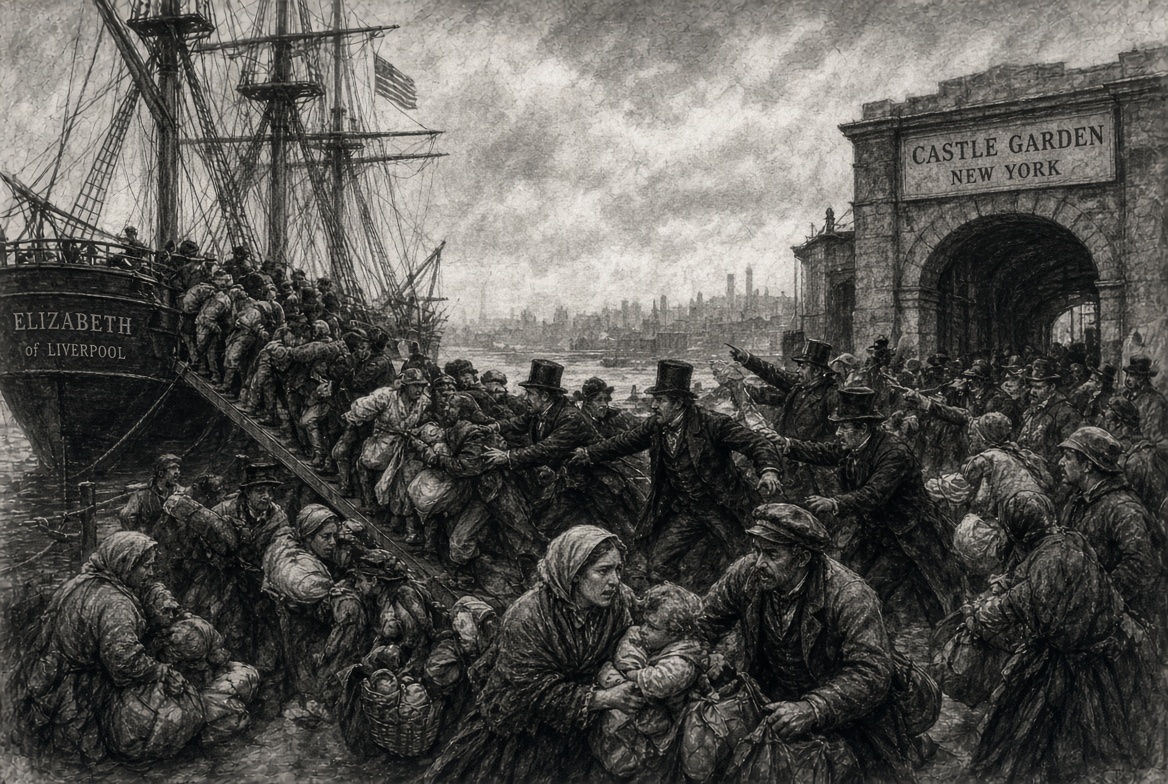
When Patrick disembarked, he kissed the ground and almost immediately stepped into a port that in the 1840s–1850s was one of the most dangerous places an Irish immigrant could arrive. Patrick saw luggage stolen right off the dock and other forms of petty theft. He would’ve been shoved and threatened by the throng on the shore and fellow travelers, and he would’ve seen children separated from the parents in the chaos. “They tore my bundle from my hands, and I never saw it again,” one woman wrote home to Ireland.
Then, once he survived all that, he saw “No Irish Need Apply” signs in windows of factories and other workplaces. He later experienced Anti-Catholic violence, including church burnings, stereotyping that depicted Irish as lazy, drunk, criminal, or inferior in general, and Patrick faced political exclusion, with efforts to block Irish voting rights. And this didn’t just last as long as it took for the one million immigrants from Ireland to settle into their country, as some historical accounts suggest this many Irish immigrants experienced varying degrees of hatred that Irish lasted from Patrick’s arrival in America, in or around 1847, to the early 1900s, depending on the region they eventually called home. So, if Patrick was a twenty-two-year-old when he arrived in New York, he may have experienced intense discrimination in America for the rest of his life. But he did it.
He Did It
 Patrick beat the odds by surviving the long perilous journey from Kilkenny County Ireland to America, and whatever joy he felt was surely dispelled by those he left behind, but he had no choice. I’m the reason Patrick, and his immediate family, made those painful sacrifices and tough choices, and they are the reason I’m here today, living in the greatest country in the history of man. How do you repay that? We’re fortunate to be here and alive, no doubt, but how do you appreciate it?
If there is an afterlife, and that afterlife has a screening room where we can view the painful sacrifices, tough choices, death-defying incidents, improbable survival of illnesses, and anything and everything the Patricks of our ancestry had to survive for as long as it took to have a child, I think we would all realize that it’s not just luck, though luck played a huge role, but it’s so far beyond luck that it’s almost an accident. Every person alive today has their ancestors to thank for the unbroken chain of good decisions, narrow escapes, and sheer chance for their life, but most of all they have good luck to thank.
My guess is Patrick’s tale was far more harrowing than I could possibly report. The horror he experienced lay in the details of the death-defying moments he experienced, and everything else he witnessed. We can also guess that when he finally settled down, Patrick probably found it difficult to smile or laugh in the aftermath. All things considered, he probably found the rest of his life unrewarding. Unless, Patrick saw it as his mission to live, survive, and thrive for those who made it possible for him to leave Ireland and pave the way for those of us who existed because of him. It was probably difficult for him to enjoy small talk, going to the beach, or any of the other useless things we do to relax when we’re not working, but if he learned how to use the opportunity they gave him, Patrick could show everyone, including himself, that they made the right choice.
How do we properly appreciate the gift of life? It’s such an overwhelming idea that we’ll never be able to find a fully adequate answer, so why try? Decades after missing that question on that World History test, I’ve found is to use the gift others bestowed upon me by doing what I do best; learning the story, researching it ad nauseum, and writing an article about it. It’s what I do, but in the course of doing it, I found another form of appreciation that might be more affirming to everything Patrick did to make sure I saw life, and that is reversing my decades old characterization of Patrick’s plight and The Great Potato Famine’s blight as boring.