In the months between February 1692 to May 1693, nineteen citizens of Salem, Massachusetts (14 women and 5 men) were executed for the charge of being a witch. One person was tortured to death for refusing to admit he was a witch, and five people died in jail after being accused. More than 200 people were accused in what we now call the Salem Witch Trials, and five dogs. As harrowing as it is to believe that a small American village executed twenty of its citizens, Europe executed up to 80,000 between 1500 and 1660.
History.com writes that the hysteria swirling around Salem, Massachusetts began in “January 1692, [when a] 9-year-old Elizabeth (Betty) Parris and 11-year-old Abigail Williams (the daughter and niece of Samuel Parris, minister of Salem Village) began having fits, including violent contortions and uncontrollable outbursts of screaming.” Even though the medical community knew about ergotism, the residents did not know what afflicted these girls. The Parris family called in a doctor named William Griggs. Dr. Griggs could not diagnose the girls, and he declared their fits were “beyond epileptic or natural disease”. Dr. Griggs fell prey to the very human condition that applied to their day, as much as it does to today, of filling in the blanks he couldn’t by suggesting that the girls were victims of a supernatural bewitching.
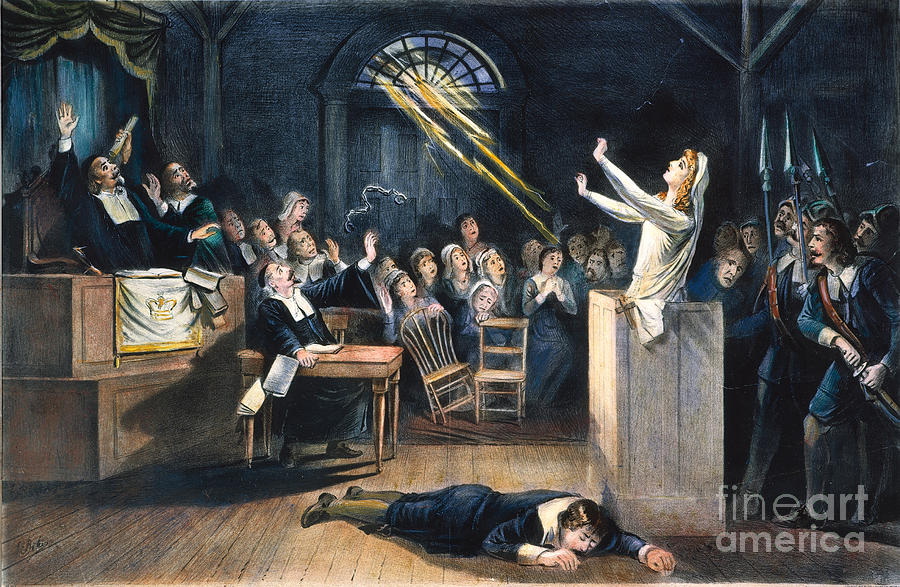
Based on that diagnosis the Parris family were distraught, and they decided to accuse three women of bewitching their girls, including a woman named Tituba. After weighing the evidence against her, and the cultural climate surrounding Salem at the time, Tituba unknowingly set a precedent for those who would be accused in the future by confessing to “the crime” of bewitching. She confessed, we can only surmise, because she knew the deck was stacked against her, and she would be convicted regardless. In her confession, Tituba implicated others by saying that they worked alongside her in the service of the devil against the Puritans. Seeing how Tituba beat the system by providing states evidence, as it were, future accused witches confessed to similar charges to avoid execution and/or imprisonment, and they, too, began assisting the state by informing on other witches. Hysteria spread throughout the Salem community, and the local justice system was soon overwhelmed.
There were a number of factors surrounding Salem at the time to add to the culture of fear, including the fear of neighboring communities, fear of attacks from Native American tribes, and what historians call “The Little Ice Age” that destroyed their economy and many elements of their daily life. To explain what they considered inexplicable, the residents of Salem turned, in fear, to the supernatural, witches, and the devil to explain why their lives were destroyed.
Amid this culture of fear, four other young girls, all between ages nine to twenty, began accusing their neighbors of witchcraft. The six girls were commonly referred to as the afflicted girls. The afflicted girls would accuse, testify in court, and drop to the floor in convulsions during the witch trials. There are a number of theories regarding why these six girls did what they did to lead to public executions, but the one thing we now know with absolute certainty, with no facts to bolster that certainty, is that they were not lying or faking the convulsions.
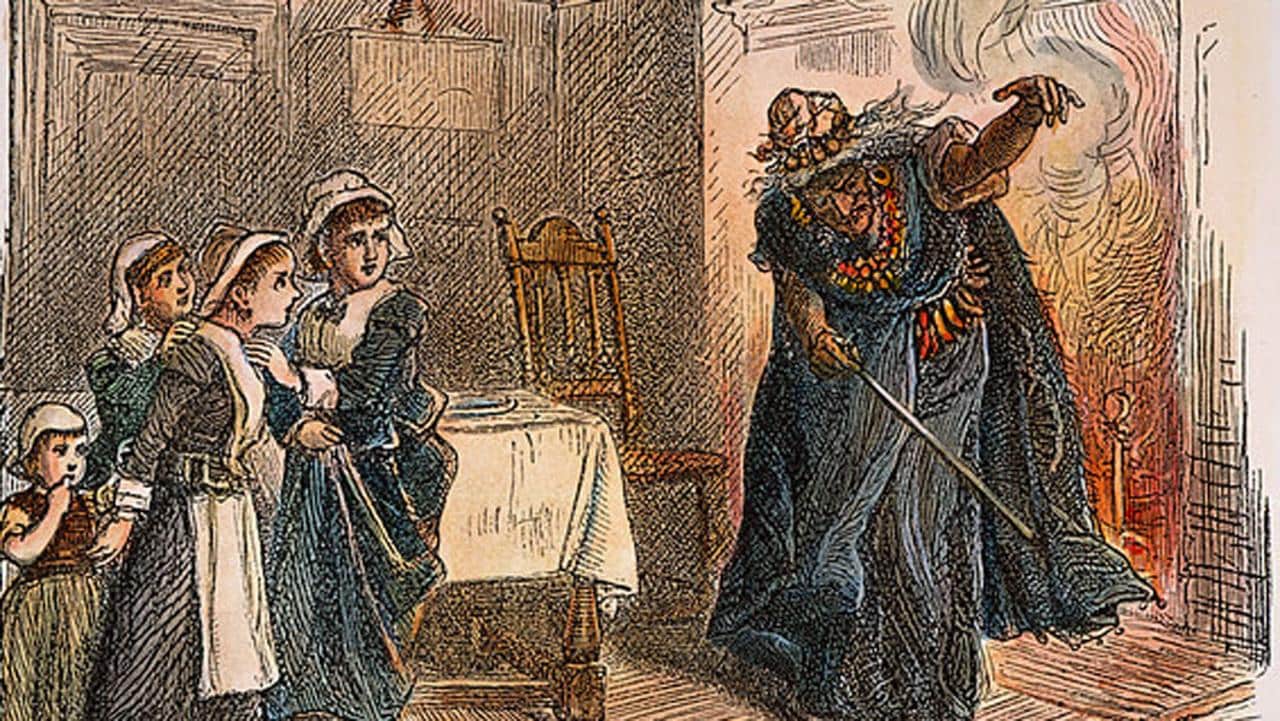 One of the most wide-spread modern theories to explain the ailment the Parris and Williams girls suffered from is ergotism. Ergotism, or ergot poisoning is a result of a long-term ingestion of ergot alkaloids, or mold, that can be found on rye, wheat, and other cereals, which were all primary components of the diet of Salem residents. In the list of symptoms of Ergotism is delusions, hallucinations, vomiting and muscle spasms that could lead to convulsions, which many say lines up with the symptoms the Parris and Williams girls experienced.
As with any theory of matters that have occurred nearly three hundred years ago, historians have debunked this theory. Historians Nicholas Spanos and Jack Gottlieb argue if the young girls were victims of ergot poisoning why weren’t there more cases in Salem, and why wasn’t the rest of their family in their homes afflicted? The two historians admit that ergotism only takes place in hosts suffering from a vitamin A deficiency, but they state that Salem was rich with cows and their milk, so they conclude that it isn’t possible for a resident of Salem to suffer a vitamin A deficiency. They do not include the possibility that these two girls did not enjoy the taste of milk, so they didn’t drink it. They also do not include the possibility that the girls suffered from underlying conditions, such as bleeding stomach ulcers or some form of malnourishment that could’ve led to a greater susceptibility to ergotism via the ergot alkaloids. Nor do they consider the general idea that funguses and mold can affect individuals in the same house, with the same genes, different, based on varying underlying conditions.
Another theory is that the four girls who followed the Parris girls may have suffered from a psychogenic illness called mass hysteria in which one exhibits symptoms and another, unconsciously, begins exhibiting the same symptoms.
“We’ll probably never know the truth of what happened to these girls,” one person, with alleged authority on the subject suggests, “but the one thing we know is they weren’t faking it.”
One quick read through the history of the Salem Witch Trials can lead the reader to some impulsive reactions and cynical, knee-jerk assumptions. Those of us who want to know the truth, try very hard not to fall prey to our own biases, so we keep reading and researching. We do find out we’re wrong, on occasion, but more often than not, we read through all the thoughts and theories on the matter, and we find a whole lot of overthinking, until we fall back on our all-too-simplistic assumption that the afflicted girls made false accusations and they faked their convulsions.
All of the theories about what caused the girls to go into convulsions are not just possible, they’re probable, but the certainty some display in the face of what happened is what draws us back to our impulsive and cynical guesses. If we can rule out ergotism and mass hysteria, with no proof, how can we rule out the idea that they were lying and faking? Especially when one of them, Mary Warren, admitted that “afflicted persons did but dissemble,” or fake their symptoms. Now we know that Ms. Warren later recanted and accused those who might have pressured her into making the admission, but she provided the only evidence for any of the primary theories.
Another crucial element that leads me to believe that the afflicted girls were faking it, was the timing of their convulsions. We weren’t there for the proceedings, of course, and we don’t have the minutes of the trial, but the historical recreations lead us to assume that the convulsions the afflicted girls experienced in the courtroom were conveniently timed to convince the judges of the accused’s guilt. When Mary Warren was asked, in court, to clarify her statement that “afflicted persons did but dissemble,” or fake their symptoms, the afflicted girls in the courtroom went into convulsions. Mary Warren responded, on the stand, by going into her own convulsions. This fits the definition of mass hysteria, provided above, but it doesn’t explain the case for ergotism, and it could be argued that it only bolsters the cynical argument that they were all faking it.
One of the reasons, I think, that we seek to nullify the claim that they were lying and faking, is that it’s almost too horrific to imagine that anyone would purposely, and maliciously make a claim that leads to the executions of those they accuse. Cynical types, who impulsively believe the worst of humanity, often have no proof for their assertions, but those who impulsively believe everything is more complicated than all that don’t either.
One of the causes historians list as a cause for the Salem Witch Trials is the fear of the powerful women. To say full-grown women were second class citizens in 1692-93 Salem, Massachusetts, is being generous, and whatever power women had in Salem, young women had even less. Is it possible that these young women enjoyed their brief moment in the Sun? Not possible? Too cynical?
The next point that most historians consider to bolster their claim that the patriarchy feared and loathed strong women, is that they wanted to keep them in a state of fear. This is plausible, because while the Puritans of Salem considered women equal before God, they considered them more susceptible to the wickedness of the Devil. They suggested the later based on the story of Eve falling prey to the temptation of eating the apple in the garden of Eden. These characterizations are all unfortunately true, but while the thrust of the campaign might have been engineered by men, for men, it may not have gained a foothold in the culture were it not for the accusations made by the young girls. It’s also worth noting that five men were executed, and there is a list of men who were named, accused, imprisoned, and otherwise had their names sullied.
We’ll never know the truth, and I’m not saying I know better than anyone else, but when someone tells me that one theory is categorically false, without any evidence to back that claim up, my mind immediately invites those possibilities in.
“Think about it,” we say when someone else is so muddled in their thoughts that they can’t see straight. We might say that when someone is so blinded by simple truths that they can’t see the evidence that complicates the matter. We also say it when someone’s conclusion is so clouded by evidence that they sift and sort through it to develop speculation that complicates the matter so much they can’t see a simple truth. The simple truth of the matter is supernatural witches with supernatural powers do not exist. They might exist in a realm we don’t understand, but how often do we use otherworldly spirits to explain the gaps in our understanding of the human mind? We wonder, how can one man kill another with no feeling, he must be a monster, a vampire, a werewolf, or something else supernatural, because no normal man would kill another without reason. We can also use them to explain how a seemingly normal person can somehow fail to generate a sympathetic response to the aftermath of blind rage. It was the nature of residents of Salem, Massachusetts to blame supernatural spirits and monsters to explain what they could not explain then, it’s human nature now, and it probably always will be, because “We’ve seen things that no one can explain.”
We make fun of the people who lived over three hundred years ago for believing in such things, but my bet is that for the next three hundred years we’ll continue to believe someone, somewhere exhibits such powers. The only problem is that over the course of the last couple thousand years, we have yet to find substantial proof of it. Supernatural witches, and their Specters, a fancy term they used for spirits, ghosts, or demonic forces that the accused would allegedly sic on the victim don’t exist in the same manner that vampires, Frankenstein’s monster and Spongebob Squarepants don’t exist.
 Rilaly