Hoomans, Ha!men, and Humans 


Taxonomists and biological anthropologists classify modern humans as the Homo sapiens sapiens species. No, that is not a typo. The reason for the double-word is that we are a subspecies of the Homo sapiens species. Taxonomists and biological anthropologists created this distinction to separate Homo sapiens sapiens species from the Homo sapiens neanderthalensis, or Neanderthals, the Homo sapiens idaltu, or Herto man, and the debatable inclusion of the Homo sapiens denisova, or Dragon man. We’re all homos, in other words, under the genus Homo, and the biological anthropologists break us down after that.

Our Homo sapiens sapiens subspecies is characterized by advanced cognitive abilities, language, and complex social structures. We’re the most complex subspecies in this regard, but if aliens from another planet were to meet us, greet us, and play in all our reindeer games, they probably wouldn’t agree that we all belong in the same categorization.

When we talk about Alien Life Forms (ALFs) here, we’re talking about Spock, S’Chn T’Gai Spock from the original Star Trek. Spock was half-human, half Vulcan, but we’re going to characterize our ALF as a full-on Vulcan, a full-on reason and rational thinking Vulcan with no empathetic or sympathetic emotions. In this ALF’s After Earth report home, it would write, “Even Earth’s scientists refrain from proper delineations in their Homo sapiens subspecies, because the scientific community thinks that a proper breakdown of various individuals in their subspecies might hurt feelings, but there are clear delineations. Some Homo sapiens sapiens have not fully evolved to the point that they belong to that species. Others have.”

If we never meet Spock-like ALF, or fail to prove they exist, we’ll never be able to verify this characterization. Thus, we will have to turn to the closest thing we have to an Alien Life Form in our universe, one with intimate knowledge of the Homo sapiens sapiens that is dispassionate enough to provide objective analysis. I would nominate the cat. Anyone who has owned a cat knows that we share an off again relationship with them. The cats definition of our relationship might even be punctuated with a “I really don’t care that much what happens to you” exclamation point that is furthered by a “As long as I get some milk and food every once in a while, and someone or something keeps me stimulated every once in a while I’ll continue to exist near you.”

Some might say the dog has as much, if not more, knowledge of our species as the cat, but the dog is biased. Dogs love us. They are so loyal that if they were commissioned to analyze our species, they would tell us what we want to hear. There’s a reason we call them man’s best friend, and it is largely based on the idea that they accept us for who we are. They don’t analyze us in the manner a cat will, and they know nothing about our inadequacies or failures, because their sole goal in life is to make us happy. They know when we’re happy, they’re happy. Cats are almost 180-degrees different.

Instagram posters have characterized this on again, off again, “I really don’t care that much what happens to you” relationship we have with cats with a somewhat humorous, somewhat condescending term that their cats use to describe us, hoomans. Hoomans is a cutesy eye-dialect, similar to that of the “No Girlz Allowed” sign that moviemakers put outside the door of a boy’s clubhouse. The cutesy error is employed to enhance the cutesy idea that cats and young boys can’t spell. The moviemakers might even add a backwards ‘R’ to further emphasize the cuteziness of the boy’s sign.

Another intent behind the cutesy hoomans contrivance is to inform us that we’re not viewing this interaction from the customary human perspective. We’re viewing this particular interactions from a perspective we may not have considered before, the cat’s.
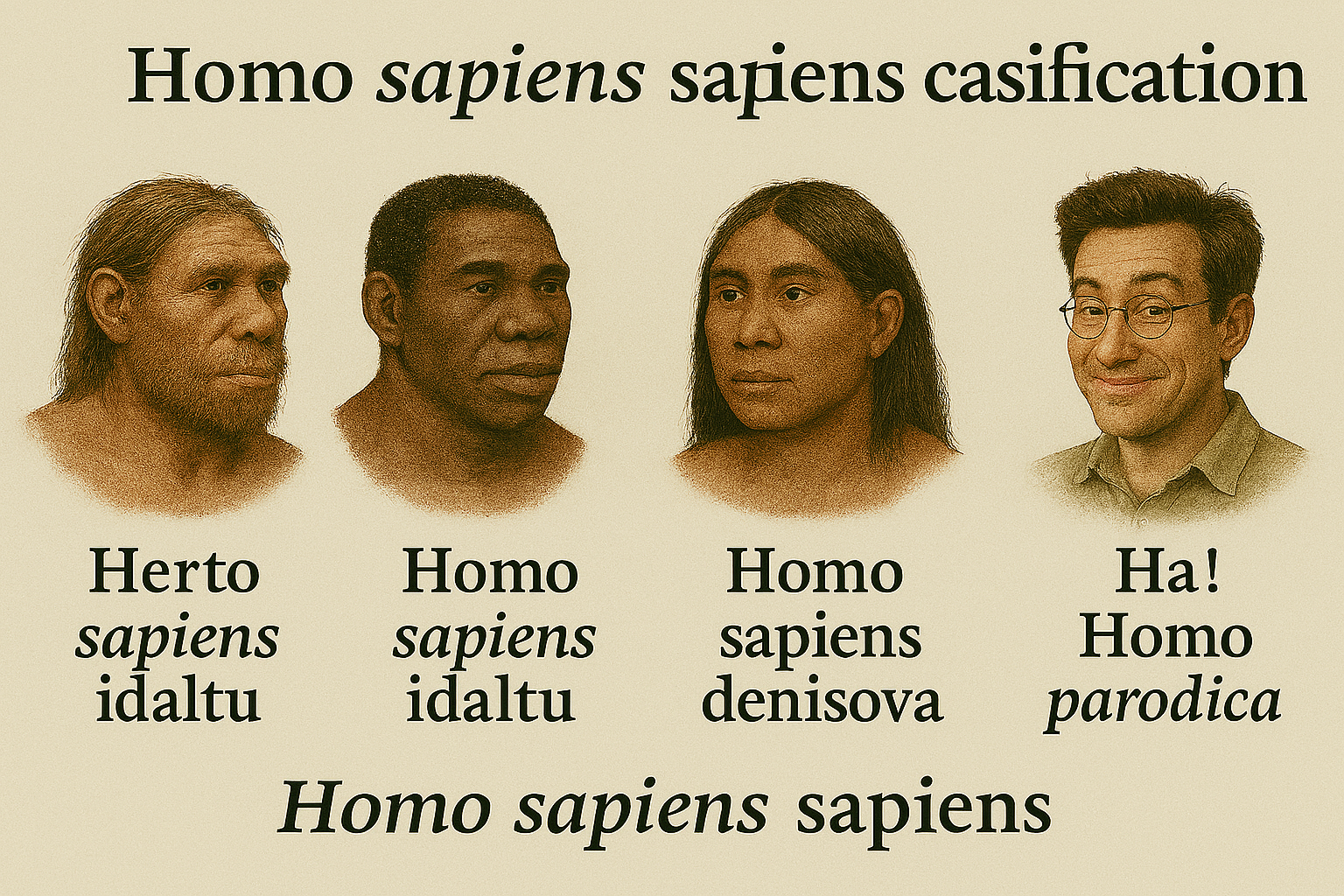
In that vein, the unsympathetic delineations of the cat would suggest there are Homo sapiens sapiens who fail the “advanced cognitive abilities, language, and complex social structures” standards put forth by biological anthropologists. They might suggest we introduce a Homo sapien confusocortex, or Confused Man, subspecies for those who haven’t evolved completely. 

These hoomans were born at full capacity, and their schooling years proved that they were able to achieve full functionality, but as with any muscle, the brain can deteriorate with lack of use. We’re not attempting to make fun of them, but there is a delineation between those who know how to operate at an optimum, and those who fail to make necessary connections.

In the cat-world, I’m not sure if they would characterize me as a human or a hooman. I think they might develop a separate category for those of us who measure up, but we enjoy disrupting the meticulously crafted model they’ve created for human actions and reactions. The cats view such joyful interference with their carefully designed understanding of human nature and its patterns with something beyond skepticism. They’re alarmed. If we watch cats in the wild, they study their prey carefully to gauge whether or not they’ll get hurt. If after examining us completely, they developed a full categorization, it might be ha!men. My brief experience with cats informs me that they don’t have a sense of humor, so it would be impossible for them to properly categorize ha!men without some form of condescending insults. My guess is they would spit out something like, the symbolic, or ironic inversion of their cultural input often critiques the very idea of cultural output, then twist it into recursive satire. Their social systems resemble Escher prints—technically sound, emotionally disorienting. “They are players, jokesters, and fools,” the cats would conclude, “and we say that in the most condescending way possible.”   
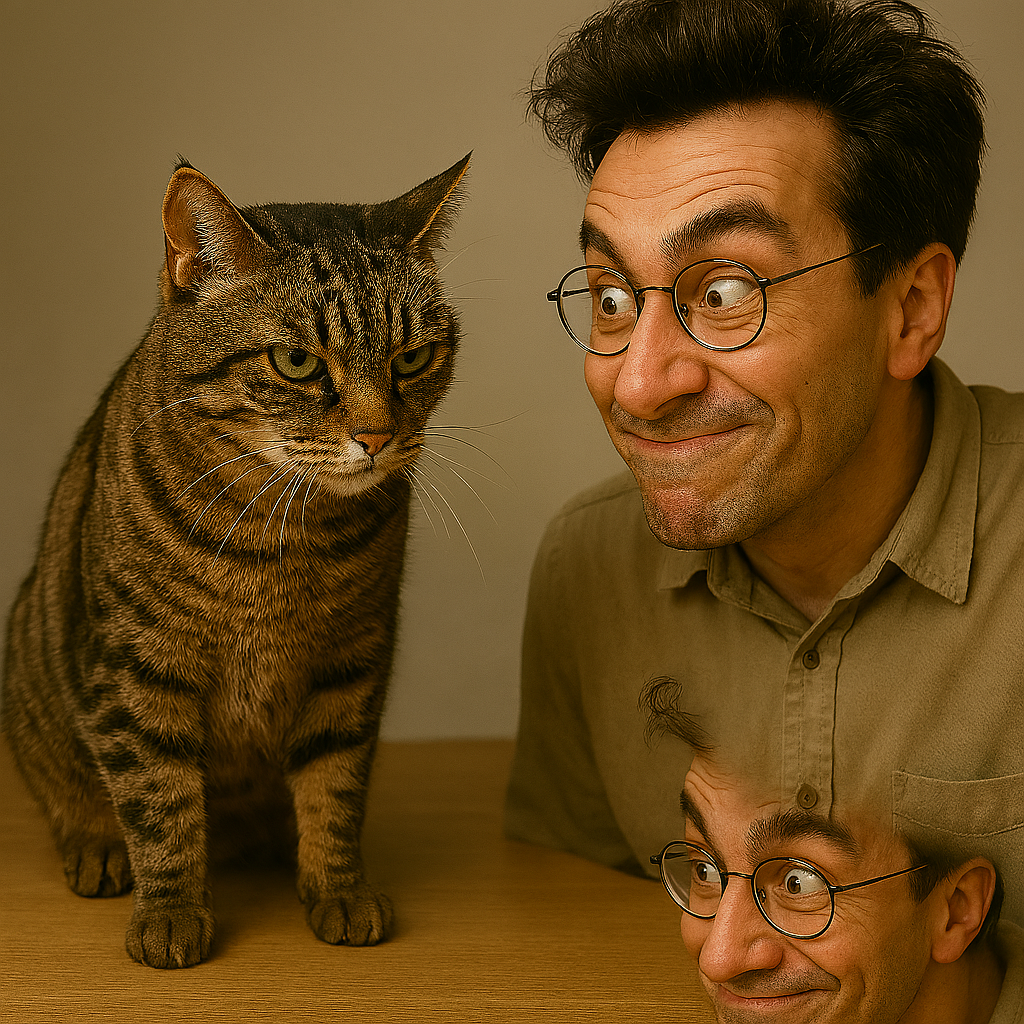
Ha!men know that pets and children create profiles of humans based on patterns, and I think cats are quite comfortable with the thought that hoomans were put on this planet to serve them. Hoomans are to provide the cat food, milk, a place to relieve themselves, and various forms of stimuli. It’s a tenuous relationship that suggests if hoomans fail to fulfill the expectations of their relationship the cat will simply go to another hooman who can. Those hoomans who fulfill expectations can, could, and probably should receive the reward of affection. They know adult hoomans need this every once in a while, and they don’t mind occasionally playing that role for them, as long as the bullet point, requirements are met.

They also know we arrive home at around 5:30, feed them and themselves, and sit before the glowing box for a couple hours before it’s time to go to bed. They grow accustomed to these patterns, the way we conduct ourselves, the way we make sounds at one another, and our gait pattern. When we meet their criteria, they might sleep or find some other stimuli to occupy them, as they probably find most hoomans as boring as any other superior would find the actions of their underlings.

I don’t know cats would characterize me, but I highly doubt they would consider me boring. I’ve been their sole focus more times than I can count, and there have been occasions where these rooms housed a half-dozen people. I noticed how cats study us with more intensity than any other pet at a very young age, and I found it creepy in the beginning. “What are you looking at?” I wanted to ask, as if that would help matters. I noticed, early on, that when I acted somewhat out of sorts it only intensified their study of me. After numerous interactions over the years, I found their study of me fascinating, and I began tweaking my actions to destroy their research.

Just to be clear, I never touched one of these cats. I just enjoyed playing the role of their anecdotal information, their aberration. I exaggerated my differences just to be different than any other human they’d ever met, just to see how they’d react. The minute the cat owner I was dating left the room, I would walk across the room in a decidedly different gait pattern. I might slow turn my head to them in the manner an alien would in a movie, and I’d repeatedly stick my tongue out at them. I might even take a drink coaster and throw it across the room in an erratic manner. The list of things I did just to mess with their heads is long, but those are a few examples I remember. I’ve found that all we have to do is act a few deviations away from the normal hooman actions to make their pupils expand with increased scrutiny or fear.

Do the same things to a dog, and they might raise their head for a second, their ears might even perk, or they might even bring us a toy, thinking we want to play. Whatever they do, their reactions suggest they’re either less alarmed by abnormalities among the hoomen population, more forgiving of those who suffer from them, or they’re less intelligent than the cat and thus less prepared for an eventual aberration that cats foresee. Cats immediately switch to alert status. They don’t care for these games. If they don’t run from the room to avoid what they think could happen, they watch ha!men with unblinking, rapt attention. Even when they realize it’s just an act, as evidenced by our return to normalcy when the woman-owner returns to the room, they continue to study us. “I’ve decided that I don’t like you,” is the look they give us ha!men throughout.

***

Suzy Aldermann wasn’t a ha!men, but we thought she was. When we heard what happened at a corporate boardroom, we thought Suzy’s portrayal of a ha!man might’ve been one of the most brilliant portrayals we ever heard. Prior to that meeting, she appeared to abide by so many of the tenets of human patterns that when she deviated, we thought Suzy was employing a recursive inversion technique known to all ha!men as the perfect conceptual strategy for dismantling normative frameworks from within.

Prior to her “full-fledged panic attack!” Suzy successfully presented herself as an individual of advanced cognitive abilities, language, and complex social structures. So, when she experienced this panic attack, this “full-fledged panic attack!” after she opened the door to a meeting room and saw Diana Pelzey conversating with her chum, we thought she brilliantly portrayed a ha!man to the uninformed. As the report goes, Suzy whispered to a friend that she would not be attending the meeting because Diana was present. “BRILLIANT!” we said. “Absolutely brilliant that Suzy would pick the least threatening person in the room to initiate her alleged panic attack!” We all agreed to keep Suzy’s ruse secret to see how it would play out, and we expected a lot of hilarious high-brow hi-jinx as a result. The joke, it turned out, was on us. We either overestimated Suzy or underestimated her, I’m still not sure which, but it became clear that Suzy decided to run away rather than up her game to match, and/or surpass Diana’s presentation. It was, according to Suzy, a full-fledged panic attack.

In the aftermath of our misreading, anytime we met a melodramatic hooman who was having a “full-fledged panic attack!” over a relatively insignificant issue, our instinctive response, based on our understanding of human patters is to think either she’s a ha!man who is joking, or she probably needs to experience some real problems in life to gain proper perspective.

Yet, when we’d talk to Suzy, she’d detail a relatively rough upbringing that included some eyebrow-raising experiences. Those incidents were real issues that Suzy had to manage, and she had to claw through the tumult to reach a resolution. The normal human progression, for those of us who study humans with relative intensity, is that when a human experiences a number of real problems, they become better at resolving them through experience. Suzy worked her way through all of those problems, but she never developed better problem, resolution skills.

We’ve all heard from other souls who purport to travel some tumultuous avenues. Wendi Hansen, for example, detailed for us her “rough life,” but when she was done, we couldn’t help but think that much of her self-imposed trauma was the socio-political equivalent of first-world problems. Suzy was no Wendi Hansen. Suzy’s issues were real and severe, and they were backed up by eye-witness testimony. Our natural assumption is that if she’s experienced problems far worse than a colleague purportedly interested in stealing her job, it would be nothing compared to what she’s experienced in real life.  

If we were to view the humans, the ha!men, and the hoomans from the perspective of the Alien Life Form (ALF), or the cat, without empathy or sympathy, we would conclude that some humans get stronger, better, or gain a level of perspective that allows them to see minor problems for what they are in the moment. Some hoomen, on the other hand, deploy the tactical maneuver of retreat, and they do so, so often that they never fully develop their confrontational muscles.

After experiencing so many different souls who maneuver around their tumultuous terrains differently, I now wonder if hoomans, who’ve experienced real problems in life, blow otherwise insignificant issues up into real problems, because they’re more accustomed to handling their problems at that level. Either that or they know if they retreat during the relatively insignificant phase, it might never progress into more severe phases. Whatever the case is, their experiences have taught them that they can’t handle problems, and as a result of retreating so often, they never do.

***

“It’s a lie,” Angie Foote told me, regarding something Randy Dee told the group.

“It’s not a lie,” I said. “It might be an exaggeration, a mischaracterization, or something he believes is true but is in fact false. It’s not what I would call a lie.”

“Barney, he told everyone that this is what he does, and I’ve seen how he does it. He doesn’t do it that way. He’s a durn liar is what I’m saying.”

Angie is what we in the biz call a simple truther. She sees everything in black and white. A truth is a truth, and a lie is a lie. There is no grey matter involved in her universe. I respect simple truthers in this vein, because I used to be one. I’m still one in many ways, but experiencing precedents in life can wreck the comfortable ideas we develop in our world of simple math and science. Facts are facts and truth is truth is their mantra.

Some of us hear a lie, and we know it’s a lie. When we’re telling lies, we know we’re lying, and we can’t help but view the rest of humanity from our perspective. When they’re lying, they know that one plus one equals two. I know it, you know it, and most importantly, they know it. We witnessed them doing one thing, and we heard them say they do something else, and they said it as if it was something they truly believed happened! How can they do that with a straight face?

My asterisk in the ointment, my new definition of a lie, is that a lie is something someone says that they know to be false. There are good liars who are so good at it that they can convince themselves that it’s true before they try to convince us. The other liars, the fascinating ones, fall into a greyer area. They don’t know they’re lying.

One of the most honest men I ever met, a Randy Dee, taught me the grey. Randy Dee told some whoppers. He told some untruths to me, regarding events that happened the previous night, and I was there for those events. 

He misinterpreted the truth so often that it affected how I viewed him. When I viewed him, and the way he’d lie, I’d watch him with the rapt attention a cat would when encountering a ha!man who proved an aberration to my study of human patterns. While involved in this study, I became convinced that we could put a lie detector on him, and he’d pass with flying colors. “He’s just a durn liar!” I said to myself. Yet, if you knew this guy, and I did, you’d know he’s not lying, not in the strictest sense of the word. By the standard of taking everything we know about lying and inserting that into the equation, Randy Dee never told a lie.

I knew Randy well for a long time. I knew him so well that I learned he was incapable of lying. He was a law-and-order guy who despised deception and all of the other characteristics inherent in criminality. Yet, by our loose standards of truth v. lying, the man was a big, fat liar.

He was incapable of detecting the lies others told him, because he just didn’t think that way. He was somewhat naive in that regard, and after getting to know him well, I considered it almost laughable that anyone would consider him a liar.

Randy Dee was an unprecedented experience for me, and I would have a lot to sort through before I fully understood what I was experiencing with him. If we took this to a social court with a simple truther sitting in the role of a judge, we would experience an exchange of “He’s lying.” ‘I’m telling you he’s not. You have to get to know him.’ “You’re over-thinking this.” ‘If you know the guy as well as I do, you’d know he’s incapable of lying.’ “All right, he’s an idiot then.” ‘If idiot suggests a lack of intelligence,’ I would reply, ‘You have to meet him to know he’s anything but.’

If this argument reached the point of no-return, one of us might suggest using a lie detector. If Randy Dee passed the lie-detector test, the simple truther would then suggest that there was something wrong with that mechanism, and there might be.

When lie detectors first entered the scene, their findings were considered germane to cases. Judges, lawyers, and juries not only thought their findings should be admissible in proceedings, they considered them germane to findings. 

“Did he take a lie detector test?” a judge might ask. “Yes, your honor,” the defense attorney said, “and he passed with flying colors.” Lie detectors eventually became less prominent, because they were deemed wildly inconsistent. How can a machine with no powers of empathy, sympathy, or any emotions differentiate between hoomens, ha!men, and humans to produce inconsistent findings? What progressions occurred? Were so many Ha!men and Hooman able to beat lie detectors so often that the machines lost their relevance in criminal cases?

Randy Dee, a man who was so honest that it seemed almost ridiculous to suggest otherwise taught me that the reason lie detectors are wildly inconsistent has more to do with the idea that we’re wildly inconsistent. We can convince ourselves of a lie, so thoroughly, that it’s not a lie anymore, and we can do it without ever trying to deceive anyone or anything in the case of lie detectors. Ha!men might do it just to see if they can defeat the machine, and its ability to detect different biological reactions, but hoomens might do it because they lose the ability to make those necessary connections that produce truth. The latter provides a wild ride to those of us who once viewed human nature in the ritualistic patterns cats will, and if we continue to view hoomens with the rapt attention a cat gives a Ha!man, until we find the truth, it will wreck every simplistic truth we thought we knew about lying liars and the lies they tell.  

The Chosen Ones? Jordan, Einstein, and “The Babe” Defy the Myths


Genius Chronicle: April 30, 1992, game three of the first round of the Eastern Conference’s playoffs, and Michael Jordan is nearly trapped in the corner of the three-point arc by Kiki Vandeweghe and John Starks. Jordan moves left and Kiki Vandeweghe drops off. Starks then baits Jordan into a trap, leading him into one of the most feared defenders in the NBA, Charles Oakley. Seeing those two Knicks narrow in for a trap into the corner would’ve led 99% of the NBA brightest stars to pass the ball. Jordan gambled. He faked left, and Starks fell for it, almost literally falling to the Madison Square Garden floor. Jordan then tucked under Oakley to take advantage of a sliver of real estate that existed between Oakley and the baseline. He straddled that baseline and dunked on arguably the most feared defender in the game at the time, future Hall of Fame inductee Patrick Ewing. If this wasn’t one of the greatest plays in NBA history, it might’ve been one of the most memorable. Jordan himself claimed it was his personal favorite dunk. Some said it was “Michael being Michael.”

Michael wouldn’t have been able to accomplish that play, against those guys, without incredible natural abilities. Yet, how many NBA stars, past and present, have been blessed with similar abilities? Jordan fans would say no one, but what separated Jordan from his peers was his ability to achieve the spectacular and the comparatively routine. He did both so well, so often, that he helped the Bulls achieve a 65.9% winning percentage in the regular season and a 66.5% in the playoffs, and six NBA Championships. Those of us who marvel at highlight reels often forget about that other half. Yet, a Michael Jordan, an Albert Einstein, or any of the geniuses of physical and cerebral accomplishment couldn’t have accomplished half of what they did without outworking their peers.

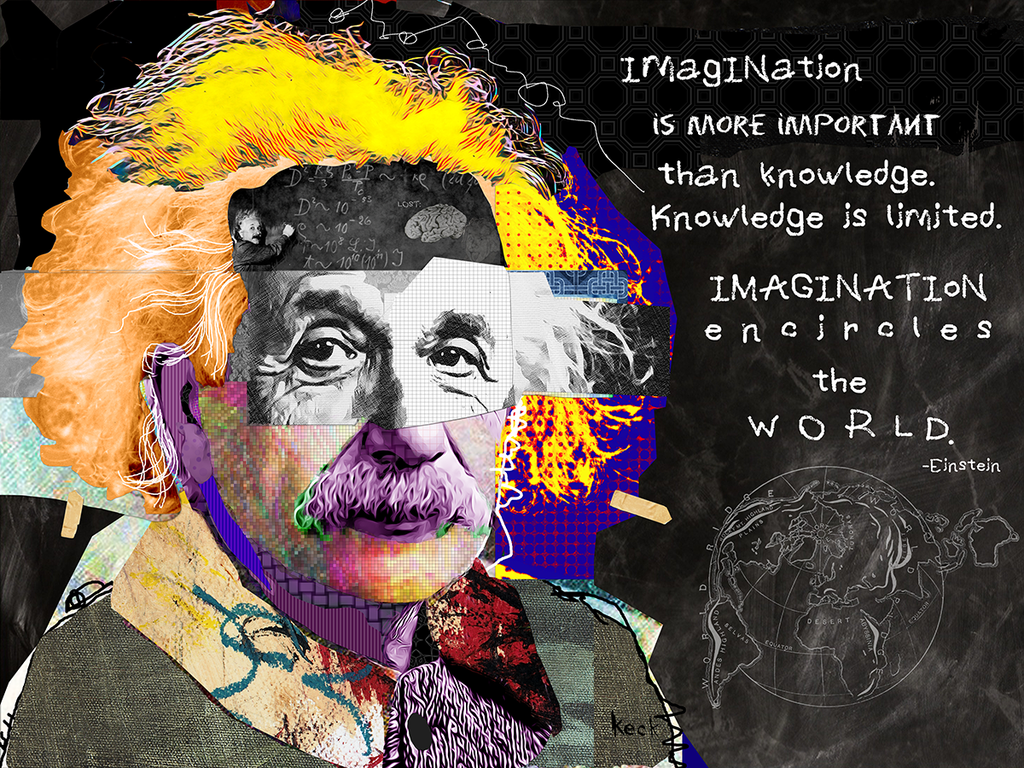
Genius Chronicle: June 30, 1905, Albert Einstein drops the first of four major contributions to the foundation of modern physics special relativity (later expanded into general relativity). The other major contributions included the photoelectric effect, and Brownian motion. In doing so, he helped fundamentally transform physics by redefining space, time, gravity, quantum theory, and atomic behavior, shaping modern theoretical and applied physics. Those who knew Einstein probably marveled at Einstein’s findings, but others probably said, “That’s just Albert being Albert.”

A line like that sounds like a compliment. It sounds like we’re saying that they’re so talented that they make the miraculous appear mundane, and we just came to expect that from them in their prime. Yet, I consider such lines reductive, because they fail to recognize their struggle to get to the point that their continued greatness was just “them being them”.

Dealing with Failure

Those who drop the “Michael being Michael” line should know that Michael Jordan wasn’t always Air Jordan, or Black Jesus, as some called him. He was cut from the Laney High varsity team as a fifteen-year-old sophomore, due to his height (5’10” at the time), his physical immaturity, and his lack of experience. Yet, how many fifteen-year-old sophomores make the varsity team? Prodigies do, and Michael Jordan thought he was just that. The coach, Clifton “Pop” Herring, later said he spotted Jordan’s potential, but that he didn’t believe the fifteen-year-old was ready to face varsity level competition. Herring basically told Jordan, he wasn’t a prodigy, not yet, and that crushed Jordan. He was so crushed that according to Roland Lazenby’s Michael Jordan: The Life by Roland Lazenby, Jordan kept that publicly posted tryout list as motivation. The young Jordan obviously sulked about it, but then he went to work. Over the decades that followed, Jordan developed a relentless work ethic that he double downed on anytime he experienced defeat.

“I’ve missed more than 9,000 shots in my career [12,345 regular season and 2,309 post-season for a total of 14,954],” Michael Jordan is famously quoted as saying, “I’ve lost almost 300 games [380 regular season and 60 in the post season]. 26 times I’ve been trusted to take the game-winning shot and missed.” This number, twenty-six, is the best-known estimate, attributed to Jordan himself, but it’s not independently verified by modern statistical databases. It likely includes shots to tie or win games in the final seconds of the fourth quarter or overtime, across both regular season and postseason. Bleacher Report estimated Jordan’s clutch postseason shooting percentage at 50% (8 of 16 attempts through his first 16 clutch shots), but this doesn’t specify total misses.

Einstein was asked to leave his school at fifteen. The school’s administrators informed Einstein, “Your presence in the class destroys the respect of the others.” He failed an entrance exam at Swiss Federal Polytechnic, and then he struggled to find work postgraduation, leading him to experience some level of poverty firsthand. His initial attempts at academic recognition fell flat when all of his early papers were either ignored or rejected, as his peers deemed his work unremarkable. Yet, how many young scientists, with no connections, are accepted into the scientific community in their initial attempts? Prodigies, or the “chosen ones” who can remove the proverbial Sword in the Stone are. Like Jordan, the idealistic, young Einstein knew he was destined for greatness, but no one else did. They were both faces in a crowd of idealistic young people who knew they were destined for greatness. 

When we read such stories about geniuses, we can’t help but think of ourselves as faces in that crowd. We thought we were destined for greatness when we were young, and it would’ve meant so much to us to be recognized as the geniuses we were, back then. Is that irrational, considering that we probably didn’t have the remarkable talent we thought we did, and if we did have any talent, we didn’t put in the work necessary to hone it? It is, but we were young, idealistic, and a little delusional back then. When we attempted to remove the proverbial sword from the stone, we realized that we weren’t “the chosen one”. Learning this hurts, but the notion that we are a lot more common than we ever thought stings. Even when it was obvious to everyone around us that we weren’t ready, we resented the guardians at the gate for not recognizing our genius. We became bitter, and we sulked. I don’t care what any eventual recognized geniuses say, they sulked too, and then they achieved greatness by using that rejection as fuel to prove their detractors wrong. Most of them had no shortcuts through nepotism, or anything else to ease their rise, and their only recourse was to just work harder than the similarly gifted.

Dealing with Rewards

The question those of us who will never be invited into the historical halls of greatness would love to know is, was your eventual, hard-won invitation just as meaningful as it would’ve been when you were an idealistic, and perhaps a little delusional, young teen? We’ve all been taught to think that success is the reward for hard work, but how much hard work is too much? When we devote so much of our time and energy to achieving greatness, sometimes we sacrifice the ability to develop normal, human relationships, we might accidentally ignore family members, and we could employ a level of tunnel vision that effectively ruins what could’ve otherwise been a happy life. Is that moment of acceptance as euphoric as we think it would be, or is it almost, in way that’s “tough to describe” anti-climactic?

Our knee-jerk response is that instant recognition would’ve stunted their growth, and the great ones probably wouldn’t be as great if bitterness, resentment, and all that inner turmoil didn’t fuel their drive. Yet, we can also imagine that there had to be some measure of “Where were you when this really would’ve meant so much more to me?” involved in their acceptance.

Michael Jordan hugged and cried on the Larry O’Brien Award the first time he won it, but those in his inner circle say that his almost ingrained sense of bitterness and resentment drove him to win five more. This bitterness and resentment could also be heard after his retirement, in his Hall of Fame induction speech.

Einstein harbored a similar sense of “smoldering resentment” toward the gatekeepers who dismissed him. In a 1901 letter to his sister, he wrote of “fools” in academia who favored conformity over originality, implying that if they weren’t so rigid he wouldn’t have had to work so hard to gain acceptance. The two of them both had chips almost biologically attached to their shoulders throughout their lives, and we can speculate that they may not have achieved half of what they did if they weren’t rejected early. They both used those early rejections to fuel their inner fire to prove their respective communities were wrong about them, but even when they did, my guess is it didn’t remove the pain of those early rejections.

The Supernatural, Natural Abilities

We’ve since limited the idea that Einstein was a genius as Einstein being a genius, as if he didn’t achieve that status. He was just different, so different he may have been a slightly different creature. We’ve studied his brain to see why he was so much smarter than everyone else, to see why he was so different that he was special or supernatural. We discovered that his brain had what they called “a unique morphology, and abnormal Sylvius Fissure, increased glial cells.” We also found that his brain “was actually smaller than average (1,230 grams vs. typical 1,400 grams), contradicting the assumption that larger brains equate to higher intelligence.” Even though speculative estimates suggest less than 1% of the population might have neurological enhancements comparable to Einstein’s, based on neurodiversity research, I still find it reductive to limit his incredible accomplishments with the idea that he had an unusually efficient brain. Why can’t we just say that all of his findings could’ve been the result of a lifetime of intense research into general and specific areas of physics? Why can’t we say that he spent so much time studying physics, persevering through the failures inherent in trial and error that he ended up developing some incredibly creative theories? Why can’t we say while he may have been biologically predisposed to intellectually brilliant findings, many others had the same cranial gifts, and they didn’t do anything anywhere close to what Albert Einstein did with these advantages. Why can’t we just say he worked harder, and more often than his peers?

We know there was nothing supernatural about what Einstein or Jordan did, but it’s just not very interesting to talk about all the hard work they put into it. We’re interested in the origins of genius, and we’re interested in the results, but everything in between is the yada, yada, yada portion of that discussion. We’d rather ask “How did they do that?” than learn about how they actually did it. It’s far more entertaining to think in terms of a “natural talent fallacy” or a “the genius myth” than breakdown the hundreds of hours they spent in a gym, or in a lab, honing their ability, or dedicating so much of their mind and energy to their profession, or craft, that when they happened to be “around”, they probably weren’t much fun to be around.

The Babe

George Herman Ruth (AKA “The Bambino,” “The Sultan of Swat”, or “The Babe”) may have been the opposite of Einstein and Jordan in that he appeared to enjoy every step of his gradual ascension to greatness. The Babe didn’t face the same substantial levels of rejection Einstein and Jordan did, but that may have been due to the fact that The Babe never felt entitled to it. I don’t think anyone would accuse Jordan or Einstein of being entitled, but whatever vagaries we apply to the term entitled in these cases, The Babe was the opposite when he was but a babe.

Babe Ruth was born into poverty, in a rough working-class neighborhood well known for crime and violence. His parents were hard-drinking saloon owners, who provided their son a chaotic, unstable, and troubled environment that led him to commit petty crimes and truancy. His overwhelmed parents sent to a St. Mary’s Industrial School for Boys, a reformatory school. While attending this school, a Brother Matthias taught him baseball, but Ruth’s talent was confined to the school’s teams, unseen by wider audiences. Students of St. Mary’s were not expressly forbidden from playing in youth baseball leagues, but his confinement to the school’s isolated campus and strict schedule prevented participation in other organized, external leagues. Thus, while Ruth excelled, he toiled in obscurity, playing on St. Mary’s team.

Ruth’s luck changed when an owner/manager of the then minor league team the Baltimore Orioles, Jack Dunn, just happened to spot The Babe’s talent in 1914, and by 1916 he was a twenty-game winning pitcher for the Boston Red Sox who pitched a one-run, fourteen inning complete game (still a World Series record) to help the Red Sox win the World Series. Every talent has his or her story on the rise to fame, and they’re littered with personal motivations, including others seeing their raw talent that needed development and those who underestimated how talented they were, but compared to Einstein and Jordan, Ruth’s rise to fame was relatively quick and smooth.  

Based on Ruth’s upbringing, we can only speculate that he didn’t view rejection in the same way an Einstein or a Jordan would. Prior to being “discovered” Ruth likely viewed himself as nothing more than a poor, dumb, reform school kid. As such, we can guess that Ruth didn’t have the social awareness or the levels of expectation they did. As a poor, dumb, reform school kid, The Babe probably viewed anyone giving him a chance, someone paying him to play baseball, and all of his numerous accomplishments thereafter as gravy. In his autobiography, The Babe Ruth Story (1948), he describes his St. Mary’s days fondly, focusing on baseball and Brother Matthias’ mentorship, not on being overlooked. His 1914 minor league struggles (doubts about his discipline) were met with defiance, not despair, per teammates’ accounts. Therefore, we can say that bitterness and resentment never drove The Babe to accomplish rare feats in the beginning, or throughout his illustrious career, but something unusual drove him on the tail end, the very tail end, of his baseball career.

Genius Chronicle: May 25, 1935, George Herman Ruth is five days away from retirement. Did The Babe know 1935 would be his last season? He may not have at the beginning of the year, but his performance was so bad (he hit .181 that year, with thirteen runs batted in, and most importantly, only three home runs prior to 5/25/1935), and his 1935 Boston Braves were so awful, and that he knew. By the time he stepped to the plate in 5/25/1935, the accumulation of twenty-two years, and 2,503 games, of Major League Baseball play were also catching up to him, as his knees were so bad that he ended up only playing 28 games for a team that didn’t even know the definition of the words in-contention. He probably spent the 1935 season depressed with the knowledge that the natural talents, the grit, perseverance, and everything that made the man who changed the game into what he know today, were all gone. He was a shell of his former self, and he was only forty-years-old, relatively young for the average human but ancient for an athlete, particularly in his era.

Even with all that George Herman Ruth stepped to the plate on May 25, 1935, against the Pittsburgh Pirates. The Pirate pitchers he faced were “respectable but not dominant”. The days when Ruth dominated headlines were long-since passed, and I’d be willing to bet that most casual baseball fans probably didn’t know Ruth was still playing by this date. This was probably best reflected by the attendance of Forbes Field that day, was a mere 10,000 attended a game in which Babe Ruth played in a 25,000-seat capacity. Few wanted to see a man many considered one of the greatest to ever play the game of baseball, because it’s always sad to watch a broken-down, old horse gallop around the track in his final days. How many of them regretted that decision afterwards when they learned that Babe Ruth managed to put everything that made George Herman Ruth “The Babe” one final time, and in one final blaze of glory by hitting three home runs, which just happened to be the 712th, 713th, and 714th of his storied career.

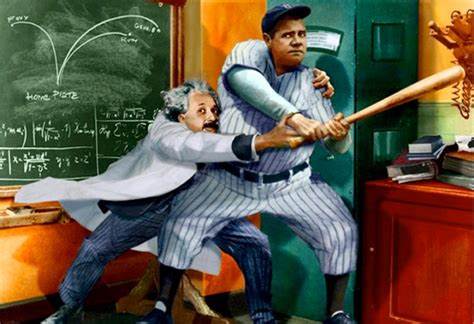
Hitting three home runs in a game is still a remarkable feat for any Major League Baseball player, but at the point when Ruth did it, professional baseball was roughly sixty-five years old, and this feat had only been accomplished seventeen times by thirteen different players, including Ruth, who only accomplished it twice before in his lengthy and storied list of home runs. Ruth would go onto only have five more at-bats in the five games left in the season, before he retired. This entry is included in this article because Babe Ruth was often called the “Most naturally talented athlete of his generation.” Fans and players alike appreciated his talent and domination of the game of baseball, but there had to be some temptation to reduce his natural talents as supernatural, as if he  just picked up a bat on a Thursday and by Friday he basically invented the home run that we all celebrate today. Some fans probably marveled at the fact that this celebrated athlete put it all together in one final blaze of glory, but others probably laughed and reduced it to “The Babe being The Babe”.  It’s just kind of what we just do. It’s human nature.

Even with all the information we have about the rise of Jordan, Einstein, and The Babe, we still attach this The Sword in the Stone characterization to them, because we love the idea of superheroes. The three of them may have been blessed with superior natural abilities, but they weren’t supernatural abilities. Yet, belief in the latter permits us to worship them, and it gives us comfort to think “they’re just different”. We prefer to avoid thinking about all the “yada, yada, yada” of true grit, unusual levels of perseverance, and all of the work they put into honing their abilities. We prefer to focus on “natural talent fallacies” and the “genius myth” that suggests their Creator was so generous with them and comparatively stingy with us when it came to dispersing talent. I have news for you brothers and sisters, the idea of a chosen one being the only one able to remove the sword from the stone is a fictional tale, and there’s no such thing as a chosen one. Gifts require honing, dedication to craft, and a level of tunnel vision that would lead many of us to grow so bored with the mind-numbing hours of practice and work these men put in. We also wouldn’t be able to deal momentary, temporary embarrassment that arrives with the level of failure they dealt with under the scrutiny of white, hot lights. Those of us who admire these geniuses from afar often characterize them as the chosen ones, and ourselves as the character Sir Kay of that book, who attempted to pull the sword and failed, because it gives us comfort to think if we were as blessed as they were, we would do the same. It’s a compliment that we deem them different, of course, but it’s also uninformed and reductive.

To my mind, the greater details of the stories of Jordan, Einstein, and Ruth remind us that greatness and genius aren’t a gift bestowed at birth, but a fire forged through rejection, toil, and unrelenting drive. From Jordan’s high school cut to Einstein’s academic snubs and Ruth’s reform school obscurity, their triumphs—whether a baseline dunk, a revolutionary theory, or a final three-homer blaze—were built on the ashes of doubt. We marvel at their highlights, but their true legacy lies in the unseen hours of grit, proving that greatness belongs to those who dig deep enough to find that elusive “other layer” so often that we develop creative theories about how it’s all so unfair.

Leonardo da Vinci’s Woodpecker


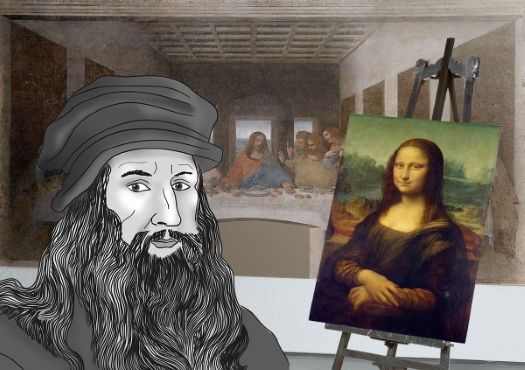
“Describe the tongue of the woodpecker and the jaw of the crocodile,” Leonardo da Vinci wrote as a reminder to himself in his Codex Atlanticus.

How many of you are curious about inconsequential matters? Let’s see a show of hands. How many of those curiosities will end up serving something greater? Some will and some might, you never know. We could end up studying something largely consider inconsequential that ends up helping us understand ourselves better, our relationship to nature, and all of interconnected facets of our ecosystem. What seems inconsequential in the beginning can prove anything but in other words, but what would purpose could the study of a bird’s tongue serve a 16 th century artist? 

“Everything connects to everything else,” a modern da Vinci might have answered. There is no evidence that the 15th and 16th century Leonardo da Vinci ever said, or wrote, those words, and it’s likely apocryphal or a 20thcentury distillation of Leonardo’s notebook passages on the unity of nature, such as the earth-man analogy he made in the Codex Leicester or water’s role in the Codex Atlanticus. So, the answer is da Vinci studied the woodpecker’s tongue to try to find a greater connection, right? Maybe, sort of, and I guess in a roundabout way. When we study da Vinci’s modus operandi, we discover that his research did involve trying to find answers, but his primary focus was to try to find questions. He was, as art historian said, Kenneth Clark said, “The most relentlessly curious.” That characterization might answer our questions with a broad brush, but it doesn’t answer the specific question why even the most relentlessly curious mind would drill so far down to the tongue of the woodpecker for answers. For that, we turn back to the theme we’ve attributed to da Vinci’s works “Everything connects to everything else.” He wasn’t searching with a purpose, in other words, he was searching for a purpose of the purpose of the tongue.

We’ve all witnessed woodpeckers knocking away at a tree. Depending on where we live, it’s probably not something we hear so often that it fades into the background. When we hear it, we stop, we try to locate it, and we move on. Why do they knock? Why does any animal do what they do? To get food. Yet, how many of us have considered the potential damage all that knocking could have on the woodpecker’s brain? If another animal did that, it could result in headaches, concussions, and possible long term brain damage. How does a woodpecker avoid all of that? Prior to writing this article, I never asked how the woodpecker avoided injury, because I never delved that deep into that question, because why would I? As with 99.9% of the world, I just assumed that nature always takes care of itself somehow. As curious as some of us are, da Vinci’s question introduces to the idea that we’re not nearly as curious as we thought.

Was da Vinci one of the most relentlessly curious minds that ever existed, or was he scatterbrained? We have to give him points for the former, for even wondering about the woodpecker’s tongue and the crocodile’s jaw, but the idea that he we have no evidence that he pursued these questions gives credence to the latter.

Did he find the fresh carcass of a woodpecker to discover how long the tongue was relative to the small bird, and its comparatively small head? Did he initially believe that the extent of its functionality involved helping the bird hammer into wood, clear wood chips, and/or create a nest. If his note was devoted to what he saw the bird do, he probably saw it perform all of these chores, coupled with using it to retrieve ants and grubs from the hole its knocking created. If da Vinci watched the bird, he probably saw what every other observer could see. It doesn’t seem characteristic to da Vinci to leave his conclusions to superficial observations, but I have not found a conclusion in da Vinci’s journal to suggest that he dissected the bird and found the full functionality of the tongue. There were no notes to suggest da Vinci found, asIFOD.comlists: 

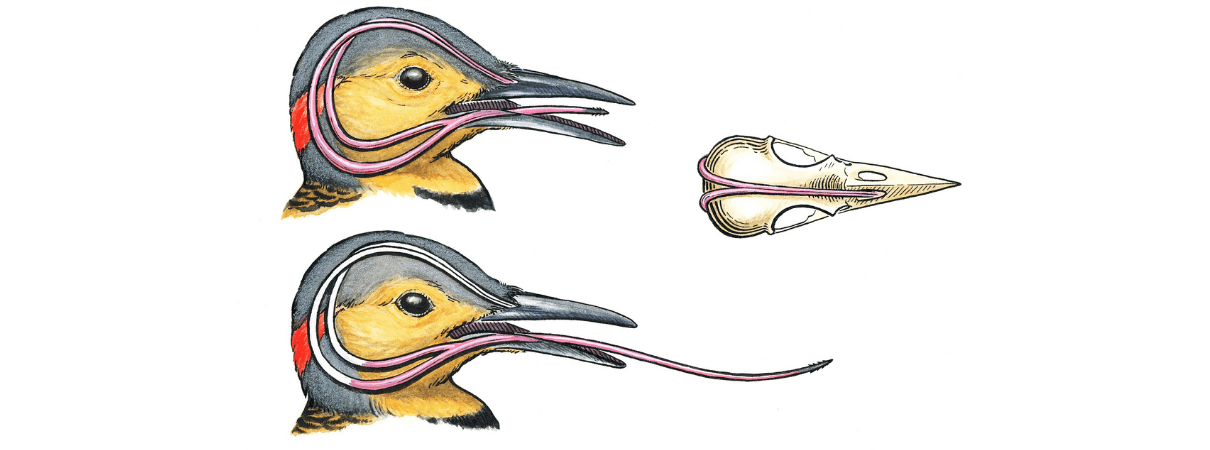
“When not in use, the woodpecker’s unusually long tongue retracts into the skull and its cartilage-like structure continues past the jaw to wrap around the bird’s head and then curve[s] down to its nostril. In addition to digging out grubs from a tree,the long tongue protects the woodpecker’s brain. When the bird smashes its beak repeatedly into tree bark, the force exerted on its head is ten times what would kill a human.But its bizarre tongue and supporting structure act as a cushion, shielding the brain from shock.”    

Brilliant musicians dive deep into sound, acoustics, and how they might manipulate them in a unique manner to serve the song. Writers pay attention to the power of words, as we attempt to hone in on their subtle yet powerful forms of coercion, and the power of the great sentence. Artists, in general, seek to achieve a greater understanding of little relatively inconsequential matters for the expressed purpose of gaining a greater understanding of larger concepts, but a study of the woodpecker’s doesn’t appear to serve any purpose, large or small.  

The idea that he was curious about the tongue is fascinating, as it details the full breadth of his sense of curiosity, but it still didn’t appear to serve a purpose. The only answer Walter Isaacson wrote for da Vinci’s relentless curiosity was:

“Leonardo with his acute ability to observe objects in motion knew there was something to be learned from it.”   

There is no evidence to suggest that Leonardo da Vinci regretted the idea that he didn’t create more unique paintings, but I would’ve. If I worked as hard as da Vinci obviously did to hone the talent he did, I would regret that I left so few paintings for the historical record. (Though he may have created far more than we know, art experts are only able to definitively declare that da Vinci created 15-20 paintings.) Thus the price we art aficionados pay for da Vinci for stretching himself so thin ( as discussed in Walter Isaacson’s Leonardo da Vinci), is relatively few paintings.

“You could say that,” we might say arguing with ourselves, “but if he wasn’t so relentlessly curious about such a wide range of what we deem insignificant matters, the relatively few works we now know likely wouldn’t have the detailed precision we now know.” If he wasn’t so relentless curious about the particulars of the manner in which water flows, and the effects of light and shadow, the techniques he employed (sfumato andChiaroscuro) might’ve taken future artists hundreds of years to nuance into its final form. Da Vinci did not discover these techniques, but according to the history of art, no one employed them better prior to da Vinci, and the popularity of his works elevated these techniques to influence the world of art.   

Arguments lead to arguments. One argument suggests that thirty quality artistic creations define the artist, and the other argument suggests that one or two masterpieces define an artist no matter how many subsequent pieces he puts together. An artist who creates a Mona Lisa or a The Last Supperdoesn’t need to do anything else.I understand and appreciate both arguments, but we can’t fight our hunger for MORE. When we hear the progressions that led to The Beatles “The White Album”, and then we hear “The White Album” we instantly think if those four could’ve kept it together, or Come Together one more time, we could’ve had more. If Roger Avary and Quentin Tarantino didn’t have a falling out after Pulp Fiction, they could’ve created more great movies together? If Franz Kafka could’ve kept it together, and devoted more of his time to writing, it’s possible that Metamorphosis and The Trial wouldn’t be the two of the far too few masterpieces he created.

The rational side of me knows that more is not always more, and that the “Everything connects to everything else” theme we connect to da Vinci’s modus operandi informed the art we now treasure, and I understand that his obsessive pursuit of perfection led to his works being considered the greatest of all time, but I can’t get past the idea that if he wasn’t so distracted by everything that took him away from painting, we all could’ve had so much more. Yet, I reconcile that with the idea that that which made him is that which made him, and he couldn’t just flip that which made him into the “off” position to create more art.

Why did da Vinci pursue such mundane matters? Author Walter Isaacson posits that da Vinci’s talent “May have been connected to growing up with a love of nature while not being overly schooled in received wisdom.” On the subject of received wisdom, or a formal education, da Vinci was “a man without letters”, and he lacked a classical education in Latin or Greek. As with most who rail against those with letters after their name, da Vinci declared himself “a disciple of experience”. He illustrated his self-education by saying, “He who has access to the fountain does not need to go to the water-jar.” He who has access to primary sources, in other words, doesn’t need to learn about it throughthe second-hand knowledge attained in text books. Da Vinci obviously suffered from an inferiority complex in this regard that led him down roads he may not have traveled if his level of intelligence was never challenged. His creative brilliance was recognized and celebrated, as da Vinci knew few peers in the arena of artistic accomplishment. We can guess that his brilliance was recognized so early that it didn’t move his needle much when even the most prestigious voices expressed their appreciation for his works. Yet, the one thing we all know about ourselves is that we focus on our shortcomings, and while we celebrate his intelligent theories and deductions, we can only guess that those with letters behind their name dismissed him initially. “What do you know?” they might have asked the young da Vinci, when he posed an intellectual theory. “You’re just a painter.” Was he dismissed from intellectual discussions in this manner early on in life? Was he relegated-slash-subjugated to the artistic community in his formative years, in a way that grated on him for the rest of his life? Did he spend so much of his time in intellectual pursuits, creating and defeating intellectual boogie men in a manner that fueled a competitive curiosity for the rest of his life? 

Even today, we see brilliantly creative artists attempt to prove their intellectual prowess. It’s the ever present, ongoing battle of the left vs. right side of the brain. The brilliant artist’s primary goal in life, once accepted as a brilliant artist is to compensate for his lack of intelligence by either displaying it in their brilliant works of art or diminishing the level of intellect their peers have achieved. Is this what da Vinci was doing when he laid out a motto for all, one he calledSaper vedere(to know how to see). He claimed that there are three different kinds of people, “Those who see by themselves, those who see when someone has shown them and those who do not see.” In this motto, da Vinci claims his method superior, which it is if one counts consulting primary sources for information, but why he felt the need to pound it into our head goes to something of an inferiority complex.

One element that cannot be tossed aside when discussing da Vinci’s relentless curiosity is that he was born into a comfortable lifestyle. The young da Vinci never had to worry about money, food, or housing. As such, he was afforded the luxury of an uncluttered mind. When a young mind doesn’t have to worry about money, food, or achieving an education to provide for himself and his family, he is free to roam the countryside and be curious about that which those with more primary concerns do not have time to pursue. Isaacson’s writing makes clear that although Leonardo da Vinci was an unusual mind on an epic, historical scale, the privilege of thinking about, and obsessing over such matters can only come from one who has an inordinate amount of free time on his hands. Perhaps this was due to his privilege, his comfortable lifestyle, or the idea that he didn’t have much in the way of structured schooling to eat up so much of his thoughts and free time in youth. 

Having said that, most modern men and women currently have as much, if not more, free time on their hands, and we could probably compile a list of things we wonder about a thousand bullet points long and never reach the woodpecker’s tongue, the peculiarities of the geese feet, or the jaws of a crocodile to the point that we conduct independent studies or dissections. We also don’t have to do primary research on such matters now, because we have so many “jars of water” that we no longer have the need to go to the fountains to arrive at ouranswers.  

Consider me one who has never arrived at an independent discovery when it comes to nature and animals, as I don’t seek primary source answers on them. I, too, am a student of the jaws of water that various mediums, be they documentaries on TV or books, but I am a student of the mind, and I do seek primary source information on the subject of human nature. On this subject, I do not back away from the charge that I’m so curious about it that I exhibit an almost childlike naïveté at times, but reading through Leonardo’s deep dives makes me feel like I’ve been skimming the surface all these years. I mean, who drills that deep? It turns out one of the greatest artists of all time did, and now that we know the multifaceted functions of the woodpecker’s tongue, we can see why he was so fascinated, but what sparked that curiosity? It obviously wasn’t to inform his art, and there is nothing in da Vinci’s bio to suggest that that knowledge was in service of anything. He was just a curious man. He was just a man who seemingly asked questions to just to ask questions, until those questions led him to entries in journals and paintings that we ascribe to the theme everything connects to everything else.