“Hey Patrick come over here and check out our sinkhole,” Hector said when he spotted his neighbor walking outside. Patrick walked over and looked, because who wouldn’t want to look in a sinkhole? He looked from a careful distance, made a comment that I can’t remember, and he began walking away. “Wait, Patrick, you really gotta see this thing,” Hector urged. “C’mere.”
“I saw it,” Patrick said. “It’s a sinkhole Hector. I’ve seen sinkholes before. It’s not a circus exhibit.”
“C’mon,” Hector said, “I’ll hold your hand, if you’re afraid of falling in.”
“You don’t understand, I will fall in. I’m just that dumb,” Patrick said, dropping his new favorite line on those of us standing around the sinkhole.
 “No, you won’t. They’ve cordoned off the dangerous spots, so we know how close we can get,” Hector said, noting that he already called the police, and they put yellow tape around the weak spots. “Just don’t cross the tape.”
“Trust me,” Patrick said. “I’ll fall in. I’m just too dumb.”
Patrick loved that line. He dropped it so often, in so many situations, that it kind of became his catch phrase. Why did he love it? I wasn’t there when he first heard it, but I wonder if he thought it was so hilarious that he would start using it. Did he think it was so hilarious because he could relate to it? Did he think it applied to him so well that he thought he should start using it? He might have started using it because he found it funny, but he began using it so often that I think he now believes it.
“Be careful what the brain hears you say,” a friend of mine said when I told her this story. “It might start to believe it.”
Others can convince us of just about anything, if they repeat it often enough, but can we convince ourselves of something if we repeat it often enough? If we hear someone else’s schtick, and we love it for being such a great, self-deprecating line, can we accidentally convince ourselves that of something like being so dumb that we might do something that could cause ourselves irreparable harm? It’s possible of course, but is it probable? I would say this is not a joke, but it probably started out that way to Patrick, until he accidentally convinced himself that not only is he dumb, he’s so dumb that if he doesn’t check himself, and his brain, he’s probably going to end up in an emergency room saying, “I told you. I told you how dumb I was. Why didn’t you listen? Why didn’t I?”
I’m not exactly sure why I considered Patrick’s “I’m too dumb” joke so funny. He dropped this line on me several times, in casual conversations, and I always enjoyed it. We’ve all heard people drop variations of self-deprecating humor, but Patrick’s delivery was so pitch-perfect that I can’t but think he believes it on some level. He was so flat and straight, and nothing about his presentation suggests that he’s seeking laughter. Does that make his joke better, yes it does, but does he deserve credit for his ability to deliver a joke, and is it possible for someone to deliver a joke that well without some belief in it?
To arrive at answers that plagues us, we need a control group. When research scientists attempt to arrive at answers regarding psychological complexities, they divide their group into subjects and a control group. Patrick is a jokester, always telling jokes, and he’s a pretty funny guy, but he has one flaw. He laughs harder at his jokes than anyone else does. To understand if he is kidding, and by how much, we need to study the methods, patterns, and reactions he has when telling his other jokes. Following his other jokes, he drops a “I mean, C’mon, right?” followed by laughter. He pumps his head back, and his eyebrows go high on his head as he laughs. When he drops his “I’m too dumb” jokes, however, he doesn’t laugh, and his head goes down in the manner a dog’s might to signify submission. Is this part of his schtick? Does he do that to sell the joke better? Patrick is funny, but he’s not that funny. He does not apply such subtle intricacies to any of his other jokes, even the other self-deprecating jokes he tells. I don’t think it would take a team of research doctors to find that the reason Patrick tells this joke so well because he believes it.
For all the reasons listed below, reasons I imagined later, this instance at the sinkhole struck me as particularly hilarious. Patrick added to the comedic nature of his joke by putting greater distance between he and the sinkhole. He walked away from Hector’s home, and off Hector’s lawn, and he then went into his home. I don’t know if he locked the door, but my guess is he did to presumably place one more obstacle for him to cross to get back to the hole. I presume Patrick did this, because he no longer trusts his brain to help him avoid an impulse that might cause him harm. Those of us standing around this sinkhole in Hector’s lawn could only presume that Patrick lost all faith in his brain’s ability to protect him from harm.
I flashed to Patrick falling in the hole, a near bottomless pit in Patrick’s imagination (it was about three feet deep), looking up at us saying, “See, gawdangit, I told you how dumb I was.”
 “Listen, I have two kids to raise, and they count on me to be there for them in so many ways,” I imagine Patrick pleading if Hector pressed him further. “If I start following whatever impulses my insufficient brain provides, I’m going to leave my wife a single-parent, and I’m not going to do that to her or my beloved children. I have to learn to reject whatever temptations I encounter to protect my body, so I’m there for them throughout their maturation.”
We’ve all heard psychologists talk about a person being at war with their brain. It’s a deep, complex topic they use to describe those with seriously troubling psychological issues. Patrick doesn’t have those, but he does appear to be in conflict with his brain on a level that he describes with repetitive jokes. At one point in his life, I think Patrick decided to wage a cold war against his brain. A cold war, by our definition, involves “threats, propaganda, and other measures employed just short of open warfare.” Or, as others put it more succinctly, “Waging war without firing a shot.” At some point, Patrick’s internal forces decided to mount an internal coup against the brain, because those mechanisms decided that the brain no longer had their best interests in mind.
One of the primary directives of the brain is to protect us. It protects us from heights, guns, and the prospect of encountering large, man-eating animals through chemical compounds that induce fear. When we fear, we learn to employ various defensive measures, including creating distance from the temptation, to prevent what the brain suspects could cause bodily harm. Over the years, we learn what to eat and drink, and what we do and think to prevent bodily harm. The brain instinctively knows, and learns, what can cause death. What isn’t so obvious are the irrational fears we develop for the dark, ladybugs, and inanimate objects.
 Why are we so afraid of insects, even relatively harmless insects such as the ladybug, at a young age? We don’t know what a ladybug is when we’re young, or if we do on some rudimentary level, we don’t know the extent of their abilities. This is the fear of the unknown. As we age, we learn that most animals and insects have an instinctual fear of humans, and it provides us a level of comfort when we’re walking down the sidewalk, and they clear the way for us. Some of the times, insects occasionally land on us in their confusion, and our young, fantastical mind can interpret that as purposeful, especially when the ladybug begins to crawl up our leg in a manner we could further interpret as a purposeful violation of the parameters we thought we had with insects. We convince ourselves that they’re not afraid of us anymore. They’re crawling up our legs with a specific purpose in mind that we don’t even want to imagine, and that leaves us paralyzed with fear.
At some point in our maturation, our brain learns the parameters of threats against the body. There’s nothing to fear from ladybugs, even those that appear to violate the parameters of the relationship we have with insects. We’re quite sure that there are some anecdotal tales of a ladybug causing human deaths, but they’re so few that we know there’s little to fear from them. There are, however, a number of tales told of spiders causing death, but not as many as those from the mosquito archive. Yet, the number of people who fear spiders far outweighs those who fear mosquito. The whole world of fearing spiders involves their creepy nature, their physical appearance, and the techniques they use to poison their fellow insects and eat them.
At some point in our search of what to fear and what we learn is relatively harmless, the brain plays tricks on us. We fear the relatively harmless, clowns and cotton, yet we don’t fear some of the things that can actually harm us, and kill us, like driving ninety miles an hour down the interstate.
“I like to tease my fears,” a friend told me. “I prefer to live dangerously. It’s a rush to put your life on the line by skydiving from a plane, or bungee jumping, and bungee jumping is actually a lot more dangerous than people know.”
“So, you consider jumping from 50 to 500 feet with nothing but a cord tied to your ankle dangerous?” I asked sarcastically. The fact that she felt the need to tell me that bungee jumping was dangerous suggested to me that most people she knows have tried to argue against her position, and if that ain’t the brain messing with people, I don’t know what is.
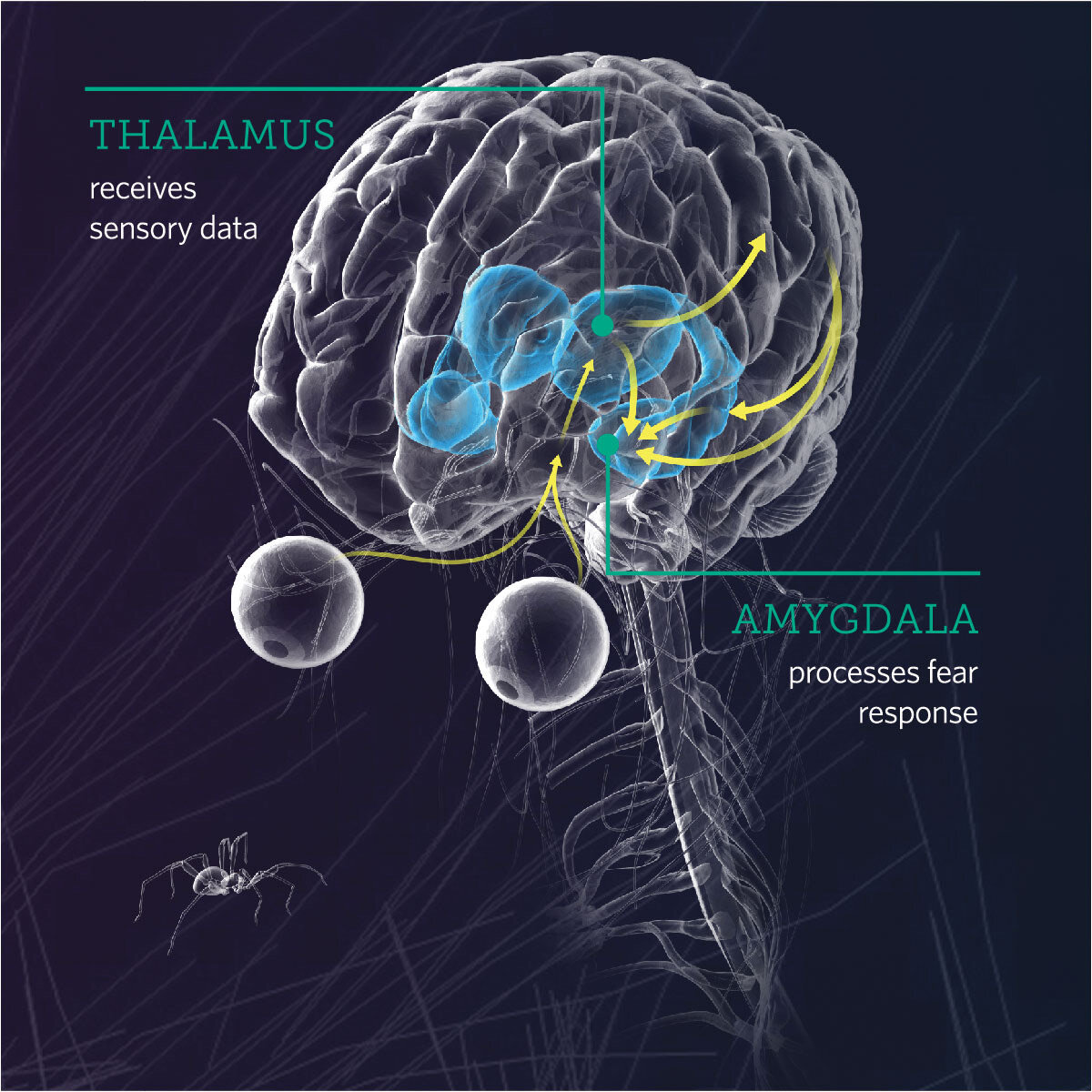 Patrick’s brain has obviously spent a lot of time messing with him in this manner, trying to convince him that nothing is as dangerous as they say, and his brain has obviously done this so often that Patrick just doesn’t trust it anymore. We’ve all heard that those working a police beat believe half of what they see and none of what they hear, but I’ve always assumed that was intended to illustrate their trust of what others do and say. Others can deceive us into accepting what we know is not true, but can we do this to ourselves? Are we at war with our own brain in relatively benign situations such as our approach to a sinkhole? There’s knowing and not knowing, of course, but as Patrick said he’s seen sinkholes before, so he presumably knows how to approach it. He just doesn’t trust his instincts, and he’s skeptical of what he might do.
We all engage in self-deprecating humor, and we all enjoy the fruits of a person showing that he doesn’t take himself too seriously. As I’ve written many times and many ways, be careful with this comedic tool, because your audience might begin to believe it. Patrick’s use of self-deprecating humor seemingly adds another layer of caution, be careful how often you use it, because you might start to believe it.
Patrick is not a dumb man, and if we are ever tempted to join him in the belief that he is, all we have to do is talk to the man for about forty-five minutes to learn how knowledgeable he is on so many different and diverse topics. Somewhere along the line, Patrick heard someone say that they were “so dumb” that they might not be smart enough to prolong their health and well-being. Patrick obviously considered that so funny that he began using it, and he saw how this exaggeration of the typical self-deprecating joke comforted his audience. It obviously comforted him too, to a degree, to think that he wasn’t all that. At some point, he began to fear that he might actually be “so dumb” that he could find a way to convince himself that he might cross that yellow, police tape to end up in a bottom of a sinkhole without knowing how it happened or why he did it, because his brain is now so deficient that it might lead him to him harming himself in some life-altering manner. Faced with such internal strife, Patrick decided that it was just safer for him to walk away, enter his home, and lock the door to try to prevent his kids from being fatherless children. “Trust me, I will fall in,” he warns us, and presumably himself, “because I’m just that dumb.”
 Rilaly