Silly Super Sports Fans Saying Stupid Stuff 


“Sorry fellas, I’m just sooo competitive,” Mark said after yelling as loud as he could in a public bar. He yelled because the other team just made a basket to clinch a victory over our team in game we were watching on the television set. His yell temporarily silenced the bar, so I assume his apology was partly genuine and partly based on embarrassment.

Men are biologically predisposed to respect other extremely competitive men, so when he said he yelled because he was “sooo competitive” we felt biologically required to understand. The sticking point for me is that Mark is old. He is a couple generations removed from being so loaded with testosterone that it occasionally boils over the top into the public. He’s so old that employees at Arby’s give him the senior citizen discount without even asking, yet he’s still “sooo competitive” that he can’t control his impulsive need to scream indecipherables at images on a television set.
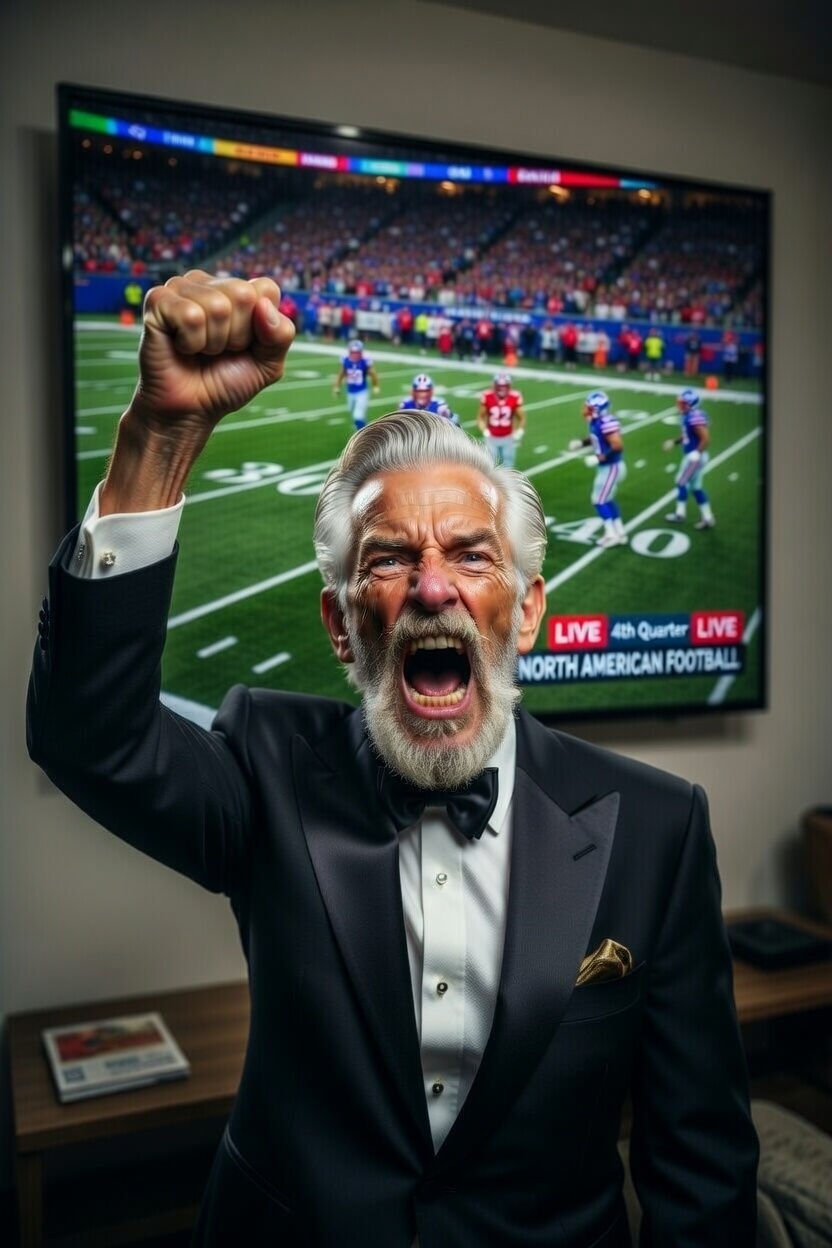
‘Is that odd, or is it just me?’ I asked myself after Mark screamed. I didn’t care that everyone else acted like Mark just asked for extra cheese on his mashed potatoes, it was odd. I couldn’t accept this as a natural reaction to our favorite team losing. I couldn’t accept it as something we’ve all seen fans do, things I’ve done, so often that it’s become socially acceptable. I’m sure those who dismissed as an extra cheese considered it part of the package we all buy into when we decide to watch a game in public at a bar: We chose your bar to watch our game, we paid your cover charge, and we spent all this money on your alcohol, so if our team loses we reserve the right to scream like a lunatic in your establishment if we lose, because we’re “sooo competitive”. 

Not only is Mark old, he’s so well put together. The women I know report that he is a good looking man who knows how to wear a shirt. He’s also well-spoken, successful, and he displays an otherwise healthy, happy demeanor. If we asked long time bar employees to bullet point the typical indecipherable screamer, there would probably be a lengthy, inconclusive list, but we can guess that Mark wouldn’t fit of any of them. Watching Mark do that, opened my mind’s eye to how foolish I must’ve appeared after screaming like an idiot the minute the fellas wearing my favorite laundry, fail to make as many baskets as the fellas in the other laundry.  

At this point in my description, Gary, the line cook, would cut me off in a way he often cut me off to suggest I’m taking too long to get to the point: “It’s funny when someone makes an ass out of themselves in public.” It is still funny, and I don’t care how much societal and cultural pressure they apply, we’re still going to laugh when someone acts like that. It’s the ‘it’s funny, get over yourself’ level of comedy that will probably never be entirely vanquished. When Mark screamed like that, he silenced the entire bar of patrons momentarily, as they probably assumed it was a cry for help from someone having a heart attack. If Mark laughed after doing that, comedically implying that he was imitating a twenty-something reacting to a loss on TV, it probably would’ve been humorous. The fact that Mark genuinely had such trouble controlling his impulses that he felt the need to apologize for it, felt like another level of comedy. It felt like a level that unintentionally commented on itself with a sprinkling of irony and cleverness on top. 

It is funny when people do foolish things, but when someone does something that informs us what we look like when we do foolish things, its a level of comedy that is so funny we don’t laugh or even smile in the moment. It’s a level of comedy that if a professional standup comedian properly deconstructed it and simplified into a three-beat punchline, it could change the manner in which all super sports fans react to soul-crushing losses by their team. The rest of us are better off trying to pretend it never happened, or ignoring it.

So, I wondered if I accidentally silenced a bar with a loud, obnoxious scream, and they thought I was so old that I might be having a heart attack, would I say something like, “I’m sorry I’m just sooo competitive” as an apology for my over-the-top reaction.

The reaction I did not give voice to was, “Who cares if you’re sooo competitive? You’re not playing, and you don’t have kids playing in this game. No one cares if you’re watching this game with a sense of competitiveness attached to it, or if you’re just watching it passively.” What would I do if someone said that to me following a similar outburst? I would probably consider the idea that I need to seriously reevaluate how I react to watching my teams on TV.

The funny thing is when Mark and I watch our sons play baseball, Mark cautions me about going overboard when I react to my son’s errors. “They’re just kids,” he says. And he’s right, but the young men playing on our favorite basketball team are young enough to be his grandsons.

Any criticism I direct at mark should be asterisked with the notion that he and I are far too similar for my tastes. As I wrote, seeing someone act foolish is funny, but seeing someone mirror the manner in which we’ve acted foolish silences us because we don’t know if our laughter is self-referential, ironic, or a meta moment that circumvents our definition of humorous in a manner that makes fun of us. 

I, like Mark, considered it a testament to my character that I refuse to accept mediocrity from the players on my favorite teams. “It says a lot about you that you’re willing to accept just being in a championship game. You should refuse to accept anything less than that ring.” Those are the type of things we super sports fans say to one another, and when I say we, I’m talking about everyone from my inner circle to talking heads on sports shows, to commentators on message boards. We all preach such platitudes so often that they became gospel to those of us watching sports on TV. 

You do understand that I was not playing in that game, right?” is a reply I learned too late in life to use against those who badger me about my team’s failures. I don’t know where I heard that, but I wish I learned it earlier. It would’ve saved me from the emotional turmoil I experience when someone calls me out. Anytime I watch a game, I want my team to win, but I also don’t want to face those who love to badger me when my team loses. I use this line now when some idiot confronts me with the fact that my team “WE” just lost a crucial game, and Ive just recently added, “And I realized, with about two minutes left in the game, there was nothing I could do.”

Of course I want my team to win that championship game, I want my team to win every single game, but what are we supposed to do when they don’t? What do I do if they do? It turns out, I’m not playing in that game, so it really doesn’t matter what I do, it doesn’t matter what I think, and it doesn’t matter what I punch, who I insult, or what I scream in the aftermath. That score will not change. If you need this therapy as much as I did, repeat after me, “If my team is in a championship game, it’s the team I chose to support that is in there. It’s not me.” Some of us need to create some distance from the “WE” mind meld we’ve created with our favorite teams that nearly exceeds beyond the vicarious enjoyment and misery we experience watching sports. We need to mentally rewrite what we super sports fans say to one another when we’re watching sports on TV. “It says a lot about you that you’re willing to accept that your favorite team is in the championship game. You should want your favorite team to win that championship game.” If you’re on the outside looking in, and you see this article as so obvious that it’s kind of funny that it took us so long to see it, we applaud you for your happy, healthy outlook on watching sports. Some of us take far too long to get there.

I was already about 70% of the way there when Mark screamed indecipherables at the bar, but that episode absolutely clinched in for me that when we’re on the cusp of the senior citizen demographic, we should start to distance ourselves from the “WE” mind meld we have with our team. When the players on our favorite team are all young enough to be our grandchildren, it’s probably time to cut the frayed tendrils of the leash we have on the idea that we’re still a part of the team. “WE” can’t help it, because we’re “sooo competitive.” “WE” love our team so much that when we watch them on the screen “WE” know when we need to run the ball more often, “WE” know when we need to put the ball in the paint more, and “WE” know what everyone else knows … we really need a hit here.” As hard as it is to accept the realities of age, it’s probably time we stop wanting our team to win so badly that we scream gibberish, hundreds of miles away from the players, in a bar of unsuspecting customers after “WE” make a horrible mistake. It’s probably time we accept the fact that it doesn’t really matter how competitive we are while watching sports on TV? We don’t have to accept the idea that second place is good enough, or that our team had a “good” season, a “good” game, but if we have good kids and grandkids, and we’ve lived a great life, the idea that that some kid dropped a ball is no longer going to cause me to scream something in a bar. I honestly don’t remember doing that, but if I did that part of my life should probably be over now. 

I did get that “NUTSO!” when one of my fellas “WE” dropped the ball, but I did it in the privacy of my home, and I now see that I did it in conjunction with how satisfied I was with the direction of my life. When things weren’t going as I planned, I was a rager. I never harmed myself or my appliances when watching the methodical destruction of my team, or when playing video games, but I was probably pretty miserable to be around. I scared my dog, and my wife no longer enjoyed watching sports with me. Now that I’m more satisfied with the general direction of my life, I’m finally starting to see how foolish it was that I got SO UPSET!!! over a group of guys young enough to be my grandchildren wearing my favorite laundry, losing a game on a television program. I love sports, always have, always will, but I don’t know if I ever really enjoyed watching sports.

“Ok, but if we’re going that deep into underlying psychology, we could say that screaming about a team losing a game is actually quite healthy,” this sports fan once said when called out for my unreasonable displays of frustration and anger. “As you said, we could probably draw hysterical reactions to matters we cannot control with the dissatisfaction he have with the life we lead that we ostensibly have more control over, but those reactions usually manifest in one way or another. Couldn’t we say that yelling at anonymous figures on a screen, be they characters in a video game or in an athletic contest, is actually a no harm no foul way to vent frustrations in life? It’s better than yelling at the wife, the kids, or the dog. If you think the universe is against you, and your favorite teams, beating the furniture, throwing the remote control across the room, or screaming out in public bars are examples of healthier ways to deal with our frustrations in life, at least when we compare them to the alternatives. If we do it right, it can be quite cathartic to be a silly, stupid sports fan.”

“If you do it alone,” I concede. The cathartic effect is all internal, so you might want to create a man cave, tell your family you don’t want to be bothered for three hours, pour your favorite drink, eat your favorite snack, and surround yourself with inexpensive fixtures to undergo your therapy. Or, you might want to consider a more nontraditional, modern method of watching sports: tape it. I know this violates a number of the commandments of the super sports fans bible, but if you have some issues dealing with your team losing that your wife characterizes as unhealthy at times, tape the game, wait until it’s over, find the final score before watching, and just enjoy watching the victories. This might defeat the whole purpose of pursuing therapy through hysterical tirades, but seeing final scores on a phone amounts to seeing numbers as opposed to the vicarious condemnations of character we experience when witnessing our team’s slow progression to failure. Mistakes and miscues during a game are also a lot easier to deal with when we know our fellas will eventually overcome them and prove victorious.  

Needless to say, the reason Mark’s over-the-top reaction affected me so deeply is that if we dismiss the time and place argument, Mark and I are lot more like-minded than I’d care to admit, I admit. We are silly super sports fans who say and do some incredibly stupid things watching sports on TV. The man did give me perspective though, as I now see how foolish I used to be. I thought about some of my bizarre reactions, my hysterical tirades, and about the nonclinical periods of depression I’d go through in the aftermath of a disastrous defeat of my teams on television. The old talk show host Phil Donahue once asked how sports fans do it, “Isn’t it enough to have women break your heart? Why would you welcome more pain into your life?” That probably sounds hyperbolic to non sports fans, but I’ve had sports teams cause me far more pain than women have. Then, after one of my teams finally FINALLY won a championship, I remained purposefully and stubbornly unsatisfied, because I immediately began to focus on next year. If you know a true super sports fan, you know that “Next year” is their refrain. Win or lose, it’s all about next year. We might raise our fist high, scream indecipherables, and maybe cry a little when “WE” win a championship, but if you’ve ever been at a championship-winning table at a bar of screamers, you’ve seen those screams stop and talk about the natural attrition of losing talent, and how “WE” were going to replace them, if “WE” hope to have a chance at a repeat. Then, when “WE” repeated, “WE” wanted a three-peat, and “WE” were miserable when it didn’t happen. Being a super sports fan should be fun and enjoyable, but it’s not if you’re purposefully and steadfastly never satisfied, and you take it as seriously as I did, it can actually make you a little miserable. The only antidote is to understand that you’re not playing in the game, and in sports, no one can hear you scream…if you’re in a public bar that is 897 miles away. 

My Futile Fight to Divorce the Atlanta Falcons


“Are you going to watch the NFL draft tonight?” John asked me.

“Of course,” I said, “and I’ll probably shout, ‘I want a divorce from this Gawdforsaken franchise’ again this year. It’s an annual tradition in my household.” 

Are you strapped into the fandom of a futile franchise? What do you mean strapped? The first image we have of being strapped in” is that of a pilot, heading upward in for a flight into the wild, blue yonder. Now picture a pilot being strapped into a vessel headed downward. That is the futile flight the passengers on board the Atlanta Falcon have experienced lo’ these many years. 

Why do I continue to cheer the Atlanta Falcons on forty-eight years after I randomly chose to cheer them on when I was nothing but a seven-year-old, stupid kid who randomly pointed at them and said, ‘That’s the team I will cheer on.’ 

“You don’t choose your favorite team,” says a sentiment in Korean sport, “your team chooses you.” I get that, if we’re from Foxboro, Santa Clara, Cleveland, or the surrounding areas, it kind of makes sense. We have regional pride, personal history, and social bonds formed by everyone who forced us to cheer on the local team. What if we’re from an area, three to four hours’ drive time from the nearest professional organization, how they choose us? 

I was seven-years-old when I chose the Atlanta Falcons as the team I would cheer on for the rest of my life. I didn’t choose to cheer them on for the rest of my life, but that is what happened. The stadium the Falcons call home is fourteen hours’ drive time from where I live, I didn’t know anyone who cheered them on, and I’ve met very few fellow fans since. My dad didn’t know much about professional football, and he admitted he’d barely even heard of the Falcons. The Falcons also didn’t have any of my favorite college football players on their roster at the time, and they’ve only had a handful of them since. I had little-to-no connection to the Falcons at the time, and I still don’t in all the ways we’ve outlined here.

We All Like Winners

The first thing the uninformed, unaffiliated seven-year-old fan routinely does is cheer on the team their dad does. If they are unable to formulate that connection, they choose to cheer on one of the closest teams they can find. The final determining factor for them is the success of the team. When you’re seven-years-old, your favorite team says a lot about you, and you want people to think you’re a winner. In the 70s, everyone’s favorite team was either the Steelers or the Cowboys, or if you were naughty, you cheered on the Raiders. Those teams were the winners in the late 70s, our formative years, and everyone I knew selected one of those three teams. I met a few Vikings fans, but the general sentiment on them was that they weren’t good enough to win the Super Bowl. I knew one Dolphins fan, but he received some grief for cheering on a franchise whose time had passed. 

I decided to cheer on a team who didn’t have a past, a present, or future. A website called Quick Report lists the Atlanta Falcons as the fourth worst NFL franchise of all time.” Another outlet called The Top Tens rates the Atlanta Falcons franchise as the 46th worst franchise in professional sports.

My favorite characterization of me is that I chose a team, independent of any influence, as a testament to the strong sense of individuality I obviously exhibited at a very young age. They were mine, all mine, and I didn’t have to share them with anyone, because no one else wanted them. Did I have an enviable streak of individuality at a young age? I did not when it came to books, music, movies, and other entertainment mediums. I liked what the cool kids told me to like, and when they turned on those players in the industry, I turned with them. I was not immune to peer pressure by any means, but I chose to thwart it in this one instance. Does that make sense to you, because it doesn’t to me. 

The only theory I have that makes any sense is color. I liked the pretty colors they wore on their uniforms. The Atlanta Falcons franchise chose to wear Red, white, and black. These were the same colors as my favorite college football team, the team that represents my states, and the university I attended. I’ve only purchased four cars in my life, all of them were either red or white, with black trim. Those colors obviously appeal to me. If you’ve followed the history of the Falcon’s uniform choices, however, you know they’ve switched the color of their uniforms from black and silver to now black, red and silver. I didn’t switch with them or from them. Why?

Philosophical and Emotional Layers

The next logical entry is the “lovable losers” tag that we used to apply to the Chicago Cubs franchise. I submit that the worst business move the Cubs ever made was winning the 2016 World Series. Why, because a large segment of the nation, outside Illinois and the surrounding region, cheered the Cubs on because they were lovable losers. They won the World Series in 1908, and they waited 108 years to win it again. Five generations of Cubs’ fans knew nothing of championship rings, and they loved it. They loved it so much that if we were to talk about their latest losing streak, their foibles in the post-season, the Cubs’ fan might chuckle with us. They knew all about it, and they loved it so much it was almost a crafty marketing gimmick, enhanced by the stories of jinxes, including the Curse of the Billy Goat, the Black Cat Incident, Steve Bartman Incident, and the Bernie Mac Jinx. The Falcons are nearing sixty-years as a franchise, and the franchise has the Eugene Robinson incident and, of course, 28-3. 

If the Atlanta Falcons fan, the WE, can make it past 28-3, what does that say about us? It suggests resilience, loyalty, and a sense that we’re all sharing in the struggle. Unwavering support is a badge of honor. If you’re a superfan, it becomes a part of who you are. It’s not just a preference, or it no longer is, it’s a reflection of your values, memories, and experiences. I becomes we, they becomes us, and those guys become our fellas fighting in the fields for glory. 

“I think we’re going to draft an Edge rusher this year,” we say, “because that’s been our greatest need for almost a decade.” Again, I know very very few Falcons’ fans in my locale, about fourteen-hours’ drive time from my home, so when I say, “we” and “us,” I’m not sharing a perspective with anyone I know, except the far-flung writers on a Falcons message board.

When a team like the Falcons become us/we, the theys on message boards drop “28-3!” on us in a snarky, smug way that attempts to force us to probe the tapestry of our being. The truly sad thing is that it took me a while to realize that the personal pain I felt, after that infamous choke job, was actually and factually absurd. It took me a while to realize that I wasn’t actually on the field, missing a crucial block, throwing a crucial interception, snapping the ball with too much time on the clock, and electing to pass rather than run. I didn’t personally do any of that, I see that now, but I didn’t see that their (not our in this particular case) loss was not a reflection on my character. I actually had nothing to do with that loss. If it’s hard for you to grasp the idea that a rational, logical person couldn’t easily separate himself with the failure of images of football players on TV, you’ve never been, or known, a superfan.    

As difficult as it can be for a superfan to disentangle himself from the emotional entanglements that emphasize his existence, I am making strides. I now write things like this, “I realize I know little-to-nothing about the day-to-day decisions on personnel and any of the intricacies involved in their decision-making process. I’m not there for the day-to-day, I don’t see these players in practice, and I don’t know them personally.” I wrote on “our” Atlanta Falcon’s bulletin board, “but I think the decision they made was a mistake.” In that disclaimer, I effectively gained some psychological distance from the ‘us, we, and our’ lexicon we superfans usually use. 

I dropped that disclaimer on the billboard page many times, because I was trying to objectively say that I know my opinion is not only relatively and comparatively uninformed, and I know my opinion doesn’t matter, but I have to write it somewhere. No one ever replied to any of my posts. My guess is that this disclaimer might have been a buzz kill, because we all kind of know we don’t know squat, compared to the owner, the GM, the coach, and all of those in the hierarchy responsible for personnel decisions, but no one admits it. Such a disclaimer might also “pop” the delusion that we all know what we’re talking about, because we read it, watched it, and saw it in the games, so we know. Their ambivalence to my posts might also have something to do with the idea that it’s so obvious that we don’t know what we’re talking about that it really doesn’t need to be said. 

Here is another element to the post 28-3 Falcons’ loyalty, if we’re going to vicariously partake in whatever glory they achieve in victory, we must also commiserate with them in pain. Wrong, watching football on TV is supposed to be something we do to pass the time, and it should provide entertainment to our lives, nothing more and nothing less. Wrong, it’s not entertaining, it’s football. It’s not life and death, and some part of me knows that, but it’s often the difference between a smile on the face for the rest of the week, and a “We suck!” Mr. Grumpy Face week. 

“I look forward to [the offseason],” a man named Ryan Ray says in the GQ article cited aove, written by Tom Lamont. “The six to eight weeks when I don’t have to focus on anything to do with this football club. I long for it.” Ray also said, “Sometimes I wish I could just sit there without any bias [while watching a game], without any interest—but it’s not me. I’m tribal.”

I’ve been there Ryan Ray, and I feel you. I’ve watched numerous football games involving other teams, and I know how entertaining this game can be, when I have no rooting interest. I wish, like Ray, I could have fun watching a Falcons’ game and appreciate them from a distance. I wish I could sit back and appreciate the athletic exploits of Falcons’ players the way normal folks do, but when Falcons’ players succeed it’s nothing more than a relief that they didn’t fail yet again. I marvel at other players play at peak performance where the difference between winning and losing can be mere inches, or the subtle juke the runner puts on a defender that only a true fan of the sport can appreciate. When it’s all on the line, and my bias is in full force, I only experience abject failure, misery, and roughly three hours of what it must feel like to have clinical depression.

“If they make you so miserable, why don’t you just switch teams?” the non-sports fans might ask from Mount Simpleton. My dad asked me this question referencing the video games that made me scream like a lunatic. “If they make you this miserable, why don’t you just shut it off?” We laugh so hard at his simple-minded question that we didn’t even bother answering him. He didn’t get it. ‘You can’t just shut a game off, because you lost,’ was probably what we should’ve said. ‘That’s the whole reason we keep playing, to eventually and finally beat it. If you’re a gamer, you know this mindset without knowing that beating a game easily and often is actually kind of boring. If you can find a game that is so hard IT CHEATS! that’s the game you will play, to figure out, forever. We don’t quit working after we make our first million, that’s just the start, we don’t dump a lover when they start acting obnoxious, because their drama kind of, sort of makes them more dramatic, traumatic, and interesting in a way thats tough to describe, and we don’t stop cheering for a professional sports team just because they’re 114 games under .500, and 10-14 in the playoffs without a ring. That’s the very reason to continue to cheer them on for life, because it says something about our character that we stay loyal to them no matter what. “NO MATTER WHAT happens!” Even if it means upping our Tricyclic Antidepressants (TCAs) and Monoamine Oxidase Inhibitors (MAOIs) on those three special Sunday hours. It’s all worth it. “No, it’s not!” It is to me, is what I’m telling you. Wait, what we’re talking about again? Oh right, shut up!  

We’re passionate “prisoners [who are so] accustomed to our jails that we refuse means of escape,” Lamont writes, “Logic is not meant to be a part of the true fan’s equipment.” 

If we did our research, and we do, every year, we find that some teams just do it better. Thats rough, tough, and difficult to accept, so we think, “They CHEAT!” They dont, but its easier to say that “and I can back it up!” than it is to sit through the incredibly long and boring NFL Draft and know that some teams obviously have better scouting staff members, General Managers, coaches, and all of the others in their hierarchy who help select the best player for their team. Its easier to suggest something nefarious is going on than to admit that the franchises in Kansas City, Philadelphia, and San Francisco are going to make “the perfect” decision for their team for the next four-to-five years.

“Why can’t we find those guys?” we shout at the screen every year. We’ve even gone so far as to hire those who used to make those draft picks for their other franchises, and they somehow lose that magic touch when they go to work for us? How does that happen for 58 years? 

“On paper,” Lamont writes, “Intense fandom is absurd.”

If the Atlanta Falcons were a company that had a fifty-eight-year record of making poor decisions, I would’ve sold stock in their company so long ago I wouldn’t even remember owning it. If it were a TV show, movie franchise, or band that put out an inferior product year after year, we would’ve stopped enduring their stench of failure long ago. If our child continued to make such poor decisions, we’d have a “Come to Jesus” sit down moment with them. If it were a spouse, we might divorce them. Why don’t we seek a divorce from our team?

Lamont, quotes a therapist, saying, “People often seek me out because they are feeling stuck in a painful emotional pattern that just won’t let go.” She was probably speaking more generally, but we could easily attribute that quote to our super fandom. The therapist also said when she heard of some suffering from a mean case of super fandom, it reminded her of the mindset of those in a cult.  

She described a commonly reported reason that people give for staying in cults: the sunk cost fallacy. “People can’t leave because they’ve spent so much time and money and energy,” she explained. I read this, and I reread it, and it tells me that some of our deepest affiliations aren’t calculated but emerge from the fabric of our lives.

She later regretted likening it to extraction from a cult. “The situation,” she said, “had more in common with addiction, the high highs, the low lows, the swearing-offs, the shame-inducing returns to the cookie jar.”

“There is a fascinating page on NamuWiki, the Korean-language Wikipedia, that outlines the philosophical case against abandoning one’s team,” Lamont writes. “The act is known in Korea as 팀 세탁—team laundry—and it is understood to involve a paradox. You care enough [that] you want to put an end to your suffering, [but you also] care enough [that] you can’t.”

Some of us grow wiser as we age, and we learn when, where, why, and how to expend our resources. When it comes to sports, I’ve learned, and Im still learning, with massive amounts of failure in this regard, how to not care so much. Wisdom has taught me that it’s just better for my mental well-being to if not “turn it off” as my dad might suggest, but to lower the volume on all my caring. The Salvation Army suggests that “caring is sharing”, and it’s true in most cases, but caring can be scary at times too. It should be fun to watch “my” guys play football, but it’s not. I do not enjoy it. So, I tape the game on the DVR, and I go outside and play catch with the boy. Then, I check the score of the game on one of my devices. If I find that we won the game that day, I watch the game and vicariously partake in the joy of victory. If they lose, I delete the entry on my DVR. Seeing the final numbers (the score) on a screen, gives me even more distance from the foolish notion I have that some of this final score if “my fault”. Its also so much less painful than watching their total destruction, or long, slow destruction occur in real-time. If I were part of self-help Falcon fan group session, I would suggest all participants engage in this behavior for better mental-health.   

Some of our more obnoxious group members might suggest for even better mental-health, we should all consider a messy, complicated divorce from the “fourth worst NFL franchise of all time” and “the 46th worst franchise in professional sports”. If some of them could do it, I might applaud them, because I wouldnt be able to do it. I will continue to cling to the handrail of this slowly sinking ship, in this tragic movie of my demise, where everyone in the audience is screaming, “Just jump off!” I’ve spent so much time, energy, and misspent passion on this inept franchise that even if you were to offer me a life raft, I might say, “Eh, I think I’m doing just fine right here.”

This might come as a shock to most superfine, but it doesn’t really matter what team we choose to cheer on. When fair weather fans tell me why they switch teams with regularity, they basically say, “I choose to cheer on winners, because I’m a winner.” I could say, ‘I’d like to see the science behind that,’ but I know it’s such a ridiculous statement that it’s not even worth challenging. Yet, is saying, ‘I choose to stick by my team no matter what happens, because it’s a testament to my character,’ just as ridiculous? Yes, it is. It makes no sense that I could never follow through on a complete divorce either, even though the temporary separations I’ve achieved over the years have proven great for my mental health. It’s illogical, absurd, and whatever adjectives we apply to superfans, but it is a part of our personal constitution that we stay loyal no matter what happens, and we think less of those who don’t. 

Unrealistic and Unreasonable Expectations


“Try to avoid unrealistic and unreasonable expectations,” I say to my son when he becomes frustrated that he isn’t as great in sports as he thought he should be, and he throws the same fiery, embarrassing temper tantrums I once did.

“What makes you think you should be great?” I ask him. “How have you arrived at such unrealistic and unreasonable expectations? How much work have you put in? How much instruction have you received? Is it because you’re not great at hitting the ball? How long have you been playing this game? You have unreasonable expectations of yourself, and that will not serve you well in life, trust me.”

‘Why can’t I jack the ball out of the yard every time?’ he asks himself. ‘I’m already seven-years-old, I should be able to do this by now.’ Perhaps it has something to do with the idea that I have unreasonable and unrealistic expectations of him, and I’ve passed it along. I’ve tried hard not to be that parent, but as someone who had unrealistic and unreasonable expectations of myself, throughout my youth, maybe I passed that along. Whatever the case is, my son shows signs of wanting to be better, and I think one of the keys to accomplishing that is to teach him that his unrealistic and unreasonable expectations might impede that progress. 

Failure can be humiliating and embarrassing, but how we deal with it defines us. “Don’t get mad about your momentary mistakes. Learn from them,” I say. “What did you do wrong this time, and how can you correct it next time?” We ignore such instruction, because we believe we are already there. We disregard advice, because we’re already seven-years-old, and it’s probably too late to change our ways now. We consider tidbits annoying chunks of information from some know-it-all who claims to know better than we do. We also fail to process most of the small information that it takes to succeed, because “we already knew that”.    

Former Major Leaguer, and Hall of Fame, pitcher Randy Johnson once talked about the advice that former Major Leaguer and Hall of Fame, pitcher Nolan Ryan gave him. Ryan instructed Johnson to alter his finishing step one inch to the left. Johnson said that seemingly irrelevant piece of information changed his whole career. He says he wouldn’t have been half the pitcher he was without that advice. By the time, Ryan gave Johnson that advice, Johnson was already a major leaguer. He probably pitched, at various levels, for ten years at that point. He probably heard enough advice and tidbits to fill a copy of War and Peace from pitching coaches throughout his maturation as an athlete. One of them probably spotted the same flaw in Johnson’s mechanics that Ryan did, but Johnson ignored that piece of advice. Did Johnson ignore that advice for years, because he thought he was already a great pitcher, only to cede to one of the greatest pitchers of all time, or was Ryan the only one to spot it?

What’s the difference between a Hall of Fame pitcher and a pitcher who never pitched beyond high school? Most would say it’s all about natural, God-given ability. What’s the difference between an all-star pitcher and a Hall of Famer? Baseball is simple. You throw a ball, you catch a ball, and you hit a ball. Some naturally gifted athletes will be able to throw and hit the ball better than we can, but the seemingly insignificant minutia involved in the mechanics of the process might enhance that natural ability. How open are we to such instruction? Are we a blank slate, an eager student in life, or what they call a coachable player?  

Learning, in any venue, is a methodical, meticulous process that requires the mentality of a coachable player to succeed.  The best students enter into each new venture they pursue a blank slate, eager to learn. How many of us enter into a new venture, a curious sponge seeking to learn everything we can to be better? How many of us enter into the same situation believing that with our God-given abilities we’re already halfway there? Once they see us perform, really perform to the best of our abilities, they will see that we don’t need instruction, tidbits, or piece of advice. Those giving this advice might be shocked to see how great we are, we think. How many of us miss the tiny nuggets of information that could define a separation between those who are halfway there and us?

We say such things to the young kids around us, but how amenable are we to instruction, advice, and tidbits? If we could go back in time, via a time machine, and speak to a younger us, would we be as open to advice? Are we now? Did we think our natural abilities would eventually shine through, or did we, do we, have unrealistic and unreasonable expectations?

My brother had an awkward, inaccurate jump shot. My friend and I tried to coach him up with some of the tidbits we learned over the years. He said, and I quote, “It’s probably too late to learn anything new now.” He was sixteen-years-old at the time. I laughed at him then, but I lived by the same philosophy in basketball and many other things.

Most people find sports analogies tedious, but they’re illustrative. When I played recreational sports, I never received proper coaching, and I never had an attentive mentor, but I expected to be a quality player no matter what the sport was or how much coaching I received. Everyone I knew was self-taught, and we considered advice and tidbits of information insulting. When we found out we weren’t as great as we thought we were, we found it embarrassing, humiliating, and infuriating.

“Even the most successful fail more often than they succeed and they’re wrong more often than they’re right,” I will tell my son when he’s older. “Even with proper coaching, and a mindset conducive to coaching, most people won’t excel at sports, but if you can use everything playing sports teaches a person, you might be able to use it in other venues. Most people aren’t great at fixing things either. You might think I’m insulting you, but I’m trying to teach you how to approach matters with a mind that is open and conducive to learning.”

We say such things to our kids, because we wish someone would’ve said such things to us when we were kids, yet when we take our first crack at operating a power saw, we find it humiliating and embarrassing that we can’t do it properly.

Our inability to succeed might be that we want to succeed on our own. We don’t want to give other people credit. We receive a great deal of satisfaction constructing a toy without consulting the instructions. If we’re able to successfully build that toy on our own, without any of these tidbits or advice, we might enjoy it more. We want to surprise people with our natural ability. We want to be what others call a self-made man, a prodigy, and an artist who stuck by his guns, no matter what the experts said. We want to prove how smart we are, and how athletically, artistically, mechanically inclined we are. We don’t want to know “an easier way”, or that we can do something better if we adjust our approach ever-so slightly, and we hate it when someone tells us we’re doing it wrong. We hate it, because we think we should have everything all figured out by now. We want to be “special” and special people give instructions, they don’t receive instructions. Nobody told Mickey Mantle and Alex Rodriguez how to swing, nobody ever had to tell Steve Jobs how to run a company. There was no doubt something special about them, and all of the special people that litter history, but what separated them from equally talented and skilled people of their craft? Were they able to see beyond their unrealistic and unreasonable expectations to see that there was nothing special about them, until there was.   

How many times will we attempt to construct a toy without following the instructions, until we realize that there’s nothing special about us. We’re just not very good at fixing things. Our ability to admit that there’s nothing special about us is frustrating, embarrassing, humiliating, illuminating, and the mindset we should have in any such ventures. We see the latter in the unreasonable and unrealistic expectations our children have, and it proves to be something of an epiphany for us.  

I’ve grown so accustomed to failing the first time I try to construct a toy that it doesn’t bother me that much as it once did when I wasn’t able to without instructions. I now expect to be wrong five to six times more times, even with instructions, and when I exceed that number in the reconstruction process, it might involve some inflammatory curse words, but I no longer find it a humiliating condemnation of my ability. If someone spots my struggle, and they offer a suggestion, I am not as insulted as I used to be, because I’m starting to see that most people know more about fixing things than I do. My motto, throughout this process is, “If one way does not work, try another.” That might sound simple, but we complicate these trivial matters with our unreasonable and unrealistic expectations. “I should be able to fix something as simple as this by now,” we say to ourselves. Some of the times, these unrealistic and unreasonable expectations get in the way of us completing even the most trivial matters. If we could get out of our way, we might realize there is another way, and once we’re done we might wish that someone introduced us to how counterproductive our unrealistic and unreasonable expectations were years ago.  

Parents can talk about the philosophy and psychology of sports all day long, and we love doing it, but nothing penetrates better than just doing it over and over again. This is what sports psychologists call kinesthetic learning. Throw the ball, catch the ball, and hit the ball. He hits the ball solid, he learns. He misses a perfect strike, he learns. He misses a wide open shot, he learns. He also learns that one of the keys to success in sports, as in life, is to have a short term memory. He learns the power of forgetting what he did last week, yesterday, and in the last at-bat. We can discuss the philosophy of rewarding our sons and daughters with words of encouragement, and we can debate whether the drill sergeant approach might be more effective, and kids are so different that we witness how these approaches can work differently for young individuals, but nothing is better than just plain doing it. We sign our son up for various leagues, and he gauges how he’s doing compared to his peers. He also wants to be better than them. He wants to be great, and I encourage that, but he gets so frustrated when he realizes he isn’t there yet. He’s just a kid, and when kids play sports, they not only want to be great, they expect it. When they aren’t, they don’t understand the difference between their unreasonable and unrealistic expectations and reality. It confuses them, and that confusion leads to frustration. What’s the difference between being a quality seven-year-old athlete and a poor one? Some of it’s natural ability, of course, but most of it involves just doing it over and over again, in practice, in the backyard, and in their dreams at night. Doing it, also allows them to put all of our psychological and philosophical tidbits and advice into play, and it’s there, somewhere in that complex mix, that they learn the various nuances and intricacies of the game.