Do you crave a story so side-splitting, funny and unbelievably wild that it doesn’t matter if it’s true? We all do. We’ve all been there, laughing hysterically until someone chimes in with, “That story you’ve been telling,” they whisper to us in confidence. “Yeah, it’s been thoroughly debunked.” We all probably know at least one debunker. They might spare us the embarrassment of debunking us in public, but that doesn’t change the fact that they love debunking us. They study our face and smile at us with compassion that borders on condescending glee. I don’t know if it’s jealousy, but they obviously cannot stand the laughter we receive telling a side-splitting tale that is so wild and funny that it almost doesn’t matter if it’s true. Yet, the storyteller and the debunker both know that it does matter in the sense that the difference between true and it kind of doesn’t matter if it’s true is the difference between hilarious and “It’s still funny, regardless,” and the debunker enjoys dragging our side-splitting story into the latter category.
It’s our fault, we should fact check these stories to see if they’re true, but when a storyteller gets ahold of a great, side-splitting story, we get all jacked up, and we can’t wait to share them. It’s in our blood, and it’s such a part of our identity that we end up laughing harder than anyone else, because it appeals to our storytelling nature.
Most of these stories, just to be clear, are so dumb and inconsequential that we don’t really care if they’re true, and they’re so funny that a part of us doesn’t want to check, because we hope that they’re true. That’s when the “truth trolls” come marching in to destroy our story’s comedic value. Why do they do it, they probably don’t even know the finer, psychological motivations behind it. It’s just something they’ve done for so long that it’s just kind of what they do.
Fact-checkers love to tell us that these fun stories just happen to be false, debunked, or an urban legend. If this is you, you might just want to consider moving along, because we find you exhausting. About three beats after we unleash our side-splitting yarns, their faces get hued by smartphones. “Umm, not true,” they say when they manage to become unhued, “according to (fill in the blank.com) that story has been debunked as an urban legend.” To put an exclamation point on their attempts to suck the fun out of our story, they show us their phone.
Some of us enjoy hearing, and reading, a great story almost as much as we enjoy telling them and writing them, and it’s not a gift given at birth. It’s a methodical process fraught with failure, but those who love it, learn it, and learn to love it. It’s not something that we learn so well that we never make mistakes either. It’s an ongoing process. As much as we storytellers enjoy that process, fact-checkers enjoy their end of it almost as much, as they’ve found it to be an excellent way to discredit, delegitimize, and unfunny, storytellers they just don’t like.
“I just get so tired of their BS,” they add after sucking the smiles off everyone’s face.
Feature Story #1
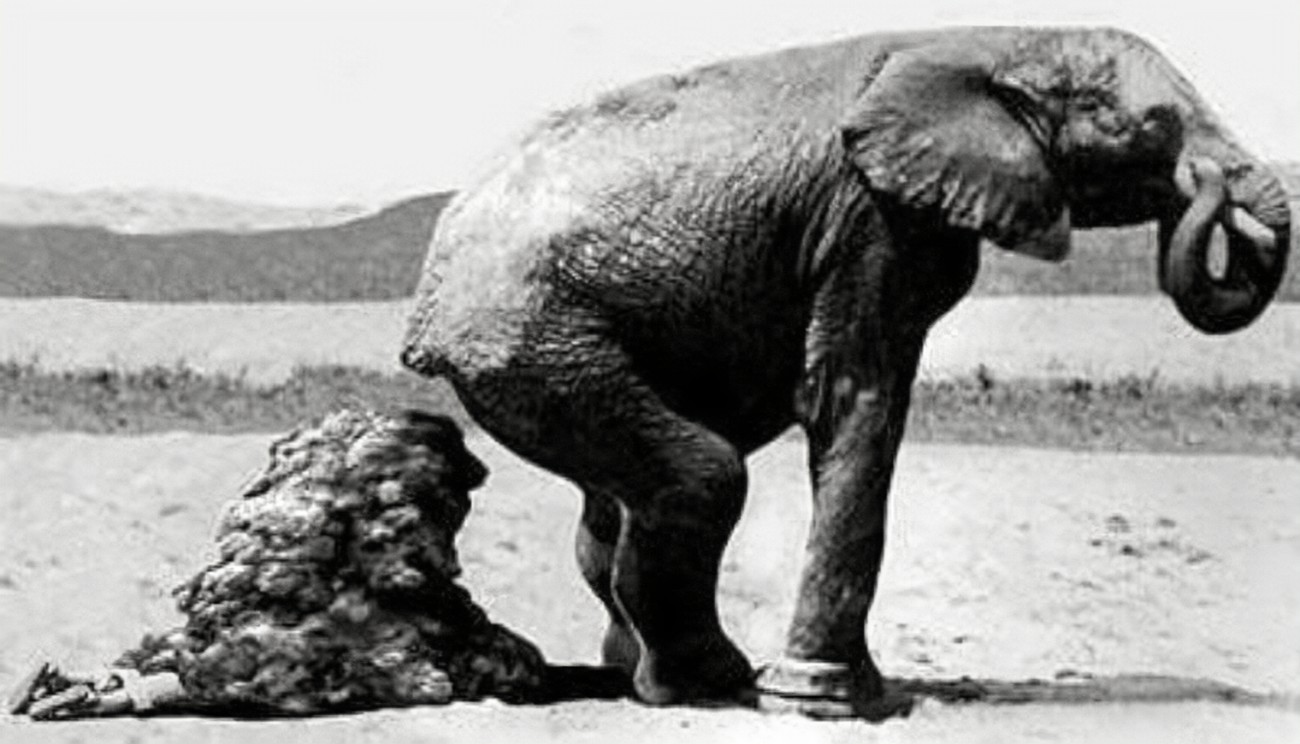
A zoo keeper grows concerned with how constipated his beloved elephant is. He and his fellow zoo keepers, management, and the zoo community try everything to provide her some relief. In total desperation, the man learns of an effective, all-natural cure of herbs and oils. He places it on a wire brush and inserts it, and it works. It works so well that the elephant unloads on the zoo keeper. The zoo keeper is hit by the violent discharge so perfectly that it knocks him down, and he hits his head so hard that he unfortunately experiences a temporary and fatal moment of unconsciousness, as two hundred pounds of dung suffocates him.
What we’re talking about here are silly, inconsequential stories that we share in employee cafeteria. We’re talking about those stupid stories that no one will remember thirty seconds after they’re told. We’re talking about telling stories that might cause some to smile, others laugh, and still others to roll around with hysterical laughter, and the minute the truth trollers pull out their phones, everyone groans. The truth trolls cannot abide by all that laughter. They need to thoroughly vet a story before they can even smile, and they won’t even smile if they happen to find out it’s actually true. “Well, it turns out that one is true,” they say with same look they have when eating a sandwich. If they find out one of your stories doesn’t pass the test, they have a smug, “I’m just calling you out on your BS!” look on their face. That appears to be the only source of satisfaction they gain from their otherwise joyless existence.
Feature Story #2
A man in Oklahoma, enters the highway, and after a couple of miles, he clicks his Recreation Vehicle (RV) into cruise control. Nothing different than anything any of us have done over a hundred times. Except, this driver, allegedly unaware of the full functionality of the cruise control feature on his RV, walks into the kitchen area of his RV to make himself a sandwich. We have to imagine that the man didn’t have enough time to get the meat between the slices of bread when all hell broke loose, as the RV drove off the road and into the ditch. Some versions of this story suggest that the man died as a result of the ensuing accident. Others claim that he not only survived, but he won a settlement with the manufacturer $1,750,000 and a new RV, because the manufacturer did not specifically document for him the full functionality of the RV’s cruise control. This story isn’t half as funny as it once was, based on the current technology that allows some cars self-driving functionality, but back when I first heard this tale, it seemed impossibly hilarious that a grown man (or woman, depending on the version of the story) could think that they could make a sandwich (or cup of coffee) in the back while the car was in cruise control.
Some great stories combine fiction and non in a manner we call creative non-fiction. I remember mentally toying around with the concept of the total capacity of cruise control, soon after I bought a car that had a working one. I thought the possibilities of a fella over-estimating its capacity could be funny, and I’ll be damned if someone didn’t consider the same plotline, either fictionally or in non-fiction. Is this story 100% true, tough to know 100%, but does it have enough truth in it to be funny? At some point, I think we should all hit that “off” switch in our cranium that analyzes, deconstructs, and refutes such stories. Just laugh or don’t laugh, but they can’t. They love pretending that they’re a reporter, and that they’re taking a story, or its storyteller, down.
Feature Story #3
Elvis Painting in Cheese
Elvis Presley had a soft spot for cheese. His favorite sandwich, according to sources, was the grilled cheese sandwich. Elvis was from the deep south, and the home he grew up in an environment that was anything but rich. After achieving a level of fame and fortune those who were never a Beatle or the primary singer on the album Thriller would never understand, he probably enjoyed the finest delicacies in the world, but he couldn’t kick his love for the grilled cheese sandwich. Elvis ingested so many drugs, and so many different kinds of drugs, that we cannot dismiss them as a contributor to his eventual demise, but what does cheese do? It stops us up, and among the numerous other things Elvis poured into his body was a truckload of cheese. As Dan Warlick, chief investigator for the Tennessee Office of the State Chief Medical Examiner, stated, Elvis’s death was brought on by something called the Valsalva’s maneuver. “Put simply, the strain of attempting to defecate compressed the singer’s abdominal aorta, shutting down his heart.” The coroners found that Elvis had “Compacted stool that was four months old sitting in his bowels.”
Did cheese take The King down? These stories are snowball stories. As they roll from one storyteller to another they gather facts, details, jokes, and out and out fabrications, until they arrive at some finished form of funny. I don’t want to know most of the time, because most of these stories are so dumb that I honestly don’t care, and the primary reason I’m writing this article is that I don’t understand why those with a dreaded and incurable hued nose disease do.
I just want to laugh, but I’ve been fact-checked me so often that I now wonder if what I’m being told is 100% true. I want to laugh, but more than that, when I hear a great story, I want to repeat that story so often that it becomes mine. If it’s going to be mine now, I have this newfound urge to fact-check it, so I don’t get fact-checked, and I so want to go back to “Who cares, as long as it’s funny!” mindset.
“The idea that you loathe fact-checkers so much only makes them seem a little more legitimate to me,” third parties say when we complain about truth trolls checking our stories.
I don’t know if it has anything to do with the fact that I’m Irish, but there are few things I enjoy more than sitting in a circle of friends, all with beer in hand, telling a story that has but one agenda, to make them laugh. “There’s no way that’s true,” they say between laughs, and I have no problem with that because I know that for most people that line gives them license to be free from naiveté, and it also frees them to laugh harder. We all know that that story is so sensational that it can’t be true, but we don’t care in that small space in time where all we can do is laugh about it. “That guy is so full of crap, it’s not even funny,” we might say to a third party after the storyteller leaves the room, but the next time he enters, we’ll be all over it when he tells us he has another story to tell.
Truth trolls won’t go through any of this with us. They might want to, but they can’t. They have some odd belief, probably born of some childhood experience that left them vulnerable to the charge of naiveté, that if they believe that, they’ll believe anything. They believe that if they believe our silly, stupid story, their credibility is on the line. Their noses contract a blue hue, and they come out, “Not true!” Now I will grant you that if a story is 100% true, it might slide it a little higher on the funny scale, but by how much? Does it lift such a story from funny to knee-slapping hilarious? If we add, “It’s true, all the fact-checkers checked it and sourced it out, and they found that it’s 100% factual.” How much does that truly add to the entertainment value? If you’re a hue-faced truth troller who has neck problems, because your head is permanently fixed in the 45-degree position, will you go back to 90-degrees with an “It’s true” and laugh? No, and you might even be a little disappointed by your findings, right? Yeah, I’m looking at you.
Feature Story #4
A raging alcoholic was informed by his doctor that he had a form of throat cancer that would end his life quickly if he chose to continue to drink alcohol. The alcoholic peppered the doctor with questions, “Cut back, wean myself off of it over time?”
“I don’t think you understand the severity of this,” the doctor said going over the biopsy and the image test results with the alcoholic. “This is what we call stage four cancer, and if you quit now, cold turkey, you have a chance, about a 39.1 percent chance to live five years. Keep drinking, even a little amount, and you’re likely dead in months.”
This scared the alcoholic. He did not want to die, but he couldn’t imagine going weeks and months without a small swig of alcohol here and there. In some respects, it was psychological torture to him to see everyone around him drink so casually, and have so much fun, but he kept coming back to the idea that he didn’t want to die.
It hurt to drink alcohol too, and that was really one of saddest things in this alcoholic’s life. It was the only reason he went to see that doctor. Once the doctor took alcohol away from him, he realized that he never learned how to live. He didn’t have any hobbies, friends, and he didn’t know how to fix things. He had family, but they distanced themselves from him a long time ago. He was a man who worked his tail off and came home to drink alcohol with his beloved wife while the two of them watched TV together, and he couldn’t even enjoy that. In short order, this man became depressed and desperate to live the only life he knew. He did some research on his computer and discovered something called butt-chugging, or boofing.
“We’ll be using this device,” he informed his wife, “to deliver alcohol to my system by enema. It won’t touch my throat and exacerbate my condition.” His wife was hesitant, but the alcoholic broke her down. “What most people don’t know is we all have enzymes in our stomach and liver that break alcohol down and dilute it. Regular butt-chuggers say that it stings a little, initially, but after a while some say that they start to enjoy the sensation. They even have a term for those people. They’re called klismaphiliacs. Due to the fact that you’re essentially bypassing all of the biological protections our body has in place by going the enema route, they say there’s no hangovers and no puking involved.”
Some dispute whether or not the wife obliged the alcoholic, but she was charged with negligent homicide for delivering what turned out to be a lethal and fatal dose of two 1.5-liter bottles of sherry into her husband’s system. In her defense, the wife claimed innocence by declaring that he did it himself. “He did it all the time,” she pled. “He was always giving himself enemas. Coffee enemas, alcohol enemas, and even soap enemas. He even had enema recipes.” The case against the wife was dropped due to insufficient evidence.
One of the primary lessons this alcoholic-turned-butt-chugger didn’t consider is that puking, while uncomfortable, disgusting, and painful, it serves a biological purpose as important as coughing, sneezing, and bumps on our arms. It is the body attempting to push what it cannot dilute, absorb, or handle out. While we’re puking, it’s difficult to consider that this is probably our body protecting us from the damage of what we do to it, and that it’s actually a good thing that our body knows how to protect us from the debilitating and at times, fatal things we do it.
I am not a regular patron of the sites and shows that feast on the misfortunes of others in this manner, but I used to occasionally enjoy an episode of Thousand Ways to Die, and The Darwin Awards email lists we used to pass around the office. Their entertainment value, while short and limited, can produce a guilty smile or a laugh behind a hand. There’s really no sense in trying to deny that we love stories involving the misfortune of others, “You mean he died?” we say with an oh-my-gosh face on, and we experience a hybrid of laughter and horror. It’s a part of us.
In researching some of the new ‘believe it or not’ sites for this article, I found some new sites I never heard of that preyed on our misfortunate few, and they had “100 percent true” stamps all over them, as if that’s the primary purpose of their existence. The administrators, and authors, of the stories on these sites are careful to properly source each story with links, footnotes, and various other forms of attributions to perpetuate this idea that they’ve learned from those past publications we all enjoyed that focused on sensational stories that had little-to-no foundation of truth in them. Thus, we can gather that the older sites and publications probably got fact-checked to irrelevance, which, in essence, opened up a niche for these new guys to prosper, but the problem is their stories, while guaranteed and certified to be 100% true, are actually kind of blah and mundane. Their stories amount to, “There was this one guy, from some town in a state who made an unwise decision,” and we un huh them with some excitement as we read on, “and well, no one was hurt or anything, and no one died, but wasn’t that a foolish decision?” Well, yeah, it was, but I was kind of looking for some entertainment here. These sites learned from the past, and they decided to forego the sensational for the factual. As much as it pains me to see this need to have certified 100% guarantees, I understand it’s now the price of doing business in this arena, because in this incarnation of the Information Age, everyone has a phone, and everyone has a site to help them bunk, debunk, or take the bunk out of things, and in this case, it’s better to give than receive, because it can be embarrassing and even a little intimidating at times when fact-checkers discredit, delegitimize, and unfunny every stupid, silly, and inconsequential story we tell, but that’s just what they do, they’re fact-checkers.
“I’m disappointed, and I just can’t hide it!” I whisper/shout to the author of the book I’m reading. “You had me. You really had me, and it’s almost painful hanging here.”
Hi, I’m whatever his name is, but you can call me what’s his face, and I love a great story. Some love money and power, some love their family, and some love a really good cheeseburger. I love the great story. I love them big and small, on a device, in a book, and in a mall. I love the story you told me last week about that big, hairy guy you saw in a tank top last Tuesday at Walmart who shouted something about the price of a 3-pack of Fun Pops. If it’s unique, funny, and complete, you might have me on the edge of my seat. I might ask you so many question that you’ll “Just let me tell the story for God’s sakes” me, because I love your details. I love them so much that you will probably joke that I focus on parts of your story no one ever has ever considered before. That’s just kind of what I do. I might ask you to repeat that word you just used to describe that 3-pack of Fun Pops fella, and I might even use it later. I want to be there with you, in your story. I want to love it, enhance it, and make it my own. My leading questions might even help make your story better. I’ve done it before, without intending to do so, and I’m sure I’ll do it again.
I might be phony in a number of ways, but my love of a great story is authentic and organic. I’m not saying my passion is greater than anyone else’s. I’m saying, we all love spending some time in the hands of a great storyteller. We used to go to the town square to hear a great story, before that the amphitheater, and the rock opposite the storyteller. No matter where or when we heard, saw, or experienced the great story, the elements have not changed. That great, classic intro led us to that rock, and the perfect climactic ending almost made us forget the fascinating information in between. Some stories entertain, some educate, but the greatest storytellers of all time find a way to meld the two in an unforgettable tome. Some of us, most of us, don’t particularly care what we are at the end, as long we’re something. Which is why when I have the finished product of a master craftsman in my hands, and they drop the ball, it’s tantamount to an ugly divorce.
They can get me. I’ll give them that. These skilled wordsmiths, who are far better at their craft than I will ever be, can have me flipping pages rapidly, flopping around at night, hours after I’ve put the book down, wondering what they’re going to do to me next, and I’ll probably be talking about those progressions the next day. When the novel is that good, I become so obsessed that I’m thinking about the possibilities throughout the day, into the night, and in my dreams. Then, boom! Nothing.
What? Why is that bookmark rotting in the place it’s been in for six months? After the flurried pace, why do I not care what happened to these characters now? It’s often so relative why we lose interest that it can be tough to pinpoint, but at some point, the author and the reader part ways on the best way to conclude this buildup.
I am a lot more patient with the author of a niche book that happened to cover a topic of particular interest to me. This book they wrote might be the only book they ever write, partake in, or have ghost written for them based on an interview. If that’s the case, my maniacal mind ask theirs, “Aren’t you afraid of losing the reader?” I try to frame my internal question in a very generous scope. They’re obviously not writers, but this product that they’re putting out has their name on it. I cut them an enormous amount of slack, in other words, but I searched for the topic of their book, so I’m obviously an eager customer. I read through the summary of the book, and it fit so well with what I was searching for that I decided to download a sample of it. Depending on the book, the sample is either the first tenth of the book. A song on the radio is a sample of an album in much the same way, the first tenth of a book is a sample of that book, right? It should contain the best writing that book has to offer. If I can barely make it through your sample, on a topic I’m inordinately interested in, the author’s writing must be terrible.
“You had me with the topic, and the summary, but your writing reads like that teacher from Ferris Bueller’s Day Off.” My favorite writers can make the history of grills in Mattel’s Barbie fascinating. I don’t expect that level of mastery of powerful, provocative prose from every author, but in this particular case, they have a topic that I am dying to learn more about, and they can’t even write a decent enough sample to get me to purchase their book? The author, or ghost writer, just gets lost in the description of the inanity, but even inanities can come to life with powerful prose. I’ll admit, I’m a little bitter in the sense that I can’t get published, and this guy has, but that doesn’t affect my reading selections. I might be hyper-critical when it comes to writing, but it’s only because I know I can do better. It’s not because I think I’m more intelligent, talented, or gifted in anyway. I’m just more demanding of myself. I read through what I’ve written with the fear that with any given sentence or paragraph, I can lose the reader. I’m probably more paranoid than most writers.
With master storytellers, I fall head over heels in love with their characters. I admire some from afar, embodied others, and sympathize and empathize with the rest. My favorite authors know how to create and substantiate characters, and some of them know how to juggle them in a gargantuan tome.
In the introductory phase of the huge novel, the author’s juggling skills mesmerize, as the author introduces the MacGuffin to each character in a variety of unique ways. (The MacGuffin is a term for the literary device authors use in their plot to motivate the characters to act. The MacGuffin can be the monster in a horror story, a ring in Lord of the Rings, a glowing object in Pulp Fiction, and as filmmaker Alfred Hitchcock said, “What everybody on the screen is looking for but the audience doesn’t care about.”) The MacGuffin provides the conflict, the goal, and the theme of the interactions between the characters. Yet, even in the best novels, the MacGuffin is almost irrelevant, and we see this at the end when the MacGuffin is finally defeated in an anticlimactic and unceremonious manner.
The MacGuffin doesn’t need too many details, as the best authors allow us to paint their MacGuffin in our mind’s eye. We also see need for a simplified MacGuffin in those stories that involve intricate detail that might play well in the author’s mind, and some detail-oriented readers, but for the rest of us a simple tale of good vs. evil will do. I’ve witnessed the opposite, where a MacGuffin received painstaking detail. The author was/is a painter also, so he provided intricate detail of the visual elements of the monster, and rich details regarding their lives, values, and goals. It was so much that it was too much, and my bookmark remains in the 2/3rds of that description to this day.
I stressed the word defeated, because most modern authors try to avoid having their MacGuffin defeated. Modern authors don’t enjoy having their readers think in terms of good vs. evil or triumph vs. failure. Winning and losing is not a part of their equation, as it’s too simplistic or something, and they fear that it paints their narrative as a game or sporting event. Some authors even introduce the delusional elements of victory by having the characters defeat the MacGuffin, only to have it rise again in the midst of their celebration. When this happens, we know the author is mocking the simple-minded notion of victory, as we are only three-fourths the way through the novel. We also know to prepare for a complicated, winding effort the characters will employ to form a collusive effort that helps them overcome whatever personal, inner demons they may have had that caused them to be susceptible to their fears of the MacGuffin, or the unknown in general. In Stephen King’s It, for example, Pennywise mocks the groups’ efforts to defeat It. In It’s mockery, it actually instructs one of the individual members on the best way to defeat It. I don’t know if King struggled with the best way to convey the information necessary to kill It, but I have to think it would be better that this information comes from anyone else but the MacGuffin. It just seemed odd that It, or anything else would aid in their own destruction. If they’re evil, perhaps they should lie to the good guys, but telling them how they should approach an attack next time kind of dispels the notion that they’re truly evil. It’s complicated and deep and some of the times, readers wonder if it might be more fun if the author dropped all the pretentious efforts to please their peers and the critics and just wrote a simple novel of good defeating evil.
In the early stages, the characters encounter the MacGuffin individually, and they’re overwhelmed by it. “We obviously cannot do this alone,” the characters say throughout the narrative in individual ways. One important trait of the typical monster story is that the meager human cannot do it alone … if at all. The methods of warfare we’ve developed are inferior to the ways of the MacGuffin, and the creativity of the human being is incredibly primitive in reference to its power. For these reasons and others, many, many others, I could not write a compelling monster narrative, for my tale would be far more interested in the human ability to overcome. My tale would be less interested in the power of the monster and more in the resolve most humans find when they’re backed into a corner. A theme of my tale would be, you think the badger is deadly when backed into corner, try a human. We might not think much of our fellow humans on most days, but while we don’t have the claws of the badger, the jaws of the alligator, or the ferocious strength of the bear, there’s a reason we sit atop the animal kingdom, the human brain. The best you’ll ever see of a human happens just after they’re backed into a corner. When they’re so desperate that they think their lives will end, they will find some levels of ingenious resolve they didn’t even know existed. My characters want to live, and they will do whatever is necessary to see one more day. If the gun doesn’t work, and it doesn’t in an overwhelming majority of most monster stories, they’ll try something else, and then something else to help them survive. Such a theme would not play well in most monster movies, because at all points in between, and with very specific characters, it’s not about them, and they usually do nothing but lay there in the spot the director designated for the death scene. If they fight or thrash about a bit, it’s often a minimal fight. More often than not, all they do is scream.
After they experience nothing but failure in the face of the MacGuffin, they seek others who’ve experienced similar, but different, failures in their respective interactions with it. They learn a lot about it and themselves in the process, and they bring that knowledge to the other group, who have uncovered their own truths. They then use that combined knowledge to carve out some temporary peace for themselves. In doing so, the author effortlessly funnels these characters together in a quest to defeat, uncover, or discover a truth about the MacGuffin. The ebb and flow of this part of the narrative is often the most engaging and provocative part. If it wasn’t so engaging, I would consider dropping most novels at this point, because the buildup, for me, is the part that builds the obsession.
At some point, the author needs to make an initial reveal, a tease, and a summation of what the author has spent hundreds of pages foreshadowing. The reveal involves a progressed, unexplained truth about the MacGuffin. The quality author teases this out, and they leave us in some doubt about whether or not it is in fact a truth. There are relative truths each character discovers and even though the author depicts their characters as weak, the narrative is still about them, and their perspective. It is about the MacGuffin, but it’s not.
In this reveal, we’re not entirely sure what happened, but we know that one of the novel’s most beloved, but expendable side characters, (the proverbial red-shirted Ensign from Star Trek), is dead. Some believe the guy in the red shirt did something ill-advised, and they place much of the blame for his death on him. This permits them to continue to believe the MacGuffin is benevolent, as they continue to argue with those who view the MacGuffin as vindictive and vengeful (a hint at various interpretations of God, Satan, or some confusing hybrid of both). This scene also permits the author to reveal the powers of the MacGuffin, a power that will cause the reader to fear it, but the power will later be diminished by whatever the group of characters chose to define it.
One character, often the militaristic lunatic, steps forward to demand revenge or retribution. He wants to eradicate the MacGuffin from the Earth as a result of the beloved side character’s death. The militaristic side character also seeks to disguise his bloodlust as a form of protection, under the proviso that he could be next, or we could, and he believes in the tooth for a tooth response to what he perceives to be the MacGuffin’s deadly aggression. The majority disagree and side with the saner main character who suggests the group needs a more complex, less violent resolution.
The characters have obeyed the rules, based on the nature of the MacGuffin they’ve collectively discovered thus far, but they’ve also found some loopholes. If they do this, while doing that, there will be no ramifications from the MacGuffin. There are rise and fall and fall and rise, a rise, fall, rise, or a fall, rise, fall arcs throughout to build the tension. The characters learn from their mistakes.
The various arcs appeal to just about everyone, as we try to keep an open mind. At some point, we begin to identify with the problem-resolution ideas of one character over the others. We also enjoy the love-interest angle two of the leaders developed, how the sick child became sick, and if it can be attributed to the MacGuffin in some way, but we keep coming back to the ultimate resolution.
For those of us who have read a number of modern books, and watched such storylines play out on current TV shows and movies, we pretty much know where 99% of them are headed. We might disagree with the angle the characters choose, but more that, we know that eventually the author will have to choose sides in this dilemma, and we always know what side the more modern authors are going to take. The only drama left, is how is they are going to get there.
They often lead us into “their” position with numerous, failed efforts by the lunatic, military type to wipe the MacGuffin off the face of the planet with some drastic overreach that will affect life on Earth. We are to side with the intellectual pacifist, normally employed as a scientist, a professor, or a reporter in most modern stories. This is where the gist of the story becomes clear. The MacGuffin is not bad, or evil in the simplistic terms we use to define good vs. evil. Is the white shark bad, the bear, or the tiger? No, they just want to eat, but in our cartoonish narratives, we often depict them as mean, and they always have an otherworldly growl that shakes us to our bones. Plus, there is a now a complex, rational explanation for the death of the beloved side character, and any related activities that follow. The whole idea that the MacGuffin was a bad entity, was a relative term defined by the obnoxious, military man who just wants to blow stuff up. The more rational scientist, professor, or reporter finds another way that turns out to be correct. They find a way to communicate with the MacGuffin. This narrative often dismisses the fact that some MacGuffins we encounter in life are bad, and in real life we shouldn’t be so naïve as to believe every MacGuffin is misunderstood. We might meet a real bad guy in life, our MacGuffin, and if we choose to try to talk to them, or advise counseling, they’ll be back to do what they did to us, to someone else. This part of the narrative is often the whole purpose of the artist starting this project, to have the author’s side win. Logic often prevails, but the conflicted logician may employ some violent tendencies, as a subtle ode to those who enjoy some level of violence in every storyline, or to display the main character’s progressed desperation, but it’s often directed at the the real bad guys of this narrative, the irrational, militaristic bad guys who won’t listen to her.
Again, I could not write a modern monster story, because my problem solving techniques would be too simplistic, anti-climactic, and a little boring. My resolution would probably involve a gun. One of my characters would pull out a gun and shoot the MacGuffin dead. If that didn’t work, my character would shoot it again, multiple times, until it is dead. If that didn’t work, the character would try something else. This resolution would probably bore most modern monster book readers, because they prefer conflict resolutions that are deep, complicated, and multidimensional. My methodology is if one thing doesn’t work, try another. Gather all of the most brilliant minds, militaristic and otherwise, and try to develop a master plan of attack. In the modern monster movie, nothing works. I understand that leads to some compelling drama that defines their desperation, but this cliché often leads the authors to fall prey to some formulaic storytelling.
It’s not that I want the author to write a story that employs my fundamentals, or that I want my side to win, it’s the eventual formula of these stories I find so deflating. Most modern authors play it safe with a formula loaded with so many clichés, tropes, and stereotypical characterizations that I eventually put the book out of its misery. I empathize with the difficulty of adding it all up to a fiery crescendo, but how many endings just crush? I’d say very few. I don’t know if some authors write too many books, or if they overcome blocks by just writing what amounts to the same endings every time out, but their formulas often leave me wanting.
“What would you have done different?” defenders of the modern author might ask. It’s not my project, and I’m not the skilled author that brought the reader, almost effortlessly to point ‘R’, in the ‘A’ to ‘Z’ progression. They fumbled the ball three-fourths the way through is what I’m saying, and they had such a healthy drive going. “Do you think you could’ve done better?” No, but I would’ve done it different. I’ve given up on the big ‘O’, originality, because it’s almost impossible to be original nowadays, and an artist could go mad in the effort. Doing different is not always original, but the author could vie for unique. Every modern author, it seems, travels from ‘R’ to ‘Z’ in almost the exact same way. Why wouldn’t you take a right at ‘T’ or a left at ‘V’ to surprise me with something different? There’s just so much same-same going on in most novels that I can predict where they’re headed.
I still love the great story, and I probably always will. I might ‘X’ some authors out for the predictability of their formula, but that doesn’t mean that I’ve given up on the art of storytelling. I’m always on the lookout for the next great story from the next great author who shocks me with their innovative approach, unique techniques, their style, and a crushing crescendo, but I’ve been beat down by those who fall back on the tried and true.
The first and last thing that the audience of the movie Suicide Squad should know is that Intelligence Operative Amanda Waller is one bad mujer (as opposed to hombre). It is imperative to the plot of the movie that the audience member regard this paper pushing bureaucrat in a pant suit(?) as an intimidating figure that warrants such respect from the most ruthless, murderers of our society that they are willing to do whatever they have to do to prevent her from being cross with them.
If you are not convinced that a bureaucrat –a character that is often depicted as a bumbling fool in so many other movies of this genre that the creators of this movie knew that they would have to continually shove the audience over this otherwise insurmountable hill– can be intimidating, you will be inundated by the characters in this movie informing you that they are intimidated by her.
Operative Waller is respectfully trumpeted as “The boss” by a ruthless, murderous character in one scene. The question that immediately comes to mind is, why does this ruthless, murderous character care what the institutional makeup of the hierarchy constructed against him is? If he is a ruthless bad guy, one would think his entire existence has been to thwart authority, regardless its makeup. Waller is then depicted (by the same ruthless, murderous character) as an intimidating leader who knows how to fire up the troops in another scene. Again, why does he care? He’s being informed that he is going to be forced on a mission that stands in direct opposition to his principles. One would think that his goal would be to thwart that mission, regardless who is delivering the steps of the mission to him. In a third scene, in which Waller enters a room shrouded by ominous music, another ruthless, murderous character asks her if she is the devil. Why a ruthless, murderous character would show such deference, respect, and intimidation to anyone, much less a paper pushing bureaucrat, is not explained. Yet, as the movie progresses, we learn that it’s germane to those of us in the audience that we know how powerful she is.
We then learn that Waller is not only respected and feared by “the worst of the worst”, but she is actually liked by them, as evidenced by one of the ruthless, murderous characters saying, “I like her.” This is the only scene in which the audience is left to infer that Waller has the type of powerful, bad ass leadership qualities that a ruthless, murderous character can appreciate. In the other scenes, the audience is pounded over the head with this idea so many times that it becomes almost laughably redundant.
I write the word idea, as opposed to fact, because as anyone who has ever attempted to write a story knows, a fictional fact can be established in the minds of an audience by showing that character in action. An idea, on the other hand, is transferred to the audience by having the characters tell the audience something. Those who have attempted to write novels or short stories, are informed that telling an audience something, as opposed to showing them, is a violation of the highest order, and in movies this is an even more severe violation since they have the luxury of being a purely visual vehicle through which they can convey facts. If the author is going to tell an audience something, as opposed to show, the audience might excuse that if the author uses that to build up to the scene that proves it as a fact. If there is only telling, the audience will still be left with notion that the characterization has not been proven.
There is one attempt to prove, or establish, the bona fides of the Waller character in a scene in which she whips out a machine gun and ruthlessly kills some of her employees, and the characters that surround her are shocked by this action, and one of them says something along the lines of, “I thought I was supposed to be the bad guy.” By this point, however, the movie has established the fact that these bad guys have ruthlessly killed so many men that one ruthless act should be considered relatively meaningless to them. We can guess that anyone, even a murderous thug, would be shocked to witness a bureaucrat taking out the office with a machine gun, but we might also think that a murderous thug would follow such shock by either laughing at a paper pushing bureaucrat’s attempt to appear intimidating, or they might find some sort of camaraderie with her after such an action. Neither is the case in this particular movie. They gain so much respect for her that they’re intimidated. It’s germane to the plot.
One could say that a portion of the fear, intimidation, and respect the ruthless, murderers have for Waller is based on the fact that she holds their lives in her hand, but since when do irrational, murderous thugs fear for their own lives, in the movies? Such characters are supposed to have an unusual disregard for their own lives. And since when do ruthless characters, purported to have no respect for anything, begin to respect anything or anyone? Some might suggest that everyone has a boss, and everyone respects someone. We might further suggest that even ruthless murderers have a hierarchy in their world, but these particular murderers have no respect for their more immediate authority figures. When it comes time for them to meet their ultimate authority figure, they have respect for her. It lacks consistency for the murderous thugs to loathe and disrespect all other authority figures except for her. They’re respect for her, we can only is infer, is that she’s a paper pushing bureaucrat in a pant suit. It’s germane to the plot.
My guess is that the actor that played Ms. Waller either did not inspire fear and respect in market testing, or the creative powers that put this movie together feared that the audience would have a tough time making the leap to a pant suit wearing bureaucrat engendering such intimidation from the ruthless, murderous bad guys (turned good guys! Surprise!! Spoiler Alert!!!) that they would do whatever she says. Whatever the case is, the actors that play the bad guys in the movie are forced to deliver stilted lines that suggest that they respect her more than any of the non-pant suit wearing contingent that attempt to take temporary leadership roles in the movie.
I understand that it is germane to the plot that these ruthless murderers go servile to a paper pushing bureaucrat, but in most movies any level of respect, fear, or intimidation a bad guy might feel for an ultimate authority figure is either unattainable for that authority figure, due to the ruthless, irrational nature of the bad guy, or it’s left unsaid and constantly rebelled against. Having never been around ruthless murderous types, I can only guess that the only time they concede to an authority figure, if ever, is after the authority figure has displayed unquestioned authority through action not words, or reputation. They, more than anyone else, I can only assume demand to see diligent and consistent atrocities greater than those they themselves do. At the conclusion of this movie, most of that is this is still left unsaid.
Most movies attempt to define the relationship between the bad guys and the ultimate authority figures that they fear, or hate, in the movie, as existing by means of a tenuous thread. This helps define the conflict of the movie, the relative nature of good versus evil, and further characterization for the characters involved in this conflict that is, for the most part left unsaid, with the action sequences saying more than lines of dialogue ever could. The place we’re currently in, at this point on the timeline of movie making, dictates that we place females in a position of power, and that more often than not those females be some sort of minority. The movie makers do this with a combination of bravado and insecurity, the latter being something they feel they have to compensate for with constant verbal references to the ultimate authority figure’s power, her ability, and the manner in which everyone that encounters her, backs down for no discernible reason, and they do so in a manner that ends up proving to be detrimental to the ruthless, irrational characteristics that they hoped to instill in the murderous characters. If we are going to continue to insist that females be in positions of power, in our movies, we are all going to have to agree that this can happen, and it is plausible, if for no other reason than to end this preoccupation movie makers have for establishing the idea that it can happen, and that it is plausible with tedious, redundant, over-the top characterizations that supplement what the movie makers must fear is a lack of whatever they think makes us believe is impossible regarding characters in their movies.
Feature Story #1
A man in Oklahoma, enters the highway, and after a couple of miles, he clicks his Recreation Vehicle (RV) into cruise control. Nothing different than anything any of us have done over a hundred times. Except, this driver, allegedly unaware of the full functionality of the cruise control feature on his RV, walks into the kitchen area of his RV to make himself a sandwich. We have to imagine that the man didn’t have enough time to get the meat between the slices of bread when all hell broke loose, as the RV drove off the road and into the ditch. Some versions of this story suggest that the man died as a result of the ensuing accident. Others claim that he not only survived, but he won a settlement with the manufacturer $1,750,000 and a new RV, because the manufacturer did not specifically document for him the full functionality of the RV’s cruise control. This story isn’t half as funny as it once was, based on the current technology that allows some cars self-driving functionality, but back when I first heard this tale, it seemed impossibly hilarious that a grown man (or woman, depending on the version of the story) could think that they could make a sandwich (or cup of coffee) in the back while the car was in cruise control.


“I don’t think you understand the severity of this,” the doctor said going over the biopsy and the image test results with the alcoholic. “This is what we call stage four cancer, and if you quit now, cold turkey, you have a chance, about a 39.1 percent chance to live five years. Keep drinking, even a little amount, and you’re likely dead in months.”




 Rilaly