“Ask not what your Beagle can do for you. Ask what you can do for your Beagle!”
When we purchase a puppy, any puppy, and bring them into our beloved home, it’s our natural inclination to focus on what that puppy can do for us. Some say that it’s a puppies job to bring love, happiness and an overall sense of joy into our home. We paid to bring him home, after all, and as with the purchase of a loofa, a barcalounger, or a toothbrush, we expect them to perform certain functions for us. If the puppy doesn’t perform to our expectations, we might even think of returning it. (Talking to certain employees at kennels, I’ve learned that this is a part of the business, as they offer a 90-day return policy to customers who aren’t happy with their purchase.)
His job is to play with us, cuddle with us, provide a general sense of companionship, and do all the things a puppy should do. If he fails to comport with how we think a puppy should act, we see it as a failure on his part, and we might seek professional assistance and advice for him. Most of us do not consider what we can do for the puppy to make them a happy, more well-adjusted dog who doesn’t mind comporting to our standards. We might give him a big backyard to run around in, toys galore, chew sticks, treats, companionship and love, and anything and everything we can think of that would make a dog happy, but we don’t think beyond all that to what we should be doing to build a symbiotic relationship with our new puppy.
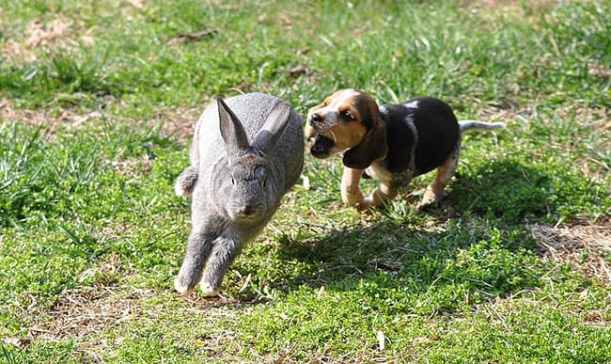 “Feed the breed,” I now say. “Feed the breed.” I list this as a consideration for all dog owners to consider, but it’s specifically tailored to Beagle owners, because I have a Beagle, and I love Beagles. I write this for all dog owners who now see that that beautiful, little puppy they just brought home, who now plays in what we might consider an almost mean-spirited manner. There were times when my Beagle, Max, bit a little too hard during playtime, chewed up some of my precious items, wouldn’t leave the other dog in our home alone, and he was a naughty little boy so often that he added to some of the wrinkles and the grey hair we now sport. My puppy acted as if he was almost (and I normally hate to assign human characteristics to a dog) frustrated.
When I write, “Feed the breed,” I’m not suggesting that you feed your Beagle bunnies, or that you need to let them catch and devour bunny. When I suggest that you feed the breed, it doesn’t necessarily mean that you have to watch them feed. If you’re anything like me, it might make you uncomfortable to watch your beloved Beagle actually catch and devour a rabbit. I’m suggesting that you do some research on the breed you purchased and feed into the breeding of your dog.
When I went online, searching for answers to my naughty, little Beagle, I kept seeing this short characterization, “Beagles were bred to chase bunnies.” I didn’t think too much about it at the time. Prior to purchasing a Beagle, I owned a Puggle (part Pug, part Beagle), and that Puggle loved chasing rabbits. Among all the other things he enjoyed, he enjoyed chasing rabbits. So, when I saw that line, “Beagles were bred to chase bunnies,” I continued to skip it with an “of course” in mind.
Friends and family told me Beagles were hunting dogs, and I saw some evidence of it, but Max was purchased to be a family dog. I didn’t want a hunting dog. I wanted a cute cuddly, overly playful dog, and the fact that he happened to be a hunting dog, bred to chase rabbits, was to me an asterisk on the list of characteristics I found. I read it, and then I went onto reading all of the other characteristics I wanted to learn about more. Notice the emphasis on “to me” and “I wanted”. I wanted him to be what I wanted him to be, and I failed to consider what he might be in a larger context. I failed to consider the idea that a Puggle might love to chase rabbits for the sport of it all, but a Beagle needs to chase bunnies in a way that is (again, I cringe when I assign human characteristics to dogs) fundamental to his constitution.
We took him on those small, daily walks, fifteen minutes a day that every Beagle owner prescribes for those who want a happy dog, I noticed that he huffed every inch of ground beneath him. (A Beagle doesn’t sniff the ground, he huffs on it.) He still exhibited signs of frustration. We took him on more walks in other areas, and in those other areas there was some evidence of bunnies. Even with that, he remained the dictionary definition of a high maintenance dog. I could go through all of the various characteristics and incidents to illustrate how high maintenance Max was, but I think I can summarize my mindset with a comment I began making, “I think I made a huge mistake purchasing this dog.” I walked him constantly to get some of his energy out, and he spent a majority of the rest of his time outside, in our big backyard, running around playing and barking with the neighboring dogs. A human, knowing the general characteristics of a dog might think Max landed in a canine version of nirvana, but he was still always on, and he continued to be somewhat frustrated.
When I walked him, I walked him through our neighborhood, and the idea that he was bred for hunting rabbits was obvious. He would freak out when he occasionally caught some stray scent of a bunny, and I saw that, but I still didn’t catch on entirely.
It wasn’t until I made the decision to take a long walk into areas with a large bunny concentration that I saw the other side of Max. When he’s in rabbit-infested arena, Max develops tunnel vision. If humans approach him for a quick pet, Max doesn’t even acknowledge their existence. He’s in the zone. Other dogs run to the fence barking and wagging their tales, ready to play. They might as well be on another planet as far as Max is concerned when he’s on the hunt. When he catches a scent, he begins huffing the ground (as opposed to his usual sniffing), and there are times when he huffs the ground so hard that he begins sneezing (as often as twelve-to-fifteen times in a row, some of the times, blowing mucus and excess saliva all over the place). He pulls on the leash to continue to huff every inch of that select ground, and he pulls with all his strength on the leash to signify that he’s far from done with this area. On frequent occasions, he lays out on all fours to anchor himself to the ground, until he’s done covering every square inch of that scent.
One of the websites devoted to dogs wrote, “Beagles can tell us where bunnies were, but they’re not as proficient at telling us where they are.” This, in my humble opinion, is because they obsess over the ground where “they were” to the point that they might not be as concerned with where that trail leads.
When Max hits a trail that he knows a bunny has spent some time on, he yips, barks and howls en route to the suspected location. (Have you ever heard a Bloodhound’s howl? It’s that.) Max gets so loud that it can prove embarrassing, at times, as we might fear that unsuspecting and uninformed onlookers might think we’re beating our poor, little puppy. “Is he okay?” a concerned neighbor asked from the foyer of her backyard door. I saw her standing there seconds before, and I think she was watching my actions to see if I was beating my dog. The near-screams coming from Max were that intense.
“Thank you for your concern,” I waved. “He just caught the scent of a bunny.” She smiled politely and all that, but I could tell she wasn’t thoroughly convinced, and she slowly re-entered her home watching us to try to spot a reason to call the Humane Society on me.
My advice to the dog owner who might want to explore the extent of the characteristics of the Beagle, is make sure you carry dog water bottle on these walks, because your Beagle will obsess over these little areas to the point of excessive exhaustion and dehydration. The typical dog owner will want to move on after a while, but it can prove difficult, and almost impossible to convince your Beagle to move on. (Our new ritual of walking in bunny areas, can take a forty-five minutes to an hour.)
 Prior to these long walks in rabbit-infested areas, we tried everything we could think up to make this dog happy. We even went so far as to consult his veterinarian, who told us that he was a puppy, and you should start to see these puppy characteristics subside around aged two. Well, aged two came and went, and he was still high-strung, mean-spirited, and he exhibited some levels of frustration. After these walks, which we do on average three times a week now, I’m happy to report that when I am eventually able to convince Max to move on and begin the long journey home. He returns to our loving home a more normal, less unstable, satisfied and less frustrated dog. By feeding into his breeding, I now have a dog who doesn’t get into things, bite too hard, or display any of the other naughty characteristics I’ve listed above. He’s now an exhausted, less frustrated, and satisfied dog.
Read the Breed
It’s human nature to expect a child, a dog, an entertainment system, or a loofa to perform according to our expectations. Unlike a loofa or an entertainment system, children can be complicated, frustrated, or dysfunctional in some minor ways that require attention or treatment. We know that, and that’s why we developed the aphorism, “Parenting is one of the hardest jobs in the world.” We don’t expect raising a dog to be as complicated. Yet, like children, to a far lesser extent, all dogs are different. Some are naughty, highly intelligent, and bred different.
Having written everything I have thus far, let me say that the idea of returning a dog, even one as obnoxious, high-strung, and even mean as Max could be on occasion, was the furthest thing from my mind. I know I’m different, but I would’ve considered that an epic fail on my part. I did my research not to find information to support my thesis that I made a huge mistake by purchasing him, but to find out how I failed and how to rectify it. I have heard tales of bad dogs though. If you have what you consider a bad dog, you think there’s something wrong with your dog, or you pointed your finger at the word frustrated and said, “It’s that,” or “I’m not sure if it’s that, but it’s something like that, that we’re dealing with here.” Bad dog, or something wrong with your dog, can be a description relative to the dog, their owners, or some complex combination thereof. Nobody is saying you’re wrong. There are bad dogs, just like I’m sure zoo keepers can probably tell us there are bad meerkats, bad, mean, or otherwise obnoxious butterflies, and otters. There are also, believe it or not, some bad humans, but with humans we often do extensive research before reaching a final conclusion. That’s the advice I would give all Beagle and dog owners, read the breed and feed the breed. Do some research on your dog, read through their characteristics to find out what makes them tick and feed into that to see if you might be able to use some measure to ease their frustration and make them happy before you reach some final conclusion on them. The best thing I ever did was learn more about my Beagle, and how I could feed into his breed to make him happy, because he’s done everything in his power to return the favor ever since.
 Rilaly