“Your dog is a hunting dog,” some men say when they see a Beagle. “Seriously, they’re bred to hunt.”
“Really,” I say. “That’s interesting.” I found the characterization, or categorization, interesting. I heard it before, as I watch cartoons, but I dismissed it based on the fact that I’m not a hunter, and I didn’t think I’d witness those characteristics.
I owned a Puggle (part Beagle, part Pug) for over eleven years, and I named it Mr. Fehrley after the landlord on Three’s Company. Mr. Fehrley was the best dog I’ve ever owned. Loyal, obedient, easily trained, affectionate as all get out, and as fun as a dog could possibly be. If anyone is looking for a great dog, I don’t think you can do much better than the Puggle. I could be wrong, but I think Mr. Fehrley took the best of the Beagle traits and combined them with the cute, cuddly traits of the Pug.
I loved that Puggle so much that I wanted another one right after Mr. Fehrley’s tragic demise. My wife said that I would forever unfairly compare the new puppy to Mr. Fehrley. She was right, of course, as no dog could live up to the lofty plane I put Mr. Fehrley on.

If I wanted another Mr. Fehrley, the question was should I go Pug or Beagle? I’ve met some pugs, and I read about a whole lot more. While they are one of the more attractive dogs the consensus on them is that they are cute and cuddly lap dogs. They are characteristically loyal and affectionate, but their preference (according to the various websites on dogs) is to sleep. They enjoy sleeping by your side, on your lap, but they are just as content to sleep by themselves, as long as they’re sleeping. They will occasionally chase a ball around when they’re puppies. Older Pugs fall routinely fall into the 20-hour plus sleep routines of the normal dog.
The best dog I’ve ever owned napped a lot, but most of his characteristics lined up with the playful Beagle traits. If you loved those traits so much, I thought, why not go one step further and find out what a purebred Beagle might have to offer?
Over a year in, I’ve seen the documented loyalty of the Beagle in Max. He’s no Mr. Fehrley, but he’s probably as close as I could get with all of the other characteristics thrown in.
Max, while still a puppy, had boundless energy. Just when we thought we drained every ounce of energy out of this tiny dog, he regroups. He takes a break. He drops to his belly and pants it out, and then he’s ready to go all over again, usually within minutes.
As I suspected I didn’t see the hunting side of Max, and I never thought I would, until we took a trip to grandpa’s house. Grandpa’s house is in a small town, surrounded by acres of forested region. On the outskirts of that forested region, we spotted a deer.
Anytime Mr. Fehrley spotted something wild, his motto was “I’m game!” He spent his eleven-and-a-half-year existence chasing anything and everything just to do it and just to see what it was. He loved “the chase”. (He chased an opossum once, and he caught up to it, but he didn’t know what to do with it when he did.)
We could see Mr. Fehrley’s Beagle characteristics in the course of a chase, but the Pug characteristics appeared when he was easily dissuaded from pursuing it by our arbitrary definition of “too much”. If I decided this would be a fun hunt, and I did more often than not, Mr. Fehrley was game. He was all-in, as it were, but after a while, humans get tired, bored, or in other ways disinterested in the chase. A Puggle follows suit. “I get it,” they basically say. “It’s time to move on.”

A Beagle, as evidenced by this trip to the grandparents, and a couple of instances since, cannot flip the switch of their internal mechanism off as easily.
The quote “Your dog is a hunting dog” came back to me when I saw Max’s internal mechanism go primal. Mr. Fehrley whined and barked after squirrels, rabbits, deer, and any other being we saw through the course of his life, but his emotions dictated that he enjoyed chasing things more than anything else. He was a very curious dog and highly intelligent. Max’s reactions suggest he doesn’t want to just chase prey, he wants to rip the throat out of whatever is on the other end of this scent. His whining and barking are more of a primal, desperate cry to satiate the characteristics bred into his DNA.
It’s difficult to describe the distinction between a dog who enjoys the hunt, as if it were a game, and one who displays an internal, primal switch. To illustrate the difference, Mr. Fehrley chased hundreds of rabbits under chain link fences. He then dug fastidiously under the fence, and he whined while doing it, but after a time, Mr. Fehrley recognized the pointlessness of the exercise. It was cute and funny to see him display all of these characteristics. Max did all of the same things, but at the point when Mr. Fehrley would recognize the pointlessness of it, Max attempted to bash through the fence, headfirst, twice. If I didn’t pull him away, I suspect he would’ve harmed himself in the pursuit.
The men who told me Max was a hunting dog said it was why humans bred them. We all knew this. We know this about our German Shorthairs, our Pointers, and the various retrievers we call our best friends. We know some dogs are bred for hunting, but until we see it firsthand, we don’t truly know it.
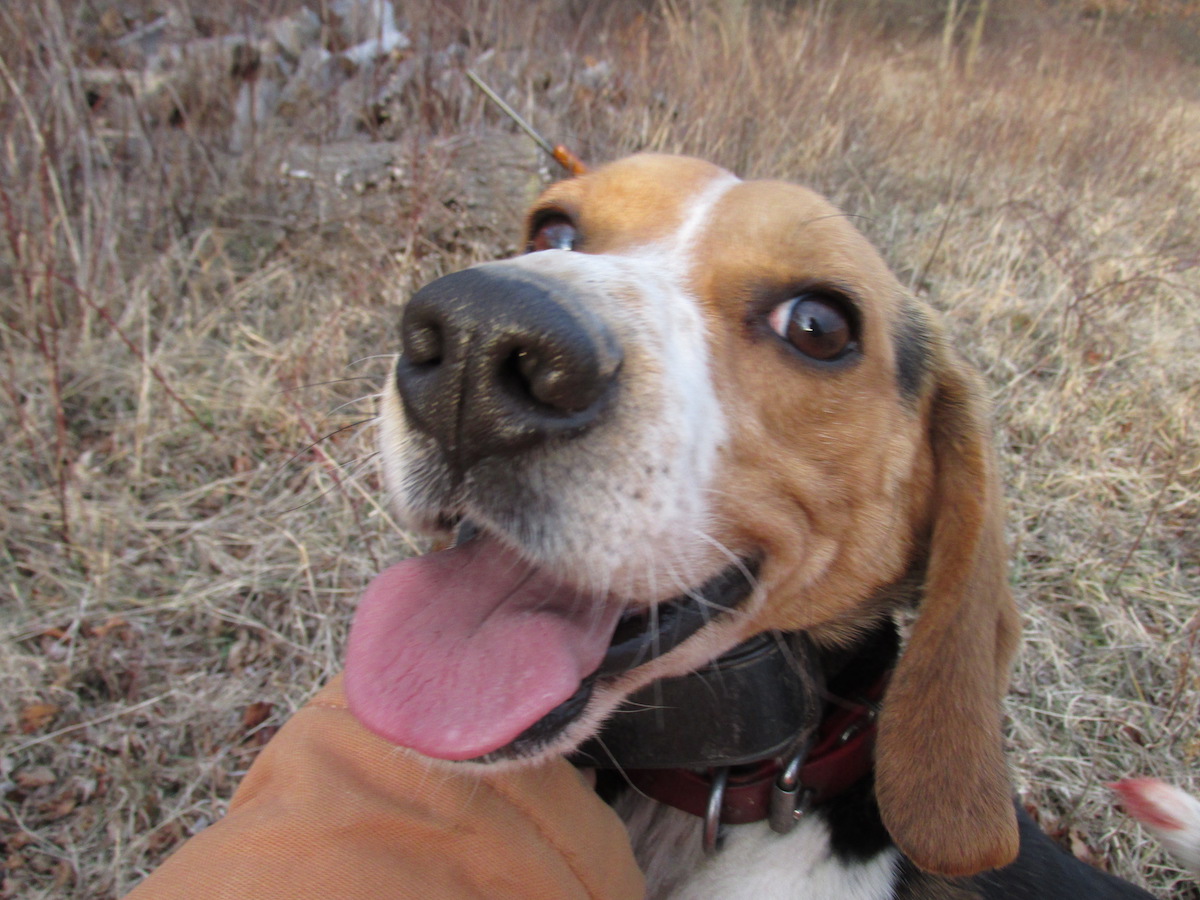
Mr. Fehrley ran to the extent of his talent to capture the goal, but he never came close to achieving it. Max is so fast and so quick with his change of direction speed that if I let him off the leash, I can only guess that he wouldn’t stop until he ended the life of whatever it was he was chasing, and he’ll come back with a bloody beard when he’s done.
I let Mr. Fehrley off the leash to chase his intended victims, because I knew he’d stop when I ordered him to, and he’d always come back. I’m almost positive that the moment after I let Max off the leash, I’d never see him again.
I flirted with letting him off the leash once, but there was a fairly busy thoroughfare a quarter of a mile away. Just seeing what I saw that day at the grandparents’ home, I know Max would go to that thoroughfare and beyond it if that was required to catch his game.
The Passion of the Beagle
Dogs love their masters in a general sense, defined by the way they greet us at the door, the way they enjoy being pet, and in all the ways a dog expresses love. If we were to define love, in this sense, we would define a Beagle’s love as passion. The French have a term joie de vivre, which basically means to express a cheerful enjoyment of life, an exultation of spirit, and a general sense of happiness. To watch Max go through life, one gets the feeling that they’re not enjoying life to the fullest. Everything is the greatest thing that ever happened to him. When he greets you at the door, it’s as if you’ve been gone for a year, and he curdles under your touch when you pet him. When you pick him up, he wears a full doggie smile, coupled with a quick lick to your nose, and a wriggling that suggests he wants you to put him down. If you abide by what you consider his wishes, he tries everything he can to get back up. He wants to sleep with some part of his body touching you, and he even sleeps passionately, which you learn if you move your leg. “I’m sleeping here,” he growls. Most dogs love to play chase the ball, but of all the dogs I’ve owned, no dog plays chase with more zest, zeal, and passion than the Beagle. When he greets a stranger that you’ve acknowledged in some way, he passionately pursues their affection in ways that can, at times, prove embarrassing. If you watch him in your backyard with seemingly nothing to play with, he races around in the yard, in a manner some call the zoomies. I’ve watched him chase nothing for a good ten minutes as top speed with no break. I’ve watched him flip a stone up in the air and chase it around for a couple minutes, then he rolls his back on it, flip it up and repeat for an unusual amount of time.
Max is the most passionate and affectionate dog I’ve ever owned. He’s as loyal as any in-the-home, domesticated dog I’ve ever encountered, much less owned. After a year of ownership, I thought I knew him as well as any dog I’ve ever spent every day with for a year. I’ve owned a Cain Terrier (a Toto) who surprised me by digging so deep into a ground squirrel’s hole that I was reminded my cute, little fuzzy buddy was a carnivore. I owned a Puggle who showed me what he was bred to do, but neither of those two dogs could prepare me for what the Beagle wants to do, how badly he wants it, and what he might do if he catches it.
If you’re in the market for a dog, the Beagle is one of the most beautiful dogs you’ll ever see, and they’re one of the best family dogs on the market, but they’re also listed as one of the best hunting dogs by many other outlets. If you want to buy a Beagle for evidence of the former, but you don’t want to see evidence of the latter, my advice is never take them out of your city neighborhood. Doing so, might lead you to see a side of them you don’t care to see. I enjoy it all to a limited extent. You can call me a soft, city-dweller if you want, but I must admit that I was not ready to see the extent of my Beagle’s ability as a hunter. Now that I see it to the extent that I know it, I’ve learned how to feed the breed to make him happy.
 Rilaly