“It was not an explosion,” a witness recalled. “It was more of a low, deep guttural roar. We thought it was the El. It sounded like the El anyway.” (The El was the elevated train that passed on the tracks surrounding the neighborhood in the image).
“I heard a staccato rat-tat-tat, like a machine-gun-like sound,” other witnesses said to describe the sound of thousands of rivets being shot out of the steel plates of the storage unit, like projectiles.
“And that was followed by this swish sound, a hiss, or rush of air/wind,” other witnesses said to describe the sound of the molasses rolling through town.
The visitor’s bureau of tourism and travel love historical tragedies like these, because we love “how could they be so stupid?” tragicomedies. “I’m sorry, but it’s funny” we say on the walk-through tour of the failure that led to the destruction of infrastructure of a town/city that led to widespread death. Maybe the latter isn’t funny in the strict sense, but if tourism agencies can “schwing” this information in a sympathetic manner, with the perfect snarky tour guide, joking about maple syrup and pancakes, buttermilk, and The Blob, we might find some “behind a hand” comedy in it.
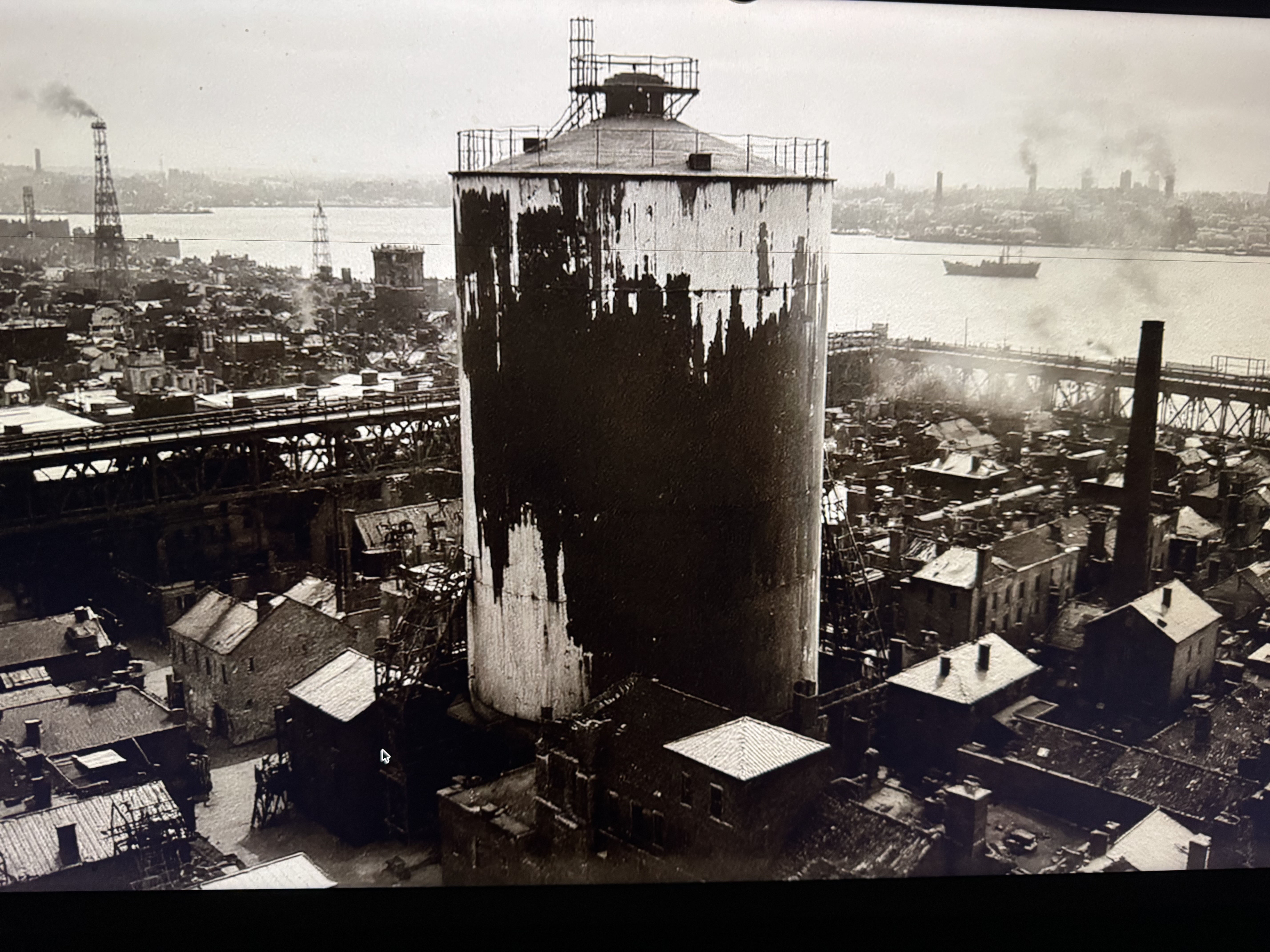 First, The Great Molasses Flood of 1919 didn’t involve maple syrup. It was molasses, and we’re not splitting hairs here. There’s a big difference, as we’ll explain later. There were also a whole bunch of Bostonians in 1919 who didn’t find this “molassacre” the least bit funny, but you know that, and you can’t stop giggling.
“All right,” a 1919 Bostonian might say, “If you still think this is all funny, hows about the next time you’re farting about town, you have a 15–25-foot tidal wave of 2.3 million—not thousand, million—gallons, or twenty-six million pounds of molasses, chase you through your neighborhood at speeds of up to thirty-five miles per hour. My bet is that would put an end to your hee hee, haw haws.”
Good Guys vs. Bad Guys
No one knew what the loud sounds that occurred on January 15, 1919 at 12:40 p.m, at 529 Commercial Street in the North End of Boston, were, initially. Isaac Gonzales, who worked on the fifty-foot molasses storage unit on a daily basis as its maintenance man, would’ve known exactly what it was, but he quit the job in frustration when no one would heed his repeated warnings. William White, Gonzales’ immediate supervisor, probably had an idea, but only because Gonzales complained about the structure so often. Gonzales’ manager Arthur Percy Jell, the treasurer of Purity Distilling Company (PDC), a subsidiary of the United States Industrial Alcohol Company (USIA) probably had an idea what it was too.
The historical record states that Jell knew all about Gonzales’ complaints. Gonzales complained about it so often, and was so frustrated at one point, that he went over his supervisor’s head and walked straight into Jell’s office without an appointment. He walked in prepared. He addressed his boss in the most respectful manner he could, and he spelled out the problem. Gonzales informed Jell that he thought the USIA storage unit was coming apart. He told Jell he thought it was due to structural issues. Arthur Jell likely took personal offense to that comment, since he oversaw that 1915 project, and a back and forth ensued.
Isaac Gonzales had been working on this tank for months, and he knew its condition on that day better than anyone, including Arthur Jell. After Gonzales’ respectful approach failed to reach his manager, he reached into his coat pockets and dumped a bunch of its rust flakes on Jell’s desk to provide tangible evidence of the unit’s overall deterioration that he and his crew were witnessing on a daily basis.
“I don’t know what you want me to do,” Jell said. “The tank still stands.”
There is no evidence of Jell escalating Gonzales’ complaints, but the company did learn of them. They calculated the cost of fixing the leaks the maintenance men were spotting against leaving the structure as is. They decided that the record profits they were seeing were such that the company could withstand the cost of a few leaks. Gonzales complained that it wasn’t just the leaks, and that he thought the leaks were symptomatic of an unsound structure that could lead to a worst-case scenario. Jell responded to Gonzales’ complaints by recaulking the storage unit, and he eventually painted the storage unit a shade of brown that matched the color of molasses to cover the signs of leakage. When Gonzales continued to complain after all that, Jell informed him that if he continued to complain, he would no longer have a job at USIA. With the Boston economy being what it was, this proved a substantial threat, but Gonzales couldn’t take the ongoing stress of no one taking him seriously. He decided that his best course of action was to simply quit the company and join the Army. To presumably avoid seeing or hearing about what he knew was going to happen, Gonzales asked the Army to station him as far away from Boston as possible, and they stationed him in Columbus, Ohio.
If we were to make a disaster movie called The Great Molasses Flood of 1919, or The Molassacre, Isaac Gonzales would be our good guy. He would be the whistle blower, trying to warn his immediate authority figures about the impending doom he foresaw. To uphold his good guy status, we would fail to mention that after Gonzales quit his job, he failed to report his evidence-rich findings to building inspectors, city officials, or the media. Gonzales defenders could say that this just wasn’t done in early 1900’s. Whistle blowers weren’t celebrated in the manner they are today. They were labeled troublemakers back then. Gonzales probably also thought that public disclosures would make life more difficult for his fellow maintenance men, his friends, going forward. Whatever the case is, Gonzales, our good guy, didn’t do everything he could do to save his fellow Bostonians from the impending doom he correctly forecast.
Arthur P. Jell would be our bad guy in this disaster flick, and most filmmakers don’t waste their precious minutes characterizing their bad guys. If we were to call them out on this, they would probably say, “It’s a movie, not a trial.” Bad guys are often the countering force that do nothing more than make good guys look better. Most filmmakers want quick and superficial characterizations for their bad guys, so they instruct their casting agencies to find an overweight actor with noticeable jowls and ruddy skin that always looks a little too sweaty. With this in mind, we would seek a Sorrell Booke (Boss Hogg from The Dukes of Hazzard) type for this role. These characteristics would give the audience the impression that Arthur Jell was a guilt-ridden character. We would further characterize our bad guy as an arrogant, unsympathetic type by introducing him with an obnoxiously large cigar in his mouth and a glass of hard liquor on his over-sized desk. We would also include the rust flakes scene, and we would have our Arthur Jell character insult the Gonzales character as an exaggerator when he continued to complain, and we would include lines that had our bad guy reminding Gonzales about their respective positions in the company and their economic stations in life. The Arthur Jell would then command Gonzales to leave his office with a level of arrogance the audience might find almost criminal at the end of our film. Then the Jell character would collect the rust flakes Gonzales dropped on his desk and throw them at Gonzales, saying, “And take all this crap with you!”
History has not been kind to Arthur Jell, and it’s entirely possible that he earned it. He could’ve been the awful person that history remembers. Yet, he could’ve been a regular fella who, prior to this episode, lived a relatively meager life. When his superiors picked him to head up the construction of a storage unit that was going to hold the lucrative molasses that the country desperately needed for military weapons, ammunition, and other munitions for their planned entry into World War I, Jell probably thought it was the greatest day of his life.
Jell was informed that if he could get this storage unit built in a timely manner, and under budget, there might even be a promotion in it for him. Arthur Jell was nearing forty. He was not a failure, but his career wasn’t going the way he imagined. He was still living paycheck-to-paycheck, and then his superiors chose him to oversee the construction of a large molasses tank. Jell likely viewed this assignment as a way out of the paycheck-to-paycheck existence and a ticket a table he never thought he’d see.
To quell any concerns Jell might have had about his complete lack of engineering or technical experience, his superiors eased his doubts by pointing to the regulatory loophole that a “receptacle” did not have to meet the same building codes or inspection requirements as an ordinary structure.
It probably relieved Jell that he wouldn’t have to know the building codes required for a permit, and he wouldn’t have to deal with bureaucrats in the process, but the “Why me?” questions still had to plague him. Yet, if we’re ever lucky enough to secure a job for which we’re unqualified, we don’t inform our bosses that we’re unqualified, or ask questions in that vein. We “fake it, till we make it.” We might think they see something in us that we don’t, and we try to live up to the belief and confidence they have in us. We, like an Arthur Jell, make it our life’s mission to live up to their belief in us.
The construction of this fifty-foot storage unit was a job for Jell, as much as it was a job for everyone else involved. It helped him pay the bills, support his daughter, his wife, family, and live the life he dreamed of living while toiling away in the near-poverty existence he knew for most of his life. Thus, when things started to fall apart, Jell may have feared that if didn’t do everything he could to keep costs low and ignore Gonzales warnings, his bosses would find someone who would. As an unqualified man, he didn’t have a leg to stand on, and he probably felt a lot “fake it, till you make it” pressure, self-imposed and otherwise, to complete and sustain this large, expensive project for his superiors.
Everyone Has a Boss
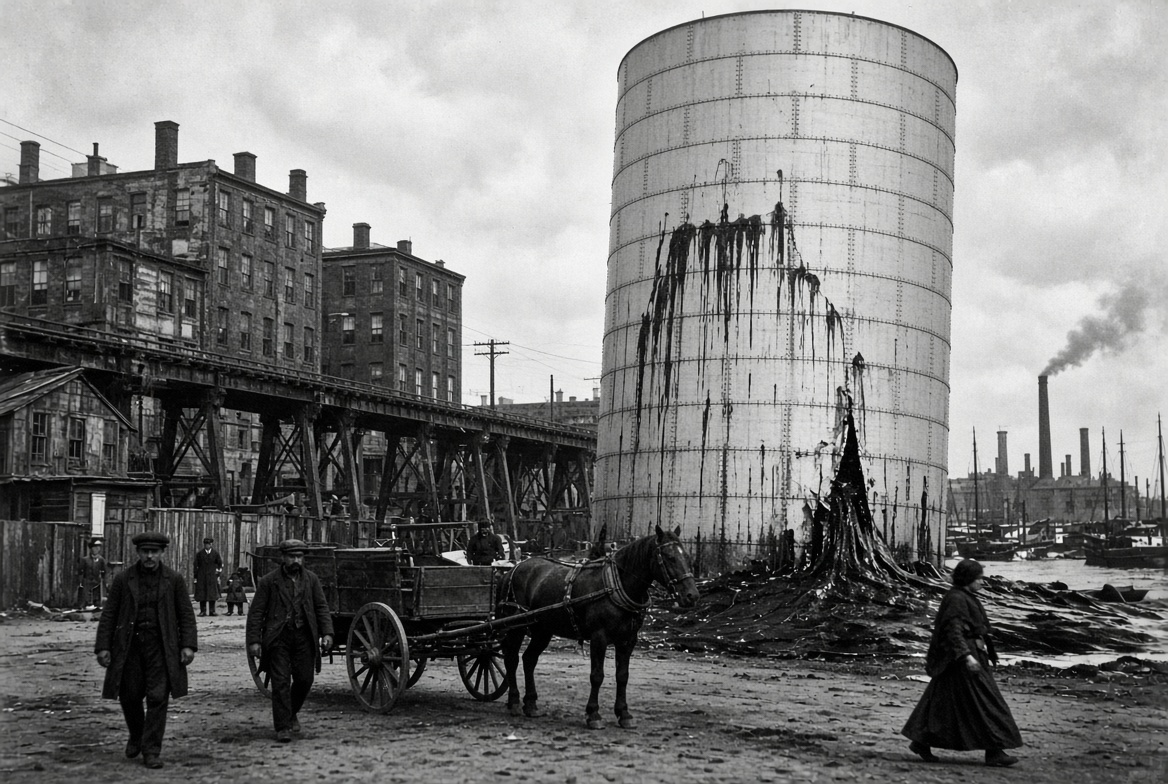 An historical characterization of Arthur Jell has it that “[He] wanted to cut the costs of the project by reducing the thickness of the massive tank’s walls.” They further damn him by writing, “On the day the tank exploded, he worked safely in his Cambridge office.”
Further historical characterizations of the tank/storage unit suggest that the steel Jell used in its construction was 50% too thin, and the steel contained too little manganese, which made the steel brittle. Another historical fail attributed to Arthur Jell was the hydraulic capacity test. To properly test the unit, Jell should’ve ordered a near capacity test, to test its structural integrity. He ordered a test of six inches of water, or roughly 24,000 gallons on the bottom of the storage unit. This shortcut was taken to save time and expense and allowed Jell to declare the tank ready for use almost immediately.
“Everyone has a boss,” I would say to the jury, if I were Arthur Jell’s personal attorney. “When a catastrophe like this happens, we want to find someone to blame. We want to find the bad guy. Yet, in a corporation like USIA there is a hierarchal structure in place that requires Mr. Isaac Gonzales to report to a Mr. William White, Mr. White’s boss was Arthur Jell, and Mr. Jell’s bosses were on the corporate board, a board chaired by Charles Edwards Adams. Mr. Adams’ bosses was accountable to the shareholders and other investors of USIA. Everyone has a boss, and those bosses want to see huge profit reports at the end of a quarter to justify their jobs, promotions, wages and salaries, and their investments and the inherent risk involved. So while the relentless drive to cut costs and maximize profit became this story’s ultimate villain, it is also the force that has enabled humanity to create the goods, enterprises, and infrastructure upon which modern economies depend.
“What happens when things go wrong?” I would ask the jury. “These hierarchies mysteriously collapse. Those at the bottom have no authority to act without approval, and those at the top insist they didn’t grant such approval. The blame, the bad publicity, and the historical infamy falls on the midlevel manager.”
One of the first things we learn as midlevel managers for a corporation with a substantial hierarchy in place, is that our job is to make everyone happy. We’re required to make our superiors happy, and we’re required to make the employees on our team happy too. When things go wrong, we learn that the dung rolls uphill and downhill at us. As the Spanish proverb states, “Success has a thousand fathers, and failure is an orphan.”
When a catastrophe like this one happens, and structures are demolished, and one hundred and fifty people are injured, and twenty-one people die, a whole bunch of someones want to find someone to blame. We want a name and a face to plaster on the masthead of our newspapers, and we want a name to scream at in bars and at funerals. Gonzales couldn’t have done anything without approval from his hierarchy, but either could William White, or Arthur Jell. The problem for the inexperienced Arthur Jell was that he was the man who gave the thumbs ups, signed the authorizations, and became the face of the project, the failure, and the court case that followed. The questions that Jell answered in the trial, and all of investigation records that preceded it and have followed since, suggest that Arthur Jell was actually granted very little genuine autonomy in the construction and ongoing maintenance of the molasses storage tank. His role was that of a midlevel manager operating within strict corporate control, as opposed to an independent engineer or decision‑maker.
Arthur Jell was, himself, a cost-cutting measure, as the corporate board at PDC and USIA, and their chairman Charles Edwards Adams could’ve sought out a proper engineer to complete the project. They could’ve hired third-party inspection teams, or some sort of oversight to see to it that Arthur Jell put proper safety measures were put in place. They didn’t because they sought to appease their bosses, shareholders and other investors by capitalizing on the explosion of need for industrials and munitions before and during WWI at the lowest costs possible.
The Molassacre
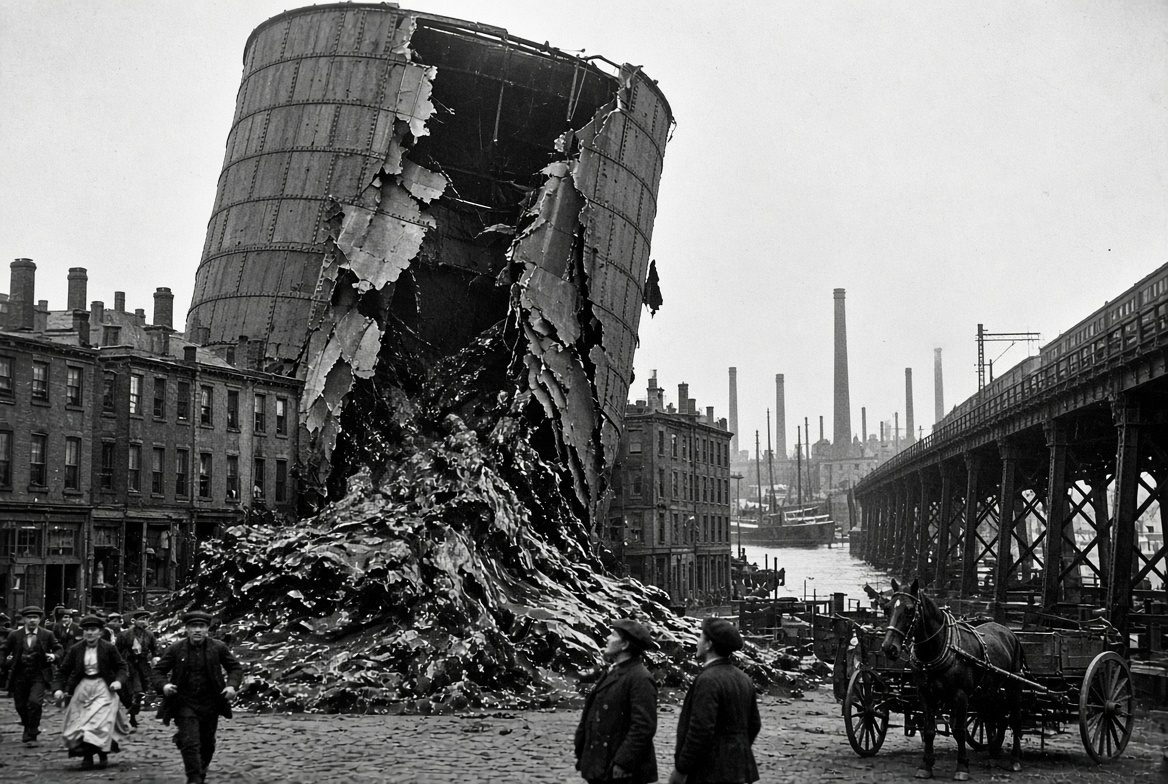 Construction of the fifty-foot-tall storage tank was finished in 1915, and it collapsed in 1919. So, Bostonians from the north end heard their impending doom for four years, but the groaning and rumbling sounds emanating from the tank just sort of blended in with all of the other sounds of the city. The average Bostonian, from the North end, heard the daily sounds of freight trains, the sounds emanating from factories, and all of the other industrial sounds of a bustling city’s activities on a daily basis. Most of those who lived around 529 Commercial Street probably heard these sounds so often that they probably couldn’t sleep without them after a time, and they heard them so often that they didn’t even hear them anymore. Those of us in a city grow so accustomed to sights, smells, and sounds that we acclimate to them. We acclimate to them so well, over time, that when a visitor hears them, they say something like, “How can you stand all of that?” We shrug and say, “I don’t even notice it anymore.”
On January 15, 1919 at 12:40 p.m, they heard it, everyone in the area did. Some reports state that citizens living three miles away heard it. If people from three miles away heard it, imagine what it must have sounded like to those who lived right next it. The storage unit was fifty-foot high, and to put fifty feet in perspective, the average two-story house is between 18-25 feet.
The collapse released the 2.3 million –not thousand, million— gallons of this sticky, icky molasses into the neighborhoods and the business district at speeds of up to 35 mph. Reports state that at its peak, this tidal wave reached a height of 15-25 feet, again the size of the average two-story house. The molasses leveled buildings buckled elevated railway supports, crushed vehicles and people, and flooded streets several blocks deep (initially waist-deep or more in places). Twenty-one people were killed (many by drowning/suffocation or crushing under debris) and about 150 were injured; dozens of horses also died.
When those of us who are generally uninformed on the matter hear the word molasses, we think of maple syrup. Yet, if we were to pour three bottles together, one holding water, another with maple syrup, and the third holding molasses, we would see three remarkably different flows. The measurement of these flows is called viscosity, or the measure of how much fluid resists flowing. We could get into exact measurements of viscosity, but our common sense dictates that water is easy to stir, maple syrup is a little tougher, and molasses is even more difficult. Depending on the temperature, water flows freely, maple syrup flows at a viscosity similar to a light honey, and molasses often drips slowly and may leave a trail. Maple syrup will drip slowly off the spoon when you’re done stirring, but molasses might end up sticking to the utensil with very little of it dripping off until the weight of it becomes too great. If we held water on a spoon, at a ninety-degree-angle, all of it would fall off with precious few remnants remaining, a more substantial amount of maple syrup would remain on the spoon, all conditions being equal, but depending on the weight on that spoon, a majority of molasses would remain stuck to the spoon, like a soft tar, until we have to physically scrape most of it off.
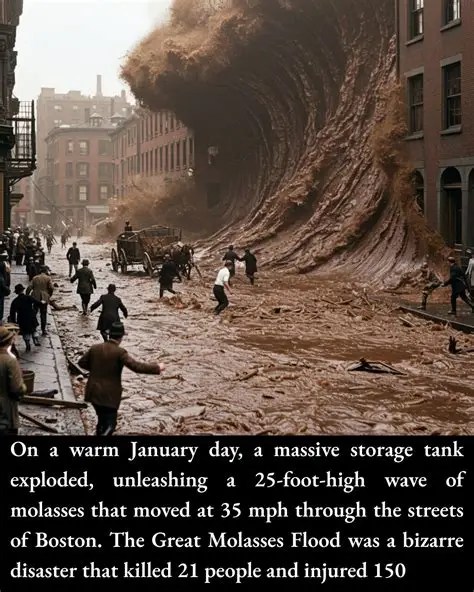 In the Boston flood, the molasses didn’t flow like soft tar, as it would have if we held it on a spoon at a ninety-degree angle, as the sheer weight of the 2.3 million gallons increased its viscosity. Another factor that played a role in this disaster were the varying temperatures inside the tank and that which occurred in the outside Boston air. The day before the incident, January 14, 1919, a fresh shipment arrived, and it was artificially warmed to increase his viscosity. This warmed shipment was mixed in with the molasses that was already in the storage unit, and that latter molasses was substantially cooled by a roughly two-degree temperature in the air in Boston on January 14th. On January 15th, the outside air of Boston increased to the mid-forties. Some suggest that thermal expansion, cause by the temperature fluctuations inside the tank combined with those outside it, likely exacerbated the inevitable collapse of the unsound structure.
After the collapse, the heated molasses hit the cooler air. It cooled and congealed, and it hit the North End of the city a far cry from the warm honey flow we associate with maple syrup. When we combine the temperature of the air in Boston with the force of the weight of 2.3 million pounds, the molasses hit the city of Boston with the force of concrete. It did not splash around structures in the manner we might associate with water or warm honey; it crushed structures, people, and everything else in its path.
The question that hounds us regards the 2.3 million gallons in the structure. That’s a bunch of molasses to just leave sitting there. Apparently, the soaring demand for molasses was just that great, because the United States was preparing for entry into World War I. (They entered in 1917.) The defense department needed to prepare for entry by stockpiling weapons, ammunition, explosives, and other military equipment. Those munitions required Molasses, or industrial alcohol, in their creation. Coupled with these preparations was the speculation that The Prohibition movement in the U.S. was gaining steam, and that alcohol would soon be prohibited for sale in the U.S. Molasses was used in the production of rum and other alcoholic beverages. There has been speculation that companies wanted to stockpile molasses before Prohibition took effect. (The molasses storage unit fell apart on January 15, 1919, and Prohibition was ratified on January 16, 1919, though it would not be fully implemented until January 1920.) Research suggests that this speculation is spot on and timely, but the production of molasses for alcohol was viewed as little more than another revenue stream, as opposed to the primary one. The primary reason the storage unit was constructed so hastily, and the reason 2.3 million gallons of molasses were stored in Boston was World War I.
The Victims
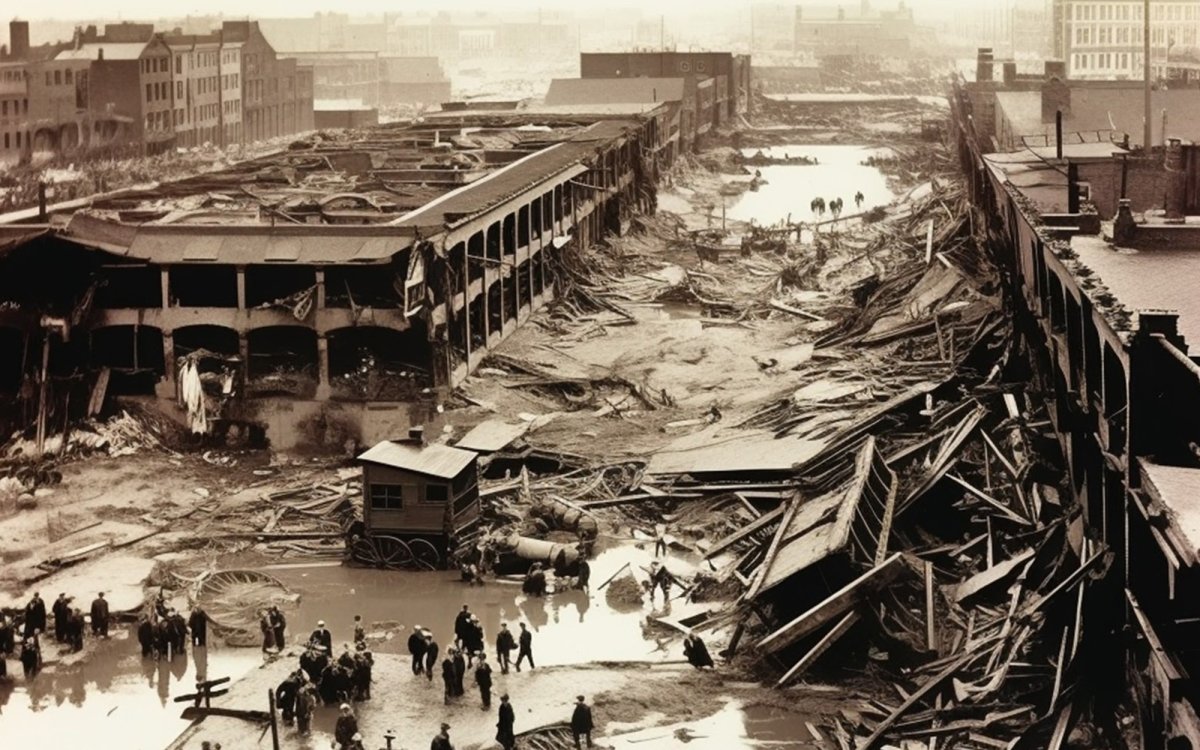 When a tragedy such as this happens, we read the statistics, and as shocking as some statistics can be, they have a way of desensitizing us. “It says this horrible catastrophe killed twenty-one and injured 150,” we say when our wife enters the room. “What a horrible tragedy,” she says shaking her head. Statistics and numbers almost accidentally permit us to avoid getting to the heart of lives taken, damaged, and ruined in the aftermath. We don’t have to think of the trauma a John Barry went through when he was pinned face-down under debris with molasses filling his nose and mouth. He used his free arm to keep an air pocket clear and survived, though his dark hair reportedly turned white overnight from the trauma. A statistical presentation also helps us avoid learning the details of what Patrick Breen went through when he was hurled into Boston Harbor by the wave. Sailors from the USS Nantucket rescued him, but he later died from pneumonia and infection stemming from fractured ribs and a leg injury. Or, a wagon driver named Cesare Nicolo. Mr. Nicolo was declared missing, and no one could find him for months, until someone randomly discovered his body floating under a wharf nearly four months later. When we read the story in periodicals, Mr. Barry, Nicolo and Bream are collected into a number that barely registers. As horrific as their stories are, they don’t compare to what happened to the Cloughertys and the Iantoscas.
Ten-year-old Pasquale Iantosca and his siblings Antonio and Maria di Stasio (ages roughly 8 and 10), were playing near the storage unit, gathering firewood and scooping the molasses that leaked from the storage unit with their sticks, as they always did during their lunch break from school. The exact timing of Pasquale’s father, Giuseppe, going to his apartment window is unknown, regarding whether he was watching his kids the whole time, or if he just happened to check in on them at the worst possible moment, but when Giuseppe looked out his apartment window, he did so in time to witness the 15-25 tidal wave of molasses swallow his three children.
Giuseppe raced from his apartment to help them, but this catastrophe happened so fast that by the time he reached his front door, his entire neighborhood was gone. Everyone he knew and loved was either gone or stuck in whatever this brown gook was. This nightmare had to be so confusing and alarming that Giuseppe probably spent a moment trying to orient himself to the idea that this was real as opposed to a nightmare. When the reality of the situation hit home, he entered into the molasses without considering his own safety. He had to do so without thinking about the sounds of destruction and screams he heard from those who had been injured by the tidal wave. His children had been swept away by whatever this thing was, and he had to find them. The problem was, he had no idea where to run or where to look. He decided to simply follow the flow. Based on vague descriptions, it sounds like he found his beloved daughter Maria’s dead body relatively quickly, as she had been suffocated by the molasses. We don’t know how much time he spent trying to revive her, but we can guess he ran with her body, trying to revive her, while trying to find his other two children. Whatever the case is, we wouldn’t include this unspeakably tragic, Sophie’s Choice dilemma in our disaster movie, as we would deem it too horrific for our audience. Giuseppe couldn’t find his son Antonio, but a firefighter did. The firefighter informed Giuseppe that Antonio had been flung against a lamppost by the explosive force of the molasses, and that he managed to pull Antonio free from its sucking force. The firefighter informed Giuseppe that Antonio suffered a severe head injury (fractured skull and concussion). Giuseppe, we can only guess, was out of his mind with concern for Antonio, but he also had another child, Pasquale, that he couldn’t find. When Pasquale’s body was later found, Giuseppe learned that his son was killed after being struck by a railroad car that was swept into him by the flood.
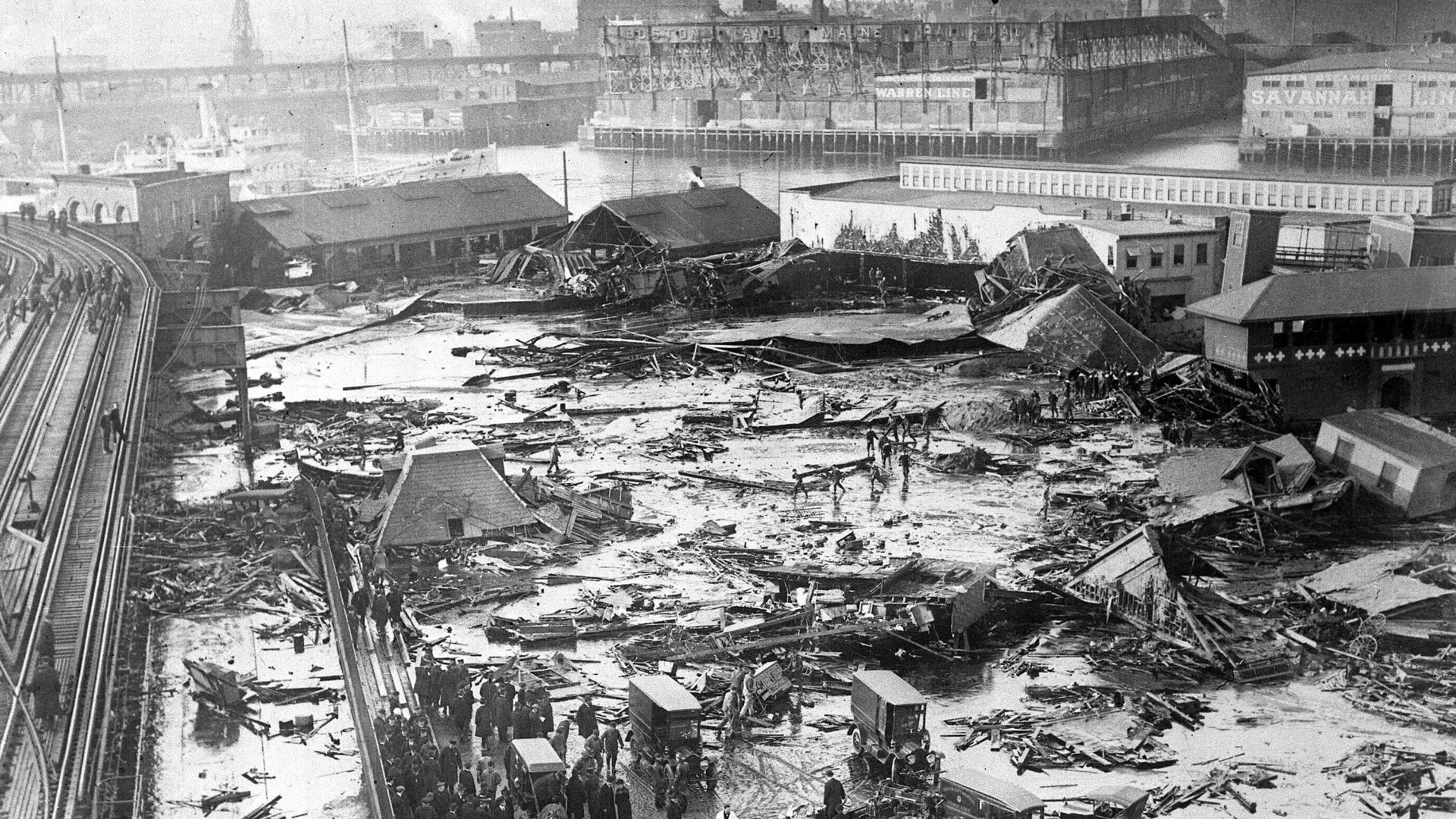 When Mary Musco heard the deep rumble of the storage unit collapsing, she went to her window to see what that incredibly loud clatter was, and she looked out just in time to watch the Clougherty’s house “fly into the air” before disappearing under the elevated tracks into a chaos of thrashing people, horses, and wreckage. Mary ran from her house hysterically screaming that everyone in the Clougherty house “were all dead”. She said that she became more hysterical when she saw the absolute carnage occurring in her neighborhood, as her neighbors were running around, screaming and crying, covered in molasses.
The Cloughertys lived in a three-story wooden house at 6 Copp’s Hill Terrace, right along Commercial Street and overlooking the massive molasses tank. Martin Clougherty was asleep on the third floor when the tank ruptured just after 12:40 p.m. Teresa, his sister, came to wake him. As she turned toward the window, she saw something terrible happening near the harbor and cried out, “Something awful has happened to the tank!” Almost immediately the house began shaking violently.
The 25-foot-high wave of molasses slammed into their house, tore it completely off its foundation, and hurled it into the elevated railway trestle. The Cloughertys house split and collapsed. Martin later told the Boston Globe:
“I was in bed on the third floor of my house when I heard a deep rumble. I was asleep and the rumble did not wake me thoroughly. The first impression I had that something unusual had happened was when I awoke in several feet of molasses. It didn’t dawn on me that it was molasses I was in. I thought I was overboard.”
Martin Clougherty felt himself being sucked under and nearly drowned in the thick, sticky flood. Fighting the suction, he managed to surface and then climbed onto his own floating bed frame, which became a makeshift raft for him. When he saw his sister Teresa choking on the molasses and struggling to get free, he instinctually pulled her up onto the bed frame with him, saving her life.
Their mother, Bridget, was crushed under the debris and timber of the collapsed house. She was pulled from the wreckage but died about an hour later from her injuries. The force of the collapsing house and the flood hurled Stephen, Bridget’s other son, out into the street, and he was pulled from molasses by sailors from USS Enterprise. The cuts and bruises he suffered were considered minor by the staff at Boston City Hospital where he was eventually transferred. After a while, Stephen began displaying severe behavioral and psychological symptoms that included panic attacks, hallucinations, and violent outbursts, or what we might now call PTSD. The record specifically attributes these changes to the trauma caused by the Molasses Flood and the death of his mother. The shocking trauma of such a traumatic moment can sometimes dissipate with time, counseling, and the love and support of remaining family members and friends. Stephen’s didn’t. Stephen declined rapidly. He was placed in an asylum three months later, where he died eight months later after that. Historians regard Stephen Clougherty as an indirect victim of the disaster because the trauma of losing his mother appears to have triggered a rapid decline from which he never recovered.
Whenever we read “hysterical moments of history” articles, the 1919 Molasses Flood is often included. Yet, to keep these articles in the funny, infotainment genre, the author(s) depersonalizes them with statistics and succinct good guy v. bad guy characterizations. They don’t dig deep into the personal stories involved, they don’t bother trying to understand what could’ve motivated the “bad guys”. Who cares why they did what they did, they imply, they messed up. Arthur Jell messed up, there are no qualifiers that can dispute that general fact. Was he a bad guy though? He could’ve been a good person who just happened to mess up, due to circumstances beyond his control. If we could talk to those with intimate knowledge of this situation, would they characterize Arthur Jell as a relatively naive man who took over the project of building a storage unit with no idea how to do it? (In the multi-year civil trial that followed, Arthur Jell was exposed for having no engineering experience. The record states that he spent entire professional career, before this catastrophe, as a financial administrator/clerk. It also states that he had so little engineering experience that he could not even read building plans or specifications (blueprints), and that he had so little technical experience that he couldn’t judge whether the construction work was done properly or whether the tank was strong enough.)
If I were his lawyer in the six-year trial that followed, I would provide this closing argument to the jury, “We’re here to blame Mr. Arthur Percy Jell for what happened on Boston on January 15, 1919, because his name is all over the paperwork we have for the construction of this storage unit, but Mr. Jell is just a patsy that they decided to push into the klieg lights for us to scorn.”
Was Arthur Jell nothing more than a patsy who took all the blame, because his name was all over the paperwork? We will never know the answer to this question, because all we have is the paperwork, and the trial that followed the tragedy. Aside from his testimony, Arthur Percy Jell, the man, never gave intimate details of his side of the story. We could speculate that Jell silently went along with all of the defense team’s pre-trial motions, including the motion that the tragedy was a result of anarchist sabotage, until they all failed. When he took the stand, however, Jell testified to the fact that he was hired to manage the construction of the storage unit with no engineering, architectural, or technical training, which proved to be troubling testimony for his bosses at USIA and the defense team. As awful as Jell’s testimony was for USIA and its defense team was, they were devastated by the series of admissions he made about the numerous, systemic shortcuts that were taken in building and testing of the tank. Jell’s testimony was so devastating that USIA’s concerns probably switched from whether or not they would be found liable for the tank’s failure to some form of criminal guilt. A grand jury found the evidence insufficient for manslaughter charges, and the civil case resulted in USIA paying $628,000 ($10-11 million in modern dollars) to settle the 119 separate claims filed against it. So, the higher corporate figures did not escape scrutiny, as Auditor Hugh W. Ogden’s 1925 report assigned liability to the company primarily on structural and construction negligence grounds. Yet, neither Jell, nor any of those deemed the ultimate authority figures of USIA were ever charged criminally. So, we could interpret this to mean that the various jurors, be they grand juries and otherwise, deemed the actions of USIA, in the construction and maintenance of the storage unit, guilty of misfeasance as opposed to malfeasance.
Those who sit on proverbial juries of history have not been as kind to Arthur Percy Jell as the jury of his peers were. Go to any of the modern websites, videos, and podcasts that cover this story, and Jell is characterized as the greedy man who took shortcuts in safety procedures required to build a storage unit. A deeper look suggests that he was a midlevel manager who was subject to the direction and authority of his superiors. Yet, if we are going to hold Isaac Gonzales accountable for not doing everything we think he should’ve done to prevent this tragedy, we must also hold Arthur Jell accountable for not doing everything he could’ve done to prevent this from happening.
To attempt to historically convict or vindicate Arthur Jell, we might look at what happened to him after this incident and the trial that followed. After the trial, Jell was promoted/transferred to New York, and he decided to keep a low public profile. He later served as a vice president of the American Solvents and Chemical Association (a trade body in the industrial alcohol/solvents field in which USIA and related companies operated). We could use this information to suggest that Jell may have received some form of quid pro quo, payoff, or reward for his favorable testimony. Yet, the promotion and continued employment are consistent with a company man who decided to stay within the industrial alcohol sector after a high-profile liability loss. The problem with the conspiracy related to the quid pro quo idea is that Jell’s testimony proved harmful to USIA, and they knew it would. USIA and its defense team resisted putting Jell on the stand because they knew what answers he would give, presumably through pre-trial depositions, and they knew it would hurt their case. When Auditor Hugh W. Ogden issued his 1925 report’s findings, findings that damned the actions of USIA, Jell’s testimony proved instrumental in that report. So, why would anyone in the industry reward him with a promotion? None of that matters to the various incarnations of the modern historian, as they don’t have the time or space to devote to a deep dive into the 1919 tragedy. “It’s a podcast, not a trial,” they might argue, “and Arthur Percy Jell was the bad guy.” Arthur Jell never tried to publicly rebut these characterizations, as he lived in obscurity from that point forward and died quietly in 1963, at eighty-four-years-old, in Annapolis, Maryland.

