Annie Cook II: The Horror is in the Details 


As horrific as the murders and mysterious deaths surrounding Annie Cook were, they pale in comparison to the detailed account her niece, Mrs. Mary Knox Cauffman, provides of the physical and mental torture she experienced on a daily basis at the hands of that unusually awful woman. 

“Oh no, I can’t talk about it,” Mary Knox Cauffman informed Evil Obsession author Nellie Snyder Yost. “I don’t even want to think about it.”

Ms. Yost was standing before Mary’s door informing her that she was writing a book on Annie Cook, and she wanted to invite Mary to tell her side of the story. Other than writing that Mary’s reaction exhibited an “all too evident pain,” Ms. Yost also characterized Mary’s immediate reaction as one of “the old paralyzing fear and pain surged upon within her.”  

A gifted creative writer would’ve asked Ms. Yost to further convey for the reader Mary’s reaction to someone asking her to relive the worst moments of her life. Yet, it probably would’ve been difficult-to-impossible to do so in a paragraph, or with words written on a page. Even the greatest creative writers would’ve had a tough time conveying the extent of mental and physical torture Annie Cook inflicted on Mary over the course of sixteen years to the degree that the woman exhibited “all too evident pain” forty years later.

After Ms. Yost apologized for causing Mary such pain, she began walking back to her car. Mary recovered from the initial shock, and she asked Ms. Yost to come back. “Come in,” Mary said. “I’ll tell you what you want to know.” In the epilogue, Ms. Yost characterized Mary reliving the pain as Mary speaking “All that afternoon [reliving] all the old fear and pain and despair.” She described Mary’s “flood of words” providing “a veritable catharsis of long pent up emotions.” When Ms. Yost left, “[Mary] felt cleansed, relieved, [and] serene.” We can also only guess that Mary thought if she told this tale as she remembered it, it might help prevent others from looking “the other way and permit it to go on, as the people in this tale did.” 

Before we get into the details of what Mary could remember, forty years later, how many horrors did Mary forget, and purposely forget, in her effort to try to remove these horrible stains from her mind? How many of the horrors Mary experienced were day-to-day traumas Annie committed against the young girl that weren’t noteworthy in a literary sense? How many of Mary’s memories did Ms. Yost edit down to what she considered the highlights, for lack of a better term. How many awful moments, incidents, and crimes will the reader never know that led Mary to react in such a manner at the mere mention of the name Annie Cook, forty years later? I think it’s safe to say that the true horrors this woman experienced lay not in the highlights that she relayed to Ms. Yost, but in the daily details of what Annie Cook did to these women to maintain absolute control of Mary and her mother Liz’s hearts and minds.

“We [Mary and Liz] did the daily housework, the farm chores, worked out in the fields, picked the fruit, took care of the 150 ducks, 150 geese, 400 chickens, and never less than 10 cows,” Mary testified in court, long after the worst of it was over for her. “We had to clean the manure out of the barn and clean the chicken pens.

“Whenever the work wasn’t done just when she wanted it done, or it wasn’t done just right, Anna would use the buggy whip on mom and I,” Mary furthered on the stand. “I don’t think a day passed that we didn’t get whipped. Mom and I were really scared.”

“They [Mary and Liz] were forced to clean the barn and chicken houses, and had to work from 4 A.M. to 10 P.M,” Annie’s foster son, Joe (Martin) Cook, said to confirm Mary’s testimony when he took the stand. “I saw Anna ‘sic’ the dogs onto Liz many times, and it was strictly against the rules for Liz to eat with Anna. Company got fried chicken, and we got leftovers or whatever Anna gave us.” Those two testimonies, to determine if Liz had a claim on the Cook Estate (after Annie’s death), read like victim testimony in a criminal trial. When reading through testimonies such as these, our eyes tend to glaze, as we see a recitation of facts. As Nellie Snyder Cook states in the preface of Evil Obsession the purpose of writing and reading books that deal with such sensitive subjects is to warn us to “Not look the other way and permit it to go on, as the people in this tale did.” Immersive reading of such horrors teach us how to empathize with the subjects far better than any other formats do.

If you’ve ever done any work on a farm, you know it’s not for the faint of heart. Imagine doing it every day from 4 A.M. to 10 P.M. for sixteen years, as in the case of Mary, and forty-seven years for Liz. At the end of their eighteen-hour day, they not only were whipped with a buggy whip if the job wasn’t completed when and how Annie wanted it done, but they were also denied food at the end of the day for further punishment. Mary reports that she was denied food for three days in a row at times, and if Annie’s husband Frank hadn’t snuck her food every once in a while, when Annie wasn’t looking, she probably wouldn’t have survived. On the days when he couldn’t find a way to sneak her food, she had to do all of these chores, and wake up the next day before 4 A.M. exhausted and painfully hungry to try to do it all perfect again the next day. And if they didn’t do it according to standards, because they weren’t nourished in a manner to provide them the necessary energy to do so, Annie whipped them. (Annie’s husband Frank often treated their open wounds, when Annie wasn’t around so their wounds didn’t get infected.) 

In one of Mary’s most harrowing tales, Annie introduced the then five-year-old Mary to her new life on the Cook Estate by informing her that she was to tend to livestock. When Mary informed Annie that her work shoes were still at her Aunt Nettie’s home, the home where she spent her first five years, Annie informed her that she would not be tending to livestock in her good, church shoes. Thus, she forced Mary to feed the hens and break ice for the ducks in freezing temperatures with no shoes or socks on. When the “thick coat of hoar frost” burned the five-year-old girl’s feet, she screamed out in pain. Annie instructed her to hush her bawling and hurry up. The five-year-old girl somehow managed to keep her cries of pain quieter, until they were finally done and they made their way back to the kitchen. Once there, Mary felt no pain, as her feet were now white and numb. Annie feared that she may have gone too far with the five-year-old, and she put hot water in a pan for Mary’s feet and instructed her to put her feet in it. When the color returned to her feet, Mary cried out in pain, and her Aunt Annie slapped her and told her to shut up. We readers cannot imagine how shockingly horrifying this introduction to her new life on the Cook Estate must’ve been for this little girl to learn that her aunt would force her to do work that burned her feet so badly that they were near frostbitten.

As difficult as this tale was to read, in Evil Obsession, it paled in comparison to the idea Annie came up with to remove that awful mole from Mary’s otherwise beautiful face.

From the few pictures we have of Annie Cook, we can see that she was not an attractive woman, and we can guess that she was not an attractive young girl either. Who cares, right? What does physical appearance have to do with anything? As an unattractive person who sought power over people, Annie probably spent a lifetime seething with jealousy over the effect the beautiful can have on a room simply by walking in.

Beautiful people get us talking, whispering good things and bad. No matter how well Annie did herself up and no matter how many fancy, new dresses she wore to church, no one ever paid any attention to her. Yet, when her fellow church patrons saw Annie’s little five-year-old niece Mary walk into church, they said such wonderful things about her. They informed Annie that her young niece was a natural and unblemished beauty.

“Quite fetching,” they said. They talked about Mary’s lovely dimples, her dark hair, and her lively, sparkling eyes. Annie agreed with them that Mary had fetching qualities, but she did so with resentment. When they wouldn’t shut up about it, Annie reached a point where she couldn’t take it anymore, and she began obsessing over Mary’s lone imperfection, that mole. 

“Except for that awful mole,” Annie said, after agreeing with the church ladies that Mary was a naturally beautiful, young child. “You say she’s a natural, unblemished beauty, but I can’t stop thinking about that big, ugly mole. It looks like the devil.”

That?” the church ladies replied. “That’s nothing. It’s so little. Plus, some cultures and professions actually prize a beauty spot like that, when it’s that small.”

Annie realized that she couldn’t dissuade people from saying such things, and while she harbored deep resentment that no one ever said such things about her, she learned to accept that for what it was to some degree. When they failed to talk about her beloved daughter Clara in that manner, it frustrated Annie further.

These frustrations eventually manifested into an obsession with Mary’s mole, and Annie began ridiculing Mary for her mole relentlessly in the confines of the home the three of them shared. She did it so often that her sister Liz and Mary began to cry when Annie started in on the little girl’s one imperfection so relentlessly. After spending a lifetime with Annie, her sister Liz learned that the best way to defeat Annie’s relentlessness was just to ignore it, and she taught her daughter Mary the same. “Just ignore it,” Liz probably said at some point when she saw how Annie’s relentlessness shattered her daughter. What else could Liz do to protect her daughter? 

We’ve all known bullies, and some of us have firsthand experience with their relentlessness. The one thing we all learn is that there is no handbook or standard operating procedure that will help us deal with bullies. We tried things when we were young, and we watched our peers try things, but we all reached the conclusion that nothing works. In total desperation, we reached out to our authority figures. Those of us who have experienced the desperation Liz must’ve experienced when she saw her daughter’s tears know those feelings of helplessness, but we also know that the worst thing she could’ve done was to instruct her daughter to “Just ignore it.” I don’t know if bullies sense weakness, or if they just can’t stop until someone stops them, but when I hear someone advise another to “Just ignore it” I think that’s a mistake, huge mistake! It’s a huge mistake, to my mind, because as anyone who knows a bully knows when we effectively ignore them, we deprive them of their sole source of satisfaction on the matter. Some bullies move onto other vulnerable targets, but most of them up their game.

No matter how this progression happened, Annie eventually decided to remove her five-year-old niece’s lone imperfection, saying, “That big, ugly mole looks like the devil, but Aunt Annie can take it off for you.”

To remove a mole during this era, medical practitioners with cosmetic ambitions used various, now antiquated techniques, and there was always some scarring, but their clients considered that an acceptable trade-off for removing conspicuous blemishes. Annie didn’t want to pay for all that, of course, and using such medically approved procedures wouldn’t accomplish Annie’s goal of destroying Mary’s natural and unblemished beauty.

Annie decided that the best way to remove that “awful mole” was with a coal-fired hot poker that would leave her five-year-old niece with an embarrassing and nasty scar for the rest of her life. Whether or not Annie derived satisfaction or pleasure by destroying a naturally beautiful young girl is not detailed in Evil Obsession, but it’s tough to imagine another motive for permanently scarring a five-year-olds face. As awful as this incident sounds, the details are worse. The images that Ms. Yost provides in Evil Obsession, culled from Ms. Knox Cauffman’s retelling, left this reader with an image I might not be able to ever shake. It is, as I wrote, the most difficult story in this book to finish.

The idea that this unusually awful woman got away with horrific incidents like this one and the others that would follow are another reason Evil Obsession would never reach the bestseller list. When good people read about awful people doing awful things to other people, we want retribution, especially when those usually awful things are done to an innocent, young five-year-old girl. 

When readers read scenes like the near-frostbite incident and the hot poker one, we think, “Thats just too much.” Burning the feet and face of a five-year-old girl burns an image in our mind that never leaves us, and some of us fantasize about going back in time so that we can step in and stop this. We know we can’t do that, but we want to do something.

We’ve all watched moviemakers rewrite history to right a wrong in a fictional sense, and we think “YES!” when we read scenes like this one. It’s a sophomoric desire to achieve some sort of vicarious catharsis, but after I finished reading these unusually awful scenes, I imagined the five-year-old Mary fighting through the hold Annie forced her daughter Clara to hold Mary in. I had Mary grab that coal-hot poker and put it through Annie’s good eye. I also imagined Mary’s mother Liz finding a way to burst through the bedroom door at the last second to wrestle around on the floor with Annie, burning herself and Annie on the hot poker, but sparing Mary that horrific moment in her young, naive, and unblemished years. “We could rewrite scenes like this one and add a ‘based on a true story’ subtitle to the book,” I would submit to Ms. Yost if I were given the chance to ghost write her book with her. “We cannot leave this scene as is, I can’t anyway, because I won’t be able to sleep again, thinking I should’ve done something. Someone should’ve done something, our readers will think, and they’ll throw the book across the room, and they won’t recommend it to anyone, saying, “It’s a beautiful, little five-year-old girl we’re talking about.” 

“It’s the truth though,” Ms. Yost would argue. “And the sad truth is that some of the times the most awful people in history got away with everything. One of the goals of any author writing a long-form book of true horror is to procure intimate levels of sympathy and empathy in the reader, so that if they witness similar incidents of true horror in their life, they might do something or say something to prevent the escalation that follows. If we fictionalize to add some sort of fictional retribution, we remove ingrained images that the truth could foster.”

Mary’s Independence Day

The criminal acts Annie Cook allegedly committed, commissioned, and took part in were not of cinematic quality. Starving patients to death, leaving them in an abandoned wagon box to either bake in the Sun or starve, and mentally and physically scarring a five-year-old for life are not horrific events that would excite an audience looking for a “cool” bad guy. These are relatively insignificant incidents against the insignificant that stick in the mind for decades, because of our almost ingrained and reflexive desire to protect the insignificant. My guess is that the relatively minor incidents Mary could remember forty years later don’t scratch the surface of the mental and physical torture Mary endured. My guess is its 1/100ths of the story that ruined that good woman’s life.

As awful as Marys’ tales in this book are, they do lead to the one redeeming tale in Evil Obsession. It occurs soon after Mary refuses to become one of Annie’s prostitutes. “I’ll die before I do that,” she said when Annie put forth the notion when she believed Mary was old enough to become one of Annie’s entertainers. Mary’s reaction makes clear that Annie’s command pushed her beyond the terror she always had of the woman. When Annie threatened to test Mary’s resolve by ending her life with her buggy whip, Mary screamed, “Never!” After a prolonged stand down, Annie tossed her whip aside and grabbed a big butcher knife that her husband Frank always kept as sharp as possible. Holding the knife like a spear, Annie ran at the screaming girl. Mary jumped to the side at the very last moment and caught the knife in the hip as opposed Annie’s more fatal target, the stomach, and Mary ran from the Cook Estate when Annie prepared to strike again. 

After Mary managed to escape the confines of the Cook Estate and into North Platte, she ran to the safety of a new sheriff, who was not under Annie Cook’s thumb. The new sheriff wouldn’t return Mary to Annie in the manner the old one would, as he stated that she was now of age, and she didn’t have to return to the Cook Estate if she didn’t want to do so.

This was the third time Mary managed to run away from the Cook estate, and this reader slowly worked his way through the next few chapters waiting for Annie to eventually find a way to force town officials to bring her back. Annie did try, numerous times, but she failed. Mary managed to secure her own freedom, and she went onto live a decent, though thoroughly damaged life.

I hate to confess this, but when I purchase a book about unusually awful people, I usually find the redemptive stories of those who managed to escape and live a relatively normal life a little anti-climactic. Most authors detail the relatively boring but free life these victims of the tale enjoyed. Ms. Yost provides those extensive details of Mary’s new, independent life, but no matter how mundane and relatively boring those details were, I found myself cheering every detail of that woman’s newfound independence. Mary worked in a hotel, cleaning rooms for the woman who housed her, and she worked on a father-in-law’s farm after a failed marriage. She then did some odd jobs, like cleaning work, to help pay the bills. Again, I don’t know if other readers will savor these relatively insignificant details, but I cheered on every word, because the mentally and physically tortured Mary Knox did them as a free woman. As a free woman, Mary tried secure the freedom of her mother, Liz, for twenty-eight years, she tried, and she lived within ten miles of her mother, but Liz would remain under Annie’s control until the day Annie died. 

The Unusually Awful Annie Cook 

Annie Cook III: What Drove Her? 

Annie Cook III: What Drove Her?


In one specific retelling, Joe (Martin) Cook, recounts a sit down he had with Frank after Annie brutally whipped him with a stick “Why is Annie the way she is?” stepson Joe (Martin) Cook asked Frank after Joe endured one of Annie’s brutal beatings. 

“I don’t know,” Frank said after a long pause. “When we were first married, she was a good wife. She worked hard and was never mean. Then she got sick and went down to Omaha to see a doctor. She was gone quite a while, and when she came back, she was –different. She went back to Omaha a few more times when she didn’t feel well, and every time she came home more –spiteful, meaner.

Joe (Martin) Cook

“You see,” Frank explained. “Annie isn’t happy, hasn’t been for a long time, and she doesn’t want anybody around her to be happy. All she’s thought of, or cared for, for years, Joe, is money. Money and the power over people to make them do what she wants them to do. It’s a sickness, boy, a sickness of the mind. I guess we should feel sorry for her, Joe. It is a terrible thing to be sick in your mind.”

There’s no question that Annie Cook had some sort of mental illness, but what drove that? In Evil Obsession, author Nellie Snyder Yost provides some informed speculation, based on Frank’s characterization, but she abides by Frank’s characterization that it was all about greed, lust for power, and blind ambition. I don’t question that that was Annie Cook’s primary driver, but it does seem a little too surface. It doesn’t explain why she enjoyed hurting members of her own family so much. It doesn’t provide answers for why she progressed from someone who worked hard, to a micromanaging superintendent that could be a little mean at times, to a woman who could be cruel, sadistic, and have no regard for the sanctity of human life. 

If the reader suggests that Annie may have done so to manipulate her workers and family members, and keep them submissive, I understand that, but a controlling, micromanager could’ve accomplished that. Even a mean person could’ve found numerous other ways to achieve that. Only an unusually awful would do such things, the way she did them, because she clearly enjoyed humiliating and hurting those she considered her possessions. This, in my opinion, requires a deeper answer to Joe’s question, beyond the “greed and lust for power” answer.

Actor Portraying Annie Cook

Ms. Yost might say that it’s not the job of a nonfiction writer to provide answers through psychoanalysis and speculation. The quality nonfiction writer provides the evidence to allow their readers to draw their own conclusions. We all respect that answer, and most of us will agree, but there’s nothing wrong with providing some insight based on research. 

If we take some of the bullet points of Annie Cook’s life and draw lines from her past to her present, we could speculate that spending an overwhelming amount of her life on farms may have influenced Annie’s views on the animals vital to a productive and profitable farm. That insight could lead an author to suggest that Annie Cook may have regarded the guests of her Cook Poor Farm as nothing more than another type of animal working on her farm.     

Before we continue, I think it’s important to note that an overwhelming majority of farmers and their family and friends, are upstanding members of their community. I was going to write that the percentage of good people versus bad in farming communities is equal to members of every other demographic, but I knew some farm kids growing up, and I know some adults who spent their entire lives on farms. In my experience, most farming families don’t just turn out quality individuals on par with other families. They often turn out better people than most. There are numerous reasons why farm kids turn out to be better adults, but the first and most obvious reason is that most farmers work such long hours that most of them don’t have the free time the rest of us do, and as the old proverb states, “Idle hands are the devil’s workshop.”

As with most farm kids, Annie started out with a child’s innocent love of animals, but the harsh realities of farm life—harsh to an innocent, naive child anyway—hardened her. She probably fed and tended to the farm’s chickens, pigs, and other livestock so often that she developed a fondness for some of them. Their eventual deaths probably hit her hard, but she learned, as all farm kids do, that livestock not only provides food for the family but financial gain when they’re sold to the local butcher. It’s a way of life on a farm, that farm kids learn, but we can imagine that they had a tough time adjusting to that early on. 

Everything that lives dies, and farm kids learn that earlier than most kids but they must also come to grips with the harsh reality that some animals live so long that they overstay their usefulness. Farmers must measure their livestock with a Feed Conversion Ratio (FCR). The FCR is a measure that farmers use to determine how much it costs to feed an animal versus their level of productivity and overall sense of usefulness. Thus, if Annie’s favorite chicken, pig, or whatever livestock she loved most on a farm failed to produce enough to outweigh what it cost to feed them, she knew they were not for long.

Most farm kids also have more pets than most kids, as farms need cats to keep the rodent population manageable, and they need dogs to protect their territory in other ways. They learn, as all kids do, that very few animals live as long as humans. Farm kids experience so much death on a farm that, for lack of a better term, they just get used to it. 

After spending a lifetime on farms, experiencing and learning everything it takes to run a profitable farm, how much of a reach is it to ask if an unusually awful person, with a twisted perspective that could be the result of a mental illness, could view human beings as nothing more than a cog in the machine of farm production? How much of a reach is it to suggest that Annie viewed the humans on her property as her property, or something she owned in the same manner we own cats and dogs, goldfish and parakeets, and livestock. Every state now has their own variation of cruelty to animal laws now, but the laws of the 1930s were relatively limited in scope compared to modern standards. The 1930s citizen could do whatever they wanted to their pet parakeet back then, because they were the owner. How much of a reach would it be for an unusually awful person to suggest they own the guests of the Cook Poor Farm in the same manner, and they can do what they want to them using the Feed Conversion Ratio (FCR) to determine how much it costs to feed them versus their level of productivity, or if they’ve overstayed their usefulness in harsh, stark, and unusually awful determinations of the profitability of the farm.

Humans are easier to train but harder to maintain. Humans are able to do the more complex work animals can’t, and most of them can outwork other animals, but unlike other animals, humans tend to stubbornly seek freedom, fun, and trying to get the most out of life. They also have a way of overstaying their usefulness that just doesn’t make sense financially. The first inclination we might have is to fire the personnel who don’t help turn the farm profitable, but Annie wasn’t paying her farm hands. They were either poor or indigent wards of the state, or family members working for free. The next logical next step, for the farm owner is to find a way to encourage them to work harder, and fear can be a great motivator. Annie believed that mental and physical torture helped keep her staff productive. If that failed to produce results, how hard is it to convince an unusually awful person that those farm hands are overstaying their usefulness?

Anytime we read a true crime book, like Evil Obsession, our goal is to derive motive and motivation of its monsters. As hard as it is for us to imagine how someone could be so callous, malicious and sadistic, it has to be much more difficult for them. “Well, I don’t think a monster like Annie spent one second reflecting on what she did,” you might say. I wouldn’t dispute that, except to say that you might be talking about moral justification. I don’t think Annie Cook spent a second trying to morally justify her actions, but she surely had some “I’m not a monster” moments before a mirror. I base that on my experiences with Beryl Carnelia, who she never tried to morally justify her actions, but she did try to square it in a way that made sense to her and those she respected.

Beryl Carnelia

I never met Annie Cook, or anyone who knew her personally, but I knew Beryl Carnelia, a woman so similar to Annie that reading Evil Obsession felt intimately and eerily familiar. Beryl ran a prostitution ring from her bar, and she exclusively hired less fortunate workers to do the manual labor chores that needed to be done at the bar and in and around her home. The less than fortunate workers didn’t require much money for their services, or respect, and she didn’t give them either. She beat them down mentally as opposed to the physical torture Annie would with her less than fortunate staff, but Beryl’s staff feared her in a manner somewhat similar to the manner in which the staff at the Cook Poor Farm feared Annie. No one feared Beryl ever putting them in an abandoned wagon box to fry in the sun and eventually starve to death, I should clarify, but they feared her abusive tongue. The portrait of Annie Cook that Ms. Yost paints reminds me of Beryl Carnelia most in the sense that they were colorless individuals who were fundamentally unhappy.  

Those who had the opportunity to talk to Beryl learned that this woman had a rock solid personal constitution built on a foundation of solid moral values. Beryl followed the golden rule of treating others the way she wanted to be treated, as long as they were as respectable as she was. She knew the difference between right and wrong, in a philosophical sense, and she would drop the great declaration of human equity and universal rights that “all men and women are created equal.” Watching how Beryl treated the less fortunate, led some of us to think that if she ever read anything, she really would’ve enjoyed author George Orwell’s “but some are more equal than others” asterisk to that great declaration.

She would say things like, “Yeah, but I did that to John Wissam,” when we called her out on the inconsistencies of her philosophy when it came to the way she treated the less fortunate. “He’s an idiot.” She said that as if we should join her in recognizing the clear distinction between an upstanding man, one who may have experienced some rough times, and a total idiot like John Wissam. Anyone reading the characterizations Ms. Yost gathered of Annie Cook can see that she drew the same distinctions. 

Beryl, like Annie, could not stand to see certain people happy. It just rubbed them the wrong way to see select people laughing, enjoying life, and acting the fool. As Annie’s husband Frank said, “Annie isn’t happy, hasn’t been for a long time, and she doesn’t want anybody around her to be happy [either].” Those who are miserable in their own skin are just like this, and they don’t even know they’re doing it. If we were to call them out on it, in the moment, they would deny it, or they would drop the line, “It’s John Wissam. He’s an idiot.” And we let it go, because John Wissam has adapted to this part of his existence, and we know it’s just a part of their relationship. When she does it to us, however, we realize that Beryl Carnelia just can’t stand seeing other people laughing, acting the fool, and enjoying life. 

There’s a tale told in Evil Obsession of Annie’s daughter Clara purchasing a brand new paid of overalls for Joe (Martin) Cook. The two of them enjoyed the new overalls for what they signified and symbolized for a spell, until Annie ordered Joe to remove the overalls. She took the overalls and destroyed them. Another tale speaks of Mary proudly displaying a certificate of achievement from school, Annie took it from her and destroyed it. Another incident involving Mary, spoke of how Annie criticized her for spending too much time in front of a mirror. She cut the girl’s hair off at the ponytail.

“That’s too much,” her daughter Clara complained. ‘That’s too much?’ the reader asks. ‘Annie scarred Mary for life with a hot poker to the face, nearly burned her feet to frostbite when she was a five-year-old, and physically beat Mary with a buggy whip almost every say for sixteen years, and she mentally abused the young girl for sixteen years to essentially damage-to-ruin her entire life, and cutting her hair off at the ponytail is too much for Clara?

To despise others’ happiness that much, it has to be ingrained, right? The dark, colorless nature has to come from somewhere, and our first suspect is the family. Evil Obsession does not provide a thorough analysis of Annie Cook’s family, but we assume that they had to be a dark and colorless family, and Annie absorbed that darkness. As Frank characterized Annie, Beryl appeared to be a good person at one time. We never knew that to be fact, but we often caught glimpses of a kind, loving character, who was full of fun and frivolity. We knew that Beryl Carnelia was spared, or saved, in the past, but we never knew the specifics of what she endured in her youth, because she never talked about her past. Thus, we could only guess that she had whatever color she had taken from her, or stolen from her, through circumstances she couldn’t control.

What is a colorful character? We all define that term differently, depending on the character, but I have my own definition of a colorful character by way of contrasting it to the Annie Cooks and Beryl Carnelias of the world. Beryl laughed at times, we saw it, but it made us feel uneasy when she did, because we knew she wanted our jokes dark. “I have a very dark sense of humor,” she confessed, but we all say that. We all enjoy hearing stories about human foibles, but some like Beryl, and presumably Annie, need something more if they are going to be entertained. There are simple stories of degradations and humiliations, and we’ve all heard those so often that they’re just not as impactful or personal. Beryl types, Annie types, and the type of person we could call unusually awful consider those stories equivalent to cute and clever knock-knock jokes that might not even get a smile out of them. They want stories about human degradation and humiliation. They want pain, be it emotional or physical, in their punchlines. They want to hear a story that if repeated to the subject might cause a tear in their eye.  

Beryl saw the world in black and white so often, and in so many situations that when we talk to her, we can see that she’s had the color drained out of her. She became black and white, colorless, vague, unmemorable and miserable. She became so consumed by bitterness that we can feel it shortly after we say, “Hey, how you doing?” and she responds with some witty, dark retort that she’s learned along the way. Again, we all do this to some degree, but something about the dark trail that followed Beryl’s response told us that somewhere along the way, darkness consumed her.

Final Days 

“Evil always get theirs, in the end,” social commentators tell us. “It might take a while, but it always comes back, one way or another.” And it does …in the movies, and other fictional tales that are built to satisfy our need for substantial forms of retribution. We could say that the darkness so consumes souls, like Beryl and Annie, that we say, “Imagine having to live with them. Imagine being them.” That is its own form of intangible justice, but it’s not enough for us. We want real, tangible justice for the victims who suffered at their hands, and that does not always “come back, one way or another.” Sometimes, evil doers get away with it all, and they never pay a price.

When we immerse ourselves in the tale of an unusually awful person like Annie Cook, the reason it makes us feel so uncomfortable is based on the idea that they disrupt the moral architecture of our world, and we seek some form of retribution to provide a scaffolding that repairs it. We crave resolution not just for the victim, but for the symbolic universe their tormentors fractured. Annie never did time, she was never subjected to an official investigation of any sort during her life, and she never suffered in anyway that would satisfy those seeking some form of karmic justice.

As she laid on her deathbed, however, Mrs. Cook had very few visitors, the only documented one being Joe (Martin) Cook. The officials who befriended her in life were surely relieved that their secrets died with her, and they probably didn’t want their name associated with her legacy in a way that a hospital visit might invite. Her family and various other associates may have been just as glad to see her go for their own reasons. That latter line might straddle the line of speculation, but it’s based, in part, on those witnesses of Annie Cook’s life that Nellie Snyder Yost interviewed after Ms. Cook’s death. Thus, the only form of subtle retribution her victims and other observers felt at the end was that Annie Cook managed to estrange so many she spent her final days on her deathbed, friendless, alone, and unloved. 

If we, somehow, found out that we would die alone and unloved, it might reshape how we live our lives going forward. Would it affect someone like Annie Cook? I can tell you that it didn’t affect Beryl Carnelia. What affected Annie, the woman who killed her daughter, and estranged the husband who once loved her with a malicious, unfounded charge of incest was the idea that she might lose her money. “Oh gawd, help me take care of my money, Oh Gawd help me take care of my money, Oh gawd…” Annie bawled over and over in an irrational state.

When Joe (Martin) Cook, her foster son, and her only documented visitor, heard her shout this, he probably thought about what Frank had said about Annie, “All she’s thought of, cared for, for years, Joe, is money. Money and the power over people to make them do what she wants them to do. It’s a sickness, boy, a  sickness of the mind. I guess we should feel sorry for her, Joe. It is a terrible thing to be sick in your mind.” Poor old woman, he thought after leaving what they assumed her deathbed, all she had to show for eighty years of living was her farm, a little money, and the questionable loyalty of a dozen people she “bought”. Not a friend in the lot. Not a friend anywhere.

Dying without a loved one crying at your bedside, or even a friend visiting her in her final days is probably not what readers would call a very satisfying form of retribution, but when her final tears were cast for her money, the only thing that provided her life meaning and comfort, it does feel fitting and emblematic of her empty and meaningless existence. 

“Evil always get theirs, in the end,” social commentators tell us. “It might take a while, but it always comes back, one way or another.”

The last vestige of hope readers cling to when we hear that “Evil always get theirs, in the end,” was did Annie Cook have a deathbed revelation? Did she find some way, even in an Annie Cook way, to seek some sort of redemption of some kind or ask us for forgiveness in a spiritual or more general way?

One of the former North Platters telling me this story knew a deathbed nurse who tended to Annie Cook at the end, and the nurse informed her that Annie Cook was unreasonably awful to and demanding of those who tried to offer her some relief from whatever pain she experienced in her final days. (Ms. Yost also alluded to this on page 255 of Evil Obsession.) We can also be sure that Annie did not link the pain she experienced with the physical and mental torture she inflicted on others. To her, it was probably just pain, black and white, and colorless pain, and all she had to do was call the nurse for more pain reliever. If the reader of Evil Obsession read furiously to the end to find her comeuppance, some form of retribution of any kind, they either have never known someone even close to Annie Cook, or they didn’t read carefully enough. Annie Cook, like Beryl, died quietly, unceremoniously, and without any hint of regret or remorse, because she never thought she did anything wrong.  

The Unusually Awful Annie Cook 

Annie Cook II: The Horror is in the Details 

The Voluntary Visit to the Dentist


“As nice as you are, I’ve come to realize that you are not my friend,” I informed Ms. Mary, my dental hygienist, after she provided a deep cleaning procedure that involved the sights and sounds of my worst nightmares.

Ms. Mary is an extremely pleasant woman. Some might even go so far to say that with her disposition, she’s the perfect hire for such a position, and she has a voice that would sound perfect for audiobook versions of children’s books. She may have missed her calling, we think as we listen to her. She also has an unusually melodic laugh that makes us smile regardless how much trepidation and fear we feel sitting in her chair.

In a place many of us consider one of the scariest places on Earth, Ms. Mary’s bedside manner (or in this case chair side) puts us completely at ease. She is, indeed, the perfect hire. At some point, however, and we both know that this moment is inevitable, Ms. Mary will twist to the left to get down to business, and her business is not kind, sweet, or endearing. Her business involves something called a Sickle probe, a Scaler, and the most feared dental tools of all, the drill, a dental air drill to be precise. She doesn’t cackle when she picks it up, and no one cues up harrowing music to inform us that the setting is changing. She just quietly turns to gather her tools, while we’re answering one of her polite, sweet questions about our lives, and she returns to start the process

Some of Ms. Mary’s tools make the most awful sounds, and some of the others chip away at the plaque and other buildup her patients have so recklessly acquired over the years. They’re all painful. At some point in the process, we inform Ms. Mary that we obviously don’t have enough painkiller, and at another point in the process we know there never will be enough. Ms. Mary appears to do her best to accommodate us, but we know, somewhere deep in our heart, Ms. Mary is an awful person who enjoys this. 

When I tried to assure Ms. Mary that I was just joking when I said ‘you are not my friend,’ she said, “Oh, don’t worry about that. I love my job.” That convinced me that she knew I was joking, but it also led me to wonder if she might be something of a psychopath. She loves doing this to me? She loves doing this to kind, well-meaning people like me so much that she’s been doing it for over ten years? Ms. Mary has such a beautiful portrait of her family up in the corner of her cubicle, and as I said earlier she is so pleasant and seemingly well-centered, and happy that I’m sure I’ll feel different about her tomorrow, so I have to write this today.

I know this is Ms. Mary’s job, and I know someone has to do it, and I know that neglectful clients are almost required to find someone to do this, but I can’t help but suspect that if Ms. Mary enjoys doing such awful things to otherwise pleasant individuals like me, who never do anything to harm anyone, she might have some psychopathic tendencies. If as Diffen.com says, “[Psychopaths] can pretend to be charming and loving, so those around them can’t always detect their lack of empathy,” I suspect Ms. Mary might have some tendencies that remind us of psychopaths. Before we dismiss this idea entirely, I think we should look up the job history of some of our country’s worst psychopathic serial killers to see if we can find some corollaries. My bet is we find one who says:

“I was a dental hygienist for a couple years, and I found it absolutely thrilling, but I realized I needed to inflict more pain after a while. There was a reason that I was attracted to the profession in the first place though.”

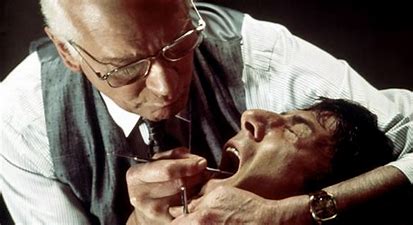
No one portrayed the sadistic tendencies of a dentist better than Laurence Olivier in the movie Marathon Man. There was one relatively horrific scene, in this otherwise boring movie, in which Olivier threatens to pull a healthy tooth from his patient without painkillers, unless the patient gives him the information he needs. The reason I consider the horror in this scene relative is that when I’m nowhere near a dentist’s chair, I don’t understand why anyone would consider having a healthy tooth pulled without painkillers so frightening that they would give up state secrets. When Ms. Mary and the dentist liberated me from their office, after about an hour of a level of torture all clients know, however, I recall that movie scene with a shudder.

The scene we’re starring in involves us lying supine, mouth open, and vulnerable to whatever they have planned. In the moment, I know I would’ve talked if Laurence Olivier prodded some sensitive nerves, telling me, “You need to take better care of your teeth.” If he hit those sensitive nerves with the high-pitched sounds of his drill, and I had no painkillers, I suspect I might give up every state secret I know.

Some talk about the high-pitched sounds of a drill with abject horror. This conversation is so common and the need to address the fear is so prevalent that most dentist office’s now provide their clients headphones to drown that sound out. Clients and prospective clients also talk about how much they hate the pain involved, so they take all of the painkillers the dentist has to offer, plus the nitrous oxide. Some potential clients seek dentists who have all of painkillers the state will allow, including putting them to sleep.

Prior to this particular dentist office visit, I informed everyone I knew that I turned down all but the basic painkiller, because I wanted the dentists and their assistants to hurry up and finish whatever procedures they proscribe for the horrors going on in my mouth. A younger, braver me opted to endure the pain to expedite the process. I did not want to wait for the nitrous to take hold. I just wanted them to start, so they could end sooner. Something changed over the years. I don’t know if I psyched myself into a frenzy or what, but when they started drilling, I raised a hand and asked for more painkiller and more time for the nitrous to take hold. I took all the painkillers they had at their disposal this time and the headphones.

***

I’ve heard about the Stockholm syndrome in which the captive begins to develop unusual feelings of trust and affection for their captors. Some of the captives, used in various case examples, develop an emotional attachment to the captors who torture them, and they do so because they become reliant on their captors for survival. At some point in the torture, they slip from being a hostile captive to a cooperative one, and finally to one who unwittingly begins to side with their captors’ cause. Everyone develops coping mechanisms for stressful moments, and while we understand that sitting in a dentists’ chair is not in the same league with all of the various forms of torture known to man, it does give those of us who know nothing of real torture some insight into what we might do when our captors know the right nerves to hit to get us to talk. 

My coping mechanism for dealing with this relatively, low-level stress was writing the article you’re reading right now. I wrote most of this article, in my mind, while Ms. Mary chipped away at my plaque, and I completed it when the dentist finished me off. When Ms. Mary tapped a sensitive nerve, I laughed. I did not laugh because I’m impervious to pain. I laughed because I thought of a great line I wanted to add right here … but I forgot it. Did I forget it, because our mind sweeps out negative memories to keep us happy? Some students of the mind suggest that the mind distills bad memories from our thoughts to keep us happy, in a manner similar to the liver distilling unhealthy products from our body to keep us healthy. I thought not, because the session wasn’t that horrific. I blame it on the drugs Ms. Mary induced. Whatever the case was, I remembered thinking that it was such a great line that I should hurry up and write it down before I forgot it, as I knew that it would get lost in the ether, or to the ether, and I probably should hurry up and write it down. I didn’t write it down, or even say it to Ms. Mary to make it more memorable, because as much as I live for great sentences, I didn’t want to prolong the process for even a minute more.    

I experienced a small window into how I might fare under torture when Ms. Mary drilled into a nerve that was not sufficiently dulled with painkillers. She responded in the manner I hoped she would, but I couldn’t help but think of what I might do if my captors not only didn’t stop when they hit that nerve, but they continued to explore the extent of my pain to get me to do whatever they wanted. We all love to think that we’re the heroic captive type who would never talk, but receiving a drill to a tender, exposed nerve reminds us why we revere those who endured what we cannot even imagine. I thought about how much I might hate the people doing this to me while they were at it, and I thought about how glorious it would be for me when they decided to stop. 

When the dentist finally decided I had enough, I appreciated his mercy so much that I felt grateful. It’s over, I survived, and I appreciated his contributions to my survival. The Stockholm syndrome suggests that the captive might appreciate their captors’ mercy for stopping. Those who study this effect say it doesn’t always happen to captives, but it has obviously happened so often that we’ve developed a term for it. For those who want to understand how this anomaly might happen, try going ten years between dentist visits. When the scraping, grinding, and drilling finding ends, it feels like they’re acting in a merciful, kind, and sympathetic manner, and the euphoria you feel might lead you to inexplicable feelings of affection that you don’t have for people who have never drilled anything into your face for a couple hours.

***

The thing about going to the dentist is it’s voluntary. We don’t have to go. If we want to keep our teeth, and keep them in such good shape that they might last for most of our lives, we must visit the dentist biannually. Some even suggest that a deterioration of our oral hygiene can lead to a decline in our overall health, but  it’s still voluntary. When we don’t visit the dentist’s office regularly, no one will think less of us, because no one will ever know. They might see the degradation of our teeth over time, but few will suspect that it has anything to do with the fact that we haven’t visited a dentist’s office in a while. They just cringe when we smile, and they think less of us, but they likely won’t make the connection. 

My dad had a miracle cure for bad teeth, milk. He thought the calcium in milk helped preserved his teeth so well that he didn’t have to brush, and he would never have to go to a dentist’s office, and he didn’t for most of his life. He thought milk, and the calcium therein, were the miracle cures to maintaining oral health to the point of having his natural teeth into old age. A high school friend of mine never brushed his teeth either, and he never visited the dentist’s office. His miracle cure was Listerine. Both men found the error of their ways during “the most painful experience I’ve ever had” when they eventually found their teeth so painful that a visit to the dentist proved to be the lesser of two evils. 

If they hadn’t volunteered this information, we would’ve never known, because no one lauds a person for responsibly visiting a dentist biannually, and no one talks about a person who doesn’t. “There goes Stewart, he hasn’t visited a dentist’s office in ten years.” I’ve never heard anyone say this, or anything else, about a person regarding the regularity of their dentist visits. There’s no peer pressure, parental pressure, or any other form of pressure, other than internal, to routinely address what could be a problem if we don’t.

“It’s voluntary? You mean I don’t have to subject myself to pain if I don’t want to do so? I have to be self-motivated to subject myself to the pain involved? Even those who regularly visit the dentist responsibly experience some pain in every visit? Who, in their right mind, would do this on a biannual basis?”

“The longer you wait the more painful it will be,” they caution.

“So, the only motivation to endure regular, painful visits, is to stave off the prospect of more pain?”

Most of the rewards for enduring everything Ms. Mary has at her disposal on a biannual basis, to maintain a healthy mouth, are long-term. If we maintain that biannual schedule, it’s possible that we might never experience a toothache, if we proactively follow their prescriptions for greater oral health on a daily basis. Yet, if we never have a toothache, how much do we appreciate it? If there are so few tangible, short-term rewards, what are the long term ones? Well, if we’re lucky enough to live into the 70s, 80s, and beyond, we might be able to luxuriate in the idea that we’re one of the few in the retirement community who still has most, if not all, of our natural teeth, but we’ll have to wait decades to lord that over our peers. When we finally arrive at that glorious day, how will they react? What will be our lifelong reward for having the various dentists and their Ms Marys drilling into our face for an hour, two times a year, for decades? If we’re lucky enough to live that long, we might one day receive nothing more than an unceremonious shrug from that guy who is now forced to wear dentures.