The True Thief’s Mentality


“Why do you watch such awful shows about such awful people?” our mother asks us. “Even the comedies you love are about awful people doing awful things to one another.”

“It’s complicated.” We say that because that’s what the critics call the complicated characters of Pulp FictionThe Sopranos, and Breaking Bad. They call them complicated characters, because they’re good guys, family men in some cases, who just happen to do bad things. It might be complicated for them, but it’s pretty simple for us. We love criminality, violence, and a general stench of awfulness in our entertainment vehicles.

“If it doesn’t have some violence, or the threat thereof, we’re kind of bored,” a friend of mine said to wrap it all up for me. Is that so complicated it’s simple or so simple it’s complicated. We let those who concern themselves with such matters resolve those heady concepts, we just know we love reading watching, listening, and playing games that are violent in nature.

The funny thing is an overwhelming majority of us haven’t even considered using violence to solve our problems since our kindergarten teacher scolded us for doing so. We also pick up on their bizarre, cringey, and hilarious justifications, “He had to do it ma’, that guy just ate some of his peanut butter without asking. It’s about respect.” Yet, we only apply it to fictional characters in fictional settings.  
“I only take from the rich,” is another justification the modern thief uses, in modern movies, to establish their nobility. ‘Fair enough,’ viewers at home might say if we accidentally view their actions in an objective manner, ‘but who are the rich?’ Gilligan’s Island prototypes dance in our heads when we think of “the rich”, but the rich guy demographic is actually a pretty broad category. It can include “evil” hedge fund managers who short-sell a company into oblivion and devastate its employees, but it can also include the little old lady who scrimped and saved her whole life, so she didn’t have to work when she became frail and feeble. We don’t want to think about the latter, because they don’t fit the Robin Hood myth that thieves only steal from the obnoxiously rich to level the unfair playing field by giving it to the poor, and overcomplicating such simple matters does ruin movies. 
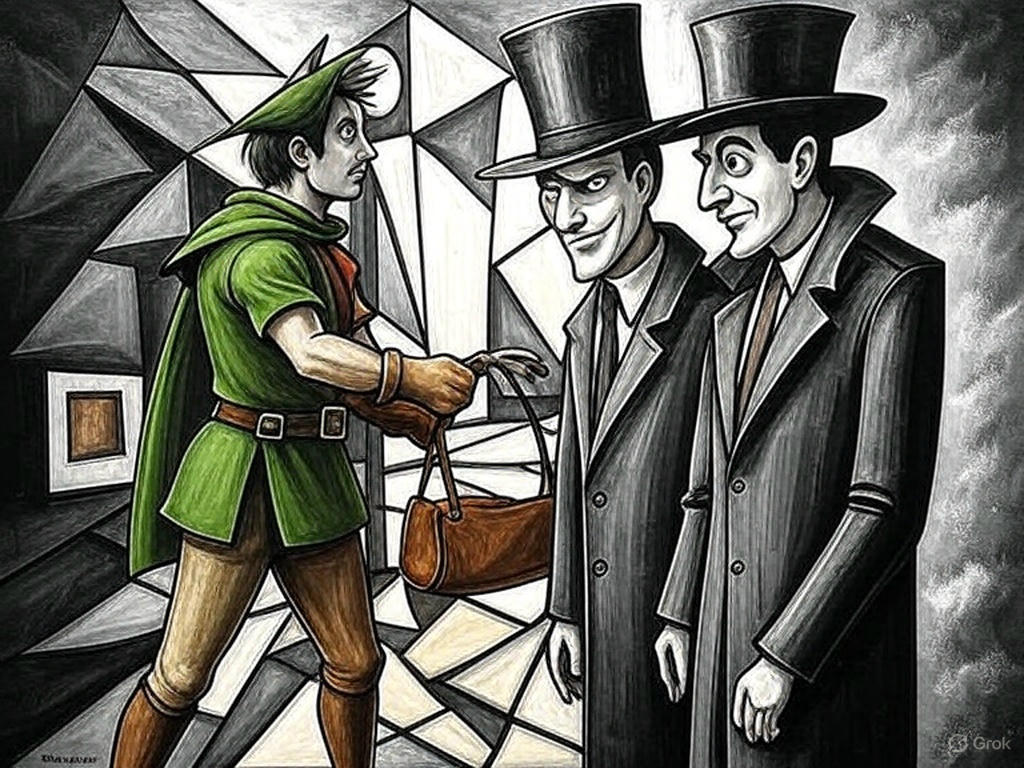
The thing with the Robin Hood myth that permeates so many of our favorite stories about thieves is that our more modern interpretations have twisted the original tales. We can’t call these modern portrayals wrong, because there’s no definitive evidence to suggest that an actual Robin Hood ever existed. Yet, the current interpretations are very different from the original English ballads and poems about this fictional character. They referred to a Robin Hood who stole from corrupt government officials who overtaxed and overregulated their constituents. These pre-Victorian-era English ballads and poems of Robin Hood detail how the Sheriff of Nottingham and the abusive local authorities overtaxed and over regulated their constituents to empower the government and line the government officials’ pockets. Why did this fictional hero prove so popular? Were the governments of this era too powerful? Were the people of Robin Hood’s era so overtaxed and over regulated that they were so reliant on government that they needed a hero to take that money and power back? 

These government officials became “the rich” by stripping their constituents of financial freedom through confiscatory taxes and burdensome regulations, and Robin Hood stole in back. For whatever reason, the Victorian-era fiction writers began leaving out the idea that the rich were government officials, and their bad guys were those individuals who amassed their own wealth. We don’t know why the Victorian-era writers rewrote the tale to leave out government officials, so we can only speculate that it either fit their worldview to do so, or they feared reprisals from their own government officials.

The altruistic, Robin Hood-style thief who steals from the rich and gives to the poor is such a romantic figure that we forget that some thieves steal stuff just because they want other people’s stuff. We think it says something about us that we assign noble goals to thievery. “They are only doing it to feed their children.” Some are, of course, but how many steal for the Thrill of it All? How many steal, because “He has so much that he won’t even miss it.” How many thieves “only steal from bad guys”? How many steal, because they think they deserve to have nice things? It is complicated in some cases, but in others, it’s actually quite simple.

No writer is going to write a story about a thief who just wants to steal things though. That would deprive their story of romantic and/or empathetic attachments. We want our fictional thieves, mass murderers, and other assorted criminals to be noble when they inflict pain on other people. Yet, we don’t need to read Dostoyevsky to understand that no thief considers themselves the bad guy in their autobiographical tale. All we need to do is listen to them. AsSocrates once said, “No one knowingly commits an evil action. Evil is turned into good in the mind.” They just have a want, and a want can easily be twisted into a need for those who want/need the justification. 

In the modern landscape, writers climb all over one another to depict the “gritty reality that no one wants to hear.” Yet, when they have their complicated characters say, “I only take from the rich,” they only have their characters steal from hedge fund managers who have yachts and second and third homes. I’ve never stolen from a hedge fund manager, but I have to imagine it’s not only very difficult, it’s fraught with peril. I have to imagine that most hedge fund managers have the best and most updated security systems set up in their homes and to guard their internet activity, and they also have a team of lawyers on retainer who are always on the lookout for cases to justify their existence. Thus, not only would it prove more difficult for the thief to steal from hedge fund managers, if they get caught, they know their prosecutors will be high-priced lawyers who know how to secure justice. 

Like the great white shark and the mountain lion, most thieves don’t act impulsively. They don’t want to get hurt, and they don’t want to get caught, so they profile their victims and stalk their prey, studying their practices and patterns for vulnerabilities. They want to know how easy it’s going to be to steal. If they’re able to steal something, they’d prefer victims who don’t have the money or the wherewithal to prosecute them. Thus, most real-life thieves aren’t as likely to pursue the noble cause of stealing from a hedge fund manager. They’d prefer to go after a little old lady’s life savings.   

No thief ever says anything along the lines of, “I’m actually a bad guy, and I have no qualms about saying that. I don’t care who I have to steal from, I’ll steal from my own mother if it means avoiding having to go to work. Say what you want about stealing, but it is so much easier than working for a living. People who work are such saps, especially when there are so many vulnerable people in the world who have so much stuff worth stealing. Hey, I know my soul is tainted, and it has been for most of my life. I’m just a bad person who enjoys hurting people financially. If I have to hurt them physically to get what I want, I will, but that’s not my go-to. And if there is an afterlife, I know I’m going to pay, probably for the rest of eternity, so I’m just going to enjoy this life while it lasts.” 

If no writer would have their beloved main character say such a thing, how about they have their thief drop all the typical “steals from the rich and gives to the poor” mythical justifications on us, and then steal from frail, little old ladies? To our complicated character, this would be true, technically, as the little, old lady in our production would be rich, and our thief would be poor. 
In our “gritty, real-life” production, the thief would get caught, and he would manipulate our thought patterns by complaining about the rough treatment he received from the arresting officers, the conditions of their jail cell, and how the judge took away their phone privileges. If a book captured that effectively and creatively established our otherwise sympathetic character saying a line like, “I only steal from frail, vulnerable old women because it’s easier and they don’t fight back. They just scream a lot about how I’m stealing their life’s savings and all that, and I find their tears delicious.” That book would not sell well, because it would be so confusing. 

I think it’s safe to say that we’re accustomed to our “bad guys” turning out to be the production’s most virtuous character when the smoke clears, and the generally agreed upon “good guy” being found out to be the complicated character in the end. We don’t want our favorite bad guys to hurt genuinely nice people just for the money. We also don’t want to learn a lot about the victims. We prefer they be largely faceless entities and corporations that have no people involved, or unattractive people who haven’t bothered to monitor their diets well. We prefer that the author avoid characterizing them, so we can enjoy the violent thefts without having to go through the guilt of watching the victims suffer. Or, if they’re going to characterize them, we prefer the victims be bad guys that no one but our very perceptive thief knows is a bad guy, because he’s done his research. We want those “good guys” who are actually bad to pay, because that’s the typical duality we’ve come to expect in our modern movies.

Some thieves experience remorse for their actions, some regret getting caught, but our psychopathic thief would prefer to steal from the lemonade stands that seven-year-olds set up, because that’s easy money. “I love money. I don’t care how I have to get it. I love money.” Our complicated character would characterize that seven-year-old, lemonade stand’s lead entrepreneur as a bad girl, because he considered her so aggressive that she was likely a bully. Then, on his death bed, our complicated thief would steal something from the dying patient with whom he was forced to share a hospital room. As our movie closes, his theft is discovered, and one of his nephews turns to the thief’s wife, hugs her, and says, “Well, he died doing what he loved.” Now that would be “a gritty taste of reality that would unnerve audiences about the reality of our world.” 

Whenever I sit through one of these modern portrayals of the nobility of the thief, the Robin Hood-style tales, I think about every thief I’ve encountered. They’re not prejudicial about choosing victims, as long as it’s easy, and they don’t give the proceeds from their theft to anyone, poor or otherwise, because, for all intents and purposes, they consider it theirs now. “I went to all the trouble of planning this, and I put my can on the line to get it. If they want theirs, they gotta go get it themelves!”  

I know my experiences with criminals, thieves, and fraudsters are anecdotal, but I worked in the fraud division of a huge company, and I spoke with hundreds of victims and alleged perpetrators on a daily basis. Those who created our website gave these thieves the opportunity to be an anonymous figure who could try to rip off other anonymous people in almost total anonymity. They weren’t ripping off a Helen Otterberg form Pocatello, Idaho, in their mind, they were ripping off a faceless, Hotter@internetcompany.com entity. They weren’t Steve Jurgensen from Loch Arbour, New Jersey, in their mind, they were Imhotep@othercompany.com. The anonymity, relieved the alleged perpetrators from the feelings of remorse or guilt they may have felt if they actually saw Helen. Well, I spoke to the Helens of the world, some of them were little old ladies who were a little careless with their information, and they didn’t the first thing about spotting fraud on the internet. The Steves didn’t hear the fear and sadness I heard on the other end of the line, and some of them may not have cared if they had. They believed they could use the anonymity inherent in the platform my bosses created to steal as much money as possible. 

Our fraud teams stopped an overwhelming amount of money from being withdrawn from our system into the fraudsters’ bank accounts, but we did not seek law enforcement’s assistance, unless the fraudster’s activity reached very specific levels. Thus, it was on the victim to seek further action, and in my experience few of them did. They considered it our job to stop the money, and it was, but once we completed our job, the matter was basically closed as far as most victims were concerned, and the victim and the alleged perpetrator learned something from the experience, and they both adjusted accordingly. As I wrote, these experiences are all anecdotal, but my experiences with friends who stole stuff, and my work in a fraud unit, gave me a better taste of the true thief’s mentality than most will ever have. 

Even with experiences that differ from what screenwriters portray on screen, I still love fictional violent crime dramas. I think The Godfather and II, Goodfellas, Pulp Fiction, Breaking Bad, Better Call Saul, and The Sopranos are some of the greatest productions of all time. I also love their cringey, complicated moral relativism, their attempts to achieve nobility, and the excuses these characters use to absolve themselves of wrecking so many lives with their actions. Yet, I absolve myself for ever flirting with the notion that their actions were justified by saying I don’t believe in the supernatural beings with supernatural powers, but if I know if I want to enjoy a movie about them, it’s incumbent upon me to suspend my disbelief for as long as it takes to enjoy the movie.  

Rilalities XII


Story, Harrowing Story

“Our son overdosed on Tylenol,” a mom and dad said entering a hospital’s emergency department. When they were directed to a room, they informed the nurse that the family experienced a dispute in their home. Their teenage son didn’t deal with it well. “He overdosed to teach us a lesson,” the parents informed the nurse. The argument, it turned out, was based on a huge misunderstanding. After emotions subsided, the three put the missing puzzle pieces back in place and realized what happened. (The author doesn’t know the particulars.) The parents and their son concluded their Q&A with the nurse by telling her they were in the emergency room that day to get their son’s stomach pumped.

“Okay,” the nurse said after the parents explained what happened in their home. “When did he take the Tylenol, and how much?”

“It’s been a couple days,” the mother said, “and he took almost an entire bottle.” She had the near empty bottle with her, and she informed the nurse that it was full before the incident. The mother finished that explanation with a compassionate smile directed at her son, and she mouthed, ‘It’s okay,’ to him.

The nurse made a mental note that she later shared with the doctor “that the three appeared almost happy, or maybe relieved in some odd way.”

The doctor agreed, and he said, “I think they were relieved that the heated argument was over, and they were just happy to have their son back.” 


“The treatment for an acetaminophen overdose is a drug called acetylcysteine,” the doctor informed them when he sat in the emergency room, about a half an hour after the nurse left, “but it only shows maximum effectiveness within an eight hour window of the overdose. We will use acetylcysteine, and we will also perform a gastric lavage or nasogastric tube suction, or what you call a stomach pump, but there are similar time constraints on the maximum effectiveness of those procedures too. The problem with ingesting so much acetaminophen and leaving it in the system for so long, is that it has been absorbed by the liver.”

“So, so, what does that mean?” the family asked.

“Our medical team is going to do everything at our disposal today,” the doctor said, “but my job is to make sure you are well aware of the facts of the situation here.”

“And the facts are?” the mother asked.

The doctor had sympathy for the patient and his parents inability to grasp the severity of the matter, and he tried to describe the ramifications as delicately and with as much sympathy as he could. He chose his words carefully while repeating everything he said about the effectiveness of acetylcysteine and stomach pumps after a couple of days, and he repeated what he said about the medical team at that hospital doing everything they could do to help their son, “But if your son took as much Tylenol as you’ve described here today, this is going to be as difficult a situation as you can imagine.”

We can only imagine how difficult this was for the doctor, and we can imagine that the parents put the doctor through it over and over in excruciating detail, asking questions we might regard as obtuse, but what was, in fact, a couple of parents and a son having a difficult time digesting the grim reality of the situation. We have to imagine that they interrogated the doctor, until he finally broke down and said, “In cases such as these, the normal life expectancy is around two-three-days.”

After the initial hysteria broke down, we can also imagine that the parents and their child enjoyed their final moments together. The reports suggest that this is a painful way to die, but if the son was able to manage the pain to a certain degree, we can imagine that the three of them did everything they could to celebrate his last days on earth. 

The team of medical professionals tried acetylcysteine, they performed the stomach pump, and anything and everything at their disposal. The teenage boy died two days later. 

I heard this story decades ago, and it still haunts me. It’s the da Vinci of stories. It doesn’t matter the angle, or perspective, it stares back at you as hard as you stare at it. How could the parents not know their child overdosed? For a couple of days? Was the argument so intense that they were not on speaking terms? I don’t know much about overdoses of this nature, but how was he not showing concerning symptoms, concerning to him in particular? We can only imagine that the parents have dreams where they spot something and do something sooner.

As much as the parents probably went through, and still go through, we have to imagine that no one involved in this situation will ever forget it. Everyone from the nurse, to the doctor, to anyone else involved still have nightmares about it. It’s also a harrowing reminder that no matter how bad the fight, or how profound the disagreement, get it out, get it all out, speak to the ones you love, and straighten it all out before it’s too late. 

Heart Attack

Those who were there know that I had a rocky relationship with my dad. We were two stubborn, ornery, Irish roosters butting heads. He kept me in check by threatening to kick me out of the house. I didn’t want to leave my home, and I didn’t want to be known as the kid who got kicked out of the home. My plan, once I got out on my own, was to never forgive him and never forget what he did to me. Years into the plan, my dad had a massive heart attack. His chances of survival were slim. I visited him and saw him hooked up to a variety of machines, and I realized that no matter how awful he was to me, he was the last parent I had left in life. He survived, barely.

We spent the next eleven years rectifying everything that happened during my youth. During these eleven years, I thanked him for assuming the role of step-father for me when I was two-years-old. That was so hard. It was difficult to avoid qualifying it, and placing “But you did this to me” type of asterisks. I left it as a standalone thank you. 

It was the best thing I ever did. I wish he would’ve lived for another ten to twenty years, but he didn’t. When he eventually passed away, however, I said goodbye to him with a heart free of anger, without the need for some sort of retribution, and hatred. If he died after the first heart attack, I would’ve been an absolute wreck. The moral of the story is, no matter how bad the fight between you and your loved ones is, get it out, speak to one another, and straighten it out before it’s too late.

Why I Write

Ever drive down the road and see a bumper sticker with exclamatory statements on their car? How about that guy who wears a T-shirt, in public, that says something meaningful? And what about that guy we all know who debates his friends on a variety of topics, with a palpable sense of frustration. “No one will listen to me,” he shouts. Everyone who talks to that guy feels his underlying sense of frustration, and they know how angry he is. We begin to interact with him less and less, because we know he can turn everything from a discussion on geopolitics to whether or not the snap pea is a delicious food into an uncomfortably confrontational argument. Every time I meet that guy, I’m so glad I’m not him anymore. That guy has no venue. He needs to express himself all over you. Whether you deem the material I discuss valuable or not, I found my venue. 

I always valued friendship over the temporary feelings one can derive through defeating another in an argument, but I felt a certain sense of frustration when no one would agree with me. When I expressed some anger and frustration, people would give me that extra look. If you’ve seen that look, you know it. That look follows you, and it says something uncomfortably revealing about you. It’s a double-take that precedes most rational, sane people just walking away. Others, who care about you, say, “Maybe you need some counseling.” Tried it, didn’t work for me. I wouldn’t say the counselor was stupid, or I am more intelligent, but she didn’t understand me. I didn’t understand me, until I found an outlet. I wouldn’t say I was complex, or anything extra ordinary, but there was no question that I needed to do something to get everything that was in me, out. 

“Music sets the sick ones free,” Andrew Wood, lead singer of Mother Love Bone, once wrote. That was me. I didn’t just love music, I needed it. I could drop the cliché that I needed music, like some people need oxygen, but it wasn’t that severe. I prefer to think of my need for music to help balance my mental stability as one might view a farmer living out on the prairie with little-to-no law enforcement. I needed music the way those farmers need to be armed to protect their land, their livestock, and their family. The only issue was I never wanted to be anything more than a music listener. I didn’t know how to play an instrument, and I didn’t have the patience to learn one. Yet, I was in desperate need of some form of self-expression in some sort of artistic manner. 

If “Music sets the sick ones free,” and I believe it does, writing was directed neurological therapy for me. Music was equivalent to a neurologist prescribing necessary over the counter pain medication. Writing, would prove the directed neurotherapy a neurologist might prescribe after repeated visits and extensive study of my reactions to everything prior.  

I was never ill, compromised, or depressed in any substantial manner, but I had an internal itch that ruined days. Writing felt substantial to me. I wanted it all, but when it didn’t come, I kept writing. I was no prodigy. I wrote some awful stuff, but I loved it, needed it, and I kept wanting to do it no matter what. Writing anything and everything I could think up is what has led me to the definition of sanity I now know.

No Hugging and No Learning

When I watched Seinfeld, I had no idea why it appealed to me so much. It was funny, of course, but there were dozens of situation comedies on the air at the time, and hundreds of them throughout history. Seinfeld was special to me, and I had no idea why. When I learned that the writer’s room had a “no hugging and no learning” thematic approach, I said, “That’s it” to myself.

Seinfeld was special, because it wasn’t “special”. Everyone from the creators, writers, on down to the actors made no effort to be special, nor did they add special ingredients into the mix. The special ingredients for most writers on most situation comedies involved the “very special episodes”. These episodes made special connections to the audience through special issues. A character, in their narrative, discovers that they’ve been so wrong for so long that they now question their foundation, and the audience understands, agrees, cries, hugs, and leaps to their feet in “clapture”. Clapture is a framing technique used by comedy writers to get the (Emmy!) audience to clap with laughter, or to agree with them more than laugh. I didn’t realize, until Seinfeld, how cringeworthy those special, meaningful messages were. The Seinfeld writers maintained that there would be no hugging, no learning, and if I might add, no special understandings in their show. They just tried to be funny. When we watch such shows, we always wonder if they reflect our values, or if we begin to reflect theirs. I think Seinfeld, more than any other sitcom I’ve watched, reflects my values. I prefer a good steak with very little seasoning and nothing else! Unless steak sauce is used to cover up the quality of the meat, I want nothing else on my steak. If you’re going to come at me and tell me what you really think of me, I prefer that you come bold with no qualifiers. I also prefer music that is complicated, fun, interesting, creative, relatively brilliant, unique, and utterly meaningless. Don’t tell me what you think of the domestic economy of Istanbul, the mating habits of the emu, or anything else that you wished you put in your college thesis. Just write lyrics that fit the music and be done with it. Seinfeld, in my opinion, met all of those standards.  

Scat Mask Replica III


1) The Rasputin Paradox. Are you involved in an enterprise in which one person’s alleged ineptitude is holding you back from realizing what you considered its vast potential? Is your enterprise one-step away from removing that alleged ineptitude? Those who know the history of the Russian Empire know to be careful what they wish for. Some speculate that Grigori Yefimovich Rasputin had far less influence in the Russian Empire (circa WWI) than history details, and they double down on that by saying that the Romanovs would not refute what others said about the levels of Rasputin’s influence, because the Romanovs presumably enjoyed letting Rasputin play the role of the scapegoat. If they did not know the level of blame others placed on Rasputin while he was alive, they definitely found out after his death, because after Rasputin was murdered the focal point for the Empire’s ineptitude was gone. Those in politics, business, and in personal crisis should note that casting blame on one particular person for the failure of your enterprise might prove cathartic in the short-term, but once that person’s gone, it might reveal more about the general ineptitude of that enterprise than any of the other players imagined.   

2) “If you have facts on your side, pound the facts. If you have the law on your side, pound the law. If you don’t have either, pound the table.” One of the more uncomfortable situations I’ve experienced involved someone pleading with me to accept them as a genuine person. It’s a gross over simplification to suggest that anytime someone pounds the proverbial table to convince me of something that they’re lying, but experience informs me that the more someone pounds the table the more insecure they are about the information they’re trying to pound into my head. We’re all insecure about our presentations, and some of us pound the table even when we have the facts on our side. I know it’s easy to say, but those with facts on their side should relax and allow them to roll out as they may. The truth teller who finds it difficult to avoid pleading their case should also know that after we reveal enough supportive evidence most will believe us, but some just enjoy watching us squirm.

3) Speaking of the genuine article, it has recently come to my attention that some pathetic soul stole at least two of the articles from this site. Some call this plagiarism, but I call it pathetic. If imitation is the sincerest form of flattery, I suppose I should consider it a compliment, but this is outright theft. It seems redundant to me to clarify the rules on this matter, but if a writer is going to “repost” they are required to provide attribution. (For those unclear on the definition of this term, it means that a writer is supposed to inform their audience that they didn’t write the article.) Not only did this pathetic soul avoid attributing the article to me, but they also didn’t provide proper attribution to the quotes I did in the article they stole. So, this person (who provides no discernible path back their identity) anonymously steals posts to presumably receive checks from companies that pay writers to sport ads on their site. I don’t care how much those sponsored ads pay, how does this person sleep at night knowing that the profession or hobby they chose is one in which they cannot produce their own quality material. If I were ever to reach a level of such a desperate act, I would seek another profession or hobby. 

4) The difference between selfishness and self-awareness. A complaint about young men and women is that they’re too selfish. It’s the root of the problem, they suggest. I don’t know if it’s true, but if it is I would suggest that those speaking out against it are delivering an incomplete message. My platform would suggest that these selfish types are focusing on self-awareness, and that they should seek it to achieve a level of fulfillment. We could view striving to achieve greater self-awareness as a selfish pursuit, but self-awareness can take several forms. Performing selfless acts, for example, can teach a person a lot about themselves, and it should be encouraged, as people performing many selfless acts can become more aware of themselves and more selfless. The process could lead to an antonym of the vicious cycle these complainers decry. If I had a pulpit, I would also declare that an individual could learn more about themselves through spirituality. I’ve been on both sides of the value of scripture, and I think this gives me greater perspective on the matter. I look at scripture and other Biblical teachings as a roadmap to personal happiness through reflection. Self-interest drives me to follow those teachings because I believe it’s in my best interests to follow them. In short, I would play my sermon to the selfish predilections of the young. I hear sermons that suggest otherwise, and I can’t help but think that the priest is missing a beat.

5) As a former service industry employee, I’ve encountered my share of disgruntled customers. I could provide a list of examples, but the material of their complaints is irrelevant. Most experienced service industry employees know that the most disgruntled customers are often the most disgruntled people. They might hate their kids, the spouse, and their life. Whatever the case is, the discrepancy they find causes them to unload, “What kind of Mickey Mouse operation are you running here? Your ad says this item is on sale today for two bucks. If you think I’m going to pay more than that, you must think I’m stupid! Or, are you singling me out based on my characteristics?” These statements are often a mere introduction to a heated exchange that reveals the effort of the disgruntled customer to achieve some satisfaction they can’t find elsewhere in life. A more confident customer would simply say, “Your ad says that this item is on sale today for two dollars.” Those of us who have experience in the service industry know how intimidating a confident presentation of the facts can be, especially from a more secure individual.

6) A new documentary captures an ant crawling down from a piece of cheesecake with a piece of it lodged in its mandibles. The makers of this documentary capture the ant’s progress, in stop action photography, as this permits progressed commentary from various filmmakers talking about the brilliance of each segment. Where does the ant go, and what will it do with the small, round ball of cheesecake? This is the plot line of an amazing new documentary called Posterula. (Spoiler alert) The ant makes it off the plate, but the viewers don’t know if the ant ever takes the piece to the colony to feed the queen. This leads this viewer to believe that an as of yet undisclosed plan for a sequel to this brilliant documentary is in the works.

(Hi, I’m Rilaly, and if I were to take you on a tour of my young mind, this would be but an example of what you would read. Some suggest that such humor is too niche, and if that’s the case I would’ve niched my way out of the market. If I had one of my stories published, customers at bookstores would’ve walked past my serious pieces, thinking that I’m nuts, too far gone, and unserious. They probably still think that. I’m niche.)

7) I landed upon the term “vague and flexible by design” the other day. The author of the term intended it as a compliment for the subject, but if they directed such a characterization at me, I would view it as an insult. I understand that we’re different people in different surroundings, and that we should all remain flexible with our ideals to prepare for new findings on the subject in question, but the “vague and flexible by design” compliment would register a ‘no core’ insult to me.

8) What hotel, or meeting space, first decided to serve a ball of meat as a solitary entrée? Someone somewhere should’ve stepped in and said, “Woops, you forgot the fixins.” Those who have attended more than twenty corporate galas, weddings, or any catered event are now more than accustomed to the items served in a buffet line. I now eat before I attend one of these functions, because I cannot eat another pinwheel, I’m burnt out on hot wings, and I hit my personal threshold on room temperature potatoes au gratin somewhere around 2004. I am not a finicky eater, but I can no longer stomach this list of dietary choices. I will acknowledge that being American provides me the luxury of making odd and unreasonable dietary choices, but if I’m going to limit myself to one meal a day to maintain a relatively plump figure, as opposed to fat or obese, I’m not going to eat something just because others provide it in a visually pleasing manner.  

9) There is a difference between writing a grammatically correct sentence and quality writing. I took college classes on creative writing, I’ve read the MLAs, and I’ve learned through word-of-mouth what leads to quality reading. I’ve fixed the passive voice sentences, deleted the word “had” as often as possible, and I’ve tried to avoid what fellow writers call “the you-yous”. The goal for the writer is to adhere to the rules of writing while attempting to maintain a stream-of-consciousness style that makes for quality reading. It’s not considered grammatically incorrect to write that you may not enjoy this sentence, but writing that the reader may enjoy it without the word you is considered a more pleasant reading experience. I’ve also attempted to write “who” instead of “that”, and I’ve attempted to limit my need to “that” too often. Example: “You don’t want to write that it was someone else that said something, when who said it is much more familiar to you.” In that sentence, fellow writers suggest using the word “Writers” to replace the first you, and “Readers” is an advisable replacement for the second you. Beta readers suggest that doing otherwise means the writer has a bad case of the you-yous. You is too familiar to you, and that is too unfamiliar, and you do not want to be too familiar or too unfamiliar. The first reason for following this rule is that the writer does not want to write in the manner they speak, because the way one speaks in one locale may not be as familiar to a reader in another locale. These standards set a common base for readers, free from colloquialisms. The you yous also creep up on a writer in free flow, and they may not notice how redundant the use of the word is in their document. The question that haunts me is do I want a perfect document to impress accomplished writers, or do I want to pleasure myself with a document that might have some flaws. The notion one writer lofted was every writer makes mistakes, we readers weave them into the cloth of our expectations, but is there a point when the mistakes distract from the whole.

10) “He’s such an idiot,” Teri said after her boyfriend left the party table to go to the bathroom. “He cheats on me all the time. For all I know, he’s arranged something in the bathroom. I’m serious. I can’t even trust him to go to the bathroom.” I find such honest and provocative comments hilarious.

“Why are you dating him then?” I asked. Room silencing, impulsive comments like these are my gift to the world. I can flatten the smile of any decent person from fifty yards with a single thought implanted in their brain. I don’t do it on purpose, but some of the times my curiosity gets out in front of my common sense.

The comment sat right with me, but the moment after I delivered it I realized it was so loaded with complications that no one in the right mind would deliver it to a table of people gathered together for the sole purpose of mixing in some laughter with their fun. I thought it was a leading question that might spur her into extensions on the joke, but I was wrong. I made her uncomfortable.    

As soon as she recovered from the blow, aided by my discomfort, she displayed the idea that she locked herself into a certain, cynical dynamic of life. She knew the world was full of it, and everyone around her was too, in one way or another, because she knew who she was. She thought her beau was full of it too, but “He’s a nice guy…most of the time.” I didn’t know if that was her final answer, but I overemphasized my acknowledgement of her answer to suggest that was what I sought.

No matter how often I affirmed her answers, Teri kept coming at me with answers. She said he was “Funny and fun to be around.” She said he was good looking, and she said he did “Sweet things for her.” I couldn’t get out of this uncomfortable spiral of my own making. I pretended to be interested, because I knew I put her in the uncomfortable position of having to explain one of life’s most illustrating choices, but I was trying to end the episode with every word she said to me.

Most of us cannot explain our life altering choices so well that we can weather interrogations. I knew this, but I thought I could explain most of my choices at the time. The question that even the most reflective must ask themselves is, is their base so solid that we make rational, informed choices in the impulsive moments? I don’t think many reflective types would pass their own interrogations, in the moment, for I think we color in the blanks later to make us believe we made informed choices.

Teri told me her boyfriend was a good man, with a good job, and he had an unusual curiosity about life that she found fascinating. I also learned that while it was obvious he had a restless, nervous energy about him, “He’s incredibly lazy. If he had his choice, he would spend his day on a couch.”

I still didn’t understand the dynamics of their relationship, even though she provided me numerous answers. I wouldn’t understand it for a while. I had no idea at the time that their relationship depended on the idea I had that she enjoyed playing the jealous girl, because, I can only assume, she considered him worthy of her jealousy, and in a world of average men with no discernible qualities, that is something. He was the naughty boy, and he enjoyed that role. “We fight like cats and dogs,” she said with a gleam in her eye, “but then we have makeup sex.” I wondered if she ever tried dating guys who wouldn’t cheat on her. I wonder if they wouldn’t fight with her. I wondered if they bored her. He provided her something to focus on other than herself. He was the dunce, but he was an amiable dunce. He provided her drama. He was always on the cusp of cheating on her. She also had a desire to date a guy that she could be better than, and she wasn’t much. Either that, or there is a desire to care for something that could break. “He’s an idiot, he doesn’t know how good he has it,” she said more than twice. The guy was fulfilling the age-old male need of feeling like a bad boy. Most guys need this coursing through their veins, and some girls apparently need a guy like this too.

11) Unhappy couples fascinate me. They don’t smile often, but smiles are a refuge of the simple minded. They don’t hug, kiss, or touch very often, but they’re not that type of people. They’re emotionally distant people, and happy people make them sick. Do they have a greater understanding about who they are than we ever will, or are they jealous? She didn’t date in high school, and he was a broken boy. Death of a loved one breaks some, divorce breaks others, and still others experience a seismic betrayal that creates an irreparable break. Yet, they found something in one another that they always wanted. As an outsider looking in, we can’t understand the allure, but the two of them stay together for years. Some stay in a job they hate, because they fear the unknown. Do people stay in relationships for the same reason? He doesn’t speak often, and relatives find it difficult to strike up a conversation with him. He gives off the vibe that he’s not interested in what others have to say, and this affects the way others react to him.

My initial instinct was that he wasn’t interested in what I had to say, for reasons endemic to our relationship, until others informed me they shared similar experiences with him. He’s more interesting when he drinks, but when the night is over, the participants realize he wasn’t really interesting in the truest sense of the word, but he was more interesting than they expected him to be. A couple of drinks loosen our inhibitions. A couple more might loosen them even more, until the potential exists for us to become interesting. That’s the mindset of the drinker anyway, I’m not sure if this is his mindset, but he does have a drinking problem. He is emotionally distant, because those that formed him devastated him emotionally. Yet, it many ways he appears satisfied with who he is.

12) No one is as boring as we think they are, but we’re not as interesting as we think we are either. How many of us look back to our authentic years with the belief that we weren’t nearly as authentic as we thought we were, especially with the level of authenticity we’ve currently achieved. How many of us will look back ten years from now with the same thought? One could say that the level of effort put into being authentic provides a corresponding level of diminishing returns. 

13) How many of us remember the first person who told us about America’s atrocities? Did they package it with a provocative statement such as, “This is something your moms and dads don’t want you to know about.” For those of us who are now parents, it’s probably been so long since someone introduced us to the dark side that we forget how intoxicating it was the first time we heard it. I don’t remember my first messenger because I’ve heard about these atrocities so many times since that they’ve all but drowned out my first messenger. Thanks to a myriad of resources I’ve encountered since, I am now able to frame those atrocities with the virtuous acts America has done throughout her history to arrive at the independent conclusion that America has been a noble nation overall. It did take me a while, however, to arrive at that conclusion. 

Some might think that learning of the atrocities for the first time might leave the recipient feeling cold, disillusioned, and/or depressed that their parents sold them a pack of lies. In the combative environment of my youth, one of the many focal points of ridicule was naïveté. “Don’t tell me you believed all that baseball and apple pie crap?” someone would say in the aftermath of a discussion on American’s atrocities. I did, and those early messengers in my life provided me information to combat the characterization that I was naïve. I considered them more informed, brave and righteous. I thought they were cooler than cool for speaking out against the marketing arm of America, and I thought they were treating me with the type of respect than my dad never did.

Now that I’m a seasoned adult, I know my dad wasn’t necessarily lying to me, and he wasn’t withholding a truth, but he didn’t give me the whole picture either. He didn’t know some of the atrocities these messengers told me, but there were incidents that he did know, and he neglected to tell me about them. Anyone who remembers their teenage mind knows how much we exaggerate the characterizations of our parents, especially when “truth tellers” package such information accordingly. Their presentations excited me in a way that’s tough to describe. I thought I was finally hearing the truth from someone.

A vital mindset for parents to have, while sharing our knowledge of American history, is that they are in a constant battle with their peers to avoid appearing naïve. For those worried about telling their children about the awful things the country has done, consider it ammunition to combat these stories with the stories of the country’s virtues. Our goal should be to instill a love of country in a comprehensive manner. To a certain point, we parents have told them what to think and how to think for so long that we may have a difficult time giving up those reins. On this particular subject, however, we need to present this information in a manner that allows them to decide, and we might even add that we understand it’s a lot to take in one setting, so we should allow them to think about it.

If we don’t do this, the truth will rear its ugly head when we least expect it. Those who provide them this information will likely not frame it in the manner we think they should, and our kids might turn around and accuse us of lying, telling half-truths, and not trusting them enough to deal with such sensitive information. Whatever the case is, we might never be able to win them back. My advice is we teach them the virtues of this country and couple it with a healthy dose of the horror some Americans have done since the country’s birth. Do some research on the atrocities and prepare for the follow up questions, because there will be questions. Once we’re done, we should repeat the cycle so often that by the time that cool, rebellious person tells our children, “The things we don’t want them to hear,” they will turn on that person and say, “I’ve heard all of this a million times, and to tell you the truth I’m sick of hearing about it.” If condemning your country in such a manner is difficult, much less teaching it to your child, ask yourself how you would prefer America’s atrocities framed? Would you rather provide your child with a more comprehensive narrative, or would you rather someone who hates their country do it for you? One way or another, your child will learn this information.

14) I’m about 15 years into using devices to stream music on a daily basis at this point in my life, so it might seem a little odd to show appreciation now. Anytime I take a very short drive, I gain greater appreciation for the freedom technology has offered when I turn on my local FM stations and I hear a DJ offer tidbits from their life. I’m not talking about morning show hosts, as I think I listened to one morning show decades ago, just to hear what everyone was talking about, and I never listened to another one. When a DJ informs me about a day in their life, I switch the channel so hard my fingers hurt later. I don’t care about the private lives of celebrities, but I understand that some do. No one knows who these DJs are, and I think even less care. Yet, when they are on the clock, moving from one song to another, they tell us about their day. They tell us about a party they attended, a soup they enjoyed yesterday, and something their significant other said to them in the movie theater. Nobody cares! The only line we should hear from a radio DJ is, “That was one song, and here’s another.”  

15) Most people have heard the quote, “The definition of insanity is doing the same thing over and over and expecting a different result.” The quote is widely attributed to Albert Einstein. Most people know this quote, but they only apply it to innovative qualities that appeal to them and their relative definitions of the status quo. When another innovator sticks their nose out and tries to revamp other things that might not fit within the established definition of change, they receive nothing but scorn and ridicule. “Do you know the quote?” we ask.

“Yes,” they reply, “but it doesn’t apply here. This proposed new way of doing things, just isn’t the way we do things.” Okay, but the way we do things hasn’t worked for decades now. The counter argument is that we’re on the cusp of it working, and they provide some details of that progress. Those details are often talking points, and they don’t detail, in any meaningful way, actual progress. They then conclude that this new person, with all of their new ways of thinking, might damage all of the progress we’ve made. Again, we’ve been on the cusp of their way working for decades, and it hasn’t worked. Why shouldn’t we try a new way? Because that isn’t how things are done?  

The thing that bothers me is we’ve been lopping off innovative noses off for decades, and it leads me to believe that many innovators have shied away from the spotlight, because they like their noses, and future innovators will be just as shy. We might even recognize some of the merits of this proposed solution, but we will cede to the better minds and continue to do things as they’ve always been done, because that’s the way we’ve always done it.