A man let his pet out for a tinkle. Nothing strange about that, right? His pet was a rooster. I was the visitor walking my dog passed his property, witnessing a homeowner doing what he does from the comfort of his own home, so I was in no position to evaluate his activities. Watching the man do that, led me to feel that I was a stranger in a strange land, and I couldn’t shake it. Other than this small, relatively insignificant episode, it wasn’t a strange land to me. Even though I was born and raised in a relatively industrial city, my home state is generally considered an agricultural one, and just about everyone I knew and spent some time in and around the agricultural industry. The state was I was now walking my dog in was so close to mine that I didn’t expect to see anything different from what I knew, and I didn’t, until this rooster sprang out the backdoor that the homeowner held open for him.
I tried to look away quickly, because I didn’t want him to know I saw it. I didn’t want to share that uncomfortable smile that we share with someone after they do something we consider embarrassing, and I didn’t want to have to come up with some comment to lighten the load for him. Just before I could look away, the homeowner waved. It was a hearty wave, strengthened by a pleasant smile. The man’s smile and the wave suggested that letting a rooster out in the backyard was nothing but routine for him, and there was no reason for me to stress out about it in the moment. I returned the smile, waved back, and continued walking my dog.
While attempting to force the conclusion of the episode in my head, I almost missed the rooster rush the fence after it saw how close my dog and I came to its territory. It quickly ambled down the considerable stairs that descended from the porch, and it sprinted across the yard to us, until its beak protruded through the fence. It eyed my dog, and it eyed me. It offered us an unmistakably foreboding eye to caution us against stepping any closer. It did not cockle-doodle-doo us, but some sound, like a bark, seemed like the next logical progression to punctuate its warning.
It followed us along the fence line with that foreboding eye. The silent tension percolating between us was not one of fear, but I was so confused that I wanted to hurry up and end this episode before a more confusion progression occurred. The writer side of me wants to write that when we reached the end of its fence line, it stood there watching us as if it didn’t know what to do, but even though its actions were born of mimicry, the rooster appeared to know exactly what it was doing. The rooster’s actions were so foreign to my limited understanding of roosters that they unnerved me. They unnerved and confused me so much that I thought if I were a four-to-five-year-old when I experienced this episode, I might walk away in tears. Especially, I thought, if this rooster tried to bark. If it tried to bark, or make some sort of sound to punctuate its warning, I thought it might rattle my foundation in the same ways some of the early David Lynch films could.
I forgot about this incident soon after that walk ended. I didn’t consider it a “You’ve got to hear this!” type of story for months. I considered it a “you had to be there” story where so many stories go to die. When one of my friends told me a story about an incident that “kind of freaked them out a little”, I dropped this story on them in that “You think that’s weird, get a load of what happened to me one day” vein that we do to outdo their stories. His reaction to this story was such that I began telling it so often that it became my story. I told it so often during the next year, that when I returned to the locale where it happened, I began telling it again without proper foresight.
“Oh, that’s my brother Harley,” a man said. “He has a pet rooster.”
Harley’s brother interrupted me in full story mode. I was in my element as a storyteller with a number of people listening in, and I was on a roll. Harley’s brother locked me up. I couldn’t think of anything to say. It was equivalent to driving down the street at eighty miles an hour and slamming on the brakes.
My favorite stories are of the “strange but true” variety that can stand on their own. They don’t require embellishment or a clever, fabricated conclusion. A more clever writer might’ve added something more to ignite laughter or some sort of other sense of satisfaction for their audience. They might have the rooster bark, or have it make some sound that it mimicked from the dogs it was obviously raised around. Strange but true stories like the-rooster-that-thought-it-was-a-dog are my favorites, not because they’re hilarious, but because they’re so true that they leave the listener with that “All right, but what do you want me to do with this?” reaction. When I’m in the middle of one of these stories, and someone interrupts the timing and emphasis I’ve developed after so many retellings, it annoys me. When that interruption deflates my story, I become visibly flustered.
I had a finger in the air, and a smile on my face, as I prepared to launch into my critically acclaimed conclusion, but this man’s intimate familiarity with the rooster’s owner brought me to that screeching halt. It locked me up so bad that for the next couple of guilt-ridden moments I wondered if there was a colloquial antonym for verbal diarrhea. I considered the term verbal constipation, but I wasn’t sure if that captured it.
“Harley had two dogs,” Harley’s brother added. “They died. That rooster is the only thing he has left.”
There was something in the man’s tone I couldn’t immediately place. I immediately assumed it was compassion that he was directing at his brother’s loss. The more I thought about it, however, the more I began to believe that he might have felt bad about ruining my story and causing me a mean case of verbal constipation. He might have noticed how much I enjoyed telling this story before his interruption, and he might have recognized that he had taken one hell of a good story away from me.
Whatever the case was, the man provided me an answer for why a homeowner would release a rooster in his backyard. The rooster grew up around dogs. The rooster either mimicked the patterns of those dogs protecting their property, for so many years, that it couldn’t stop after they passed, or the rooster thought it was a dog. I did not ask if the rooster scratched at the door when it wanted to go outside, or if it saw my dog and I approaching and began running in canine circles, until Harley picked up on the visual cues that the rooster mimicked when it wanted outside. I didn’t ask about Harley, and if Harley participated in this routine because he missed the dogs so much that continuing the routine provided some sort of therapy? I didn’t ask if Harley thought the rooster’s actions were kind of cute, or funny in the beginning, and he ended up doing it so often that whatever drove him to do it in the beginning was gone and the routine of it all took over, because by the time I saw Harley do it, I saw nothing but routine on his face. I wish I asked some of these questions, just to fill out the details of this story, but Harley’s brother caught me so off guard that I ended the moment with a mean case of verbal constipation.
The Art of the Nod
A speaker began speaking about himself. He began informing us of his talents, what he planned to do with them, and all of his subsequent dreams and expectations. His life story was interesting in the beginning, but he just went on for too long. He was also the type of speaker who provides far too many details, and he provided so many alternatives that no listener would be able to maintain interest no matter how much they wanted Ari to like them. I managed to maintain the façade that Ari intrigued me, but it was a struggle. When everyone else failed in this regard, I became the center of his attention. When that happened, maintaining interest became more of a chore for me.
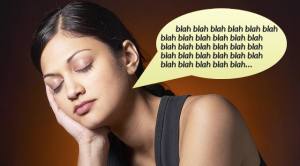 My friend, a third party in this conversation, was not as successful in her efforts to purport interest. She nodded off. I was, presumably, the only one who saw her nod off, and I was the only one to witness her artistic recovery.
When she nodded off, her head went down and some instinctual part of not wanting to appear so bored that she fell asleep took over, and she jerked her head up. The art of this nod occurred a second later when she nodded down again. This second nod was not a result of falling asleep, but an attempt to rewrite any theories we might have had about her falling asleep in the first place. She performed the second, voluntary nod to re-characterize the first one as nothing more than the first in a series of nods of agreement.
She even added a “Yep!” to further characterize the hearty series of nods further.
She had no idea what she was agreeing to, but she got away with it. I looked out at the faces of the others in the room. No one else saw it. I was impressed. I looked back at her, and she had not only maintained her agreement, she strengthened it, until she was garnering more attention from Ari than I was.
In the halls of social protocol, I considered this art.
I all but applauded her for this reaction when I asked her about it later. I mentioned that I didn’t think a person could carry something like that off once “That!” I said, “was too artistic. That requires practice!” I asked if she ever did this to me. She said she hadn’t. She said I was never that boring. I was grateful for the compliment, but I had to know how often she did that. She said as far as she was concerned it was the first time. She had no other explanation for it, other than the fact that she was trying to avoid appearing rude. She tired of my questions after a while, and she stated that the moment embarrassed her, and she asked that we move onto other subjects.
Old People
 Old people? Old people? Let me tell you something about old people. Old people set the parameter. If it weren’t for old people, your nuance would have no contrast. All that rebellion you cherish, that avant garde comedy, would just be blather. Old people? Have you ever watched the movie Caddyshack? Did you find it humorous? Uh huh. Ask anyone that knows anything about the finer nuances of comedy, and they’ll tell you that that movie would not have been half as funny as it was, were it not for the old person in that production, Ted Knight, providing contrast. Without contrast in comedy, the movie is just a bunch of buffoons standing around reciting lines to one another. Contrast provides the pivot point for comedy, and that old man in Caddyshack, that fuddy duddy as you call him, set the standard for the role that straight men would play in comedy for the next four decades. The straight men set the parameters for other players to bounce off, and that’s what we old, boring types do. We set the parameters for the rest of you to appear funny, cool, hip and sexy. Try writing a cool, hip, funny scene without a Dean Wormer, and we’ll see how far you get.
Like Boxing for Writers

Some writers believe that what they write is witty, humorous, or a display of their as of yet undiscovered talent in the art of comedy? We’ve all watched them write about clouds and trees, and we’ve all let that go, because we know all writers have to preen themselves every once in a while, but when they attempt comedy some of us think these writers need an intervention.
One of the dangers inherent in comedy is that it’s relative, and every audience member should acknowledge that before they castigate another’s attempt at being humorous, but some attempts at humor are so bad that I want to say that we can all see the writer’s haymaker coming.
When the author writes about a disagreement they had with their daughter about what television show to watch, we know to put our laughing galoshes on. We also know that every author, if they are male, will provide exhaustive detail about how they regard their daughter a superior intellect. They will provide us with eyewitness testimony of their daughter’s brilliance, and for some authors this will last for about a quarter of the story.
At this point, many of us envy those who can start a story and ‘X’ out of it when it fails to intrigue them. Those who are able to find their way through the maze of the author’s shame, apologies, and qualifiers are introduced to a flurry of jokes that are intended to impress the judges. There’s no power behind the punches, because the author doesn’t want to offend the reader, their daughter, or any judge that might happen upon their story. We see their effort dangling, and as the joke plays out we all learn what not to do when we’re looking for a laugh. The author is the butterfly that floats merrily through our head without the fear, or the need to fear, the bee sting. They’re the Pernell Whitaker, Sugar Ray Leonard, and Floyd Maywhether of the writing world that gets points from the judges, but bores those of us who don’t understand the art of boxing. We want something exciting to happen, the judge can call it blood lust if they want, but if the reader wanted to witness the majestic art of dance, they would’ve attended the ballet.
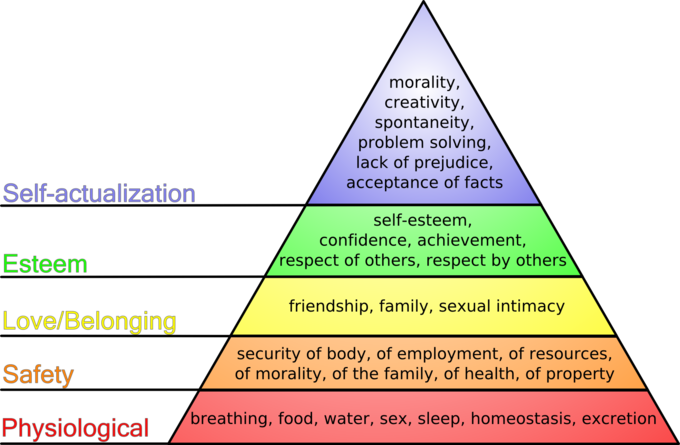 We’ve all heard of Abraham Maslow’s Hierarchy of Needs that lists the various needs a person must satisfy to achieve a sense of completion. The initial stages of the hierarchy concerns basic needs (food, water, and breathing) that we take for granted, until they are not met. As this hierarchy progresses to completion, the needs become more complex, and the need to satisfy them more profound. There is also an idea that that person may take one level for granted –such as the need for friendship, and the need to be loved– and they may regress back a level. The basic structure of the Hierarchy of Needs suggests, however, that one cannot progress to next level, until the needs of the prior level are satisfied. Every person is different, of course, but the basic tenets are such that most people are not immune to the needs of a level you are currently on, and our stubborn refusal to accept the idea that we need more of whatever you currently have, has us stuck at that level.


 Rilaly