Zero has always meant nothing to us. It lurks in the shadows of something. It’s a number, but it kind of isn’t in some confusing, “I don’t want to think that much” way. It has its own identity, and it doesn’t. It’s complicated, and it’s not. It’s an odd number, but it’s not odd. It’s not even even, but it is and it isn’t. We don’t consider it prime or composite. It’s not positive or negative, as it separates the negative from the positive. It’s a number but it also represents the absence of a number. It’s so confusing to us that we have to wonder if teachers should even teach its advanced concepts, and if they do, at what age? We were taught the basic facts of how to add, subtract, multiply, and divide zero, but when we reached advanced mathematical concepts, we learned that certain mathematical answers cannot be answered. They’re undefined, which led us to say, “What do you mean undefined? It’s zero.” At this point, the mathematician explains that if we try to divide twelve groups of people into zero groups, it cannot be done. It’s undefined. It’s complicated, and it’s not.
As Andreas Nieder writes in a 2016 paper, “For a brain that has evolved to process sensory stimuli (something), conceiving of empty sets (nothing) as a meaningful category requires high-level abstraction. It requires the ability to represent a concept beyond what is perceived.”
 “We’ve now reached a point in our history where we have to describe nothing,” someone, with some sort of twisted brilliance, said at various points in human history to try to advance the cause of what we now call zero. “How can we properly appreciate the concept of something, without a concrete grasp of nothing?”
“But there’s always something,” his counterpart probably argued. “Is there nothing in the vast expanse of a desert? There’s sand, over one septillion of tiny grains of sand, and how many molecules litter the water of the vast quantities of nothingness in the ocean? Even in the vast expanses of space, there’s always something.”
Zero is not substantial when compared to the other numbers, and it’s not tangible, but how many of our current creations, and measurements for those creations, would be almost inconceivable without it? It’s been there for so long now that we take it for granted. Yet, it went through a long, slow, debated, and debatable gestation cycle. Even in the relatively limited historical record of ancient civilizations, such as those in Babylon, India, and the Mayan civilization, zero, or some semblance of zero, appears. We don’t know why it made an appearance numerous times in different civilizations. Its birth remains a mystery to us, because its purpose wasn’t defined. They invented the concept of zero, but there is no evidence to suggest that they developed it in a substantial manner. As with most theories, they appear to have failed to apply the concept of it to real world constructs, but we have to give them credit for developing the theory of it. Bottom line, their theory was probably as difficult for them to grasp as it was to explain, because there’s always something. Even if we laid four avocados on the ground and then removed them, there would still be the millions of granules of dirt beneath it, trees, leaves, and the micro organisms that feed on them. There’s always something.
“We’ve now reached a point in our history where we have to describe nothing,” someone, with some sort of twisted brilliance, said at various points in human history to try to advance the cause of what we now call zero. “How can we properly appreciate the concept of something, without a concrete grasp of nothing?”
“But there’s always something,” his counterpart probably argued. “Is there nothing in the vast expanse of a desert? There’s sand, over one septillion of tiny grains of sand, and how many molecules litter the water of the vast quantities of nothingness in the ocean? Even in the vast expanses of space, there’s always something.”
Zero is not substantial when compared to the other numbers, and it’s not tangible, but how many of our current creations, and measurements for those creations, would be almost inconceivable without it? It’s been there for so long now that we take it for granted. Yet, it went through a long, slow, debated, and debatable gestation cycle. Even in the relatively limited historical record of ancient civilizations, such as those in Babylon, India, and the Mayan civilization, zero, or some semblance of zero, appears. We don’t know why it made an appearance numerous times in different civilizations. Its birth remains a mystery to us, because its purpose wasn’t defined. They invented the concept of zero, but there is no evidence to suggest that they developed it in a substantial manner. As with most theories, they appear to have failed to apply the concept of it to real world constructs, but we have to give them credit for developing the theory of it. Bottom line, their theory was probably as difficult for them to grasp as it was to explain, because there’s always something. Even if we laid four avocados on the ground and then removed them, there would still be the millions of granules of dirt beneath it, trees, leaves, and the micro organisms that feed on them. There’s always something.
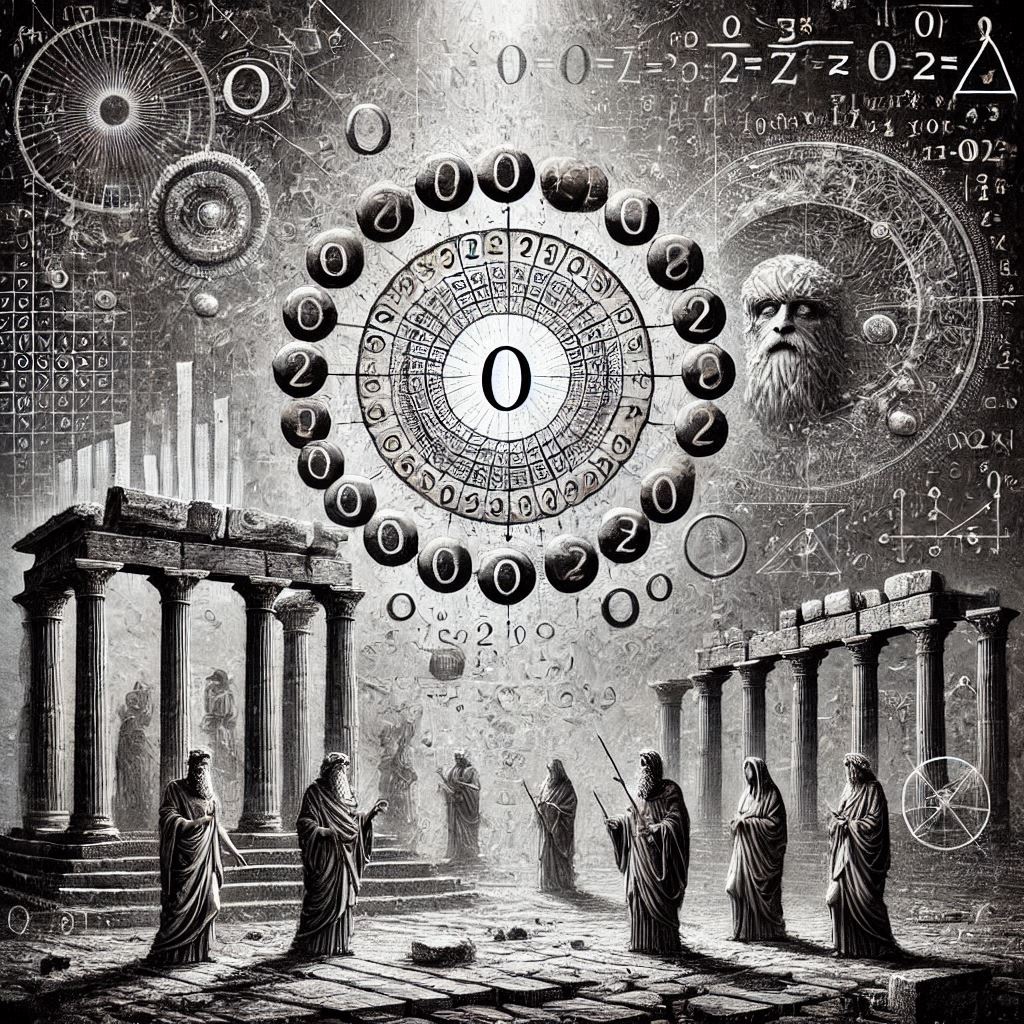 Scholars believe zero began its life as something to fill columns when humans advanced their attempts to count. When those who invented, developed, and applied a method of counting, they encountered a void after nine. Their question, how do we get past nine, and all the other nines that lead to ninety-nine without something to carry us to the next number. How do we get to eleven, twenty-one, and one hundred and one? India’s positional numeral system needed a zero to scale past 9, and their trade demanded it. They needed a placeholder, or something to fill the void. They didn’t start counting numbers with zero, but they wrote a placeholder in the tens, the hundreds, and the thousands to fill columns when necessary.
In a Scientific American article, Charles Seife, author of Zero: The Biography of a Dangerous Idea (Viking, 2000), says “Filling columns is not a full zero. A full zero is a number on its own; it’s the average of –1 and 1.” “The Number Zero began to take shape as a number, rather than a punctuation mark between numbers, in India, in the fifth century A.D.,” says Robert Kaplan, author of The Nothing That Is: A Natural History of Zero (Oxford University Press, 2000). “It isn’t until then, and not even fully then, that zero gets full citizenship in the republic of numbers,” Kaplan says. Some cultures were slow to accept the idea of zero, which for many carried darkly magical connotations. But Seife is not certain that even a placeholder zero was in use so early in history. “I’m not entirely convinced,” he says, “but it just shows it’s not a clear-cut answer.” He notes that the history of zero is too nebulous to clearly identify a lone progenitor. “In all the references I’ve read, there’s always kind of an assumption that zero is already there,” Seife says. “They’re delving into it a little bit and maybe explaining the properties of this number, but they never claim to say, ‘This is a concept that I’m bringing forth.’” Kaplan’s exploration of zero’s genesis turned up a similarly blurred web of discovery and improvement. “I think there’s no question that one can’t claim it had a single origin,” Kaplan says. “Wherever you’re going to get placeholder notation, it’s inevitable that you’re going to need some way to denote absence of a number.”

 A very brief and succinct description of our favorite number/non-number zero is that it flickered in ancient Babylon as a placeholder wedge by 300 BC, but India’s Bakhshali manuscript (3rd-7th century AD) and Brahmagupta’s 7th-century rules made it a real number. The Maya mirrored this leap by the 4th century, while Al-Khwarizmi carried it to the Islamic world in 825 AD. Europe, stubbornly resisted until Fibonacci’s 1202 Liber Abaci, finally caught on—linking India, the Middle East, and the West in a slow, vibrant chain.
The research suggests that if Aryabhatta, Brahmagupta, Al-Khwarizmi, and Fibonacci, and the other brave souls hadn’t weathered the storms to bring zero to absolute indoctrination, the progress we know today, “the opening of the universe,” wouldn’t have been possible. Zero defines nothing and everything at the same time. It can be used as a point of origin, in positive and negative ways, and some suggest that those brave souls ended up furthering knowledge to advance Physics, Calculus, Engineering, Geometry, relativity and quantum mechanics, and a large part of finance and economics.
The very idea that the “nothing is something and something is nothing” complex identity of zero ended up playing a starring role in science. In Calculus, for example, zero provides a tease of limits, where functions flirt with the abyss as values approach it. In relativity, zero-point energy keeps the universe buzzing even at absolute rest, and in binary code, 0 as “off” teams with 1’s “on” to whisper digital secrets to us.
Mr. Zero, as we should now address his highness, or lowness, depending on how we choose to view him, transformed computers from clunky gear-spinners to sleek bit-flippers, while revolutionizing physics and engineering. Without zero, we might have to work with Roman numeral guesswork to form the precise calculations necessary to build bridges and figure out planetary orbits. If the geniuses listed here hadn’t developed a theoretical counterpoint to something, in these fields and others, we might have to leave such matters to vague speculation and our imaginations. Imagine that!
Zero is also one of the primary languages of the computer. We’ve all heard the phrase ones and zeroes. Zeroes are needed to create code and messages that the computer requires for functionality. If the properties of zero were never invented, discovered, and advanced, is it possible we wouldn’t have the knowledge or the technology necessary for the computer?
Even after everything it’s been through and everything it has accomplished for us, we still have no love for zero. The full zero, standing on it’s own, and the average between -1 and 1, represents absolute failure in the classroom, a complete condemnation of athletic ability on a scoreboard, and desperation when it appears alone in our bank accounts (zero involves some desperation, but not the total devastation the negative numbers create in our equations). We considered calling someone an absolute zero to be worst insult we could say about a person, until Billy Corgan came along and reminded us of its positive, negative and abstract qualities. We also thought we had a firm grasp on the traits of nothing, until the writers of Seinfeld redefined it and showed us how brilliant nothing could be. Now imagine going back to a time before zero to explain to the most brilliant minds in math and science how zero and its resulting revolutionary concepts have reshaped our world. “Achieving something is just as important in our time as it is yours,” we might say, “but the most brilliant minds of the civilizations, since your time, couldn’t have achieved half of what they did without fully developing and realizing the properties and possibilities of nothing.”
A very brief and succinct description of our favorite number/non-number zero is that it flickered in ancient Babylon as a placeholder wedge by 300 BC, but India’s Bakhshali manuscript (3rd-7th century AD) and Brahmagupta’s 7th-century rules made it a real number. The Maya mirrored this leap by the 4th century, while Al-Khwarizmi carried it to the Islamic world in 825 AD. Europe, stubbornly resisted until Fibonacci’s 1202 Liber Abaci, finally caught on—linking India, the Middle East, and the West in a slow, vibrant chain.
The research suggests that if Aryabhatta, Brahmagupta, Al-Khwarizmi, and Fibonacci, and the other brave souls hadn’t weathered the storms to bring zero to absolute indoctrination, the progress we know today, “the opening of the universe,” wouldn’t have been possible. Zero defines nothing and everything at the same time. It can be used as a point of origin, in positive and negative ways, and some suggest that those brave souls ended up furthering knowledge to advance Physics, Calculus, Engineering, Geometry, relativity and quantum mechanics, and a large part of finance and economics.
The very idea that the “nothing is something and something is nothing” complex identity of zero ended up playing a starring role in science. In Calculus, for example, zero provides a tease of limits, where functions flirt with the abyss as values approach it. In relativity, zero-point energy keeps the universe buzzing even at absolute rest, and in binary code, 0 as “off” teams with 1’s “on” to whisper digital secrets to us.
Mr. Zero, as we should now address his highness, or lowness, depending on how we choose to view him, transformed computers from clunky gear-spinners to sleek bit-flippers, while revolutionizing physics and engineering. Without zero, we might have to work with Roman numeral guesswork to form the precise calculations necessary to build bridges and figure out planetary orbits. If the geniuses listed here hadn’t developed a theoretical counterpoint to something, in these fields and others, we might have to leave such matters to vague speculation and our imaginations. Imagine that!
Zero is also one of the primary languages of the computer. We’ve all heard the phrase ones and zeroes. Zeroes are needed to create code and messages that the computer requires for functionality. If the properties of zero were never invented, discovered, and advanced, is it possible we wouldn’t have the knowledge or the technology necessary for the computer?
Even after everything it’s been through and everything it has accomplished for us, we still have no love for zero. The full zero, standing on it’s own, and the average between -1 and 1, represents absolute failure in the classroom, a complete condemnation of athletic ability on a scoreboard, and desperation when it appears alone in our bank accounts (zero involves some desperation, but not the total devastation the negative numbers create in our equations). We considered calling someone an absolute zero to be worst insult we could say about a person, until Billy Corgan came along and reminded us of its positive, negative and abstract qualities. We also thought we had a firm grasp on the traits of nothing, until the writers of Seinfeld redefined it and showed us how brilliant nothing could be. Now imagine going back to a time before zero to explain to the most brilliant minds in math and science how zero and its resulting revolutionary concepts have reshaped our world. “Achieving something is just as important in our time as it is yours,” we might say, “but the most brilliant minds of the civilizations, since your time, couldn’t have achieved half of what they did without fully developing and realizing the properties and possibilities of nothing.”  Rilaly