“Somebody doesn’t like me. Shhh! Don’t tell anyone it might be perceived to be a comment on my character.”
All apologies to Larry David, but robust research suggests that most people like us far more than we think. Anyone who watched David’s brilliant comedy Curb Your Enthusiasm knows that David is pretty, pretty, PRETTY sure nobody likes him. His little secret, one he shares with everyone he encounters, is he doesn’t care.
The rest of us care, but I don’t. “Yes you do, and you know it.” All right, but what did I do or say to cause them to not like me? Am I saying it now? I don’t care. “Yes, you do.” Is my hair in the right place? Are my clothes fashionable? Do I have the correct opinion on this matter, and if I don’t, will they respect me in the morning if I change that opinion to get them to like me more? “Shut up and listen.”
That’s one of the fundamental keys to getting people to like you, if you care. Listen to them, make them feel interesting, and they’ll be more apt to find you interesting. An enthusiast on this topic suggested there are three words to achieving this, “Tell me more.” My personal variation of those three words is “Are you serious?” That drove my dad nuts, “Yes, I’m serious. You think I’d joke about something this serious?” He said that all the time, but most people know that my “Are you serious?” acts as a conjunction, or an active listening prompt, to inform the listener how interested I am in their story. It’s my personal favorite active listening prompt. Whatever yours is, enthusiasts encourage us to use them often in conversation, if we want people to like us, because there’s nothing a person loves more than thinking another someone is interested in what they have to say.
Even with that, there will always be someone, somewhere (“I see you”) who just doesn’t like us. We would love (and I do mean LOVE!) to hide behind the teenager’s, “I don’t care what anyone thinks!” righteous banner, but we know better now. We know we care, but we don’t know what to do about it?
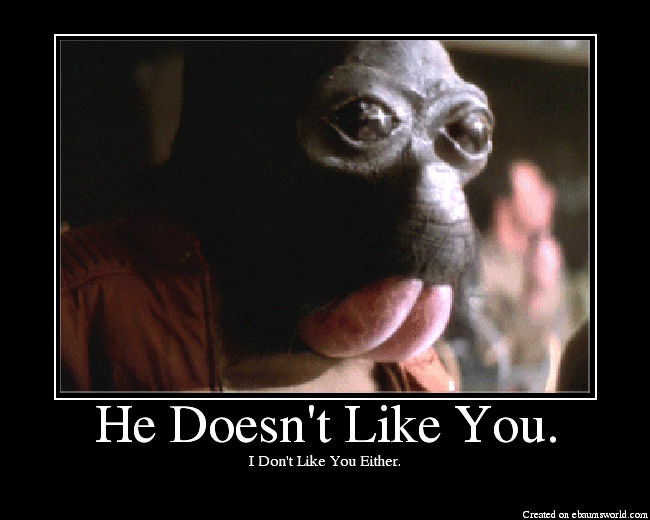 The first thing to do is nothing, because there is always going to be someone who doesn’t like us for who we are, what we look like, and a number of other superficialities for which we have no control. They are members of a group, and it may not matter to us what group they are in, but it’s vital to those who don’t like us to maintain that for which they stand. It is a fundamental tenet of their personal constitution, and an essential part of their identity. It’s the “I might not have done much with my life, and I’m probably not the type you might call intelligent, successful or happy, but at least I’m not one of you!” group mentality for which they stand. In cases such as these, we should do nothing, because there’s nothing we can do, but we shouldn’t change what we do, who we are, or how we speak, because if we bend to these terrorists, they win. If that sounds like something a teenage, righteous warrior might write on a bathroom wall, it is, but once we get past the best swear words and the exclamation points following their potty prose, we do find a germ of truth in it.
Have you ever heard someone compliment another with a, “She’s so nice that if people don’t like her, there’s probably something wrong with them!” That’s really the nut of it all, as far as I’m concerned. If you’re nice and pleasant, and you manage to avoid the narcissistic tendencies of waiting for a speaker to finish, so you can start talking and actually listen to what they say, and they still don’t like you. There’s probably something wrong with them.
Humans are hardwired to adjust however. The others in our lives are our critics, and we should be open to their criticism in the sense that some portion of it might be constructive. In our never-ending quest to be liked, however, some adjustments turn out counterproductive, for if this person has a psychological underpinning that causes them to dislike us, they’ll just adjust their reason for not liking us accordingly, and they’ll have less respect for us for adjusting in the first place. If we can clear the fog we created, with the underpinnings of our own insecurities, we might find pleasing nuggets from that robust research that declares most people like us, and there could be something wrong with those who don’t.
I have often found that upping the ante on the characteristic they dislike not only puts an end to this vicious cycle, but it subverts the prejudicial judgements they’ve made. Most observers subconsciously find that they respect a person more for not adjusting, and not conceding to the hard wiring of human evolution. We call this the “suck it!” strategy.
The “suck it!” strategy relies on the idea that we’ve established the fact that we are already pretty, pretty, PRETTY nice and likable. If we’re not likable, and this person’s judgments are corroborated by others, such that it might form something of a consensus of thought, we may want to consider adjusting. If we are a well-liked person, however, we should be who we are to the people who surround us, and group thought might eventually sway our critic to the idea that their prejudicial notions about us are wrong.
Every situation is different, of course, and there have been times when I’ve gone beyond the complaints the person who dislikes me makes. I don’t do this on purpose, but it excites me when certain people don’t like me, and I consider it a challenge to maintain my stance in the face of the wind they’re trying to blow my way. I’ve made minor changes to complaints about my attitude and personality when those complaints were verified and bolstered by others, but I can’t remember ever changing in a way that I considered an extension beyond my personality to the point that it cannot be maintained over the long haul.
As for the ‘do nothing’ advice, I’ve often found that with the relative nature of taste there’s not a whole lot we can do about someone choosing to dislike us. Most people usually formulate a prejudicial opinion of us before they’ve ever met us. We’ll know this is the case, if the hand we shake is cocked and loaded with a question like: “Is it true that you said (or did) this …?”
The base of the word prejudicial is prejudge, and we are making strides in our society to avoid such judgments. We are trying to avoid prejudging people, but we are selective in our attempts to rid it from our culture. Chances are, if you are a human being, living in the 21st century, you’re being judged, and prejudged as often as any man in any century, but we don’t discuss such things, lest we be judged, or prejudged, for doing so.
If prejudging people is such an anathema, one would think that the simple act of declaring another prejudicial would be enough to diffuse everything that follows. What we see instead, are people who get more upset over a prejudicial opinion than an informed one. As discussed, it’s human nature to care. It’s quite another to obsess over it.
“I know,” they will say, “but how can she form an opinion of me based on …” This sentence is usually concluded with “based on something they heard from a third party” or “based on our very brief encounter.”
“They can’t,” I say. “They do not know you. So, why are you getting so upset about it?”
This speaker was excessively beautiful, and a number of people despised her for it. “Why do you like her? Why do you talk to her so often?” To which I said, “Why don’t you?” The reply was often something like, “I don’t know, I just don’t like her.” One person suggested that I talked to her because she was so beautiful, and I replied, “Is that why you don’t?” There are no concrete, general answers is the answer, and talking about it is often as pointless as thinking about it, or writing about it, but this happens all the time. The problem for you, is that it’s happening to you now. You catalog everything you said to this person who doesn’t like you, and you come up with nothing. She doesn’t like you because you’re beautiful and anything that comes out of her mouth will only serve her cause. There’s little-to-nothing you can do about it, except be who you are and let her change her mind, if she decides.
If a person knows us well, and issues an informed opinion, it can be devastating, but the person who makes a snap judgment of us, based on a couple here’s and there’s, should be dismissed to whatever degree we dismiss uninformed opinions. This is hard, because it’s hard to believe that we’re nice and everyone should like us. It’s much easier to believe that we’re flawed, because we all know that there’s something to improve upon. We just don’t know what it is, and maybe she does.
What we’re talking about here is psychology, both on a macro and macro level. The basis for modern day psychology is about 150 years old. The idea of the study may date back to Ancient Greece, but the incarnation we know today, an in-depth study of the choices that we make, and why –my preferred definition– is relatively new.
“She only says that, because she’s jealous,” is the fallback position for most of us who have to deal with the fact that someone don’t like us. It’s a snap judgment that may have more merit, if we attempt to seek in-depth psychological answers about them.
The extent of our knowledge of psychology often begins and ends with that Psychology 101 course we took in college, and that course likely focused inordinate attention on the study of dots, swirls, circles, and other such tricks of the mind to test perception. There is some ontological value in that study, of course, but it just seems like such a waste of time compared to the far more important study of human interaction, and how we can learn to dot the I’s and cross the T’s of the five W’s of social interaction and psychological warfare. It seems to me that there is a dearth of understanding of psychology in some, which results in very little desire to dig deep into another’s psychology to understand them better.
The study of the swirls and circles have some invaluable traits, as they teach us perception, perspective, depth, and the value of how the human mind perceives visual images. When we view the characteristics of others, for example, the images we see tend to derive from the point of origin, until the motion of the arrows could be said to form an oval between us. This is called psychological projection, or the ability to better see another’s weaknesses through comparative analysis.
Political partisans are often the first to call me a partisan, for example, people who need the last word are often the first to accuse me of being a person who needs to have the last word. Their accusations may be true, but they’re often the first to spot it, because they are viewing us from their perspective.
If we are going to have some sort of long form engagement with this party, we may want to understand their psychology better. We should be prepared to be wrong in our assessments for we have our own subjective agendas and our own base from which we view others, but we should study them anyway, and adjust our analysis according to our findings.
After our initial analysis of this other person is complete, and all of our adjustments have been made, we may want to focus some of our attention on the third party who was informed by this other person of their decision to dislike you. It’s possible that the third party plays no role in this, other than being a third party, but is it possible that that person played an instrumental role in this other person not liking you. It’s possible that we may be a perceived threat in the relationship they have with this third party, and they have an agenda that this other person fears we may expose. It’s also possible that they’re insecure people and they fear that we’re better. Whatever the case is, it’s possible that we may never be able to entirely figure it out, and their insecurities are such that they’ve overestimated us, but they don’t want to take that chance.
“I don’t know why,” we’ve all heard others say about others. “I just don’t like them.” Perhaps the people who don’t like us are saying these same things about us. Perhaps they can’t put their finger on why they don’t like us. They just don’t.
If they do know why they don’t like us, they’re probably not going to tell anyone, for that might reveal something about them. They may also avoid revealing the exact reason, because they enjoy watching us flop around like a fish on shore, trying to figure it out.
If it’s true that robust research finds that most people like us, why are we bugging with those who don’t? It’s all about us, we do it to ourselves. Is the driver behind our desire to have everyone like us all of the time ego, or is it based on our insecurities? We don’t really know, but it bothers us when one person in the group makes that face whenever we talk. We know that face. Hell, we make that face when that person we don’t like for reasons we cannot articulate speaks. We do it to ourselves. The idea that not everyone is going to like us, is something we probably figured out in second semester of the tenth grade when that one kid told us off for being who we are. We thought there were very specific reasons he didn’t like us, but he would never tell us what they were, and it drove us insane. The one thing we noted in this particular specimen was that he just enjoyed getting under our skin. She was anecdotal evidence for the question why do some people not like us, but it’s possible that she enjoyed being anecdotal evidence. She probably just enjoys being the face on our ceiling, as we fight through the insomnia her words have caused us.
 Rilaly