There was something different about Norman Gene Macdonald (Norm). He was funny, but there are a bunch of different flavors of funny. Norm was the type of funny we might only see once to thirty-four times before we die. Stick with me here for just a second, and four-thousand words. There have been a bunch of guys who tried to save the world, and we all gathered together to listen to them. We followed their prescriptions for a better world, and where did that get us? Some of them cured stuff, technologized stuff, and said some profound things to change things temporarily, but after they died we all went back to the world they lived in. So, what if we tried something so unusual that it changed us. I’m always on the lookout for something different, and why aren’t you? Nobody says they’re the same as everyone else. Everyone says they’re different, but they’re all different in the same ways. “I’m different! I don’t know listen to the man or nothing.” Who’s the man, I don’t know, but the band Anthrax says he puts you in detention. Norm had no authority, and he didn’t want it, so why should we give him the keys to the castle? Well, we’ve tried everything else, and nothing has worked so far. Why wouldn’t we try something different? Just to see if it works. I watched, read, and listened to Norm a lot, and I thought he was so different that he might just be the type who could’ve saved the world.
Norm wasn’t that guy of course. He was a type who’d much rather go boozing and gambling when he wasn’t on a stage. He had that self-destructive gene that seems imprinted in his type, but what if he wasn’t? What if he was the type who could analyze us, undress us, and leave us feeling so naked with a few words that left us laughing our socks off, and we felt so foolish in our certitude and convictions that we changed just a little bit?
In our modern geopolitical world, with all of our political ideas and ideals, we’re just certain that we’re right and they’re wrong. We’re the most advanced people in the world, because we’ve learned. What have we learned? Who are the they that were better than? Other countries, other parties, other people, or the past? We might not be better than present tense people, but we’re definitely better than the past. Ok, but didn’t they think the same thing when they were in their present? They were as certain as we are that they they were better than people from the past, and they probably were, but they didn’t account for us, the people of the future. We’re the people of the future, but we think we’re the people of the present, and we are, but are we so right on, right now, that people in our future won’t think they’re superior to us, mocking us, and deriding us for our convictions? They won’t, because we have science, and we know our science. The past had gaps in their knowledge, and we filled it. We think we’ve filled those gaps so well and so thoroughly that people of the future won’t have anything to fill. “What are you going to fill?” we ask. “It’s already full.” Norm didn’t just fill the bad gaps that ignorant people believe, he filled the gaps of the good stuff that we love, want to believe, and we need to believe for our own superiority, or if he didn’t fill those gaps, he asked us to ask ourselves if it was at all possible that we might still have gaps in our understanding that future man might come along and fill and ask us why we were so stupid that we thought there weren’t any gaps. Then, there’s that truly humiliating question everyone hates and no one wants to hear, questions that make us question everything we hold dear, what if we, the people of the present turn out to be wrong about all the this and that’s that are so decided that we don’t even consider them this and that’s anymore?
What if we missed our chance at a real game changer, because we were looking for some charismatic type who wanted things. If you have a guy who wants things, you know him, because he’s a lot like you, because you want things too. Norm didn’t appear to want anything more than to sit around and think things. Was he lazy, and did he lack ambition? Yes. He had no material desires, he didn’t do much to foster what could’ve been a better career, and he didn’t openly wish for a happy death. He basically said once we’re all dead no one is going to remember us, “So, who cares if you do things or don’t do things.” People might be sad for a while after we die, because it will be a tragic thing, and they might bring up some of the things you did and didn’t do, but after a while your name will not come up as often as it once did, until no one remembers that you were ever here. So, enjoy your life, and do and don’t do what you want.
To illustrate Norm’s point further, I saw a picture of my great-great grandfather. I didn’t even know he existed. I sort of knew that he had to exist, because for me to exist, he had to exist, but I saw a man who very loosely reminded me of former president James Garfield. I saw another great-great grandfather on the other side, who looked like Abraham Lincoln, people apparently told him he resembled Lincoln on a daily basis (sans the beard). Other than fancying the notion that I might be a descendent of two former presidents (imagine how much better my story would be if that were the case, or how comparatively depressing), I thought about how my great-great grandchildren wouldn’t exist if I didn’t exist. “I’m responsible for your existence!” You think they’ll be grateful? If they see a picture of me, they might “huh!” me and toss me aside to look at pictures of people they do know. (If they even notice a picture of me in a cloud of millions of unlabeled iPhone pictures.*Note to self: Label your photos.)
Not a Wonderful Guy
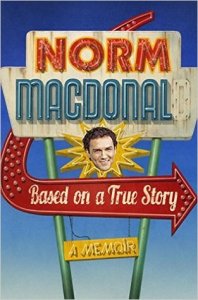
Norm didn’t write Based on a True Story: A Memoir to further his career. He wanted to write a book, and he wanted to get loads of money for it, but career advancement was about as far from a goal as it could be. What was his primary goal? What’s the primary goal of any celebrity writing a memoir? They want you to think they were one hell of a good fella or female throughout their life. 99.9% of Hollywood, political, etc, memoirs drift around various definitions of ‘wasn’t I wonderful?’ Some are direct. They’ll tell you about that time they donated to charity, interactions they had that lead you to believe they had wonderful intentions, or how comparatively awful everyone else around them was. Reading through good, old Norm’s book, we get the idea that Norm didn’t care about any of that. His closest friends, peers, and cultural commentators will tell you that the only thing Norm cared about was being funny. He didn’t care about money or fame, everyone writes that in their book, so you’ll find them wonderful, but in a strange, almost unsettling way we think Norm didn’t care about any of that. He cared about being funny. He didn’t care if you thought he was funny, as long as it was funny. Most of his friends and peers label Norm a comedian’s comedian, which in my estimation means he strove for comedic purity. How does an artist near the point of purity, at least internally? We ask those in the craft that who are pursuing the same thing. It might sound elitist, and it is, but if our goals in life revolve around making the best horseshoe known to man, we might not care what our customers, the laypeople, think, if those in our field of expertise consider those horseshoes the best they’ve ever seen.
Most artists use the memoir as a vehicle to promote their career, or their image, and the idea that while they may appear to be a little quirky to the naked eye, deep in their heart, they want you to know they are actually a very wonderful person. No matter how apathetic, somewhat cruel, and insensitive an author of such material is, the unspoken rule of such comedy is that the author breaks down the fourth wall, in some manner, to let you in on the joke and in on idea that they’re actually pretty nice and very wonderful people who care. Norm Macdonald, the character that he has created for this book, and all of the layers in between, does not seem to care that you get any of that. Most authors that approach a style similar to the book, qualify their motivations for doing what they did with follow ups that redound to the benefit of the author. Norm Macdonald does not appear to care why the reader bought his book, about their outlook on him, or if that reader feels good about themselves, and their world, when they finish the book.
Norm’s Untimely Timelessness: There are no timely elements in this book. Norm Macdonald appears to feel no need to convince us that he is actually very smart, savvy, or anything more than he is. There are no subtle approaches to timely or timeless notions that inform the audience that Norm is compassionate, empathetic, or nuanced. Norm was one of the few celebrities that did not care to tell you what he thinks about pressing or non-pressing matters of the day, and I’m not really sure he cared what he thought either.
 Norm was Always an Old Man

Norm was an old soul. He probably sounded old when he was very young. (How many modern books, Based on a True Story: A Memoir, invoke the word “Hoosegow”?) Norm’s dad was old when Norm entered into the world, so Norm spent most of his youth in the company of old men who knew manual labor for the majority of their lives. Norm surely went through the stages of rebellion we all go through to unshackle himself from parental influence to form an individual identity. He probably mocked his old man in various ways, and he surely rejected the old man’s ways of thinking for a time, but by the time we met him, circa aged thirty-one, he came back around to his Hoosegow talk. A more insecure comedian and cultural commentator might try to sound more hip, cutting edge, and nouveau to appeal to the audience. Norm’s voice employed an old man, old world influence that served to intrigue rather than confuse. If the reader is the type that needs some sort of qualifier, or apology, for the somewhat cruel, and insensitive scenes, takes, and reactions that occur throughout this book, it can be found somewhere in the kind, pleasing Midwestern sounding voice that Norm, and his ghost writer Charlie Manson, employed.
I knew nothing of Macdonald’s upbringing, prior to the reading of this book, and I didn’t care about it either. After reading the initial chapters of this book, however, I found myself relating to the rhythms and lexicon Norm learned from the old, hired hands he knew growing up. His dad, my dad, and their friends were old, no-nonsense men that had an old world, no-excuses, masculine structure to their being that is too often lacking in today’s culture. The locale of Macdonald’s rearing was far different than mine as it turned out, but the details of his maturation were so similar to mine that I was surprised to learn we didn’t grow up the exact same time and place. This could be as a result of Norm’s better-than-expected ability to relate to the reader, or his ghost writer’s ability to translate Norm’s thoughts into a book that I found my voice in. The ghost writer is renamed Charlie Manson for the purpose of this book (not that Charlie Manson, the other one.)
Norm on Sex
Norm enjoyed talking about sex, but he did so in a manner that is almost 180 degrees different from any cultural commentator. He talked about sex as if it were nothing more than a stage in life, as opposed to the customary way we have of referring to it as if it is life. He talked about the routine elements of sexual actions, and he talked about the routine immaturity of the act. In an online collection of his jokes, he talked about having sex in his youth, and how he grew out of it to some degree.
“I don’t care for sex. I find it an embarrassing, dull exercise. I prefer sports, where you can win.”
Even though Norm submitted his unique take on not enjoying sexual activity, he admitted to being human in this regard:
“This is the amount of time you think about sex: every once in a while. The problem becomes, when you think about it, it’s all you can think about. It encompasses your whole brain. You’re like a werewolf or something. Usually you’re a civilized human being, but then every couple of days, you’re like “Arrrgh.” Then you’ve got to close the blinds.”
As for the routine nature of it, Norm suggested that he, like all of us, tried to shake the routine of sexual activity up and try something different every once in a while:
“Sex couldn’t be simpler. I think there’s only like five things you can do in the whole thing. You ever think you invented a sixth? Then later you go, “Ah, in all humility, I guess that was pretty close to number five.”
“My wife dresses up like a nurse; then, I dress up like a nurse, also. And then, we don’t even have sex, either. We just sit behind this huge, semicircular wooden desk and get annoyed when people buzz us for juice.”
The bits above are funny, but they don’t really cut to the heart of Norm’s unique, refreshing views on sex in the manner Norm opened up about it on a transcript from a talk show:
“I find sex very repetitive and dull and kind of pointless.” Norm said he finds it a childish desire which he’s spiritually outgrown. I find sex to be a very filthy act in the sense of being shameful. Sex is an activity we don’t do in public due to its intrinsic shamefulness.” He quotes scripture saying, “When you’re a boy, you do boy things. I know most people are children for their whole life, and [sex is] a way of having fun.”
The Out-Joke
When the cavemen drained all of the comedic value out of punching each other in the face, an enterprising young caveman comedian probably tried violating his tribe’s taboo by punching women in the face. And before you say jokes like that only attract troglodytes, remember that was Mujmuj Kandar-Smith’s key demographic. Once they moved past those jokes, and the jokes about the limbs they lost in their Sabertooth Tiger hunts, they probably turned to self-effacing humor. The key to really good self-effacing humor is that it allows us to laugh at ourselves through the vulnerability of the comedian, yet most standup comedians are not of such strong constitutions that they can handle an audience laughing at them, so they cloak it in a type of humor that asks us to laugh with him, as opposed to at him. They’re letting the audience in on the joke. It’s the “aren’t I silly, aren’t we all just silly” approach that carefully approaches their foibles in a way in which we can all laugh at ourselves, so that we’re not just laughing at the comedian. Norm perfected the art of not allowing the audience in, so that the audience uncomfortably enjoys laughing at Norm. Norm didn’t invent this form of comedy, of course, as his most immediate predecessors might be David Letterman, Andy Kaufman, Chris Elliot, and perhaps Will Farrell. Yet, Norm may have even carved out his own niche in this niche in this form of comedy with his old timey lexicon that led us to believe we were laughing at our dad, our grandpa, or our predecessors. We also know that his social commentary was delivered in a tongue-in-cheek manner. In the character Norm developed, onstage and off (with this book) the reader is not so sure if it’s all good. The narrative of Based on a True Story: A Memoir leads the reader to feel sorry for the character, while laughing at his naiveté, and his inability to abide by social norms.
Norm was a Savant
Norm Macdonald didn’t do well with some basic simplicities of life. He never learned how to drive. Some, who knew him well, said that he had some difficulties with what we might consider normal human interaction, or he wasn’t gifted in this arena. When he failed to understand the consequences of his actions, some assigned motives to his actions. Others, those who knew him best, said that was just Norm. Yet, his peers suggest he might have been a comedic savant, or an individual with detailed knowledge in some specialized field. Norm was a brilliant satirist, a gifted jokester, and well-read history buff, but it appears that he was missing some ability to make links. He made a joke one time, on Adam Carolla’s podcast that he ate Count Chocula for dinner and generally had the diet of a seven-year-old child. Was it intentional, whimsical, or did he have such tunnel vision that he failed to understand some of the complexities to keep up with the rest of us. I wouldn’t say I know a truth, of course, but there is evidence of a complex understanding of the greater things in life, in the mind of Norm Macdonald, coupled with an almost child-like naïveté in matters we consider simple.
Norm was Different
Monty Python had a slogan that prefaced much of their material, “And now for something completely different.” For those of us who pine for something different, this book contains stories, reactions, and anecdotes that I have to imagine most authors, and almost all celebrities do their best to avoid. I have a sneaking suspicion that Macdonald’s public relations people asked him to include the “Based on” words to the title of his book. I have a sneaking suspicion that Norm wouldn’t mind it one bit if the reader believed this was the true story of Norm Macdonald’s life. Something tells me that his people, friends, associates, and business partners cautioned him to bolster the doubt regarding the material, because too many people might believe it’s his true story, and that this book may do some damage to his career.
Norm was a Closer
Norm’s good friend, Dennis Miller, said, “Always be closing” on a daily basis on his talk-show. As such, “Based on a True Story: A Memoir” is either building to a close throughout the various chapters, or its closing throughout. When it’s not strict to script of the respective story, hilarious anecdotes break the story up so well that one has to gather one’s self and remind themselves where the narrative was heading. The anecdotes appear to be accidental humor in other words. In the beginning of this book, I began highlighting some of the jokes believing that they would be precious jewels that I would have to remember. I do this with all provocative lines and paragraphs, but as I continued throughout the book, I gave up, knowing that when one highlights too often, the portions that are highlighted begin to lose value.
Norm Macdonald was Norm Macdonald
Norm Macdonald does whatever the hell Norm Macdonald wants. Is this a true narrative, Norm not does appear to care what the reader believes one way or another. Is this a readable narrative that involves the time-honored traditions of storytelling, Norm doesn’t appear to care. The storytelling format does have a Fear and Loathing in Las Vegas feel to it, but other than that it does not follow the rules of any celebrity memoir that I’ve ever read. He may have informed us of some true facts regarding his upbringing, and the many things that have happened to him along the way, but he doesn’t care if the readers knows the difference, or, apparently, if those distinctions could lead to some damage of his career as an entertainer. As a result, I would say that this is by far the best celebrity memoir I have ever read, but I have the feeling Norm wouldn’t care what one way or another.
Norm Macdonald Could’ve Saved the World
With all of his flaws, and according to friends, family and peers, the flaws were numerous, he probably wouldn’t have been elected a world leader, but how many world leaders are so flawed that their handlers do much of the public affairs and public relations work? He couldn’t have been elected to anything, because he wouldn’t take it serious enough. Yet, in those spare moments when the real Norm Macdonald stepped up to the plate to drop some truly profound nuggets on us, I thought this man is one of the more unusual thinkers I’ve ever heard. He was, by many accounts, the smartest guy in the room who tried to conceal his intelligence for reasons of humility, and he fell prey to the notion that smart people aren’t cool. He didn’t care about that, and he obviously did at the same time. It was so surprising to me that when I heard him talk serious, I wondered if the alternative sides of Norm Macdonald could’ve done something historic if he wasn’t so lazy and apathetic about all the things we consider so serious.
*I’ll refer to Norm Macdonald as Norm throughout this article. It’s not intended as a note of familiarity, though I do feel as if I know him as an audience member, I had no personal ties to him in anyway. I also don’t intend it as a lack of respect, as one would if they took the time to wrote his name in full, or labeled him Mr. Macdonald. I’ll refer to him as Norm throughout this article purely for readability.
 Rilaly