“He thinks we should talk to our food, to develop a relationship with it that he thinks will ease and aide digestion,” we say. “On the face of it, that seems crazy, but let’s break it down.”
“Who sits there and thinks about how they feel about their food that much?” she says. “I mean, you either eat it or you don’t.”
“You might know how you feel about your food,” we say, “but how does your food feel about you?”
 As ridiculous as that joke sounds, neuro-gastroenterologists are now suggesting that our relationship with food is in dire need of an upgrade. How do we enhance our relationship with food? It could be said that we’ve been eating for so long that we forget to appreciate it for what it is. We eat most of the food on auto-pilot. We might appreciate eating a hot, juicy ribeye, our reward for eating fairly well for weeks, but do we appreciate the ham in a ham sandwich? Generally, no, because the only reason we eat a ham sandwich is to quell hunger. Anti-meat eaters have a point, in this sense, when they suggest that we don’t appreciate that an animal had to die for our self-serving desire to nourish ourselves. Some anti-meat eaters say not only do we fail to appreciate the fact that an animal died, we choose to disassociate the slab of meat we eat from the animal. We call a piece of cow beef, a piece of pig is pork, and a domestic bird is poultry. Poultry might be the exception in common parlance, for we rarely ask for poultry from a butcher or a restaurant. We usually say chicken, duck, etc. The point of this disassociation, say anti-meat eaters, is to relieve ourselves of the guilt of eating animals. It might sound foolish since most people over six-years-old know what they’re eating, and we here at Rilaly.com are not suggesting that anyone end or cut back eating meat, but more knowledge about the food we’re eating might serve to aid in digestion.
One of the biggest problems for those who develop such an unhealthy relationship with food to the point that it can lead to an addiction is we need food. We need food to sustain life, we enjoy it so much that we look forward to it, and it’s part of our routines and patterns in life. As such, food provides comfort, and it can ease suffering, but food can also cause suffering. If we eat the wrong things too often, or we eat too much of a good thing, we can experience everything from IBS to constipation, diarrhea, bloating, pain and upset stomach after a night out at the Greazy Dog.
We also link food to relationships in subconscious ways. What did we eat growing up? Did our parents provide us a wide variety of meals on a regular basis, or were they primarily meat and potatoes people? How much do you love that first bite of a quality burger? Is it all about the immediate satisfaction of taste, or are there a big mess of associations going on inside your head? I always wondered why I had an almost romantic relationship with Kentucky Fried Chicken. I’m not going to join the throng who trash on fast food, now that they’ve aged out of it. KFC is not horrible chicken, but I’ve had better. I can’t eat it now without paying dearly for it later, but when I see those iconic red stripes on a bucket, they lead me to feelings of nostalgia. I couldn’t pinpoint it for decades, until one of my relatives informed me that my step-dad used to purchase a big bucket of chicken for my mom and I to woo us. We would go to the park, and I would play after those picnics. I was so young that I don’t remember it, but it was obviously the source of my romantic association with chicken from KFC. I obviously associated that food with a great moment in my life where a man came along to assure us that everything would be ok after my father passed.
***
Researchers at John Hopkins suggest that we have a more conscious relationship with food dictated by our two brains communicating in a biological language on the best ways to use or discard the food.
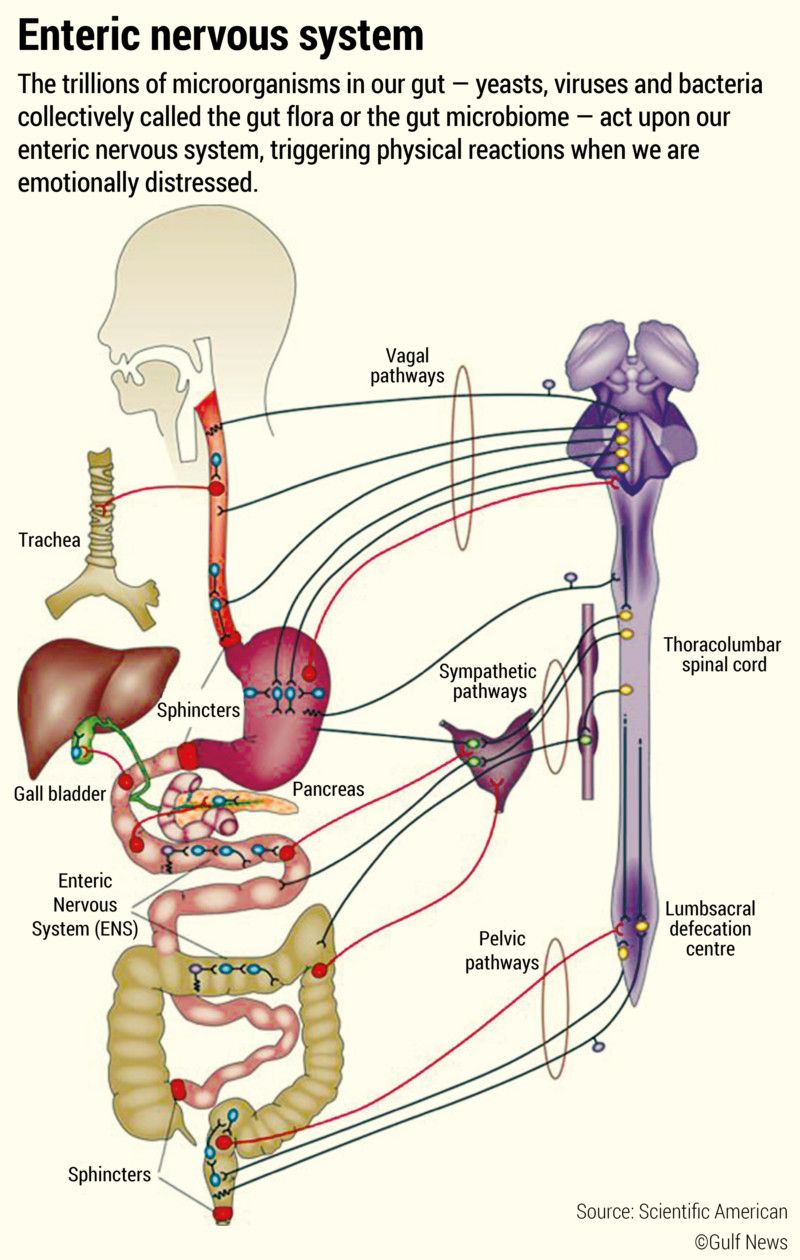
Our second brain, their research suggests, controls our digestive system. “[It] involves two layers of more than 100 million nerve cells that line our gastrointestinal tract, from our esophagus to our rectum.” They label this second brain the enteric nervous system (ENS).
“The enteric nervous system doesn’t seem capable of thought as we know it, but it communicates back and forth with our big brain—with profound results.”
“[Our two brains form two separate] paths to govern two separate areas of the body. This is where the material changes to form our brain, the central nervous system, and the stomach, the enteric nervous system.
“The interesting aspect of this split revolves around the Vagus Nerve. The Vagus nerve connects the two nervous systems for life. Because of this connection, both the brain and the gut share neurotransmitters and hormones.”
The profound results, they suggest, could lead to anxiety or depression.
“For decades, researchers and doctors thought anxiety and depression contributed to [gastrointestinal] problems. But our studies and others show that it may also be the other way around,” director of the Johns Hopkins Center for Neurogastroenterology Jay Pasricha says. “Researchers are finding evidence that irritation in the gastrointestinal system may send signals to the central nervous system (CNS) that trigger mood changes.
“These new findings may explain why a higher-than-normal percentage of people with IBS and functional bowel problems develop depression and anxiety,” Pasricha adds. “That’s important, because up to 30 to 40 percent of the population has functional bowel problems at some point.”
Some suggest we have a heart brain too, and other specialists suggest the complexities in the system they specialize in might have another brain. Regardless, some scientific research suggests the terms “go with your gut on this one,” “gut-instinct”, and the ever popular “Spidey sense” might have real biological origins.
“The ENS (Enteric nervous system) is [also] the reason why you can sense danger. The stomach naturally sends these signals to the brain.”
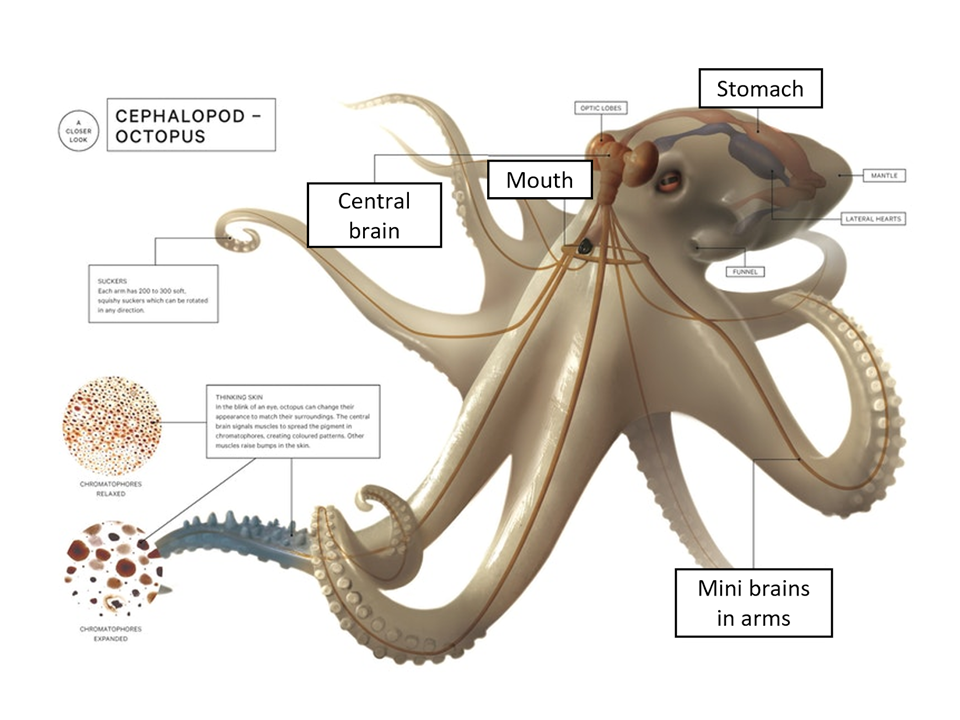 The first association we made, when learning about our second brain, a third, or numerous brains working in complex orchestral harmony to control and regular basic functions was the octopus. The octopus has a central brain, and each arm is loaded with nerve cells that form a brain of their own, so the octopus technically has nine brains. The latest research suggests that these nine brains have no autonomy. They act in conjunction with the Central Nervous System (CNS) brain, and they are subservient to its cause, but research scientists leave the door open to possible future research findings dictating otherwise. If future findings dictate otherwise, will we find that it’s possible for an octopuses’ seventh arm to refuse the CNS brain’s prime directive in the course of a hunt? “I’m not going into that hole after that crab. Six did that, last Thursday, and he’s experiencing the complex functions in the eel digestive system now. Find another arm to do it.” The nerve cells in our ENS appear subjected to CNS authority in our system, but how would our relationship to food change if we found out that everything from IBS to constipation, diarrhea, bloating, pain and an upset stomach are the ENS brain’s autonomous attempts to rebel against the CNS brain? “We know you love the taste of Indian food, but we’re going to make you pay long-term for your short-term thinking.”
Current research suggests that that does not happen, but disruptions in the gastrointestinal system can affect mood in many ways and vice versa. One such disruption can be caused by the ribeye steak. The instantaneous rewards of taste from the glorious hot and juicy cut of cow are one of the primary reasons some of us enjoy life so much, but it is also a luxury we dare not indulge too often. Why do we limit our ribeye intake? The digestion process can make us miserable.
After we eat a big, huge ribeye, we don’t want to do anything but sit on our coach and watch TV, and we don’t know why. Dieticians suggest that our two brains might not know what to do with it, immediately. “I can feel it,” we say, in the midst of our gastrointestinal misery, “sitting like a rock in my gut.” Gastroenterologists and neuro-gastroenterologists suggest this might not be a bad description for what’s happening, and its connection to our overall misery might be more direct than we ever considered before.
With all these relationships between us and food, and between our two brains trying to complete complex functions, how do we upgrade our relationships? The first thing they suggest we try is slowing down. No matter how beautiful that sizzling slab of meat on our plate appears, we need to slow down when we eat it. Cut off one small bite, and chew it thoroughly while doing something else. We might want to take one small bite and finish cutting the rest of the meat, or we might want to eat something else for a little bit, before indulging. Every suggestion we’ve found is that we don’t have to wait long. Our two brains know the sights, sounds, and the smell of the ribeye has us slobbering out the corners of our mouth, but they’re suggestion is that we slow down just a little. We need to give our brains enough time to develop an attack plan of easier digestion.
Do the brain(s?) need enough time identify the food, process the information, and develop a proper plan for digestion, or could this be an exaggerated, overly detailed description they use to try to convince us to slow down while eating.
The process, regardless how we choose to interpret it, falls under the intuitive eating umbrella. Everyone knows we need food to sustain life, and that certain foods can provide greater health than others. Those of us who have been eating for a while now have noticed that the better food tastes the worse it is for you and vice versa. There are no direct correlations that we can graph, of course, but it feels like a pretty substantial, and general, rule of thumb.
 While the incredibly tasty ribeye steak has healthy benefits, including protein, fat, vitamins and minerals, it’s taxing effects on the digestive system can be extreme. Ask anyone who has accidentally eaten a hot, juicy ribeye too quick, because they were so excited, and they’ll tell you how miserable their next couple hours were. Ask anyone who attempted to play a sport after eating a ribeye, and they’ll tell us it’s almost impossible to achieve a peak performance.
That’s due in part to the digestive system having such a tough time digesting it. The process can prove so difficult, at times, it saps our energy, and it can even prove painful. Perhaps this is why Lions on the Serengeti sleep for about 12 hours after devouring a wildebeest.
A little bit of mindfulness can aid in the process of digestion. What are we eating, are we employing a disciplined measure of moderation, and how slow are we eating it? To this point, the information these sites provide is relatively rational and thought-provoking, but as with every discussion of this nature, some take it to extremes.
Talk to our food? The idea of talking to it for any reason, seems so silly that this has to be a comedy. Unless, the question they’re trying answer for us involves building a better relationship with what we put into our body?
“Who sits there and thinks about how they feel about their food that much?” my friend asked. “I mean, you either eat it or you don’t.” I might’ve said the same thing as a knee-jerk reaction to people speaking to food, learning more about it, and the various relationships we’re discussing here. Yet, our greatest attempt at nonpartisanship on this particular question asks if we can better inform our ENS and CNS brains on proper digestion. Do we say the same things to the muffin and the asparagus? We assume they speak English, but is that assumption akin to some form of jingoism?
There are probably people who actually speak to food, but what are they saying? Are they talking to the food to find out about it? Are they trying to make better food choices? Or, are they discussing the benefits of slowing down? Regardless, I do think there are benefits to learning more about food, slowing down, and thinking about the various relationships between the ENS and CNS brains, even if this involves, for most of us anyway, a one-way conversation.
 Rilaly