‘Let them have land,’ was a decision the Australian government arrived at to honor, reward, and/or pay tribute to soldiers returning home after World War I. ‘What could go wrong?’
“Anything that can go wrong, will,” we now say, almost reflexively, when we hear someone ask that question, citing the principles behind Murphy’s law.
‘Who could possibly be against such a proposal?’ someone in the government probably said. They might have a point there, as the land in question was Crown land, state-owned, or land acquired by the state. By giving that land to the soldiers, the politicians thought they would appear generous, noble, and patriotic, and the soldiers could lead a quiet life of growing wheat as a reward for their heroism and sacrifices. The politicians involved considered it a win-win. The proposal gained momentum, because it promised that the unattended lands would be worked by soldiers, ostensibly generating more tax revenue for the country.
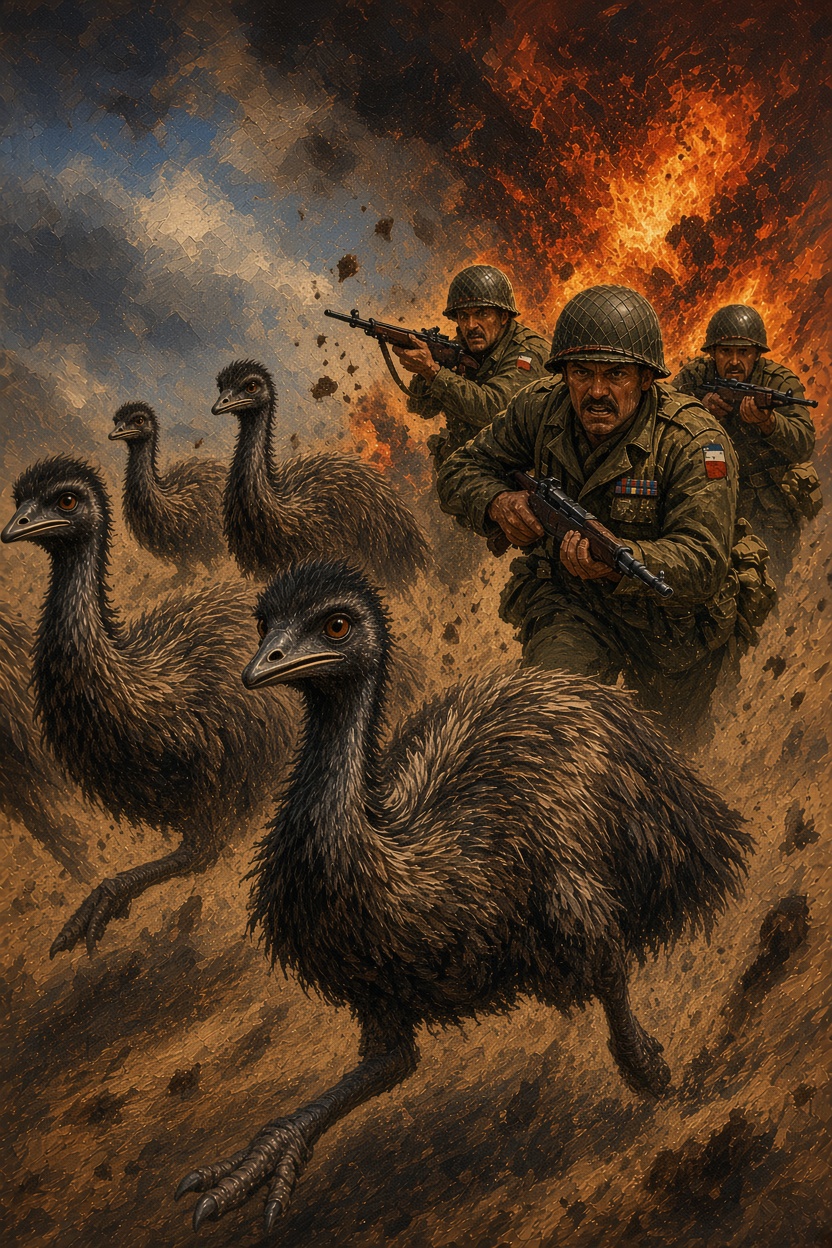 The problem was that many of these soldiers didn’t know anything about farming. They were infantry men who knew how to kill people and break things, and they obviously knew how to survive on the battlefield. They did not know how to grow stuff. The politicians foresaw this problem, of course, and they provided the soldiers training farms in which they received extensive hands-on experience in general farming, dairying, poultry raising, and other agricultural activities. Private farmers and others provided government officials the essentials of farming to train these soldiers, including pest control measures and techniques to employ against insects, rabbits, kangaroos, birds, and any other animals who might eat away at their profits.
The next problem arose when even those soldiers who knew how to farm learned why no private farmers bought the land in the Campion district of Western Australia; the land was crap. The quality of the soil was poor, and it didn’t rain very often.
The government officials knew the land wasn’t great, and they admirably tried to do everything they could to help these soldiers-turned-farmers out, but no one could prepare for The Great Depression, and the collapse of wheat prices. After that, there was little government officials could do, and they likely felt horrible. When some of the landowners began complaining about an inordinate number of emus eating away at their profits, the government officials leapt at the chance to provide any assistance they could.
They started by offering “no need to panic” information that detailed how the emus were following their normal migration patterns, from the inlands to the west coast, after breeding season. The government officials offered them step-by-step advice and sent them brochures about the techniques they could use to cull emu populations.
The third problem arose when it stopped raining in the inland region. This drought caused the normal migration patterns to explode to roughly twenty thousand emus migrating to the coasts in search of food.
The emu is an odd-looking bird. The adult emus can reach 6’2” in height and about 121 lbs. Emus are generally skittish and harmless, like most birds, unless you corner them or appear to threaten their young. The soldiers never feared they were in danger, in other words, but the emus began treating their wheatfields like their own personal buffet.
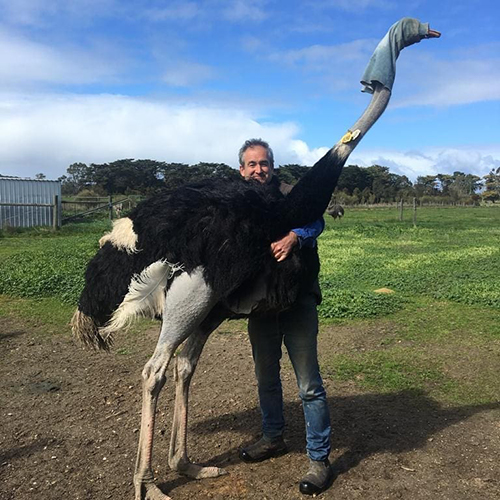 The adult emu can eat around 2.5 lbs. of crop a day, and they were so fast and quick when they scattered that they proved difficult to impossible for the soldiers to catch or cull. The emus were also surprisingly strong, as they trampled the fences the soldiers put up, as if they were made of paper. This allowed the rabbits in, and the rabbits ate what the emus didn’t. Even those soldiers who had experience in farming were overwhelmed, and they joined the inexperienced farmers in asking the Australian government for any assistance the government could offer.
“Of course we will help,” Australia’s Defense Minister Sir George Pearce said. Pearce was speaking for a frustrated and helpless Australian government. There are no sources to confirm this interpretation, but I think the Australian government’s decision to attempt to cull the emus was a desperate attempt to do something in the face of a public outcry. There was nothing the government could do to improve the soil of the land they gave the soldiers, they couldn’t make it rain, and due to The Great Depression, there was little they could do about the subsidies they promised these soldiers.
The Australian citizen probably knew all of the above, but some citizens think the government can fix whatever is happening to them. This outcry was intensified by the fact that the Aussies who were suffering were WWI veterans.
The fourth problem was that the government officials thought this was something they could fix. There was little-to-nothing they could do about the farmers’ other problems, but culling a bunch of dumb birds seemed doable.
In his effort to do something, Sir George Pearce sent his best and brightest: Major Gwynydd Purves Wynne-Aubrey Meredith of the Royal Australian Artillery, Sergeant S. McMurray, and Gunner J. O’Halloran. Pearce also ordered Lewis machine guns and ten thousand rounds of ammunition for them. Sir George Pearce and his defense ministry considered this such a great idea that they informed a cinematographer from Fox Movietone about the problem, and their proposed solution. All parties concerned thought this would provide some excellent newsreel footage for their audience.
Before we continue, it should be noted that emus cannot fly due to their small, vestigial wings, reduced flight muscles, heavy bones, and evolutionary adaptations that favor running over flight. This might lead the reader to believe it almost unfair for hunters to have this much ammunition to take down a bird that cannot fly. If unfair is a harsh term, how about not very sporting to shoot ground bound birds with machine guns?
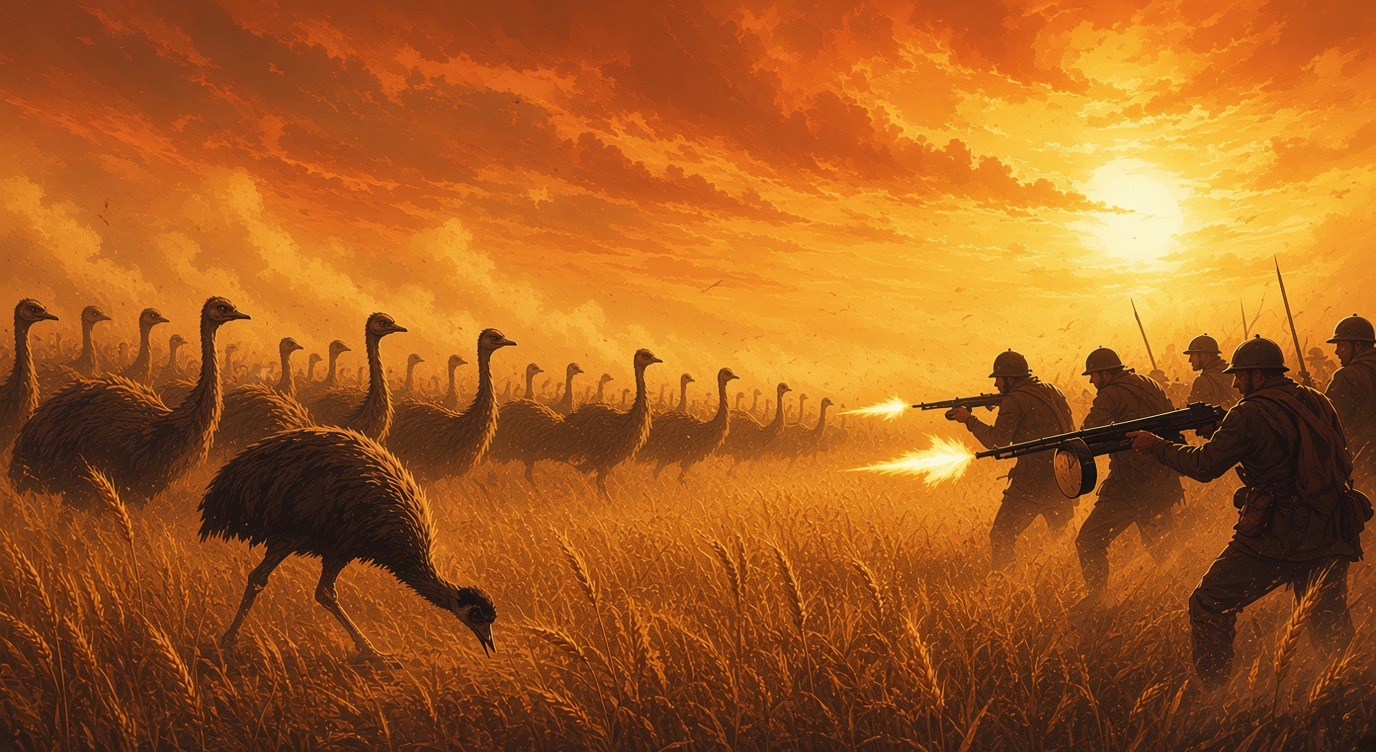 The fifth problem arose when Major Meredith and his best and brightest contingent discovered that it’s not as easy to shoot stuff as they thought. If we have the best artillery human minds could create and the craftiest strategists the military found, the result is almost academic. We aim, shoot, and the thing is dead. It’s 1+1=2. The result on that first day was these decorated soldiers ended up firing about 2,500 rounds, and estimates suggest they culled roughly 50 to 500 emus. Meredith’s initial operation was widely viewed as so ineffective that contemporary reports claim that only a few had been killed. This led Meredith and his men to discover a sixth problem.
The sixth problem was emus do not form ranks, hold ground, and they don’t operate in patterns. There’s nothing strategic about what they do, so there is nothing to strategize over or figure out. They gather in herds, then they scatter into smaller groups, and they keep running. They’re not stationary targets. The three highly decorated warriors were equipped with a weapon optimized for densely grouped battlefield targets against thousands of highly mobile animals spread across miles of countryside. Meredith’s final report reads like a man trying to salvage dignity from absurdity. He praised the birds’ tactics. He noted their ability to absorb bullets and keep moving. He did not say the obvious thing: we brought the wrong tool to the wrong fight.
Before entering into this situation, Pearce and his people should’ve consulted with experienced emu hunters, as even the most experienced emu hunter often describes the effort involved as a humbling, frustrating, and exhausting experience. The adult emu can sprint up to thirty-one miles an hour, and some have clocked them as high as forty-three miles an hour. They can also change direction on a dime. When they lined up these emus in their sightlines, however, they either underestimated their speed, or the crack of the gun scared the emus into changing direction on a dime. At the end of the first engagement, these experienced, highly decorated soldiers only managed a handful of kills of the fifty sighted.
It should also be noted that these shots were taken after the locals in the area joined in on the effort and herded the emus toward the soldiers. The birds instinctually and involuntarily split into smaller groups and ran.
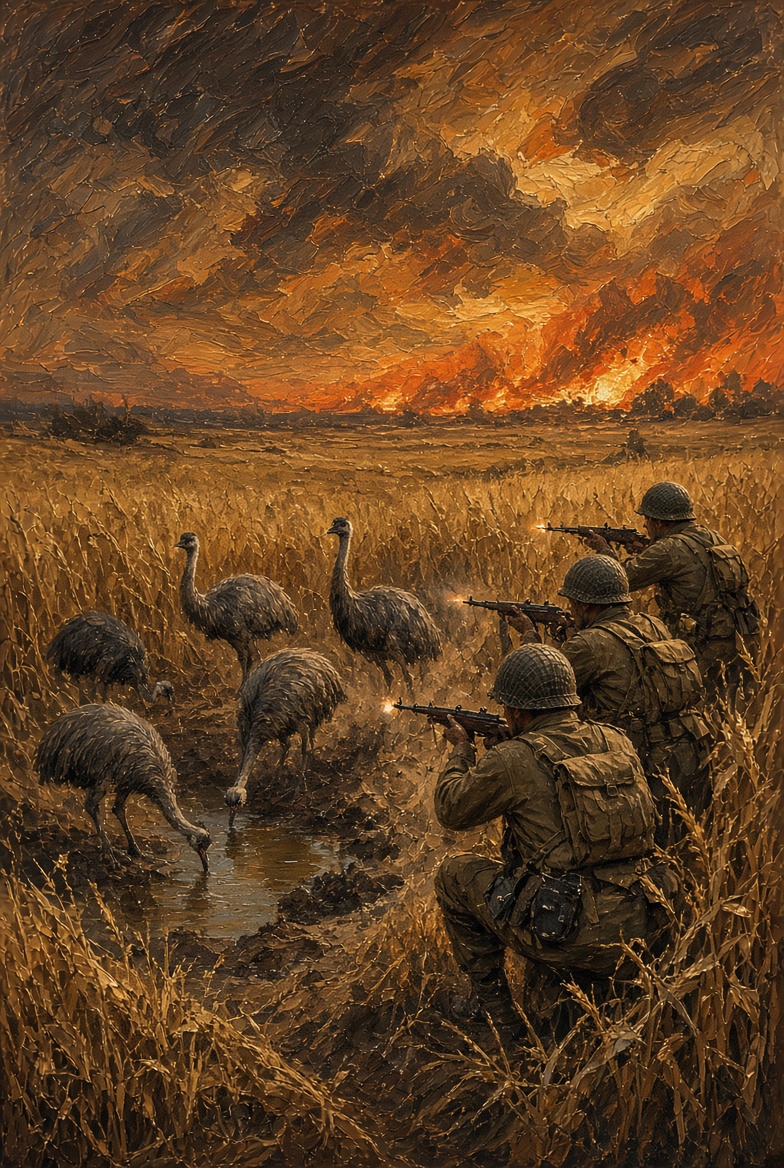 Two days later they set up an ambush at a water hole. A thousand emus fell for it. The gunners waited until the birds were close. They opened fire, but the prized Lewis gun jammed after a few rounds. The birds scattered.
Major Gwynydd Purves Wynne-Aubrey Meredith of the Royal Australian Artillery later described the effort, writing that the emus had “the invulnerability of tanks.”
The best and brightest tried mounting a gun on a truck and chasing the flocks. The terrain was so rough that the gunner spent more time holding onto the truck than shooting. One dead emu got tangled in the steering and the truck crashed through a fence. Meredith and his men realized that this was much more difficult than they suspected, and they suspended the operation.
The desperate farmers begged Pearce for another try. Major Gwynydd Purves Wynne-Aubrey Meredith of the Royal Australian Artillery and his two men returned on November 13th.
This second phase lasted until December 10th. Meredith claimed 986 confirmed kills and estimated another twenty-five hundred birds later died of wounds. That works out to about ten rounds per confirmed kill over a period of one month, one week, and one day.
For reasons endemic to human nature, Australia’s newspapers and their readers loved this humiliating exercise. They characterized it as the “Emu War,” and story was moving newspapers nationally and internationally. The writers and their readers loved the idea that a decorated defense minister, and his best and brightest, couldn’t effectively cull a bunch of dumb birds. They loved the idea that even though they had the best ammunition known to man and the benefit of the greatest military minds in their country, they were “outsmarted” by a bunch of emus. The idea that the warriors-turned-farmers were still suffering was basically viewed by these newspaper writers as the other side of a sensational story that they wanted to cover. They ended up devoting so little space to this other side that it’s fairly obvious they didn’t want to let something like human suffering get in the way of a great story.
We cannot fault the Australian government, Pearce, or Meredith for trying, but the circumstances beyond their control became circumstances beyond their control. They ended up culling less than 1,000 of the estimated 20,000 emu infestation. Meredith eventually conceded that he and his men could not effectively cull the emus, and he was recalled, thus ending all military operations.
Recognizing the futility of their goodwill, the government officials eventually decided to just give the ammunition to the farmers themselves, and they introduced a bounty system for every emu they shot and killed. The rifle-armed settlers proved far more effective than the machine-gun toting mercenaries. The rifle-armed settlers weren’t better shots, but they weren’t weekend warriors trying to prove their mettle either. They knew the land better than Meredith’s men, they were invested in the success of their efforts, and they had the time necessary to take out the tens of thousands of emus who were destroying their friends’ fields.
We could mock Major Gwynydd Purves Wynne-Aubrey Meredith and his men for failing to effectively cull a bunch of birds. They would probably confess that they were fighting a war against an enemy they didn’t understand. They would probably add that even though the emu is not blessed with the brain size that we normally associate with intelligence, they underestimated how intelligent the birds are. As those who establish modern scientific standards for animal intelligence later found, emus are not dumb birds. They cannot outdo crows or parrots on intelligence tests designed for birds, but they show some surprising abilities to solve puzzles, and they’re capable of noteworthy levels of innovation, memory, and adaptive learning.
The seventh problem arose when the government officials and the soldiers realized that in reality this was never a win-win situation, it was a lose-lose scenario. Even if they achieved their ultimate goal of effectively culled the emus, no one would be cheering them on, because the general sentiment would’ve been, “You did your job, what do you want from us an Ice Lolly?” They realized that in operations of this nature, the reason they resonate with the public is that it’s human nature to cheer on the underdog.
 When we read the headlines like, emus vs. Australians, The Emu War, or humans vs. emus, we’re all cheering for the emus. We all cheer on the most helpless underdog of every situation. If, for example, there is a minor tragedy that killed numerous humans and one puppy named Fluffy. The media will find an image of Fluffy, or a picture of the breed, and Fluffy will become the local, statewide, and national symbol of the tragedy. Fluffy will become the helpless underdog in that story for the audience, in the same manner the emus were in this story. Yet, the other side of this story was that a bunch of veterans-turned-farmers couldn’t make ends meet for a variety of reasons, including that a bunch of emus were devouring whatever slim profits they should’ve made.
The other side of the story is that even without all the hurdles these soldiers-turned-farmers faced, farming is not only hard, it’s fraught with failure. For those who don’t know anything about farming, the idea that someone might call it a full-time job is a gross understatement. The typical farmer doesn’t have a social life or even much of a family life. Modern technology has made farming less arduous, but in the early 20th century, farming consumed a farmer’s life. And to have the blood, sweat, and tears they put into it go into a wild animal’s belly, should elicit, at least, equal amounts of sympathy. As we’ve detailed throughout this article, the emu infestation was only one element of the “all kinds of hell” these soldiers had to endure.
The government officials, Pearce, and Meredith knew this, and they did everything they could to help. Did they overdo it, did their desire to do something in the face of their inability to help the farmers in other ways, lead them to overdo it? Were some of their motivations political? They wouldn’t have invited a film crew to film if it wasn’t at least a little political, but it’s tough to argue that their goals weren’t noble.
In the end, the matter was eventually resolved by the government providing farmers ammunition and providing a bounty for every emu carcass. Perhaps that influenced non-farming Australians to join in a more extensive and long-term extermination strategy. The farmers also employed better fencing, which led some to believe the long-term resolution didn’t involve killing emus as much as trying to make it as hard as possible for the emus to enter the farm fields and damage the crops.
Hindsight is 20/20 of course, and it’s our natural inclination to read such a story and think we would’ve done things so much different and better, in the beginning, when it really counted. Those of us who are longtime fans of Swamp People can’t understand why the Aussies didn’t introduce the tried and tested, and age-old bounty system from the very beginning. There are no sources to suggest this, but we can guess that someone somewhere in the Parliamentary debates, correspondence, or local administrative officials introduced this proposal in the beginning. The problem was that the public outcry for government officials to do something for these veterans reached a fever pitch, and the officials wanted to do something tangible and substantial that they could point to in the next election as a record of their efficiency. The something they did led them to do something without considering the warning that whatever can go wrong will, a word of warning that later became Murphy’s Law.

