Find Your Own Truth


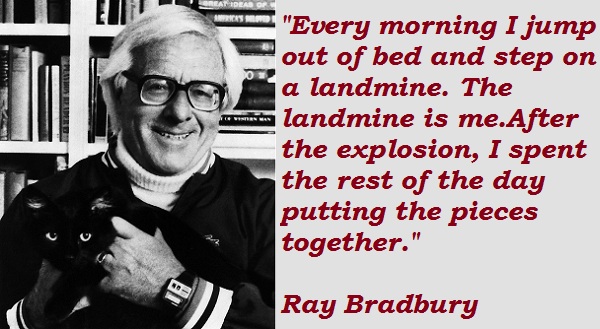
“You need to find your own truth,” Ray Bradbury said to a caller of a radio show on which he was a guest. Mr. Bradbury expounded on the idea, somewhat, but he remained vague. He said some things about following the lead of influential masters of the craft, and all that, “But you’ll eventually need to find your own truth,”

We loathe vague advice. We want answers, thorough and perfect answers, that help us cross bridges. We also want those answers to be pointed and easy to incorporate, but another part of us knows that the seeker of easy paths often gets what they pay for in that regard.

When we listen to a radio show guesting a master craftsman, however, we expect nuggets of information to unlock the mystery of how a master craftsman managed to carve out a niche in his overpopulated craft. We want tidbits, words of wisdom about design, and/or habits we can imitate and emulate, until we reach a point where we don’t feel so alone in our structure. Vague advice and vague platitudes feel like a waste of our time. Especially when that advice comes so close to our personal core and stops abrupt.

Ray Bradbury went onto define his vision of an artistic truth as he saw it, as a guest on this radio show, but that definition didn’t step much beyond the precipice. I tuned him out by the time he began speaking of other matters, and I eventually turned the channel. I might have missed some great advice, but I was frustrated.

After I heard the advice, but I went back to doing what I was doing soon after hearing it, because he didn’t give me what I wanted and needed at the time. It did start popping up when I was doing something, and then it started popping up when I started doing something else. The advice initially felt like useless new-age advice we give to confused souls looking for guidance. It felt like sage advice from some kind of guru who never figured out how to succeed within normal structures in life, so he began dispensing gobbledy gook that others should interpret but never can, so they just label the guru a spiritual guide, because they don’t know what else to call him.  

It might take hours, it might take weeks, but this idea of an individual truth, as it pertains specifically to artistic vision, becomes applicable so often and, in so many situations, that we begin to chew on it and digest it. Others may continue to find this vague advice about an artistic truth nothing more than waste matter –to bring this analogy to its biological conclusion– but it begins to infiltrate everything the eager student does. If the advice is pertinent, the recipient begins spotting truths what should’ve been so obvious before. They begin to see that what they thought was their artistic truth, and what their primary influences considered true, is not as true for them as they once thought.

Vague advice might seem inconsequential to those who do not bump up against the precipice. For these people, a platitude such as, “Find your own truth” may have an “of course” suffix attached to it. “Of course an artist needs to find their artistic truth when approaching an artistic project,” they say. “Isn’t that the very definition of art?” It is, but if we were to ask an artist about the current project they’re working on, and its relation to their definition of an artistic truth, they will surely reply that they think they’re really onto something. If we ask them about the project after they finish the piece, we will likely receive a revelation of the artist’s frustration in one form or another, as most art involves the pursuit of an artistic truth coupled with an inability to ever capture it to the artist’s satisfaction. Yet, we could say that the pursuit of artistic truth, coupled with the frustration of never achieving it, provides more fuel to the artist than an actual, final, arrived-upon truth ever could.

Finding an artistic truth, involves intensive knowledge of the rules of a craft, locating the parameters of the artist’s ability, finding their formula within, and whittling. Any individual who has ever attempted to create art has started with a master’s template in mind. The aspiring, young artist tries to imitate and emulate that master’s design, and they wonder what that master might do in moments of artistic uncertainty: Can I do this? What would they do? Should I do that? Is my truth nestled somewhere inside all of that awaiting further exploration? At a furthered point in the process, the artist discovers other truths, including artistic truths that contradict prior truths, until all truths become falsehoods when compared to the current artistic truth. This is where the whittling begins.

In a manner similar to the whittler whittling away at a stick to create form, the storyteller is always whittling. He’s whittling when he writes. He’s whittling when he reads. He’s whittling in a movie theater, spotting subplots and subtext that his fellow moviegoers might not see. He’s whittling when we tell him about our experience at the used car dealership. He’s trying to get to the core of the tale, a core the storyteller might not see.

“I could tell you about the greatest adventure tale ever told, or a story that everyone agrees is the funniest they’ve ever heard,” she says, “and you’d focus on the part where I said the instead of the.” The whittler searches for the truth, or a subjective truth that he can use. Is it the truth, or the truth? It doesn’t matter, because he doesn’t believe that the storyteller’s representation of the truth is the truth.

Once the artist has learned all the rules, defined the parameters, and found his own formula within a study of a master’s template, and all the templates that contradict that master template, it is time for him to branch out and find his own artistic truth.

The Narrative Essay

Even while scouring the read-if-you-like (RIYL) links the various outlets provide for the books I’ve enjoyed previously, I knew that the narrative essay existed. Just as I’ve always known that the strawberry existed, I knew about the form some call memoir, also known as literary non-fiction or creative non-fiction, but have you ever tasted a strawberry that caused you to flirt with the idea of eating nothing but strawberries for the rest of your life? If you have, your enjoyment probably had more to do with your diet prior to eating that strawberry than the actual flavor of the inexplicably delicious fruit. In the course of one’s life, a person might accidentally indulge in a diet that leaves them vitamin deficient, and they might not know the carelessness of their ways until they take that first bite of the little heart-shaped berry.

“You simply must try these strawberries,” a co-worker said in a buffet line at the office. I have always loved strawberries, but I didn’t even notice these particular strawberries in the shadow of the glorious array of meats and carbs at the other end of the buffet. While I stood there, impatiently waiting for the slow forking procedures some have for finding the perfect piece of meat, she gave me a look. “Just try them,” she said. I did.

Prior to eating that strawberry, I knew nothing about chemical rewards the brain offers for fulfilling a need, and I didn’t know anything about it after I took that first bite either. The only thing I knew, or thought, was that that strawberry was so delicious that I experienced a temporary feeling of euphoria. I piled some strawberries on my plate, and ate a couple of them, but the line was so slow that I was allowed to eat a number of the strawberries on my plate before progressing. I normally do not do this, and I normally loathe those people who do. I prefer to assemble a meal for myself and wait until I’m at a table before I even take my first bite. My co-worker was so insistent that I try one, that I bit into to one to indulge her.

“These things are glorious,” I said.

“What are?”

“The strawberries.”

“Oh, right,” she said. “I told you.”

The sixth and seventh strawberries were as glorious as the first few, and before I knew it, I was gorging on the fruit when another friend behind me, in the buffet line, informed me that I was holding up the line.

At this point, the reader might like to know the title of the one gorgeous little narrative essay that spawned my feelings of creative euphoria. The only answer I can give is that one essay will not quench those suffering from a nutrient depletion any more than a single strawberry can. You might need to gorge on them in the rude, obsessive manner I did that day in the buffet line. One narrative essay did not provide a eureka-style epiphany that led me to understanding of all the creative avenues worthy of exploration in the form. One essay did not quench the idea depletion I experienced in the time-tested formulas and notions I had of the world of storytelling. I just knew I needed something more and something different, and I read all the narrative essays I could find in a manner equivalent to the effort I put into exploring the maximum benefits the strawberry could provide, until a grocery store checker proclaimed that she never witnessed anyone purchase as many strawberries as I was in one transaction. She even called a fellow employee over to witness the spectacle I laid out on her conveyor belt. The unspoken critique between the two was that no wife would permit a man to make such an exaggerated, imbalanced purchase, so I must be a self-indulgent bachelor.

An unprecedented amount of strawberries did not provide me with an unprecedented amount of euphoria, of course, as the brain appears to only provide euphoric chemical rewards for satisfying a severe depletion, but the chemical rewards of finding my own truth, in the narrative essay format, have proven almost endless. The same holds true for the rewards I’ve experienced reading the output of others who have reached their creative peaks. I knew narrative essays existed, as I said, but I considered most to be dry, personal essays that attempted to describe the cute, funny things that happened to them on their way to 40. I never thought of them as a vehicle for the exploration of the answers to our abundant questions on how to be, become, and live in  the stories written by those authors who accomplished it.

It is difficult to describe an epiphany to a person who has never experienced one or even to those who have. The variables are so unique that they can be difficult to describe to a listener donning an of-course face. More often than not, an epiphany does not involve the provocative shock of unique, ingenious thoughts. My personal definition involves all of the of-course thoughts nestled among commonplace events and conversations that one has to arrive at by their own accord. When such an explanation doesn’t make a dent in the of-course faces, we can only conclude that epiphanies are almost entirely personal.

For me, the narrative essay was an avenue to the truth my mind craved, and I might have never have ventured down that path had Ray Bradbury’s vague four words “Find your own truth,” failed to register. For those who stubbornly maintain their of-course faces in the shadow of the maxim the late, great Ray Bradbury, I offer another vague piece of advice that the late, great Rodney Dangerfield offered to an aspiring, young comedian: “You’ll figure it out.”

If advice such as these two nuggets appear so obvious that it is considered unworthy of discussion, or the reader cannot see how to apply it, no matter how much time they spend thinking about it, adding to it, or whittling away at it to find a worthy core, I add this: You’ll either figure it out, or you won’t.

The Other Side of Talent


“He has a talent,” one person said of another. “I don’t know what it is,” she furthered, “but he has a real knack for taking photos.” The subject of that compliment beamed in the aftermath. The compliment was vague, but she used the ‘T’ word, and very few can avoid the gush that follows having a ‘T’ word thrown at them.

It was a nice photo (not the one pictured here), but the ‘T’ word? The compliment suggested that this photo was but one of a long line of photos that you had to see to believe, but it was still just a photo.

Most of us reserve our use of the ‘T’ word for athletic and artistic accomplishments, but we know that many use it in broad terms. We know, for example, that an engineer can display a wide array of talents for his craft that others may not have, but we often say that that person is good at what he does, a master craftsman, or expertly skilled, but the use of the word talent is not often used in conjunction with most skills.

Some could say that a grown man’s ability to outdo his young peers in a game of hopscotch is a display of talent, but most fellow adults watching this man hop from square to square would suggest that he should consider finding a more constructive use of his abilities, if he wants others to consider him a talent.

Merriam-Webster defines talent as “a special ability that allows someone to do something well.”

Philosopher Ayn Rand steadfastly refused to recognize photography as art, but she did concede that it requires a skill, a technical skill, as opposed to a creative one.

We all know that definitions, such as these, can be broad, but most of us have personal definitions that fall on stricter lines. If the definition of talent is as broad as Merriam-Webster described, and photography requires some technical skill, then we should concede that taking a quality photograph does require some talent. One could also say that a talented photographer uses discretion and selectivity when he selects his shot, but could this ability to capture a moment be nothing more than a right place, right time decision? Some of them don’t even display that. They take ten to twenty photos and display the perfect one.

If one takes a hundred different photographs, and only one of them is of an exceptional quality, is that a display of the photographer’s skill? Yes it is, in a broad sense of the term. If that’s the case, we could say that if a man takes a hundred free throws and only makes one, he has a talent for shooting free throws, if that one free throw is so perfect that it barely touches the net.

If a photographer purchases a top of the line camera, and he uses the best photo-enhancing software available to produce evidence of his prowess, and he lays that photo down on a table next to the photo of another taken with a disposable Walmart camera, and no enhancements are permitted, does his superior photo reveal God-given talent on his part, or does it contribute to the lie that a skilled, talented photographer is artistically talented?

The Truly Talented

We’ve all witnessed the effect truly talented people can have on a room, and this effect often makes us a little sick. “He’s just a human being for God’s sakes!” is one of the snarky, coping mechanisms we’ve developed for dealing with “the gush” to adore the talented.

The adoration of talent varies with the skill required to accomplish the feat, of course, but if you’ve ever met a truly gifted people, you know that most of them are not interested in being better today than they were yesterday. Most of them enjoy the potential they have to be better more than they do the work involved in becoming better. “We’re talking about practice!”

Those that become obsessed with being better, and enjoy the benefits the rigors of practice can produce, often end up having their names etched into something by the time they’re finished. These few don’t necessarily bathe in adulation, they focus on one on one battles. When they get beat, and everyone gets beat, they do things that the overwhelming majority of us avoid to get better. For the overwhelming majority, sports, artistic endeavors, and all the venues that require talent involve moments. The talented enjoy those moments for what they are, when they happen, but the people who will have their names etched into something take it home with them. For these people, their talent is but a starting point and a gift that they end up honing to perfection, but even for these people talent can be a curse and a burden, and it can lead to acceptance, love, worship, and being scrutinized, ostracized, hated, and ridiculed. The idea of their talent, i.e. their potential, can also haunt them when they encounter its limitations.

An edition of 30 for 30 called Of Miracles and Men portrayed the other side of talent. It depicted the other side of the Miracle on Ice story that we all know of a ragtag group of American amateurs defeating the most talented Russian hockey team ever assembled. Some would argue that this Russian team might have been the greatest assemblage of hockey players ever to tie skates on their feet. This team had already won four Olympic gold medals in hockey, by the time they took to the ice against this American team, and some of them would go onto win a fifth after the 1980 defeat. To hear this group of talented men speak of their careers, the 1980 loss to a group of American amateurs, in a medal round, sits in their system like a kidney stone that will never pass. This Russian team beat an assemblage of Canada’s best that included probably the greatest hockey player that ever lived Wayne Gretzky. They also beat the 1980 American team in a match that preceded the 1980 medal round upset, and those two matches were not even close. This team was so dominant that they could not be beat, until they were.

Some would think that such an historic upset might serve to highlight the Russian team’s greatness, if one could say that one defeat in the midst of a record of total annihilation is a blip in the overall dominance this team displayed over the hockey world for two decades. Listening to these men speak, however, the listener gets a taste for the other side of talent when the only story anyone wants to hear from them involves the one time they didn’t succeed, and how that has haunted them since.

The point one could take from this 30 for 30 episode is that these men spent an excruciating amount of hours of their young lives in cold, dank gyms honing their God-given gifts, trying to improve on the smallest details of the game, only to fall to a bunch of ragtag Americans that may not have spent one-fifths the amount of time honing their gifts. Even with five gold medals (including the 1984 Olympics), the only thing we want to talk to them about is that one match they failed to win thirty-five years ago.

If you’re acknowledged as the most talented person anyone you know has ever met, and the only thing anyone wants to discuss is the one time you failed, why would you want to raise their expectations? Why would you want to endure the marathon practice sessions that focused on the minutiae your coach informed was going to be vital when you encountered the wall of your God-given abilities? Why would you want to invest more of your life becoming better at something other people hate you for being so good at? We’re talking about desire here.

We’re talking about the desire to be better today, than you were yesterday. “We’re talking about practice!” We’re talking about preparing for that day, that every talented person experiences, when they meet their personal wall.

The wall, for those that have never read about it, involves going up against other people that were the most talented people anyone they know had ever met. It involves seeing what the gifted person is made of when they encounter the another person loaded with so much talent that talent is afterthought.

To read the former NFL quarterback Kurt Warner’s examination of the natural talents that fail to succeed on the NFL level, it’s about having a coach, or mentor, early on that recognizes the person’s talent level, and challenges them in a brutal, heartless manner, to reach within themselves to find various other methods of succeeding beyond the talent level they’ve always known. This heartless mentor also helps the talented person in question determine if they have the desire to succeed on a level they may not have even considered to that point.

The Less Than Talented

“My talent has always been, and will always be, and it should be written with a capital ‘P’!” –Your Potential once said.

What if your talent has never taken you the places you thought it would, but you’ve always known you had the potential you had to succeed. What if your talent lays somewhere between being as talented as anyone that you’ve ever met, and perhaps more, but that untapped potential to be more has always remained at a frustrating distance?

We spoke of ‘the wall’ that every recognized talent experiences, but there is another wall that can be more formidable: the wall of self-imposed expectations. The talented might encounter this wall in moments considered inconsequential to other participants, and observers, but to the person that has lived with the idea that they’ve always had the potential to succeed it is but another example of their ineptitude. Most of them do not know that this is the source of their frustration, or if they do, they won’t acknowledge it.

As the Kurt Warner story informs us, the primary difference between those who will succeed and those that won’t occurs soon after they experience adversity. Moments of adversity can be large and small, but they all reveal who we are, and who we are going to be.

A young Kurt Warner may have dealt with moments of adversity throughout his largely undocumented young life, but we can guess that none of them would compare to the adversity that the adult Kurt Warner would experience in his adult life. The most talented person in his area received so few scholarship offers that he ended up playing quarterback for the University of Northern Iowa. The NFL draft did not draft him, following that college career, and the only team that gave him a try-out, cut him before the season even started. He ended up stocking shelves for a supermarket chain. He then played quarterback in the Arena Football League, and he had a stint in NFL Europe before an injury to a starter allowed him to start for a NFL team and lead them to a Super Bowl victory. He was MVP of that Super Bowl and MVP for the season. That Super Bowl team cut him a couple seasons later, and he went onto play for another NFL team for a couple of unproductive seasons, and he ended up with a team that he, again, guided to the Super Bowl. After Kurt Warner’s career concluded, he was considered to be the best undrafted free agent to ever play the game.

Kurt Warner’s story is one of not living up to his self-imposed expectations. It’s a story of what he did after failing to succeed on many levels. (After leading the St. Louis Rams to a Super Bowl victory, then a Super Bowl loss, he ended up on a New York Giants team that gave up on him in favor of future Hall of Fame starter Eli Manning. Warner then led the Arizona Cardinals to the Super Bowl.) It’s a story that should be held out as an example to talented people, but for most of those that are more talented than anyone they’ve ever met, talent and work have always been a zero-sum game: The more talent one has, the less work they think they have to do.

Warner states that most coaches and mentors coach to the talent, and they let the talent do what they do well in a manner that the coach hopes will reflect the coach’s ability to harness talent. They coach for the next game. They coach to keep the talent happy.

If we’re talking about practice, however, one of a coach’s duties should be to put talented people in uncomfortable positions to reveal to them what they must do when talent alone may not be enough get them out of moments of adversity.

It also allows those talented people –that have always used their talent as a picket sign to avoid the rigors of practice– to learn how to finesse the minutiae of their abilities and hone their desire.

As anyone who has displayed an ability to do anything knows, there is always a ceiling, and when one hits their head on that ceiling it can be humbling and humiliating. Some of the times, it’s more rewarding to hide in a cloud of potential. Those of us considered lesser-thans don’t understand what it must feel like to have so many consider us a true talent, and we never will, and that can provide the talented a comfortable space between the reality of their talent and the potential we believe they might have.

If you’ve ever witnessed a display of YouTube-worthy temper tantrum in a bowling alley, on a miniature golf course, or at a softball field, and you’ve wondered why a person would attempt to gouge their own eye out after missing a two-foot putt, I can tell you –as a former wild temper tantrum thrower– that there’s something more to it than the idea that the ball doesn’t always go where we want it to go. We thought we spotted something at a very young age, we thought we were going to be a somebody, a contender, and the obnoxious five-pin that will not fall no matter what we do is not just a configuration of rock maple wood to us, it is the eye of fate staring at us, mocking us for not being able to fulfill the potential we thought we saw.

These eye-catching temper tantrums are borne of an inability to deal with even the most inconsequential moments of adversity, because we never had a heartless mentor who cared enough not to care that we were tired, that our feelings were hurt by something they said, or that we wanted to quit the game because “it’s just not fun anymore”. One could read this post, and think it’s all about sports, until they witness a guy who has no capacity for dealing with the obnoxious five-pins of life, and in the moment that captures his frustration in life for all to see, he does something to the ball return that causes parents to shield their kids’ eyes. For an overwhelming majority of those who would have their names etched into something by the time their career is over, their mentors would spend countless hours teaching them how to deal with such adversity, how to overcome walls –self-imposed and otherwise– and how to become successful people, and yes, talented photographers, I guess.

Hey You, Get Off My Microbial Cloud!


Have you ever wanted to commit murder? Most of us don’t, but that doesn’t mean we don’t fantasize about it. Most of us don’t have anyone in mind, and we don’t think about it to the point of gauging the ramifications. We just think about how exciting it might be to test our skills against the most brilliant minds of the criminal justice system to see if our attention to detail could match theirs. We would love to see if we could get away with it, just to do it. If we believe what scientists at the University of Oregon, and microbiologists at Argonne National Laboratory suggest might be on the horizon in the science of criminal investigations, you might want to stop procrastinating, and just do it, because getting away with murder could become a lot more complex in the next ten-to-twenty-years.

Getting away with murder is such a common phrase that it doesn’t really mean anything to Americans any more. We toss the phrase around in such a cavalier manner that it confuses foreigners, learning the language and the American culture. They don’t understand how anyone could equate getting away with using a TPC form to complete a CPT request, could be equated to getting away with killing another person. They know that no one in the company is supposed to use this form for a CPT request, they know the dire consequences that await those who do, and they understand that the perpetrator in question didn’t experience any of the proscribed consequences after doing it, but they don’t understand how that is, in anyway, similar to getting away with murder. 

The cavalier use of such phrases may speak to the inability of most to express themselves, or the need we have to exaggerate everything for the purpose of illustrating how strong we feel about a matter. Whatever the case is, we use the phrase getting away with murder, because we deem it one of the most difficult things to do. Even in the days of Sherlock Holmes, when law enforcement officials had little more than their wit, elevated observation skills, the ability to read people, and all of the experience and training that honed those natural attributes, we deemed getting away with murder so difficult that few, if any, could escape a thorough investigation unscathed.

With the first conviction in 1987, by way of DNA evidence, the degree to which science was used in crime scene investigation grew by leaps and bounds. Some have said that jump was a generation-defining leap. Since that point, the FBI has compiled DNA records on more than five million convicted offenders, and around 240 convictions have been overturned because of DNA evidence. In most cases, law enforcement officials are now able to use science to narrow the field of suspects of an investigation with the assistance of DNA evidence. They are able to use it to apprehend suspects, and to build a strong enough case for conviction, as DNA evidence is now recognized by courts and juries alike as a tangible form of evidence. If we are to believe Christopher Cobble’s article for Findlaw Blotter, we’re about to take another huge leap forward with something called a microbial cloud.

Research scientists, and microbiologists, state that they have found that a cloud of bacteria surrounds every living being. This cloud is something they call “microbial miasma”. It is similar, in nature, to the cloud of filth that surrounds the character Pig Pen of the Peanuts comic strip. The cloud that surrounds us every minute of every day is a sort of haze of our microbiome that we emit, comprised of viruses, fungi, yeast, cells, cell parts filth, every piece of bacteria that lives on or around the skin, every piece of skin you shed, and every little, otherwise discreet fart that happened to come from you.

Have you ever encountered a person who had a body odor so strong that you swore you could taste it? Have you ever said something along the lines of, “I know this sounds foolish, but I swear his funk is still crawling on me!” The findings of these microbiologists, and research scientists, suggest that this thought may not have been as far-fetched as once thought.

The BBC summarizes these findings by writing, “When you approach another person’s microbial cloud, their bacteria “rains” down on your skin and is breathed into your lungs.”

Those of us who have a lifelong aversion to close talkers have found it difficult to express our discomfort, for we consider a violation of a norm to break that two-step invisible bubble we all have. It’s a custom of Americans, and some may even call it social protocol, to ask another for some space, but we understand that other cultures have other rules of space. This confusion makes it difficult for us to ask for more space in this regard, but this idea of a microbial cloud might be our saving grace.

“Could you back up a step?” we can now say. “You’re getting your microbial cloud all up in me.”

Reading the various studies of this new information on the net, leads this reader to believe that such hip jargon may not be too far off the mark, for even the customary distance of two-steps may involve the speaker’s microbial miasma going up your nose, in your ears and mouth, and through your immune system. Those of us who have an aversion to close talkers can now state with confidence that a close talker might exacerbate normal bacterial intrusion levels.

This research also gives credence, unfortunately, to the idea germophobes have feared for a generation that they will contract airborne diseases through the simple act of talking to people.

These researchers suggest that the bacteria located in microbial clouds are not just indigenous to every living thing, but they’re also individualistic in their own right. They have their own DNA.

“Researchers ran two trials with participants sitting in sterilized rooms and working on computers while air filters and trays on the ground detected and collected bacterial particles. According to Wired, “[T]he two trials showed that, at least in these 11 people, microbial clouds varied significantly from person to person. They also found that different people shed microbes at different rates.” This means we all have our own, personalized bio-dome following us around, but the DNA is so individualistic that science can now ID it.”

“We expected that we would be able to detect the human microbiome in the air around a person,” a James Meadow of the University of Oregon, said in a news release from the journal PeerJ, “but we were surprised to find that we could identify most of the occupants just by sampling their microbial cloud.”

Those of us who adored the brilliant 70’s television show Columbo, now watch it with a slight cringe and a quaint smile, as we watch the trench coat investigator solve “perfect crimes” by paying an inordinate amount of attention to the details that the average person would’ve missed. “Getting away with murder” back then involved a perpetrator wearing a pair of gloves, paying careful attention to their footprints, and wiping down door handles, lamp switches and telephones to cover any trace of evidence they may have left behind. We also watch the show’s perpetrators attend to the various circumstantial details that might account for the murderer’s whereabouts at the time of the murder, and the warmth of the body that might confuse the coroner’s time of death, and all of the other details that were difficult, but not impossible, to cover up. Those of us in the age of DNA, now watch Columbo with that quaint smile, knowing that if the trench coat investigator had access to the modern technology we have today, most of the “perfect crimes” it appeared that Columbo was the one man to solve, could now be solved by a forensics intern.

The generational differences may not be that stark, and some law enforcement officials will argue that science will probably never replace the basic investigatory tactics, such as knocking on doors, interviewing witnesses, and all of the tactics that Columbo used to solve crimes. The science, as I am sure every law enforcement official would admit, is a nice supplement to help close a case and gain a conviction, but it will never replace the hard work done to solve a murder. I am sure they would also admit that the advent of DNA into criminal investigations, and the depiction of it on shows like C.S.I., might discourage some from indulging in their sick and twisted fantasies with the belief that it’s harder to get away with than ever.

Getting away with murder has never been easy, but with the advent of DNA, and the understanding of it on a level that it could assist law enforcement, as depicted in numerous shows, such as C.S.I., leads those with a lust for blood to dress themselves, and the location of their crime in plastic, in the manner the Dexter would in that Showtime series. How will future assailants account for their microbial cloud? Will we view Dexter and C.S.I., one day, with the same cringes and quaint smiles we now view Columbo?

Jack Gilbert, a microbiologist at Argonne National Laboratory, has been working with crime scene investigators on how to use microbial residue to track down criminals. Mr. Gilbert believes that in the future, we might us microbial clouds, like DNA, to assist law enforcement officials in the future.

“Mr. Gilbert notes that our microbial clouds are not only particular to us, they are particular to where we’ve been, as we add microbes from the surrounding air, soil, and water to our personal Petri dishes. Therefore, an individual’s unique microbial signature could either confirm their alibi or place them at the scene of a crime.

“Solving crime with bacterial vapors remains in its infancy,” writes Christopher Coble. “As with DNA evidence, collection is one thing, but having a large enough database to compare results to it is quite another. But as the technology evolves, it’s yet another reminder to be careful about what you store in the cloud.”

If this research evolves to the point that Mr. Gilbert believes it might, criminal investigations may go beyond the as of yet simple study of skin and the complex collection of DNA, to the study of the DNA of the bacteria that lives on and around the skin. Bacteria, after all, are living organisms with their own DNA signatures.

What will happen in investigations of the future, according to Cosmos Magazine, is that the forensic scientists will get a hold of the bacteria in question and study it using high resolution DNA. In the course of their study of this organism, they will seek out the bacteria’s 16S gene that they say provides their reading a DNA signature equivalent to a grocery store barcode. All bacteria have this gene, but it varies by slight differences between species.

Dexter’s plastic wrap outfit, in essence, would not prevent future forensic specialists from narrowing the field down to him. If they were able to get a hold of the germane bacteria involved, scan it, perform a census on it against the different bacteria communities available, compare it to the 16S genes in their database, and compare it to victim’s bacteria on the alleged assailant or vice versa. If that failed, the forensic team could take soil samples from the area and compare the bacteria in that soil with the bacteria at the bottom of Dexter’s shoes, for example, to build a case against him. 

As Mr. Gilbert says of light switches and door handles, Dexter could be meticulous in his effort to wipe down every inch of the sole of his shoes, so that no milligram of dirt existed on that shoe, but the microbial signature, contained in the 16S genes of bacteria of that sole would be “virtually impossible” to wipe away. Mr. Gilbert even contends that anti-bacterial sanitizers would not be wipe this away entirely.

Dexter had a habit of putting plastic around his shoes, you argue. It’s a decent argument, until we ask the question when he put that plastic on. Did he put that plastic on before he left the car? When he opened the car door, did any of the microbial dust, indigenous to the area, make its way into his car? If he didn’t put them on in the car, did he wait until moments before entering the abandoned rail car? Did he step on any incriminating microbial dust en route to the abandoned railcar? If you watch an episode of Dexter, you’ll notice that his eyes are not covered, and that leaves him susceptible to getting some of the victim’s microbial miasma is his eyes. If investigators are able to get to him quick enough and put him into a sealed chamber, to test his air samples, they might be able to find some 16S genes from the area in question, or the victim. If law enforcement was able to locate and legally confiscate the plastic wrap Dexter used they could scour the outside of the outfit for location, and then they could test the inside of the plasti-wrap to see if his microbial cloud was in it. 

The point is that if you remained calm in the face of the intense interrogations of the Porfiry Petrovichs, the Father Browns, the Sherlock Holmes, and the Columbos of their day, and you were able to weather their psychological games of misdirection and distraction, your ability to get away with murder increased. Getting away with murder  was still so difficult that it became a euphemism for getting away with the impossible, but it was still possible.

The day may never come when the idea of getting away with murder is so impossible that it’s not even worth trying, but there may come a day when a forensic specialist locates some Propionibacterium and Corynebacterium on a clover leaf, in the soil, and around a duck pond where it was alleged that you got your thrill on by killing your neighbor that had belly fat hanging so low below his shirt that you couldn’t stand looking at it anymore. There may come a day when a forensic team is able to determine that those bacteria had a 16S gene, bar code that is specific to you, and there may come a day when they are able to convince a jury of your peers that this alone is enough to have you executed for your crime.

That day is not here yet, however, so it’s not too late for those who want to use all the knowledge they’ve gained from binge watching C.S.I., in the plasti-wrapped basement we’ve told everyone is for our daughter’s third birthday. If these reports are to be believed, however, and the science achieves all that these microbiologists, and research scientists, are projecting, we may want to stop procrastinating, because the forensic science involved in criminal investigations may get so intense that it may become almost impossible for even the most brilliant and meticulous to get away with murder, and that phrase could take on a whole new meaning in the next ten-to-twenty-years.