Octopus Nuggets


We love octopuses! Clicking on this article is a tantamount admission on your part that you probably love learning about the octopus as much as I do. To say they’re fascinating creatures is an understatement. To those of us who love lists, and we all love lists, we might list octopuses as our second favorite animal, but there are so many unique features and unique personalities animals possess that it’s difficult to narrow down the rest of that list.

If we read through one of those top ten most fascinating animals lists, we learn that most animals have one, maybe two, fascinating features, but there are three animals that have such a wide array of unusual characteristics that they’re the most fascinating. The platypus has so many different features that they confused zoologists for decades, and the history of that confusion is so compelling to me that I would list them as my third favorite animal. The octopus might have the second most unique features that continue to fascinate everyone from those of us on the lower rung of enthusiasts to specialists, such as Marine Biologists, Neuroethologists, and Cephalopodologists. (Did you know there was a profession that focused specifically on cephalopods? Neither did I. They’re rare, but they are out there.)

There is one animal more popular than the octopus, the platypus, the monkeys, the lions, gators, and panda bears. Don’t see where I’m going, I’ll give you two hints: every animal has a love/hate relationship with them, and  when archivists compile a list on the subjects of most books, fiction and non, this species dominates the list, and it’s not even close. If you guessed humans, you’ll get nothing, and you’ll like it.

Even those of us who love the octopus and the platypus so much that we want to write something about them know that if we’re going write an article about them, we better involve humans in some way, shape or form. Most people aren’t so interested in octopuses that they’re going to click on an article about them if that article is solely about the octopus. Such an article would feel too dry and “too sciency”. In this vein the inclusion of a human interest angle might be the difference between hard and soft science. Writers of soft science articles know that to personalize an article, we have to include people in some way. 

This problem is somewhat similar to one that plagued famous author Kurt Vonnegut. His problem wasn’t related to octopuses, or articles about them though. His problem involved a dog, or a problem he had with his dog that he perceived to be a problem. Vonnegut’s perceived problem was that his dog was too human. The dog loved being around humans too much for Vonnegut’s taste. The dog was so happy around them that he wanted to be around them all the time. The problem, Vonnegut perceived, was that he felt his dog was spending so much time around humans that he was losing touch with his canine nature. Mr. Vonnegut thought this was his fault, because he rarely put his dog in canine environments. He believed his dog should explore its canine nature more by interacting with other dogs more often, so that it could remember where it came from.

To rectify this, Vonnegut took his dog to a dog park to introduce him to the wonderful world of canines. The dog initially greeted those other dogs in the park with pure joy and excitement, and he did everything a dog typically does when it meets a new dog. When that initial euphoria died down, Vonnegut’s dog turned to the dogs’ owners, the new humans there were to meet in the park. For the rest of their stay in the dog park, the dog’s attention remained stubbornly exclusive to humans. His dog only wanted to meet, greet, and play with the humans who were in the park. Vonnegut was a little frustrated. He tried to do everything he could think up to get his dog to play with other dogs, but the dog only wanted to play with their owners. “As frustrated as I was, I kind of understood,” Kurt Vonnegut wrote, “for I, too, spent a lifetime trying to understand these curious creatures.”

The moral of this story, for me and other young, aspiring writers, is that although creative writing is one of the freest art forms ever created, it does have one concrete, almost inescapable rule. No matter what the subject matter is, the writer had better find a way to involve humans, if their target audience is the human demographic. If we’re going to make a cartoon about dogs, sea creatures, or monkey, for example, we’ll have to anthropomorphize those animals. We’ll have to have them speak, typically in English, have them interact in ways humans understand, and even include some sociopolitical inserts that we all know plague the puffer fish. Even if humans are not our target audience, a writer may not want to take the chance of writing about other animals in the most authentic manner they can conjure up, devoid of human interest, because most animals are as fascinated with humans as humans are, as Kurt Vonnegut found that day in the dog park.

If a writer is going write about something relatively obscure, like the octopus, they better find some way to tie their story of that octopus into the human experience, if they hope to capture the human demographic. The writer may want to find a way to compliment their fellow humans for the various ways in which they co-exist with this cephalopod mollusk. The writer may want to find a zoo that declares the octopus to be their most popular attraction. They may even want to find a way to compliment their fellow humans for the ingenious ways in which they serve the subject of their piece to their fellow humans for consumption, or use them in various medicinal products if there are any.

If the writer seeks to condemn their fellow man for all the ways in which they harm, or otherwise destroy, the cephalopod mollusk, and its environment, on the other hand, they may want to find creative ways of telling their fellow humans how evil the are. Humans love that too. It makes them feel guilty and powerful at the same time.

If the writer’s research does not support such material, the writer may want to write about their personal experiences they’ve had with the subject. Humans, for whatever reason, enjoy reading about another human’s process. We enjoy silly, little anecdotes about how the writer grew up with an octopus wall tumbler toy, and how the writer’s obsession with the octopus grew by leaps and bounds after those formative years. Humans may want to read about some interactions the writer has had with the species they plan to cover, and how that octopus displayed cute, anthropomorphic characteristics. The human-interest angle is what they call it in the biz, and if a writer is not willing, or able, to add some element of humanity in their documentary, book, or article, they may want to find another way to make a living.

  • The Plural War: The ideal plural tense of the word octopus is octopuses. Some reports suggest the plural tense Octopi “was created by English speakers out of a mistaken belief that the word octopus was of Latin origin and hence pluralized with an -i. But the word octopus comes from ancient Greeks, where its plural is octopodes, and though it came to English via scientific Latin, it was never a native Latin word and didn’t exist in that language until scientists borrowed it from the Greeks in the 18th century (and if it were a Latin word, it would take a different form and would not be pluralized with the -i ending).” So, while the word octopi “can’t be justified on an etymological basis, it is not wrong. It is old enough and common enough to be an accepted variant.” Those of us who loath the idea of accepting a variant, because it’s common, might prefer to use the plural form octopuses based on its Greek origins, or octopodes if we’re trying to sound professorial, but we should not correct our peers when they say octopi. It’s not incorrect, but it’s not as correct as the other two, and its asterisk is arrived at by common usage. The only definitive point I arrive at is that I agree with those attempting to learn the English language when they suggest that it is one of the most confusing languages to speak for all of its various rules and acceptable variants.
  • Octopuses have no bones. This makes them a very tasty morsel for the many predators in the ocean. Their survival, therefore, depends on a number of ingenious tactics. The most fascinating of which is the pseudomorph. Most people who watch documentaries on the octopus have witnessed the “inking” defense in which an octopus leaves a cloud of ink in its trail, then switches directions after they leave an ink cloud to confuse a pursuing predator. The pseudomorph is similar, but more complex, in that it contains mucus. The mucus gives the excreted defensive substance a little more staying power than the typical ink cloud, and it gives the octopus enough substance to create an image that mirrors its own. The pseudomorph, also called the “blanch-ink-jet maneuver”, is what many researchers believe is a self-portrait the octopus leaves behind to further confuse the predator. It may not be a self-portrait as rich in detail as those Van Gogh left behind, but it’s similar enough to serve its purpose of confusing predators. Predators have been so confused by this image that not only does it alter their attack, but some have attempted to bite the pseudomorph with the mistaken belief that it is the octopus.
  • Octopus’ ink can also cause physical harm to enemies. The ink, reports the Smithsonian, “contains a compound called tyrosinase, which, in humans, helps to control the production of the natural pigment melanin. When the ink is sprayed in a predator’s eyes, however, tyrosinase can cause a blinding irritation. It also garbles the predator’s sense of smell and taste.” The defensive concoction is so potent, in fact, that if the octopus doesn’t escape the cloud that they create, they could die. As we’ll learn in Octopus Nuggets II, there are fascinating and illuminating reasons these otherwise defenseless globs of boneless matter have survived a reported 296 million years.
  • Sodahead.com commentator states that the octopus has separate and distinct brains in each of its arms, as “two-thirds of an octopus’ neurons reside in its arms, as opposed to its brain. As a result, one arm can be sent out on a task of opening a shell fish, while the octopus, and the other seven arms, are busy doing something else. The arms even react to stimuli after they’ve been completely severed. In one experiment, severed arms jerked away in pain when researchers pinched them.”
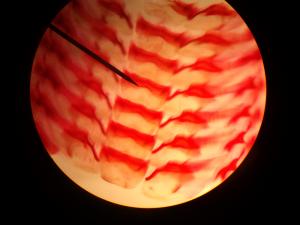
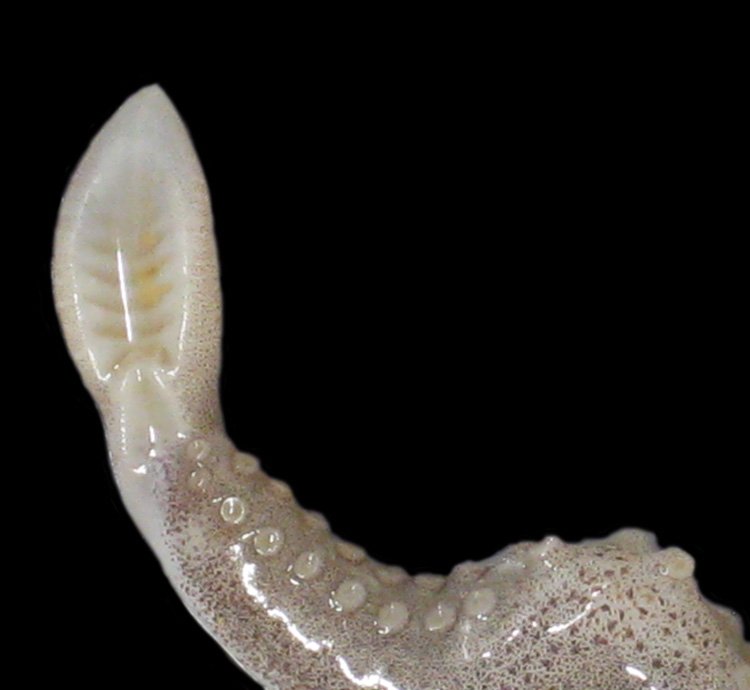
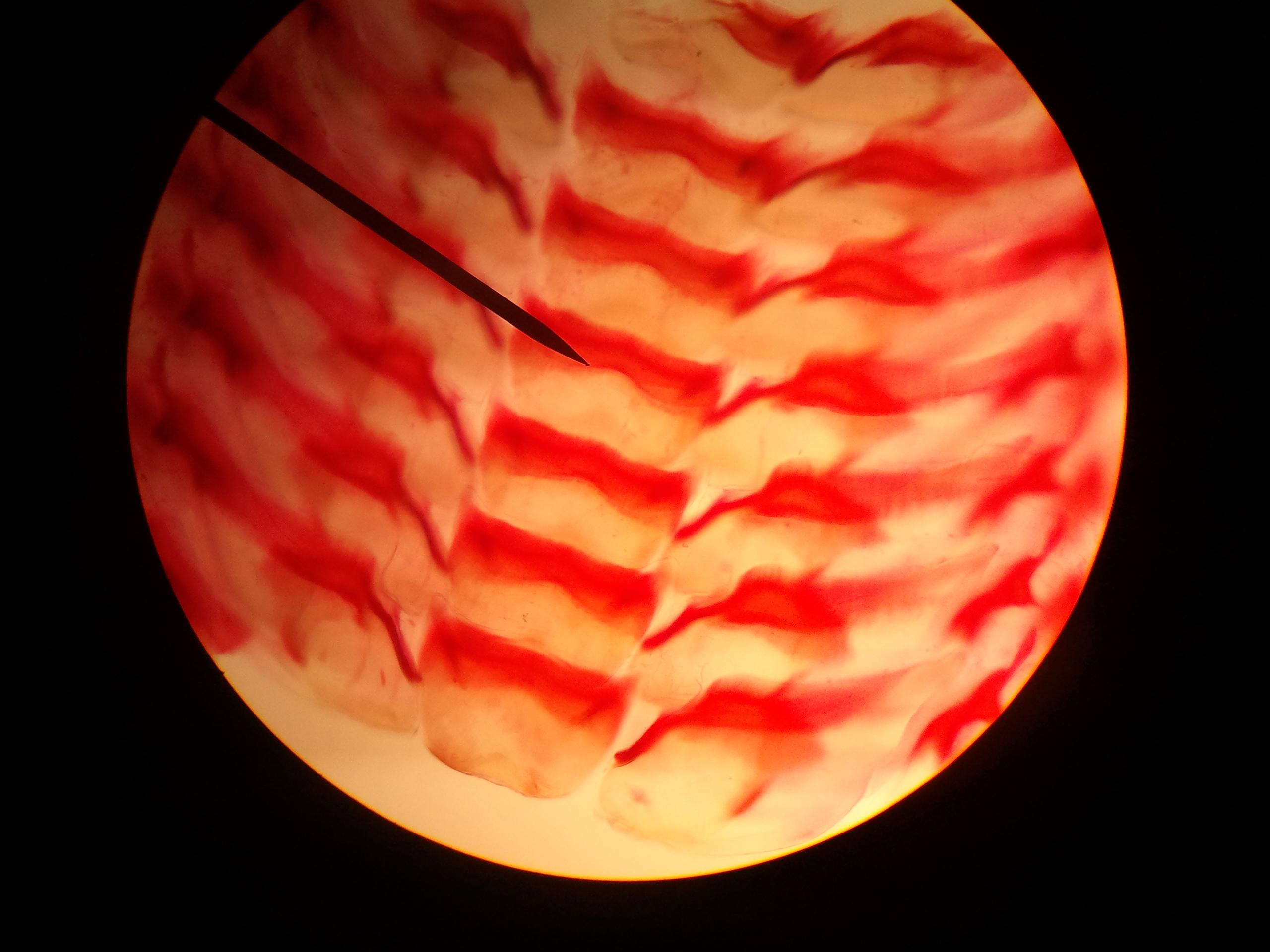
  • gastropod_radula_(2)1322614038542When an octopus comes upon a clam shell, it immediately attempts to rip it open with its many incredibly strong arms acting in unison. If the octopus is not strong enough to rip it open, it drills a hole in the top of the clam with its tongue and injects a neurotoxin to stun the clam into opening up. The word tongue, is used here for the purpose of human understanding, for experts claim that even though it sits in the mouth of the octopus, it is inaccurately called a tongue. The radula has numerous, minute, horny teeth (pictured here) that the octopus grinds on food for the purpose of breaking it up.
  • The octopus has three hearts. Two of the hearts work exclusively to move blood beyond the animal’s gills, while the third keeps circulation flowing for the organs. The organ heart actually stops beating when the octopus swims, explaining the species’ penchant for crawling rather than swimming, which exhausts them. It also has excellent vision in that it can see long distances, but it is basically deaf.
  • Jacque Cousteau has an interesting story involving a friend named Gilpatric. Gilpatric decided that he wanted to keep an octopus as a pet. Knowing the intelligence and strength of the octopus, Gilpatric presumably decided that it didn’t matter how smart the mollusk was if he put a heavy enough lid on top. A short time later, he discovered the aquarium was empty. After searching through his house, he finally found the octopus going through his library book by book, turning the pages with its arms.
  • Male octopuses have a sex organ at the end of one arm, the (the sex arm). This gives octopuses a number of options when it comes to the act of reproduction. They can do it in the traditional manner, but due to the fact that the male’s hectocoytlus arm has a funnel–mantle locking apparatus that keeps it lodged in the pallial cavity of the female, the male octopus will most likely lose that arm in the process. As a result of this eventuality, some male octopuses decide to forego what they must sense is going to be a painful, and humiliating, process by simply detaching the sex arm and giving it to the female to do with what she pleases. (If this option were available to humans, some might wonder if it might solve the conflicts that arise between the genders, or if it would only make matters worse. Others claim to know human males that already engage in this process to avoid the pain and humiliation involved in the process.) Another option that octopuses have at their disposal is to build homes so close to the female that all the male has to do is stretch his hectocoytlus arm into the female’s home and hand her the spermatophores necessary for reproduction.{1} The female then accepts the spermatophores with her right arm. (Researchers do not know why it is exclusively the right arm, but they do not connect it with the reasons that most cultures will only shake with their right hand.)  
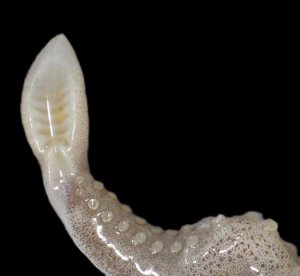
  • There is something of a contradiction concerning the male’s life after reproduction. Some sites state that the male octopus wanders off to die after reproduction, and others claim that the male will have many mates before dying. Does the male octopus engage in a flurry of reproduction, with various females, in the space in time in which it senses their fertility, or does the male’s death fluctuate within the species? If anyone knows the answer to these questions, feel free to reply to this post with that information.
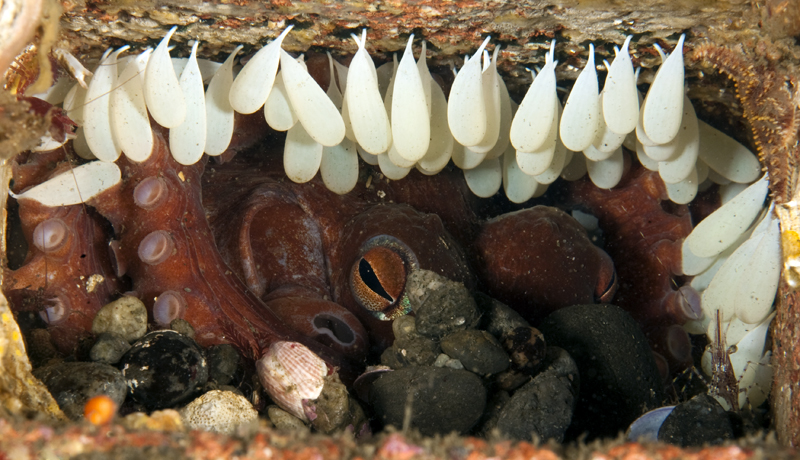
  • The females can lay up to 400,000 eggs, which they have been known to hang from the ceiling of their homes in a manner that resembles translucent, beaded curtains. The mother then obsessively guards her eggs to a point that she actually stops eating. This does not lead to a death by starvation, however, as it has been determined that her body begins to undertake a cellular suicide that begins in its optic glands and ripples throughout her tissues and organs until she is dead. One could guess that this might be the direct result of not eating, but researchers insist that this is not the case.
  • Regardless when an octopus succumbs to death, or how, it appears that even if an octopus manages to avoid reproducing throughout the course of their lives, the maximum life expectancy of a wild octopus is around five years.

To the untrained eye, this invertebrate appears to be little more than a large lump of flesh, but further inspection reveals that they are an incredibly complex species that survives and thrives with a utility belt of tools at its disposal to defend and attack. And fossil records indicate that this complex mollusk may date back to the Carboniferous period, some 296 million years ago, and that these findings indicate that the being hasn’t changed much at all during this time period.

__________________________________________________________

Further Reading on this subject: Octopus Nuggets II

{1} Horowitz, Kate.10 Hidden Talents of the Octopus. Mental Floss. May 2015.Pgs., 36-37.Print.

Fear of a Beaver Perineal Gland


“Do you know what you’re eating?” an informed consumer asked as I approached his table with a strawberry shake in hand. “Do you know what’s in that?”

Informed consumers annoy me. They act like they have this whole formula figured out. They pretend to have some authority on this subject after reading some information on some click-bait site, and they can’t wait to share it with the world. Do they pursue primary information from some top notch health advisory board that has decades of research to back up their claims? No, they often rely on one of those “Know what you’re eating,” click-bait articles. The thing of it is, these purveyors of click-bait info then drop contradictory click-bait articles in the next two days, weeks, months, or however long it takes to make it feel fresh. “There might be some medicinal properties to coffee,” “It turns out eggs are good for you, depending on how you prepare them,” and “there is such thing as too much water.” These contradictions don’t make it into informed consumers’ presentations, however, because they don’t stimulate their need to demonize our diet.

If their sole goal in life was to attain and retain information for their diet, or if they shared it exclusively with their close friends and family, I would have no problem with them. The thing that fries my ham is that they’re not afraid to intrude on an associate’s meal. They’re not afraid to make that face when those of us they hardly know sink our teeth and gums into a greasy cheeseburgers. “I just hate to see you put that into your body,” they say to associates who associate with them.

“That’s fine,” we say, “don’t watch.”

If we were preparing to down a plain salmon sandwich with a side of sautéed yellow squash, would they applaud us? “Good, feed, feed!” Are they concerned that if we don’t change our diet, we might not make it to sixty? I don’t think they care. They barely know us. No, their interruption of our meal is a small, insignificant power play. That “How can you eat that?” is not born of concern, it’s disgust, and displaying disgust for another’s dietary choices is one of the last socially acceptable avenues for displaying disgust for our fellow man. It’s a repository for the disgust we have for all of mankind that comes billowing out on us when they see us eating a chili and cheese dog.

What happened to all of our lines? You remember those lines, those imaginary lines we erected to keep associates we hardly know from invading our privacy. Those lines defined our relationships with those around us, and we knew not to cross them to violate the unspoken tenants of those relationships. We might be genuinely concerned about the diet of a family member, and others with whom we’ve developed a substantial bond, but we should have abide by the unspoken rules that suggest we probably shouldn’t say the same things to those who casually and infrequently associate with us. Our fathers and grandfathers went to great lengths to establish those lines and teach them to us. Those lines are gone, and I for one, miss them. 

There may have been a time when we considered what informed consumers said and adjusted accordingly. We thought their lectures came from a good place, because we joined them in their concerns for our good health. We know you-are-what-you-eat, but somewhere along the line it reached a tipping point. Somewhere along the line, it felt like too much information and too much knowledge. Somewhere along the line, it felt like informed consumers stepped over the line with too much knowledge.  

Yet, we know better than to complain about too much knowledge, because we know they’ll hit us with a “What are you talking about? Too much knowledge regarding quality food, good health, and ways for us to live longer? That knowledge? I’ll take too much knowledge over too little.” Game, set, match they win. Yet, every time we leave our home, someone hits us with their knowledge, until we’re drowning in it.  

“Let’s put it this way,” my informed consumer continued. “What would you say if I asked you to tell me the difference between the strawberry flavoring in your shake and a beaver’s anal secretion?”

“I’d say I can tell the difference,” I managed to say without yawning.

“You’d think that wouldn’t you?” asked my informed consumer, “but people confuse the two every day. Those of you who enjoy eating strawberry, raspberry, and vanilla flavorings are, in essence, big fans of beaver anal secretion. It’s true. If they’re willing to pay a little more for products that use ‘natural flavorings,’ they’re probably eating a number of secretions from animals, insects, and a wide array of repulsive animal byproducts. The natural assumption is that the opposite of natural flavorings involves manmade, chemical enhancements, but does the average consumer know the true extent of the ‘natural flavorings’ in the products they purchase? Chances are, anyone who prefers natural flavoring in their strawberry shakes has actually been devouring this yellowish, mucus-colored secretion from the dried perineal glands of the beaver, in a most gratuitous manner, for years.”

The Castoreum Connection

Castoreum is the exudate from the castor sacs of the mature North American Beaver. Consumers state that they prefer this natural flavoring augment to other natural flavorings in blind, taste tests. The internet offers no details regarding whether this market-tested preference is due to the scent of the secretion, or if the flavor has been determined to be more delicious than any of the other alternatives flavorists have tried over the years. Whatever the case, the beaver doesn’t produce this exudate from its castor sacs to tweak our senses. Rather, they release this natural product as a territory marker. The procedure involved in extracting the exudate is such that the beaver doesn’t have to give up his life to provide this flavoring. Rather, enterprising young hands milk it from the castor sacs located in the beaver’s anal glands. One warning to those curious enough to pursue too much knowledge on this subject, entering the search term “milking the beaver” in a search engine may not pull up the information videos they seek.

It’s important to note that research scientists in this field, called flavorists, have developed synthetic substitutes for castoreum and almost all of the natural additives listed herein. Yet, informed consumers tell us that synthetic substitutes fall under the artificial flavorings umbrella, and artificial flavorings fall under the manmade umbrella, and that we should all consider these two terms unacceptable. When informed consumers read the words “synthetic substitute,” “chemical additive,” or “artificial flavorings,” they may make the leap to animal testing or to the unintended consequences of man messing with nature, because some anecdotal bits of information stick in our minds regarding chemical synthetics leading to cancer and other health concerns. As a result, we prefer the natural flavorings such as the beaver’s anal secretion.

Natural and Artificial Flavoring

So, what is the difference between artificial and natural flavorings? Gary Reineccus, a professor in the Department of Food Science and Nutrition at the University of Minnesota, writes that finding the difference between the two requires one to look at the original source of the chemicals used.

“Natural flavorings just mean that before the source went through many chemical processes, that it came from an organic, natural source as opposed to an artificial one that has no natural origin.”

“I used to be a vegetarian,” a friend of mine told me. “I grew up on a farm, and I saw what they did to the chickens and the ducks to prepare them for our meals. I decided that I would no longer eat them. I felt bad for them. When I was a little girl, I had no idea I was eating the chickens from the pen. I never associated the chickens from the pen with the chicken I enjoyed eating. The question of why they had the same name just never occurred to me. When they explained it all to me, and I saw how they prepared all of my friends for consumption, I couldn’t eat chickens or any other meat for years.”

How much do you enjoy M&M’s and jelly beans? Informed consumers might ask us if we enjoy their shiny appearance. “How do you think they get so shiny?” they might ask with something similar to a smug smile. “Have you ever heard of shellac? Yes, the substance they/we lay on wood furniture to give it that extra, little shimmer. What’s the problem with that, though, if it passes the rigorous standards of our Food and Drug Administration (FDA).”

“Nothing,” writes Daisy Luther, for the Organic Prepper, as long as consumers know the shellac “is a resinous secretion from bugs during their mating cycles, the female lac beetle in particular. Glazed donuts and glossy candy shells owe their shininess to her secretions.”

If we listen to and abide by the informed consumers’ findings, we might not be able to eat shiny candy again, much less the strawberry Frappuccino from Starbucks.

“You’re seeking visual appeal,” informed consumers ask with a snicker. “That’s all right. We all are. What we see and smell adds to our enjoyment of flavor. Even I admit that.”

They inform us that Starbucks once had a difficult time keeping their strawberry Frappuccino a visually appealing vibrant red. The struggle for Starbucks was that most of the red flavorings they tested couldn’t offer us a delightful hue, so they turned to Natural Red #4 dye, otherwise known as carmine. This proved more successful in holding the color, but informed consumers discovered that it is actually a cochineal extract, a color additive derived from the cochina beetle’s shell. The process involves drying the insects and grinding them up to give their strawberry Frappuccino a more sustainable red flavoring. Informed consumer groups forced Starbucks to end the practice and caterwauled them into transitioning to lycopene, a pigment found in tomatoes.

As usual, all this caterwauling is much ado about nothing, as studies performed over the last sixty years by independent researchers and the FDA’s research arm conclude that while most of these additives land high on our yuck list, there are no discernible health concerns or anything life threatening about them. Our culture once laid out a perfectly acceptable joke for such matters, “If you want to enjoy sausage, do not watch how it is made.” No more. We will not abide. We substitute that joke with “Do you know what you’re drinking?” questions that informed consumers end up saying so loudly that corporations hear them and adapt.

Fish Bladders and Bitter Beer Face

“We do it for you,” informed consumer groups might say when they intimidate corporations into changing their practices. We don’t think you do. We don’t know what goes on in hearts and minds, of course, but how many of us act in such a manner to pursue purely altruistic goals. How many of us pursue goals that align with an agenda or a worldview? Some are subtle, some are not, in their calls for greater corporate social responsibility. They suggest that food producers and manufacturers are engaging in deceptive business practices because they do not list “beaver anus juice” in their ingredients, and the FDA should force them to be more transparent.

To this charge, I submit that most of these ingredients have been market tested and FDA approved, and they will bring consumers no harm. They’re gross, some of the ingredients informed consumers dredge up are so gross that they might change our opinions of said products, but that’s our choice as consumers. “Are you informed?” they ask. “Isn’t that the core issue here?”

Informed consumers might seduce us into avoiding beer, because most beer manufacturers dry swim bladders of beluga sturgeon (Isinglass) to filter sediment, but the alternative is yeast-filled beer that no consumer, informed or otherwise, would purchase. We prefer clear beer that has little-to-no sediment.

I also submit that in most areas of the food and beverage industry, profits are far slimmer than infotainment, click-bait purveyors preach. If they’re able to keep their costs down, they’re able to keep our costs down. The food and beverage industry is such a competitive industry that the need to keep costs down, and their ability pass those savings on to the consumers is often the difference between being able to sell said products and folding up shop. If an informed consumer demands more corporate responsibility, along industry lines, they should be prepared to pay more for these alternatives, because those higher costs will be passed on to consumers. Informed consumers are also fickle beings who force corporations into changing from natural flavorings to synthetic and back, nearly undermining their efforts with constant barrages from their outrage-of-the-day vault. Those of us who pay attention to such matters, long for a pushback from corporations and consumers. We long for the day when uninformed consumers will step up, en masse, and say something such as:

“I don’t enjoy hearing that my beer spends some time in a dried fish bladder. I might prefer that they find some other way to clean my favorite beer, but I’ve been drinking it and those fish bladder remnants for decades. I eat fish all the time though, and I see nothing wrong with it, and I think the idea of bullying corporations to do things another way has reached a tipping point.”

To Get Us in the Mood

Various corporations also use the beaver castoreum to cure headaches, fever, and hysteria, as it contains large amounts of salicylic acid, an active ingredient in aspirin. These anal secretions also contain around twenty-four different molecules, many of which act as natural pheromones that help us get in the mood.

Castoreum gives off a musky scent used in perfumes, much like ambergris, the solid, waxy, flammable substance of a dull gray or blackish color, produced in the gastrointestinal tract of sperm whales. The whale does not have to die for ambergris extraction either. Ambergris is a bile duct secretion produced to ease the passage of hard, sharp objects the whale ingests in the sea. As such, enterprising souls often locate the ambergris floating on the surface of the ocean in whale vomit, which makes it easier to harvest and include in our favorite perfumes and colognes.

Giacomo Casanova, well-known raconteur, often sprinkled a dash of ambergris in his evening hot chocolate, in the hopes that when his lover approached its musky aroma would be permeating from his skin. If Casanova were feeling particularly insecure, while in the company of a promising damsel, he added an extra coat of it on his collar.

The theory is that our sense of smell serves a dual purpose: warning us of danger and attracting us to a prospective mate. Market research has expounded on these findings. They have it that animal materials such as civet, castoreum and musk (from cats, beaver, and deer, all located in the same region) offer a sensual fragrance, because they harbor chemical structures similar to our own sexual odors. Musk has almost identical properties to human testosterone, in other words, an enzyme that powers our sex drive.

Who Discovered It First?

The last questions that arise in discussion involving natural substitutes and additives involve their origin: “Who first discovered this, and how did they arrive at the conclusion that it could be used in the manner we now use it?”

Did someone notice that an inordinate number of women had an inordinate attraction to whalers? Did this first observer set about to try to discover why? Did whalers, after a number of successful conquests of women, realize that there was something to their success rate? Did some notice that the correlation went beyond the rugged individualism women of the era seemed to associate with whaling? Did one whaler rub some whale vomit behind his ears before he went to the tavern one night and encounter so much success that his fellow whalers followed suit? How long did it take before someone officially unlocked the alluring properties of ambergris? On that note, who was the first person to mix beaver anal juice in ice cream and decide it was such a winning proposition that they should pitch it to corporations? What did this enterprising soul say in that pitch to make it persuasive? While we’re on the topic, how did someone discover the psychedelic and psychoactive properties of the toad?

What was the trial-and-error process that led to this discovery? Did someone eat a toad and find themselves feeling a little loopy in the aftermath? Did they discover these toad venom properties after an incident, or did this enterprising individual walk around licking everything in the forest, from the trees to the various orifices of the aardvark, armadillo and the antelope, seeking a natural high that they hoped might eventually lead to fame and fortune?

We can make an educated guess that any individual who persisted in this manner probably didn’t care about money as much as they did achieving a state of mind in which they could no longer care about money.

We know the natural properties in plants and animals can provide homeopathic remedies, and these theories date back to the Native Americans, to Aristotle, and beyond. We also know that there was a great deal of trial-and-error in that research, much of it accomplished in environments that were not sterile, and they produced results were not consistent and would have a difficult time standing up to the kind of peer review such a finding would experience today. With that in mind, another question naturally arises: “How many people became ill during these trials? How many experienced short and long-term paralytic effects? How many died before they found that the 5-methoxy-N, N-dimethyltryptamine (5-MeO-DMT), is a chemical derivative of bufotenine located in toads? This chemical, after all, is not available in all toads. It appears to be a property exclusive to the bufo alvarius. We can only guess that many people had to lick a wide variety of wild animals before they discovered the one that secretes the perfect venom for those who wish to experience the euphoric results of brain cell death.

The chemical (5-MeO-DMT) is a natural venom these toads produce to defend against attackers, and recent research indicates that the toad-licking phenomenon is dangerous, and that the hallucinogenic properties are an old wives’ tale. That research reports that human beings, whom the toad views as attackers, are susceptible to the same consequences of any attacker that runs up to lick it. The human attacker may become ill and/or paralyzed in an attempt to milk the toad in a squeezing motion or to ingest it in an oral manner. This leads to the next question, which alleged educated researcher watched their fellow researchers or test subjects fall to the ground in paralytic spasms, or to their death, and crossed out the words lick it. The researcher or the one next in line must have tried everything before they found the successful method of drying the toad and smoking it. Word then leaked that someone found the Holy Grail of brain cell-killing euphoria, and the proper use of the secretions of the Bufo alvarius soon became so ubiquitous and eventually so detrimental that Queensland, Australia, deemed toad slime as contraband, an illegal substance, the possession of which is punishable under their Drug Misuse Act?

My 

Advice to Informed Consumers

If the reader is anything like my informed consumer friend who insisted on informing me about the natural byproducts of my strawberry shake, and the reader is interested in trivial information about consumable products, that reader already knows about the number of websites that will feed the need. These websites provide tidbits and warnings about just about every product and service available to mankind, updated on a daily basis. If the informed consumer is so interested in such information that they feel an overwhelming need to share, just know that an ever-increasing segment of the population has already reached that fight-the-yawn tipping point, because most of this information proves to be little more than a conglomeration of trivial concerns, if not contradictory.

My initial fear, in publishing this particular article, was that it might contribute to what I deem a violation of social protocol, yet I offer it here under the banner “There’s no such thing as too much knowledge.” I am aware, however, that there will always be some informed consumers, like my broiled to black on too much information friend, who don’t believe that sharing such information will do any harm. I also know that the moment of sharing will arrive soon after the unsuspecting sits down to enjoy those products the informed consumer is now afraid to consume based on what they know about said product. To these people, I offer my paraphrase of one of Mark Twain’s most famous quotes: “Sometimes it’s better to keep your mouth shut and appear uninformed than to open it and remove all doubt.”

The next time someone approaches your table with a strawberry shake, a bottle of beer, M&M’s, or a fried Bufo alvarius toad that they plan to consume, just swallow your bullhorn. Don’t even say something you consider relatively benign like, “Well, I wouldn’t eat it.” Just let it go, because you’re not doing it for us. You’re doing it for you. You’re doing it to solve some mysterious mess you have entangled in your innards, and the sooner you admit that the happier we’ll all be. I would also ask them if they really care about my health, “Seriously, you don’t really care, and I don’t care about your prescriptions for my greater health. The difference between the two of us is that I’m not going to pretend I do.”

The Real Back Pain Solution


Did you wake with the level of excruciating back pain I did the other day? It can ruin an entire day. Sometimes, it ruins a couple days. I’ve been there too. When we’re experiencing that much pain, it doesn’t matter that other people might be in more pain. Pain is pain. It doesn’t matter that others may experience chronic back pain, where ours could be called occasional and temporary. Pain is pain. It makes us irrational, emotional, cranky, and it disrupts our lives.

The first culprit we seek for interrogation is sleep. Did we sleep on too many pillows, or in some other way cause our head, neck, or back to be at an odd angle the night before? Sleep is often a hostile witness, however, never answering questions, or if it does, those answers are often incoherent and incomplete. Our next step, is to retrace our steps leading up to the moment we fell asleep to see if any of our actions were the culprit. We analyze every minute of the day, every time we grabbed something, reached down, up, or around, and we can do this, because we have all day, check that ALL DAY, to lay there completely still, staring up at the ceiling to retrace every single step of the day.

Woman-With-alot-of-Back-Pain-walking-tall-chiropractorTo deal with that pain, we take whatever meds we can find. We heat, cool, cool, and heat, and if it becomes a recurring we may take a trip down to the massage clinic to have them work it out until it’s gone, and to provide us tips to prevent it in the future.

When we’re immersed in that pain, we may vow to develop a routine at the gym that will strengthen those particular muscles as a form of preventative medicine, but that vow often lasts about as long as the pain does. If the reader is serious about solving recurring lower back pain, a therapist informed me of her expert opinion on a cure: The leg press. There are a variety of methods to avoid in the procedure, and a variety of optimal methods to use that are relative to the person and the location of the pain, but as one who has experienced recurring, lower back pain, this machine has proved to be a cure all for me. Another method that never occurred to me (embarrassing? sure) was to pay a little extra for a quality mattress, then when that mattress loses its quality, replace it. These seem like such easy fixes, and they are, even if there is no cure all, there are cures, and it’s your job to find it. If one solution doesn’t work, try another.

The next, and more prominent, question is how often does back pain occur in our lives? The answer to this question gets to the heart of why we should not complain about intermittent, minor, and temporary back pains as often as we do. We all complain when it happens, but some of us complain in a manner that suggests that God and nature are somehow against us. Some of us even act like our body has failed us in some manner for which we are not to responsible, and we go to a doctor to tell them to fix it.

On the situation comedy, Louie, Louis C.K. complains to his doctor, a Dr. Bigelow, about the temporary back pain he is experiencing.  Rather than treat Louie in any manner, Dr. Bigelow informs Louie why he has back pain.

“You’re using it wrong,” Dr. Bigelow says. “The back isn’t done evolving yet. You see, the spine is a row of vertebrae. It was designed to be horizontal. Then people came along and used it vertical. Wasn’t meant for that. So the disks get all floppy, swollen. Pop out left, pop out right. It’ll take another. I’d say 20,000 years to get straightened out. Till then, it’s going to keep hurting.

“It’s an engineering design problem,” he continues. “It’s a misallocation. We were given a clothesline and we’re using it as a flagpole.

“Use your back as it was intended. Walk around on your hands and feet. Or accept the fact that your back is going to hurt sometimes. Be very grateful for the moments that it doesn’t. Every second spent without back pain is a lucky second. String enough of those lucky seconds together, you have a lucky minute.”

The human body may be a marvel in many ways, in other words, but it also has structural flaws. The back, for instance, has structural flaws, and it functions for most of our lives from a flawed premise. So, rather than complain about our temporary back pains, we should take a moment, consider our age, and calculate the number of days when our back was defying nature and providing us with a pain-free existence. We don’t appreciate the back until it fails us, of course, and now that it has, we should take that opportunity to thank it for supporting all of the innumerable actions we’ve asked it to perform for all those years. If Dr. Bigelow’s assessment of the back’s design flaws is to be believed, those days of peak performance shouldn’t occur as often as they do, and that’s the marvel of the back.

When you’re in pain, however, such twisted logic is about the furthest thing from our mind. Pain is pain, and when our back pain is so severe that we can do nothing but crawl on the floor, you’re not going to be comforted by the idea that the sole reason that your down there is a structural flaw that human evolution has yet to iron out. As for the idea of being grateful to your back that you’re not down there more often, as a result of its flawed design, that’s about as irrational as being grateful that at least you’re not being attacked by a big brown bear. As a former ground bound, back pain sufferer that has never been eviscerated by a bear, I can relate, but I still have to imagine that being attacked by a predatory, brown bear would be worse.

At maximum size, a brown bear can weigh 1,500 lbs., and they reach a height of ten feet when standing erect. On all fours, some brown bears have even been measured to be five feet high, near the height of the average human. After imagining the hysteria one might experience with something that large racing at them, the victim should know that bears aren’t known to go for the throat in the manner wild cats will, and the nature of their attack is such that they often don’t employ tactics that would lead to a more instantaneous form of death. If they are protecting their young, or acting in a manner that could later be determined to be defensive, they may let most humans off with a warning. That warning may land you in the hospital for a year, and leave lacerations on your head and face that have you looking like the elephant man for the rest of your life, but it is just a warning.

I would have to guess, however, that in the aftermath of a defensive bear attack, fruit will taste better, and the victim will begin to say ‘I love you’ to their loved ones more often, after park rangers inform them that the bear was not acting in a predatory nature, and all that that implies. If the victim is witnessing a bear acting in a predatory manner, and they don’t believe in guns, they might find it interesting that a brown bear can sprint at speeds of up to thirty miles an hour over short distances, and that they can break a caribou’s back with a single swipe of one of their massive paws.

If a potential victim is unsure as to whether an oncoming bear is acting in a predatory nature or not, they should know that there is no substantial proof to suggest that bears prefer us alive. Cannibals have refuted the notion that the adrenaline that courses through our system, as a result of fear, unnecessary suffering, and pain, makes humans taste any better. So, even though playing opossum may be the only tactic for a victim to explore at one point, it may not do any good if the bear regards us as food. Bears appear to have little regard for the state of consciousness of their victim while feeding.

Due to the fact that bears are forced to store food for their long hibernation periods, most of their dietary needs involve fat content. What this means to you, if you are being attacked as a food source, is that they’re prone to go after intestines, and other internal organs. To get there, of course, they will have to claw away at the skin casing, and the rib cage, while you lay conscious, trying to fight for your life, with one paw holding you down, as they rip these fat-laden morsels from your body.

“That still does not help me!” screams the victim of agonizing back pain. It may not, I’m forced to admit, but it may answer the question why God can’t hear your cries. Some people are screaming louder.