Tattoo You


Most people don’t search for answers, only solutions, especially when they’re young and impressionable. Tattoos are the solutions for those that can’t achieve differentiation through creative, internal methods, but if you’re one of those looking for the answers to some of life’s greater problems, you’re probably not going to find them in tattoos.

This may seem like a foolish notion, for how many reasonable people look to a tattoo to complete them? A portion of the answer involves the question, how many people are unable to finesse the gifts of intelligence they’ve been given to have an effect on people, and how many people, especially young and impressionable people, are unable to cultivate their personality in a manner that wows people? In an attempt to answer some of these questions, some believe that a simple, short-term fix involves changing their wrapping.
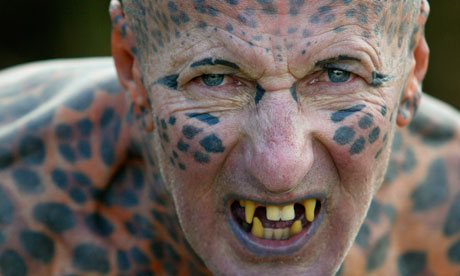
Tom Leppard, 'the Leopard Man of Skye'When people get their first tattoo, they usually show it off with an expectant half-smile. That half smile suggests that the reason they got that tattoo was either to impress those that surround them, or tick them off. The thing that these people either don’t know, or forget, is that most people don’t care about them one way or another.

Nobody cares what you do to your body, and nobody cares about the rebellion that drove you to get your first tattoo. You may think people care. You might think that most people are looking at you with a screwed up and indignant look, and that may be part of the reason you got it in the first place. Some people will provide you this joy, but most of us won’t, because most of us don’t care. We don’t care that you don’t think the world is unfair, and we don’t care about the way you wear your hair, and if your driving force for getting a tattoo was to tick off those who really do care a great deal about you, you should know that you will probably, and eventually, accomplish that goal, and they won’t care about it either.

Tattoos make a statement, they provide an insecure, and reaching, individual an identity. It also provides one internal temerity. In that, those that won’t get a tattoo are said to be weak, because they fear needles. While this may account for a segment of those that are not tattooed, it does not represent all of them. The tattoo also gives the tattooed the ability –some of the times for the first time– for young people to believe that they are cool. This apparently allows them to stand in stark contrast to the relatively normal, somewhat nerdy, most likely insecure individuals that are unable to find a means through which to rebel against their parent’s societal standards.

Gaining this identity, apparently, is the selling point to getting a tattoo. “What prompted you to get a tattoo? I can see Duke Bradford getting one, but you Ned Backwater? I’m shocked!” Suddenly, everyone wants to talk to Ned. Everyone wants to ask him about that tattoo. He is the center of attention. Ned never did have the type of personality, the type of well-rounded intelligence, or the diversity of thought necessary to sustain such popularity, so once this headline began to fade, so did Ned. This depressed Ned, because once he finally found the limelight, through that tattoo, it was narcotic, and the only possible answer to this new dilemma was, of course, to get another one.

The idea that a second tattoo would achieve the degree of notoriety Ned received with the first one, isn’t likely. It’s more likely that once Ned achieved the role of tattooed individual, the shock and awe of a second tattoo will do little more for his standing in his community. Let’s say that it does, however,  let’s say that Ned’s new persona allows him to mock all of those that don’t have tattoos. Let’s say that a pretty, young thing approaches Ned and says, “Did it hurt when you got that tattoo right there?” “Nah!” says Ned with aplomb. “I got that one to illustrate the duality of man! It’s Cuneiform! The Sumerians rock dude!”

Let’s say it all goes according to plan, and Ned regains the center of attention, and he decides that more tattoos equals more attention, and more attention equals more definition of character, and more definition of character leads to a more meaningful life, and a more meaningful life means he can leave the Backwater traditions and standards in the dust with each tattoo. What does Ned do when he is standing in line at the bank, and a different beautiful young thing spots him and snickers at the fact that Ned’s obsession has progressed to the point where getting leopard spots tattooed all over his face seemed like a reasonable progression at the time?

I know what you’re saying, “I’m a normal dude, and no normal dude don’t get no tattoos in his face.” I know that there is a line in the sand in the tattoo community that suggests that getting a facial tattoo is a taboo, even in the tattooed community. Isn’t that the very reason that you got a tattoo in the first place? What kind of rebel picks and chooses the taboos he is going to violate? If one tattoo on your arm made you feel like a rebellious renegade, why wouldn’t you want to break all the rules, until you’re standing in line, at a bank, with leopard spots on your face? It seems to be a natural progression to those of us trying to understand.

I didn’t get a tattoo when I was younger, but the peer pressure to get one wasn’t what it is today. I did, however, engage in the many short-term fixes for happiness, and identity, offered in my era. I knew all the reasons to indulge in these short-term fixes, for their proponents littered my life, and the opponents never did give me a decent philosophical answer regarding why I shouldn’t.

The best possible answer I could give to such a question today, regarding tattoos, alcohol, or any other temporary fix to all that ails my interrogator is, most people don’t search for answers, only solutions. Answers can be difficult to find, complex once they’re found, and ever-progressing. It’s much easier, and more fun, to engage in short-term fixes.

‘Are you happy now?’ I would ask them. Depending on their age, most of them would probably say no. Most of them would not want to go into how confused they were about their irrational and chaotic lives, they would just say no. Most of them wouldn’t want to talk about how difficult it can be to cultivate a creative and interesting personality that others wanted to be around. Most of them wouldn’t confess how difficult the search for answers can be, and most of them probably wouldn’t recognize that they’re engaging in short-term fixes, so that they can, at the very least, ignore their problems for a little bit. Most of them would not appreciate our answers to their problem is time and experience. It wouldn’t be good enough for most of them to hear that you’ll learn things in life that will cultivate your personality and cause your inner core to grow, for they need answers now.

By choosing to indulge in the solution that you’ve selected, I would say, your ceding your search to something else. It’s admittedly tough to find happiness in your inner resources, being as immature as you are now, but your inside sources give you a freedom to decide what emotion you will have for the day and how much. The outside sources can provide short-term fun—in the case of alcohol and tattoos—and I would not try to diminish those aspects. I would probably lose that argument, but I would tell them that you run a circuitous route when you attempt to sprint past your problems with short-term fixes, and you usually end up with more questions and fewer answers than when you started. There will also come a point when that short-term fix doesn’t do the trick anymore. At that point, the only reasonable answer you will find, will be to double down on the short-term fix, for that was the only reasonable solution you could come up with in the first place.

Imagine eventually reaching a point where your happiness depended on the short-term fix only that outside source could provide. Imagine that you soon began to believe that the only way you could be happy is to have more of those outside sources. At some point, you would begin incrementally ceding your whole life to the short-term fixes that only outside sources can provide. Eventually, you would reach a point where you decided that this was no way to live. Eventually, you would decide that the best way to find happiness is to strengthen your inner resources. The final question I would ask is, is it better to try and strengthen those inside sources now or later, after you have gone through all the self-discovery it takes to rectify all the damage you’ve done to yourself with your short-term fixes?

At this point, many of you are saying I’ve left the world of tattoos and entered the world of dependency, and for the most part you’re right, but I would say tattoos are neither the answer nor the solution. Tattoos, like most short-term fixes, never resolve the questions that a Ned Backwater attempted to conceal when he started getting them in the first place.
The Creativity


Bill Cosby had a show called Kids say the Darndest Things, and they did say the darndest things on the show. We all did at that age, but we all knew that we would have to grow out of that if it was our goal to be taken serious. Those of us who wouldn’t, had to be institutionalized into the ways of human operations (i.e. school), if we ever hoped to mature properly. Some of us matured into good business assets, fathers, and occasional games men. For the most part, however, those fantastical ideas were required to be laid by the roadside in the pursuit of a quality, adult life.

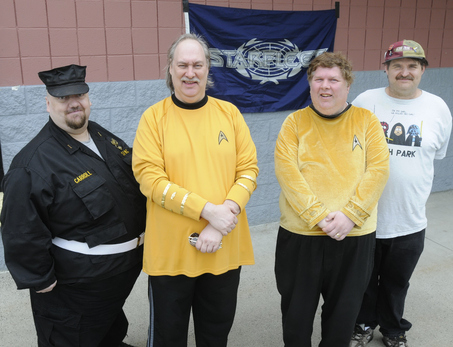
Some of us remain trapped in a fantastical mindset, and while we led a good life, and had a good wife, we haven’t matured to the point that we can meld a serious life with a fantastical mindset. We all know people who cling a little too much to fantasy, and while we try not to think less of them, it can prove difficult to take them serious. These people are apt to have an unhealthy addiction to gaming, science fiction, vampires, and now zombies. These people, depending on the progression of their fantastical mind, often have little to nothing to offer corporate America.

sct star trek.jpgOthers have all the foolishness of unconventional thinking, and fantasy, behind them early on. They are often children of ultra-serious parents who want their children devoid of foolish thinking. These people eventually get so locked in on serious, or conventional, ways of thinking that they end up neglecting that part of their brain that indulges in fantasy, art, and creativity for so long that they ignore a huge ingredient of what it means to be human. They eventually veer so far into the serious side of life that they become disgusted by creative thinkers. They “don’t have time” for such silliness. They have developed the tunnel vision necessary to compete in the corporate world, and they can’t understand people that don’t have a master plan. These people usually have a mathematical equation for life.

They prefer the absolutes inherent in the Superman story over the cloudy interpretations offered by the Batman character. They prefer the concrete absolutes of standard music over any creative music that messes with the formula, and they prefer the more standard comedy of Everybody Loves Raymond over the comedic study of intangibles on Seinfeld. These are bottom line people who will tell you all you need to know in life to succeed are two words: “Yes and sir!”

At some point, this type usually crashes and burn under the weight of all that seriousness. The purchases they’ve made to substantiate their status begins to lose their luster, the family no longer interests them in a substantial manner, and the career they’ve worked their whole lives for has suddenly become meaningless to them. When they reach that point, they either seek the fantasy of an adulterous affair, a job change, a move to another state, or all of the above. At some point, the master plan loses value, and they become perpetually unsatisfied with their direction. These people can be just as unhappy as the fantastically minded, and neurologists say that the only thing keeping them from utter insanity is the fantasy they experience in the dream world while sleeping. Everyone tells artists to have something to fall back on, in case their creative pursuits never come to fruition, but you rarely hear anything like this directed at conventional thinkers that succeed in conventional ways with nothing fulfilling the side of their brain that contains healthy ingredients of play and fantasy.

KidThe healthiest mindset, and the one probably most difficult to achieve is the matured, creative mind. The matured, creative mind is one that has progressed beyond the fantastical thoughts of youth to a more practical hybrid of conventionally unconventional thinking. The problem they generally have is how to make their unconventional thoughts productive, practical and profitable, for as anyone who has worked in a corporation knows it’s not exactly a conducive climate for unconventional thinkers. In this equation, of course, the onus is on the creative mind to make their talents know to their bosses.

Some, like CEO Steve Jobs suggests that anyone unable to reach their creative peak, should try hallucinogenics. This statement made some creative types think that Steve Jobs wasn’t as creative as we had all been led to believe. It made some of us think that he views creative types from the same, jealous distance conventional thinkers view creative types. How many times have we heard non-creative types assign drug usage to creative types? “They had to be on something to make that,” they say. “No normal human could create something like that, sober.” Those of us who have flirted with creative thought encounter epiphanies on a much lower scale, know that the mind can be mined with constant work, and it can produce incredibly creative thoughts without artificial aid. Jobs’ comment was such a shock from such a creative mind that we wondered how creative he was. If he were that creative, why would he feed into that cliché?

Those who know the story of Apple, know that Steve Wozniak was the creative genius behind the Apple I and II, and he had a major influence on the Apple Macintosh. We didn’t know the instrumental role Jonathon Ive played as the chief architect of the iPod, and that he was a part of a team that included: Jon Rubenstein, Scott Forstall, Michael Dhuey, and Tony Fadell. We learned that while Jobs may have overseen the project, but we had no idea these names were the creative types behind the final product we know today.

Jobs’ role in the insurgence, and resurgence, of Apple is unquestioned, but the undue credit he received (see took) for the iPod outraged those on the creative team who sweat blood over it. Jobs was the leader of the company at the time, and he changed the company’s culture to “think different”, and he eliminated distractions to provide more focus. He may have been overly demanding with the aesthetics, the processes and the machinations, and he may have remained stubbornly unsatisfied with what he termed “unfinished” products. He may have gotten more out of his creatives than anyone in his market, and in the end he was the “guy in charge” of the company that created products that were unmatched in its field, but Steve Jobs did not deserve the amount of creative credit he took for the products it produced. And some creative types were partial to the complaints his creative teams made, after Steve Jobs said all creative types should take drugs to increase their creativity.

The primary reason it bothered us is that it’s the typical charge that all conventional thinkers make about creative types that create something conventional thinkers consider inhumanly creative. I don’t know if this “They had to have been on some wild drugs” cliché began with The Beatles, but it does appear to be one of the origins of the charge. The other reason that it bothered creative types is that it allowed non-creative types to feel more comfortable in their serious, mathematical world: “Well, I could’ve created something like that too, if I decided to take all those drugs.”

When it first came out that Led Zeppelin sold their souls to the devil, that made sense to a number of my friends, because, “No one could come up with that many great songs on their own.” When these friends grew out of such fantastical notions, they changed their minds on the subject saying that “corporate guys, or unaccredited songwriters, must have stepped in there and changed, mixed, altered, or finessed the final product, because there’s no way Page and Plant wrote all those songs alone.” Or, they say, “They must’ve been stoned out of their minds to think up things like these.” It bothers creative minds, because we know it’s possible to reach unbelievably creative planes without artificial substances, and those who have tried some artificial substances don’t see how an altered state of consciousness can lend itself to productive creativity.

It’s possible that mind-altering drugs can introduce thoughts to a brain, but how many of those thoughts are absolute nonsense? It’s possible that they can lead the brain to “Think different”, but my guess is that it takes a sober brain to sort through those different thoughts to help them make sense. I wonder if we were the tamper with the timeline and The Beatles never touched a drug, how much different would their discography be? As with using ‘save your hair’ products, it’s almost impossible to know if the mind-altering drugs did it, or if the drugs gave the mind the perception that they were free to do something wildly different than they ever tried before. It could be that continued use of hallucinogenic drugs teaches one to finesse creativity in an altered state, but most truly creative minds only experiment with altered states, and most of them found that it didn’t enhance their creativity. Unfortunately, in the case of The Beatles, and Led Zeppelin, it appears as if they either created, or fed into, this misconception.

That cliché was born, in my opinion, based on the frustration that non-creative types have for those that are excessively creative. These people can accept that a bunch of fellas could sit around and write Back in Black, or Eliminator, but “You’re trying to tell me that three guys (John Paul Jones) came up with Led Zeppelin IIZosoand Physical Graffiti? Sober? With their souls still intact? Come on!? There’s just no way.”

Some non-creative types make the same charge with Albert Einstein. They state that the autopsy performed on Einstein’s body showed traces of LSD, as well as Dimethyl-triptimene in his system. They also state that his heart exploding could’ve easily have been caused by years of cocaine use. This led all non-creative types to almost leap with joy, as it confirmed for them the fact that no one man could think all that stuff up, not sober, with his soul intact. As we all know, these opiates were common, at the turn of the century in medicines and painkillers, so the fact that they were in his body, at the time of his death, doesn’t necessarily indicate that Einstein used them recreationally, or to enhance his creativity. “It was still in his system,” non-creative types would argue, “and whether he took these opiates for medicine or recreationally, it’s possible that it affected him.” It’s also possible that it didn’t.

EinsteinHow many people looked up to the stars and tried to figure out the ways of the universe prior to Einstein? How many of them ingested the same opiates, whether or not it was deemed medicinal? How many of those same people had all of the same information on the abstract concepts, and couldn’t make meaning of them in the categorical manner Einstein did by picturing himself riding a light ray bareback? “By picturing himself riding a light ray bareback, you say? Yeah, he had to be on some serious stuff to think like that. That ain’t normal.”

Einstein also said that playing the violin helped him make sense of the universe by helping him make a connection with sense-experiences. Is that something a drug-user would say? Perhaps, but here’s something that could blow your mind, so if you’re not prepared for it read no further, but it’s possible, possible that a person could indulge in different thoughts so often, that they produce creative ideas that are unimaginable to those who have never indulged in creative thinking.

“Insanity is doing the same thing over and over again and expecting different results,” Einstein once said to define insanity. 

Einstein thought differently, and he thought so differently, so often, that he was able to approach the problems from so many different angles that he ended up approaching these problems in ways conventional thinkers couldn’t fathom. They still can’t fathom it, so they suggest that it had to be drugs.

Those of us who routinely think different know where the mine is. In our experience, it’s not chock full of illustrative colors. It’s just a mine. If you’re anything like me, you’ve been surface mapping and sampling that mine your whole life, so you know exploring and exploiting the mine will be worthwhile, because you know the ore and minerals in there, all you have to do now is drill deep to start the discovery phase, the development stage, until we reach the production stage. It’s not simple or immediate, but the hard work we put into excavation will produce results.

The results for the reader will be the highlight reels of all of our effort, as we learn to edit and delete until the effort is removed. The excised material is the nonsense we developed in childhood, and the whimsical inanities we created on mind-altering substances, be they drugs, beer, or other stimulants. Most of the time, we just write poor sentences, be they littered with errors, or those not as engaging as we originally thought. We’ve all unearthed bizarre ideas, sober and otherwise. An overwhelming majority of them, about 99%, are cast aside, but there are some valuable nuggets in that mine that needed to be cultivated and cleaned up. We won’t have fans in the stands who “were there” when the star was born, because most artistic endeavors occur in quiet corners when no one else is around. Most of it is finessed, staring at a poor sentence, trying to approach it in multiple ways to make it make sense, and most of the finished product, an article, essay, or novel is an assemblage of highlight reels that appears inhumanly creative. 

It would be foolish to say that some brilliant creative types don’t find refuge in mind-altering substances from The Beatles to Edgar Allen Poe, but did their alteration of choice enhance the thoughts or form them? It’s the 100 monkeys on typewriters joke that suggests one of them could accidentally write Hamlet. Anyone could write Sergeant Peppers or The Raven on the right drug. Everyone could be creative, brilliantly creative, if they had the time and resources necessary to devote time to it. I don’t know if it’s jealousy, or if most people have no idea how hard it is to create something beautiful, but I think we should all drop our ideas about shortcuts regarding the creative process and just recognize brilliance for what it is.     

Most creative people came about their matured creativity naturally, for creativity cannot be taught. It can be workshopped, and it can be finessed day by day and interaction by interaction, but no one can teach another person how to be brilliantly creative. For that reason, and for all the reasons listed above, creativity remains a largely unexplained phenomenon, but those of us who have spent most of our lives honing the science and math parts of our minds would much rather think mind-altering substances spawn that which separates them from creative brilliance.

Avoiding misery in the midst of the culture war


A chapter in Chuck Klosterman’s book IV asks why some people insist on making themselves miserable when the culture disagrees with their values?

“(Most of these people) don’t merely want to hold their values; they want their values to win, and this is the reason why so many people feel “betrayed” by art, consumerism, and by the way the world works.” 

The point Klosterman is making is your values are your values, but if you expect the culture to pivot to your way of thinking you’re probably going to end up making yourself miserable in your pursuit.

All of us have our own set of morals, values, and principles.  They can be instilled in us by region, parents, school, or religion, but Klosterman states that these can vary quite a bit from one group of people to another.  He states that the code you live by is not wrong, but the code that the culture has is not wrong either.  It’s just different.  Even if you disagree with him, Klosterman does have something of a point when he says that documenting points, in a sports-related mindset, is inevitably going to end in a losing proposition.  The culture is the culture, and you have to accept the fact that your code is not going to win all of the time, and if you don’t you’re probably going to end up drive yourself crazy.

Klosterman essays is largely focused on cultural tastes, regarding the manner in which some people get so upset by the fact that some people like the group Limp Bizkit over Nirvana; or that so many dumbed down novels occupy the New York Times Best Seller List; or that shows like Everybody Loves Raymond remains so popular.  He rarely mentions politics, except loosely with his “the way the world works” phrase, and a brief mention of voting patterns.  So, as one that gets upset by voting patterns,  I find it intriguing to contemplate the idea that I might one day take this so far that accidentally become a miserable person.

Is Klosterman saying that we shouldn’t defend our values?  He isn’t.  He’s saying that if you have integrity, you should be able to defeat any attempts at cultural attacks on what you think.  Can we get angry in the privacy of our own homes, without fear of being called ridiculous by Klosterman and those that can’t believe that some of us get indignant by these values obliterated on our TV?  I think so, but it is a decent point that we shouldn’t take our righteous indignation so far that we accidentally become miserable to all of those around us.

When the author suggests that we’re all going to run across “certain instances” where the culture is diametrically opposed to our values, and those oppositions are so confusing to us that we’re going to become unhappy by it, I would say he’s wrong by a matter of degrees.  I would say that I’ve encountered so many “certain instances” over the decades I’ve been watching TV that I should, by Klosterman’s definition, be a miserable person by this point.  Anyone that knows me, however, knows that while I may have a stick up my ear some of times, I’m generally a pretty happy person.

One such “certain instance” happened to me the other day, when I watched an episode of Netflix’s Orange is The New Black.  I disagree with just about everything that happens on the show, just about every character on the show, and just about everything but the credits.  (I skip the credits, so I’m sure if I watched them, I might be able to find something I disagree with in them.)  I disagree with the show, but I watch it, and I don’t become angry watching it.  I get a little ticked during some scenes, as you’ll see, but I don’t end up becoming miserable.

My problem with the show, and all shows like it, is that there is no significant debate on some of the topics I consider important and worthy of more discussion.

In one particular scene of this show, an insanely duplicitous, evil religious wacko attempts to convert the poor, “just wants-to-be-left-alone” main character to Christianity.  The main character is somewhat agreeable with going through the motions of this conversion, if it means pacifying the evil, proselytizing Christian that the main character “disrespected” in another episode.  (Sorry about all the adverbs and adjectives, but liberals love using them to describe evil, in-your-face religious people.)  So the harmless, sensible, and “truly kind” main character agrees to be baptized by the meth head, out-of-her-mind with-this-religious-stuff, and monstrous (ROAR!) Christian, until the main character sees that the water she is to be baptized in is a little dirty.

“I can’t do this,” the main character begins.  She then goes on a liberal, Bull Durham-style rant regarding things she believes in and concludes it with: “On some level we all know that this (religion) is BS don’t we?”  She then proceeds, in that condescending meme of all snearing non-religious types talking to religious people: “I wish I could get on that ride, I’m sure I would be much happier.”  (Translation, I am just too intelligent for religion.) Feelings aren’t enough,” she says, “I need it to be real.”

This clichéd response is the ultimate form of hypocrisy in a world where most non-religious, demand that religious types be respectful of all opposing viewpoints and lifestyles.  When a religious person fails to be open-minded to lesbianism, for example, they’re called narrow minded.  When a TV show ridicules and sneers at religious people, saying, ‘I wish I could be more open-minded to your set of beliefs, but I’m not as dumb as you,’ it’s called a yuppie, coming-of-age narrative.

I honestly don’t care if anyone is religious, but this piece of dialogue simply calls for some sort of response.  I’m not saying the main character’s worldview had to be defeated, but for the sake of quality writing, for the sake of some sort of conflict in the scene, it would’ve been nice if some character had said something to provide for an interesting exchange.  Notice I didn’t say debate.  I’m not saying that the creators of the show needed a Scopes Trial style debate.  I’m saying something would’ve been nice, something along the lines of: “Well, isn’t science wrong too … some of the times?”

If you watched this show, you saw all the scenes that led up to this point in which the hysterical, religious character was a mouthy, confrontational sort that couldn’t keep her mouth shut.  Was she rational, of course not.  She was barely lucid in most scenes —to fit the worldview of the show’s creators and writers of religious people— but until this scene, this obnoxious tart always had something to say when her beliefs system were challenged, and this scene contained more condemnation of her beliefs system than any of the prior ones.

I realize that all of the religious women in this show, save the transsexual nun, are depicted as slovenly creatures that probably would’ve felt more comfortable in the Palaeolithic Age, but they could’ve said something like, “I believe in science too.  Can’t science and religion stand hand in hand on some matters?”  At that point, another religious woman in the scene could’ve said, “Didn’t Einstein suggest that such a relationship could exist?  Didn’t he say something along the lines of: “Science without religion is lame.  Religion without science is blind.”  The combative females could’ve said, “You do believe in Einstein don’t you?” with an equal amount of snarkiness and condescension.  I realize such a line would’ve been inconsistent with the ‘barely above grunting’ characterization of the religious people on this show, but that would’ve been excellent writing as far as I’m concerned.  That would’ve provided some excellent conflict, and it could’ve ended with the main character still winning.  Instead of any of these exchanges, one of the religious women made a snarky comment about religious people believing in angels.  Boring!

Instead of some small semblance of a debate, what we get in shows like Orange is the New Black is open-mouthed awe and silence from the “Cletus the slack jawed yokel” Christian side that has obviously (you’re supposed to laugh knowingly here) never-been-in-no-science-class before.

The exaggeration of the casting  in this show has to be seen to be believed.  The main character is depicted as an urban, well groomed, beautiful woman, with beautiful teeth, while the Christians are all female meth heads with stained, and missing, teeth and unwashed, stringy hair that suggest that they, along with their beliefs, may be more comfortable in the Cro-Magnon era.  (I realize that I’m mixing eras here, but it’s hard to know where these violations of modernity would be most comfortable.)  What we get in this “secular humanist” oration scene is a main character that gets to deliver her sermon on the mount without the any form of debate on the topic.  We get slacked jawed yokels that can’t hope to compete with big words, like science.  We get a form of unchecked proselytizing that many claim the other side was guilty of in another era.

In the closing paragraphs of the “Cultural Betrayal” chapter in Chuck Klosterman’s book, IV, he basically writes that it will be your own fault if you get irrationally angry about the fact that the culture doesn’t agree with you, and you will be happy if you learn to care and not care at the same time.  You can care, in other words, but if you have integrity —“if you truly live by your ideals, and those ideals dictate how you engage with the world at large— you will never be betrayed by the culture.  You are not wrong,” he writes to close the chapter, “and neither is the rest of the world.  But you need to accept that those two things aren’t really connected.”{1}

On the point that the culture and I should be able to co-exist on separate planes, and that for my mental health it’s probably not a good idea that I reach over and try to convert the other side, I say that I’ve waved the white flag long ago.  I still attempt to competitively defeat those “certain instances” of manipulation that all writing attempts to exert on its audience, but this is not done with the hope that the culture will pivot back to me.  I just need to point out their subtle forms of manipulation and defeat them internally.  I think it’s a healthy practice that I’ve developed to challenge myself with all attacks and attempt, be it in my living room or in a blog like this, to defeat all of their theoretical arguments.  When I’m done, I’d be more than happy to shake the creator’s hand, say, “Nice try!” and go back to my respective corner to inform Mickey (Rocky reference) that I should probably be cut to prevent the kind of extensive damage that might prohibit me from coming out for the next round.

The point is that I don’t get miserable.  I don’t care that my sensibilities aren’t shared by those that write movies or shows, and I don’t expect them to pivot back in my lifetime.  I don’t care if people are religious or not, and I secretly don’t care that they’re not respectful.  As far as I’m concerned, it’s on them that they’re hypocritical in their quest for universal respect of all people in all walks of life.  It actually fuels me to write material like this when they aren’t.  If I did care, and it was eventually going to make me miserable, you would have to call me a sadomasochist for paying PAYING for HBO and Showtime over the last decade and a half.

I do know people that get miserable though, they’re out there, and I thought of them while reading this chapter, but I enjoy internally defeating those cultural attempts to change my ways of thinking.  “I don’t get miserable when I see my sensibilities getting slaughtered in the culture,” I say with an action hero’s menacing whisper, “I get competitive.”

{1}Klosterman, Chuck.  IV.  New York: Scribner, 2006. Pages 265-269.  Print.