Kinesthetic Learning in Sports


“Who is the best athlete of all-time?” That question, this debate, can be as intoxicating as watching the athletes perform. Who’s the best boxer of all-time, Muhammed Ali, or Mike Tyson? Was there a professional athlete more exciting to watch than Walter Payton? Does Michael Jordan have a peer in basketball? If you grew up in the Bill Russell, Will Chamberlain era, you think he does. Some avid fans could probably list off twenty to thirty athletes on their personal Mount Rushmore of sports, who are not listed here, but the greater question is not who is the best athlete, but how did they achieve elite, Mount Rushmore status? 

Personal preferences often play a role in a person’s list. There are also those who achieved rarefied air during their era that sportswriters often find criminally underrated in the historical record. Once we eliminate those two groups, we find a short list of elite athletes. What is the difference between the professional athletes who achieved rarefied air in their era and that small pack of elite athletes that we consider the best of all time? How does an elite athlete appear to execute to perfection every single time out, while another phenomenal athlete executes a majority of the time? What’s the difference between the natural gifts of a supreme athlete, like Allen Iverson versus a gym rat like Michael Jordan? One word. Practice. We’re talking about practice.

The theme of such bar stool discussions often centers around the physical exploits of said athlete, but as author David Wallace suggests, in a posthumous collection of his essays Both Flesh and Not, the physical may no longer be as instrumental as it once was in the separation between those in the upper echelon and the elite.

Most of us have participated in organized sports at one time or another in our lives, and most of us have experienced a point, in practice sessions, where we’ve withered under the demands of a demanding coach who pushed us to levels some may consider cruel and inhuman.

Kinesthetic learning (also known as tactile learning) is a style of learning devoted to physical activity, rather than listening to a lecture or watching a demonstration. These types are inclined to learn more by doing than they ever will by studying, contemplating, or actualizing. Those who learn in this kinesthetic manner are learners we call “do-ers”.

Even most doers do not have a level of internal discipline necessary to achieve an elite level. Most parents attempt to cultivate the creative and physical gifts their children display, and those parents seek to keep that focus varied and well rounded. For the purpose of this discussion, such desires may prove harmful. As the child may have trouble achieving the tunnel vision necessary to achieve a level of discipline required to achieve what those in the field call “autonomic responses”. In the wide variety of concerns a parent may have for their child, achieving autonomic responses might not be in the top 1,000. They want their children to succeed, but not so much that they deprive them of the joy of being young.

The creative mind needs constant stimulation, nuance, variation, and entertainment. A creative mind can suspend that need for creativity to learn the basics of anything, when that something is new, fresh, and exciting. Once that knowledge loses its “newness”, it no longer excites the child. At that point, they may begin to tune out much of the information that follows. Learning sports is fun, and athletic achievement can be exciting to a young child, but every child experiences a breaking point when they learn that if they are going to succeed in sports they must learn to avoid their creative inclinations.

Achieving success in sports requires an acute focus on the muscles involved in, say hitting a baseball, and there is little in the way of variation for how to approach to the ball, the point of contact, or the follow through. The creative mind may acknowledge the teacher’s bona fides in the quest to become proficient, but the more they cede to the creative portion of their brain, the more difficult it will be to fight the urge to personalize their play a little. The creative mind does not want to be an automaton, in other words. They want to look cool, they want to have fun, and they want to introduce some creativity in the process of their swing. If the child achieves some success on the playing field, they may begin to believe that they achieved that level of success on their own, and this may lead them to ignore their coaches on some level. They might want to introduce some individual nuance into their game. They might develop creative desires that lead to ideas on how they can succeed. The ability to ignore such desires or to learn the problems inherent in falling prey to them leads to what some might call an inhuman, machine-like mind, enhanced with massive amounts of discipline, such as that of a Roger Federer, to achieve levels of success in sports, and maintain it over time.

How did Roger Federer learn how to return a serve, how did he learn to return a 130 mile per hour (MPH) serve, and how did he learn to return such a serve in a manner that he could place it in a specific, and strategic, corner of the other player’s side of the court? In a David Foster Wallace essay, we receive a description of Federer’s exploits that have left tennis aficionados with their mouths hanging open for decades. Wallace terms these moments, moments when Federer separated from the pack of the phenomenal athlete to an elite status, as “Federer Moments”.

“Returning a 130 MPH tennis ball, in a successful manner, requires what’s sometimes called the kinesthetic sense, meaning the ability to control the body and its artificial extensions through complex and very quick systems of tasks. English has a whole cloud of terms for various parts of this ability: feel, touch, form, proprioception, coordination, hand-eye coordination, kinesthesia, grace, control, reflexes, and so on. For promising junior players, refining the kinesthetic sense is the main goal of the extreme day-to-day practice regimens we often hear about. The training here is both muscular and neurological. Hitting thousands of strokes, day after day, develops the ability to do by “feel” what cannot be done by regular conscious thought. Repetitive practice like this often appears tedious, or even cruel, to an outsider, but the outsider can’t feel what’s going on inside the player — tiny adjustments, over and over, and a sense of each change’s effects that gets more and more acute even as it recedes from normal consciousness.

“The upshot,” Wallace Continues. “Is that pro tennis involves intervals of time too brief for deliberate action. Temporally, we’re more in the operative range of reflexes, of pure physical reactions that bypass conscious thought. And yet an effective return of such a serve depends on a large set of decisions and physical adjustments that are a whole lot more involved and intentional than blinking, jumping when startled, etc.” 

The key, in other words, is to practice so often that the creative mind, and even conscious thought, do not enter into play. A player can return a serve with some creativity, by turning a wrist flat to achieve a flat return, and they can get a little top spin on a return by twisting the wrist a little at the point of impact. These descriptions of the proper return are what many consider elementary, even to those who only play tennis for recreation. For most tennis players, most of these elementary aspects of a proper return go out the window when a serve is flying at them at 130 mph. Even most of those listed in the top 100 seeds of professional tennis are satisfied just to return such a serve of that speed, but the elite athletes can return such a serve strategically. How does one achieve the degree of mental mobilization necessary to return such a serve with a left turning topspin that hits the weakest point of their opponent’s court? The short answer is that the kinesthetic learner has achieved a point where they’re no longer thinking, a result of what Wallace says others may perceive to be inhuman, cruel, and youth stealing hours, months, and years of practice to achieve a kinesthetic sense.

To suggest that this degree of kinesthetic learning is exclusive to tennis or exclusive to the return of a serve is an oversimplification of the comprehensive idea of kinesthetic learning, for it is now taught in every sport and in numerous situational events within those sports, until the student learns autonomic actions and reactions without thought.

“Do, or do not, there is no try,” says Yoda.

If Star Wars were to attempt capture the basics of kinesthetic learning to a point where Luke could use this kinesthetic sense, i.e. the force, against all of Darth Vader’s actions, the movies would’ve portrayed Luke in training for, at least, the first three episodes of the series, or episodes four, five,  and six for Star Wars purists. They would’ve wanted to age him, and portray him as doing nothing but training for these episodes. This wouldn’t have been very entertaining, of course, but it would’ve properly portrayed how intense this training can be.

Most people don’t have the aptitude to achieve a kinesthetic sense on this level, and they don’t have the discipline to endure exhaustive years of practice. Most will also never know such levels for they also don’t have the natural talent required to achieve Federer-level results from kinesthetic learning.

Sports, in America, used to be mano y mano. It used to be the ultimate, physical confrontation between a Bob Feller against a Ted Williams. The mental aspects of baseball, tennis, and all sports have always been a factor, as one athlete attempts to overpower his opponent with mental and physical prowess. There has also always been some association with this process among top tier athletes, but one has to wonder if the current prominence placed on psychological domination of a sport, in the manner Wallace describes, would shock even Ted Williams, the well renowned hitting aficionado of his day. He might have practiced more than others, and he may have studied his opponents for tendencies and signs of weakness, but did he practice to levels that some may consider inhuman, cruel, and youth stealing levels? Many considered the hours he spent honing his game legendary, in other words, but would he be shocked at the new levels of learning put forth by current sports’ psychologists?

Williams had mentors, and others who helped him focus on the intricacies of his swing, but this new focus on the “tiny adjustments, over and over, and a sense of each change’s effects that gets more and more acute even as it recedes from normal consciousness” probably did not enter into his world. This acute focus on kinesthetic learning in baseball, tennis, football, and all sports and kinesthetic learning has ticked up to levels that Ted Williams and Bob Feller may have found astounding. Williams may have watched Bob Feller’s game, and he may have detected some tendencies in Feller’s play, but he didn’t spend the mind-numbing hours watching game film that a Tony Gwynn did with his opponents. Tony Gwynn, and others, changed sports a little with intense tape study, but our current understanding of the process involved in succeeding in sports through this acute focus on repetitious kinesthetic learning has progressed to a science.

This psychological concentration on minutiae goes beyond the positioning of the thumb on a driver in golf, the tweak of the forearm in the tennis stroke, and all of the muscles involved in the follow through. It goes beyond the pure physical aspects of sports to the mental. We have known about some of these concentrations for eons, and the general idea behind them might not be a shock. The acute focus on the actions and reactions has increased tenfold over the decades, until the game no longer involves mano y mano confrontations at the plate, but one well-honed machine conditioned to the psychology of the game versus another equipped with the same.
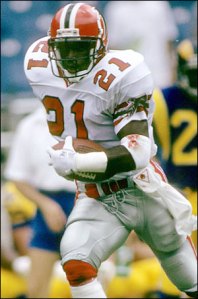
deion1What separated Michael Jordan from the second best player in his era? What separated Deion Sanders from the second best cornerback of his era? I used to marvel at the athletic exploits of the Atlanta Falcon’s cornerback in his day. People would say that Deion isn’t a tackler, and that he was a liability on the Atlanta Falcons defense. “Why should we consider a defensive player great, if he isn’t a great tackler?” They would add that he was a liability against the run. “Who cares?” I said. “Do you see what that guy can do when the ball is in the air?” The hundreds of little snapshots that most people either don’t see, or talk about often define an athlete’s career, just like anyone else’s career. These moments are the moments of crunch time, when the ball is in the air. A professional athlete practices for such moments, they think about them, they eat and drink them, until they reach a point where they’re no longer thinking about them when they occur, and they’re acting and reacting with autonomic responses.

Most normal humans haven’t engaged in any activity to the point of achieving autonomic responses. Most normal humans engage in athletic activities for casual enjoyment, and they involve their kids in sports for the purpose of the character definition it can provide. Most do not subject themselves, or their kids, to the kind of “cruel, and inhumane” amount of practice that could steal a young person’s youth. As a result, most of us cannot comprehend how a man could return a serve of 130 mph and place it in that tiny spot that is his opponent’s greatest after serve weakness on a consistent basis.

Those involved in the science of sports clocked the 130 mph serve at .41 seconds, or the time it takes you to blink twice in rapid fashion, or a speed that defies the natural facilities of human reaction. On the flip side, there are other, more deliberate moments in sports. The time it takes a quarterback to throw to a receiver that a Deion Sanders is covering, for example. Depending on the quarterback, and the length of the throw, this could take a couple seconds from the time the quarterback releases the ball to the moment it hits Deion Sanders’ area. What happens in those seconds? I call this moment the blank space. In the blank space, athletes on every level know what to do, but they may not be able to accomplish it on a consistent basis. They might panic. Even the greatest of athletes panic in this small window of time, and this might cause them some confusion as they try to come to grips with the fact that their minds and body didn’t act in unison during that crucial moment in time. They had such belief in their ability, they thought they worked as hard as anyone to prepare for that moment and they failed. After the years and decades they spent practicing, they didn’t execute in the manner they know they should have. It can be painfully confusing. After reading Wallace’s description, and the descriptions of Federer’s workouts, these players may not have worked out to the point that some characterize as exhaustive and cruel amounts of practice required to reach a kinesthetic sense, or an autonomic response, to the ball being in the air. What we’re talking about here is practice. As much as former NBA great Allen Iverson tried to tell us it isn’t about practice, it’s pretty much everything. 

Those interested in this subject might also be interested in:

The Conspiracy of the NBA Western Conference Finals, in 2002

The Psychology of the Super Sports Fan

What’s So Funny?


Why do we laugh? Why do we cry? “Confusion,” suggests author Kurt Vonnegut. “Laughter is similar to crying,” he said, “in that, in some cases, these are the only reactions we can find to react to that which otherwise confuses us.” How many times have we laughed at something shocking? How many times have we laughed when we didn’t know what else to do? How many times did we laugh, without taking the time to figure out the gist of the joke? How many times have we laughed and followed that up with a “Wait … What?” 

“What’s black and white, and red all over?” was a joke I found on a Bazooka Joe wrapper. “A newspaper!” I repeated that joke a number of times. I went into the punchline with what I believed to be the perfect pitch, and I hit that punch line perfectly, but I had a little secret: I didn’t get it. I asked those in my inner circle –those I knew would gracefully illuminate me how and why it was funny without attaching the public ridicule I probably deserved– to explain it to me. They couldn’t. They didn’t get it either. One person told me that they thought the ink newspapers use comes from a red-base. It didn’t think that was funny, but I was relieved that I finally had an answer. It was years later when someone finally told me that the joke involved the homophone spellings of red and read. Read, as in the in the past participle read, as in while a newspaper may have a white base, and black print, it is read all over, as opposed to the color red. If you got that joke right off the bat, congrats, but I assume that there has to be at least one joke that you retold that you didn’t get. The point is that we may actually laugh harder at jokes we don’t get than those we do, and that laughter may be an instinctual, fallback position to those things that confuse us.

How many of us asked a joke teller to explain a joke? We hate to do it, because we know it reveals us, and we hate to ruin another person’s joke by asking for an explanation, but some of the times, we need explanations. How many times has the explanation confused us to more and led to more laughter? Were we using this laughter to cover for the fact that we didn’t get it, or were we –as Vonnegut suggests– laughing more in conjunction with our confusion? Has this progression ever led us to find a joke genuinely hilarious without ever understanding it in the first place?

The relative nature of humor is obvious to anyone who has attempted to crack a joke, but the extremes are noteworthy. There are some universal truths to comedy, but for the most part comedy may be our most subjective art form. Individual experience leads us to finding relative humor in a subject, but it would be impossible for a comedic artist to try to relate to all of his audience members. Thus, it is incumbent on a qualified comedic artist to create funny.

Falling is funny. We all love a great fall, and no one is confused by its comedic value. Seeing Chevy Chase do what he did in the 70’s was a brand of humor he never had to explain. Stupid is funny. Abbot and Costello, John Ritter, and the Airplane/Naked Gun writers proved that by creating timeless humor with people falling and doing stupid things. Most comedians began their careers by falling, doing stupid things, and imitating famous people, but most of them realized, at some point, that they could only do those things for so long before they started to become a parody of themselves.

***

I was too young to see Richard Pryor’s gestation cycle in comedy. I didn’t know the middlebrow, Bill Cosby-like Richard Pryor. I only knew the racial and radical comedian that launched himself from the pack to the stratosphere of comedy, but that didn’t mean I understood his brand of humor. I didn’t understand George Carlin or Cheech and Chong either. Knowledge and experience have taught me that Carlin and Pryor are funny, but how did I arrive at that answer? I have to imagine that Pryor and Carlin struggled to reach audiences when they first attempted to stretch their comedy beyond the border. I have to imagine they experienced pratfalls on their road to the hip, cool, dangerous, and edgy titles that their work would eventually assume. There had to be an inclusive group that “got it” that everyone wanted in on. Those people then had to teach other people, until those other people taught my people, and my people taught me that I if I didn’t “get it” too I faced ostracizing.

Cheech and Chong followed Carlin and Pryor through the doors they opened. They introduced some of their own elements to the brand, but for the most part, they owed a deep debt of gratitude to Carlin and Pryor. I learned these comedians were funny by watching my friends and my friend’s parents watch them. I was young and impressionable. I wanted to be hip and cool, and I wanted to understand adult humor. I learned that this material was innovative, and a tour-de-force and I learned that if I wanted to be all that I was hoping to be in life, I would have to laugh to tears at the things Cheech and Chong did.

“Man, you have got to see Up in Smoke,” my friends would say, “That thing is hilarious.” I watched it, but I didn’t get it. I didn’t get it, because I knew nothing about the drug world. I didn’t want people to know that, so I pretended to get it, and I put a lot of effort into pretending, because I didn’t want to be that naïve, little kid who didn’t understand. Later, while watching it with friends, I made sure to laugh in all the right places. I still didn’t get it, but they didn’t have to know that. They didn’t have to know I wasn’t hip or cool. It was my little secret.

I learned that drugs and sex were funny. Cussing was even funny after a while, because cussing was naughty. I became an adult, I had my own individual adventures in life, and I eventually learned that cussing, sex and drugs were funny because they were naughty. Naughty is funny, but it is playground funny. It is base humor, and some are satisfied providing base humor, but an artistic comedian needs to make it situational.

Situational humor is the: “I can’t believe he did this while doing that?” brand of humor that we all have to learn in life if we want to be cool and hip. Sex is funny, especially if you do it wrong and you’re willing to be self-effacing about it in front of a group of people. Farting is funny no matter where it occurs. Most of our most embarrassing biological functions are funny, because we all do them, and we can all relate, but if you can mix in a dash of the “Doing that while doing this?” element to the story, you can achieve hilarity. “I farted in church.” Funny? Maybe. It might be funnier than farting in Walgreen’s. “I farted in church after the priest said, this is the body of Christ, and I farted so loud everyone in the vicinity heard it.” That’s hilarious my friend. Time and place, my friend. Time and place. Stories of drug abuse are just as funny, as long as the we’re not currently doing it. We’ve agreed that it’s sad if someone is currently chasing demons, but if they say they did it in the past “while doing that” the next thing they will have to do is hire a manager to handle their bookings.

The guy under the Darth Vader mask, David Prowse, once admitted that he did more cocaine during the filming of the Star Wars movies than there is snow on Hoth. That’s not great comedy, until you factor in that Darth Vader was a character kids adored, and that Prowse did cocaine while playing the character … that’s funny. Really? Why? Because he was doing that while doing this. That’s hilarious. Because Prowse pulled the ultimate naughty … doing drugs while doing that? If someone says a joke about a mean mama, and your mama was mean, the comedian can reach you on your level, but how many of us have snorted a line of coke, or injected heroin in our veins, and why do we laugh so hard about that? The current strain of “doing that while doing this” involves adult comedians cussing in front of children? We love it when someone shocks us by breaking taboos, but George Carlin basically warned us that breaking taboos should be done carefully and strategically. He basically said that societal standards should always be respected and taboos should be carefully and gradually broken down, for once they’re all obliterated comedians will have nothing left to mock.

“If I fall down a manhole, that’s not funny. If you do, that’s funny,” Mel Brooks once said.

Jay Leno once mused that he didn’t understand why social, highbrow comedians felt a need to shake their audiences’ foundations and breakdown barriers. He said that he didn’t understand comedians bringing high-falootin’ sensibilities to their comedy. He said being a comedian is a wonderful profession that has two basic components: telling jokes and getting paid for it. “Well,” Larry David responded, “You (Leno) can think that, because you were good at it.”

Bob Hope and Jack Benny told jokes and got paid in their day, but theirs were different jokes, safer jokes, that appealed to fathers and sons alike. Benny and Hope did not seek to break boundaries or expose the culture’s sensitive underbelly. There were no sensibilities brought to their brand of humor. One would think that they would probably have a lot of trouble breaking through the ranks today. Hope told some risky jokes about Raquel Welch and Loni Anderson, but they were never so bold that they would offend a parent. Benny’s self-effacing humor would land him gigs in Omaha and Des Moines, but if he wanted in the upper echelon, he probably would’ve have to do some border stretching today. The difference between a Bob Hope and a Sam Kinison, or an Andrew Dice Clay, shows that humor evolves and changes over time.

Richard Pryor started out wanting to be the next Bill Cosby, but he realized there were limits to that, so he carved a niche out for himself. His primary goal was to tell jokes and get paid, but there came a point in his career where he realized that ultimate success could not be achieved through those traditional avenues. George Carlin was also one who could’ve stayed safe doing hippy, trippy weathermen, but he realized there was other territory out there for him to mine. Jim Carrey was a master impersonator, but he saw an end game to it, so he reinvented himself and his comedy. Andy Kaufman could’ve never made the stage with traditional comedy sets, so he decided not to be funny, and he hoped that we would laugh instinctively at the confusion he created.

These comedians, and others, have broken down barriers in our society. They’ve shaken our sensibilities and made us laugh at ourselves, and they’ve shaped our politics, our views on religion and music, how we treat our children, what we think of our parents, how we define our sexual mores, and if we were going to have a puritanical or a more permissive society. One could say that the power comedians wield in our society dates back to court jesters and beyond. Yet, even those court jesters had a pecking order that divided the talented from the untalented. We can assume that some of those jesters were so talented that they could tell a joke and get paid. Others recognized that they weren’t as talented, and they needed to carve out a niche for the untalented that didn’t rely on imitating and falling, and they most likely had to teach the king a new brand of comedy that relied on the natural human instinct to laugh when confused.

Is That All There Is?


We expect things to be different. We don’t know if it’s going to get better or worse, but the human mind is built on expectation. We fail at times, and we succeed in others, but we never let these moments get us too high or too low, because we expect the opposite is hiding in a bright or dark corner. There’s always despair, there’s always hope, and there’s always something more to life. There’s always some extraneous force that counters and balances our current situation. We’re in a perpetual state of looking around the corner for the next event to fulfill our expectations. We look forward to the weekend, to vacations, to moving, to promotions, retirement, and the afterlife. Eager beings like us look forward to tomorrow because we know it will be different than today, for better or worse.

In this quest for a greater tomorrow, songwriters Jerry Leiber and Mike Stoller write that we are frequently disappointed. The song, written in November 1969, is called Is That All There Is? The song’s lyrics detail the nature of expectations and the revelatory disappointments of life that begin in childhood. The song uses the circus as an example. The moment that circus began, we thought we would experience one of the greatest moments in our life. When they do it right, there’s something magical about the circus. Those who do it right appear to engage chaos in their presentation, but when you sit there long enough, you begin to see the patterns and rhythms, until you began to see the orchestrated chaos. You figured it out, and that’s what brought a warm smile to your face. 

There is a smell endemic to the circus. It might take you a while to source the smell, but you soon realize it’s animal dung, both horse and elephant. Anytime you smell horse and elephant dung, you smile that warm smile, because it makes you feel five-year-old again, the first time you went to the circus. Couple that smell with the warmth of the room under that incredible large and tall tent, the taste of that stale, overly salted popcorn, and the pageantry of the pre-game show and we’re giddy again, as giddy as we were when we were five. No matter what age we are, we’re not quite six when the first clown makes its appearance. We pretend that we’re laughing with them, but we feel some sort of strange, internal glow we cannot push back down. We laugh wildly at everything the clown does, even though nothing a clown does is really adult funny. If they did the same thing without makeup, would we even smile? We laugh because for one brief spot in time, we are five-years-old again, and our laughter and that warmth are borne of expectation. When we saw the magnificence of elephants walking around, yards away from us, our little faces just beamed with awe, but they usually didn’t do anything to meet our expectations. They just walked around in circles and occasionally did painfully slow tricks that were supposed to impress us, but we were kids. We didn’t know how much it took to make an elephant stand on one foot on something. We know now, but we remember when we thought different. We saw a beautiful lady in pink and green tights flying high above our heads, and we cringed with the expectation that she might fall, and then she didn’t, and then it was over, and we walked out of from under the tent disappointed that our incredibly high expectations weren’t met. We couldn’t help but think that we missed something. Is that what everyone was talking about? “Is that all there is to a circus?”

Is that all there is?
If that’s all there is, my friends, then let’s keep dancing
Let’s break out the booze and have a ball
If that’s all there is

PJ Harvey

Sung by Peggy Lee (later PJ Harvey) Is That All there Is? moves to more depressing matters as the song progresses. It talks about how the most horrific moments in life, even fire, can end up a little disappointing when one is all hyped up with horror. When the afterlife is discussed, the lyrics detail how we don’t want to die, because we fear that final disappointment. The theme of the song, as evidenced by the above refrain, is that if that’s all there is to life, let’s live life to the fullest. Let’s break out the booze and let’s keep dancing if all these overhyped joys and horrors turn out to pale in comparison to what are supposed to be life’s greatest joys and horrors.

When we talk about the power of America in the world today, we talk about how she has the ability to shape the world in its status as the world’s lone superpower. When we talk about the technological advances she has made in her 200+ years of existence, we talk about it being the lone beacon in the world for individual achievement. Even after acknowledging this ingenuity and creativity, we are still vulnerable to insecurities that lead us to notion that there is something bigger, brighter and more powerful out there just waiting to expose us as frauds. We don’t know what that is, but we know that we can’t be all there is in the world.

Peggy Lee

We fear China. While few would say we have nothing to fear from China, our overhyped fear of them is borne of expectation. They are a very secretive country. If they were superior to all countries on earth, wouldn’t it be counterintuitive for them to keep that a secret? If that’s not the case, what’s the alternative? Do they enjoy our overhyped fear? Do they enjoy remaining the unknown? They number into the billions, they speak a funny language, and they’re a very industrious people. In our greatest fears, we portray their people, their citizens as almost machine-like. Their government has less regard for their lives and their suffering than we do. They pay their workers peanuts, and they rip off our creativity and ingenuity, but does this equate to superiority? If we were to construct a line-by-line comparison, we might find that they are not superior. They have their areas, of course, and we have ours? How about in the future? Ah, there’s the rub Skippy! The future is the unknown quality. The Chinese may be more organized, they may be better at math and engineering, and they may be so disciplined that they can they march in lockstep? But, are they superior? We don’t know, and our insecurities are driving us nuts.

We fear aliens from outer space for the same reasons. Aliens are superior to us. According to all speculation on this topic, they have technological advances we haven’t even dreamed of yet. Some claim that their culture may be thousands of years older than ours, so they must be thousands of years more advanced than we are. Some even claim that we base our comparatively little technological advancements on that which we’ve learned from alien visitations. There is one small problem with all of these assumptions: aliens may not exist. They may not exist, but if they do they’re superior to us. At least with the Chinese, we have tangible evidence for our fears, but the fear of aliens from outer space is a manifestation of our insecure belief that we’re limited by human constraints, and we can’t compete with them, and their superior intellect and machine-like abilities. The fact that we engage in these hypothetical fears is all is built on the expectation that this can’t be all there is.

Is that all there is?
If that’s all there is, my friends, then let’s keep dancing
Let’s break out the booze and have a ball
If that’s all there is

What would we do if we learned of an alien visitation from an individual who claimed the aliens who visited him were not as superior as we were led to believe? What if he said, “They might have been exceptions in the species, but I think I just got visited by a couple of alien hicks. When they stepped out of their incredibly advanced flying saucer, I think they were drunk. If they weren’t drunk, they appeared as drunks do in Buggs Bunny cartoons. They were drinking something, and they appeared to be belching. Then, there was the way they talked. We couldn’t understand what they were saying, but their rhythms made me and Todd think they were swearing. Then, when they violated us, I think they were laughing while they did it!” Would we believe this person, or would their story violate our theories on alien superiority so much that this would be the lone alien visitation story that we didn’t believe? How convincing would this the poor person have to be to override our need to believe that there is something spectacular out there that we have yet to experience?

Alien visitation stories also feed into fears of our ultimate destruction. The subject of the visitation usually relays information from the overlord, alien visitors that suggest that our reliance on war and technology will have an ultimate price if we don’t stop now. Most aliens also appear to be anti-corporate peaceniks. Due to the fact that aliens are superior, we know that they’ve seen the horrors technology can have on a society, so we could do a lot to stave off our Armageddon if we’d just put our iPods away and go back to a more primitive nature. The advice the aliens give us tend to follow the subject of the visitation’s political philosophy, and it’s usually advice that is as simplistic as the subject appears to be. “When ordering from a fast food menu, lay off the Biggee portions they’re not good for you,” the wizened alien says in his alien tongue that has been translated to English by the subject. “Stop driving SUVs, and lay off the cigarettes. Doobies are fine, but the nicotine and tobacco cigarettes are killing you Tony.”

The rational must accept the fact that we cannot be the only lifeforms in the entire universe, but does that mean they’re superior? If some are superior, isn’t it just as likely that some of them are inferior? If we met an alien dignitary, we assume that they would only send their best and brightest, their version of Earth’s astronauts, but what if a couple of drunk, alien hicks stole and hijacked their aircraft and decided to give Earth a visit? That would bring us back to square one if we didn’t witness their technology and believe that theirs is thousands of years more advanced than ours. Most people who indulge in alien folklore don’t even question alien superiority or inferiority. For these people, the evidence is in, and their fundamental belief system is based on ALF superiority. This is based on their frustrations with life on Earth. This is based on the fact that they don’t make a whole of money in a job that they hate, their family hates them, and they don’t have a lot of friends. They need something to believe in, and believing in a God just isn’t cutting it for them anymore. They need something bigger, better and brighter than the stuff their stupid parents taught them, and they expect to be right.

Some fear UFO people, some fear the Chinese, and some fear God. Some believe in some form of astrological control of destiny, and others believe that with the correct federal government legislation on the books we can all avoid total failure. Most of us have some belief in a controlling authority that directs our fate, our daily lives, and our failures and successes, and some psychologists suggest that is actually be quite healthy. They say that because believing in things gives us some distance from our failures, and it gives those of us who have had our expectations damaged some hope that things will get better, or if they don’t, then we have someone, or something, to blame for it. We might read, and reread, that definition of healthy with a skeptical, furrowed brow, but what’s the alternative? The alternative could lead to a psychological blackhole in which the patient implodes in on themselves with the knowledge that most of their fears and beliefs were overhyped and they break out the booze and dance to try to forget that this is all there is.