DDTY: Don’t Do This Yourself


2020 was a huge year in the DIY (Do-it-Yourself) industry. We spent so much time inside, isolated, that we spent record amounts on DIY tools and accessories to accommodate what we thought might be our new reality. We spent so much time inside, isolated, that people who rarely used a tool were now purchasing power tools. Faucets, kitchen cabinets, and toilets were flying off the shelves. Home Depot saw a 20% increase in net sales, and Lowe’s saw a 24.2% increase. We spent record amounts on DIY tools and accessories to accommodate what we thought might be our new reality.

I thought it might be a revolution in individual empowerment, but the number one answer given to pollsters on this subject was “[I] finally having the time for it.” Translation, I always knew how to do this stuff, I just never had time for it before. The numbers reflect that, as DIY industry numbers have plummeted since 2020 back to normal, but those of us who didn’t know what we were doing before COVID, but learned it within, took our first bite of that apple and found the flavor empowering. We found fixing things ourselves less intimidating after seeing an oaf with a mustache on YouTube explain that insulating our attic and changing our garbage disposal can be accomplished in ten easy steps. 

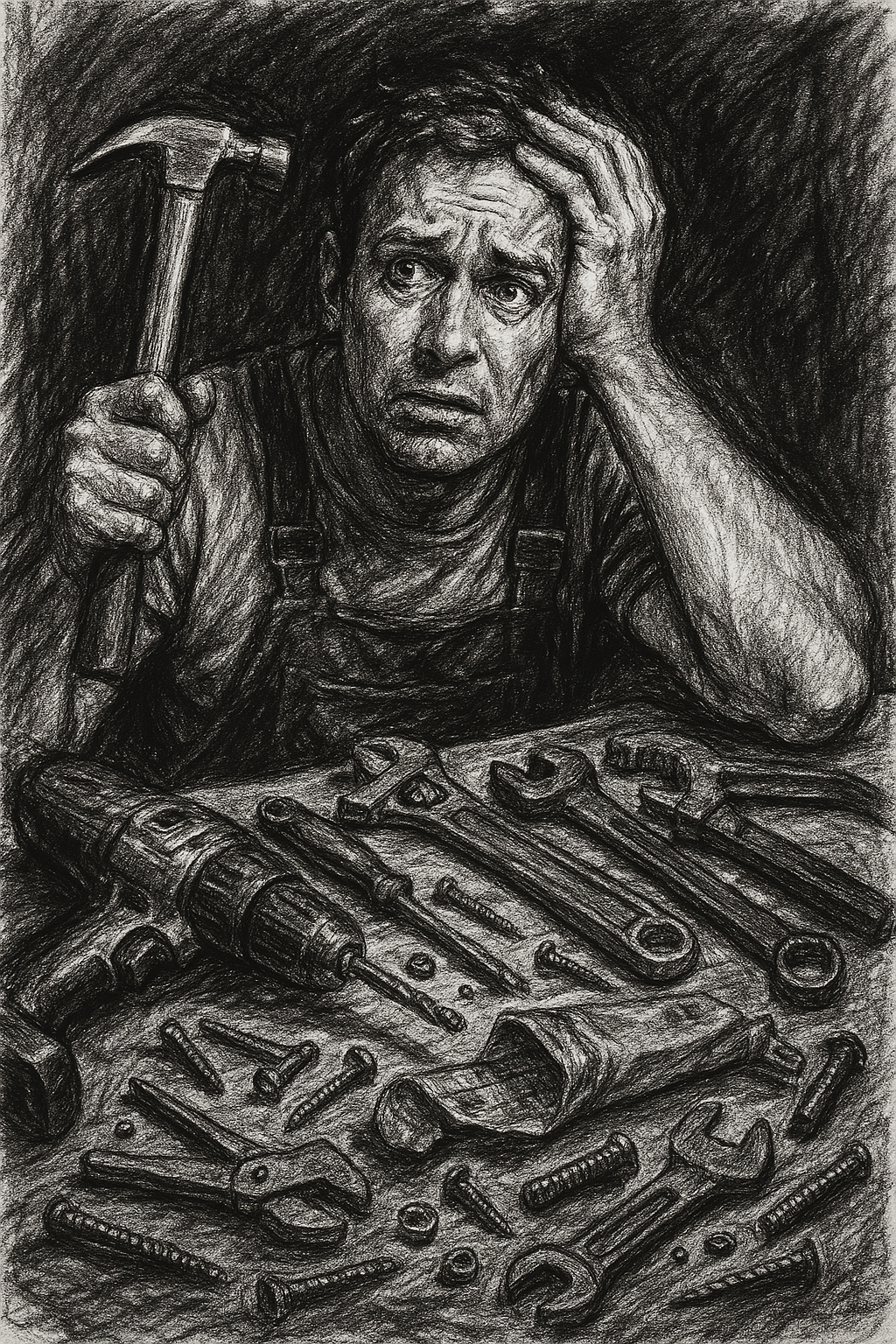
Bob Peters didn’t know anything about plumbing, HVACs, appliances, or anything else in his home that required fixing. Anytime he had a problem, he just called an expert. Mr. Peters would’ve loved to fix his belongings in the beginning, but he never learned how to do it. His dad was probably less informed and less experienced in fixing things that he was, and Bob spent the first twenty years of his adulthood living in apartments. After purchasing his own home, Bob knew he was physically capable of fixing his fixables, but two minutes after opening these things up, he felt overwhelmed by the idea that an idiot like him could do it.

“One huge part of intelligence,” Bob often joked to friends and family who encouraged him to fix these things himself, “is knowing your limitations.”

Bob Peters wasn’t an idiot. He worked hard, and his hard-earned expertise, in his arena, was valued and well-compensated. He didn’t have the time or the wherewithal to Do-It-Yourself (DIY). During COVID, the individuals weren’t as overwhelmed as the certified, licensed experts. The wait times were insane.

“I understand your frustration, but if you knew what we were up against, you would understand.” The resultant desperation led Bob to discover the oafs with mustaches on YouTube. These oafs were licensed plumbers, certified HVAC guys, and former and current employees at the companies that manufactured the appliances Bob owned. They were experts in their field hoping to make some side money in the YouTube universe. They taught Bob that he no longer needed Mike the plumber, Leo the HVAC guy, and Craig the fix-it-guy to fix everything in his home. He could do some of this himself. The idea that an unlicensed, uncertified individual could fix the small things in his home “by following these steps” was a revelation to Bob Peters, and the only question left for him was how far do I take this? 

We’re not licensed plumbers, yet we can fix some of the majors, and most of the minors, in a little under an hour with the assistance of the ideal YouTuber. Bob even found that messing with electricity isn’t as scary as he thought it was. He maintained a healthy respect for electricity, but that healthy respect was a healthy fear prior to an oaf with a mustache informing him that as long as he followed “these necessary steps,” the electrical world wasn’t as foreign and scary as he thought it was.

The problem for Bob was that as healthy as his home, and now his car, were now through DIY maintenance, he could never maintain his own health. “How far do I take this?” he asked himself when he experienced yet another setback, a level of pain that suggested he was going to have to endure yet another emergency room visit. 

Bob’s life devolved to seemingly endless trips to doctor’s offices, rushes to emergency rooms, and some hospital stays. The routine was so demoralizing, painful, and tedious that in the midst of Nurse Nancy attending to him yet again, he said, “I just have this feeling that this is my life now.”

Those employed in health-related institutions gain knowledge, wisdom, and a level of expertise from books, professors, and personal experience, but they are methodical sorts who can leave a fella waiting, in pain, for thirty-to-forty minutes. I know what you’re thinking, a thirty-to-forty wait isn’t such a bad thing in the grand scheme of things, but when you’re in excruciating pain, each click of the minute hand feels endless. These doctors and nurses further complicated Bob’s life with all of their monitoring. They suggest that they need to keep us, sometimes overnight, to monitor the effects of our medicinal and procedural treatments. Bob Peters just got sick of the whole shebang, and when he experienced yet another flair up, he wondered “How far can I take this DIY stuff?”

He’d been through the process of having a catheter inserted into his nether region so many times that he joked, “I could probably do this myself at this point” to Nurse Nancy the last time she helped him through the painful procedure. He repeated that joke, in his head, as he waited in the hospital room that last visit, as they monitored his levels. He then repeated that joke to his friends and family when they asked how his last visit went, and he ended up repeating that joke so often that when he experienced another flair up, he began seriously contemplating it. Even though his friends said, “You’re not seriously considering this are you?” He said no, and he meant it, but now that he was in need yet again, and he thought about going through all the typical procedures again, he began seriously considering it. 

The beauty of YouTube is that they list for us the bullet points of most DIY projects. Most viewers at home were so uninformed we didn’t even know there were bullet points and finding them proved an empowering revelation. The one caveat that experts list for anyone considering YouTube-style DIY fixes is that oafs with mustaches often don’t cover variables well. 

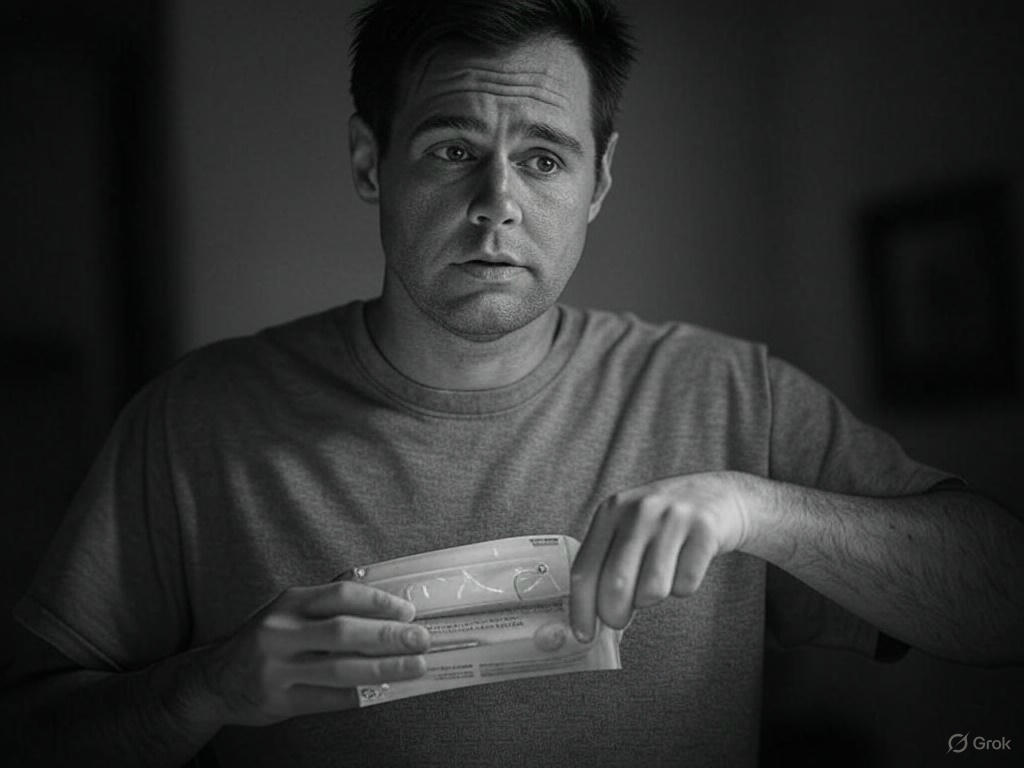
Bob came to our attention after experiencing just such a variable. He consulted a YouTube video that instructed him how he could insert a catheter from the comfort of his own home. The oaf with a mustache covered the basics, the principles behind it, and a number of caveats and variables, but he neglected to cover whatever led to Bob experiencing what he called “a warm rush of liquid” that occurred shortly after he inserted the catheter. 

“I didn’t hear a pop,” Bob told Nurse Nancy, “But that warm rush of liquid concerned me, and I’ve been urinating blood since. And, it ain’t stopping.” Although he managed to drive himself to the emergency room, Bob characterized his pain as a ten on the pain scale. “I always characterize the pain I feel as a ten, don’t we all, but the pain I’m experiencing right now gives me new perspective. I’m going to go ahead and edit all those previous pains as sevens now.”

Fearing the worst, Bob suggested that Nurse Nancy have the doctor, “Check to see if I punctured one of my testicles.” Those in charge of making preliminary guesses, guessed that Bob didn’t do anything as drastic as that, and he probably scratched something or popped a boil of some sort, but they knew that without further analysis, the possibilities were endless.

Unfortunately, we don’t have the details of this furthered analysis, but suffice it to say that Bob found an answer to the question, “How far do we take this?” As a relatively new advocate for Doing-It-Yourself, Bob probably sounded like an evangelist on feelings of empowerment inherent in being able to fix your own fixables. Even after his episode, he would stand behind the DIY sword and shield, but he would encourage those of us who ask ourselves “How far do we take this?” to ask one crucial question: “What’s the penalty for error?”  

Bob would probably add that even in the age of oafs with mustaches on YouTube, AI, and the resultant sense of individual empowerment inherent in fixing it yourself that there is still, at this point in human history, as of yet devoid of superhumans melding with AI, a need to avoid traveling in areas we don’t belong. As much as the not-easily-intimidated crowd hate to admit it, there is still a need for knowledge and expertise in certain arenas. There is still a need for professional analysis, waiting on those with firsthand knowledge, experience, aptitude, and all of that monitoring for the effects of all of the above. What’s the penalty for incorrectly installing a garbage disposal? What are the penalties for making errors in trying to fix an HVAC, their electricity, or their plumbing? “Go ahead and pay attention to all those ‘Don’t try this at home’ disclaimers that oafs with mustaches list on their YouTube videos before they start in,” Bob might add, “because some drains are more intricate, delicate, and indispensable than others.”

The Chilly Bin


“Chilly bin,” an actress in a New Zealand show called Wellington Paranormal said. What’s a chilly bin? It was obvious, in the scene, that a cooler, a portable ice chest, or whatever you call it in your region was the product of her concern. Colloquialisms, like this one, fascinate me. I’ve even been informed that I use some colloquialisms, we all do, without knowing it. We use terminology, phrases, and various descriptors that our ancestors, family, and friends do, and we absorb all this from those in their country, region, and locale. My cousin uses some different terms and phrases, and everyone around him does too. They also have a subtle, almost imperceptible drawl, and they overemphasize their ‘R’s’ in a manner that catches the ear. They live an hour and a half from me.     The modern version of the portable ice chest made its first relatively wide-scale appearance around 1951, which means the terms cooler and chilly bin weren’t derived from old world languages. Chilly bin also isn’t a result of a creole, a pidgin, or any other linguistic quirk with a characteristic mixing of parent languages typically born in a culture of multilingual settings. The term chilly bin was born and bred in New Zealand. So, when and why did New Zealanders (AKA Kiwis) begin calling the portable ice chest the chilly bin? A short but decent search of the term chilly bin suggests there is no person or event responsible for the term, and there is no point of origin or any identifiable historical trails for the term. “It’s just Kiwis being Kiwis,” some sources say. One explanation for this lack of explanation is that sometimes Kiwis simply enjoy “adding a touch of Kiwi personality to the English language, making it distinct and memorable.” 
Australians (Aussies) call the portable ice chest an ‘esky’, but that makes more sense because they derive that term from a famous brand of coolers sold in Australia. Americans call tissues Kleenex, gelatin is Jell-O, toaster pastries are Pop-Tarts and Aussies call the portable ice chest an esky. The term chilly bin makes no sense, in that vein, because there hasn’t been a chilly bin brand sold there until a recent effort to start one. 
How do linguistic quirks, specific to a locale, start? How do they survive the “Isn’t it called a cooler?” corrections? “Yes, but that’s not what we call it here,” I imagine fathers telling their children. “But we’re the only ones who call it that,” I imagine the kids replying. The population of New Zealand stands at just over five million, so I can only guess that people who are proud of their heritage and traditions, big and small, have a tough time sustaining them against the language found in movies, TV, and the internet. Though I know nothing about New Zealand, and I’ve never met a Kiwi, I have to imagine that younger people, though proud of their heritage and traditions, refuse to use the term chilly bin, because it sounds so local, yokel.  

It’s All Relative to Relatives

I have a cousin who moved from the Midwest to the Southern part of the United States. Our family is from a region of the Midwest that has no discernible accent, and this cousin spent his entire childhood, the formative years, in our locale, until his family moved south in his early teens. When we visited him, decades later, we found that he switched languages. I didn’t understand that as a young kid, so I asked him about it. He said something about how he didn’t intend to switch, but he picked it up as a result of linguistic osmosis.  “It sounds like everyone down here made the switch,” my brother said. “They all speak with an accent.”  Our cousin overheard this and joked, “Son, down here, you’re the one with the accent.”
“Really?” I said. “Because, if you watch TV and movies, everyone talks like us?” My innocent comment basically asked him why he didn’t see the error of his ways and switch back to our accent-free dialect. My naïve, uninformed point was that he should’ve recognized, at some point, that he wasn’t speaking in “the normal manner” the rest of us in our shared English-speaking country did.
Manufacturers make a concerted effort to localize their products for consumers, and online stores often do the same. If New Zealand comprises roughly five million, manufacturers likely do not spend too much time and effort regionalizing their products to accommodate their terminology. Kiwis surely recognize the more worldly terms “cooler,” “portable cooler,” or “ice chest,” but the maintain their terminology among one another. I could see the term chilly bin existing in an inclusive world that involved New Zealanders speaking among one another, but I would think that involving themselves in the world wide web would lead them to recognize that they’re holding onto the term in some kind of quant Kiwi manner that should eventually weed itself out among those who don’t want to ascribe to their quaint Kiwi traditions.     Americans have slang terms, the French do, and the Brits do. We all have slang terms that we use growing up, and isn’t it fascinating how they transcend generations? What Americans call a popsicle, the Brits call an ice lolly. Americans refer to the “rising chair” as an elevator, and the Brits call it a lift. Due to the fact that the Brits used to own America, the inclination might be that Britian should own these linguistic levers, but America tends to dominate the world in media, technology, and international business. When we talk about media, we’re including TV shows and movies, and since American entertainment is more popular worldwide, their lexicon tends to dominate. Most countries formerly owned by the Brits (Australia and New Zealand in particular) adopted their slang and lexicon, but the Americas branched off and refused to use British slang in an apparent effort to further their revolutionary quest for total freedom, but did the British then refuse to adopt the American lexicon, because they refuse to speak the language of their refuse? Or are dialects and colloquialisms a natural course of insular language/lexicons among people?  Order fish and chips in Britian, and you’ll receive a plate of fish and fries. Some suggest that most Brits do not call French Fries chips when they order it as a standalone, as various American fast-food chains have forced the term French Fries into the British vocabulary, but the term fish and chips continued in Britain when it’s ordered as a meal. Brits call chips, or potato chips in America, crisps. Some sites suggest that the Brits see the fried bits of potato Americans know as French Fries as those that were chipped off a potato, i.e. each fry was chipped off a potato. The actual origin of the French Fry may have started in 1629, in the country of Chile, or later in Spain, but the Belgians and French have had a long dispute that the French Fry developed in their country. Regardless, we can only guess that the Brits developed the term chips, because they are averse to referring to anything with a French designation. The term fish and chips hold true for Aussies, the Irish, and Kiwis.

The Loo 

In my locale, we’ve loaded the American lexicon with contractions. ‘Fyouwanto’ is a common phrase in certain regions of America that contracts the words if you want to. Brits say, ‘Innit’ for isn’t it, as in, “Cold day today, innit?” My very young son once noted that Americans say, “I’m headed to the restroom” if they’re in a restaurant and “I’m going to the bathroom” if they’re at home. Brits say, “I’m headed to the loo” regardless where they’re at. I’ll admit here that I always thought they were saying, the Louvre. Now, I know the Louvre, the art museum in Paris, is pronounced “The Loov-rah,” but when I hear the Brits and Americans refer to that museum, they say, “The Loov.” Seeing as how Brits often leave off the last syllable of many of the words they say, I thought “the loo” was a tongue-in-cheek shot to the French that they developed to conflate the waste removal room with one of France’s most treasured tourist destinations. 
As with most commonly and casually used terms, “the loo” has uncertain origins. As such, we can only derive possibilities and theories. One theory has it that the loo was derived from the French term for water: l’eau. “This theory suggests that the word “loo” was originally used to refer to a water closet or a room with water facilities, which eventually came to be associated with toilets. Another theory is that the term “loo” originated from the cry of “gardyloo” used by medieval French-speaking servants in Scotland before throwing their waste matter out of the window. Over time, the theory states, the cry of “gardyloo” may have been shortened to “loo” and used to refer to the location where waste matter was disposed.” Gardyloo basically means “guard yourself for the water/waste,” or “watch out for the waste matter that I’m about to throw out the window here.” At some point, so goes the theory, the Brits just shortened it to “the loo”. 

Linguistic Laughter

When my Southern cousin eventually returned to the Midwest, he said, “I was almost afraid to talk, because every time I opened my mouth, someone started giggling.” Our laughter is an unfortunate, involuntary, and almost reflexive reaction to anyone who uses different terms, speaks with regional dialects, or has a specific drawl or accent. We laugh based on the ‘I didn’t know whether to laugh or cry’ confusion. On my trip to the South, I managed to get the shock and awe giggling out of my system, but there was something about his drawl, his colloquialisms, and his slang, idioms, and patois that still had us all looking at each other, pumping our eyebrows, and giggling, because it was one of those “I’m sorry, I know it’s rude, but I can’t stop laughing” moments.  If you’ve ever been on the other end of the laughter, you know we all have regional dialects, accents, and ways of saying things that are regional and local. The worst thing I ever heard was “You’re not from here are you?” a cashier asked me. “You know how I can tell? You don’t have an accent.” My initial thought was that I didn’t have her accent. I’ve since learned that in my region of the country, we don’t have any accent. We might be the section of the country with the least amount of accent, and little in the way of regional dialect. I don’t write that to gloat, as I think accents, dialects, and drawls are colorful, and my region of the country might lack those more than any other. Yet, we do have various colloquialisms and slang terms. It’s all relative, but when we’re young, and we have no idea that there is another way to say what we’ve said our whole life, we don’t understand it when someone says something different or they say it a different way, and it strikes us as funny. Homer Simpson summed this up with his typical brilliance saying, “He’s talking funny-talk,” after hearing Herschel Krusofsky (AKA Krusty the Clown) pray in Hebrew.

You Do What you Do


“You’re basically crushing on a teenager,” Susie said to conclude her accusation that we were flirting with our teenage server. It wasn’t true, but it was funny, and all insults are not created equal. Some hit the soft spots we spend most of our time trying to hide from spectators, and some are just plain funny. Funny gets the competitive hackles up high, and if we don’t hit back, she owns the funny.

“You’re a couple of dirty old men,” she added. We spoke to this server the way we spoke to every woman who served us food and drink. This young server engaged in our playful banter, and she laughed while doing it. We laughed, everyone laughed, and we all had a good time doing it. This was our routine. If we had a server who was a homely, senior citizen with a hairy wart on the end of her nose, we would’ve engaged her in playful banter to try to make her laugh, so we can laugh, and everyone could have a great time. Unless the server happened to be male, we were consistently playful with everyone who served us food and drink. This particular waitress just happened to be a beautiful, young blonde who wore a crop top that exposed her washboard stomach, and she had a great set of teeth. 

We could’ve laid out our “completely consistent with our character” defense, but that likely would’ve devolved into a tired “Nuh uh!”/“Yes huh!” debate. We could’ve called Susie’s age into question and asked her if she was jealous that she was no longer a young, hot body that old men might want to entertain intermittently for a couple hours. Attempting to reset the parameters in this manner can fall under a petty and mean umbrella, however, and Susie’s challenge was not a confrontational, mean-spirited challenge of our character, but an entertaining way for her to belittle the men around her. If you step out of that parameter and become unnecessarily defensive, not only will you face the humiliating “I was just joshing,” but you also reveal something weird and uncomfortable about yourself. No, when someone like Susie hits you with something funny like this, you join in. 

Even if such a comment makes us angry, and especially if it makes us angry, we join in, and attempt to outdo them there, in their spot and the frame they’ve created in the moment. If you let it go, you lose; if you try to “Well, what about you?” them, you lose; and it you get too defensive, you lose. The best course of action is to play with them on the playing field they’ve created and try to beat them there. 

“We’re old, she’s young, I get it,” I said to Susie. “I agree with everything you’re saying about us and our relationship here, but she has belly exposed.” 

“What does that have to do with anything?” Susie asked.

“The exposed belly changes everything,” I said. “All conditions being equal, you take out the exposed belly, and she’s just another woman who is far too young for us to even engage in polite conversation. The exposed belly changes the chemistry and circuitry, or for you mystical types, the interiority, of the adult male mind. It’s science.”

“She’s probably eighteen-years-old,” Susie said to further her admonishments. “She’s young enough to be your granddaughter.”  

“Fair enough,” I said. “But that crop top she’s wearing exposes the fact that she has a washboard stomach.”

“And that she’s eighteen.”

“If you study your science, you’d know what the exposed washboard belly of a teenager does to the chemistry and circuitry of the male brain. If I reach the point where you begin to question my level of brain activity, perform all of the traditional, medical tests, but if everything else fails, walk a female washboard stomach in front of me. If I don’t respond in anyway, pull the plug.”  

***

“I’ll let you try a little bit of this drink, but if you don’t like it, you cannot make a face,” I say when I let someone try something I love. I didn’t invent the drink I want them to try, write the song, the book, or make the video I want them to watch, but for some reason, it’s so important to me that they like it too. I don’t own shares of the company or have any personal stake in the success of the product, but it’s my opinion that they made something delicious, interesting, and I want to share that temporary, nebulous bond with you. When they make that face it suggests that the drink is absolutely disgusting, it hurts in some strange way that is impossible to describe to anyone who doesn’t share my brain with me.

“I don’t care,” we say, “I still like it.” That’s a front, a BS front that we create to hide our pain. There is some element of truth in it, however, for we will continue to drink it, listen to it, or read it, and we will continue to enjoy it in all the ways we did before they made that face, but it still hurts that they don’t like it the way we do.

“How can you drink that sludge?” some say, further down the line, to compound their insult. They flip the page on us by somehow making us defend our appreciation of the product we once wanted to share with them. It’s almost as if they know we have some vulnerability on this subject, and somewhere deep in the recesses this feels like a violation of some bond that we once wanted to share with them. 

***

“Who do you think is going to win the big game?” 

“I don’t know.”

“Of course you don’t know. I don’t know, no one does, it hasn’t even started yet, but we all sort of play this game with one another to guess who is going to win. If you’re wrong, no one cares. No one cares if you’re right either, as a matter of fact. It’s just a little game we adults play with one another, and no one remembers who said what five seconds after the game ends.”  

***

The material in this article is not meaningful, important or germane. Was it brilliant, hilarious, or groundbreaking? No, it is what I do. Some have natural gifts for storytelling, others have talent, but the rest of us have to work through it, for it, and to it. At some point in between, we reach a point where we can only do what we do. We all have talents, limitations, and everything in between. “Explore,” I say. “Eat it, drink it, learn it, live it, love it.”  

Once we dig past that crusty superficial layer, it’s easier to dig, but if we dig too far, we hit that which is pleasing to the eye and ear. It’s a purposeless depth with an artificial feel to it, and it feels fine to write it, but when we read it, we know it ruins the article. When we learn to avoid such depths, the reader might say, “This is great and all, but what do you want me to do with it?” There’s a beginning, an arc, and a conclusion, but to the reader it’s not everything it could be. To which we the author responds with the tired but true, “It is what it is.”

What is our definition of success? How do we know when we’ve achieved completion? Next question, what do we do when we don’t? We develop excuses for failing to achieve the maximum, but another point follows that point where we realize that we probably weren’t D) all of the above. We may have been A) and C), but we were lazy, scared, intimidated, or not ambitious enough to put a foot on the next rung up on the ladder. It might be one of those things, all of them or none, but I wonder how many suffer from the ‘I just never thought of myself as one of those guys’ mindset. We’ve all heard about the definition of success, and we love the general discussions of one guy succeeding over another, but how many of us know that we’re going to succeed within a structured format, regardless the obstacles they place before us? This concept struck me when Jackie and Jody informed me that they were both anchors for competing local news networks.

“How do you even think you’re capable of such a thing?” I asked them. I knew Jackie on an intimate, friendship level, and I spoke with Jody on an almost-daily basis. They were my people, and I couldn’t believe that any one of my people could go beyond dreaming of such things. 

“It’s a low-rent, very local network,” Jackie said. “You’ve seen it. The production value of my broadcast is zilch. It’s about two notches above what some guy filming himself in his mom’s basement. It’s nothing to write home to mom about.” It was to me. It was a stratosphere I never even considered before, and I didn’t think I’d ever even meet someone who thought like they did. I don’t know if Jackie and Jody had a better support system growing up, or if some people just believe in themselves more than others. I don’t know, but I’ve met a number of people I life who succeeded beyond my wildest dreams, and they never thought as much of it as I did. They dreamed higher. We could grow frustrated by it, develop excuses for our inability to succeed, or just keep doing what we do.