We’re Doomed! Long Live the Gloom!


“The planet’s not in trouble,” a comedian said onstage. “It has survived countless threats, tragedies, and catastrophes. The planet will be just fine. Human beings, however, we’re screwed.”

The End of The Road

We’re doomed, and we love it! If ratings, proceeds, and ratings mean anything, doom and gloom is big business. 

We want it in the all-too-near future, “Ten years from now…” Ten years is one of our favorite time frames. Twenty years is too far away and five years is too close. We want urgency, we need it now, but not too close. We might deem it hysterical if it’s too close, and we might not worry about it if it’s too far away, so we’ve deemed ten years the Goldilocks, sweet spot for dystopian rants. I think I can top them. I think future street corner bell ringers might want to narrow their hysterical rants for greater appeal among consumers. If you know anything about grocery store pricing, you know that consumers find round numbers too stark, too pricey, and generally unappealing. Their psychologist advisors have informed them that consumers find $9.99 more appealing than $10.00. It’s a penny right, what’s the difference? These psychologists say it’s everything to consumers, so we now see their items listed accordingly on all shelves, car salesmen do it, and everyone who wants to appeal to this mindset we all have. The chicken littles of our future might want to recalibrate accordingly and say, “Nine years and nine-nine days from now…” 

Ten years also seems like enough time for human ingenuity to develop a solution. If we’re facing a true cataclysm that will end the human population, we have to think it would become the sole focus of more than a few of our brightest stars in science, engineering, and just about every other focus we have to attempt to counter the sure-to-come devastation of life on the planet? 

How many times has human life faced extinction only to have some genius come along and devise an ingenious way of saving life? This time it’s different, of course. This time, no one can save us. We’re helpless. How exciting!

We’ve all been here before, in theoretical forecasts, but this is the future. We’re here to report that the ten years in the future that we’ve forecast for the last seventy years is now here. It is ten years in the future, and a moment, not the moment, but a moment we’ve feared for at least seventy years is here, and we don’t know what to do about it.

The reporters investigated and attempted to locate and expose a human culprit. They hopscotch between various narratives to find a bad guy before it’s too late. They join forces with the scientific community to narrow the focus of their study on human involvement. Regardless whether they’re wrong or right, they have the best intentions.

So Scary, It’s Beautiful!

There are no high-profile news agents ten years in the future. They’ve been exposed in one way or another, and relatively few read, watch, or listen to them anymore. In their wake, citizen journalists rose up on the internet and developed reputations for telling the truth in the years preceding the looming tragedy. Some of the more prominent citizen journalists provided a contrarian belief that certain scientists developed by studying the looming tragedy through various angles that focus on the math and science of the universe. These contrarian scientists eventually proved incorrect, and those with no knowledge of science rained fire upon them. 

“It’s you job to figure this out!” a reporter screamed at a contrarian scientist, as he walked to his car. This confrontation went viral and social media launched “It’s your job!” meme at scientists, and the citizen journalists who supported them.

The contrarian, non-human theories were rejected so often, and so publicly, that most become afraid to voice their concerns with their neighbors, lest they be called a denier. “There’s nothing we can do!” becomes the credo of the day. “The scientific consensus suggests there’s nothing we can do.” 

Teams of scientists hear this, of course, and they’re scared, but some of them brave the cynical firestorm to push this theory that the new, unforeseen, looming, and disastrous event involves a detailed and complicated natural occurrence that has nothing to do human beings. 

“It is,” they write, “an event that occurs throughout the universe on a relatively infrequent basis, and it is going to occur near Earth, unless we are able to do something about it.” 

Numerous scientists attempt to disprove their theory, as is their role, and most of them suggest that their findings are inconclusive. Some of those scientists who unsuccessfully attempt to disprove the theory, decide to pursue the theory in purely hypothetical mathematical and scientific forms. “If true,” they write, “then we could use an end around to avert the looming disaster.” Other scientists join in and posit theories around this new end around theory. 

“It’s time to say it, Science has failed us!” a major online news publication, that no one reads anymore, states in the title of an article they publish in a desperate attempt to remain popular. The article proves popular, of course, as a crude attempt to develop “if it bleeds, it leads” style click-bait articles that feed into the gloom and or doom themes. “As time continues to tick down,” the article states, “our most brilliant minds continue to fail to find a solution.” 

Scientists develop other theories, and other scientists disprove them. The lack of understanding of science, leads to mayhem all over the world as citizens the world over begin to panic over the delays. In the midst of that panic, as time ticks precariously closer, a scientific hypothesis emerges.

High profile scientists immediately reject the hypothesis, with no evidence, and popular sentiment follows suit. Prominent leaders of the world join the popular sentiment. With the lack of any government endorsements, and more importantly government funding, these teams of scientists desperately seek private donors to help them pursue the hypothesis that no scientist has been able to concretely disprove. The theory does not please anyone and everyone is torn, until it works. The event from the far reaches of the universe is thwarted, and the little dots in the universe, we call human beings, avoid extinction. Most of us feel weirdly disappointed when we realize that we get to live at least a little bit longer.

Science does not experience a popular upgrade in the aftermath, since so much of it failed, so often, when people were really scared. The citizen journalists do not experience more popularity, as the historical record suggests they backed the wrong horse more often than not. One citizen journalist, in defense of his record, and the record, suggests that this is the nature of science. “Most of science is as wrong, flawed, and incompetent as the humans who develop it. Scientists develop theories and other scientists disprove them, until the various teams compile a deeper knowledge of the harmony of math and science in the universe.” He continues, “Scientists are flawed human beings who aren’t large enough to qualify as a speck in the universe. Our/their knowledge and understanding of how universe the works wouldn’t qualify as a speck either. The failure of these brilliant minds only reinforces how little we are, and we can know what we know and still be wrong an overwhelming number of times, until some congealed form of human ingenuity, based entirely on observations, wrong educated guesses, and the infighting we now all know about leads, inevitably and almost accidentally, trip on a truth.” 

The politicians who said the end around theory would never work, because they wanted us to follow the theory that they supported, now attempt to embrace the end around theory as one they supported all along. The reporters and social media outlets who rejected and condemned anyone who believed in the theory move onto other, click-bait stories of the next looming disaster. 

When Tuesday rolls around, everyone forgets how close we actually came to extinction on Monday, as few appreciate a tragedy that never happens. The various teams of scientists who developed, pursued, and helped execute the end around theory are vilified by the scientific community, the politicians eventually join in the condemnation for those who saved the world, and the media seeks numerous angles to further vilify them. A major, online publication produces a series of pictures depicting the team of scientists most responsible for saving the world in mug shots. “They saved the world,” the title of the feature article says. “Why it’s not okay to like them.” 

Some of the scientists who braved the negative forces primed against them to save the world, quit their jobs, others finish out their career anonymously, because their names were never attached to the chains that led to the theories that saved the world, and one unfortunate scientist commits suicide. “Leave my family alone!” was the first sentence of his suicide note.

“He joined a team that wound end up saving the human race from annihilation,” the suicide victim’s friend said in the eulogy, “and they destroyed him for it.”

It is the future, it is the past, and it is the present. 

Mutually Assured Destruction

“He was the worst human being on the planet,” we now hear. “What he did was indefensible!” The definition of defensible involves flowcharts. Who is the alleged perpetrator? “Who are his victims?” What was the nature of his crime? “Was he well-intentioned or just awful?” It’s impossible to know, and we might never know. We base our conjecture on what team we’re on.

If we’re on his team, we qualify with excuses. We have so many excuses. Why? We don’t really know what happened, so why do we care so much about the accused that we’re willing to put our reputation on the line to see our guy go free or be penalized as little as possible? “What if he’s guilty?” What if he’s innocent? “All right, but what if?” We have no serious, vested interest. We’re just watching it on TV.

They don’t believe him. We know they’re on a certain team. If they believe him. We know they’re on the other team. The bad team. We know they’re capable of anything. We don’t know the truth, but we know if they pound the table harder than the other guy, they can sway popular opinion.

“What is the truth?” No one would openly say that the truth doesn’t matter anymore, “but someone has to be right,” and someone has to be wrong. Do we crush the importance of truth under the weight of what’s right? “I don’t know and you don’t know,” but let’s not study that subtle distinction. “Right.” We know that they’re wrong, and no one will be able to convince us otherwise. Our guys aren’t capable of wrongdoing, because like us, they come from better stock. “They would never do that.” We like our side, because they make us feel like a major component.

When we debate the other team’s proponents, we fear they might know something we don’t. We know our stuff, but we don’t have that haymaker to silence all debate. Everyone is searching for the person, place or thing that provides the haymaker. Yet, we don’t even bring it up, thinking that they might know something we don’t, or they could be offended. Saying our guy could be innocent might offend their sensibilities, and our friends might not be our friends in the aftermath.

The End of The Road

We can find the truth, as always, nestled somewhere in between. The lawyers in every industry define a truth. Not the truth. They manage information and disinformation so well that they push us further away from the truth through whatever means necessary. It’s called a quality defense, and we’re willing to pay buku bucks for it. Everyone is afraid of lawsuits, so we don’t question their version of the truth.

There are those who report a truth based on how they see it. Are they right? Who cares? We dismantle truth seekers based on past behavior to destroy them, so no one believes their version of truth. The truth seeker goes on defense, and our assumption of guilt and innocence depends on how much they defend themselves. The more they defend themselves, the guiltier they are. We think we’re onto something. As far as we know, they reported their side’s version of truth. Is their side’s version of the truth true? Who cares, destroy them before they destroy us in a pact of mutually assured destruction.

This might sound cynical, but how could anyone paying attention avoid some semblance of cynicism? Cynicism is the safe place for those seeking foolproof status. You can’t fool me, and neither can they, but while no one can call me a fool, I can’t say I know anything about the spaces in between.

Is Elizabeth Holmes the Face of Fraud or Failure?


If Elizabeth Holmes could’ve had an idea that worked, she could’ve been a contender, she could’ve been something real, and oh, the places she could’ve gone. The idea that we’re fascinated with this woman is obvious with all of the bios, documentaries, and news segments devoted to her. There are probably hundreds of different answers as to why, but I think it has something to do with the idea that her story is not a simple ‘person perpetuates fraud’ story. 


Elizabeth Holmes was found guilty by a jury of her peers of perpetuating fraud. That’s a fact, and the glaring headline, and it might influence everything we learn about her story. Her story is just the latest in the ever-present, not-going-to-end-anytime-soon Cringe-TV. We love to laugh, cry, and scream in horror, but we also love to cringe. There’s probably something wrong with it, as we shouldn’t love it this much, but when someone gives all their money to a con artist, and then they convince their friends and family to give their money to them too, we cringe with excitement. Do we think we’re better than the victims? If we did, we wouldn’t develop crinkles (cringe wrinkles) during our obsessive binges. Our motive, when watching these shows is not to find out if the fraudsters did anything illegal, but how they did it. 


After watching all of these shows, the viewing audience should ask themselves two questions. Did the 19-year-old sophomore at Stanford drop out of college to commit fraud, and if not, what did she know and when did she know it? Did Elizabeth Holmes want to become the next Steve Jobs so bad that she was willing to do anything to make that happen? Or, did that just kind of happen in the course of her troubled venture? Even though she was eventually deceitful, the idea that Elizabeth Holmes won over some of the intellectual glitterati of our nation is a testament to her talent, intelligence, and charm. She professionally seduced George Shultz, Henry Kissinger, David Boies, James Mattis, and, of course, Theranos Chief Operating Officer Ramesh “Sunny” Balwani. She also managed to secure $700 million in funding from the likes of Larry Ellison and Tim Draper. At its peak, her company Theranos, was valued at $9 billion. 


Watching Hulu’s bio Dropout, HBO’s Inventor, the 20/20 news segment, or reading any of the web articles devoted to her story involves a battle between cringes and knee-jerk reactions. One knee jerk reaction we have is to now say Elizabeth Holmes was a con artist who engaged in fraudulent activity to secure funds from investors. We then dismiss her on that basis, but how many world leaders, politicians, and other charismatic, skilled, and deceptive people have attempted to pull the wool over the eyes of those luminaries listed above? Another knee-jerk reaction is to say that Elizabeth Holmes was a young, blonde woman who had obvious appeal to old, grey men. They might have enjoyed meeting with her. They might have enjoyed her attempts to professionally seduce them, but what happened when those meetings ended? A cadre of advisors probably sat down with the old, grey men and poured through her books, and they had a pro and con discussion with a George Shultz. He took their advice under consideration, and he ended up believing her. At one point in the story, Shultz even believed Holmes over his own grandson. How many years of experience did George Shultz, and all of the names listed above, have dealing with con artists and fraudsters? What does that say about them that they fell for Elizabeth Holmes’ deception, and what does it say about her? If she had a product that actually worked, imagine how real her success could’ve been. 


The Theranos Corporation had a machine called the Edison, so named because lightbulb inventor Thomas Edison said, “I didn’t fail 10,000 times. The lightbulb was an invention with 10,000 steps.” How many careers were built out of try, try, and try again? Thomas Edison wasn’t excusing his failures. He was saying that he had to learn from the 10,000 misfires he made. Did Holmes’ Edison machine fail 10,000 times? “Who cares?” Holmes, Balwani, and all of the engineers and scientists could’ve answered. “Who cares if it fails 100,000 times. Imagine if we keep failing, and we learn everything there is to learn from those failures? Imagine if, one day, it works. We could transform the landscape.” The central question in this fiasco, to my uninformed mind, is is it possible that the Edison would have ever worked? If not, then we have beginning-to-end, no excuses, and full-fledged fraud on our hands, but what if Walgreen’s didn’t push for its arrival in their stores? What if Holmes and Balwani hadn’t pushed the engineers to make the Edison happen to satisfy Walgreen’s? Was it ever possible? Were the talented engineers and all of the employees they had on the payroll at Theranos for the money, or did they believe in Holmes’ dream? 


The Hulu bio Dropout depicts biochemist Ian Gibbons, who served as the chief scientist of Theranos, complaining that the Edison “is just not ready” for Walgreen’s. He was the first experienced scientist Holmes hired, his name was on all of the patents, and from everything we read about Gibbons, he was more than a believer. He was one of the chief architects of Holmes’ vision. The portrayals of Gibbons on the 20/20 story, the Hulu bio, and the HBO documentary The Inventor, suggest he was never a naysayer. They suggest that he just set rigorous benchmarks for the product. He doesn’t say, at any point, that this was a fictional dream that Holmes concocted (as a Stanford professor did), that it’s a fraud perpetuated on investors and the public, or that it will never happen. With all of his experience in the field of biochemistry, Ian Gibbons believed in the product, but he said it was just not ready to meet Walgreen’s timeline. There was a certain duality to Gibbon’s pleas however. He needed a job. He was in poor health, and he needed the health insurance that Theranos provided.  


What if they waited? Could they have waited? Would the money dry up if they delayed yet again? The stories of Elizabeth Holmes depict her as someone who had a natural gift for raising money. Could she continue to raise money at such a blinding pace, or were her chickens coming home to roost?  


Now that we know Elizabeth Holmes was successfully convicted of fraud, our knee-jerk reaction is to believe that the whole venture, from beginning to end, involved a years-long series of deceitful acts. Suggesting otherwise insults our intelligence. The details of her ambition suggest this whole venture was narcissism as opposed to altruism. Now that we all know this was a fraud, we tint our rose-colored glasses with such a heavy dark tint that we can’t see anything else. Did Holmes believe in this idea, at one point, or was she so desirous of her own Steve Jobs image that she would do anything to get it? In that light, she’s rightly depicted as a narcissist, but did she wear black turtle necks and lower her voice to become the next Steve Jobs, or were these façades her attempts to have the world take a 19-year-old (or however old she was at the time) blonde seriously, so she could sell an altruistic product to the masses, to save lives?   


In a fascinating, possible explanation of Elizabeth Holmes’ motivation for continuing “the lie”, behavioral economist Dan Ariely discusses a psychological experiment using a standard, six-sided die in the HBO documentary on this story The Inventor. In this experiment, the subject of the test is encouraged to predict the number of pips that will appear when the research scientist rolls the dice. One of the twists in this experiment is that the subject gets to pick the top or the bottom of the die, after the roll is complete. They keep that prediction, whether top or bottom, in their head. They don’t say it aloud. The scientists will give them a dollar for every pip on the die that appears with a correct prediction. If the number is one, they get one dollar, two for two, and six dollars if the number appears, top or bottom. In some cases, the die displayed one pip on the top and six on the bottom. “Which one did you pick?” the scientists ask, “The top or the bottom?”  


“The bottom,” they said, when the six was on the bottom.  


“Are you sure?”  


“Yes, I picked the bottom that time.” Boom, six dollars went into the subject’s pocket. In the next stage of the experiment, they are hooked up to a lie-detector to find that they lie some of the time to get the most money they can. The third part of their experiment involved charity. “All of the proceeds from a correct guess go to charity,” they informed the subjects. The scientists found that the subjects’ lies went up dramatically when the reward for their correct guesses went to charity.  


If Elizabeth Holmes genuinely believe Theranos was an altruistic venture that would eventually help save lives, then what was the harm of a few lies here and there? We all lie, and most of us lie for narcissistic reasons. What if we genuinely believed we could revolutionize the world, and as Holmes continually suggested we could spare our proverbial brothers and sisters from having to say goodbye to the world too soon? Would we fudge the numbers, lie to investors, and treat obnoxious employee questions the way Theranos did if it could buy a little time to see our dream actually come true?  


Elizabeth Holmes was told that this will never work by one of the Stanford professors she approached with her the idea. Our knee-jerk reaction, knowing what we know now is, why didn’t she listen? How many ingenious minds are told such things at the outset? Then we learn that another esteemed Stanford professor compared her to Mozart, Beethoven, Newton, Einstein, and da Vinci. Others said she might be the next Archimedes.  


Elizabeth Holmes had a childhood fear of needles, and she thought the products she and her team created at Theranos could spare future sufferers of this fear. She also thought that she could transform the medical industry. At some point, her dream ran into reality, which begs the old Watergate question: “What did she know, and when did she know it?” When she encountered Edison’s 10,000 failures with the Edison machine, she pushed on. Why did she push on? Did she believe in this machine, and this dream, that much? Or, was she in too deep? The cringe takes hold when the main character not only continues to lie, but she doubles down. “Why would you do that?” our cringe asks. “When it’s plainly obvious that you’re trying to swim out of a sand hole.”


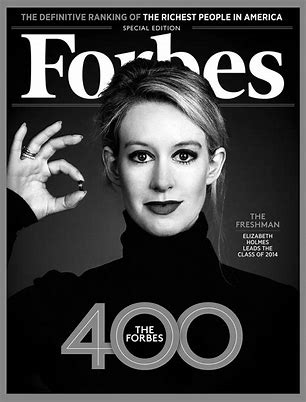
How much pressure was Holmes under at this point? She had 800 employees counting on her, numerous investors, and friends and family counting on her to make this happen? She appeared on the cover of Forbes, Fortune, Bloomberg, and Inc. Magazine. She appeared on CNBC a number of times, spreading her gospel. How many of us could experience this level of adulation, coupled with the pressure that it entails, and say, “All right, well, we’ve failed ten thousand times, over the course of ten some odd years, and well, it looks like this thing doesn’t work, and it never will. Everyone can go home now. There’s nothing more to see here. We’re folding up shop folks, it’s now time to go home.” 


In the midst of our knee-jerk reactions and hours-long cringes, we turn to our wives and say, “At that point, right there, I would’ve been more forthcoming.” To which, our wife should’ve said, “And then what?” And then, after you’ve cleared your name of any fraud by declaring the dream over, everything is over. Everyone you know and love realizes that you’re not the golden child they thought you were yesterday. You’ll become a punchline, as everyone you know will begin to mimic and mock your forthcoming statement, and the life you knew for ten-plus years is over as you spend the rest of your life realizing that you peaked at thirty-years-old.   


Among the top CEOs of Fortune 500 companies, there is one characteristic common among them an uncommon belief in self. If Holmes shared this enviable trait, as many suggest she did, she believed she could overcome any obstacle before her, and to do so there are times when we might have to fudge and fib a little to encourage the skeptical and skittish around to trust our unwavering vision just a little bit longer? An edited number here and there to encourage the legions of media members and employees who worshipped you will mean nothing when this product finally reaches completion. When Theranos employees on the ground floor begin to ask questions, it’s fine, as long as they don’t discourage their fellow employees and spread poor morale. As long as they don’t violate their NDAs and speak to the press or their family and friends, we’ll be fine. Plus, forcing employees to sign NDAs is a common practice in Silicon Valley and the rest of the business world. Furthermore, the best CEOs learn to lean on some level of obfuscation to sidestep deep, penetrating questions regarding initial results of products during their gestational period. Did Elizabeth Holmes have an unwavering and uncommon belief in herself or her products, in a manner those in sales will say are one and the same?


*** 


“I’m not going to fall for this,” we say when we click on the app to watch an episode of Cringe-TV. We know the perpetrator has been convicted, and we know some of the details of the case, but we want to see the suffering. We want to see the faces of the people who were duped, and we want to laugh at them when they confess the extent of the betrayal went from hundreds to hundreds of thousands, and if we’re really lucky, we’ll see the face of that poor sap who dumped millions. We might see something wrong with us for enjoying it so much, but we keep watching.  


I just can’t wrap my arms around Elizabeth Holmes being a fraudster from beginning to end. As a former fraud investigator, I know she’s been convicted of fraud by a jury of her peers, but I can’t help but think Elizabeth Holmes believed in her idea for a majority of those twelve years and presumed 10,000 failures. I know many of the facts of the case, but I would love to know what happened to her when it became obvious that her products were never going to work. Did she and her team switch to Siemans’ products, and all of the other measures she used to allegedly defraud victims, or was she desperately seeking more time. Or did she fear that “What then?” question if she was totally forthcoming at some point.    

Fraud is perpetuated throughout our country on a daily basis from Silicon Valley to Bangor, Maine. How many of these acts are committed for purely narcissistic reasons, and how many of these paths are paved with altruistic intentions? We might never know what was going on in Elizabeth’s head throughout the trials and tribulations she experienced, and our knee-jerk reaction is to shut down all discussion on the matter with the fraud conviction, but think about what an incredible person Elizabeth Holmes could’ve been if she devoted all of the energy, talent, and intelligence that impressed so many luminaries of our society into something that actually worked.   

The other side of the coin, the elephant in the room that no one wants to discuss is that Elizabeth Holmes was a woman. Going through all the interviews of her investors, and all the luminaries who invested in her company, I couldn’t get that fact out of my head. Elizabeth Holmes was obviously charismatic, she had a excellent work ethic, oodles of talent, and she had unwavering belief, but would all these people, including the financial magazines who had her image on the cover of all of their magazines, have fallen for her claims if she was a regular forty-something male CEO making substantial and exciting claims? We can only speculate, of course, but I think the idea that she was a woman relaxed some concerns. They wanted her to succeed, and they wanted to be the ones who were so open-minded that they didn’t want to be the type to speculate that her claims were just unrealistic, because that might subject them to the “Are you saying all this, because she’s a woman?” charge. We’ll never know, of course, but I have to think that a regular fella wouldn’t have received the benefit of doubt.

Guiteau Gets Garfield


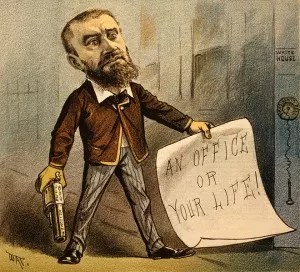
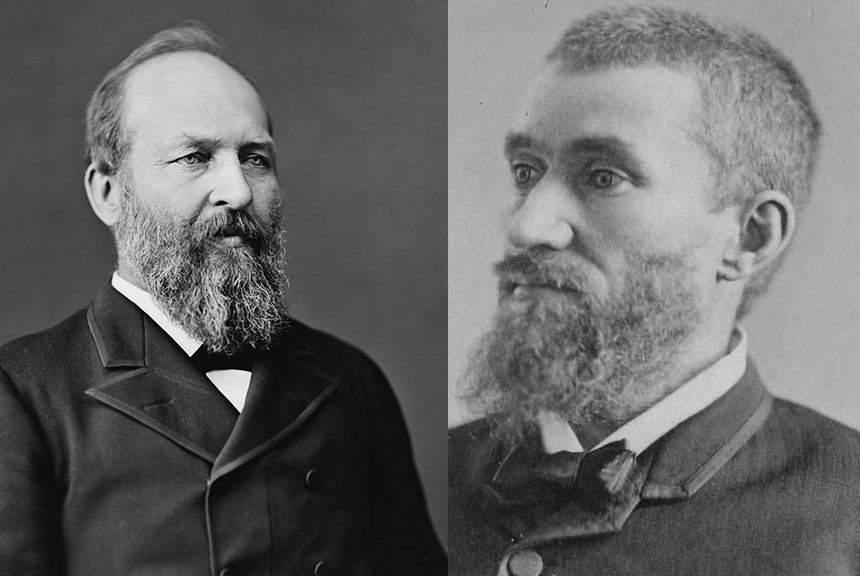
“I am a Stalwart of the Stalwarts … Arthur is President now,” an assassin named Charles Julius Guiteau said after shooting the 20th President of the United States, James Abram Garfield in the back at the Baltimore and Potomac Railway station in Washington D.C., on July 2, 1881. (New York Herald, July 3, 1881).  

Charles Guiteau believed he played an instrumental role in the presidential election of James Garfield, and he thought the administration owed him a job. He believed he was a Stalwart, a hard working, supporter of the cause, and when the administration decided not to reward him for his efforts, he decided to shoot the president. He dressed the motive up later, saying that he was on a mission from God to save the party and the country, but the motive that drove him to borrow money for a gun, practice target shooting, and stalk the president arose because the president wouldn’t give him a job.  

There are no records of a meeting between Garfield and Guiteau, so there were no personal rejections, but Garfield’s Secretary of State told Guiteau to “Never bother me again about the Paris consulship so long as you live.” There are also no records of a direct relationship between Guiteau’s annoying persistence and the Garfield administration’s decision to end the practice of offering positions to Stalwarts, also known as the patronage or spoils system. Ending this practice, encouraged Guiteau to believe he should assassinate a president.  

Why did Charles Guiteau do it? What drove this man to want to commit such a violent? What was his motive? Inquiring rubberneckers of history want to know. We could say people just have a natural curiosity, but that would suggest that once we have our answer, we all walk away. We’re obsessed with serial killers, mass murderers, psychopaths, sociopaths, and assassins. We want to know what drives them to violence. 

Is our drive to find out what drove them all about intrigue, or do we have a motive behind wanting to know the motive? Who cares why a man kills people? Who cares why a man tries to assassinate a world leader? Some suggest that if we know the motive, we might be able to prevent future incidents of a similar nature. To do that, we need to understand the criminal mind. To do what? What if the violent perpetrator has no motive? What if he lies? What if he realizes that assassinating a president, because that president wouldn’t give him a job is a pretty stupid reason to kill a man? What if he invents a motive to assign some level of importance to what he did? What if the truth is that he always wanted to commit a random act of violence?  

Do we appreciate it when a killer provides a specific motive for his actions? Does knowing a motive provide us some level of comfort? Some accept the fact that someone shot a bunch of people, because a dog told him to do it. It’s better to believe that than it is to think that they did it because they just wanted to commit a random act of violence.   

In service to his Stalwart duties, Guiteau gave poorly attended speeches on candidate Garfield’s behalf. The audience to these speeches suggest Guiteau thought President Ulysses S. Grant was going to seek a third term. They thought he simply crossed out the name Grant and replaced it with Garfield. They said this because Guiteau accidently attributed Grant’s accomplishments to Garfield. The mentally unstable Guiteau still believed he proved instrumental in Garfield’s victory, and he wrote numerous letters to Garfield, and he visited the White House and the State Department numerous times, to argue that they should reward him for his efforts with a position in Garfield’s administration. When these efforts failed, the narcissist Guiteau decided he needed to assassinate the president to save his party and his land. 

“[S]aved my party and my land. Glory hallelujah!” Guiteau wrote in a poem he recited, as his last words before execution. “But they have murdered me for it, and that is the reason I am going to the Lordy.”  

Before the assassination attempt [Guiteau] wrote an “Address to the American People,” making the case for Garfield’s assassination. In his address, Guiteau accused Garfield of “the basest ingratitude to the Stalwarts” and said the president was on a course to “wreck the once grand old Republican party.” Assassination, Guiteau wrote, was “not murder; it is a political necessity.” He concluded, “I leave my justification to God and the American people.”  

Guiteau wrote a second justification for his planned assassination or, as he called it, “the President’s tragic death.” Guiteau, claiming himself to be “a Stalwart of the Stalwarts,” wrote that “the President … will be happier in Paradise than here.” He ended his note with the words, “I am going to jail.” 

Guiteau arrived at the station about 8:30. He felt ready for the job, having practiced his marksmanship on a riverbank on the way to his destination. Garfield entered the nearly empty station at 8:25 with Secretary Blaine and a bag-carrying servant. They walked several steps into the carpeted “ladies’ waiting room” when Guiteau fired his first shot. It grazed Garfield’s arm. Guiteau moved two steps and fired a second shot. The bullet entered Garfield’s back just above the waist. The president fell as the back of his gray summer suit filled with blood. 

After shooting the president, Guiteau tried to calm the onlookers, “It’s all right, it’s all right,” he said before the police officer on duty arrested him. 

“I did not kill the President,” Guiteau said during his trial. “The doctors did that. I merely shot him.” Though a laughable defense in a criminal proceeding, historians suggest that when used as a defense against execution in a murder in the first-degree case, it might merit some consideration. Esteemed historians, such as Candace Millard, author of the excellent Destiny of the Republic, suggests that if President James A. Garfield’s doctors did nothing, Garfield might have recovered. Her assumption is based on the idea that the doctors who attempted to locate Guiteau’s bullet were untrained in Listerian antiseptic methods that would be in widespread use a decade later. Historian, and Garfield biographer, Allan Peskin disagrees. He stated, “That medical malpractice did not contribute to Garfield’s death; the inevitable infection and blood poisoning that would ensue from a deep bullet wound resulted in damage to multiple organs and spinal bone fragmentation.” An autopsy identified the cause of death as a rupturing of an aneurysm in the splenic artery. 

In the hours after his arrest, Guiteau acted strangely. On the way to city jail with a police detective, Guiteau asked the officer if the detective was a Stalwart. When the detective replied that he was, Guiteau promised to make him chief of police. In jail, he balked at removing his shoes, complaining that if he walked barefoot over the jail’s stone floors “I’ll catch my death of cold.” When a photographer snapped his photo, he demanded a royalty payment of $25.  

Prosecutor John K. Porter demanded to know whether Guiteau was familiar with the Biblical commandment, “Thou shalt not kill.” Guiteau responded that in this case “the divine authority overcame the written law.” He insisted, “I am a man of destiny as much as the Savior, or Paul, or Martin Luther.” 

Guiteau approached his hanging with a sense of opportunity, but he eventually abandoned his plan to appear for the event dressed only in underwear (to remind spectators of Christ’s execution) after being persuaded that the immodest garb might be seen as further evidence of his insanity. 

The problem for Guiteau, as it applied to a first-degree murder case, was that he displayed the characteristics of malice and forethought. He stalked President Garfield, he practiced shooting the gun he purchased at a riverbank, and he abandoned a previous attempt to assassinate the president, because the president was with his wife at the time, and Guiteau didn’t want to upset the wife.  

The trial of Charles Julius Guiteau was what some call “the most celebrated insanity trial of the century” with many alienists (psychiatrists) debating whether Guiteau was sane. Many historians, and almost all neurologists, now agree that, by today’s standards, Guiteau was clinically insane. After Guiteau’s execution, public opinion on the issue of insanity shifted.  

Although modern and future readers, who sit in the proverbial jury room, might sympathize with some of the antiquated measures used to determine sanity in 1881, but they might also calculate some of Charles Guiteau’s premeditated calculations into the equation. Months prior to the 100-year anniversary of Guiteau’s assassination attempt (March 30, 1981), John Hinkley provided a case similar to Guiteau’s, as Hinkley premeditated his assassination attempt (on President Ronald Reagan), and he did not kill the president either (reagan would live 23 more years, but Garfield died 8 weeks after Guiteau’s attempt). We might consider a stereotypical clinically insane individual to act on impulse, but the more modern jury of his peers, declared Hinkley clinically insane, and he spent 35 years in a psychiatric institution before being released. Hinkley now uploads love songs on YouTube. 

Further Reading