Why So Insidious?


“Why so serious?” – The Dark Knight, Christopher and Jonathon Nolan 

Why so cynical? Cynicism is truth. Cynicism is real. Scene: The cynical character confronts an optimistic, positive one. The positive character has no reply. Why does he just sit there and take it? The underlying truth is finally coming out, and the positive character just can’t handle it. We favor the cynical character, because, “He’s just being real with us.” He’s gritty, she’s so dark, and the cynical are no longer afraid to speak truth to power. The truth is that your precious, little world is awful, your neighbor is trash, and you’re probably no better. Cynicism is alarming, scary, hilarious, and so insidious.

“Harmful but enticing: seductive.” – Merriam-Webster.com’s definition of insidious.

Why so insidious? Want to write a best-seller? Bring the pain (muderporn). We readers crave a taste, a dose, and a heaping forkful of the worst elements of the worst moments of another’s life. We don’t want it too familiar, of course, yet we enjoy watching it from a distance. We may not bring it up in polite company, but if someone else does, we join in, and it’s difficult for us to hide the excitement in our voice. 

Why so violent? Violent narratives require a generous portion of brutality, but the most successful writers define it by clever and intelligent means. Undefined brutality is fine if we’re writing a mob narrative, or a historical recount of the Ku Klux Klan or Nazi, Germany, because they come backloaded with such a brutally violent history, but if we’re going to write about serial killers, we need to employ some level of poetry, symbolism, or some other form of intellect in their acts for it suggests the killer (and their writer) is surprisingly intellectual. In the cat-and-mouse game with the police, writers use law enforcement officials to define the serial killer’s intellect. “He’s obviously incredibly intelligent,” they will say at the outset, and at some point, in the chase, they say, “He’s too smart to fall for that.” If the writer can combine the killer’s savage sense of brutality with some ode to Geoffrey Chaucer, Dante Alighieri, Shakespeare, and/or Biblical references, it illustrates a shocking intellect that will lead to best-sellers, ratings, and clickbait. 

I’ve created fictional characters with whom I developed a mostly platonic relationship, and the answer to the question of what I was going to do with them didn’t involve whether or not they were going to commit violence, but how much? 

“We might develop a crush on non-violent stories,” I said to explain this predilection, “but if we’re going to fall head-over-heels in love, there has to be some violence involved, or at least the threat thereof.” 

Why so awful? We want to read/watch about awful people doing awful things to one another, with a dash of humor thrown in to further define, or even slightly contradict, their awfulness. At some point in the timeline, the awful writers began adding clever humor to add an element of the casual and the common place to their violence, and we loved it. If it’s not love we experience, it’s some complicated adherent. We’ll repeat a clever and humorous line with a chuckle. We might even knowingly invite such seductive characters into our home. We’ve all seen movies of enraged violent people, and it just doesn’t connect the way the calm, clever killers do. Look at our favorite performances, most of them involve actors portraying the most awful characters imaginable with a little bit of flair. The message to writers is clear: if you want gain, bring the pain, and it doesn’t hurt to add a little levity to their refrain. 

Why so artistic? Does art reflect society, or does society reflect art? Is society as evil as artists of modernity want us to believe, or do we interpret their attempts as beautiful works of art? Those who aren’t afraid to expose us to the truth of what’s going on in their neighborhood receive special accolades. Their exposes might be dark and negative but that’s their truth. Is it truth, or is it an embellishment intended to generate sales? I can see you, with your fingers poised above your keyboard, ready to defend your favorite book, movie, or TV show. Your reply will include something regarding how I can’t understand the plight of someone who might not experience the comfortable lifestyle I do. I’m not saying you’re wrong, but would you be so defensive if we were discussing a positive, uplifting narrative? “There’s nothing wrong with light-hearted fare, of course,” you might say, “but there’s no question that gritty, dark, and cynical are definitely more artistic.”

Why do repetitive? We love violence in our art, and we identify with cynicism as truth, but what is that truth? As we work our way through controversial, provocative portrayals of the truth, we often hear, see, and learn the same reportage, fictional and otherwise, over and over. How many times do we have to hear, watch, and read the same cynical exposés on the same institutions before we accept their portrayals as truth? How many otherwise beloved and trusted institutions in our society are the most corrupt in these narratives? There’s the member of the civil service, the man of religion, or military man you thought you could trust who turns out the most corrupt among them in our controversial and cutting edge stories. This trope is almost as repetitive as the all families are dysfunctional trope. We all understand that an author needs to introduce conflict, be it external or internal, but these tropes are repeated so often that most of us can pick out the good guys and bad guys in an ensemble narrative before the actors have read one word of the script. Through sales, we’ve encouraged storytellers to evolve to nothing but hardcore, unapologetic cynicism to appeals to our worldview. 

Why so dark, angry, and hopeless? To paraphrase a line from Cool Hand Luke, “That’s the way he wants it,” and we want it dark, cynical, negative, hateful, and violent. Most of us have no violent tendencies. We never have, and we never will. Yet, we won’t read a book, watch a movie, TV show, or play a video game that doesn’t involve at least some hint of violence? What does that say about us? If we are of a stable mind that isn’t easily influenced, I don’t think it says much, but is it human nature to think that the ultimate, or final, truth about human nature is that it’s awful, nasty, and we’re all headed for dark, gritty truth?

Why no happy endings? It wasn’t too long ago that the market demanded a happy ending, no manner how dark and gritty a fictional piece was. We enjoyed watching awful people doing awful things to each other, but we all knew that some over-the-top, big, sloppy happy ending was coming. We knew the movie would end with someone drinking an exotic, adult beverage with a tiny umbrella in it, in front of an impossibly white, sandy beach? Everyone knew that somehow, someway, it would all end happy for the players involved. It became a long-running joke. Those who concern themselves with such things say that there wasn’t one particular movie that brought an end to this, but a series of thematically complex narratives of the late 60’s early 70’s that challenged the whole idea of the necessity of happy endings in movies. If this is true, it was a long, insidious arc that led us to demand that our stories end in despair for the purpose of being true, while illuminating us about the despair around the world. When we watch happy endings now, they seem so anticlimactic that movie makers have responded by leaving one last hint that the bad guy/monster might might still be alive somewhere.  

“If you want a happy ending go Disney or some other manufacturer of dreams, cause you ain’t gonna find it here.”

I come at this from an advantageous position, because I led a sheltered life until I was about fifteen. I received a lot of grief for believing that most of humanity was good, and I still do, but when I was young and impressionable, my worldview encountered a special brand of the-world-is-junk, and a dose of everyone is a piece of junk. “You shouldn’t trust anyone outside your home,” they instructed me, “and you should probably be skeptical of them.” The contrast to everything I knew and believed couldn’t have been more shocking if it was delivered with defibrillator paddles. I initially considered their skeptical cynicism a romantic notion, and I was angry that my authority figures shielded me from the truth for so long. The more I learned this outlook, the more I embraced it, acclimated to it, and I accepted it as truth. The repetition was such that I knew if I didn’t adjust and assimilate, I would be nothing more than a naïveté who would eventually meet my demise as a result of some proverbial pack of wolves who would take advantage of it. As with all constant and repetitive messaging, it eventually reached a tipping point for me. Looking back, I probably needed that dose of cynicism to round out my wide-eyed optimism, but when the “theys” in my inner-circle continued pouring gasoline on this fire, I realized that, like uplifting positivism, there’s a point of diminishing returns of too much cynicism too. “Just because it’s awful, negative, and cynical doesn’t always mean it’s true,” I began telling my “theys” after I hit that tipping point. I don’t know if that revelation proved as shocking to them as their revelations did me, but they couldn’t come up with anything to counter it. 

When we seek the truth, we often get bounced around a bit, until we eventually find it nestled somewhere in the in-between. Are we more cynical or optimistic, or are we somewhere in-between, and what’s in the in-between? 

As the new saying goes, “If you ever want to know where you stand are as a culture, look to the major marketing firms.” They pour millions into researching human nature and the zeitgeist for the purpose of appealing to us in their marketing campaigns? When they create advertisements for their clients do they seek a truth, or something we generally perceive to be true? Marketing departments don’t necessarily seek to tell us the truth, but their extensive studies find a truth that we consider true enough to move products, and they have obviously reached the conclusion that our outlook is pretty bleak. They understand that times are tough, but their client is here to help. If we just purchase their new and improved product, we’ll find our days and nights bigger, brighter, and more productive, because we’ll have more time to do what we always wanted to do. They pay attention to our intricacies, and they’re saying that we have a negative, cynical and all hope is lost mentality. It’s The Beatles, “It’s getting better all the time. It couldn’t get much worse.” It’s Dickens’ “It was the best of times. It was the worst of times.” It’s the in-between.

I haven’t poured tons of money into extensive research on humanity, but I think we could all use a healthy dose of something else, and it doesn’t have to be uplifting. It can’t be, because uplifting is cringe, but it could be something different. It could be something dotted with refreshing honesty without being overly cynical. It can also be something other than the college thesis paper, or dissertations, writers insert into every song we hear, and every TV show and movie we watch. When I watch these over-the-top insertions, I can’t help but think, “Hows about we just go for entertainment, so we can forget the serious, deep, and the meaningful for just a moment?” 
Feed the Breed: The Beagle


“Ask not what your Beagle can do for you. Ask what you can do for your Beagle!” 

When we purchase a puppy, any puppy, and bring them into our beloved home, it’s our natural inclination to focus on what that puppy can do for us. Some say that it’s a puppies job to bring love, happiness and an overall sense of joy into our home. We paid to bring him home, after all, and as with the purchase of a loofa, a barcalounger, or a toothbrush, we expect them to perform certain functions for us. If the puppy doesn’t perform to our expectations, we might even think of returning it. (Talking to certain employees at kennels, I’ve learned that this is a part of the business, as they offer a 90-day return policy to customers who aren’t happy with their purchase.) 

His job is to play with us, cuddle with us, provide a general sense of companionship, and do all the things a puppy should do. If he fails to comport with how we think a puppy should act, we see it as a failure on his part, and we might seek professional assistance and advice for him. Most of us do not consider what we can do for the puppy to make them a happy, more well-adjusted dog who doesn’t mind comporting to our standards. We might give him a big backyard to run around in, toys galore, chew sticks, treats, companionship and love, and anything and everything we can think of that would make a dog happy, but we don’t think beyond all that to what we should be doing to build a symbiotic relationship with our new puppy. 

“Feed the breed,” I now say. “Feed the breed.” I list this as a consideration for all dog owners to consider, but it’s specifically tailored to Beagle owners, because I have a Beagle, and I love Beagles. I write this for all dog owners who now see that that beautiful, little puppy they just brought home, who now plays in what we might consider an almost mean-spirited manner. There were times when my Beagle, Max, bit a little too hard during playtime, chewed up some of my precious items, wouldn’t leave the other dog in our home alone, and he was a naughty little boy so often that he added to some of the wrinkles and the grey hair we now sport. My puppy acted as if he was almost (and I normally hate to assign human characteristics to a dog) frustrated. 

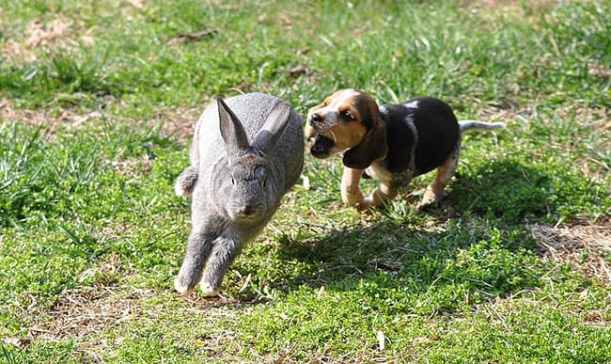
When I write, “Feed the breed,” I’m not suggesting that you feed your Beagle bunnies, or that you need to let them catch and devour bunny. When I suggest that you feed the breed, it doesn’t necessarily mean that you have to watch them feed. If you’re anything like me, it might make you uncomfortable to watch your beloved Beagle actually catch and devour a rabbit. I’m suggesting that you do some research on the breed you purchased and feed into the breeding of your dog.

When I went online, searching for answers to my naughty, little Beagle, I kept seeing this short characterization, “Beagles were bred to chase bunnies.” I didn’t think too much about it at the time. Prior to purchasing a Beagle, I owned a Puggle (part Pug, part Beagle), and that Puggle loved chasing rabbits. Among all the other things he enjoyed, he enjoyed chasing rabbits. So, when I saw that line, “Beagles were bred to chase bunnies,” I continued to skip it with an “of course” in mind.

Friends and family told me Beagles were hunting dogs, and I saw some evidence of it, but Max was purchased to be a family dog. I didn’t want a hunting dog. I wanted a cute cuddly, overly playful dog, and the fact that he happened to be a hunting dog, bred to chase rabbits, was to me an asterisk on the list of characteristics I found. I read it, and then I went onto reading all of the other characteristics I wanted to learn about more. Notice the emphasis on “to me” and “I wanted”. I wanted him to be what I wanted him to be, and I failed to consider what he might be in a larger context. I failed to consider the idea that a Puggle might love to chase rabbits for the sport of it all, but a Beagle needs to chase bunnies in a way that is (again, I cringe when I assign human characteristics to dogs) fundamental to his constitution.  

We took him on those small, daily walks, fifteen minutes a day that every Beagle owner prescribes for those who want a happy dog, I noticed that he huffed every inch of ground beneath him. (A Beagle doesn’t sniff the ground, he huffs on it.) He still exhibited signs of frustration. We took him on more walks in other areas, and in those other areas there was some evidence of bunnies. Even with that, he remained the dictionary definition of a high maintenance dog. I could go through all of the various characteristics and incidents to illustrate how high maintenance Max was, but I think I can summarize my mindset with a comment I began making, “I think I made a huge mistake purchasing this dog.” I walked him constantly to get some of his energy out, and he spent a majority of the rest of his time outside, in our big backyard, running around playing and barking with the neighboring dogs. A human, knowing the general characteristics of a dog might think Max landed in a canine version of nirvana, but he was still always on, and he continued to be somewhat frustrated.  

When I walked him, I walked him through our neighborhood, and the idea that he was bred for hunting rabbits was obvious. He would freak out when he occasionally caught some stray scent of a bunny, and I saw that, but I still didn’t catch on entirely.

It wasn’t until I made the decision to take a long walk into areas with a large bunny concentration that I saw the other side of Max. When he’s in rabbit-infested arena, Max develops tunnel vision. If humans approach him for a quick pet, Max doesn’t even acknowledge their existence. He’s in the zone. Other dogs run to the fence barking and wagging their tales, ready to play. They might as well be on another planet as far as Max is concerned when he’s on the hunt. When he catches a scent, he begins huffing the ground (as opposed to his usual sniffing), and there are times when he huffs the ground so hard that he begins sneezing (as often as twelve-to-fifteen times in a row, some of the times, blowing mucus and excess saliva all over the place). He pulls on the leash to continue to huff every inch of that select ground, and he pulls with all his strength on the leash to signify that he’s far from done with this area. On frequent occasions, he lays out on all fours to anchor himself to the ground, until he’s done covering every square inch of that scent. 

One of the websites devoted to dogs wrote, “Beagles can tell us where bunnies were, but they’re not as proficient at telling us where they are.” This, in my humble opinion, is because they obsess over the ground where “they were” to the point that they might not be as concerned with where that trail leads.

When Max hits a trail that he knows a bunny has spent some time on, he yips, barks and howls en route to the suspected location. (Have you ever heard a Bloodhound’s howl? It’s that.) Max gets so loud that it can prove embarrassing, at times, as we might fear that unsuspecting and uninformed onlookers might think we’re beating our poor, little puppy. “Is he okay?” a concerned neighbor asked from the foyer of her backyard door. I saw her standing there seconds before, and I think she was watching my actions to see if I was beating my dog. The near-screams coming from Max were that intense.

“Thank you for your concern,” I waved. “He just caught the scent of a bunny.” She smiled politely and all that, but I could tell she wasn’t thoroughly convinced, and she slowly re-entered her home watching us to try to spot a reason to call the Humane Society on me.  

My advice to the dog owner who might want to explore the extent of the characteristics of the Beagle, is make sure you carry dog water bottle on these walks, because your Beagle will obsess over these little areas to the point of excessive exhaustion and dehydration. The typical dog owner will want to move on after a while, but it can prove difficult, and almost impossible to convince your Beagle to move on. (Our new ritual of walking in bunny areas, can take a forty-five minutes to an hour.) 

Prior to these long walks in rabbit-infested areas, we tried everything we could think up to make this dog happy. We even went so far as to consult his veterinarian, who told us that he was a puppy, and you should start to see these puppy characteristics subside around aged two. Well, aged two came and went, and he was still high-strung, mean-spirited, and he exhibited some levels of frustration. After these walks, which we do on average three times a week now, I’m happy to report that when I am eventually able to convince Max to move on and begin the long journey home. He returns to our loving home a more normal, less unstable, satisfied and less frustrated dog. By feeding into his breeding, I now have a dog who doesn’t get into things, bite too hard, or display any of the other naughty characteristics I’ve listed above. He’s now an exhausted, less frustrated, and satisfied dog. 

Read the Breed

It’s human nature to expect a child, a dog, an entertainment system, or a loofa to perform according to our expectations. Unlike a loofa or an entertainment system, children can be complicated, frustrated, or dysfunctional in some minor ways that require attention or treatment. We know that, and that’s why we developed the aphorism, “Parenting is one of the hardest jobs in the world.” We don’t expect raising a dog to be as complicated. Yet, like children, to a far lesser extent, all dogs are different. Some are naughty, highly intelligent, and bred different. 

Having written everything I have thus far, let me say that the idea of returning a dog, even one as obnoxious, high-strung, and even mean as Max could be on occasion, was the furthest thing from my mind. I know I’m different, but I would’ve considered that an epic fail on my part. I did my research not to find information to support my thesis that I made a huge mistake by purchasing him, but to find out how I failed and how to rectify it. I have heard tales of bad dogs though. If you have what you consider a bad dog, you think there’s something wrong with your dog, or you pointed your finger at the word frustrated and said, “It’s that,” or “I’m not sure if it’s that, but it’s something like that, that we’re dealing with here.” Bad dog, or something wrong with your dog, can be a description relative to the dog, their owners, or some complex combination thereof. Nobody is saying you’re wrong. There are bad dogs, just like I’m sure zoo keepers can probably tell us there are bad meerkats, bad, mean, or otherwise obnoxious butterflies, and otters. There are also, believe it or not, some bad humans, but with humans we often do extensive research before reaching a final conclusion. That’s the advice I would give all Beagle and dog owners, read the breed and feed the breed. Do some research on your dog, read through their characteristics to find out what makes them tick and feed into that to see if you might be able to use some measure to ease their frustration and make them happy before you reach some final conclusion on them. The best thing I ever did was learn more about my Beagle, and how I could feed into his breed to make him happy, because he’s done everything in his power to return the favor ever since. 

Dear George Carlin,


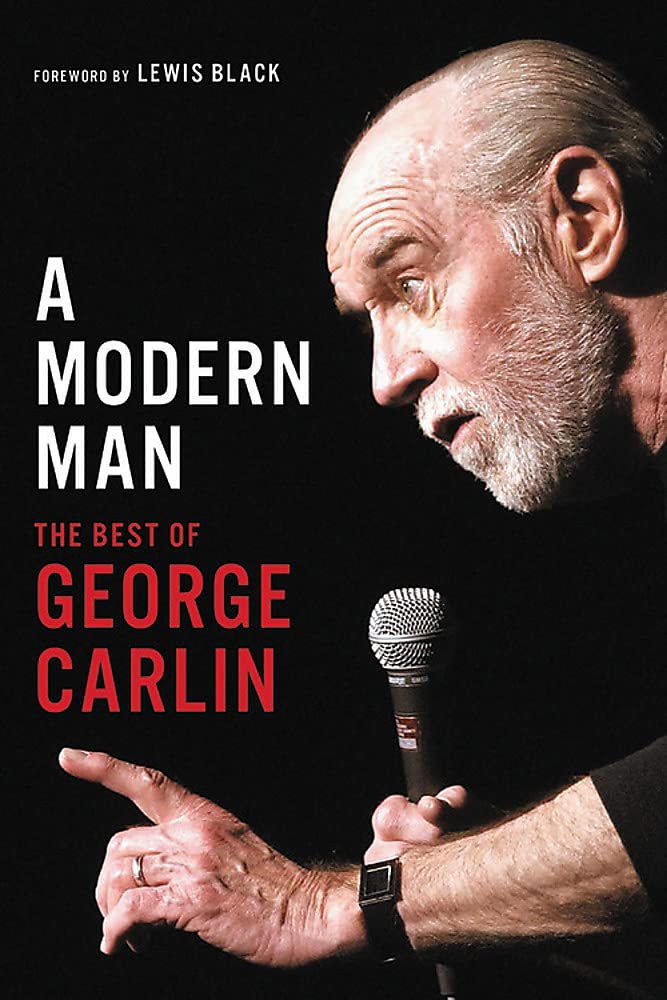
George Carlin’s latest and last book: A Modern Man: The Best of George Carlin, includes a section of short takes called Short Takes. He almost wrote it as a letter to future readers, and it inspired me so much that I decided to write back. 

“Most people aren’t particularly good at anything,” George Carlin wrote. “We’re all amateurs. It’s just that some of us are more professional about it than others.” 

Most of the truly impressive people I’ve met, over the years, didn’t impress me at hello. My impressions of them involved a slow build that could take days, sometimes weeks to process, until it ends coming out on a little, yellow piece of paper, similar to those that came out of computers in old sci-fi shows. The primary reason most truly impressive types fail to blow us away in the intro is that they’re not trying to impress us. There are others, of course, and they usually greet us with a little something like this: 

“Please, don’t call me Mr. Duggin,” those who’ve attained levels of authority often say in a handshake, “Call me Henry.” 

“I understand that you’re trying to impress me with your humility,” we should say to Henry, “but could you wait until we’ve felt each other out here a little bit?” I could be wrong, of course, but I think they consider the ‘Call me Henry’ hello a shortcut to impressions through humility. They’re basically saying, ‘Hey, I’m not as impressive as you think. I’m just another peon, like you.’

‘All right, well, I didn’t consider you particularly extraordinary until you said that. Now, I’m just like wow, your humility is so impressive, but if you are truly humble, why do you need to impress it upon me? What are you hoping to accomplish here?’

Is Henry as impressive as he wants us to believe, or is so uncomfortable that he hasn’t adapted to the societal norm we all use to address someone we don’t know with a prefix followed by their surname? He has, of course, but Henry Duggin is hoping to short-circuit these dynamics, so we consider him more humble, more professional, and more impressive. Henry wants us to consider the idea that only an all-that-and-a-bag-of-chips guy would demand informalities. 

When I had a “Please, call me Henry” as a boss, I tried to think of a time when I arrived at a familial link with a boss who allowed me to call him Henry in the privacy of a corporate boardroom. I know others enjoy this. I’ve seen that warm glow and those blushing smiles of euphoria on their faces when the boss dropped that invitation on them. They appreciate the gesture of a boss reaching down to touch them on a familial link, as God did in Michelangelo’s The Creation of Adam, but I see it as Henry’s method of reinforcing his leadership mystique.  

“Why do you keep calling him Mr. Duggin?” they ask me. “He wants us to call him Henry.” 

“Because that’s the way I was raised,” I lie. “I was taught to address a boss as Mr. or Ms. Duggin. It isn’t intended as a compliment or an insult that I refuse to call him Henry. It’s just the way I was raised.” In truth, I feel queasy calling him Henry, because I feel like I’m feeding into his narcissistic humility.  

***

“Nothing rhymes with nostril.” –George Carlin

Thanks to the modern convenience of the search engine that George Carlin obviously didn’t use often enough, I found some words, austral, claustral, and rostral that rhyme with nostril. Sorry George! Now that we’ve established that, the next question is why haven’t any of the millions of lyricists (poets and/or songwriters), since Shakespeare, invented a more romantic, or utilitarian, word that rhymes with nostril? The Oxford English Dictionary claims that William Shakespeare invented 1,700 words, and other lyricists invented innumerable words to serve their cause, but none of them rhyme with nostril. If necessity is the mother of invention, why didn’t Mr. Shakespeare (“Please call me Willy”), or any lyricists since, invent a word to rhyme with nostril? 

How many words have lyricists devoted to the eyes and the lips? Their beauty is so self-sustained that some artists have painted nothing but eyes and lips. Lyricists have written songs and poems about nothing more than a woman’s eyes, and we could probably create a War and Peace-length compendium to the space created for lips. Artists also focus effort on high cheek bones, or a high or low forehead, but they don’t put any effort, beyond necessity, to the size and shape of nostrils.  

Some nostrils are thin, others wide, and some take on a more oval shape. There are even some that appear to take on an unusual pear-shape that almost achieves a point. We might think these variations would excite artists to invent words to capture the perfect nostril, but they haven’t, because the nostril(s) is never strikingly beautiful or ugly. They’re just there. They might be more attractive than the other orifices, but they’re never so stimulating that we would rank a persons’ degrees of attraction based on the size or shape of their nostril. To my mind there aren’t any subconscious visual stimuli regarding their sizes and shapes either. Maybe there are, and I just don’t know it.  

Picasso believed beauty arrived in angles and symmetry, but if the nostril achieves either of these, the artistic credit goes to the nose. The point is, no artist I know of has expended artistic energy, beyond necessity, to the nostril. If they did, they might’ve invented a word that rhymes with it we all know by heart by heart, or they would’ve used some artistic license to use austral, but how does even the gifted lyricist, create beautiful rhyming sentences around a “southern” nostril, or a nostril from the south? If they attempted to soundboard a rhyme with claustral, what artistic benefit could they achieve with a nostril that is “secluded”. “I felt claustral in her nostril,” or “his nostril left me claustral.” The artist’s interpretation of such lyrics could lay in the affect of feeling lonely in her presence, which would be a beautiful sentiment worthy of exploration. If the lyricist was in a band, however, my guess is that his bandmates would suggest they know where the lyricist was headed, but they might caution him that the general public might misinterpret the lyrics to mean that his beloved is booger-free, except for him, dangling on a precipice. To declare that the poet’s lover was such a beauty that her nostril appeared rostral, or “a scale in reptiles on the median plate of the tip of the snout that borders the mouth opening”, just doesn’t achieve a level of artistic appeal most artists seek when they’re trying to impress upon others their talent for expression. So, we can’t fault George for not knowing that there are words that rhyme with nostril, because no lyricist has ever sought to capitalize on what could’ve been an artistic first for someone.   

***

“Everything is still the same. It’s just a little different now.” —George Carlin

In the not-so-distant future, future earthlings will have not-so-distant emotions, if we believe George Carlin. If we believe time travel movies, however, we will all have exaggerated emotions. The characters therein are either overwhelmingly happy, in a creepy, surreal way that suggests they don’t question anything anymore, or they’re incredibly unhappy, because of that whole Armageddon thing. Some of these movies were made in the 50’s and 60’s, and in the 50’s and 60’s, we apparently thought that 2000 man would have all these exaggerated emotions. No one predicted that not much would change in the ways of human nature and human emotions. If we 2000 men and women could send a message back, we might write, “Everything is still the same. It’s just a little different now.”

With that in mind, how do we view 2100 man? We don’t, because to our figurative schemes of thought, if there is an Earth, it will be uninhabitable. Interpersonal relationships will evolve to intrapersonal relationships, or on the inside, or within. If we smile, it will be strained, and we will no longer feel the need to leave the house. In truth, the future will probably evolve to everything being the same, just a little different. 

2100 man will also, apparently, lose any and all skills at problem resolutions, and they apparently won’t feel the need to survive either, if current time travel movies are to be believed. We won’t be happy or sad. We will enter an era of acceptance. We’ll just accept things the way they are, and the fact that life is rotten and death is close at hand. If these characters have water or food shortages, they just learn to live with it. Geniuses, who fix things, are apparently nowhere to be found in the future, and the only thing 2100 man will do is accept life the way it is and learn to accept the fact that they’re just going to die soon as a result. I would submit that these writers know as little about humanity as we do the future.  

***

“Not only do I not know what’s going on, I wouldn’t know what to do about it if I did.” “The nicest thing about anything is not knowing what it is.” “When I hear a person talking about political solutions, I know I’m not listening to a serious person.” —George Carlin

Anytime someone proposes solving a problem with political solutions, the yang to that yin should be, “What then?” What happens when “we” attempt to resolve a problem from the outside in? Every effect involves a countereffect, and some unforeseen consequence that we forgot to imagine. “We just wanted to fix the problem?” the political solutions proponent says. Their intentions were more important to them, and hopefully to you, than their attention to detail. Political solutions involve the invisible hand putting a thumb on the scale, but most of us don’t know what’s going on, so we try to find someone who does. We turn to someone who has great hair, with a side part, 3-4 inches on top, and about an inch on the sides and back. He has a suave, confident hairstyle that matches what we associate with knowledge and power, and she has a chin that harmonizes with the face, and is well balanced. It’s not too small, too wide, or retracted. It’s also well-rounded, and she has beautiful arms. So, when our preferreds say something to us, it sticks, because in some way we haven’t fully explored, we want to be them. If we sound like them, because they sound like they know what they’re talking about in a way we find inspirational, we hope that we might be sound as inspirational as they do when we repeat it. We still won’t know what’s going on, and we wouldn’t know what to do about if we did, and now we know that they didn’t either. Their proposed solution now is to fix all of the problems their initial political solution created, with another political solution, but they sound like they know what they’re talking about now. Their presentations are so artful, no ums or uhs, and isn’t that somewhat, sort of, important enough? The “What then?” guys are often nerdy guys who wear some kind of gel (ick), and they wear some kind of clip-on to keep their ties straight.