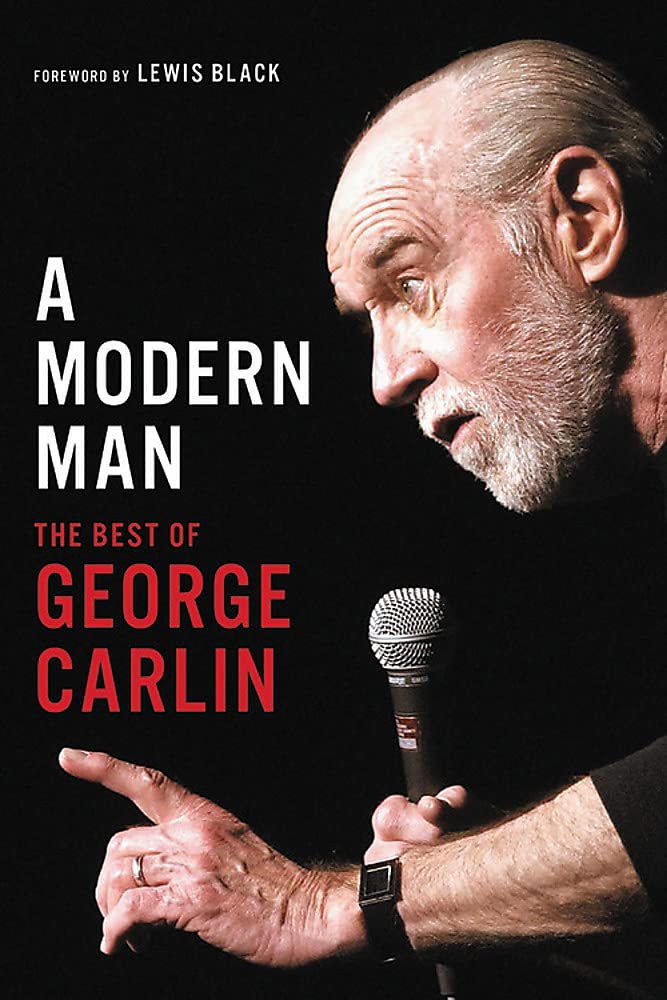
George Carlin’s latest and last book: A Modern Man: The Best of George Carlin, includes a section of short takes called Short Takes. He almost wrote it as a letter to future readers, and it inspired me so much that I decided to write back.
“Most people aren’t particularly good at anything,” George Carlin wrote. “We’re all amateurs. It’s just that some of us are more professional about it than others.”
Most of the truly impressive people I’ve met, over the years, didn’t impress me at hello. My impressions of them involved a slow build that could take days, sometimes weeks to process, until it ends coming out on a little, yellow piece of paper, similar to those that came out of computers in old sci-fi shows. The primary reason most truly impressive types fail to blow us away in the intro is that they’re not trying to impress us. There are others, of course, and they usually greet us with a little something like this:
 “Please, don’t call me Mr. Duggin,” those who’ve attained levels of authority often say in a handshake, “Call me Henry.”
“I understand that you’re trying to impress me with your humility,” we should say to Henry, “but could you wait until we’ve felt each other out here a little bit?” I could be wrong, of course, but I think they consider the ‘Call me Henry’ hello a shortcut to impressions through humility. They’re basically saying, ‘Hey, I’m not as impressive as you think. I’m just another peon, like you.’
‘All right, well, I didn’t consider you particularly extraordinary until you said that. Now, I’m just like wow, your humility is so impressive, but if you are truly humble, why do you need to impress it upon me? What are you hoping to accomplish here?’
Is Henry as impressive as he wants us to believe, or is so uncomfortable that he hasn’t adapted to the societal norm we all use to address someone we don’t know with a prefix followed by their surname? He has, of course, but Henry Duggin is hoping to short-circuit these dynamics, so we consider him more humble, more professional, and more impressive. Henry wants us to consider the idea that only an all-that-and-a-bag-of-chips guy would demand informalities.
When I had a “Please, call me Henry” as a boss, I tried to think of a time when I arrived at a familial link with a boss who allowed me to call him Henry in the privacy of a corporate boardroom. I know others enjoy this. I’ve seen that warm glow and those blushing smiles of euphoria on their faces when the boss dropped that invitation on them. They appreciate the gesture of a boss reaching down to touch them on a familial link, as God did in Michelangelo’s The Creation of Adam, but I see it as Henry’s method of reinforcing his leadership mystique.
“Why do you keep calling him Mr. Duggin?” they ask me. “He wants us to call him Henry.”
“Because that’s the way I was raised,” I lie. “I was taught to address a boss as Mr. or Ms. Duggin. It isn’t intended as a compliment or an insult that I refuse to call him Henry. It’s just the way I was raised.” In truth, I feel queasy calling him Henry, because I feel like I’m feeding into his narcissistic humility.
***
“Nothing rhymes with nostril.” –George Carlin
 Thanks to the modern convenience of the search engine that George Carlin obviously didn’t use often enough, I found some words, austral, claustral, and rostral that rhyme with nostril. Sorry George! Now that we’ve established that, the next question is why haven’t any of the millions of lyricists (poets and/or songwriters), since Shakespeare, invented a more romantic, or utilitarian, word that rhymes with nostril? The Oxford English Dictionary claims that William Shakespeare invented 1,700 words, and other lyricists invented innumerable words to serve their cause, but none of them rhyme with nostril. If necessity is the mother of invention, why didn’t Mr. Shakespeare (“Please call me Willy”), or any lyricists since, invent a word to rhyme with nostril?
How many words have lyricists devoted to the eyes and the lips? Their beauty is so self-sustained that some artists have painted nothing but eyes and lips. Lyricists have written songs and poems about nothing more than a woman’s eyes, and we could probably create a War and Peace-length compendium to the space created for lips. Artists also focus effort on high cheek bones, or a high or low forehead, but they don’t put any effort, beyond necessity, to the size and shape of nostrils.
Some nostrils are thin, others wide, and some take on a more oval shape. There are even some that appear to take on an unusual pear-shape that almost achieves a point. We might think these variations would excite artists to invent words to capture the perfect nostril, but they haven’t, because the nostril(s) is never strikingly beautiful or ugly. They’re just there. They might be more attractive than the other orifices, but they’re never so stimulating that we would rank a persons’ degrees of attraction based on the size or shape of their nostril. To my mind there aren’t any subconscious visual stimuli regarding their sizes and shapes either. Maybe there are, and I just don’t know it.
Picasso believed beauty arrived in angles and symmetry, but if the nostril achieves either of these, the artistic credit goes to the nose. The point is, no artist I know of has expended artistic energy, beyond necessity, to the nostril. If they did, they might’ve invented a word that rhymes with it we all know by heart by heart, or they would’ve used some artistic license to use austral, but how does even the gifted lyricist, create beautiful rhyming sentences around a “southern” nostril, or a nostril from the south? If they attempted to soundboard a rhyme with claustral, what artistic benefit could they achieve with a nostril that is “secluded”. “I felt claustral in her nostril,” or “his nostril left me claustral.” The artist’s interpretation of such lyrics could lay in the affect of feeling lonely in her presence, which would be a beautiful sentiment worthy of exploration. If the lyricist was in a band, however, my guess is that his bandmates would suggest they know where the lyricist was headed, but they might caution him that the general public might misinterpret the lyrics to mean that his beloved is booger-free, except for him, dangling on a precipice. To declare that the poet’s lover was such a beauty that her nostril appeared rostral, or “a scale in reptiles on the median plate of the tip of the snout that borders the mouth opening”, just doesn’t achieve a level of artistic appeal most artists seek when they’re trying to impress upon others their talent for expression. So, we can’t fault George for not knowing that there are words that rhyme with nostril, because no lyricist has ever sought to capitalize on what could’ve been an artistic first for someone.
***
“Everything is still the same. It’s just a little different now.” —George Carlin
 In the not-so-distant future, future earthlings will have not-so-distant emotions, if we believe George Carlin. If we believe time travel movies, however, we will all have exaggerated emotions. The characters therein are either overwhelmingly happy, in a creepy, surreal way that suggests they don’t question anything anymore, or they’re incredibly unhappy, because of that whole Armageddon thing. Some of these movies were made in the 50’s and 60’s, and in the 50’s and 60’s, we apparently thought that 2000 man would have all these exaggerated emotions. No one predicted that not much would change in the ways of human nature and human emotions. If we 2000 men and women could send a message back, we might write, “Everything is still the same. It’s just a little different now.”
With that in mind, how do we view 2100 man? We don’t, because to our figurative schemes of thought, if there is an Earth, it will be uninhabitable. Interpersonal relationships will evolve to intrapersonal relationships, or on the inside, or within. If we smile, it will be strained, and we will no longer feel the need to leave the house. In truth, the future will probably evolve to everything being the same, just a little different.
2100 man will also, apparently, lose any and all skills at problem resolutions, and they apparently won’t feel the need to survive either, if current time travel movies are to be believed. We won’t be happy or sad. We will enter an era of acceptance. We’ll just accept things the way they are, and the fact that life is rotten and death is close at hand. If these characters have water or food shortages, they just learn to live with it. Geniuses, who fix things, are apparently nowhere to be found in the future, and the only thing 2100 man will do is accept life the way it is and learn to accept the fact that they’re just going to die soon as a result. I would submit that these writers know as little about humanity as we do the future.
***
 “Not only do I not know what’s going on, I wouldn’t know what to do about it if I did.” “The nicest thing about anything is not knowing what it is.” “When I hear a person talking about political solutions, I know I’m not listening to a serious person.” —George Carlin
Anytime someone proposes solving a problem with political solutions, the yang to that yin should be, “What then?” What happens when “we” attempt to resolve a problem from the outside in? Every effect involves a countereffect, and some unforeseen consequence that we forgot to imagine. “We just wanted to fix the problem?” the political solutions proponent says. Their intentions were more important to them, and hopefully to you, than their attention to detail. Political solutions involve the invisible hand putting a thumb on the scale, but most of us don’t know what’s going on, so we try to find someone who does. We turn to someone who has great hair, with a side part, 3-4 inches on top, and about an inch on the sides and back. He has a suave, confident hairstyle that matches what we associate with knowledge and power, and she has a chin that harmonizes with the face, and is well balanced. It’s not too small, too wide, or retracted. It’s also well-rounded, and she has beautiful arms. So, when our preferreds say something to us, it sticks, because in some way we haven’t fully explored, we want to be them. If we sound like them, because they sound like they know what they’re talking about in a way we find inspirational, we hope that we might be sound as inspirational as they do when we repeat it. We still won’t know what’s going on, and we wouldn’t know what to do about if we did, and now we know that they didn’t either. Their proposed solution now is to fix all of the problems their initial political solution created, with another political solution, but they sound like they know what they’re talking about now. Their presentations are so artful, no ums or uhs, and isn’t that somewhat, sort of, important enough? The “What then?” guys are often nerdy guys who wear some kind of gel (ick), and they wear some kind of clip-on to keep their ties straight.