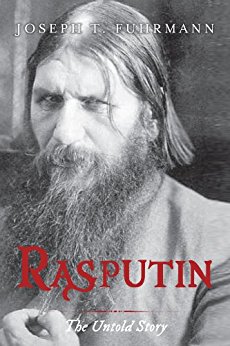
Rasputin I: Rasputin Rises


“Do you know that I shall soon die in terrible pain?” Grigori Yefimovich Rasputin is reported to have said, after being stabbed by a girl with no nose, and before eventually being assassinated. “But what can I do? God has sent me to save our dear sovereign and Holy Russia. Despite my terrible sins I am a Christ in miniature.”

At that point in Russian history, the name Rasputin was synonymous with evil. The mere mention of his name caused such suspicious dread among the subjects of the Russian Empire that they dared not say it aloud. They believed, as writer Meriel Buchanan wrote, “That by doing so they brought down ill luck on their heads.” When the inevitable subject arose, they referred to him as ‘The Unmentionable,’ ‘the Nameless One’, and they did so in whispers.

“Reports of Rasputin’s life are not ‘history’; they are the clash of history with subjectivity.” –historian Colin Wilson. 

The manipulative eyes of Grigori Efimovich Rasputin

Whether history or not, the reports of Grigori Yefimovich Rasputin would prove to be such a source of speculation and intrigue that they would secure for him an influential role in the Russian Empire, and a place in history. As the prolific British writer and historian Colin Wilson, writes the eye-witness accounts, and second hand reports, are so varied with subjectivity, and agendas, that it’s difficult to attain the absolute, irrefutable truth of any of them.

One could say as much with just about every historical figure, but the details of the Rasputin story are so debatable, and so fraught with folklore, that any writer reporting on him should be required to write qualifiers such as “alleged” or “according to sources …” before each report. While that may provide the author of such a piece some latitude in his reporting, it does not provide for very smooth reading. With the idea that every writer wants a compelling read coupled with factual accuracy, the best thing we can do is cite sources, footnote quotes, and provide quality attribution. The author of the book Rasputin: The Untold Story, Joseph T. Fuhrmann does this well without too much distraction. Fuhrmann also lists off some probabilities regarding the various incidents, and their various testimonials, and he attempts to prove, and disprove, them as possibilities.

There are a number of stories regarding Rasputin’s short life, but three launched him to his current, infamous stature in history. The first, called the Miracle at Spala, occurred in a small village called Spala, in which Rasputin was alleged to have cured the Tsar Nicholas II’s son of hemophilia; the second was Rasputin’s resultant influence over the Tsar Nicholas Romanov’s actions leading up to, and throughout, the portion of World War I Rasputin survived; and the last concerned the alleged reports of Rasputin’s murder.

A Special Child

Some accounts of the Rasputin story state that Rasputin was inspired to become what he became as a result of the death of a twin brother. Fuhrmann, asserts that it was not the death of a twin, or even a brother, named Dmitry, but a cousin named Dmitry, that changed the life of Grigori Rasputin. This would prove to be a minor distinction in that the other retellings match Fuhrmann’s assertion that it was the death of Dmitry that caused Rasputin feelings of depression and alienation that would mark him for the rest of his life. The incident that led to his cousin’s drowning also caused what could be termed a natural speculation in Rasputin regarding why his life had been spared in the incident. This speculation led Rasputin to the idea that God spared him, because God had a special purpose for him.

Rasputin’s mother would encourage, and propagate, this speculation, informing Rasputin that he had been endowed with mystical gifts from birth. His mother would claim that a comet rippled across the sky at the moment of his birth on January 10, 1869.

“A shooting star of such magnitude that had always been taken by the God-fearing muzhiks as an omen of some momentous event,” she is quoted as saying.

Fuhrmann writes that there is no record of any comets on the date of Rasputin’s birth.

Rasputin’s mother can be forgiven for such speculation, as Grigori would prove to be the one child of nine, and an alleged other sister, to survive infancy. One could speculate that with such sorrow inflicted upon a young woman, losing seven, perhaps eight children, she couldn’t help but assign a certain degree of specialness to the one child who survived the conditions that took the others. The others, who surrounded Rasputin in his youth, should not be afforded the same latitude, for they would encourage the belief that the young Rasputin was gifted with the ability to read minds, and/or “see things that others could not” without the heartache to influence it.

This fervent belief in a grand design for his life, led Rasputin to believe that he was not just special in God’s eye, but that he was so special that he was above God’s judgment.

Fuhrmann asserts that Rasputin’s belief in religion may have been deep, and humble, at one time, but he began to “embrace the dark side, regarding [each episode] as a trial sent by God” over time. Rasputin didn’t see various forms of temptation as a trial of personal morality, in the manner a mere mortal might, but as a test sent by God to His chosen one. Rasputin also claimed that his sexual encounters were sins he took upon himself, to relieve others of such weight.

After having relations with two girls, who happened to be sisters, –one twenty, the other fifteen– Rasputin informed their mother: 

“Now you may feel at peace. The day of salvation has dawned for your daughters.” 

“At least those two girls, (and the other reported sexual conquests) were willing,” writes Fuhrmann, as were the two nuns that Rasputin audaciously kissed publicly, but one girl was not. This girl charged:

“That Rasputin took her to his cellar and raped her.” Rasputin “Told the young girl, at the end of that episode, that there was no sin in what they had done; and that they had simply been celebrating the Holy Trinity.”

Rasputin statements about taking sins upon himself, and the declarations he made after these sexual trysts, may seem ostentatious manipulations to some, and they may have been, but they may have also been influenced by Rasputin’s loose adherence to the beliefs of a Russian sect called Khlysty.

The Khlysty and Sexual Spirituality

Khlysty was an underground, anti-church sect that engaged in sexual trysts as a ritualistic exercise. It involved dancing in a whirling motion until one got so dizzy that they fell to the floor. Once on the floor, the participants were instructed to engage in sexual intercourse with the person closest to them. Their goal, in performing this ritual, was to procure a “transcendental energy flowing through the arc” to achieve a peculiar and extreme religious state. They called this moment a spiritual frenzy that they believed would bring all participants closer to God. They also believed that by attaining the “dark knowledge” of sinning one could become more familiar with the nature of sin, and this level of familiarity would then allow them to purge it from the heart and be saved.

That Rasputin disavowed any participation in this Khlysty sect throughout his life, may have had something to do with the fact that it was outlawed in Russia at the time. This illegality led to its members being either arrested, or killed, and if Rasputin showed any allegiance to this outlawed sect, it would inhibit his ability to become influential later in life. It may have also had something to do with the fact that Rasputin regarded himself as a leader and not a follower. Rasputin was a member of the Russian Orthodox Church his entire life, but he didn’t view himself as a follower of the religion, but a leader that was never officially ordained by a church. He would, instead, develop his own following, that some believe was influenced by the Khlysty, without, Fuhrmann stipulates, the sexual portion of the Khlysty’s ritual.

This is not to suggest that Rasputin refrained from sexual activity with his followers, but he considered that sexual activity to be a more tangential aspect to his religion than did the Khlysty. Rasputin was a married man for much of his life, but he and his wife recognized the adultery, and flagrant sexual activity, as something Rasputin was forced to endure to relieve his followers of the dark knowledge of sin.

The teaching that sexual activity was, at least, a tangential part of the path to learning sin and receiving redemption from its knowledge –coupled with the fact that he gained quite a female following– has led many historians to speculate that his followers, a majority of which were female, may have been attracted to the quality of his leadership by way of his alleged large sexual organ. The theory being that with his endowment Rasputin could provide greater assistance to those female followers seeking to learn the depths of dark knowledge through greater states of ecstasy, and its subsequent spirituality.

The theories abound on whether this holy relic still exists, and if it does, what happened to it. One theory has it that those Russian soldiers who were called to the scene of Rasputin’s murder, stripped the dead carcass of Rasputin’s body bare, soon after death, and began measuring the enormous artifact with a brick. It was then alleged to have been cut off and stolen from the scene by a servant who preserved it in formaldehyde, after which a group of a Russian women then preserved the holy relic in Paris throughout the 1920’s, until it could be displayed, in a proper fashion, in an Erotica Museum in Saint Petersburg where it now rests, and is now regarded with great respect by a group of Rasputin’s devotees. The author Fuhrmann claims that the museum’s explanation, and all other explanations regarding its veracity, have never been proven to satisfaction.

Dispelling the Myths of the Mad Monk

The author goes through many of the debatable aspects of Rasputin’s life to prove the many things that he was not. He cannot be called a “Mad Monk”, for example, because he was never ordained as a monk. He was, at his pinnacle, nothing more than a starets, which was an informal title given by followers to one who advises or teaches. Fuhrmann also points out that Rasputin was not illiterate on the day he died, as many have suggested in a narrative that suggests that he was nothing more than an “illiterate peasant who rose to some of the greatest positions in the Russian Empire”. Fuhrmann writes that Rasputin received no formal education, but he did learn how to read, though never to the point that one regard him as well-educated.

In some portrayals of Rasputin, some speculate that his malevolence was intentional, and that he was the monster that many paint him as in their monster stories. Others suggest that Rasputin loved the Russian Empire as much as any of his fellow countrymen, and that he always had the best intentions when he advised the Romanovs. With his education, and his experiences in life, Rasputin just wasn’t qualified to be an adviser, as many of the Tsar’s advisers warned him. The fact that the Tsar took Rasputin’s advice over his more qualified advisers on some matters, and that that eventuated in the fall of the Russian Empire, is as much the fault of the Tsar’s for falling prey to the mystique of Rasputin, as it is Rasputin’s, if not more so.

For all that Rasputin was not, however, the one thing that can be stated about Rasputin, without refutation, is that he was a “right place, right time” mystical charlatan. In Rasputin’s Russia, Ouija boards, mystics, and holy men were nothing new, but when combined that with the strides that the rest of the world was making in science and medicine in that era –manipulating God’s power as it were– even the educated class was beginning to wonder how much of a leap it would be for one man to now manipulate God’s power in mystical ways. It was the first era in which electricity began to be manipulated in a safe manner; it was the first era in which automobiles began to roll off assembly lines; and it was also an era in which numerous other tremendous leaps in man’s ingenuity with respect to harnessing God’s power for everyday use began to occur. Learned men understood the principles of physics these ingenious men were manipulating, but most of the rest of the world just stood by in silent awe struggling to understand how these incomprehensible leaps could be made in the outside world. So, when Rasputin stepped into this chasm of confusion, at the right place and time in history, to “cure” or “heal” an ailing young boy of his hemophilia, he did so to an awed audience that was just beginning to believe that it wasn’t as far-fetched as previous generations may have believed for one man to harness God’s healing powers.

Next: Part II: A Miracle at Spala, Rasputin III: Rasputin’s Murder 

Fuhrmann, Joseph T. Rasputin: The Untold Story. Hoboken, NJ: John Wiley & Sons. 2013. Print.

Krauthammer on Churchill: The Indispensable Man


One of the primary goals of every writer is to have those who read his work regard him brilliant. Another goal, and a far more difficult and impressive one, is to have the reader arrive at brilliant thoughts while reading that work. Whether or not Charles Krauthammer’s new book Things That Matter: Three Decades of Passions, Pastimes and Politics accomplishes the former is relative to the reader, but in my humble opinion, the book definitely accomplishes the latter.

Book%20Cover_0In the second chapter, following the requisite intro, and the requisite chapter describing the author’s days of youth –playing baseball– Charles Krauthammer posits the notion that Time Magazine got it wrong when they nominated Albert Einstein “Man of the Century”. “Einstein may have been vital,” argues Krauthammer, and he is “certainly the best mind of the century”, but Britain’s Prime Minister Winston Churchill “carried that absolutely required criterion: indispensability” in the 20th century, and to the 20th century.

One thought this reader had, while reading, is that provocative, bar stool discussion that no person had a more prominent effect on the 20th century than Adolf Hitler. While that is arguably true, a question to that provocative notion should be, were the lessons of Hitler’s evil transgressions more transcendent than Winston Churchill’s efforts to, as Krauthammer later describes it, “slay that dragon”?

Hitler is, of course, indispensable to any study of the 20th century, in that he illustrated much of what’s wrong with human nature, and he gave us a template for how we should treat countries after war (after World War I). Though evil can take many forms, Hitler provided students of history a model of unprecedented evil that we can now use as a guide to detect evil, based on the precedent he set. We will hopefully never allow an evil despot to rise to such levels of prominence in their country that they would be in a position to coerce its citizens to do such evil things to one another. With all these lessons and precedents regarding absolute evil, students of the 20th century say that Hitler has to be the man of that century.

It’s a provocative notion, and it would probably give Hitler the stature, and historical value, that he sought all along. How many men, and how many precedents of the 20th century, will be cited more often than those Hitler provided humanity for centuries to come? Young people, involved in bar stool discussions, love such provocative notions, for they provide all listeners the impression that the provocateur is intelligent with such shock and awe proclamations. Most of us love such impressions, when we’re younger. As we age, and move past the desire to be perceived as intelligent through provocation, we actually become more intelligent, and we realize that most provocative thoughts should go through careful examination and attempts to disprove. The final conclusions we reach may not be as provocative, or as memorable, but as we age, read, and learn to temper our temperament, we realize that being correct is more valuable than being memorable or provocative. There is no doubt that the lessons evil men leave behind are monumental in history, but too often these provocative conversations leave out the dragon slayers that should, at least, be considered as prominent, if not more so.

To say that Winston Churchill hasn’t already achieved a prominent place in history would be foolish, as most historians continue to rank him in their top five most prominent figures of the 20th century, and most left-leaning historians will rank him in their top twenty. Does he deserve even greater prominence than we’ve already allowed, however?

One of the reasons Churchill is not higher on the list, I would submit, is that hindsight has proven that he was so obviously correct in his doomsayer predictions about Hitler. The idea that all of his warnings were so obviously on the mark, however, makes it almost boring to declare him the most prominent person of the 20th century.  It’s an of-course statement that causes readers to yawn over the headline, when a more prominent listing of others, such as Einstein, prove more provocative, compelling, and newsworthy.

Churchill was, as Krauthammer writes, “A 19th century man parachuted into the 20th,” but “it took a 19th century man –traditional in habit, rational in thought, conservative in temper– to save the 20th century from itself.” Yawn. Such lines don’t play well on the cover of a magazine to suggest that Churchill was right about Hitler, and thus he should be nominated the Man of the Century for speaking out and saving Britain and most likely the rest of the world. Especially when compared to the exciting, and revolutionary, bullet points a writer can compile about Einstein’s accomplishments.

Before dismissing the obviousness of Churchill’s warnings, one has to examine what he was up against while still in the British Parliament. Most of the British Parliament, and Prime Minister Neville Chamberlain, dismissed Churchill’s warnings. They did not want to view Hitler through Churchill’s simplistic, black and white lens. Churchill’s warnings were viewed as the impulsive, irrational, and the unreasonable views of a war hawk. Neville Chamberlain has been viewed, by right and left historians as one of the obvious fools of the 20th century, but is it a glaring headline that Churchill should be viewed as the most obvious hero of the 20th century, no, because it is just so obvious. It doesn’t require any creativity to back up. It just is what it is, as we now say.

Churchill suggested that the year’s delay between the Munich Pact and what he deemed an inevitable war worsened Britain’s position, in direct opposition to Chamberlain’s assessment. (Editor’s note: Chamberlain would later declare that that year allowed the British to bolster their troops, and that the British military was not prepared for war during the previous year.) In that year, between Munich and World War II, Chamberlain also exhausted the possibility of diplomacy with détente, blockades, and anything and everything the world could use to achieve “peace in our time”. To refute the Chamberlain claims, Churchill stated Hitler could have been removed from power by a grand coalition of European states to prevent World War II from happening in the year in question.

That suggestion, that in some cases waiting too long can worsen one’s position, would rear its ugly head before Hitler’s body even went cold, when U.S. General George S. Patton’s warned General Eisenhower about Russia. Eisenhower, presumably recognizing that Patton’s warnings were not unfounded, responded that Americans were simply too war-weary to make any moves against Russia. The suggestion would later haunt the world in the 21st century, with Iraq in 2003, in a manner some would suggest the reverse of the Churchill suggestion, saying that we acted too impulsively, and the suggestion will probably haunt nations around the world for many more, because the human instinct is to avoid war at all costs, no matter how black and white, and simplistic, and obvious the need for action becomes.

In later writings, “Churchill depicted Chamberlain as well-meaning but weak, blind to the threat posed by Hitler, and oblivious to the fact that (according to Churchill) Hitler could have been removed from power by a grand coalition of European states. Churchill suggested that the year’s delay between Munich and war worsened Britain’s position, and criticized Chamberlain for both peacetime and wartime decisions. In the years following the publication of Churchill’s books, few historians questioned his judgment.”{1}

It may appear redundant to call an historian a hindsight historian, since history is documented in hindsight, but some historians document the facts of an era while others provide hindsight commentary to historical events that were not as clear to the historical figures of the day. These historians provide the unlimited omniscience that hindsight provides. Hindsight historians may document Churchill’s warnings as obvious now, but most hindsight historians will not tell you how popular Neville Chamberlains “peace in our time” efforts were at the time.

Another question those who believe Hitler’s quest for power was so obvious that it’s now redundant to talk about, should ask themselves how obvious it was to Neville Chamberlain at the time. How obvious was it to the British Parliament, the isolationists in America, and the world at large? Much like today, Churchill was regarded as a war hawk, and presumably a fear monger when he spoke of what he believed to be Hitler’s aspirations. Some have said that Churchill is almost solely responsible for the meetings that occurred at Tehran, Yalta, and Potsdam with FDR and Stalin that eventually won the war for the allied forces. 

We’ve all read hindsight historians document that America shouldn’t have been “so stupid” as to allow the attack on Pearl Harbor, when so many signs pointed to its eventuality. It’s easy for them to look at the decade preceding the terrorist attack on September 11, 2001, to declare that we were obviously naïve in trying terrorists as criminals rather than wartime adversaries. It’s also easy for them to write that that the call to war in Iraq, in 2003, was impulsive based on our inability to find weapons of mass destruction in Iraq. What’s not so easy, however, is for those figures that were involved in the present tense of history to stick their neck out and speak out against the conventional wisdom of their day and declare that it’s “weak and blind” to continue to follow the conventional line of thinking. Hindsight historians now slightly diminish Churchill’s role in 20th century, because it is now so obvious that Hitler was the epitome of evil. To read through an objective telling of the history, however, it obviously wasn’t so obvious to some at the time.

As Krauthammer wrote in Things That Matter:

“And who is the hero of that story?  (The story of the 20th century’s ability to defeat totalitarianism, and leave it as a “cul-de-sac” in the annals of human history.) Who slew the dragon? Yes, it was the ordinary man, the taxpayer, the grunt who fought and won the wars. Yes, it was America and its allies. Yes, it was the great leaders: FDR, de Gaulle, Adenauer, Truman, John Paul II, Thatcher, Reagan. But above all, victory required one man without whom the fight would have been lost at the beginning. It required Winston Churchill.”{2}

Krauthammer, Charles.  Things That Matter: Three Decades of Passions, Pastimes and Politics.  New York, New York:  Random House, 2013.  Print.

James Joyce: Incomparable or Incomprehensible?


Those of us who are always on the lookout for edgy, racy content have heard the term “Joycean” thrown about with little discretion over the years. If you’ve heard this term as often as I have, you’ve no doubt asked, what does it mean to be “Joycean”? To listen to critics, it can mean whatever you want it to mean? They appear to be more interested in using the term than using it properly, but how do we use it properly? What does “Joycean” mean? If James Joyce were still alive, we would love to ask him if his last two books were two of the most erudite, most complicated pieces of fiction ever written, or were they a great practical joke you played on the literature community to expose reference makers and elitist, scholars for who they are?

James Joyce
James Joyce

Readers who seek to up their erudite status by reading “difficult” books, have all heard of Joyce’s final two works of fiction: Ulysses and Finnegans Wake, as literary scholars list these books as some of the most difficult, most complicated works of fiction ever created. Those of us who were intrigued, decided to pick them up that as a challenge of the mind, others attempt to read them to gain entrance into their subjective definition of elite status. Most are confused and disoriented by the books, but some have the patience, the wherewithal, and the understanding of all of the references made, and languages used, in these books necessary for comprehension. Those readers either deserve a hearty salute, or the scorn and laughter that Joyce provided, as a gift to the havenots, who are honest enough to admit that they don’t know what was going on in them. Was Ulysses such an ingenious book that it’s worth all of the effort it requires for greater understanding, or was it a book about nothing?  

I don’t understand either of these books, and I have gone back numerous times to try to further my understanding. Some have said that Ulysses is the more palatable of the two, but I have found it too elliptical, too erratic, and too detail-oriented to maintain focus, and I have purchased three different aides to guide me through it. Some of the readers who claim to enjoy Ulysses, admit that Finnegans Wake is ridiculously incomprehensible.

Most people enjoyed Dennis Miller’s tenure as an announcer on Monday Night Football, but most of those same people complained that they didn’t understand two-thirds of the man’s references. I didn’t keep a journal on his references, but I’m willing to bet that at least a third of them were Joycean in nature (Ulysses specifically). Miller stated that his goal, in using such obscure references, was to make fellow announcer Al Michaels laugh, but any fan who has followed Miller’s career knows that he enjoys the motif of using complicated and obscure references to make himself sound erudite. There are, today, very few references more obscure than those that recall the work of James Joyce, a man who described his last book, Finnegans Wake, as “A book obscure enough to keep professors busy for 300 years.”

Andy Kaufman referenced James Joyce when trying to describe his method of operation. The import of the reference was that Kaufman wanted to be a comedian’s comedian, in the manner that Joyce was a writer’s writer. Kaufman wanted to perform difficult and complicated acts that the average consumer would not understand, and the very fact that they didn’t “get it” was what invigorated him. He wanted that insider status that an artist uses to gain entrée to the “in the know” groups. After achieving some fame, audiences began laughing with Kaufman in a manner that appears to have bored him, and he spent the rest of his career trying to up that ante. By doing the latter, we can guess that there was something genuine about Kaufman’s path in that he was only trying to entertain himself, and his friends, and if anyone else wanted on board that was up to them. Joyce and Kaufman, it appears, shared this impulse.

Anytime an artist creates a difficult piece of work, there is going to be a divide between the haves (those who get it) and the havenots. When Mike Patton formed the relatively obscure band Fantomas, he never did so with the illusion that he was going to unseat the Eagles Greatest Hits, or Michael Jackson’s Thriller, atop the list of greatest selling albums of all time. He knew that his group would playing to a very select audience.

What is the audience for such difficult subject matter? Most people seek music, as either background noise, something to dance to, or something to which they can tap their finger. Most people read a book to gain a little more characterization and complication than a movie can provide, but they don’t want too much characterization, or too much complication. Most people only buy art to feng shui their homes. Most people don’t seek excessively difficult art, and those who do are usually seeking something more, something more engaging, and something more provocative that can only be defined by the individual. The audience who seek something so different that it can be difficult generally have such a strong foundation in the arts that they reach a point where their artistic desires can only satiated by something different.

Yet, different can mean different things at different times to different people. Different can be complicated, and discordant, but it can also be limited to style. At this point in history, it’s difficult to be different, in a manner that cannot be called derivative of someone or something, so some people seek any separations they can find. When the latest starlet of the moment twerks in a provocative manner, has a construction worker find her pornographic video, or accidentally has her reproductive organ photographed, we know that these are incidents were created by the starlet, and her people, to get noticed after they have exhausted all other attempts to be perceived as artistically brilliant and different.

There are other artists who are different for the sole sake of being different. This is often less than organic, and it often disinterests those who seek a true separation from the norm, because we feel that this has been thoroughly explored to the point of exhaustion. Andy Kaufman created something organically different that can never be completely replicated, in much the same manner Chuck Palahniuk, Mike Patton, David Bowie, Quentin Tarantino, and Jerry Seinfeld and Larry David did. Can it be said that James Joyce’s final two books were different in an artistically brilliant, and cutting edge manner that all of these artists’ creations were, or were James Joyce’s writings more symbolism over substance? Put another way, was Joyce a substantive artist who’s true messages need to be unearthed through careful examination, or was he simply twerking in a provocative manner with the hope of getting noticed by the elite scholars of his generation after exhausting the limits of his talent in other works?

Judging by his short stories, James Joyce could’ve written some of the best novels in history. Those who say that he already did, would have to admit that his final two works were not overly concerned with story, or plot. Those who defend his final two works would probably say that I am judging Joyce’s final two works by traditional standards, and that they were anything but traditional. They would probably also argue that the final two works sought to shake up the traditional world of literature, and anyone who dared to take up the challenge of reading these works would probably say Joyce sought to confound us, more than interest us, and if they concede to the idea that the final two works were different for the sole sake of being different, they would add that he was one of the first to do so. Those who defend his final two works say that they are not as difficult to read, or as complex, as some would lead you to believe. These people suggest that reading these two works only requires more patience, and examination, than the average works. Anyone who states such a thing is attempting to sound either hyper intelligent, or hyper erudite, for it was Joyce’s expressed purpose to be difficult, complicated, and hyper-erudite.

To understand Ulysses, one needs an annotated guide of 1920-era Dublin, a guide that describes the Irish songs of the day, some limericks, mythology, and a fluent understanding of Homer’s The Odyssey. If the reader doesn’t have a well-versed knowledge of that which occurred nearly one-hundred years prior to today, they may not understand the parodies, or jokes Joyce employs in Ulysses. Yet, it was considered, by the Modern Library, in 1998, to be the greatest work of fiction ever produced.

“Everyone I know owns Ulysses, but no one I know has finished it.”  —Larry King.

To fully understand, and presumably enjoy, Finnegans Wake, the reader needs to have at least a decent understanding of Latin, German, French, and Hebrew, and a basic understanding of the Norwegian linguistic and cultural elements. The reader will also need to be well-versed in Egypt’s Book of the Dead, Shakespeare, The Bible, and The Qur’an. They also need to understand the English language on an etymological level, for one of Joyce’s goals with Finnegans Wake, was to mess with the conventions of the English language.

Some have opined that one of Joyce’s goals, in Ulysses, was to use every word in the English language, and others have stated that this is a possibility since he used approximately 40,000 unique words throughout the work. If this is true, say others, his goal for Finnegans Wake, was to extend the confusion by incorporating German, French, Latin, Hebrew, and other languages into his text. When he did use English, in Finnegans Wake, Joyce sought to use it in unconventional and etymological ways to describe what he believed to be the language of the night. He stated that Finnegans Wake was “A book of the night” and Ulysses was “A book of the day”.

“In writing of the night, I really could not, I felt, use words in their ordinary connections . . . that way they do not express how things are in the night, in the different stages – conscious, then semi-conscious, then unconscious. I found that it could not be done with words in their ordinary relations and connections. When morning comes of course everything will be clear again . . .  I’ll give them back their English language. I’m not destroying it for good.” —James Joyce on his novel Finnegans Wake.

This use of the “language of the night” could lead one to say that Joyce was one of the first deconstructionists, and thus ahead of his time by destroying the meaning of meaning in the immediate sense. Those obsessed with James Joyce could interpret the quote, and the subsequent methodology used in Finnegans Wake, to mean that Joyce had such a profound understanding of linguistics that normal modes of communicating an idea, bored him. He wanted something different. He wanted to explore language, and meaning, in a manner that made his readers question their fundamentals. Readability was not his goal, nor was storytelling, or achieving a best-seller list. He sought to destroy conventions, and common sense, and achieve a higher realm of perfect, in which timeless abstractions cannot be communicated to those who adhere to common sense. This makes for an interesting conversation on high art, and philosophy, but does it lend itself to quality reading?

“What is clear and concise can’t deal with reality,” Joyce is reported to have told friend Arthur Power, “For to be real is to be surrounded by mystery.”

In the modern age, there is much discussion of the widening gap between the haves and the have nots. That particular discussion revolves around economic distinctions, as it has for time immemorial, but in the Joycean world, the gap involves those who “get” his works, and those who do not. Those who get it usually prefer to have deeper meanings shrouded in clever wordplay. They usually prefer symbolism over substance; writing over storytelling; and interpretation over consistent and concretized thoughts.

The two schools of thought between the haves and the havenots can probably best be explained by breaking them down to the different approaches James Joyce and one of Joyce’s contemporaries Ernest Hemingway. Hemingway wrote clear and concise sentences. Hemingway stated that his methodology was to write something that was true:

“The hardest thing is to make something really true and sometimes truer than true.”—Ernest Hemingway.

Putting Joyce’s final two works through the Hemingway school of thought, one could say that Joyce’s methodology was: Some of the times, it’s more interesting to make it false and allow others to define it as true. 

“Though people may read more into Ulysses than I ever intended, who is to say that they are wrong: do any of us know what we are creating? … Which of us can control our scribblings? They are the script of one’s personality like your voice or your walk.” —James Joyce

Those of us who have had a deep discussion, on a deep, multifaceted topic, with a deep thinker know that sooner or later a declarative distinction will be made if we stubbornly insist that we are not wrong. “You don’t get it, and you probably never will,” is something they say in a variety of ways. We all know what it feels like to be summarily dismissed as an anti-intellectual by a deep thinker? Those who aren’t snobbish in an anti-social manner, often avoid openly dismissing us when we’re around, but even the polite snobs give us a vibe, a look, or a chuff that is intended to let us know our place.

“Well, what do you think of it then?” is the response some of us have given, after being backed into an anti-intellectual corner by deep thinkers.

If they are an anti-social, elite intellectual snob, they will say something along the lines of: “I simply choose to think deeper!” It’s a great line, and it purportedly puts us stubborn types in our place, but it’s a self-serving non-answer. Those of us who are more accustomed to interaction with deep thinkers, will then ask them to expound upon their complicated, deep thinking? Pushing deep thinkers deeper will often reveal a lack of substance beneath their piles of style, and the careful observer will find that the results of their deep thinking is no deeper than the deep thinker cap they wear to the pub.

A number of attempts at reading Joyce has led me to believe that he probably didn’t have much substance beneath his piles of style, so he muddied the waters of his message with puns, songs, gibberish, abstractions, foreign languages, and overly complicated complications. He did this, in my opinion, to conceal the fact that when compared to his colleagues, he didn’t have all that much to say. If that’s true, he was definitely artistically accomplished in saying it.

Who can forget the many sayings that Finnegans Wake dropped on our culture, such as the transcendental sound of the thunderclap that announced the fall of Adam and Eve from the garden of Eden:

“bababadalgharaghtakamminarronnkonnbronntonnerronntuonnthunntrovarrhounawnskawntoohoohoordenenthur-nuk!”

What about the mirthsome giggles we have had in social gatherings with the catchphrase:

“A way a lone a last a loved a long the riverrun, past Eve and Adam’s, from swerve of shore to bend of bay, brings us by a commodius vicus of recirculation back to Howth Castle and Environs.”

Or the ever present: 

“(Stoop) if you are abcedminded, to this claybook, what curios of sings (please stoop), in this allaphbed! Can you rede (since We and Thou had it out already) its world?”

If you just read those sentences three or four times, and you still have no idea what it says, and you just went back to read them again, because you want to be a have that “gets it”, you’re not alone. If these passages were merely anecdotal evidence of the difficulty involved in reading Finnegans Wake, that would be one thing, but these difficulties litter just about every sentence of every paragraph of the book, as evidenced by the exhaustive assistance provided at the site Finwake.com for readers who have no idea what this writer is going on about. 

Finnegans Wake is reported to be in English, but it’s not the standard version of English where words have specific meaning. The “language of the night” was intended for linguists who are tired of reading words that have exact meanings, and it was intended to be playful and mind-altering, and rule breaking. James Joyce made references intended to be obscure even to the reader of his day who may not have Joyce’s wealth of knowledge of history, or the manner in which the meaning of the words in the English language have changed throughout history.

“What is really imaginative is the contrary to what is concise and clear.” —James Joyce

James Joyce was a stream of consciousness writer who believed that all “mistakes” were intended on some level that superseded awareness. In the 500+ page book, Finnegans Wake, Joyce found 600 errors after publication. He was informed of some, if not all of these errors, and he was reported to have fought his publishers to keep them in. Later editions were written to correct many of these errors, and provide readers “the book in the manner Joyce had intended.” If Joyce didn’t believe in errors, however, how can those who corrected them state that the corrected edition is the definitive edition that “Joyce intended”?

“The man of genius makes no mistakes, his errors are volitional and portals of discovery.” –James Joyce

Throughout the seventeen years Joyce spent writing Finnegans Wake, he began to go blind, so he had a friend named, Samuel Beckett, take dictation over the phone to complete the novel. At one point in this dictation setting, someone knocked on Joyce’s door. Joyce said, “Come in!” to the knocker, and Beckett wrote the words “Come in!” into the narrative of Finnegans Wake. When this error was spotted by Joyce, and the confusion was sorted out, Joyce insisted that Beckett, “Leave it in!” On another occasion, when a printer’s error was pointed out he said, “Leave it. It sounds better that way than the way I wrote it.”

There are three different versions of the text: The first and second are the editions that Joyce submitted for publications with all of the errors intact. The third edition has the errors that the editors located, and the 600 corrections that Joyce spent two years locating, corrected. Some would have you believe that first two editions are the definitive editions, but you have to be a Joyce purist to appreciate them.

Can it be called anything short of egotistical for an author to believe that his subconscious choices and decisions, are somehow divine? If, as Joyce said, and Picasso later repeated in regard to his paintings, mistakes are portals of discovery, then we can say that’s great, and incredibly artistic in the process of creation. To leave it in the finished product, however, and subject your readers to the confusion, just seems narcissistic. “Here’s what I was thinking at the time,” Joyce is basically telling his readers. “I don’t know what it means, but this is a higher plane of thinking than simple conscious thought. Isn’t it magical? Maybe you can make some sense of it. Maybe you can attribute it to your life in some manner.” This method of operation may say something profound about the random nature of the universe, but when we’re reading a novel we don’t necessarily want to know about the randomness of the universe, unless it’s structured in a manner that leads us to your statement. 

Not everyone can write a classic, and some realize this after a number of failed attempts. Once they arrive at this fork in the road, they can either write simple books that provide them and theirs an honest living, or they can grow so frustrated by their inability to write classics that they separate themselves from the pack through obscurity. The advantage of creating such an alleged contrivance is that beauty is in the eye of the beholder, and the beholder can assign their own relative beauty to it. Some would say this is the very definition of art, but others would say even that definition has limits. Some would say that the most obscure painting is art, because they “see it”, where others see only schlock for elitists to crib note to death, until meaning is derived.

James Joyce is considered the exception to this rule, fellow writers have told me, and if you are going to attempt to write an important novel in the 21st Century, you had better be familiar with him. I’ve tried, and I now believe that I’m destined to be a havenot in the Joycean world … even with Ulysses. The question that arises out of those ashes is, am I going a long way to becoming more intelligent by recognizing my limits, or should it be every aspiring intellect’s responsibility to continue to push themselves beyond any self-imposed limits to a point where they can finally achieve a scholarly understanding of difficult material? If this is a conundrum that every person encounters when facing challenges to their intelligence, is Ulysses, or more pointedly Finnegans Wake, the ultimate barometer of intelligence, or is it such an exaggerated extension that it had to have been a practical joke James Joyce played on the elitist literary community to expose them as the in-crowd, elitist snobs that they are when they “get it” just to get it. Do they really “get it”, or are they falling prey to Joyce’s clever ruse to expose them as people that “get” something that was never intended to be “got”?