This category contains the efforts I’ve made to cover territory that hasn’t been plodded upon too often. The Abraham Lincoln stories being the exception.
Epiphanies, like women, can pop up when you least expect them, and they can free you from a troubling part of your life you didn’t understand as a problem until they were revealed. Most of us learn if we’re multi-taskers, optimistic, outgoing, genuinely funny, and/or thick-skinned to those who label us otherwise. Isn’t it interesting when a “That’s me!” pops up that teaches us more about ourselves than we know before.
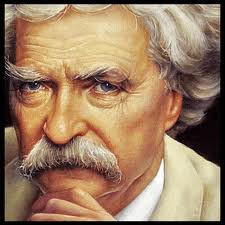
In a PBS documentary on Mark Twain, a number of incidents arose in the building of Twain’s home, and the construction team began “badgering” Twain with questions regarding how he wanted them handled. The questions regarded the construction of his home, a place the older Twain would presumably live in for the rest of his life, so the observer should forgive the construction crew’s chief for the badgering. The team didn’t know how he wanted some particulars of his home constructed, and they probably had hundreds of questions for him. What the team did not know, however, was that Twain had an oft expressed aversion for details.
“That’s me,” I thought. If I were to construct my own home, I can see myself going “all-in” on the big, meaningful constructs. I can see myself all-in on the design, and some of the details. I can see myself all hopped up in the beginning, acutely focused, and knocking out every question with pinpoint answers. I would consider other perspectives, others’ advice. I would probably read books, watch YouTube videos, and gather as much information as possible to make an informed decision. At some point, and no one knows when this point hits, I would begin to shut down. It often happens soon after the this-and-that questions hit the floor.
“Do you want this or that?”
“I’ll take this.”
“Are you sure, because that offers a this and that.”
“OhmiGod, just gimme that then.”
“It’s your house,” they say. “We just want to make sure you’re getting what you want.”
“I understand. Give me that.”
Details, regarding otherwise inconsequential minutiae, make me feel stupid. These details start firing far too many neurons in my brain for me to handle, and I often get overwhelmed and exhausted by them. I know that I should be listening to every question, and I feel guilty for not being able to ponder all of the details they give me to come up with the ideal solution for my family, but my capacity for such matters is limited. When the flood of this-and-that questions hits, I’m completely out of gas. “Whatever, just get it done!” I’ll fall away from the creative to what is expected, and what it is that those still paying attention want. My answers going, forward, are autonomic. “Yes, that sounds fine,” I’ll say without knowing the question. I’ll just want the damn thing to be built already by that point, because I’m not a details-oriented guy. I’ll want to make the big decisions, but I’ll want to leave all of the “inconsequential” details-oriented questions to others.
I feel guilty. I want to be involved, informed, and constantly making acutely focused decisions throughout the process. I feel guilty when others start making the decisions that affect me, because I know I’m an adult now, and I should be making all these decisions. There is also some fear that drives me to constantly pretend that I’m in prime listening mode, based on the fact that I may not like the finished product if I’m not involved in every step. I may not like, for example, the manner in which the west wing juts out on the land and makes the home appear ostentatious, or obtuse, or less pleasing to the eye with various incongruities, and I’ll wish I would not have been so obvious with my “Whatever just do it!” answers. Details exhaust me, though, and they embarrass me when I don’t know the particulars that the other is referencing.
I don’t know if the guilt is borne of the fact that I know I’m an intelligent being, and I should be able to make these decisions in a more consistent manner, or if I’m just too lazy to maintain acute focus. I do have a threshold though, and I know how my brain works. I know that if there are seven ways to approach a given situation, I will usually select one that falls in the first two selections offered. I usually do this, because I’m not listening after the second one. Everything beyond that involves the other party showing off the fact that they know more than I do. I know this isn’t always the case, but it’s the only vine I can cling to when having to deal with my limited attention span and the limited arsenal of my brain.
Knowing my deficiencies for retaining verbosity, I will ask for literature on the subject that provides the subject a tangible quality that can be consumed at my pace. If I do that, and I have, I will then pretend to read every excruciating word, but I will usually end up selecting one of the first two selections offered. Companies know the predilection we have to choose the first one or two selections, and they pay search engines to optimize their place in searches. We might envy the person who knows enough to know that selection #7 is the ideal company for this job, but we know we’re not that guy.
I like to think I have a complex brain. I like to think that I display all that I’m about in my own way, but I’m always reminded of the fact that most of the people around me give full participation to the details of life no matter how overwhelming and exhausting they can be to me. It’s humbling to watch these brains, I like to consider inferior, operate on planes of constant choices, and decisions, and retentions, and details I am incapable of retaining.
I have this daydream that I will one day be given an excuse for having such a limited brain by the relative brilliance I reveal to the world in the form of my book. I am interviewed in this dream, and I am asked, “So, what does it mean to you to have crafted such a fine book?” I am far wittier than reality would suggest in this dream when I reply: “It will help me deal with all of my faults better. The fact that I cannot fix my own plumbing, can now be countered with, but I wrote a fine book. The fact that I cannot fix my own car, compete with my wife in certain areas of intelligence, or hold down a decent job can now be countered with, but I wrote a book that is held up as a fine book in certain quarters.”
We’ve all heard the line “Everybody’s mind works differently,” but until we learn something regarding the fact that the brilliant mind that composed Huckleberry Finn has similar deficiencies, we cannot help but feel guilty about them. “Well, work on your deficiencies,” those around us suggest, and we do when that next project comes about. We’re out to prove ourselves in that next project. We answer every question, from the first few to the this-and-thats, with prolonged mental acuity. When that third and fourth project rolls around, however, we’ll revert back to those inferior brains that can’t retain details, and it is then that we’ll envy those “inferior” brains, consistently showing their superiority. This could lead those of us that never knew we were suffering from such a recognized deficiency into feelings of incompletion, until someone like Mark Twain recognizes and vocalizes his defeciencies for us.
It was a shock for me to hear that some assume Sesame Street’s Ernie and Bert are gay. When I first heard that, I thought the statement, true or not, was provocative, insurgent, and hilarious. I don’t remember who first made the claim, but I do recall thinking the individual was on the cusp of something new, something insidious, and transcendent. This person must be part of an insurgent generation that revolts against civil authority, through pop culture, in a manner that is not belligerent, I thought. I wanted to be at the forefront of that insurgence that didn’t just break down societal barriers but left a wasteland in its wake, and I was not concerned with collateral damage. Children be damned, I thought. I wanted to be one of those that shook the cultural two-liter bottle up, and I considered that characterization of Ernie and Bert a good start.
I wanted to convince the world, through repetition, that the reason Aloysius Snuffleupagus (affectionately known as Mister Snuffleupagus) talked and moved so slow on the set of Sesame Street was that he was stoned. I wanted to inform anyone who would listen that the Bradys were all stoned, gay, and involved in incest, along with anything else we could dream up to poke holes in the traditional wholesomeness that led my fellow brethren from broken homes to feel estranged. On the reality side of the tube, we were suffering, and many of us found it disgusting that sixties and seventies television would have the audacity to portray an idyllic image of a family that left the rest of feeling ostracized. I was ready, willing and able to join the fights, until Hollywood vindicated us by producing The Brady Bunch Movie that had its characters deal with pot smoking, lesbians, and the realities we purported to be more in line with our experiences.
“I’m serious. I can’t stand Big Bird. He’s an *******!” someone said.
I’m still not sure how much sincerity drove such comments, but that was precisely what made the insidious provocation so delicious. If it wasn’t serious, it was funny in a serious, seditious manner. If it was serious, on the other hand, it was funny in an unserious manner. Whatever the case, the artful joke teller left it as a standalone. A comment like that one stated that there was no need to preface such comments with the qualifiers most insurgents felt compelled to offer in the gestation period of the movement, when characterizing a child’s beloved creature in such a manner. Refraining from such typical hospitalities and considerations signaled to the rest of us that the age of qualifiers was over, and a full-on insurgency was under way.
Charles Bukowski was not the first to speak out against the authority figures of the sociopolitical world, nor will he be the last. The mindset might date back to the Romans, the ancient Greeks, and beyond, but to my knowledge, no one attacked the soft underbelly of civil authority through the pop culture staples of children’s entertainment as successfully as Bukowski. If he didn’t start the movement, he at least exerted tremendous influence on me and my insurgent brethren. We raised our fists high with a scream, when we learned that the writer had the temerity to come out against a cultural icon many believed to be the standard-bearer of cutesy America, and spawn of Walt Disney.
“Mickey Mouse is a three-fingered son-of-a-bitch with no soul,” Charles Bukowski said.
“For us to get back to real America,” a friend of mine said, paraphrasing Bukowski, “we have to destroy Mickey Mouse, because Mickey Mouse destroyed the soul of America.”
It was such a provocative statement, a plane of thought crashing into what I considered the foundation of America. Those I associated with at the time claimed that by making such a declaration, my friend gained panache, and the women around us dug panache. Someone else accused him of being an angry young man, and experience taught us that women loved angry young men. His statement was so provocative, and so Rage Against the Machine that we dug his anger too. Knowing nothing of Bukowski or any other insurgent thoughts at the time, we thought this guy had anger without causation, and we considered that the essence of cool.
“What are you rebelling against?” a female actor asked actor Marlon Brando in the 1953 movie The Wild One.
“Whaddya got?” Brando replied.
That’s the stuff! Suck it Mickey!
Those who have read Charles Bukowski already know that cute America began with an institution called Disney, which started with the institution created by the cartoon character called Mickey Mouse. “It all started with institutions for those who need to be institutionalized,” was a refrain of retro-hip haters. “Those who seek Mickey Mouse, as their form of entertainment live in a soulless, philosophy-free form of hell,” they said. “A life of Mickey will lead to an uncomplicated life of laughter, frivolity, fun, and soullessness. It will lead a generation of Mickey fans, children and otherwise, who will live without knowledge of the stark realities of poverty, drugs, disease, prostitution, and porn.” They apparently thought it would lead to a generation of children who wouldn’t understand the harsh realities of life.
“Mickey Mouse?” the aghast asked. “What could you possibly have against Mickey Mouse?”
“Nothing,” the cool, hip cats answered, “except that he is a three-fingered son-of-a-bitch with no soul.”
We fellas watched such cool, retro-hip cats walk away from such conversations, with laughter, open-mouthed awe, and elongated stares trailing behind them. We didn’t know if the women believed them, but we saw that some women loved such comments, and we knew we had to get some of that.
These provocative soothsayers appeared to have a formula for intriguing otherwise unattainable women, when they delivered such lines in a subtle and suave manner. The formula also appeared to be something we uncool fellas thought we could put to good use. I don’t know if others ever managed to use this technique successfully, but any flirtations I had with using the tool met a quick end when the retro-funny-nerd types stepped in with their “Elmo rocks!” and “Grover is a dude!” T-shirts. Those apparel choices were not intentionally insurgent, and their motivation confused me. Their shirts made kind, funny statements like, “Big Bird is my homeboy!” and, “I was raised on The Street” (with an accompanying picture of Sesame Street on the shirt), and they garnered laughter from women. Women asked them about their T-shirt, and the T-shirt wearers got a ticket to ride. This left the rest of us confused. “We had a formula,” we wanted to say to the retro-funny-nerd types. “You’re messing up the dynamic of what we just started to understand.”
Even if we had been able to use those insurgent statements, we would’ve said them with some humorous underpinnings. We wanted to be funny in a way that some strong, intellectual themes of that era were. I don’t know how many contra rebels sought the higher plane of funny in the manner I did, but I did run across a few who took the insurgent movement a bit too seriously and presented their arguments without any humorous underpinnings.
I don’t know if Bukowski was one of them, or if he used the insurgent formula to rise to the throne of the insurgent rebels in a capitalistic venture, but standup comedians took Bukowski’s fundamentals into the stratosphere. Bukowski might have found this a little unsettling. Then again, he might have intended these statements to serve as a launching point. Whatever the case, I’m sure that if Bukowski lived long enough to witness the insurgency permeate the culture to the degree where even little old ladies began declaring, “Barney sucks!” at Applebee’s, he would’ve been proud. Whatever the case, Bukowski’s acolytes took this message more seriously than the rest of us.
Few can pinpoint where such movements begin. Likewise, few can pinpoint their demise. In our limited perspective, we are only aware of what happens in our inner circles. In my inner circle, the insurgent institution began to wane, but the Bukowski acolytes held true. “Barney still sucks!” they said. They blasted the otherwise innocuous, purple dinosaur so often that some in their audience began to believe it was something more than comedic shtick. We began to understand that they were sincere believers. The retro-funny-nerd types and little old ladies at Applebee’s inadvertently exposed the true believers as ludicrous, and a little too serious and self-righteous, to a point where we laymen began to back away from our attempts to achieve orthodoxy.
“You do realize that Barney the Dinosaur wasn’t written for middle-aged men, right?” we asked the ultra-serious strain, waiting for their dry tones and deadpan expressions to break into a smile.
“I don’t care,” they answered. “He’s created a soulless America that seeks the cute mindset with those horrible ‘I love you’ and ‘you love me’ songs he sings. He has no soul.” Then, to further this insurgent agenda, they might turn to their children, and inquire, “Ms. Mary, What do we think of Barney the Dinosaur, Miss Mary?”
“He sucks!” Ms. Mary says. “He should have a hypodermic needle hanging from his arm, and a mohawk on his head, and the world would be a much better place if his father learned the proper use of a condom.” Ms. Mary’s learned version of cute sophistication often elicits laughter and a chorus of “Aw,” from everyone at the table.
At this point or some points in between, the observer begins to realize that the true believer has a bona-fide opinion on the matter, one they consider so consequential that they teach their children to mimic it. They are angry that any individual of any age would seek the soft entertainment that Mickey or Barney provides.
They cannot abide their children’s occasional giggles at the humorous actions of a grown man in a Barney outfit. When the show does garner a giggle, we can imagine them peering around their electronic device at Ms. Mary and admonishing, “What do we say about Barney again?”
“He sucks,” Ms. Mary repeats.
“That’s right,” the parents says before going back to their device.
At this point or some points in between, the casual observer can’t help but further question the parent’s motives. “I think this is all funny, don’t get me wrong, but you can’t possibly believe in this, this much, do you?”
For some parents, the dinosaur, the mouse, and some of the other, more popular characters of youth programming are annoying. Most parents of this era talked about the mind-numbing repetitiveness of some songs, and how the cutesy, nice interactions between the characters drove them crazy, but there are others who take these annoyances a step further. I’ve met them. I met parents who wanted more for their children, and their various definitions of more were largely left to the imagination. If a parent doesn’t want mind-numbing educational songs for their children, or cutesy interactions that might teach children how to interact with their peers, how does a parent counter such programming to prepare their children for the stark reality of the world? Do they introduce them to violent, obscene movies to give their children a more vivid picture of themes that contain violence and sexual identity? Do they do this under the guise that they believe this will lead to their children being less inclined to ostracize and hate the differences in people? What if, after watching such material, their child tickles Elmo in a department store, and they giggle along with the furry toy? We can only guess that this might manifest into some form of hopeless frustration. How does a parent counteract that? Would they sit their child down and remind them of the misery in the world? How far would they go to achieve some form of hopeless tears in their child? If they did achieve it, would they feel an odd sense of satisfaction by preparing the little one for the misery that awaits them on the other side of childhood? One has to wonder if these children are more miserable based on the efforts of their parents, and if there is anything, anyone could do to prepare them for a life of that.
Bukowski’s goal was to create an anti-Disney America that was awash in stark reality. By implication, we can suggest that if Bukowski were in charge, the children of America would be awash in alcohol, sex, and violence. He would want America’s children to know the country he knew and wrote about in his poems and books. He would want them to know the stark reality of abusive fathers and to be aware that alcohol is the only form of escapist entertainment that has any soul. “And the track,” Bukowski acolytes might remind us, “Don’t forget about Bukowski’s routine trips to the track.” We can be sure that the gospel according to Bukowski would include the belief that horses, not Mickey Mouse, can make all our dreams come true, and any child who doubts that can tune in to the cast of characters at their local track.
“Screw childhood,” Bukowski appeared to say. “Screw wholesome Americans, born and bred on Disney, who believe that naïve childhood should last as long as possible. It’s not realistic. Childhood is the very essence of cutesy America. It’s farcical, and it has no soul.”
To support the counter-argument, we must cede to the idea that Disney has damaged some susceptible children-turned-adults. We must recognize that some adults have an unusual and unhealthy propensity for fantasy, but what Bukowski and his acolytes don’t account for in the provocative, insurgent statements against Disney is that if Walt Disney’s creation never existed, there would be a need to create it. If Barney or Sesame Street never existed, something would fill that vacuous hole. Some of us may not enjoy the manner in which that hole was filled, but as my fifth grade teacher once said in various ways on far too many days, “The country in which you live has a Bill of Rights that allows you to complain about whatever you want, but if you’re going to complain in my class, you do have to offer an alternative solution. If all you do is complain, you’re useless to me.”
If those who complain about these institutions are able to see past their subjective frustrations and view the market in an objective manner, they will recognize that there was a need that Walt Disney and all of these other institutions filled. Rather than complain, in what my fifth grade teacher would’ve characterized as useless, Bukowski and his acolytes should’ve complained in a constructive manner by offering a viable alternative. If that need is institutional in America –be it is financial, capitalistic, emotional, or fundamental– these family-oriented entertainment vehicles tapped into something that made a generation of children a little happier. AY! There’s the rub, the nut-core of it all, happy. Bukowski types hate happy. If they were in control, America would be a happy-free zone.
Bukowski had a dream, a dream in which all children could one day live in a world where they were judged not by the shallow, clueless smiles on their faces, but by the spiritual –or spirited– lights of their soul. He had a dream in which all Americans, black and white and everything in between, could one day join hands in a happy-free, cute-free, Disney-free America.
Most would say America is a better, happier place for children, with Disney, Sesame Street, and most of the child-like, simple-minded, cute programming in it. Even the most jaded adult would admit that the tedious songs and simple-minded exercises make an imprint on young minds. Children learn through repetition, and the simple-minded, tedious repetitions also provide children a refuge from the various stresses that childhood might provide. The counterarguments seem incomprehensible to some of us, but perhaps that’s what makes them funny, quasi funny, and provocative. There are others, we’ve all met them, who believe these fantastical presentations do more harm than good, and they’re not trying to be provocative. The inevitable question arises, if these programming choices for children border on evil in their simplistic pursuits, how would we go about replacing them? The idea that they want children drinking alcohol, or attending the track is a strawman argument, they say, but when we advance the argument beyond the fallacious and beyond their provocative statements, we find that they’re stance is steeped in bitter contrarianism.
If Disney represents happy, cute America, as Bukowski suggested, should we nominate Bukowski an unofficial honorarium as miserable America’s ambassador? If Disney brought uncomplicated happiness to America’s shores, coupled with laughter, and joy, what did Bukowski bring? Anyone who knows anything about Bukowski knows that he had an abusive, alcoholic father. He also suffered from a clinical case of acne in his youth. These, among other issues, led him to a degree of misery that he mined to carve out a niche in the market that brought him fame and fortune. We know that while Bukowski may not have been the first to tap into the misery market, he might have done it better than those that preceded him, for few in history have relayed the unhappy mindset in such a comprehensive manner, and even fewer could express their hatred for happy people with such vigor.
Some believe Bukowski created the current manifestation of anti-happy that led to a hierarchical web of minions that display near-visceral hatred for The Brady Bunch,Leave It to Beaver, Disney, and all that is wholesome. These wholesome ideals, portrayed on screens, represented something that irritated these types. Perhaps it had something to do with the idea that these images served as a mirror to reveal something about them that they didn’t want others to see. Their anger hung out from beneath their skirt for all the world to see, but it did nothing for them to learn that in many quarters of America, it is now popular and chic to hate happy and wholesome America, simply because it’s too cutesy. It does nothing for them to know they’ve won in certain sectors, because their goal has never been about winning or achieving some form of satisfaction that could lead to happiness for another. No, the insurgent movement that I once considered so attractive was about spreading the misery, so they wouldn’t feel so much of it percolating under their skin while they sat on the other side of the tube, seething in the juices of their reality.
To those, like me, who have lived their whole life in America, we take it for granted that America is the envy of the world. Some might view this as propaganda, some sort of hype, or marketing tool that America has generated on a false premise. America does have her faults, of course, for it is and always has been run by, and for flawed humans, but if you’ve ever run into a first generation American who knows how flawed humans running a country can be. They might even paraphrase Winston Churchill by saying, “America might be a horribly run country, but it’s better than anything else we’ve tried.
One thing that I think that should put naysayers, and those of us who might take America’s place in the world for granted is that it didn’t have to go this way. A couple of elections here and there might have changed the course of the country dramatically.
There have been times, in our nation’s history when we needed a strong man who played with a bold hand at times and a soft touch in others to solve the country’s problems. Some would argue that no one did both better than Abraham Lincoln did during his tenure in office, in his quest to end the Civil War and slavery. There have been times when our nation laid in the balance, and we needed a Lincoln to come along and do what he could to preserve what George Washington, John Adams, and all The Founders envisioned. There have been other times, times far less documented in historical records, when our nation needed a humble leader who displayed restraint in times of national scandal and turmoil.
Whenever we talk about the history of America, we usually focus on Lincoln, The Founding Fathers, the Roosevelts, and the rest of the more prominent presidents who have shaped our country in profound ways, but there are many lesser-known presidents who have affected the nation in various, individual ways. If Lincoln lost his bid for president to Stephen A. Douglas our country might be very different. If Grover Cleveland lost his bid for re-election to Benjamin Harrison a second time in 1892 would our country be different? In what ways would the country be different if Calvin Coolidge lost his bid for re-election to John W. Davis? Some argue that no American legislation, and no executive orders are set in stone, and they can be righted, or sunk, by subsequent administrations. While that is true, there is the matter of precedent, and there is the question of how much damage could be done in the interim. If Lincoln lost to Douglas, and the Civil War and slavery lasted beyond 1865, how much further damage would’ve occurred in this country without the skilled Lincoln at the helm? Some of us might argue that America isn’t as great as others suggest, and that it never was, but if Lincoln lost his election, it’s likely that there wouldn’t be a United States as we know it today.
Were it not for the statesmanship restraint displayed by a Calvin Coolidge, we might be a less free nation. Quiet, obscure presidents, like Coolidge, quietly vetoed legislation and exhibited restraint throughout their tenure. Restraint, vetoing legislation, and acting in a manner to preserve individual freedoms is less sexy than winning wars, ending slavery, or passing sweeping legislation and pressing the thumb of government on the throat of individuals and businesses for the purpose of helping other people, but the imprint it left might be just as profound.
Our nation’s history is composed of the strong, Lincoln types and the quiet, Coolidge types who have shaped our country in unique ways, and on this President’s Day I thought we should all be reminded how we came to be the nation we are today, through the more obscure presidents (and Lincoln) that helped guide us to modernity.
Grover Cleveland
1) Stephen Grover Cleveland (March 18, 1837 – June 24, 1908)
The 22nd and 24th President
Cleveland was a Democrat who served the American people from 1885–1889 and 1893–1897 in non-consecutive terms. President Grover Cleveland was the only president to do so.
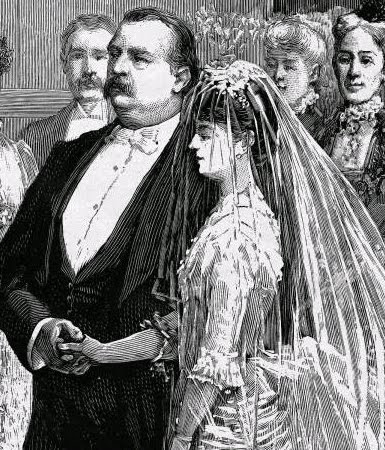
Stephen Grover Cleveland was one of three presidents (Jackson, FDR) to win popular vote for president on three different occasions, but he lost, in the second election, to Benjamin Harrison in the Electoral College tallies. He was the only Democrat to defeat a Republican for office during the period of Republican domination that dated back to Abraham Lincoln’s first electoral victory. He was the second president to marry while in office, and the only president (as depicted above) to marry at the white house. During his tenure, he and the Republican Congress, admitted North Dakota, South Dakota, Montana, Washington, Idaho, Wyoming, and later Utah to the union. His last words were “I have tried so hard to do right.”{1}
Ronald Reagan may have been the president who “tried to give the government back to the people” but some argue that Grover Cleveland was the first of two presidents of the 19th and 20th centuries –Calvin Coolidge being the other– to accomplish the feat. By the time their tenure ended, the size and scope of government was more limited than when they began their terms.
Others spoke of limiting the size of government, and the others failed. Cleveland’s first goal was to end the spoils of the political system. He did not fire the previous administration’s Republicans who were doing their job well, but he cut down the number of federal employees, and he attempted to slow the growth of what he perceived to be a bloated government. He attempted to always place appointments in positions based on merit, as opposed to the usual spoils system that dictated position holders in previous administrations. He also used his veto power far more than any other president of his day. Although Cleveland was a Democrat, he was one the few who sided with business. Cleveland opposed high tariffs, free silver, inflation, imperialism, and subsidies to business, farmers or veterans. His little battles for political reform and fiscal conservatism made him an icon for American conservatives of the era. Cleveland’s reform ideas and ideals were so strong and influential that a reform wing of the Republican Party, called the “Mugwumps”, bolted from the GOP ticket and swung to his support in 1884.
The great Abraham Lincoln
2) Abraham Lincoln
The 16th President.
Lincoln was a Republican who served the people from March 4, 1861 – April 15, 1865.
Abraham Lincoln, it could be said, is our most famous president. If one were to chart fame by the number of books written about an historical figure, Lincoln has had more books written about him than any other president. By some accounts, he has had more written about him than any historical figure alive or dead save for Jesus of Nazareth.
His fame is derived from serving as president during The Civil War, and the fight to abolish slavery. Lincoln’s fierce abolitionist views were so well known that some suggest that his election victory led the South secede. He used a heavy hand in some cases, such as the unconstitutional suspension of habeas corpus, and he used a deft hand in his attempts to end slavery. Fierce abolitionist Frederick Douglass viewed Lincoln with impatience initially. Douglass favored a firm hand. He wanted to, by whatever means necessary, quickly obliterate, on moral grounds, the Democrats who opposed ending the institution of slavery. As we discuss in another article on this specific topic, Douglass eventually saw the errors of that method. Ronald E Franklin characterizes Douglass as eventually, “Celebrating Lincoln as the perfect, God-appointed man for a task that, had the abolition of slavery been his first priority, he could not have accomplished.” This other article provides the full breadth of Douglass’ characterization of Lincoln’s political maneuvers.
We now have a number of definitions of Lincoln’s motivations, but James Buchanan’s mismanagement of a decades-old disaster landed on President Abraham Lincoln’s desk soon after he took office. The country rested on a precipice of tearing apart. If Lincoln was too firm, he might have lost the country, and thus any sense of a mandate, if he was too soft, he might have lost The South. History will probably argue his tactics until they lay our great-grandchildren to rest, but through compromise and subtle, brilliant maneuvers, Abraham Lincoln managed to both end slavery and save the union.
In the Washington V. Lincoln debate over who was the greatest president, the tale of the tape for both is long and mighty. In my personal opinion, Washington is given too much credit for being the first to set such and such a precedent. Washington was, indeed, a great leader of the country, but he was the first president, so I think we give him too much credit for setting precedents.
Quick Quip: Democrat rival in the 1960 election for the President Stephen A. Douglas once called Abraham Lincoln two-faced. “If I had two faces,” Lincoln replied, “do you honestly think I would wear this one?”{2}
William Henry Harrison
3) William Henry Harrison
9th President
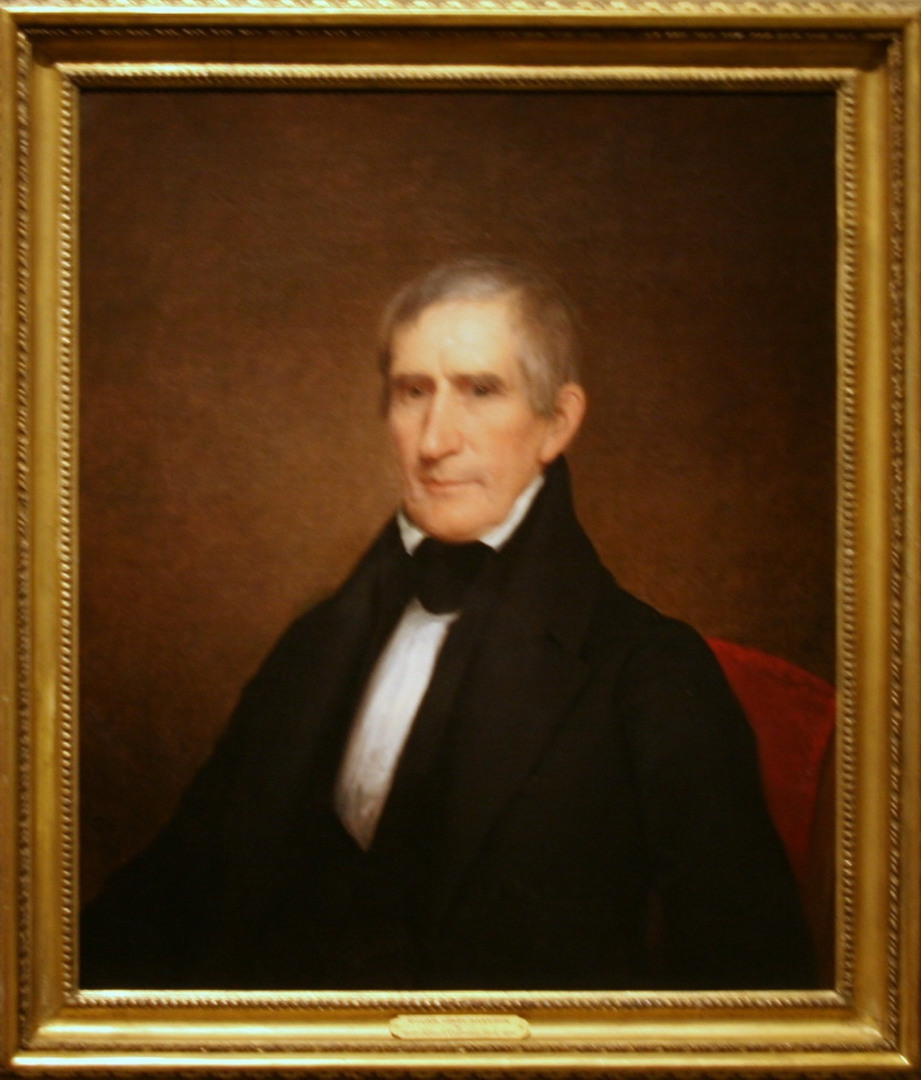
Harrison was a member of the short lived Whig party, and he served the people as president from March 4, 1841 to April 4, 1841
William Henry Harrison is most famous for dying after serving one month in office as president. He took the oath on a cold and rainy day, and he refused to wear a coat or a hat. He also rode into the inaugural on horseback rather than in the closed carriage that had been offered to him. He then proceeded, after the oath, to deliver the longest inaugural in American history. It took him almost two hours to complete it. He then rode away from the inaugural on horseback. Some believe that this reckless regard for his health brought on the illness that his sixty-eight year old body could not recover from, but historians make note that the illness did not set in until three weeks after the inaugural. Regardless how he contracted the cold, it progressed into pneumonia and pleurisy. His last words presumed to be to his successor John Tyler were: “Sir, I wish you to understand the true principles of the government. I wish them carried out. I ask nothing more.” {3}
Quick Quip: There was some debate over whether W.H. Harrison’s 8,460 word inaugural address (the longest in history) led to his demise. Harrison refused to dress appropriate for the forecast cold rain, or follow any of advice of those concerned with his well-being. As a result of his demise, Harrison’s grandson Benjamin Harrison, made sure his own inaugural was a little over half what his grandfather’s was.
Martin Van Buren
4) Martin Van Buren
8th President
Van Buren was a Democrat that served the people from March 4, 1837 to March 4, 1841.
Van Buren is regarded, in some quarters, as the father of the Democrat Party, even though Andrew Jackson was the first Democrat to be elected president. He was the first individual born as a U.S. citizen to be elected president. He was the first non-British, non-Irish man to serve as president. He was Dutch. He was also the first self-made man to become President: all earlier Presidents had acquired wealth through inheritance or marriage, while van Buren was born into poverty and became wealthy through his law practice. Van Buren’s presidency was marked by a depression, named the panic of 1837, that lasted throughout his presidency. As a result of this, Van Buren issued a statement that is also famous regarding his tenure as president: “As to the presidency, the two happiest days of my life were those of my entrance upon the office and my surrender of it.”{4}
James A. Garfield
5) James A. Garfield
20th President
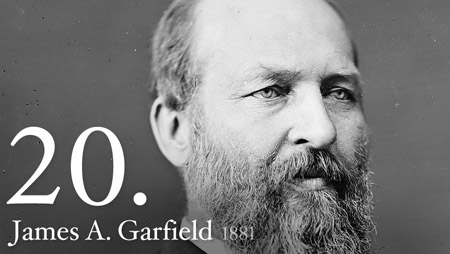
Garfield was a Republican that served the people from March 4, 1881 to September 19, 1881.
Garfield was another president known, in history, more for his death, than his life, or tenure as president. Garfield was taken down by an communist assassin by the name of Charles J. Guiteau. Though Garfield only had four months of health while serving the people as president, he did manage to give resurgence to the president’s authority over Senatorial courtesy in making executive appointments. He also energized naval power, he purged the corruption in the Post Office, and he appointed several African-Americans to prominent positions. During the eighty days in which Garfield suffered through the cruelty of the assassin’s bullet, he signed one, single extradition paper. Some historians have suggested that Garfield may have been one of our most talented and eloquent presidents had he lived long enough to expose this to the nation, but he was able to serve the nation in Congress having served nine consecutive terms, and he was able to do what he could in the short time that he served as president. Candice Millard’s brilliant book Destiny of The Republic captures the essence of Garfield with the quote: “Born into abject poverty, he rose to become a wunderkind scholar, a Civil War hero, a renowned congressman, and a reluctant presidential candidate who took on the nation’s corrupt political establishment.”
Knowing his death was imminent, James A. Garfield’s final words were: “My work is done.” {5}
Benjamin Harrison
6) Benjamin Harrison
23rd President
Harrison was a Republican that served the people from March 4, 1889 to March 4, 1893.
Harrison is most notable for being the grandson of William Henry Harrison, and the man that defeated the mighty Grover Cleveland in the Electoral College vote in 1888. Harrison’s tenure was also famous for passing the McKinley Tariff and the Sherman Antitrust Act. He was also famous for allowing federal spending to reach one billion dollars. Harrison also advocated for federal funding for education, he was unsuccessful in that regard. He also pushed for legislation that would protect the voting rights of African Americans. The latter would be the last attempts made at civil rights in the country until the 1930’s. Learning from the after effects of a long inaugural, courtesy of his Grandfather’s record long speech that some believe led to his death, Benjamin Harrison kept his inaugural address brief. Though historians tend to disregard Harrison as a prominent president, they regard his foreign policies as laying the groundwork for much that would be accomplished in the 20th century. {6}
Calvin Coolidge
7) Calvin Coolidge
30th President
Calvin Coolidge was a Republican that served the people from August 2, 1923 to March 4, 1929.
Coolidge would not stand a chance in today’s 24-7 news network, internet definition of politics. In the current climate of celebrity presidential candidates climbing all over one another for more air time, a better sound bite, and a better image, “Silent Cal” Calvin Coolidge would have been run over. In this age of bigger and better governments, where politicians on both sides of the aisle try to flex their legislative muscle in bill signings that are celebrated media events, Calvin Coolidge signed legislation into law in the privacy of the office. In a quote that could be attributed to the current, progression of big government, Calvin Coolidge said: “The requirements of existence have passed beyond the standard of necessity into the region of luxury.” Calvin Coolidge would be a laughing stock in our day and age, a man on the outside looking in, a statesman that would’ve faded into the woodwork of our society.
Social critic and satirist Dorothy Parker once said: “Mr. Coolidge, I’ve made a bet against a fellow who said it was impossible to get more than two words out of you.”
Coolidge’s famous reply: “You lose.”
After hearing that Coolidge passed away, four years after leaving office, Parker remarked: “How can they tell?”
Although Coolidge was known to be a skilled and effective public speaker, in private he was a man of few words and was referred to as “Silent Cal” in most quarters. On this reputation, Coolidge said:
“The words of a President have an enormous weight, and ought not to be used indiscriminately.”
Although known as a quiet man, Coolidge participated in over five hundred press conferences during his 2000 days as president, that is an average of one press conference every four days. Coolidge took over the office of president after his predecessor’s death, amid his predecessor’s controversy, that was called the Teapot Dome Scandal. The Teapot Dome Scandal was regarded as the “greatest and most sensational scandal in the history of American politics” until the media discovered the Watergate scandal. In the wake of this scandal, Coolidge told a reporter:
“I think the American people want a solemn ass as a President, and I think I will go along with them.”
Coolidge may have been the last statesman the American people had to serve as president. He was against the Klu Klux Klan, for instance, but he didn’t make grandstanding statements against the Klan, he just didn’t appoint Klan members to positions in his administration. This may seem to be such an obvious move that it’s not worth discussion, but the KKK had a lot of influence at this time in America, and Coolidge’s move caused them to lose much of it. Coolidge tried to take this one step further, calling for anti-lynching laws, but the attempts to pass this legislation were stopped by Democrat filibusters. He attempted to make war illegal in the Kellogg-Briand act, but that law proved ineffective. Coolidge was a laissez-faire president who didn’t believe that the federal government should have a role in farm subsidies or flood relief. As much as he wanted to help these people, he wanted to avoid setting the precedent of the federal government resolving problems that he believed could better be solved, on a case-by-case basis, locally. By the end of his administration, he achieved a tax bill that had all but the top 2% paying no federal income taxes. Coolidge disdained federal regulation and appointed commissioners that followed his philosophy that believed in state’s rights, and this caused a divide in historical opinion of his administration.
Some believe that this laissez-faire approach led to “The Roaring Twenties”, others argue that it led to “The Great Depression.” As with all matters such as these, the opinions are based on where the historian lies on the ideological divide. Some historians say that “The Roaring Twenties” was built on a bubble similar to the 1990’s tech bubble in that it wasn’t built on hard assets, and when that bubble did burst, as it did in the 90’s, a recession occurred as a result. That recession, say other historians, was prolonged into a depression that lasted to the forties by the recovery measures put in place by future administrations. The latter argument has it that the economy may have experienced a dip as a result of the bubble bursting, but the extended duration of this natural, down cycle was caused by the measures put in place by future administrations to recover from what may have otherwise been a temporary dip. Arguments such as these are impossible to resolve, however, because one cannot remove some facts to prove others.
Historians from both sides of the aisle have also defined his last words in varying ways. Those who oppose Coolidge’s actions, state that his last words were a lamentable admission that his limited government policies didn’t work. Those who favor his policies state that he was lamenting the course America was on, into a country of big government policies. They state that Coolidge’s administration was, itself, a temporary blip in a progression that Theodore Roosevelt started, and they suggest that based on everything Coolidge saw during his tenure, he foresaw this.
His last words were: “I feel I no longer fit in with these times.”{7}
Some presidents affected the course of nation in profound ways, others used underappreciated subtle, deft maneuvers to change the course of the nation and the federal government, and how it governs the people. Some of the presidents were overwhelmed and some were those right place, right time presidents who used their tenure to lay the groundwork for making this country the envy of the world. To those, like me, who might take this notion for granted, it didn’t have to go this way. Some of us find it interesting to note that if the wrong man were elected at the wrong time, even those presidents who don’t make “the greatest of all time” lists, this country could be a decidedly different one.
If you’re as interested in U.S. History through relatively obscure presidents as I am, read Obscure Presidents part II





 Rilaly