19th Century Medicine: Be Grateful


“When it comes to modern medicine, do you ever feel grateful?”

“I mean, yeah, but that’s like being grateful that Jupiter doesn’t fall off its axis. We know the catastrophe that would happen if it wasn’t there, but it’s always been there, so it’s tough to remain grateful for it.”

“Are you grateful for your good health?”

“Yeah, of course, but again, that’s like being grateful for good weather. We don’t notice it until the bad weather hits. We have to constantly have our perspective adjusted to appreciate health, wealth, and weather.”

“Because after reading Thomas Morris’ The Mystery of The Exploding Teeth, I went real grateful that I didn’t end up in a different time. I know what you’re saying about it’s always been there, but damn, you read what those 19th Century doctors were doing to their patients back then, and it seems like they were just guessing most of the time.”

“Look, our moms took us to the doctor, and he fixed it. It’s what they do. I never considered myself ungrateful, or taking it for granted, but it’s their jobs.”

“Fair enough, but did you ever have something your doctor couldn’t fix? That’s some scary stuff, let me tell you. They put us through an array of tests, they prescribe stuff, just to see what works, “Take two of these and call me in the morning.” What if nothing your doctor tries, works? Who do you blame? We don’t blame the researchers for failing to develop that perfect pharmaceutical to cure what ails us, we don’t blame innovators for failing to develop technological advancements necessary to find out what’s wrong with us, and we don’t blame modern medicine for being as yet ill-equipped or ill-informed to deal with our mysterious ailment. We blame our doctor. Our doctor is the hero or the zero, because they are our face of modern medicine. They’re who we see when we think of medicine. If you’re the one they can’t cure, it would be difficult for you to be grateful for the advancements of modern medicine, but the rest of should remember that for everything we can’t cure yet, the list of what we now can cure should earn a whole lot of gratitude. You’re right, it’s difficult to be grateful for good health, or life in general, but reading through a brief history of 19th Century medicine should remind us all to be grateful that we are not living in constant pain, and that our species managed to survive at all.”  

Previous generations reminded us to remain grateful, “Always be grateful for the times you live in, because I’ve seen worse, and my parents saw far worse.” They don’t understand our technology, and the machines their doctors put them through overwhelm them. “Don’t take it for granted,” they say. The lead by example in this dictum, because they can’t believe they’re still alive, relatively healthy, and pain-free. No matter what they say or do, however, we were born with this technology, and we can’t help but take for granted what has always been there for us.

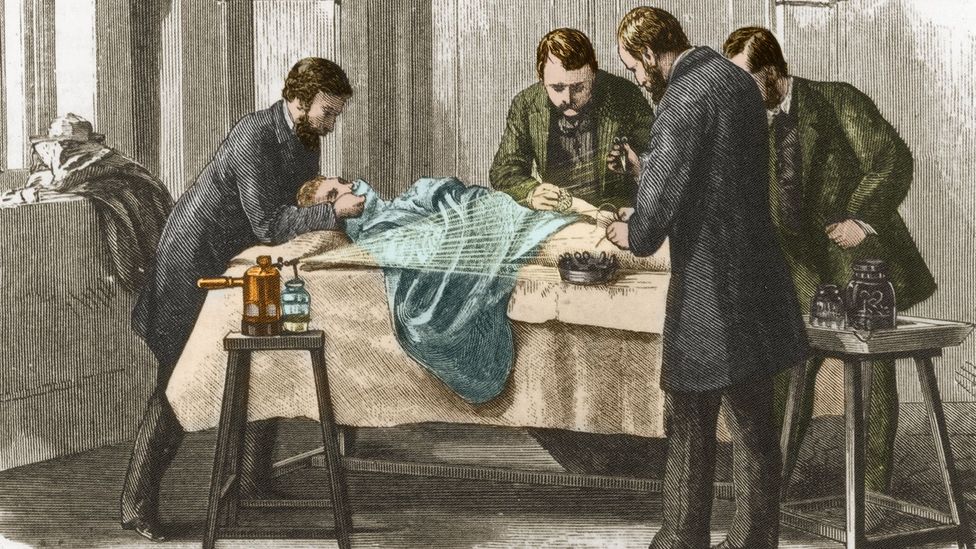
Author Thomas Morris might provide a better perspective for why we should be grateful, by “gently mocking” the medical practitioners of the 19th Century for their practices and procedures. Before gently mocking them, however, Morris adds two qualifiers every writer who compiles such material for a book should add before gently mocking prior eras for their lack of scientific knowledge:

“The methods they used were consistent with their understanding of how the body worked, and it is not their fault that medical knowledge has advanced considerably since then.”

It’s not their fault, I would add, and it’s wasn’t their doing. The doctors, family practitioners, or ear, nose, and throat specialists of the era were handcuffed by the constraints of knowledge at the time, and as Morris adds they performed admirably under such constraints.  

“One thing that these case histories demonstrate is the admirably tenacious, even bloody-minded, determination of doctors to help their patients, in an age when their art left much to be desired.”

We could use the hindsight of modern medicine to call early 19th century medicine something of a guessing game, but will 23rd Century medical professionals think the same thing of 21st Century medicine? Western medicine has come a long way in 200 years, and Morris’ book emphasizes that, but professionals in various medical fields will admit Thomas Morris could write a second book called The 21st Century: What We Still Don’t Know. Modern authors probably won’t be able to write such a book, because they don’t know what they don’t know, but a Mental Floss article details some of basic, fundamentals we still don’t understand yet, including: why we cry, why we laugh, why we sleep, why we dream, why we itch, and how we age. These matters might seem insignificant in terms of greater physical health, but if we can unlock those mysteries, what answers might follow? As with modern medicine, The 19th Century medical professionals had precedent, studies, and literature to study and guide their decisions, but the precedents they followed, like ours, were as flawed as they were.

Thomas Morris, prefaces a quote from an article James Young Simpson, the pioneer of chloroform anesthesia, writing, “[Simpson] cautioned that it was unwise to be too hard on the “extravagance and oddity” of their methods, adding presciently:

“Perhaps, some century or two hence, our successors … will look back upon our present massive and clumsy doses of vegetable powders, bulky salts, nauseous decoctions, etc., with as much wonderment and surprise as we now look back upon the therapeutic means of our ancestors.” 

Morris’ qualifiers illustrate how annoying it is to read modern authors assume a level of authority, even intellectual superiority, over the most brilliant minds of another era without qualifiers. These modern authors critique past knowledge and technology from the pedestal of modern research, acquired knowledge, and technology as if they had anything to do with it. Few of these authors acknowledge that they, like the rest of us, are the beneficiaries of modern advancements, even though they have not personally contributed anything to the difference between the eras.  

That being said, we all know the line: “those who don’t learn from the past are condemned to repeat it.” There’s nothing wrong with mocking and ridiculing the past, because it makes the art of teaching history more entertaining, and we find mockery entertaining, but the author of it should provide some sort of context.  

Thomas Morris pursuit of this is also admirable in another way, as it displays a takeaway, we can’t help but reach by the time we finish his book, gratitude. How many minor ailments (and there’s no such thing as minor when we’re suffering from them) can we magically resolve with two aspirin, ibuprofen, or a series of prescribed doses of antibiotics? How many procedures (currently considered routine) cure what harms us? How grateful are we to the technological innovators, doctors, and all of those who played roles (be they unwitting or otherwise) in the trial-and-error processes involved in research that have contributed to the progress medicine has made in such a relatively short time. It’s relatively difficult to be grateful for life, but as Morris’ book alludes, we should be grateful that our ancestors survived at all. We wouldn’t have the luxury of regarding our modern medicine as commonplace if they hadn’t, because as incredible as the human body is, it’s possible, and even probable, that we shouldn’t be here.

How did our ancestors survive the plague? World History Encyclopedia lists cures such as rubbing bare chicken butts on lesions, chopped up snakes, and drinking crushed unicorn horns as some of the more popular remedies at the time. They also list drinking crushed emeralds, arsenic, and mercury straight, with no chasers. How did they/we survive? 

We currently believe in using cardiopulmonary resuscitation when a person stops breathing, but 19th century man believed, as Morris writes, that blowing tobacco smoke in someone’s rectum might revive them after, for example, a drowning. Other periodicals note that physicians played around with blowing smoke into the mouth and nose, but they found the rectal method more effective. “The nicotine in the tobacco was thought to stimulate the heart to beat stronger and faster, thus encouraging respiration. The smoke was also thought to warm the victim and dry out the person’s insides, removing excessive moisture.”

The “How did we survive?” head-shaking laughter the follows hearing such measures might cement the fact that no one ever tries to pass such foolish nonsense along again. While we’re laughing, however, let’s keep in mind how much information, innovation and technology benefits our definition of modern know-how. We could go through that list, but even if we bullet-pointed it, it would be so lengthy that our eyes might glaze over, and we might accidentally dismiss a most vital discovery, such as the germ theory.

How did we survive the years preceding someone’s idea that they might be able to scientifically confirm the idea that the onset and spread of disease might have something to do with microorganisms, pathogens, and germs. They suggested that eating spoiled food, drinking stagnant water and poorly preserved alcohol, among other things could cause disease and the spread thereof. Modern readers might “Of course!” such findings now, but it rocked the scientific community at the time. Although the records show that the idea that microorganisms might be the cause for the spread of disease dates back to ancient civilizations, the scientifically-backed idea was credited to Louis Pasteur and Robert Koch between 1860 to 1880, and that was probably made so late in the 19th century that we can guess that it wasn’t fully implemented by family doctors (AKA Ear, Nose, and Throat doctors, or ENT) until the early 20th century. Think about how many lives have been saved by the idea that stagnant water, spoiled food, and fermentation of wine could cause diseases. This first officially documented scientific discovery also paved the way for the first official, scientific discovery of the first, widely used antibiotic penicillin by an Alexander Fleming.   

The ENT doctor is our face of modern medicine, much like the police are the face of law in our experience. They are the people we know, but if we think about it, the ENT doctor sits at the bottom of the medical community’s pyramid. They have nothing to do with the research that helps them make determinations on what courses to follow or prescriptions to write. They also use the technological innovations created by others to pinpoint our ailment, so while we could say they are beneficiaries of modern medicine, future experts might say our modern physicians were captive to the limits of 21st century medical knowledge at the time.    

Do we expect our ENT doctor to perform research in a lab before they diagnose us? Do we expect them to trial and error the medicine they prescribe? No, they have to act on the knowledge of those who specialize in those areas, and the 19th century ENT doctors and surgeons were no different. 

How many modern patients enter a general practitioners’ office, see a specialist, and undergo the array of tests we currently have at our disposal, and we still don’t know what’s wrong with them? We hear it all the time, patient A entered the office with a condition that mystified the most brilliant minds of medicine who examined her, and she died before anyone could properly source her ailment. I’ve known such a situation personally, and I’ve witnessed it intimately. I only write that to suggest that my empathy goes out to victims, family members of victims, and anyone who knows someone who has experienced such a matter, but there are times when no one is to blame. When we’re in such a desperate state, or grieving the loss of a loved one, our first inclination is to blame someone for not recognizing her ailment sooner. We blame her doctors, her doctors blamed the specialists, and they all quietly threw their hands up in the air in frustration. Who was at fault, or is anyone? Our advances in modern medicine, since the 19th Century have been so remarkable that they lead us to believe that we’re at the final frontier. We think if her parents could’ve only found the most brilliant mind of medicine, with all of latest technology available to them, and all of the information research has provided, we think she could’ve been cured. This isn’t to say there hasn’t been instances of malfeasance and misfeasance in the medical community, but as opposed to the TV shows we watch, some of the times even the most brilliant encyclopedic minds of medicine won’t know, because we don’t know yet. That’s the harrowing, humbling truth that no self-respecting doctor, or anyone else in the medical field, will admit is that in some cases the science isn’t there yet. 

If we were able to interrogate a family doctor, a surgeon, or someone else in the medical profession of 19th Century, I imagine a confident professional of that era might say, “Mock away, we deserve it on some level for our lack of knowledge, but you cannot say it was for a lack of trying. We cared deeply what happened to our patients, from the little, old ladies who complained about chronic ailments to devastated small boys, and everyone in between. These were not only our patients, they were our neighbors, and members of our community seeking our knowledge, guidance, and medical assistance to relieve them of horrific illnesses and injuries, and we did our best, with our era’s best knowledge, technological advancements and research, to help them in every single way we could. It’s not what you have today, so mock us all you want, but you cannot say we weren’t trying.”

Anytime I read such a compendium, one of the first things I think about is time machines. We all love the speculative concept of going back in time to talk to long-dead relatives, historical figures, and to experience our romanticized notion of living, if only for a moment, in a different time. The implicit warning books like The Mystery of The Exploding Teeth leave is, if some brilliant mind ever develops the technology to travel back in time, that pioneer taking one giant leap for mankind should check, recheck, and triple check to make sure they get one key component of their technology right before they leave: make sure you can get back. The authors of speculative fiction devote very little space to this need to get back to the present. It’s not very sexy, and no matter how much an author of fiction loves their character, they’re not concerned with the ramifications of their character getting stuck in another time period. They can play this short-term game with their characters, because their characters aren’t real. A real character who knows anything about the research, technology and science that influenced the decisions made by the medical community of the 19th Century should make getting back their primary concern, because while they will experience worldwide, historic fame for the technology of their contraption, if they’re not able to get back, they might not get to enjoy that fame.

Mathematics and Telescopes: The Triumph of Neptune’s Discoverers


Neptune was the first planet to be discovered through mathematical equations, as opposed to astronomical observations.”

Wait, before we continue, think about that for a second. A man, or two men, or three, used the data of the day, a pencil, paper and nothing more than their brains to declare that a planet should be … right there! Let that sink for a moment. 

Five of the planets were discovered by humans looking up, and we’ve been doing that for so long, thousands of years that someone would’ve eventually gone on the historical record to say, “I have just discovered a planet.” Was that impressive, well there is documented evidence that early civilizations in Babylonia looked up and said, “That right there, ain’t no star. That’s a damn planet” as far back as 1,000 BC. Actually, Teddy, we always knew that was there, you just beat us all to the historically documented record. 

When Sir William Herschel discovered a planet we now call Uranus on March 13, 1781 with his trusty telescope, and his further observations found that it wasn’t a comet, but a planet, they all thought he made one whale of a discovery, but if everyone had telescopes at that point, we could say Sir Herschel just beat everyone else to the historical record. Whatever the case, Sir Herschel was given credit for discovering the end of the universe. There was one problem, the astronomical community could not plot point Uranus’ positions based on mathematical projections. Every other planet had very specific orbital points that they would hit, based on the gravitational laws of the universe, otherwise known as Newton’s laws. Those planets pushed and pulled on each other to keep themselves in line. This new planet, that we now call Uranus, was all over the place, and its orbital pattern, or its projected plot points, made no sense.

Using all of the pre-discovery data, Astronomer Alexis Bouvard made seventy-seven projections on where Uranus should be, but his fellow astronomers called him out. Based on their observations, they found that all of his projections were wrong. Recognizing his errors, after the tables of his projections were published worldwide, the confused Bouvard initially blamed the pre-discovery data, but when that didn’t satisfy him or the astronomical community, Bouvard came up with a theory called “A Perturbing Force.”

My guess is that the astronomical community initially greeted the perturbing force theory as an excuse Alexis Bouvard made for his inaccuracies. “Alex, my guy, just admit it, you were wrong. We all know you’re a genius, but we’re dealing with the unknown here. Maybe you should just admit that you were wrong and move on.”

Here, we have to have some sympathy for Bouvard, as we can only guess that he pined for months and years to come up with these tables. We can guess that he said something along the lines of, “Hey, I didn’t just throw this stuff out there. These were precise projections based on all the data I had at my disposal, coupled with the laws Sir Isaac Newton. I wouldn’t just guess and then publish those guesses to subject myself to this level of humiliation. There’s something more here, something we need to study.” Bouvard further suggested something that probably furthered his abuse among his peers in the astronomical community. He suggested that this perturbing force could quite possibly be another planet. Then, he submitted that proposal that Uranus might not be the end of the universe to the Paris Observatory, but unfortunate for the legacy of Alexis Bouvard, the astronomer who received that request for a follow up left soon after Bouvard submitted that request for further findings.

Furthering the unfortunate nature of Bouvard’s legacy, Alexis died before anyone would substantiate his projections and the idea that it had to be a perturbing force gravitationally pulling and pushing Uranus off what should have been precise data points dictating its orbit. Thus, we can only guess that Alexis Bouvard probably died believing himself a failure, or at the very least that everything he accomplished in life ended with a huge stain, in the form of an exclamation point, on his legacy.

Even though Alexis Bouvard never found a workaround to nature taking his life, his idea of a perturbing force remained. Skeptics of the day argued that because Bouvard’s projections relied on Isaac Newton’s theories, Bouvard’s inaccurate projections exposed the flaws in Newton’s theories.

Mathematicians, like John Couch Adams, insisted that Newton’s theories were sound and after studying Bouvard’s projections, they believed they should’ve been true. Adams was young, twenty-four-years-old, old enough to know the laws of nature, and all the laws and bylaws his peers developed to explain the universe, but he was still young enough to think they were all wrong. He thought he could use Bouvard’s projections, and all of the data Bouvard compiled, coupled with Newton’s laws to deduce the mass, position, and orbit of this perturber Bouvard theorized. Couch Adams then devoted four years of his life to study, calculate, and project where a possible perturber could be, and he submitted those four years of work to the esteemed British Astronomer Royal George Biddell Airy.

Biddell Airy was understandably skeptical of Adams’ findings, as the mathematician submitting them was such a young pup. We can also guess that Airy was wary of placing his esteemed stamp of approval on Adams’ findings without further evidence. He decided to press Adams for more detailed computations. Unfortunate to the legacy of John Couch Adams he did not respond, some suggest that this failure to respond was due to Adams’s unprofessional demeanor, his nerves, procrastination, or the idea that Adams may not have had those detailed computations. Whatever the case was, Couch Adams’s failure to respond in a timely manner cost him sole credit for the discovery of the planet Neptune.    

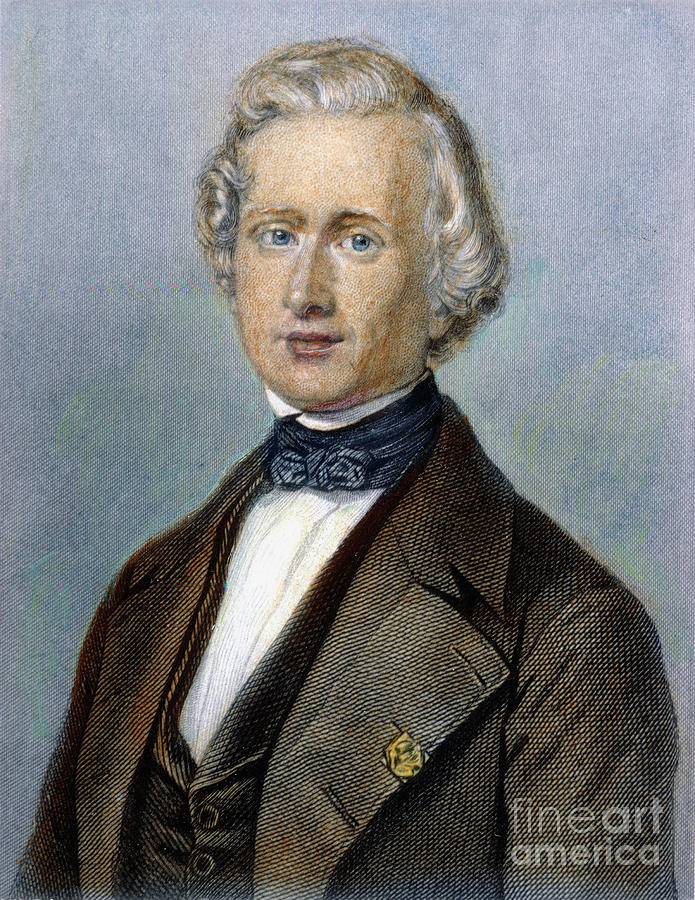
Some suggest that Frenchman, Urbain Jean Joseph Le Verrier, was unaware of John Couch Adams work, his subsequent submission, and his failure to complete the work, but Le Verrier was very aware of Alexis Bouvard’s life’s work. He paid particular attention to Bouvard’s “perturbing force”, and it fascinated him. He thought he could find the missing link, and he thought he did. He first sent his findings to the French Academy of Sciences in Paris, but due to bureaucratic inertia and a lack of proactive observation, the Academy did not follow up. They did not reject Le Verrier’s math, however, as they found it rigorous, but his findings did not translate into instant acceptance as a confirmed discovery because to them it remained theoretical until it could be observed. The Academy later stated that they had “other concerns” that precluded them from making such observations, and they claimed that they lacked the capacity to follow up with the level of immediacy Le Verrier demanded. Whatever the case, Le Verrier basically said if you’re not going to do it, I’ll find someone who will, and he submitted his edited findings to Johann Gottfried Galle at the Berlin Observatory on September 18, 1846. Berlin had a powerful new refractor telescope and a more agile response, partly because Galle and his assistant Heinrich d’Arrest were eager to test the hypothesis.

Galle confirmed Le Verrier’s detailed calculations, and they confirmed the  existence of the planet we now know as Neptune on September 23, 1846, but they added that Le Verrier was one degree off. Here we reach another “think about it, before we move on” moment. Le Verrier took Alexis Bouvard’s precise projections, based on pre-discovery data, and he joined Bouvard’s mathematical calculations on his errors, coupled with some theoretical notion of a perturbing force, pushing and pulling Uranus off what should have been its normal orbit, and declared that Neptune should be right there! And those calculating his math, nothing more than math(!), found that he was one degree off! [Note: The international astronomy community eventually decided to settle the international dispute by giving credit to both the British Adams and the French Urbain for Neptune’s discovery, even though Adams unofficially discovered it first.] Astronomy.com also states that “Adams [eventually] completed his calculations first, but Le Verrier published first. Le Verrier’s calculations were also more accurate.” The lesson here for you kids looking to submit astronomical findings to a governing body, when they approach you for detailed calculations to support your astronomical findings make sure you either respond immediately, or maybe you should have your detailed calculations ready before declaring your findings. 

Neptune is not visible by the naked eye, and this, coupled with the technological limitations of the time, forced the brightest minds in astronomy, physics, and mathematics to base their theoretical predictions and findings on the celestial mechanics of Isaac Newton theories, and this idea that the entire universe existed on universally accepted mathematical principles.

Anytime we discuss a first, we encounter the eventuality of someone discovering something eventually. In doing so, we undermine the definition of smart, creative, and ingenious. Some of us might be too easily impressed by knowledge in an arena for which we are basically neanderthals. Yet, how can anyone not be impressed that a man, or two men, or three men in total, used relatively basic theory, combined with data points, and a vague supposition to mathematically project that due to the irregular movements of one body in the universe is acting so unusual that it must be acting or reacting to another body in such a way that it has to be … right there, only to find out that they are one degree off. We can only guess that in the intervening twenty-four to twenty-five years, between Bouvard’s guess and Adams and Le Verrier’s confirmation, there were hundreds of guesses submitted to observatories, and they were all wrong.

Were all of those theoretical guesses wrong, or were they, as P Andrew Karam, at Encyclopedia.com states, simply the result of bad timing? “The discovery of Neptune proved more a remarkable coincidence than a testimony to mathematical prowess.

“Leverrier’s and Adams’s solutions for Neptune’s orbit were incorrect. They both assumed Neptune to lie further from the sun than it actually does, leading, in turn, to erroneous calculations of Neptune’s actual orbit. In fact, while the calculated position was correct, had the search taken place even a year earlier or later, Neptune would not have been discovered so readily and both Leverrier and Adams might well be unknown today except as historical footnotes. These inaccuracies are best summarized by a comment made by a Scientific American editor:”

“Leverrier’s planet in the end matched neither the orbit, size, location or any other significant characteristic of the planet Neptune, but he still garners most of the credit for discovering it.”

“It is also worth noting that, after Neptune’s mass and orbit were calculated, they turned out to be insufficient to account for all of the discrepancies in Uranus’s motion and, in turn, Neptune appeared to have discrepancies in its orbit. This spurred the searches culminating in Pluto’s discovery in 1930. However, since Pluto is not large enough to cause Neptune and Uranus to diverge from their orbits, some astronomers speculated the existence of still more planets beyond Pluto. Hence, Pluto’s discovery, too, seems to be more remarkable coincidence than testimony to mathematical prowess. More recent work suggests that these orbital discrepancies do not actually exist and are due instead to plotting the planets’ positions on the inexact star charts that existed until recently.”

The two of them got lucky in Karam’s words. They made 19th Century errors that we can now fact-check with our modern technology, and we can now say that they timed their findings at a most opportune time in Neptune’s orbit. Yet, whatever “remarkable coincidences” occurred, it turns out Adams’ and Leverrier’s “calculated position [proved] correct”. 

“The remarkable coincidences” answers the question why so many previous theoretical submissions were incorrect, rejected, or couldn’t be observed by observatories and thus verified between Bouvard’s initial theory in 1821 and Leverrier’s detailed calculations of the positioning of the planet later named Neptune.

As with any story of this type, some of us wonder what happened between the lines? Have you ever been so obsessed with something that you couldnt function on a normal human level? Have you ever been so obsessed with something that you didn’t enjoy food, drink, or any of the other fundamental joys of life the way you did before? Have you ever been so obsessed that you couldn’t sleep at night, and routine, mundane conversations with your friends seemed so routine and mundane that you can’t bear them, until you resolve the one problem that haunts you. How many accomplished individuals in their respective fields sacrificed dating, marrying, and having a family to their focus their existence on being the one to find the answer to the perturbing body theory? We can talk about fame, and fortune, and all that, but if you’re genuinely obsessed, you reach a tipping point where those things become nothing more than a byproduct to working through the question to find the answer on your own. In instances such as these, even a level of historical fame pales in comparison to the personal satisfaction we feel by finding the answer. 

Urbain Jean Joseph Le Verrier

Whatever the case was, we can comfortably guess that Adams and Le Verrier didn’t submit the first predictions. We can find fault in Le Verrier’s projections, but we should remember that he was providing an educated guess that a planet one billion miles away from Uranus, and 2.7 billion miles away from him on Earth existed. The observatory asked him for detailed calculations, he provided them, and the observatory used those calculations to spot Neptune. I consider that a point blank exclamation mark at the end of this discussion.

Yet, whenever we discuss the idea that .25% of the population, or one in 400, are geniuses, and we publicly marvel at their accomplishments, some ninny comes along and drops the ever-annoying, “It would’ve eventually been discovered by someone, somewhere.” When we express exhaustion, they add, “What? It’s a planet, a planet that is roughly four times larger than Earth. Someone would’ve eventually spotted it.” 

As much as we loathe such dismissals, it appears to be true in this case. If P Andrew Karam is correct, and we have no reason to doubt him, Adams and Leverrier were the first to submit right place, right time predictions that due to “a remarkable coincidence” could be verified due to the timing of their submissions.

It also bothers those of us who enjoy marveling at genius to hear things like, “Some guys are just smarter than others. I know some smart guys who say some smart things.” That’s true too, of course, but some are geniuses, and some of us love nothing more than dissecting, refuting, and demystifying the notions of their genius. Were John Couch Adams and Urbain Jean Joseph Le Verrier geniuses who figured something out that no one else could, or were they right-time, right place opportunists? No matter what Karam writes about their errors, he admits the “calculated position was correct”. 

John Couch Adams

Le Verrier’s calculated position was also derived without the benefit of James Webb or Hubble telescopes, and he and Adams did not know the nuclear-powered space probes that could confirm theoretical guesses on the molecular composition of the lakes on Saturn’s moon Titan. They also did not have the advantage provided by Voyager Spacecraft visits, of course. They had Isaac Newton’s laws of motion and gravitation, the idea of celestial mechanics from Johannes Kepler, some comparatively archaic technology, and a pencil and paper.  

With our modern technology, we can now correct the mistakes of the past. This is the way it should be, of course, but we should refrain from diminishing past accomplishments or inherently claiming superior intelligence now. We might know more now thanks to the brilliance of our greatest technological toys, but most of us had nothing to do with building that technology. We’re just the beneficiaries of it. We now have the advantage of all of these marvelous gadgets and tools at our disposal to fact-check prior “geniuses”, but does that mean that the brilliant minds of the past weren’t geniuses? We can talk about how some of the theories don’t stand up, but think about how many physicists, astronomers, mathematicians, and general theorists of yesteryear developed theories, without the advantage of the accumulated knowledge we’ve gathered since, that do? 

Some of the geniuses of yesteryear turned out to be wrong, of course, and some of them were right-place, right-time opportunists who discovered things first, but before you say “Someone, somewhere would’ve discovered it” remember the guys who mathematically predicted the existence of Neptune, probably road a horse to work on a dirt road, if they were lucky enough and rich enough to own a horse, and their definition of the heart of the city was often just a bunch of wooden store fronts, like the recreations we see on the old HBO show Deadwood. Most of what these 19th century astronomers and mathematicians saw in the nighttime sky is what we can see by stepping outside and looking up into the sky. They had some technological assistance back then, in the form of relatively weak telescopes, and some theorize that astronomers, like Galileo Galilei in 1613, Jerome Lalande in 1795, and John Herschel in 1830 may have used it to spot Neptune first, but they didn’t know they were seeing a planet, because their telescopes were not powerful enough for them to know that. Those of us who write articles about such topics and the geniuses who made ingenious discoveries or theories that proved slightly incorrect or somewhat flawed should asterisk our critiques by saying, “I am smart. No, really I am, really, really smart, but as ingenious as I am, I don’t know if I could’ve done what they did with the primitive technology they had, primitive when compared to ours. So, before I go about correcting and critiquing their findings with the technology I have at my disposal, thanks to those who developed it for me, I’d like to say how impressive it is that they came so close that it’s impressive that they did what they did with what they had.

The “Afflicted” Girls in the Salem Witch Trials


In the months between February 1692 to May 1693, nineteen citizens of Salem, Massachusetts (14 women and 5 men) were executed for the charge of being a witch. One person was tortured to death for refusing to admit he was a witch, and five people died in jail after being accused. More than 200 people were accused in what we now call the Salem Witch Trials, and five dogs. As harrowing as it is to believe that a small American village executed twenty of its citizens, Europe executed up to 80,000 between 1500 and 1660. 

History.com writes that the hysteria swirling around Salem, Massachusetts began in “January 1692, [when a] 9-year-old Elizabeth (Betty) Parris and 11-year-old Abigail Williams (the daughter and niece of Samuel Parris, minister of Salem Village) began having fits, including violent contortions and uncontrollable outbursts of screaming.” Even though the medical community knew about ergotism, the residents did not know what afflicted these girls. The Parris family called in a doctor named William Griggs. Dr. Griggs could not diagnose the girls, and he declared their fits were “beyond epileptic or natural disease”. Dr. Griggs fell prey to the very human condition that applied to their day, as much as it does to today, of filling in the blanks he couldnt by suggesting that the girls were victims of a supernatural bewitching. 

Based on that diagnosis the Parris family were distraught, and they decided to accuse three women of bewitching their girls, including a woman named Tituba. After weighing the evidence against her, and the cultural climate surrounding Salem at the time, Tituba unknowingly set a precedent for those who would be accused in the future by confessing to “the crime” of bewitching. She confessed, we can only surmise, because she knew the deck was stacked against her, and she would be convicted regardless. In her confession, Tituba implicated others by saying that they worked alongside her in the service of the devil against the Puritans. Seeing how Tituba beat the system by providing states evidence, as it were, future accused witches confessed to similar charges to avoid execution and/or imprisonment, and they, too, began assisting the state by informing on other witches. Hysteria spread throughout the Salem community, and the local justice system was soon overwhelmed.

There were a number of factors surrounding Salem at the time to add to the culture of fear, including the fear of neighboring communities, fear of attacks from Native American tribes, and what historians call “The Little Ice Age” that destroyed their economy and many elements of their daily life. To explain what they considered inexplicable, the residents of Salem turned, in fear, to the supernatural, witches, and the devil to explain why their lives were destroyed.

Amid this culture of fear, four other young girls, all between ages nine to twenty, began accusing their neighbors of witchcraft. The six girls were commonly referred to as the afflicted girls. The afflicted girls would accuse, testify in court, and drop to the floor in convulsions during the witch trials. There are a number of theories regarding why these six girls did what they did to lead to public executions, but the one thing we now know with absolute certainty, with no facts to bolster that certainty, is that they were not lying or faking the convulsions.

One of the most wide-spread modern theories to explain the ailment the Parris and Williams girls suffered from is ergotism. Ergotism, or ergot poisoning is a result of a long-term ingestion of ergot alkaloids, or mold, that can be found on rye, wheat, and other cereals, which were all primary components of the diet of Salem residents. In the list of symptoms of Ergotism is delusions, hallucinations, vomiting and muscle spasms that could lead to convulsions, which many say lines up with the symptoms the Parris and Williams girls experienced.

As with any theory of matters that have occurred nearly three hundred years ago, historians have debunked this theory. Historians Nicholas Spanos and Jack Gottlieb argue if the young girls were victims of ergot poisoning why weren’t there more cases in Salem, and why wasn’t the rest of their family in their homes afflicted? The two historians admit that ergotism only takes place in hosts suffering from a vitamin A deficiency, but they state that Salem was rich with cows and their milk, so they conclude that it isn’t possible for a resident of Salem to suffer a vitamin A deficiency. They do not include the possibility that these two girls did not enjoy the taste of milk, so they didn’t drink it. They also do not include the possibility that the girls suffered from underlying conditions, such as bleeding stomach ulcers or some form of malnourishment that could’ve led to a greater susceptibility to ergotism via the ergot alkaloids. Nor do they consider the general idea that funguses and mold can affect individuals in the same house, with the same genes, different, based on varying underlying conditions.

Another theory is that the four girls who followed the Parris girls may have suffered from a psychogenic illness called mass hysteria in which one exhibits symptoms and another, unconsciously, begins exhibiting the same symptoms.

“We’ll probably never know the truth of what happened to these girls,” one person, with alleged authority on the subject suggests, “but the one thing we know is they weren’t faking it.”

One quick read through the history of the Salem Witch Trials can lead the reader to some impulsive reactions and cynical, knee-jerk assumptions. Those of us who want to know the truth, try very hard not to fall prey to our own biases, so we keep reading and researching. We do find out we’re wrong, on occasion, but more often than not, we read through all the thoughts and theories on the matter, and we find a whole lot of overthinking, until we fall back on our all-too-simplistic assumption that the afflicted girls made false accusations and they faked their convulsions.

All of the theories about what caused the girls to go into convulsions are not just possible, they’re probable, but the certainty some display in the face of what happened is what draws us back to our impulsive and cynical guesses. If we can rule out ergotism and mass hysteria, with no proof, how can we rule out the idea that they were lying and faking? Especially when one of them, Mary Warren, admitted that “afflicted persons did but dissemble,” or fake their symptoms. Now we know that Ms. Warren later recanted and accused those who might have pressured her into making the admission, but she provided the only evidence for any of the primary theories.

Another crucial element that leads me to believe that the afflicted girls were faking it, was the timing of their convulsions. We weren’t there for the proceedings, of course, and we don’t have the minutes of the trial, but the historical recreations lead us to assume that the convulsions the afflicted girls experienced in the courtroom were conveniently timed to convince the judges of the accused’s guilt. When Mary Warren was asked, in court, to clarify her statement that “afflicted persons did but dissemble,” or fake their symptoms, the afflicted girls in the courtroom went into convulsions. Mary Warren responded, on the stand, by going into her own convulsions. This fits the definition of mass hysteria, provided above, but it doesn’t explain the case for ergotism, and it could be argued that it only bolsters the cynical argument that they were all faking it.    

One of the reasons, I think, that we seek to nullify the claim that they were lying and faking, is that it’s almost too horrific to imagine that anyone would purposely, and maliciously make a claim that leads to the executions of those they accuse. Cynical types, who impulsively believe the worst of humanity, often have no proof for their assertions, but those who impulsively believe everything is more complicated than all that don’t either.  

One of the causes historians list as a cause for the Salem Witch Trials is the fear of the powerful women. To say full-grown women were second class citizens in 1692-93 Salem, Massachusetts, is being generous, and whatever power women had in Salem, young women had even less. Is it possible that these young women enjoyed their brief moment in the Sun? Not possible? Too cynical?

The next point that most historians consider to bolster their claim that the patriarchy feared and loathed strong women, is that they wanted to keep them in a state of fear. This is plausible, because while the Puritans of Salem considered women equal before God, they considered them more susceptible to the wickedness of the Devil. They suggested the later based on the story of Eve falling prey to the temptation of eating the apple in the garden of Eden. These characterizations are all unfortunately true, but while the thrust of the campaign might have been engineered by men, for men, it may not have gained a foothold in the culture were it not for the accusations made by the young girls. It’s also worth noting that five men were executed, and there is a list of men who were named, accused, imprisoned, and otherwise had their names sullied.  

We’ll never know the truth, and I’m not saying I know better than anyone else, but when someone tells me that one theory is categorically false, without any evidence to back that claim up, my mind immediately invites those possibilities in.

“Think about it,” we say when someone else is so muddled in their thoughts that they can’t see straight. We might say that when someone is so blinded by simple truths that they can’t see the evidence that complicates the matter. We also say it when someone’s conclusion is so clouded by evidence that they sift and sort through it to develop speculation that complicates the matter so much they can’t see a simple truth. The simple truth of the matter is supernatural witches with supernatural powers do not exist. They might exist in a realm we don’t understand, but how often do we use otherworldly spirits to explain the gaps in our understanding of the human mind? We wonder, how can one man kill another with no feeling, he must be a monster, a vampire, a werewolf, or something else supernatural, because no normal man would kill another without reason. We can also use them to explain how a seemingly normal person can somehow fail to generate a sympathetic response to the aftermath of blind rage. It was the nature of residents of Salem, Massachusetts to blame supernatural spirits and monsters to explain what they could not explain then, it’s human nature now, and it probably always will be, because “We’ve seen things that no one can explain.”

We make fun of the people who lived over three hundred years ago for believing in such things, but my bet is that for the next three hundred years we’ll continue to believe someone, somewhere exhibits such powers. The only problem is that over the course of the last couple thousand years, we have yet to find substantial proof of it. Supernatural witches, and their Specters, a fancy term they used for spirits, ghosts, or demonic forces that the accused would allegedly sic on the victim don’t exist in the same manner that vampires, Frankenstein’s monster and Spongebob Squarepants don’t exist.