When Fish Look Back


Some of us enjoy watching fish swim around in an aquarium, because it gives us some inexplicable sense of superiority, but most of us find it one of the simplest pleasures in the world. There’s nothing to analyze about a person who enjoys the simple pleasure of watching fish swim around an aquarium, there are no social attachments to it, no cultural definitions to be found, nothing political about it, and no one can attach double entendres to it. It’s not complicated, it’s simple, and that’s why we do it. For those of us who find some way to feel guilty about just about everything, we can find some very creative ways  to feel guilty, but to my knowledge no one has been able to associate watching fish swim in an aquarium with something for which we should feel some guilt. Is this guilt-free pleasure based on our idea that most aquarium dwellers don’t appear to want more freedom. They don’t appear to love life or loathe it, as they seem to have a comparatively limited sense of their life, so is that why we feel no guilt watching them swim around in a limited space, or is it because they don’t look back?     
When we own a dog, we love watching them run free around our huge backyards, but there’s always some level of guilt we feel for fencing them in. We take them on long walks and to dog parks to allow them more freedom, but there’s always this sense that we’re depriving them of the full extent of a dog’s glorious life. There are some trade-offs of course, as we provide them food, comfort against the elements, and protection from predators, but when we compare them to their wild ancestors, we can experience some pangs of guilt. 

It might have something to do with their comparative lack of intelligence, but we experience no such guilt owning a fish. Some even find some medicinal qualities to owning a fish. Some psychology articles even suggest that watching fish swim around has medicinal qualities, as it can provide some relief to those suffering from depression. Family physicians and dentists often find purchasing an aquarium a worthy investment, because it relaxes their clientele before visits. Some homeowners find feeding them and watching them so relaxing that they want an aquarium in their home. Are these properties attained in the relative silence of an aquarium, does the order of fish in an aquarium provide some relief to chaotic minds, or does it have something to do with the fact that fish rarely look back at us? 

There are moments in life, and for some it’s more than moments, but most experience moments in life when they feel trapped. They feel trapped into high-stress, relatively confrontational jobs, but they can’t quit because they have responsibilities and obligations. Those people might enjoy seeing another being trapped by glass, because it makes us feel freer by comparison. Both parties know we are the superior being, but some fish look back, and some of those looks become stares, challenging stares.

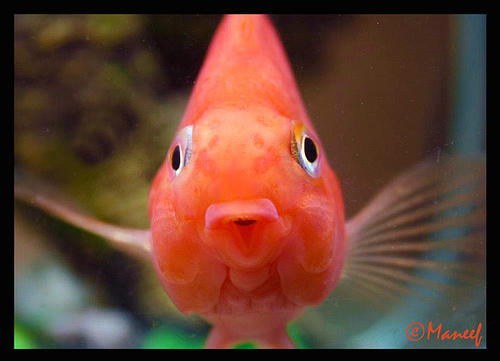
We don’t expect fish to look back, but some of the times they do, and some of the times it’s quite cute. Sometimes, we tap on the glass to try to get one fish to give us one quick look to acknowledge us in some quick, meaningless way. They usually swim away in quick, jetting motions, but some of the times they look back. “Look at this, Myrtle, he’s looking back at me!” we say to their casual, happenstance glance they offer us. When that casual glance holds, and that cute, little look back becomes a stare, it can begin to feel unnatural. Even though it feels a little odd at the outset, we stare back. We don’t have any reason for continuing to stare back, but we do, until we achieve some inexplicable and unnerving connection. If this odd connection continues, we think that they’re testing the boundaries and borders nature inflicted upon them, regarding our respective roles in the food chain. We know it’s foolish to assign human characteristics to such a brainless creature, but the otherwise enjoyable stare can lead us to consider questions that which we’ve never asked before.

Our first instinct is to believe the fish just happens to be looking in the general direction we’re standing in, and that the stare we share is nothing more than a happenstance glance. Something about this particular stare unnerves us though. We remind ourselves that they have no eyelids. They might have a membrane to protect their eyes from water, but they have no eyelids, so they cannot blink. They have pupil, and they can move their eyes, but this particular fish doesn’t even move his pupil. It’s staring right at us and through us.
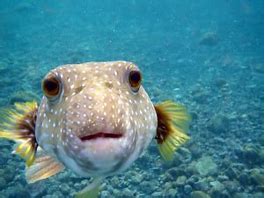
What does it think it’s seeing? Is it really looking at us, or just toward us? We make a jutting motion toward the fish to establish the fact, in our minds, that it is indeed staring at us. Another, relatively embarrassing component of that motion involves our need to establish dominance, so the fish doesn’t forget what we can do to them if driven to act. The fish will react to our jutting motion, but what happens in our interiority if after the fish flinches, it assumes its former position and resumes staring? Do we complain to the management of the pet store? What if the fish stopped staring the moment we brought the manager over to the tank and it resumed staring after the manager leaves? It looks at us, as if it thinks it knows us, and it’s unafraid. There are times when it’s okay to remind other creatures that we’re their superiors, and there are times when we consider it necessary to do so. You wouldn’t be so bold if I reached into your tank, grabbed you, and did awful things to you? we think its way. We think that hard, as if to send a telepathic message. If that message is receive, the fish remains unmoved by that threat.

We know we can’t do such things, no matter how long this thing looks at us. We know those looks the other patrons of the pet store will give us if we do. We also know what we would go through on the drive home, in bed, staring up at the ceiling, remembering what a fish drove us to do. We know no one would understand, and something about that fish’s stare suggests that it knows that too. At some point in this staring contest, it strikes us that the hundreds of thousands of years of our respective conditioning inform both parties who is superior. Yet, this means nothing to this particular fish. Its stare suggests that it is challenging that conditioning, because it knows there’s nothing we can do about it.   

Pet psychologists tell us that if we own a dog who is particularly disorderly and disobedient that one of the ways to re-establish dominance is to engage it in a staring contest. If confronted by a wild animal, they tell us, the worst thing we can do is look that animal in the eye, because both parties know, on some primal level we know nothing about, that we’re challenging their essence, and any hint of this challenge enrages such beasts.

If we try to engage in a staring contest with a lion, in the lion’s den at the zoo, most lions won’t even bother looking back at us. They have hundreds of people confidently challenging them in this way every day, and both parties know there’s nothing they can do about it. They can charge the borders of their enclosure, and if you’ve seen a gorilla do this, it can be intimidating, but both parties know, on some level, that we’ll walk away laughing at their meager attempts to challenge us. That interaction is flipped by some measure, because we’re challenging their physical superiority. We’re informing them that we’re not afraid of them, but when we’re the superior in every way, as we are with the fish, what goes through us when they stare at us so long that it starts to become uncomfortable? Is it mere happenstance, or is the fish challenging our nature? Are we so confident in our stature that we continue to stare back? How long do we participate in this staring contest, to establish our superiority, and what happens if we lose?

After such a devastating loss, what happens the next time a host asks us what we think of their brand new aquarium? More often than not, we don’t invest ourselves in situations like these, but there are days when we’re feeling particularly vulnerable. There are days when the “theys” of our lives break us down, and we feel relatively small and insignificant, so we approach that trapped fish with a smile, because we know that they are a they that is unquestionably inferior to us, but there is always one fish who won’t bow down to us. These meager, inconsequential, and perhaps coincidental challenges that we dream up can affect us so much that the next time a friend invites us to look at their fish in the fish tank they have in their home, we hesitate. We know that if we begin shrieking, the fish wins. Our reputation would not only suffer at the hands of our host, but the ten people interested in her retelling of the story. Offering our host, a simple, “No thank you,” might open a big bag of questions we don’t want to answer. Yet, acquiescing to their request might bring us right back to that day at the pet store when a fish’s stare served to undermine our confidence. When we glance over at our friend’s tank, considering her proposal, we see those probing eyes, and we remember the day when we thought we knew our place in the animal kingdom. We remember how confident we were in our respective roles in the animal kingdom before that staring contest began, and though we know we can’t put all the blame for our insecurities at the fins of that fish in the pet store, its rebellious stare unearthed something in us that we never confronted before. We know how revealing it is to have a staring fish lead us to such existential questions, but it shook our confidence down to its foundation, and we politely refused our host’s request, fearing what another loss might do to our confidence.   

Yesterday I Learned …


Yesterday, I learned that TIL is an abbreviation for “Today I learned …” Today I learned that in the era of texting and Tweeting, we are abbreviating far too often. I knew that yesterday, but it’s annoying me today.

1) Yesterday, I considered myself intelligent. Today, I learned that I’m not half as smart as I thought I was yesterday. We curious types ask questions and questions can lead to questions, such as, “How is it that you did not know that?” They ask this with that strained smile that suggests they have a haymaker awaiting us. Curious types often wipe the slate clean to learn different perspective, new angles, and nuanced approaches to known procedures. There are also times when we just don’t know. Decades of cultural and societal conditioning train us to avoid asking such questions, for we know the abuse that’s coming from those who know and those who quietly pretend to know so they’re not the subject of such abuse.

2) Yesterday, I learned that kids hate cotton candy as much as I do. Today, I learned that no matter how great it looks, cotton candy is pretty awful. Cotton candy, fairy floss, candy floss, tooth floss, or whatever we call it around the world looks so good on a stick, in a bag, or in a  bag on a stick. It looks so beautiful in other mouths, but how many of us, kids or adults, make it past the third bite? After watching others tongue their way through the confection and appear to be having one heck of a good time doing it, my son pleaded with me to purchase some for him. “You’re going to hate it,” I told him. “No, I won’t,” he said. Amid the back and forth that ensued, one that mirrored the many arguments I had with my dad, I conceded. I remembered how alluring the confection was for me. My son took one bite. He wouldn’t admit that he hated it, he wouldn’t give me that satisfaction, but he gave it back to me saying, “I can’t eat it.” I was frustrated with him, but as I said, I remember going through all of that myself.  

3) Yesterday, I learned that the Astros cheated by stealing signs, the Patriots cheated by filming the other teams’ practices, and the New Orleans Saints cheated. Today, I found out that no one has ever accused my favorite teams of cheating. If the other team has such obvious signals that my team can steal them, why aren’t they doing it? If the other team is giving away their game plan in any way, and you’re not taking advantage of any opportunity you can to win, why, the hell, am I still cheering you on?  

4) Yesterday, I learned that some of the times we buy junk for a kid’s birthday gift. Is it our fault that the toy was a piece of junk? Today, I learned that it depends how long it works. The reveal is the most vital moment in the life of the birthday present. If that kid wants to play with it moments after opening it, and it works for that first hour, we’re in the clear.

5) Yesterday, I learned the need to teach our kids to appreciate gifts they receive. “That isn’t what I wanted,” my kid said after opening a Christmas gift. Most of us learned gift etiquette from our mom when we were young. “You pretend to love that gift, no matter what,” my mom told me, as her mom probably told her. Today I learned to phrase this in such a way that the child’s rationale might view it as more honest. “You don’t have to talk about whether you like the gift or not. You just say, ‘Oh, thank you so much’ with a bright, shiny smile on your face, and everyone moves on in life.” Again, the reveal is the most important part of gift-giving. If your child can open a gift with all feelings left in tact, you’re in the clear.

6) Yesterday, I learned that there’s nothing more compelling than a well-placed, succinct disclaimer. If I were the owner of a fireworks company, I would test the limits of that theory by listing disclaimers listed all over my creations. I would warn my potential customers that this might be the most dangerous firework ever created. One part of the reason we think we need disclaimers is to protect the consumer, another is to protect the company from lawsuits, and my disclaimers would attempt to do all of the above, but they would also try to generate hype and excitement to those who seek dangerous fireworks. Today, I learned that this principle applies to music, movies, and anything that might lead a parent to warn a child. The more we warn, the more exciting the subject of our warnings will appear to the warned.  

7) Yesterday, I heard some stranger say, “You’re so anecdotal. Your whole life in anecdotal!” to another. I had no idea what that discussion concerned, but I couldn’t help but wonder how that applied. Did that person just learn the word? Did they enjoy using it, because it has so many syllables that sound so intellectual? Today, I realized that we’re all anecdotal.

8) Yesterday, I learned that some of the times I move out of another person’s way without complaint, regardless if I have the right of way or not. Most people cede space in an open area for another to pass. Some do not. Some walk straight for us, expecting us to cede the space necessary for them to get through, and we can read those signposts as they head our way. When we see them coming, we know it’s better to move out of their way. Some form of compassion often motivates this decision. Today I learned that some of the times it’s just better to get out of the way with no questions asked. Some people don’t care for our questions.

9) Yesterday, I learned that, “One of the key components to having an open mind is admitting that you’re wrong,” says the person with whom we disagree.

“That’s probably true in some personal instances,” I argue today, “but you’ll need to show me the person who was richly rewarded for admitting they were wrong, and I’ll take a look at it.”

The first thing a person who wants to have an open mind will do is listen, read, and gather all of the information they can attain to formulate a philosophy. After selecting a philosophical train of thought that aligns with ours, we should continue to gather as many dissenting opinions as we can to challenge that logic. Some people say that an open mind often contains some conflicting opinions. We all have some conflicting opinions, but the best way to limit it is to listen to, and read, as many conflicting opinions as we can find, as often as we can, so that we can philosophically defeat dissenting opinions in our own mind. If we can’t defeat their rationale, we adjust accordingly. If we can, dissenting opinions often strengthen our own. We should also compare our ability to have an open mind versus the person who requires us to have an open mind so that we might agree with them. Their mind is often as closed to dissenting opinions as those they accuse.

10) Yesterday, I learned that too many say that they are so honest that others can’t take their brand of “brutal honesty”. Today, I learned that too few of us use such brutal honesty on ourselves.

11) Yesterday, I learned that there are two types of people in this world. Those who prepare their order before they reach the drive-thru window and those who put their family of eight in park and turn to them, “Now, what does everybody want?” Today, I realized that there is a third type, the person who is trapped behind that family of eight.

12) Yesterday, I learned that I think we can tell a lot about a person by the way they drive. I sat behind a person who would not turn until they had a “clear” opening. A clear opening is a relative term that we have not codified. It can be the space necessary to avoid entering into, or causing an automobile accident, or a hole in traffic that allows for the passage of the state of South Dakota. Today, I realized that I could never be friends with such a person, in part because the man who raised me would not turn unless he could see Wyoming unobstructed.

13) Yesterday, I learned that the most horrific thing that ever happened to us probably took less than a minute. Impossible, we argue, I was there, and I know it lasted longer than a minute. Did it, or did you relived every single detail of every snapshot of that moment, the smells, and the sounds. Have you put that moment in slow-motion, and relived it so often that it seemed longer. Today, I learned that humans, on average, live 41,942,880 minutes, and some of us spend an inordinate amount of minutes reliving that one. It doesn’t help to hear others say that we should just move on, but there is a point when we begin to obsess over it so much that we ruin too many minutes of our lives. No matter what happens in the moments before our final minute comes, I can’t help but think that we’ll regret wasting so much time obsessing over that other one.

Falling Down Manholes


“Tragedy is when I stub my toe. Comedy is when you fall into an open manhole and die.” –Mel Brooks

I’ve never fallen down a manhole, but I have to imagine that it hurts. “Um, yeah,” Mel might say, “That’s what makes it funny.” So, to be truly funny, someone has to get hurt. “Well, you put it like that, it sounds sadistic. It’s not sadistic, it’s human nature. It’s the fuzzy line between comedy and tragedy that dates back to Aristotle and Ancient Greece.”

It might be a little humorous to see a faceless entity falling into a manhole on one of those video montages, but what if we know the guy? Does that make it funnier or more tragic, or is there a middle ground that reveals this unusual relationship between comedy and tragedy? If we find a tragic incident like that funny, what is funny, what’s tragedy, and what’s the difference?

Laughing at other people’s pain is just kind of what we do. We might not want to admit it, but in many cases it’s so funny that when someone calls us a heartless SOB, we can only laugh with acknowledgement. Is it our dark side coming out, or is it just human nature?

I’ve met the opposite, the few, the proud who don’t laugh, because they don’t think it’s funny. They don’t even smile or joke about it later. They’re not virtue-signaling either. They just don’t think it’s funny. One of the few I met was a first responder who she witnessed so much pain and sorrow that she no longer considered even trips and stumbles humorous. What’s the difference between a first responder and the rest of us, they run into a burning building, and we run away. There are very very few who would actually stand outside a burning building and laugh, but seeing another’s worst moment can be so shocking that some of the times we don’t know whether to laugh or cry, and laughter is our go-to. If we worked with tragedy as often as first responders, would it lead to a certain diminishment of this shock factor, or are those who deal with tragedy on a daily basis attracted to their professions because they are inherently more compassionate?

I’ve never seen someone fall down a manhole, but odds are against them falling clean, in the manner Yosemite Sam does, and most of them aren’t mumbling comedic swear words on the way down either. Most of them fear that they are going to damage something severely by the time they hit bottom, and that fear will probably produce blood-curdling screams. They might not have enough time to fear death, but anyone who has fallen from a decent height knows that it’s scary, and they probably aren’t going to be able to laugh about it for quite some time. The question is will we, the witnesses of the event, be laughing? If we weren’t there, and our only attachment to their incident is their harrowing retelling of the moment, will we be laughing? 

If our friend walks away from the fall with some superficial bumps and bruises, that might be funny, but what if he chipped a tooth? What if he took a nasty knock on the head, or broke an ankle? What if his injuries were so severe that he required first responders to free him? Does the severity of the moment, and the eventual injuries, align with the comedy, the tragedy, or does it brush up against our definition of the fuzzy line that we try to erect between the two to try to keep them separated?

Before you answer, think about how you might retell the story. When we tell a story, we might not always be looking for a laugh, but we want a reaction. To get the best reactions, standup comedians advise to always be closing. A great closing involves a great punchline of course. If punchline is the wrong word, how about punctuation, and what better punctuation would there be than adding that the subject of our story was forced to endure a prolonged hospital stay that involved tubes and machines to keep the victim alive? “They’re saying that the nasty knock on the head could leave him mentally impaired for the rest of his life?” That might be extreme, as few would find mental impairment funny, but where is the line or the lines of demarcation that define comedy and tragedy in this matter?

The initial sight of Jed lying at the bottom of the sewer might be funny, unless he’s screaming. What if he’s hurt? How can he not be? We laugh. We don’t mean to laugh. We don’t want to find this funny, but we can’t stop. Some of us might wait to find out if Jed’s okay before we laugh, and some of us might wait until he’s not around, so when we can retell the story of his fall and laugh with others. Most of us will laugh at some point though. It’s our natural reaction to something tragic.

Laughing, or otherwise enjoying, another person’s pain is so common, that the Germans, developed a specific term for it: schadenfreude. Is our laughter fueled by the relief that it’s not happening to us, is it human nature, or is it the result of comedies and comedians molding our definition of what’s humorous by twisting dark, tragic themes into something funny? The advent of slapstick comedy occurred long before we were alive, but I don’t think anyone would argue that comedy has grown darker and more violent over the decades. We now consider some truly brutal acts hilarious. Have comedy writers changed our definition of humor, or are they reflecting the changes in society? It’s an age-old question. Would the Abbot and Costello fan consider it hilarious if someone fell in a manhole, what would the Mel Brooks fan think, or a Will Farell fan? Are such incidents funny in a timeless manner, or have comedians upped the ante so much, and so often, that our definition has darkened with it? Whatever the case is, incidents such as these reveal the relative nature of humor, the fuzzy line between tragedy and comedy, and how we find comedy in others’ tragedies. The purposeful melding of the two even has its own genre now: tragicomedy.

Emergency: Tongue Stuck on Pole

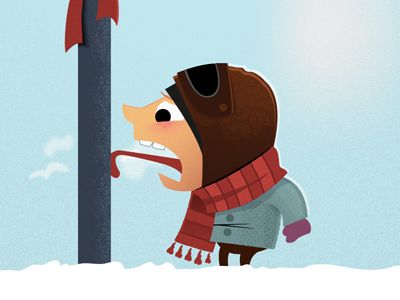
My personal experience with the fuzzy line between comedy and tragedy, didn’t involve falling into a manhole, but licking a pole. I was in the fifth or sixth grade, old enough and smart enough to know better, but young enough and dumb enough to do it anyway on one of the coldest days in February. I wasn’t old enough, or sophisticated enough, to consider the fuzzy, philosophical line between comedy and tragedy, but I knew everyone would be laughing uproariously if they saw me stuck on that pole. I also knew an overwhelming number of my classmates would not share a “Well, at least you’re okay” sentiment when it was over. I knew this wasn’t one of those types of mistakes. I didn’t know a whole lot about human nature, but I knew how much we all crave stories of pain and humiliation, because I did. I laughed harder than anyone else when Andy walked into a pole, and he hit it with such force that the impact broke his glasses in two. I just happened to be in the perfect position to see the incremental progressions of Andy’s instinctual reactions. I saw Andy’s eyes close on impact, followed by the scrunched expression of pain. In the midst of my laughter, Andy’s face turned from pained to embarrassed as everyone else attempted to soothe and coo him back to respectability. Andy’s embarrassed expression focused on me, the only person laughing, and I couldn’t stop. When his embarrassed expression evolved to one pleading me to stop, I just walked away, because for reasons endemic to my evil nature his mental emotional pain proved more hilarious to me than the physical.   

Some might call it heartless, others might suggest that anyone who would even smile at such a thing is lacking some levels of compassion, but I think it’s just kind of who were are and what we do to one another, and we don’t always do it with malice either. Some of the times, we laugh because that’s just what we do. 

I didn’t stand there and think about all this while stuck in the moment of course. The only things I thought about were how am I going to rip myself free and how much is it going to hurt? When I thought about the physical pain, though, I knew it would pale in comparison to the emotional and mental anguish that would occur soon after someone saw me like that. I ripped my tongue off the pole. I don’t remember exactly how long my it hurt after I ended up ripping several layers of my tongue off, but it hurt so bad that I thought I should’ve given more thought to an alternative. I also thought that even if I went on to accomplish historically great things, and I came back to my grade school to meet my classmates, one of them would’ve said, “Weren’t you the guy who was stuck on a pole when we were kids?”

I’ve since read local news stories of other kids stuck on a pole, and they always include a photo or a video of the kid from The Christmas Story in it. One of these stories involved a kid notifying his teacher, and the teacher, who presumably failed to consider the idea that a warm cup of water could free the kid, ended up calling first responders to set the kid free. I still cringe when I put myself in that kid’s place, and I think of all the people standing around this kid. I cringe when I think about the teachers who would never forget this incident, and while they may have been more compassionate in the moment, they probably couldn’t help but laugh behind a hand every time they saw him. This information would’ve eventually filtered out to the students, because how many times does a big old fire engine pull up to a school, and when it does everyone would want to know why, and someone would find out. The first and last question I’d have for this kid if I ever met him is, what were you thinking?

I have to imagine that this victim was either much younger than I was at the time, or that the severity of his incident was much worse. For if all of the circumstances were even somewhat similar, then I have to ask him why he didn’t just rip themselves free? My empathy goes out to him if he feared how painful that would be, but he had to consider all the ridicule, teasing, and bullying he would endure in the aftermath. Even if he feared the pain so much that he wanted an adult to come along and find a less painful solution for them, I would love to ask him if it was worth it. 

Does getting a tongue stuck on a pole compare to falling down a manhole? It does not, when comparing the possible injuries, or other painful consequences, but I would submit that it does when it comes to the probability of embarrassment. I write that because the embarrassment of getting your tongue stuck to a pole has a storied tradition of humor, a tradition enhanced by the movie A Christmas Story. The humor is now an agreed upon universal, further enhanced by the relatively minor, but painful lessons attached to it.  

One of the first faces I pictured when I got stuck to that pole was Steve’s. I knew Steve would be waiting with bated breath for any details of my tragedy, and I knew his audience wouldn’t be able to restrain themselves from laughing at his displays of cruel and clever creativity. I didn’t know what nicknames or limericks Steve would develop, but I knew he would develop something. Steve was our class clown, and he was always developing material on someone. I considered all the excruciating pain I experienced in the aftermath of ripping off layers of my tongue off worth it for all the reasons listed above, but most of all I knew Steve wouldn’t have this material on me.

We’ve all heard talk show guests talk about how they were the class clown in their school. We all smile knowingly, picturing them as children dancing with a lampshade on their head and coming up with the perfect sarcastic responses to the teacher that even the teacher considered hilarious. When we hear this, we nod, because we figure he was the class clown, because no one gets that funny overnight. They explain that they discovered an internal need to hear laughter, by whatever means necessary, at a very young age. Those of us who knew a class clown, like Steve, saw some of this good-natured humor, but we also saw what happened when Steve ran out of good-natured and fun material. We all knew the minute Steve ran out of material, he would begin looking around for victims, and I was always one of his favorite targets. Anyone who has spent time around a class clown, or a group of class clowns, knows that their stock and trade involves insults. I didn’t spend ten seconds stuck on that pole, but picturing Steve’s mean-spirited smile, after delivering a dagger that had its tip dipped in this material was the image that consumed me and convinced me that I made the right decision later.    

We all enjoy making people laugh, but some of us have a deep psychological need to make people laugh, and they don’t care who has to get hurt in the process. Based on my experiences with class clowns, I can only guess that those who would fashion a career out of it, such that they were so successful that they ended up in a late night talk show chair talking about it, probably learned early on that no matter how you slice it, if someone falls down a manhole, or gets their tongue stuck to a pole, there’s comedy gold in there waiting to be excavated. They may be too young to know anything about the complexities inherent in the symbiotic relationship between comedy and tragedy at the time, but at some point they realized that anyone can get a laugh. To separate themselves from the pack of those vying for the title class clown, those who would use that title to future success in comedy learned that they would have to spend decades learning the intricacies and complexities of their craft, as everyone from the Ancient jesters to Mel Brooks did. They also learned that for all of the complexities involved in comedy, one simple truth they learned in fifth to sixth grade remains, if one wants to go from humorous titters to side-splitting laughter someone has to get hurt.