Do you crave a story so side-splitting, funny and unbelievably wild that it doesn’t matter if it’s true? We all do. We’ve all been there, laughing hysterically until someone chimes in with, “That story you’ve been telling,” they whisper to us in confidence. “Yeah, it’s been thoroughly debunked.” We all probably know at least one debunker. They might spare us the embarrassment of debunking us in public, but that doesn’t change the fact that they love debunking us. They study our face and smile at us with compassion that borders on condescending glee. I don’t know if it’s jealousy, but they obviously cannot stand the laughter we receive telling a side-splitting tale that is so wild and funny that it almost doesn’t matter if it’s true. Yet, the storyteller and the debunker both know that it does matter in the sense that the difference between true and it kind of doesn’t matter if it’s true is the difference between hilarious and “It’s still funny, regardless,” and the debunker enjoys dragging our side-splitting story into the latter category.
It’s our fault, we should fact check these stories to see if they’re true, but when a storyteller gets ahold of a great, side-splitting story, we get all jacked up, and we can’t wait to share them. It’s in our blood, and it’s such a part of our identity that we end up laughing harder than anyone else, because it appeals to our storytelling nature.
Most of these stories, just to be clear, are so dumb and inconsequential that we don’t really care if they’re true, and they’re so funny that a part of us doesn’t want to check, because we hope that they’re true. That’s when the “truth trolls” come marching in to destroy our story’s comedic value. Why do they do it, they probably don’t even know the finer, psychological motivations behind it. It’s just something they’ve done for so long that it’s just kind of what they do.
Fact-checkers love to tell us that these fun stories just happen to be false, debunked, or an urban legend. If this is you, you might just want to consider moving along, because we find you exhausting. About three beats after we unleash our side-splitting yarns, their faces get hued by smartphones. “Umm, not true,” they say when they manage to become unhued, “according to (fill in the blank.com) that story has been debunked as an urban legend.” To put an exclamation point on their attempts to suck the fun out of our story, they show us their phone.
Some of us enjoy hearing, and reading, a great story almost as much as we enjoy telling them and writing them, and it’s not a gift given at birth. It’s a methodical process fraught with failure, but those who love it, learn it, and learn to love it. It’s not something that we learn so well that we never make mistakes either. It’s an ongoing process. As much as we storytellers enjoy that process, fact-checkers enjoy their end of it almost as much, as they’ve found it to be an excellent way to discredit, delegitimize, and unfunny, storytellers they just don’t like.
“I just get so tired of their BS,” they add after sucking the smiles off everyone’s face.
Feature Story #1
A zoo keeper grows concerned with how constipated his beloved elephant is. He and his fellow zoo keepers, management, and the zoo community try everything to provide her some relief. In total desperation, the man learns of an effective, all-natural cure of herbs and oils. He places it on a wire brush and inserts it, and it works. It works so well that the elephant unloads on the zoo keeper. The zoo keeper is hit by the violent discharge so perfectly that it knocks him down, and he hits his head so hard that he unfortunately experiences a temporary and fatal moment of unconsciousness, as two hundred pounds of dung suffocates him.
What we’re talking about here are silly, inconsequential stories that we share in employee cafeteria. We’re talking about those stupid stories that no one will remember thirty seconds after they’re told. We’re talking about telling stories that might cause some to smile, others laugh, and still others to roll around with hysterical laughter, and the minute the truth trollers pull out their phones, everyone groans. The truth trolls cannot abide by all that laughter. They need to thoroughly vet a story before they can even smile, and they won’t even smile if they happen to find out it’s actually true. “Well, it turns out that one is true,” they say with same look they have when eating a sandwich. If they find out one of your stories doesn’t pass the test, they have a smug, “I’m just calling you out on your BS!” look on their face. That appears to be the only source of satisfaction they gain from their otherwise joyless existence.
Feature Story #2
A man in Oklahoma, enters the highway, and after a couple of miles, he clicks his Recreation Vehicle (RV) into cruise control. Nothing different than anything any of us have done over a hundred times. Except, this driver, allegedly unaware of the full functionality of the cruise control feature on his RV, walks into the kitchen area of his RV to make himself a sandwich. We have to imagine that the man didn’t have enough time to get the meat between the slices of bread when all hell broke loose, as the RV drove off the road and into the ditch. Some versions of this story suggest that the man died as a result of the ensuing accident. Others claim that he not only survived, but he won a settlement with the manufacturer $1,750,000 and a new RV, because the manufacturer did not specifically document for him the full functionality of the RV’s cruise control. This story isn’t half as funny as it once was, based on the current technology that allows some cars self-driving functionality, but back when I first heard this tale, it seemed impossibly hilarious that a grown man (or woman, depending on the version of the story) could think that they could make a sandwich (or cup of coffee) in the back while the car was in cruise control.
Some great stories combine fiction and non in a manner we call creative non-fiction. I remember mentally toying around with the concept of the total capacity of cruise control, soon after I bought a car that had a working one. I thought the possibilities of a fella over-estimating its capacity could be funny, and I’ll be damned if someone didn’t consider the same plotline, either fictionally or in non-fiction. Is this story 100% true, tough to know 100%, but does it have enough truth in it to be funny? At some point, I think we should all hit that “off” switch in our cranium that analyzes, deconstructs, and refutes such stories. Just laugh or don’t laugh, but they can’t. They love pretending that they’re a reporter, and that they’re taking a story, or its storyteller, down.
Feature Story #3
Elvis Painting in Cheese
Elvis Presley had a soft spot for cheese. His favorite sandwich, according to sources, was the grilled cheese sandwich. Elvis was from the deep south, and the home he grew up in an environment that was anything but rich. After achieving a level of fame and fortune those who were never a Beatle or the primary singer on the album Thriller would never understand, he probably enjoyed the finest delicacies in the world, but he couldn’t kick his love for the grilled cheese sandwich. Elvis ingested so many drugs, and so many different kinds of drugs, that we cannot dismiss them as a contributor to his eventual demise, but what does cheese do? It stops us up, and among the numerous other things Elvis poured into his body was a truckload of cheese. As Dan Warlick, chief investigator for the Tennessee Office of the State Chief Medical Examiner, stated, Elvis’s death was brought on by something called the Valsalva’s maneuver. “Put simply, the strain of attempting to defecate compressed the singer’s abdominal aorta, shutting down his heart.” The coroners found that Elvis had “Compacted stool that was four months old sitting in his bowels.”
Did cheese take The King down? These stories are snowball stories. As they roll from one storyteller to another they gather facts, details, jokes, and out and out fabrications, until they arrive at some finished form of funny. I don’t want to know most of the time, because most of these stories are so dumb that I honestly don’t care, and the primary reason I’m writing this article is that I don’t understand why those with a dreaded and incurable hued nose disease do.
I just want to laugh, but I’ve been fact-checked me so often that I now wonder if what I’m being told is 100% true. I want to laugh, but more than that, when I hear a great story, I want to repeat that story so often that it becomes mine. If it’s going to be mine now, I have this newfound urge to fact-check it, so I don’t get fact-checked, and I so want to go back to “Who cares, as long as it’s funny!” mindset.
“The idea that you loathe fact-checkers so much only makes them seem a little more legitimate to me,” third parties say when we complain about truth trolls checking our stories.
I don’t know if it has anything to do with the fact that I’m Irish, but there are few things I enjoy more than sitting in a circle of friends, all with beer in hand, telling a story that has but one agenda, to make them laugh. “There’s no way that’s true,” they say between laughs, and I have no problem with that because I know that for most people that line gives them license to be free from naiveté, and it also frees them to laugh harder. We all know that that story is so sensational that it can’t be true, but we don’t care in that small space in time where all we can do is laugh about it. “That guy is so full of crap, it’s not even funny,” we might say to a third party after the storyteller leaves the room, but the next time he enters, we’ll be all over it when he tells us he has another story to tell.
Truth trolls won’t go through any of this with us. They might want to, but they can’t. They have some odd belief, probably born of some childhood experience that left them vulnerable to the charge of naiveté, that if they believe that, they’ll believe anything. They believe that if they believe our silly, stupid story, their credibility is on the line. Their noses contract a blue hue, and they come out, “Not true!” Now I will grant you that if a story is 100% true, it might slide it a little higher on the funny scale, but by how much? Does it lift such a story from funny to knee-slapping hilarious? If we add, “It’s true, all the fact-checkers checked it and sourced it out, and they found that it’s 100% factual.” How much does that truly add to the entertainment value? If you’re a hue-faced truth troller who has neck problems, because your head is permanently fixed in the 45-degree position, will you go back to 90-degrees with an “It’s true” and laugh? No, and you might even be a little disappointed by your findings, right? Yeah, I’m looking at you.
Feature Story #4
A raging alcoholic was informed by his doctor that he had a form of throat cancer that would end his life quickly if he chose to continue to drink alcohol. The alcoholic peppered the doctor with questions, “Cut back, wean myself off of it over time?”
“I don’t think you understand the severity of this,” the doctor said going over the biopsy and the image test results with the alcoholic. “This is what we call stage four cancer, and if you quit now, cold turkey, you have a chance, about a 39.1 percent chance to live five years. Keep drinking, even a little amount, and you’re likely dead in months.”
This scared the alcoholic. He did not want to die, but he couldn’t imagine going weeks and months without a small swig of alcohol here and there. In some respects, it was psychological torture to him to see everyone around him drink so casually, and have so much fun, but he kept coming back to the idea that he didn’t want to die.
It hurt to drink alcohol too, and that was really one of saddest things in this alcoholic’s life. It was the only reason he went to see that doctor. Once the doctor took alcohol away from him, he realized that he never learned how to live. He didn’t have any hobbies, friends, and he didn’t know how to fix things. He had family, but they distanced themselves from him a long time ago. He was a man who worked his tail off and came home to drink alcohol with his beloved wife while the two of them watched TV together, and he couldn’t even enjoy that. In short order, this man became depressed and desperate to live the only life he knew. He did some research on his computer and discovered something called butt-chugging, or boofing.
“We’ll be using this device,” he informed his wife, “to deliver alcohol to my system by enema. It won’t touch my throat and exacerbate my condition.” His wife was hesitant, but the alcoholic broke her down. “What most people don’t know is we all have enzymes in our stomach and liver that break alcohol down and dilute it. Regular butt-chuggers say that it stings a little, initially, but after a while some say that they start to enjoy the sensation. They even have a term for those people. They’re called klismaphiliacs. Due to the fact that you’re essentially bypassing all of the biological protections our body has in place by going the enema route, they say there’s no hangovers and no puking involved.”
Some dispute whether or not the wife obliged the alcoholic, but she was charged with negligent homicide for delivering what turned out to be a lethal and fatal dose of two 1.5-liter bottles of sherry into her husband’s system. In her defense, the wife claimed innocence by declaring that he did it himself. “He did it all the time,” she pled. “He was always giving himself enemas. Coffee enemas, alcohol enemas, and even soap enemas. He even had enema recipes.” The case against the wife was dropped due to insufficient evidence.
One of the primary lessons this alcoholic-turned-butt-chugger didn’t consider is that puking, while uncomfortable, disgusting, and painful, it serves a biological purpose as important as coughing, sneezing, and bumps on our arms. It is the body attempting to push what it cannot dilute, absorb, or handle out. While we’re puking, it’s difficult to consider that this is probably our body protecting us from the damage of what we do to it, and that it’s actually a good thing that our body knows how to protect us from the debilitating and at times, fatal things we do it.
I am not a regular patron of the sites and shows that feast on the misfortunes of others in this manner, but I used to occasionally enjoy an episode of Thousand Ways to Die, and The Darwin Awards email lists we used to pass around the office. Their entertainment value, while short and limited, can produce a guilty smile or a laugh behind a hand. There’s really no sense in trying to deny that we love stories involving the misfortune of others, “You mean he died?” we say with an oh-my-gosh face on, and we experience a hybrid of laughter and horror. It’s a part of us.
In researching some of the new ‘believe it or not’ sites for this article, I found some new sites I never heard of that preyed on our misfortunate few, and they had “100 percent true” stamps all over them, as if that’s the primary purpose of their existence. The administrators, and authors, of the stories on these sites are careful to properly source each story with links, footnotes, and various other forms of attributions to perpetuate this idea that they’ve learned from those past publications we all enjoyed that focused on sensational stories that had little-to-no foundation of truth in them. Thus, we can gather that the older sites and publications probably got fact-checked to irrelevance, which, in essence, opened up a niche for these new guys to prosper, but the problem is their stories, while guaranteed and certified to be 100% true, are actually kind of blah and mundane. Their stories amount to, “There was this one guy, from some town in a state who made an unwise decision,” and we un huh them with some excitement as we read on, “and well, no one was hurt or anything, and no one died, but wasn’t that a foolish decision?” Well, yeah, it was, but I was kind of looking for some entertainment here. These sites learned from the past, and they decided to forego the sensational for the factual. As much as it pains me to see this need to have certified 100% guarantees, I understand it’s now the price of doing business in this arena, because in this incarnation of the Information Age, everyone has a phone, and everyone has a site to help them bunk, debunk, or take the bunk out of things, and in this case, it’s better to give than receive, because it can be embarrassing and even a little intimidating at times when fact-checkers discredit, delegitimize, and unfunny every stupid, silly, and inconsequential story we tell, but that’s just what they do, they’re fact-checkers.
“I’m smart. Not like everyone says. I’m smart, and I want respect.” –Fredo from The Godfather. I love this quote, as anyone who has ever read this site knows. I use it so often that I use it so often, too often, because it just seems to be an evergreen quote that fits so many of my themes. It’s an everyman quote. It’s one of those quotes that if we don’t say it every day, we probably think it. We know we’re not able to figure some things out, but we’re able to figure out a mess of other things, so that should make us smart right?
What is smart, intelligent, or knowledgeable? It’s a question loaded with so many variables that it’s the literal definition of a loaded question. There are so many forms of human intelligence that it takes a lot of intelligence to understand the definition of intelligence. We all have some figurative schemes of thought that we use to develop images for matters of discussion. If I were to ask you what the elite intellectual looks like, you automatically picture the white lab coat. Researchers conducting tests on individuals know that if they want their subjects to take them seriously, they need to have a closet full of white coats. Ear, nose and throat, family practitioners probably also have a closet full of white coats they wear to presumably put an end to us complaining that they don’t know what they’re talking about. Depending on their goal of leading us to assume they’re smart, they might also want to mess their hair up (a la Albert Einstein), exhibit poor social skills, and thet should probably look like he doesn’t spend enough time outside. Our local car mechanic doesn’t fit any of these bullet points, however, but if you’ve ever sat down with one of them, you know the best and brightest among them have such a wide array of intelligence of their profession that it can be humbling and disorienting to hear them go on. That’s pretty relative you might argue, because we all have our areas. That’s kind of the point though isn’t it? If a man in a lab coat has a spark plug go out in his engine, he’s as lost as the rest of us, and the epitome of relative definition of intelligence. We all have our areas that make us feel smarter than most, but we eventually run across something, someone, or some other person place, place, or thing that makes us feel pretty darn dumb.
Some of the smartest people I’ve ever met also had another key ingredient that is in short supply: clarity. They not only have a clearer vision of life than the rest of us, they have wisdom based on experience. They’re not afraid, intimidated, or confused by questions, arguments, or refutation. They’re able to roll with the punches, because they’ve already argued with so many people that they know every possible argument for and against. Yet, before we consider those with greater clarity intelligent, we have to consider another variable of intelligence: sensitivity. Most clear-minded people I know suffer from some deficits in emotional intelligence. They know the truth as they’ve experienced it and seen it, but they don’t account for all of the variables that could undermine their version of the truth. Can something be true, if it is only true 99.9 percent of the time? If an emotionally intelligent percent invites anecdotal evidence that undermines that truth, is it still true? There are times when it seems clarity and sensitivity seem to be combatants in the pursuit of truth, intelligence, and knowledge. Most clear thinkers are so lacking in sensitivity that they almost seem robotic, and they view arguments against their views as an attempt to cloud the truth and add confusion, but they don’t alter their views one iota.
The more succinct definition of intelligence is the ability to acquire and apply knowledge. That definition might lead us to seek all of the varying definitions of knowledge, and how we apply it. It doesn’t serve a purpose, but some of us have retained more knowledge about the NFL, from the 80s and 90s, than most of the experts on pregame, NFL shows. Try to stump us. Go! Some of us know more about the show Seinfeld than anyone we’ve ever met. Say what you want about such knowledge, but it is information that we’ve retained, and in some cases used, or applied, as we’ve dropped the show’s jokes in a timely manner that has impressed people. Is it smart though? Will our audiences consider that intelligent? Our friends probably consider retention of such information the definition of intelligence, but how many strangers, who didn’t grow up in the same era we did, will put that information/knowledge on the same level with the man who is intimately familiar with Shakespeare or Chaucer? If you’re anything like me, and you enjoy searching for seemingly impossible answers to questions, you’ll probably end up saying,“I honestly don’t know if I’m smart or dumb. I’m probably Stuck in the Middle with You.”
“Clowns to the left of me Jokers to the right Here I am stuck in the middle with you When you started off with nothing And you’re proud that you’re a self-made man.” –Gerry Rafferty and Joe Egan
I’ve met a wide array of writers throughout my life. Some of them exposed for me the difference between the creative term brilliance and the more math and science definition of intelligence. I’ve met brilliantly creative writers who were so good that I was just plain jealous, which led me to try to outdo them with a long stretch of writing. I’ve also met a number of writers who knew the craft so well that they gave me some excellent pointers and valuable information that I still have in my head whenever I write. They knew the ABCs of writing so well that it was a little surprising to learn they were actually average-to-poor writers. When I see them now, I call them editors. Editors can spot all of the errors of the creatives, and their approach to writing can be so oriented in fact that it takes all the fun out of writing. Most of them don’t do it to be mean, better, or correct, it’s just the way their mind works. They’ve learned the craft by studying the masters, and if we run into a wall, they can provide helpful advice based on their studies. There’s nothing wrong with that of course, but most of them don’t know their limitations. It seems to me that they know masters’ masterpieces, so well that they wouldn’t dare approach the craft in an innovative manner that might violate the tenants laid down by those they deify. They know the masterpieces far better than jokers to the right, and they’re paralyzed by idea that if they can’t top them, why try? Those of us who aren’t as familiar with the literary canon might be dumb enough to think we have something to add to the conversation. Even if we don’t come anywhere close to what editors determine to be quality material, we don’t lie awake at night in fear of a clown from the right dropping the dreaded ‘D’ word, derivative, on us.
Those of us stuck in the middle with you grew up on KISS, and heavy metal, and we loved the silly, simplistic movies and shows from the 80s and 90s that knew how to get to the point. If we were to ask members of that generation (my generation) I suspect that most of them would say, “It was a pointless era, but who cares, it was built on being fun, funny, and entertaining.” Whatever point these entertainers had, they got to it quick, because they feared belaboring a point might lose them their short-attention span, key demo. Those stuck in the middle with you have those influences loaded in our neurons, firing our synapses. Is that a brag? Some of the songs, shows, and movies from that era were quite innovative, creative, and influential, but no one would confuse memorizing the lines of dialogue from Buggs Buggy and Gilligan, or studying the lyrics of KISS, with an intellectual exercise. Yet, when we combine all of that silly simplicity with an appreciation for the masters of literature, we end up somewhere in the middle.
Those of us in the middle “Started off with nothing”. The “Theys” of our lives helped us form a foundation by teaching us the elements of style, and the rules, but they couldn’t teach us how to deviate. Those deviations defined us in many ways, ways that led us to be a self-made man when it came to writing. We normally equate the term self-made man with success, but the self-made men who ended up anonymous failures are far more numerous. They just didn’t succeed. They were thedreamers who were so delusional they never paid heed to those who told them to give up, because they were making fools out of themselves. The term self-made man is a nebulous one that we could apply to high school graduates and “some college” applicants. We could apply it to artists, craftsmen, and small business owners who had to claw and scratch their way to some relative definition of success. The opposite of self-made man, arguably and debatably, is the college graduate. The college graduate is the product of at least four years of shaping and molding, until he establishes himself in the workplace or office.
We could also say that the difference between the self-taught, or autodidactic, and the college graduate, or manualdidactic(!), is status. The mindset of the college graduate is that they’ve achieved status, and the self-made man is forever in pursuit of it. If we think about this dynamic in terms of the waiting room for a job interview, the college graduate believes he completed most of the interview on his resume, as he listed out the bullet points of what he did in college. He has achieved knowledgeable status, and he thinks the interview process will be paint-by-numbers after that. The high school graduate and “some college” applicant sits with inferiority complex believing that everyone else in the waiting room is a college graduate. His need to prove himself surely preceded his entrance into the building, as he apprenticed for the job doing grunt work in the field in question. Who will the head hunter in Human Resources view as more intelligent, knowledgeable, and the better candidate in the interview? It’s all relative to the head hunter, of course, but self-taught man knows that the onus will be on him to prove himself in the interview.
When we hear the self-made man talk about his pursuit of success, we often hear them make the dubious claim that, “Everyone was against me,” and/or “Nobody thought I would succeed,” but we could argue that such lines romanticize their struggle. More often than not, no one cared about them when they weren’t doing anything, because why would they? If they cared at one time, it probably took the self-made man so long to get there that everyone just sort of gave up on them. The self-made man probably had a lot of people cheering him on in the beginning, and that probably ignited something in him, but whereas they started giving up on him, he never stopped believing. The self-made man probably thought there was something to it, even when there wasn’t. Whatever stoked his desire to believe in himself took, and he continued to believe in himself regardless. Most of us don’t even remember the initial driver that spurred us onto further creations, but there is some inner drive to keep doing it. We’re the self-made, self-taught men who spend our time striving to prove that we’re not as dumb as our college transcripts suggest, and we are endlessly pursuing the sometimes-silly things we love with passionate zeal.
In the craft of writing, over-the-top intellectuals are also handicapped by the Great-American-Novel syndrome. They can’t write anything that is anything less than the most important thing ever written. This is probably why they sit behind a blinking cursor for so many hours. They are profound thinkers who refuse to write anything common (“Don’t be common!”), trite, cliché, hackneyed, or banal. They prefer to dazzle with the unfathomably amazing, the intellectually illuminating, and that which is illustrative of the plight of mankind against the meaning of life. “Just write,” writing experts tell us. “I can’t,” they say. “I can’t think of anything.” They usually sit before those blinking cursors trying to come up with something so brilliant that it’s beyond brilliant. Then, in those writing groups, they criticize those who produce the common, trite, cliché, hackneyed, or banal, until they realize they share more characteristics with editors than they do writers. Those stuck in the middle with you don’t know what we don’t know, and we’re just dumb enough to think we might have something so entertaining we might eventually add a nugget that is enlightening.
“Get in, get pithy, and get out,” are the words we employ.
When we’re stuck in the middle with a quality author we get this sense that we’re joining hands with them as we walk with them on their path of discovery. If they do it right, it won’t be limited to just a facts based adventure. The quality author is still intimately familiar with being dumb on the issue, and we can hear the joy in their voice as they discover all this great knowledge. They know that fuzzy line between intellectual and dumb so well that they know how to tap dance on both sides, and we laugh right along with him. As much as we prefer to think we get it, whatever it is, we actually don’t most of the times, because we’re not as smart as those who do. We do enjoy the pursuit of knowledge, but we don’t enjoy hearing some professorial presentation from someone who knows the facts so well that they are all but reading them on a Teleprompter. Those of us stuck in the middle with you, on that fuzzy line between intelligent and dumb, are not so far removed from our misunderstandings of the world that we don’t take them for granted and no longer question the ways of the world anymore.
“Hey Patrick come over here and check out our sinkhole,” Hector said when he spotted his neighbor walking outside. Patrick walked over and looked, because who wouldn’t want to look in a sinkhole? He looked from a careful distance, made a comment that I can’t remember, and he began walking away. “Wait, Patrick, you really gotta see this thing,” Hector urged. “C’mere.”
“I saw it,” Patrick said. “It’s a sinkhole Hector. I’ve seen sinkholes before. It’s not a circus exhibit.”
“C’mon,” Hector said, “I’ll hold your hand, if you’re afraid of falling in.”
“You don’t understand, I will fall in. I’m just that dumb,” Patrick said, dropping his new favorite line on those of us standing around the sinkhole.
“No, you won’t. They’ve cordoned off the dangerous spots, so we know how close we can get,” Hector said, noting that he already called the police, and they put yellow tape around the weak spots. “Just don’t cross the tape.”
“Trust me,” Patrick said. “I’ll fall in. I’m just too dumb.”
Patrick loved that line. He dropped it so often, in so many situations, that it kind of became his catch phrase. Why did he love it? I wasn’t there when he first heard it, but I wonder if he thought it was so hilarious that he would start using it. Did he think it was so hilarious because he could relate to it? Did he think it applied to him so well that he thought he should start using it? He might have started using it because he found it funny, but he began using it so often that I think he now believes it.
“Be careful what the brain hears you say,” a friend of mine said when I told her this story. “It might start to believe it.”
Others can convince us of just about anything, if they repeat it often enough, but can we convince ourselves of something if we repeat it often enough? If we hear someone else’s schtick, and we love it for being such a great, self-deprecating line, can we accidentally convince ourselves that of something like being so dumb that we might do something that could cause ourselves irreparable harm? It’s possible of course, but is it probable? I would say this is not a joke, but it probably started out that way to Patrick, until he accidentally convinced himself that not only is he dumb, he’s so dumb that if he doesn’t check himself, and his brain, he’s probably going to end up in an emergency room saying, “I told you. I told you how dumb I was. Why didn’t you listen? Why didn’t I?”
I’m not exactly sure why I considered Patrick’s “I’m too dumb” joke so funny. He dropped this line on me several times, in casual conversations, and I always enjoyed it. We’ve all heard people drop variations of self-deprecating humor, but Patrick’s delivery was so pitch-perfect that I can’t but think he believes it on some level. He was so flat and straight, and nothing about his presentation suggests that he’s seeking laughter. Does that make his joke better, yes it does, but does he deserve credit for his ability to deliver a joke, and is it possible for someone to deliver a joke that well without some belief in it?
To arrive at answers that plagues us, we need a control group. When research scientists attempt to arrive at answers regarding psychological complexities, they divide their group into subjects and a control group. Patrick is a jokester, always telling jokes, and he’s a pretty funny guy, but he has one flaw. He laughs harder at his jokes than anyone else does. To understand if he is kidding, and by how much, we need to study the methods, patterns, and reactions he has when telling his other jokes. Following his other jokes, he drops a “I mean, C’mon, right?” followed by laughter. He pumps his head back, and his eyebrows go high on his head as he laughs. When he drops his “I’m too dumb” jokes, however, he doesn’t laugh, and his head goes down in the manner a dog’s might to signify submission. Is this part of his schtick? Does he do that to sell the joke better? Patrick is funny, but he’s not that funny. He does not apply such subtle intricacies to any of his other jokes, even the other self-deprecating jokes he tells. I don’t think it would take a team of research doctors to find that the reason Patrick tells this joke so well because he believes it.
For all the reasons listed below, reasons I imagined later, this instance at the sinkhole struck me as particularly hilarious. Patrick added to the comedic nature of his joke by putting greater distance between he and the sinkhole. He walked away from Hector’s home, and off Hector’s lawn, and he then went into his home. I don’t know if he locked the door, but my guess is he did to presumably place one more obstacle for him to cross to get back to the hole. I presume Patrick did this, because he no longer trusts his brain to help him avoid an impulse that might cause him harm. Those of us standing around this sinkhole in Hector’s lawn could only presume that Patrick lost all faith in his brain’s ability to protect him from harm.
I flashed to Patrick falling in the hole, a near bottomless pit in Patrick’s imagination (it was about three feet deep), looking up at us saying, “See, gawdangit, I told you how dumb I was.”
“Listen, I have two kids to raise, and they count on me to be there for them in so many ways,” I imagine Patrick pleading if Hector pressed him further. “If I start following whatever impulses my insufficient brain provides, I’m going to leave my wife a single-parent, and I’m not going to do that to her or my beloved children. I have to learn to reject whatever temptations I encounter to protect my body, so I’m there for them throughout their maturation.”
We’ve all heard psychologists talk about a person being at war with their brain. It’s a deep, complex topic they use to describe those with seriously troubling psychological issues. Patrick doesn’t have those, but he does appear to be in conflict with his brain on a level that he describes with repetitive jokes. At one point in his life, I think Patrick decided to wage a cold war against his brain. A cold war, by our definition, involves “threats, propaganda, and other measures employed just short of open warfare.” Or, as others put it more succinctly, “Waging war without firing a shot.” At some point, Patrick’s internal forces decided to mount an internal coup against the brain, because those mechanisms decided that the brain no longer had their best interests in mind.
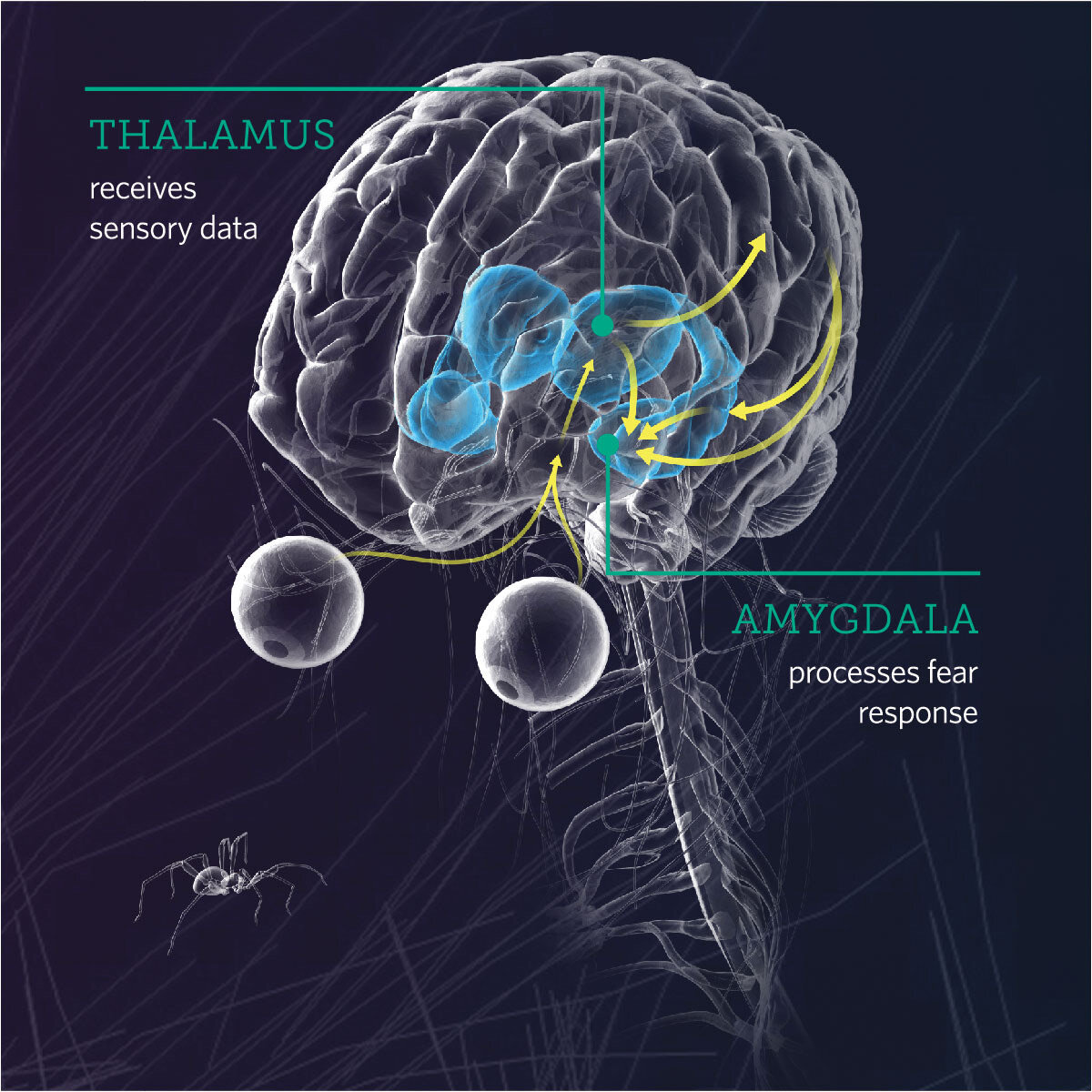
One of the primary directives of the brain is to protect us. It protects us from heights, guns, and the prospect of encountering large, man-eating animals through chemical compounds that induce fear. When we fear, we learn to employ various defensive measures, including creating distance from the temptation, to prevent what the brain suspects could cause bodily harm. Over the years, we learn what to eat and drink, and what we do and think to prevent bodily harm. The brain instinctively knows, and learns, what can cause death. What isn’t so obvious are the irrational fears we develop for the dark, ladybugs, and inanimate objects.
Why are we so afraid of insects, even relatively harmless insects such as the ladybug, at a young age? We don’t know what a ladybug is when we’re young, or if we do on some rudimentary level, we don’t know the extent of their abilities. This is the fear of the unknown. As we age, we learn that most animals and insects have an instinctual fear of humans, and it provides us a level of comfort when we’re walking down the sidewalk, and they clear the way for us. Some of the times, insects occasionally land on us in their confusion, and our young, fantastical mind can interpret that as purposeful, especially when the ladybug begins to crawl up our leg in a manner we could further interpret as a purposeful violation of the parameters we thought we had with insects. We convince ourselves that they’re not afraid of us anymore. They’re crawling up our legs with a specific purpose in mind that we don’t even want to imagine, and that leaves us paralyzed with fear.
At some point in our maturation, our brain learns the parameters of threats against the body. There’s nothing to fear from ladybugs, even those that appear to violate the parameters of the relationship we have with insects. We’re quite sure that there are some anecdotal tales of a ladybug causing human deaths, but they’re so few that we know there’s little to fear from them. There are, however, a number of tales told of spiders causing death, but not as many as those from the mosquito archive. Yet, the number of people who fear spiders far outweighs those who fear mosquito. The whole world of fearing spiders involves their creepy nature, their physical appearance, and the techniques they use to poison their fellow insects and eat them.
At some point in our search of what to fear and what we learn is relatively harmless, the brain plays tricks on us. We fear the relatively harmless, clowns and cotton, yet we don’t fear some of the things that can actually harm us, and kill us, like driving ninety miles an hour down the interstate.
“I like to tease my fears,” a friend told me. “I prefer to live dangerously. It’s a rush to put your life on the line by skydiving from a plane, or bungee jumping, and bungee jumping is actually a lot more dangerous than people know.”
“So, you consider jumping from 50 to 500 feet with nothing but a cord tied to your ankle dangerous?” I asked sarcastically. The fact that she felt the need to tell me that bungee jumping was dangerous suggested to me that most people she knows have tried to argue against her position, and if that ain’t the brain messing with people, I don’t know what is.
Patrick’s brain has obviously spent a lot of time messing with him in this manner, trying to convince him that nothing is as dangerous as they say, and his brain has obviously done this so often that Patrick just doesn’t trust it anymore. We’ve all heard that those working a police beat believe half of what they see and none of what they hear, but I’ve always assumed that was intended to illustrate their trust of what others do and say. Others can deceive us into accepting what we know is not true, but can we do this to ourselves? Are we at war with our own brain in relatively benign situations such as our approach to a sinkhole? There’s knowing and not knowing, of course, but as Patrick said he’s seen sinkholes before, so he presumably knows how to approach it. He just doesn’t trust his instincts, and he’s skeptical of what he might do.
We all engage in self-deprecating humor, and we all enjoy the fruits of a person showing that he doesn’t take himself too seriously. As I’ve written many times and many ways, be careful with this comedic tool, because your audience might begin to believe it. Patrick’s use of self-deprecating humor seemingly adds another layer of caution, be careful how often you use it, because you might start to believe it.
Patrick is not a dumb man, and if we are ever tempted to join him in the belief that he is, all we have to do is talk to the man for about forty-five minutes to learn how knowledgeable he is on so many different and diverse topics. Somewhere along the line, Patrick heard someone say that they were “so dumb” that they might not be smart enough to prolong their health and well-being. Patrick obviously considered that so funny that he began using it, and he saw how this exaggeration of the typical self-deprecating joke comforted his audience. It obviously comforted him too, to a degree, to think that he wasn’t all that. At some point, he began to fear that he might actually be “so dumb” that he could find a way to convince himself that he might cross that yellow, police tape to end up in a bottom of a sinkhole without knowing how it happened or why he did it, because his brain is now so deficient that it might lead him to him harming himself in some life-altering manner. Faced with such internal strife, Patrick decided that it was just safer for him to walk away, enter his home, and lock the door to try to prevent his kids from being fatherless children. “Trust me, I will fall in,” he warns us, and presumably himself, “because I’m just that dumb.”
Feature Story #1

A man in Oklahoma, enters the highway, and after a couple of miles, he clicks his Recreation Vehicle (RV) into cruise control. Nothing different than anything any of us have done over a hundred times. Except, this driver, allegedly unaware of the full functionality of the cruise control feature on his RV, walks into the kitchen area of his RV to make himself a sandwich. We have to imagine that the man didn’t have enough time to get the meat between the slices of bread when all hell broke loose, as the RV drove off the road and into the ditch. Some versions of this story suggest that the man died as a result of the ensuing accident. Others claim that he not only survived, but he won a settlement with the manufacturer $1,750,000 and a new RV, because the manufacturer did not specifically document for him the full functionality of the RV’s cruise control. This story isn’t half as funny as it once was, based on the current technology that allows some cars self-driving functionality, but back when I first heard this tale, it seemed impossibly hilarious that a grown man (or woman, depending on the version of the story) could think that they could make a sandwich (or cup of coffee) in the back while the car was in cruise control.


“I don’t think you understand the severity of this,” the doctor said going over the biopsy and the image test results with the alcoholic. “This is what we call stage four cancer, and if you quit now, cold turkey, you have a chance, about a 39.1 percent chance to live five years. Keep drinking, even a little amount, and you’re likely dead in months.”



 Rilaly