DIY Garbage Disposal Installation: It Ain’t Easy


“I done got my ying yang broke,” I would call out to my apartment managers. “Send Scully!” 

“Why do you pay rent to an apartment complex?” my friends would ask me over the course of twenty years. “You’re just throwing money down a well.” This! This is one of the many reasons why, something breaks, call Scully. We don’t have to mow, shovel snow, or know how to fix things with Scully around the corner, and we’ll never know what we don’t know, unless we make the leap to home ownership. When I made that leap, I realized if my dad ever taught me anything about home maintenance, I forgot all of it in those twenty plus years I just called Scully.

And it’s possible that my dad did teach me some things, but I was so bored by it that I didn’t pay attention, or if I did, I forgot all about everything he said as soon as the thing was fixed. I’m still so bored by it, twelve years into the leap, that I forget everything I learn soon after fixing it. If you’re one of us, and you’re tired of paying the Scullies of the world to fix it for you, YouTube is your friend. If you don’t already know this, YouTube is loaded with Do-It-Yourselfers (DIY) who will show you how to fix everything from a leaky roof to your poopeé (as opposed to your pooper, which, to my knowledge, still requires professional consultation).

“It Ain’t Easy”

One of the reasons I recommend YouTube, is that one of the alternatives is the company’s step-by-step instruction manual. My favorite thing to do with a product’s instructional manual is to crumple it up and try to sink it in the nearest waste barrel from what I deem a three-point range. My crumpling process can garner unwanted attention, as I passionately express the bottled up rage these vague, incoherent little pamphlets have caused me over the years. I can do this now, because the Do-It-Yourselfer videos provide so much more clarity.

These DIY videos don’t just instruct us how to fix our appliances and make better homes and gardens, they show us. They show us the difference. “This is a bolt,” they say to explain that which a product’s manual assume we already know, “and this is the difference between a bolt and a washer.” If they don’t say such things, you can see the difference. They’ll hold the bolts and screws in their hands, so you can see the differences in sizes before you start screwing on and screwing up. They’ll also suggest that you might want to consider borrowing your neighbors’ tools before you start, because the “tools” the companies provide are often so basic that they’ll only make your job harder. 

One warning before you start searching for these videos, almost every DIY guy will begin their video with, “[This] is pretty easy, IF you know what you’re doing.” Okay, but if we knew what we were doing, we wouldn’t have clicked on your video. For those of us who don’t know what we’re doing, they’ll add, “And I’ll show you how in one-hundred and twelve simple steps.” My guess is that most DIY guys have either done this over hundred and thirteen times, or they had some handyman job where they did it frequently. We do want this level of expertise, of course, but some of the times their knowledge and expertise leads them to take some knowledge for granted. 

If you’re anything like me, and you’ve spent most of your life calling Scully, I’m not going to kid you, fixing most household items properly is hard, or at least they were/are for me. My apartment dwelling friends say, “Just submit your name to that ambitious, industrious kid’s weekslong wait list. It’s worth the wait, and the labor fees, to have someone else fix it properly for you.” 

Another annoying refrain from DIY guys is the “Anyone can do this from the comfort of their own home.” Anyone can change a garbage disposal? Have you ever lifted one of those things? Try it. Walk into a hardware store and lift one, just for giggles. I can lift a garbage disposal, and I could probably curl it over 100 times, average weight 13.4 lbs., but –and this is a huge but— the angle of the extremely tight kitchen cabinet, beneath my old-world kitchen sink, is such that I can’t put my shoulder into it. For me, holding a 13.4 lb. garbage disposal is all forearm, and although I didn’t have to lift it over 100 times, it felt like it, because of all the holding, positioning, and twisting the task requires.  

To connect a new garbage disposal, we need to lift one from a very difficult angle, position it perfectly, and twist it into a groove. “EASY? You think this is easy? DIYers around the world, do me a favor, drop the word E word from your vocabulary. As David Bowie once sang, It Ain’t Easy, at least not universally.” Some of you are probably laughing at me right now, because you think it is easy. All right, well, let’s gauge the relative term easy through another relative term, experience. How much experience have you had doing this? How much experience do you have doing that? Yeah, I can do that, and I’ve done that so often that I consider it easy. So, there’s that.    

The first step, for those of us with no experience changing a garbage disposal, is to make sure your old garbage disposal is completely done. That’s right, it might not be broken, it might just be jammed. First click the overload button to reset the unit. If that doesn’t work, make sure the disposal is plugged in and the switch is working. (If you have no experience with garbage disposals, it will benefit you to run through this basic checklist before you go out and purchase a new one.) If all that checks out, find what they call an Allen wrench. Put it into the flywheel turning hole at the bottom of the garbage disposal and turn it. Turn it two to three times. If it’s a jam, you might experience a tough turn at some point. If you make it through the tough turn, and it turns with greater ease, you’ll know it was just a jam. Turn it on. If it doesn’t work initially, repeat the process (I had to do this three times on one occasion.) If that doesn’t work, your disposal might need replacing.
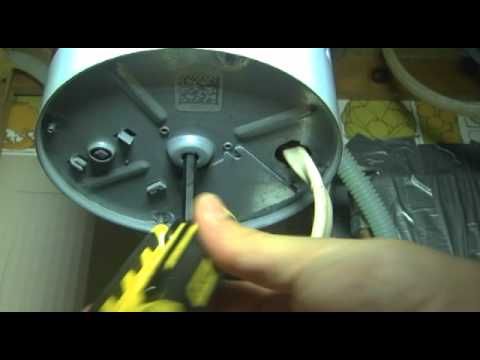
flywheel

Taking an old garbage disposal unit out can be accomplished by most. I’m not going to drop the E word here, but if I can do it, I have to imagine there are ten-year-olds out there, who’ve never heard the term garbage disposal, that can remove one. Follow the DIY guy’s instructions by unscrewing all of the this and thats, disconnect the tubes, and then twist the old garbage disposal out. (Note: Be careful that you don’t crack any PVC pipes.) It’s at this point, right here, when my fellow apartment dwellers say that they would just hire some ambitious, industrious kid to do the rest. I would’ve laughed hard at that ten years ago, but I nod solemnly now. “It’s probably for the best,” I now say, “because putting a new disposal on is hard. Don’t listen to the DIYers and their E words. Not everyone can do this.” 

To install a new garbage disposal, you have to position it just so, and twist. It sounds easy, but as I said that heavy thing becomes heavier through all the trial and errors. If it weren’t so heavy, it might be easy, but it’s hard to hold up there for as long as those of us who don’t know what we’re doing to slip it into the waiting groove perfectly for that final twist. If your cabinet is as tight as mine, you might try eleven to thirteen angles before you realize that there is only one angle that will work. You might look at the top of the unit, five to seven times, and try to line it up. It Ain’t Easy.

It’s frustrating, and yet it’s so frustratingly simple that it will become so frustrating that you might reach a point where you consider it impossible. If you reach that point, it’s time to take a break. If age has taught me anything it’s that it’s okay to take breaks, and in some cases, it’s almost mandatory. We’re conditioned by parents, employers, and other authority figures to think in terms of time constraints. Time constraints also define competency and mastery of a project, “I had some problems, sure, but I got it all done in under an hour.” It’s all true, but it’s also true that if you’re as frustrated as I was, you reach a point of diminishing returns. What are you going to accomplish beyond exhausting every profane word you’ve learned from high school? If you continue, trying to achieve a respectable time frame, you’re probably going to be easily satisfied with a half-ass job just to get ‘er done, then after you calm down, you’ll go back and do it correctly.

To clear the mind and approach the project from a new perspective, I suggest taking two breaks. Watch an episode of your favorite comedy in the first one. It doesn’t matter if it’s a movie, show, or podcast. You need to get yourself laughing. In the second break, one that occurs after another thirty minutes of frustration, try punching a punching bag for thirteen minutes. After thirteen minutes of picturing that DIY guy’s face on your punching bag, coupled with attaching some offensive terms to his “Easy” assessments, you should be able to approach this project with a clear mind.

If you take nothing from what I’ve written thus far, remember these two words: The Plug. All garbage disposals come with a plug. The manufacturers add a plug on every the garbage disposal, because some under-the-sink systems (sink, garbage disposal unit, and dishwasher) have the garbage disposal connect to a dishwasher. Some kitchen systems allow dishwashers to connect to the waterline independently. You will need to determine which system you have before installing the garbage disposal. Before removing the old garbage disposal take note of how your under-the-sink system is set up. If the dishwasher connects to the garbage disposal, and you didn’t know anything about the plug, your dishwasher will flood. 

The DIY guy I watched probably covered this, but some of them fellers talk so much that they remind me of my eighth grade teacher. My eyes glaze over, I miss critical information, and I dismiss some of their instructions as blather. Regardless how I missed the information, I knew nothing about the plug, so I installed the garbage disposal with it still attached. When our dishwasher began flooding, we ripped that appliance apart and cleaned every single element on it. We were so confused, until I retraced my steps and realized that all of our dishwasher problems started soon after I installed the new garbage disposal. I turned to my DIY guys, and surprise, surprise, they taught me about The Plug.

If you failed to remove The Plug the first time through, it turns out that you have to undo everything you’ve done. All that frustration that led you to the most comprehensive spiritual experience you’ve ever had, that included forsaking your creator and welcoming him back into your life, was for naught. If you forgot to remove the plug, you’ll have to take the garbage disposal off, grab a screwdriver, and hammer the (expletive deleted) plug out. That sentence was so easy to write, and it was probably just as easy to read. Take it off and put it on again, it’s easy, a trained marsupial could probably do it after they’ve already done it. The reality of removing the garbage disposal, watching the DIY video guy again, taking two breaks, punching him in the mouth for thirteen more minutes, and watching my favorite comedy was as exhausting as the first time through. 

The first thing I think, soon after I’m done, is some people love this. They love getting their hands dirty, doing it themselves, and they love it so much that they invent new projects for the ostensible purpose of updating, modernizing, and renovating. “I think my ceiling fan needs some updating.” Your old one still works. “I know, but it’s so old world.” You can see it on their face, and in the songs they sing while doing it, they love this stuff, and I just sit back shaking my head, asking myself: ‘Why? For God’s sakes why?’

I’m smart, not like everyone thinks, like dumb. I’m smart and I want respect.” I’m not as dumb as I look. I can do things, other things that other people can’t. Some of the things I do are considered hard, very hard to some, but I can accomplish them with ease. I might occasionally, and accidentally, betray some level of arrogance with a look, some sort of unintended feel, or a couple of words, but whenever I start to get all full of myself,  all I have to do is try to fix something in my home that everyone considers so easy to realize that I’m not half as smart as I thought I’d be at this age.   

You Don’t Critique Another Man’s Meat


“I love grilling,” Leonard said. “Absolutely love it. Some people do it, and some just do it, but for some of us, it’s a passion.” 

If someone said this from behind one of those sleek, compact, Three-Burner, Liquid Propane grills that feature porcelain-enameled, cast-iron cooking grates, you’d scream, I’d scream, we’d all scream for red meat. Check that, I probably wouldn’t scream, not anymore. I’ve been beat down, brothers and sisters, by all them grill-at-the-parkers hollering about how salvation is near. I’m here to testify that those Willie “the wunderkind” types who man the grill, and who, by all appearances should be the chef du jour, are false prophets.

You’ll be disappointed too, but you, the patron of the park, the family and/or friend of the chef, keep in mind that you ain’t paid a dime for that meat, the seat, or anything in between. You are to be grateful, always grateful, when someone hands you a plate, telling you to “Dig in!” on what you’ve been smelling and salivating over for the past ten minutes. You go grateful and stay grateful, because they paid for that meat, and they’ve been slaving over the fire, and you ain’t paid a dime. 

It’s that smelling that gets us, and it leads us astray, my friends. I’ve been there, you’ve been there. We believed in that smell, and our expectations went sky high. We tried to listen to Niece Maggie talking about her volleyball matches, but we don’t hear her, because of the symphony of sizzles going on behind our back.

When the moment of truth arrives, and I mean that in the most literal sense, we don’t even notice the au gratin potatoes when our plate hits that table. All we see is meat, all we hear is sizzling, and if the Promised Land smells anything like this, we might not mind going there a little sooner than expected. Then we get a taste, our first taste, finally, after all that waiting, and our sky-high expectations hit a gut-destroying, roller coaster dip.

“Is it just me or is this … bad?” we ask ourselves, and we’re all asking ourselves that question. You can see it at the table, especially on Cousin Teddy’s face. Do you have a Cousin Teddy? He can’t hide it? He has an eyebrow raised, but-I-ain’t-saying-a-word look on his face, but that face is just saying what we’re all thinking. Is the meat that bad, or are we all just that picky, and do we have a right to be picky, seeing as how this was all free? “But I had such sky high expectations. Doesn’t that warrant disappointment?”

“No, here’s what you do,” a friend of the family once informed me. “You shut your trap, and you keep it shut. That’s what you do. You open it long enough to put the food in it, then you close it to chew, and you keep closing it, until you’re headed home, whispering it to your wife on the drive home. You wanna be starting something? No, there’s nothing to be gained, at a family picnic, by critiquing another man’s meat.”

And when we talk about meat, we’re not talking about pork, brothers and sisters, because pork is tough to screw up. You know it, we know it, because we all done it, and we know it takes a whole bunch of stupidity to mess pork up. Brats, and all of the other meats that fall under the wiener umbrella, rarely knock our socks off or sadly disappoint, and we’ve had an absolutely horrible piece of chicken, what once? Twice, maybe twice. Red meat is the all-knowing meat. Red meat exposes a man’s under belly. It tells us who we are, who we really are. It tells us something about our attention to detail, the vulnerabilities of our spatula, and the frailties of our fork. Red meat does not forgive and forget, and it’s all about red meat.

Red meat is the reason we just drove thirty minutes to this park. We love our get-togethers, spending time with friends and family, and all that, but red meat is special. Can I get an amen, brothers and sisters? A soft, juicy hamburger is sublime, but a properly prepared steak is divine. I don’t care where they cut it, steak is the meat.  

I don’t keep a ledger on my disappointments in life, but when it comes to steak, I’ll throw out a whopping 95%. The fellas with the finest forks have disappointed me 95% of the time. The gas-grilled steak is edible, most of the time anyway, but it’s not Oh!-I-gotta-have-it scrumptious. It’s usually about two notches above edible.

I’ve seen them roll the most beautiful, top-of-the-line, stainless steel, propane gas machines into the park, and I’ve seen who’s ready and who ain’t. I’ve heard the grillers-in-the-park talk about those machines and how their top-of-the-lines can distribute heat so evenly across the grate, and how their four stainless steel burners can produce incredible amounts of BTUs that enhance heat retention so all that cooking “is not only more efficient, it’s convenient and quick.” And I know nothing about their world. I know nothing about all the knowledge they’ve attained from their research. But I’ve done my own research. I’ve researched what they generously produced for me with all their time and effort, between my teeth and gums, and I can’t remember eating a gas-grilled piece of red meat that’s earned those blue-ribbons. It’s quick, your propane grills with all their fixings are quick, but blue-ribbon? What are you smoking son?

So, we all giggle when Terrance rolls in with his $89.00 charcoal grill that he says he bought on sale at Walmart. We join in the giggles with the fellas-in-the-park, with a beer in our hands, because we know that they know, because they’ve been grilling for thirty-some-odd-years, so we trust they know their ins and outs. When the unassuming Terrance reveals his charcoal chimney starter, his flipper, his forker, and some tongs, the very, very basic three-tool set, that he purchased with the grill “all for a little over a hundy,” we join their public chiding, their gentle public shining, and we even join in on their private, and less gentle, scorn.

Terrance doesn’t talk the talk or walk the walk, because he don’t know it. He lived in an apartment and worked in an office for most of his life. Terrance is the type who prefers to eat out. He prefers restaurant food, and we all whisper that while he’s cooking, and we do it in the most condescending manner you can imagine. Terrance is the “doesn’t get it, and he probably never will” type of chef, because he started grilling late in life. If we talk about grilling with him, we started the conversation, not him, and we find he’s pretty insecure about his ability to cook a meal for the entire family.

“I let you guys do it for so long, because you love it. You all love doing this far more than I do,” Terrance whispers to me. “But I got a wife, and I got a life, so I decided to what-the-hell it.” So, it was the wife who talked him into grilling for the whole family. She also told him he was pretty good at it.

“But, for the whole family?” he complained.

“You’ll be fine,” she said.

We don’t think he’ll be fine. We wonder what she was smoking. I mean, Terrance doesn’t even own an apron that says something funny about the chef on it. He’s so insecure about his abilities that he doesn’t even join the joke Aunt Pat is telling about the time “Terrance couldn’t find the anus on a trout for cleaning.” He doesn’t know what he’s doing behind a grill, so he ain’t got time for her playtime. He needs to concentrate on trying to cook a fairly decent meal for the whole family. He also doesn’t want to make anyone sick, so he keeps plugging his “Walmart temperature gauge thinger-diller” (a term he uses because he can’t remember the word thermometer!) in the meat, and upon grilling, the verbal kind, we find he isn’t “totally sure what’s the difference between a sirloin and a ribeye”.

The “Oh, boy” we give is not kind. “Oh boy, we might need to get someone else to man the grill Helen,” our brother Jerry says about halfway through. “I’m not sure if Terrance is da man,” he adds, and oh boy do we laugh.

That “Oh, boy” consensus quietly turns kind, about twenty seconds after we sink our teeth and gums into Terrance’s finished product. “Oh, boy!” we want to say, but when no one else says a word, we quietly devour this tender and soft piece of meat that quietly changes everything we thought we knew about grilling-red-meat-in-the-park.

A hint of crisp on the outside is expected, but nothing can prepare us for the soft and chewy 145 degrees of medium-cooked insides that informs us how much dopamine the brain can reward a human being for the sense of taste. Everyone has Aunt Phyllis’s green bean casserole on their plate and Aunt Donna’s au gratin potatoes, but no one has touched any of that yet. There is no talk of trout anuses, fishing trips with our recently-deceased Uncle George, or any of the other great times we’ve had at this park over the years. There’s also no talk about how Terrance and his “under a hundy” arsenal just upended thirty years of grilling research the fellas attained with their top-of-the-line materials. We just quietly devour what Terrance made on his “one healthy sneeze and that thing’s going down” piece of junk, Charcoal grill that he purchased, on sale, from Walmart ten years ago.

Now that our course has been corrected on grilling at the park, we love hearing Leonard go on about how he knows his way around a grill, and how it’s all about love and passion for him. He has all of the latest and greatest cooking utensils, coupled with his ‘Kiss the Chef!’ apron. His stainless steel, propane gas grill has a brand name with numbers behind it that Leonard spouts as if it’s a limited model Lamborghini, and the aesthetic design of it is an absolute feast for the eyes. His wife further amplifies whatever Leonard says about himself and his new grill, and you watch him to see if there’s anything you can learn from a bona fide master. Leonard has a wide variety of wood chips, and he “ain’t afraid to use them”, and he “ain’t afraid to season neither.”

“Delicate and measured,” he says. “I know it’s verboten among the smoke whisperers, but if you keep it delicate and measured, seasoning enhances as opposed to overwhelming.”

When we finally sink our teeth and gums into the finished product of Leonard’s decades of fine-tuning, through trial and error and research, we find a truth about his marvel of science and engineering. We didn’t want to find it. That’s the most important note I want to leave you with today. When Leonard started going on about his passion for grilling, we thought we were going to be rolling around in it minutes later. Our only concern was that we would love it so much that we might make noises when we eat, and some of them might not be human noises. 

We didn’t want him to be wrong. We didn’t want him revealed. We wanted a savory slab of steak between our teeth and gums. When Leonard graciously gave us one of his steaks, we were grateful, but we couldn’t help but notice that it produced a flavor so close to steak that it was edible, but compared to Terrance’s amateur production, Leonard’s steak was anything but we we call a tour-de-force.

“It was actually pretty bland,” we whisper to our wives on the ride home. We don’t say this to Leonard, however. We lie to him, as any respectful guest who just ate the product of another’s effort and generosity will. We whisper that Terrance, and his piece of crap $89.00 cooker, “Actually grilled up a better steak.” We whisper that because we don’t want anyone to know what we don’t. 

“I know,” she whispers back, “But shhh!” We’re in the privacy of our own car, and we’re whispering, and she’s shushing me to try to prevent me from carrying on to the point that someone might hear us and know that we don’t know what we’re saying. We don’t know anything. We know so little that we don’t even know what we don’t know, but we know what we know, and we know you don’t critique another man’s meat.   

How The Brady Bunch Damaged Him


“The thing about being human is,” Bob Peters said to initiate a conversation with my friend Arnold Glass.

“No, I am human,” Arnold said. “I’m standing right before you, two arms, and two legs just like you.” 

That was funny, I thought, examining Arnold’s face for a break that would reveal the joke. It wasn’t award-winning funny, or even knee-slapping funny, but I considered it a fairly decent trap to set for Bob Peters for future jokes. Depending on where he took it from there, I thought he laid some pretty decent groundwork. The three of us were co-workers at a company, on break, shooting the stuff. I didn’t know Bob Peters. He was kind of a floater, who moved from person to person, group to group, but I thought I knew Arnold. We were co-workers who spent so much time around each other that I suppose I could’ve call him a best friend at work, but that just seems like such a grade school/high school designation. It just feels odd to call a grown man that I didn’t know before we started working at the same company a best friend, but we did a lot together over the years. Arnold could be funny occasion, but he was more knock-knock joke funny. This level of dada comedy, or what I thought might be intentionally irrational comedy without a base or direction was so out of character for him that I thought he might follow it up with, ‘Sorry, that just sounded like something to say. It didn’t work as well as I thought it would.’ Not only did Arnold not say something like that or give any cues that he was joking, he was all bowed up. I was almost positive that he wasn’t looking to throw down, during a 15-minute break on company grounds, over something as odd as this, but he looked so defensive. What an odd thing to say, I thought, and what a weird thing to get defensive about.

Bob Peters obviously dismissed Arnold’s comment as nothing more than an obnoxious attempt to interrupt him before continuing, “As I was saying-”

“No,” Arnold interrupted, growing uncharacteristically confrontational. “You called me out here. I’m a human being with all the same hopes and dreams as you. I’m going to need you to acknowledge that before you continue.”

“Fine, I acknowledge that you are a living, breathing human being with all the same hopes and dreams as the rest of us,” Bob Peters said. “Now, can I continue?”

***

“What was all that about?” I asked after Arnold and I finished our conversations with Bob Peters, and he walked back to the office.

“Cripes, I forgot to apologize to Bob for all that didn’t I,” Arnold Glass said. “He just happened to step on one of my land mines, but he didn’t mean anything by it did he?”

“No,” I said. “I don’t think so. I think he just thought it was a clever intro … but what do you think he meant by it?”

“I don’t know. It’s that name thing,” Arnold said. “I thought Bob was trying to be funny, but now that I think about it, I’m not sure Bob even knows my last name. I know I don’t know his. We’re not on a last name basis.”

“Peters,” I said. “Bob Peters.”

“Okay, Peters. Well, God bless him for having such a normal last name.”

“Glass? What’s wrong with Glass?” 

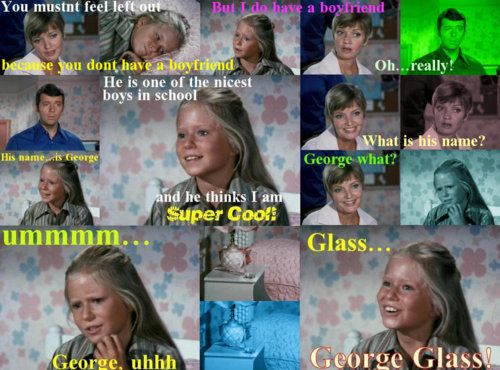
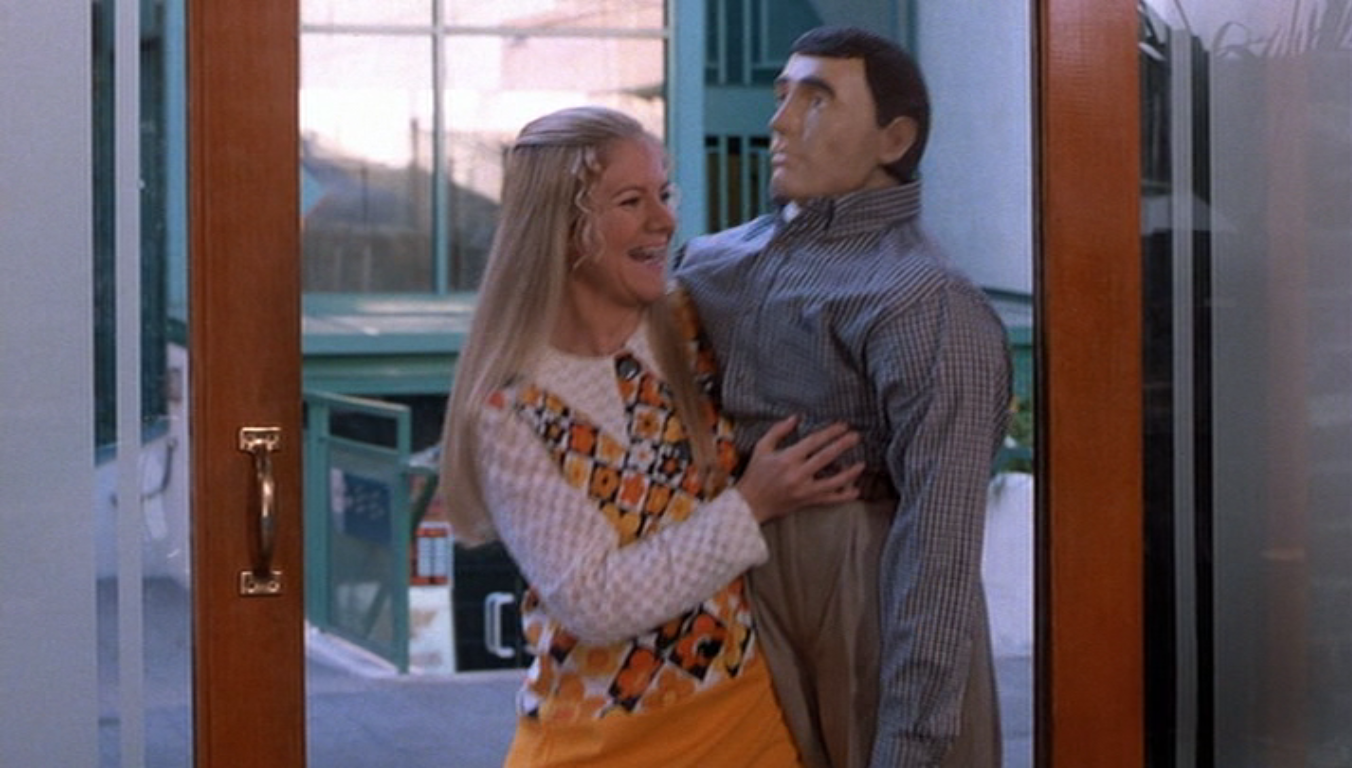
“We’ve never talked about this?” Arnold asked me with some fatigue. “You obviously didn’t grow up watching The Brady Bunch, did you?” I said I had, and the name George Glass immediately came to mind, but I feigned ignorance. “There was an episode where Jan Brady made up an imaginary boyfriend. When she was pressed for his name, she said, “George,” and then she looked around and saw a glass of water. “George Glass,” she said.”

“Okay, yeah, I remember that.” 

“I’ve had nightmares about that scene.”

“You’ve got to be joking?” I asked with suspicious but confused laughter. 

“I’m not. I’m really not,” Arnold said with a most serious face. “We were all too young to know the episode when it first came out, but, you know, reruns. I might’ve been in 2nd grade when Mary Beth Driscoll said, “Are you even real?” I didn’t get it, because I never saw the episode, so she explained it. I didn’t think it was funny, but everyone else did. Everyone else did, and they joined in on the joke. It hurt a little, but mainly because I didn’t understand it. Then, every time they reran that episode, I’d get some semblance of that joke, and I probably took way too personal, but I was young, real young, and I didn’t know how to deal with it. ‘We’re just joking, for gosh sakes Arnie’ they’d say, and that never made it any better. Things like that are stupid, insignificant, and irrelevant, until they start to gather moss. Every time you meet a friend’s mom, they ask if you’re real, or they say it’s nice to finally meet you. We thought you were fake. It sort of petered out after a while. The harmless and stupid jokes never ended, but I didn’t hear them as often for quite a while there, until the 1996 movie A Very Brady Sequel came out, and then the internet picked that whole joke up as a meme for imaginary boyfriends, girlfriends, and imaginary friends, and it started all over again.” 

I could’ve, and probably should’ve, expressed some sort of sympathy, but I couldn’t help but find it so harmless that it was cute and cute-funny. The general idea of a man being mentally badgered about anything calls for a sympathetic response, but to hear someone say that a Brady Bunch joke was the source of his pain was so unprecedented that I couldn’t help but find humor in it. I managed to keep a straight face, a solemn, sympathetic face, until he said:

“I’ve even considered changing my name more than once. I’m serious. Totally serious,” he added when I ‘C’mon’ed him’. “If my dad didn’t talk me off that ledge, talking about breaking the long, storied history of the Glasses, and their proud British heritage, I would’ve gone through with it.”

“I’m sorry,” I said when I laughed. “It’s just the words breaking the Glass got to me,” I confessed. Those words weren’t funny, but it didn’t take much to tip me into laughter, and I considered it a decent excuse for laughing.

“It’s really not funny, and it’s not a joke,” Arnold said defensively. “When I was in my teens, and I’d meet my girlfriends’ families, their sisters would jab me in the shoulder with their finger and say things like, “I just wanted to make sure you were real.” Another person, a mom, a nice, sweet maternal mom said, “We thought it was like that time Jan Brady made up a boyfriend, and she said his name was George Glass. We thought Julie did that with you. Sorry, but we thought she made you up.”

“My guess is that’s probably happened a million times,” I said after I achieved some level of control. “Nerdy girls and boys have made up boyfriends and girlfriends since, probably since the cavemen.”

“I get that,” Arnold said, “and if it happened once or twice, I’d say it’s only happened once or twice, and that’s normal, as you say, but it’s happened so often that … that you can’t help but question your identity and your existence.”

“Your existence?”

“Well, I never thought I wasn’t real, if that’s what you’re asking,” Arnold Glass said, “but these things, these little tiny, and seemingly insignificant things, can have a cumulative effect that can, regrettably, end up all over someone like Bob. Remind me to apologize to him when I see him.”   

“Example?”

“Example, let’s see,” Arnold said. “Well, there’s nothing wrong with your nose. Let me make that clear, because I’d hate to put you through what I’ve been through. I mean it’s not too long, too big, or crooked. You have a very normal nose on your face, but imagine if someone joked that there was something wrong with it. Imagine if it was nothing more than a dumb, insignificant and untrue comment on your nose. You’d tell them to shut up, or some variation thereof that allows you to swat their comment away, like a pesky mosquito. Now imagine that someone else, someone who had no relation to that first person, says the same exact thing. You might start to think there’s something to it. You might be a little paranoid about your nose, right? Maybe? Now imagine that this silly, stupid thing is the same thing your grade school peers hit you with when you were young, very young, too young to know how to deal with it properly. It has a way of chasing you into adulthood, until you’re impulsively launching on someone like Bob. Do you think it could lead to a cumulative effect equivalent to wanting to change your name, like getting a nose job or something? And the whole time, you know you have a perfectly normal nose, because everyone says there’s nothing wrong with your nose, like I had a perfectly normal name, until some writer on some stupid show decided your last name would be the perfect name for an imaginary person.

“See, what you saw was a one-time, seemingly insignificant incident,” Arnold continued. “But you didn’t see the buildup, the accumulation, and you probably just think it was bizarre, and all that, but it was the result of a cumulative effect. Have you ever heard of the Chinese Water Torture effect? They strapped a guy into a chair so tight, he couldn’t move, under a slowly dripping water faucet. Now, we can drop anywhere from one droplet of water to a million drops of water on a person’s forehead, and it won’t cause any physical damage to that forehead, but psychologically? Psychologically, it’s been documented as one of the most cruel, brutal, and inhumane forms of torture ever invented. Why? It is the accumulation of seeing the next drop of water, knowing it’s going to hit your head, and it finally hitting. It’s the same thing here, but my slow drip has occurred over the years, the decades, and it can manifest in ways you saw today with Bob Peters. Some say it can be stressful to the point of panic-inducing attacks. That’s never happened to me, those final stages, but it could. Some say it could.” 

I still couldn’t see it, and in many ways I still can’t. The whole idea of it obviously still fascinates me, but no matter how well Arnold researched what happened to him that led him to his unusual outburst, and how persuasive he was in the moment, I still couldn’t wrap my arms around the idea of what he described as a cumulative effect, even under the umbrella of Chinese Water Torture effect. It was hard to see through the bizarre, silliness of the idea, and it’s still difficult for me to wrap my mind around the idea that a person could be so damaged by a Brady Bunch joke that he’s reflexively lashing out at anyone who even hints that he might not be real, imaginary, or in this case not human. The only thing I can come up with is it’s the difference between sympathy and empathy. Sympathy is something we feel for someone experiencing something foreign to our experience. Empathy is almost a shared sentiment we have for someone who is experiencing something for which we experienced ourselves to such a degree our knowledge of it can be intimate, and the only people who can understand The Brady Bunch Glass effect are those who have experienced themselves.