The Chosen Ones? Jordan, Einstein, and “The Babe” Defy the Myths


Genius Chronicle: April 30, 1992, game three of the first round of the Eastern Conference’s playoffs, and Michael Jordan is nearly trapped in the corner of the three-point arc by Kiki Vandeweghe and John Starks. Jordan moves left and Kiki Vandeweghe drops off. Starks then baits Jordan into a trap, leading him into one of the most feared defenders in the NBA, Charles Oakley. Seeing those two Knicks narrow in for a trap into the corner would’ve led 99% of the NBA brightest stars to pass the ball. Jordan gambled. He faked left, and Starks fell for it, almost literally falling to the Madison Square Garden floor. Jordan then tucked under Oakley to take advantage of a sliver of real estate that existed between Oakley and the baseline. He straddled that baseline and dunked on arguably the most feared defender in the game at the time, future Hall of Fame inductee Patrick Ewing. If this wasn’t one of the greatest plays in NBA history, it might’ve been one of the most memorable. Jordan himself claimed it was his personal favorite dunk. Some said it was “Michael being Michael.”

Michael wouldn’t have been able to accomplish that play, against those guys, without incredible natural abilities. Yet, how many NBA stars, past and present, have been blessed with similar abilities? Jordan fans would say no one, but what separated Jordan from his peers was his ability to achieve the spectacular and the comparatively routine. He did both so well, so often, that he helped the Bulls achieve a 65.9% winning percentage in the regular season and a 66.5% in the playoffs, and six NBA Championships. Those of us who marvel at highlight reels often forget about that other half. Yet, a Michael Jordan, an Albert Einstein, or any of the geniuses of physical and cerebral accomplishment couldn’t have accomplished half of what they did without outworking their peers.

Genius Chronicle: June 30, 1905, Albert Einstein drops the first of four major contributions to the foundation of modern physics special relativity (later expanded into general relativity). The other major contributions included the photoelectric effect, and Brownian motion. In doing so, he helped fundamentally transform physics by redefining space, time, gravity, quantum theory, and atomic behavior, shaping modern theoretical and applied physics. Those who knew Einstein probably marveled at Einstein’s findings, but others probably said, “That’s just Albert being Albert.”

A line like that sounds like a compliment. It sounds like we’re saying that they’re so talented that they make the miraculous appear mundane, and we just came to expect that from them in their prime. Yet, I consider such lines reductive, because they fail to recognize their struggle to get to the point that their continued greatness was just “them being them”.

Dealing with Failure

Those who drop the “Michael being Michael” line should know that Michael Jordan wasn’t always Air Jordan, or Black Jesus, as some called him. He was cut from the Laney High varsity team as a fifteen-year-old sophomore, due to his height (5’10” at the time), his physical immaturity, and his lack of experience. Yet, how many fifteen-year-old sophomores make the varsity team? Prodigies do, and Michael Jordan thought he was just that. The coach, Clifton “Pop” Herring, later said he spotted Jordan’s potential, but that he didn’t believe the fifteen-year-old was ready to face varsity level competition. Herring basically told Jordan, he wasn’t a prodigy, not yet, and that crushed Jordan. He was so crushed that according to Roland Lazenby’s Michael Jordan: The Life by Roland Lazenby, Jordan kept that publicly posted tryout list as motivation. The young Jordan obviously sulked about it, but then he went to work. Over the decades that followed, Jordan developed a relentless work ethic that he double downed on anytime he experienced defeat.

“I’ve missed more than 9,000 shots in my career [12,345 regular season and 2,309 post-season for a total of 14,954],” Michael Jordan is famously quoted as saying, “I’ve lost almost 300 games [380 regular season and 60 in the post season]. 26 times I’ve been trusted to take the game-winning shot and missed.” This number, twenty-six, is the best-known estimate, attributed to Jordan himself, but it’s not independently verified by modern statistical databases. It likely includes shots to tie or win games in the final seconds of the fourth quarter or overtime, across both regular season and postseason. Bleacher Report estimated Jordan’s clutch postseason shooting percentage at 50% (8 of 16 attempts through his first 16 clutch shots), but this doesn’t specify total misses.

Einstein was asked to leave his school at fifteen. The school’s administrators informed Einstein, “Your presence in the class destroys the respect of the others.” He failed an entrance exam at Swiss Federal Polytechnic, and then he struggled to find work postgraduation, leading him to experience some level of poverty firsthand. His initial attempts at academic recognition fell flat when all of his early papers were either ignored or rejected, as his peers deemed his work unremarkable. Yet, how many young scientists, with no connections, are accepted into the scientific community in their initial attempts? Prodigies, or the “chosen ones” who can remove the proverbial Sword in the Stone are. Like Jordan, the idealistic, young Einstein knew he was destined for greatness, but no one else did. They were both faces in a crowd of idealistic young people who knew they were destined for greatness. 

When we read such stories about geniuses, we can’t help but think of ourselves as faces in that crowd. We thought we were destined for greatness when we were young, and it would’ve meant so much to us to be recognized as the geniuses we were, back then. Is that irrational, considering that we probably didn’t have the remarkable talent we thought we did, and if we did have any talent, we didn’t put in the work necessary to hone it? It is, but we were young, idealistic, and a little delusional back then. When we attempted to remove the proverbial sword from the stone, we realized that we weren’t “the chosen one”. Learning this hurts, but the notion that we are a lot more common than we ever thought stings. Even when it was obvious to everyone around us that we weren’t ready, we resented the guardians at the gate for not recognizing our genius. We became bitter, and we sulked. I don’t care what any eventual recognized geniuses say, they sulked too, and then they achieved greatness by using that rejection as fuel to prove their detractors wrong. Most of them had no shortcuts through nepotism, or anything else to ease their rise, and their only recourse was to just work harder than the similarly gifted.

Dealing with Rewards

The question those of us who will never be invited into the historical halls of greatness would love to know is, was your eventual, hard-won invitation just as meaningful as it would’ve been when you were an idealistic, and perhaps a little delusional, young teen? We’ve all been taught to think that success is the reward for hard work, but how much hard work is too much? When we devote so much of our time and energy to achieving greatness, sometimes we sacrifice the ability to develop normal, human relationships, we might accidentally ignore family members, and we could employ a level of tunnel vision that effectively ruins what could’ve otherwise been a happy life. Is that moment of acceptance as euphoric as we think it would be, or is it almost, in way that’s “tough to describe” anti-climactic?

Our knee-jerk response is that instant recognition would’ve stunted their growth, and the great ones probably wouldn’t be as great if bitterness, resentment, and all that inner turmoil didn’t fuel their drive. Yet, we can also imagine that there had to be some measure of “Where were you when this really would’ve meant so much more to me?” involved in their acceptance.

Michael Jordan hugged and cried on the Larry O’Brien Award the first time he won it, but those in his inner circle say that his almost ingrained sense of bitterness and resentment drove him to win five more. This bitterness and resentment could also be heard after his retirement, in his Hall of Fame induction speech.

Einstein harbored a similar sense of “smoldering resentment” toward the gatekeepers who dismissed him. In a 1901 letter to his sister, he wrote of “fools” in academia who favored conformity over originality, implying that if they weren’t so rigid he wouldn’t have had to work so hard to gain acceptance. The two of them both had chips almost biologically attached to their shoulders throughout their lives, and we can speculate that they may not have achieved half of what they did if they weren’t rejected early. They both used those early rejections to fuel their inner fire to prove their respective communities were wrong about them, but even when they did, my guess is it didn’t remove the pain of those early rejections.

The Supernatural, Natural Abilities

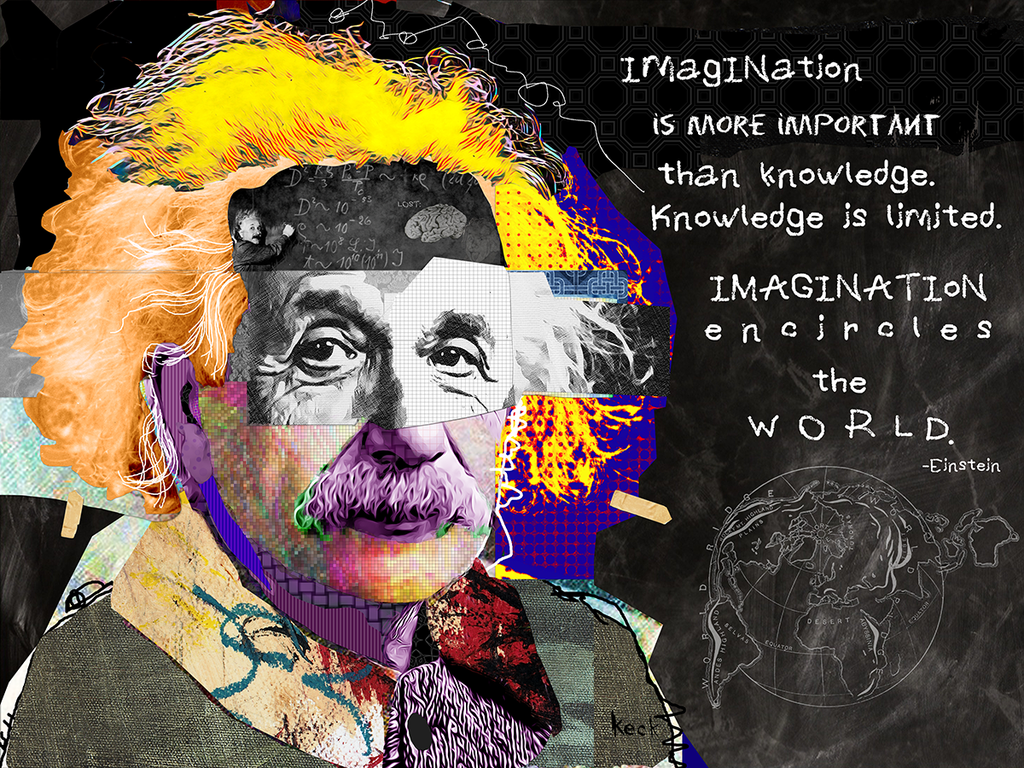
We’ve since limited the idea that Einstein was a genius as Einstein being a genius, as if he didn’t achieve that status. He was just different, so different he may have been a slightly different creature. We’ve studied his brain to see why he was so much smarter than everyone else, to see why he was so different that he was special or supernatural. We discovered that his brain had what they called “a unique morphology, and abnormal Sylvius Fissure, increased glial cells.” We also found that his brain “was actually smaller than average (1,230 grams vs. typical 1,400 grams), contradicting the assumption that larger brains equate to higher intelligence.” Even though speculative estimates suggest less than 1% of the population might have neurological enhancements comparable to Einstein’s, based on neurodiversity research, I still find it reductive to limit his incredible accomplishments with the idea that he had an unusually efficient brain. Why can’t we just say that all of his findings could’ve been the result of a lifetime of intense research into general and specific areas of physics? Why can’t we say that he spent so much time studying physics, persevering through the failures inherent in trial and error that he ended up developing some incredibly creative theories? Why can’t we say while he may have been biologically predisposed to intellectually brilliant findings, many others had the same cranial gifts, and they didn’t do anything anywhere close to what Albert Einstein did with these advantages. Why can’t we just say he worked harder, and more often than his peers?

We know there was nothing supernatural about what Einstein or Jordan did, but it’s just not very interesting to talk about all the hard work they put into it. We’re interested in the origins of genius, and we’re interested in the results, but everything in between is the yada, yada, yada portion of that discussion. We’d rather ask “How did they do that?” than learn about how they actually did it. It’s far more entertaining to think in terms of a “natural talent fallacy” or a “the genius myth” than breakdown the hundreds of hours they spent in a gym, or in a lab, honing their ability, or dedicating so much of their mind and energy to their profession, or craft, that when they happened to be “around”, they probably weren’t much fun to be around.

The Babe

George Herman Ruth (AKA “The Bambino,” “The Sultan of Swat”, or “The Babe”) may have been the opposite of Einstein and Jordan in that he appeared to enjoy every step of his gradual ascension to greatness. The Babe didn’t face the same substantial levels of rejection Einstein and Jordan did, but that may have been due to the fact that The Babe never felt entitled to it. I don’t think anyone would accuse Jordan or Einstein of being entitled, but whatever vagaries we apply to the term entitled in these cases, The Babe was the opposite when he was but a babe.

Babe Ruth was born into poverty, in a rough working-class neighborhood well known for crime and violence. His parents were hard-drinking saloon owners, who provided their son a chaotic, unstable, and troubled environment that led him to commit petty crimes and truancy. His overwhelmed parents sent to a St. Mary’s Industrial School for Boys, a reformatory school. While attending this school, a Brother Matthias taught him baseball, but Ruth’s talent was confined to the school’s teams, unseen by wider audiences. Students of St. Mary’s were not expressly forbidden from playing in youth baseball leagues, but his confinement to the school’s isolated campus and strict schedule prevented participation in other organized, external leagues. Thus, while Ruth excelled, he toiled in obscurity, playing on St. Mary’s team.

Ruth’s luck changed when an owner/manager of the then minor league team the Baltimore Orioles, Jack Dunn, just happened to spot The Babe’s talent in 1914, and by 1916 he was a twenty-game winning pitcher for the Boston Red Sox who pitched a one-run, fourteen inning complete game (still a World Series record) to help the Red Sox win the World Series. Every talent has his or her story on the rise to fame, and they’re littered with personal motivations, including others seeing their raw talent that needed development and those who underestimated how talented they were, but compared to Einstein and Jordan, Ruth’s rise to fame was relatively quick and smooth.  

Based on Ruth’s upbringing, we can only speculate that he didn’t view rejection in the same way an Einstein or a Jordan would. Prior to being “discovered” Ruth likely viewed himself as nothing more than a poor, dumb, reform school kid. As such, we can guess that Ruth didn’t have the social awareness or the levels of expectation they did. As a poor, dumb, reform school kid, The Babe probably viewed anyone giving him a chance, someone paying him to play baseball, and all of his numerous accomplishments thereafter as gravy. In his autobiography, The Babe Ruth Story (1948), he describes his St. Mary’s days fondly, focusing on baseball and Brother Matthias’ mentorship, not on being overlooked. His 1914 minor league struggles (doubts about his discipline) were met with defiance, not despair, per teammates’ accounts. Therefore, we can say that bitterness and resentment never drove The Babe to accomplish rare feats in the beginning, or throughout his illustrious career, but something unusual drove him on the tail end, the very tail end, of his baseball career.

Genius Chronicle: May 25, 1935, George Herman Ruth is five days away from retirement. Did The Babe know 1935 would be his last season? He may not have at the beginning of the year, but his performance was so bad (he hit .181 that year, with thirteen runs batted in, and most importantly, only three home runs prior to 5/25/1935), and his 1935 Boston Braves were so awful, and that he knew. By the time he stepped to the plate in 5/25/1935, the accumulation of twenty-two years, and 2,503 games, of Major League Baseball play were also catching up to him, as his knees were so bad that he ended up only playing 28 games for a team that didn’t even know the definition of the words in-contention. He probably spent the 1935 season depressed with the knowledge that the natural talents, the grit, perseverance, and everything that made the man who changed the game into what he know today, were all gone. He was a shell of his former self, and he was only forty-years-old, relatively young for the average human but ancient for an athlete, particularly in his era.

Even with all that George Herman Ruth stepped to the plate on May 25, 1935, against the Pittsburgh Pirates. The Pirate pitchers he faced were “respectable but not dominant”. The days when Ruth dominated headlines were long-since passed, and I’d be willing to bet that most casual baseball fans probably didn’t know Ruth was still playing by this date. This was probably best reflected by the attendance of Forbes Field that day, was a mere 10,000 attended a game in which Babe Ruth played in a 25,000-seat capacity. Few wanted to see a man many considered one of the greatest to ever play the game of baseball, because it’s always sad to watch a broken-down, old horse gallop around the track in his final days. How many of them regretted that decision afterwards when they learned that Babe Ruth managed to put everything that made George Herman Ruth “The Babe” one final time, and in one final blaze of glory by hitting three home runs, which just happened to be the 712th, 713th, and 714th of his storied career.

Hitting three home runs in a game is still a remarkable feat for any Major League Baseball player, but at the point when Ruth did it, professional baseball was roughly sixty-five years old, and this feat had only been accomplished seventeen times by thirteen different players, including Ruth, who only accomplished it twice before in his lengthy and storied list of home runs. Ruth would go onto only have five more at-bats in the five games left in the season, before he retired. This entry is included in this article because Babe Ruth was often called the “Most naturally talented athlete of his generation.” Fans and players alike appreciated his talent and domination of the game of baseball, but there had to be some temptation to reduce his natural talents as supernatural, as if he  just picked up a bat on a Thursday and by Friday he basically invented the home run that we all celebrate today. Some fans probably marveled at the fact that this celebrated athlete put it all together in one final blaze of glory, but others probably laughed and reduced it to “The Babe being The Babe”.  It’s just kind of what we just do. It’s human nature.

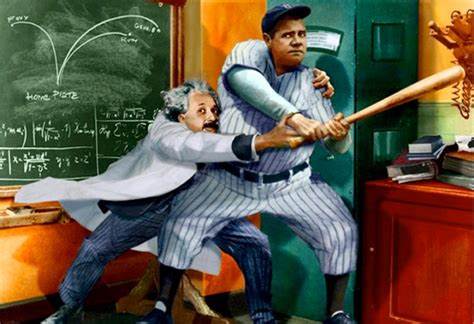
Even with all the information we have about the rise of Jordan, Einstein, and The Babe, we still attach this The Sword in the Stone characterization to them, because we love the idea of superheroes. The three of them may have been blessed with superior natural abilities, but they weren’t supernatural abilities. Yet, belief in the latter permits us to worship them, and it gives us comfort to think “they’re just different”. We prefer to avoid thinking about all the “yada, yada, yada” of true grit, unusual levels of perseverance, and all of the work they put into honing their abilities. We prefer to focus on “natural talent fallacies” and the “genius myth” that suggests their Creator was so generous with them and comparatively stingy with us when it came to dispersing talent. I have news for you brothers and sisters, the idea of a chosen one being the only one able to remove the sword from the stone is a fictional tale, and there’s no such thing as a chosen one. Gifts require honing, dedication to craft, and a level of tunnel vision that would lead many of us to grow so bored with the mind-numbing hours of practice and work these men put in. We also wouldn’t be able to deal momentary, temporary embarrassment that arrives with the level of failure they dealt with under the scrutiny of white, hot lights. Those of us who admire these geniuses from afar often characterize them as the chosen ones, and ourselves as the character Sir Kay of that book, who attempted to pull the sword and failed, because it gives us comfort to think if we were as blessed as they were, we would do the same. It’s a compliment that we deem them different, of course, but it’s also uninformed and reductive.

To my mind, the greater details of the stories of Jordan, Einstein, and Ruth remind us that greatness and genius aren’t a gift bestowed at birth, but a fire forged through rejection, toil, and unrelenting drive. From Jordan’s high school cut to Einstein’s academic snubs and Ruth’s reform school obscurity, their triumphs—whether a baseline dunk, a revolutionary theory, or a final three-homer blaze—were built on the ashes of doubt. We marvel at their highlights, but their true legacy lies in the unseen hours of grit, proving that greatness belongs to those who dig deep enough to find that elusive “other layer” so often that we develop creative theories about how it’s all so unfair.

The Hearty Handshake Handbook


A stranger I’ve never seen before, and I’ll probably never see again, wouldn’t shake my hand, ‘Because COVID!’ I can only assume it was COVID, because he never said or gave me any hints that it was related. He just wouldn’t shake my hand. Fine, it meant anything to me, but what does it say about you? As Jack, the bellman, said, “COVID is over, and we have to get back to shaking hands again.” We’re men and this is what we do. I don’t like this any more than you men, but this is what we do. We look men in the eye and offer them a firm handshake, and firm does not mean that we drop them. “That’s for tough guys,” Bill, the waiter, told me one time in the break room, “and when I say tough guys, I’m talking about the rah-rah fellas in locker rooms, who don’t know nothing about what to do in the ring.” Even when I went through my most confident period in life, I wasn’t a big handshaker, and I didn’t really grasp the whole theatrical production of the hallowed first impression. First impressions, to my mind, are largely phony. I’m huge on second impressions and third impressions. I prefer to let the game come to me, and I can do some great, unforgettable when I’m immersed in the shadow of lowered expectations, but they taught me that that’s not the world men live in.  

I had my game all figured out at one point, until Ken dropped a big old, “I never trusted a man who wouldn’t shake your hand, and look you in the eyes while doing it,” on me. I’m not up to something, I wanted to tell Ken, and I never have been. I’m not shady, and I’ll prove that to you over the long haul, but you cannot say that to a man like Ken. Ken is a serious man, a man’s man if you will, and you don’t try to realign a man like Ken to suit your needs in his home. You shake Ken’s hand, and you look him in the eye, because that’s what he considers a respectful greeting from another man. To a man like Ken, handshakes build a connection between men, and as he says, it forms a level of trust that you cannot build with him in any other way in the initial greeting. A man like Ken sees through you when you don’t shake his hand and look him in the eye while doing it, and you won’t like what he sees.  

That stranger I’ll probably never meet again had his whole routine down though. Before your hand is unholstered, he flips out a quick “Hello, how are you?” and it’s very warm, polite, and standoffish at the same time. ‘I need distance,’ that quick greeting said. ‘Because COVID, because have you read the literature on communicable diseases? Even if it’s not COVID, you could have something crawling all over you that will get on me with the proximity, and touch, required in a handshake.’ Hey, I wasn’t raised to shake a man’s hand either, but I learned, stranger I’ll never see again. They taught me over time that this is just what we men do to one another, and we learned this tradition from the Ancient Greeks, it’s in their art, so it’s just too late to go back now. And I don’t care about COVID, or the literature.

Another kid’s parent shot me a condescending ‘Haven’t you read the literature?’ smile when I went to shake his hand, but my hand was already out. He wasn’t as quick as the stranger I’ll never see again. He dropped his name in that space, and my hand instinctively went out. I apologized with my hand out, and I withdrew it in the shadow of his condescending smile. “No, it’s ok,” he said putting a hand out to shake it. He didn’t look me in the eye when he did it. His handshake was fastidious and obligatory. ‘I’ll let it go,’ I wanted to say, ‘but that would not have impressed a man like Ken.’

I’ve heard about power handshakes that involve the lefthand cupping the handshake, a power move. I’ve never experienced a cupper before, but I have to imagine that that would completely 360 Ken’s notion that the cupper was up-to-something shady, and yes, I meant 360 as opposed to 180, as Ken’s suspicions would return tenfold after a cupping. I’ve heard some handshakers move that left hand up to the elbow, and one famous/infamous handshaker went all the way to the shoulder. The higher the lefthand moves up, I’ve heard, the greater the power play. I don’t know how I would address such a handshake, but I can’t imagine a situation in which I didn’t consider that unnecessarily intimate.

No, when you meet a man who is not distracted or rushing off, you press palms with them for no longer than three seconds, you look him in the eye, and you drop an interested smile on them. When you’re in another man’s home, or in some other relatively subservient position, you wait for him to extend his hand first. If he doesn’t, that’s on him. If you’re seated, you stand, and there’s no reason to get too close, because no one likes a nose-to-nose handshake. If you’re sweaty, you just coughed, or you just wiped your nose, you discreetly wipe it off before extending the hand. There are rules, laws, and by-laws in this whole handshaking world, and you learn them as you go. Even if you think some of these rules are silly, as I do, you learn them and follow them, because it’s not about you. These things mean something really important to some men, and if you refuse to take part, you’ll mean nothing to them.    

You shake a man’s hand, because it says you’re glad to be here, and you’re interested in meeting them, and you look them in the eye to say, “Yes, I mean you!” The non-shakers accidentally send a message that reads, “I kind of dismiss you.” Even if your transgression involves health-related concerns, based on literature, it still sends that message that you’ll never be able to properly address. The old saying on gifts, ‘Tis better to give than receive,’ does not apply in the handshake world, for if you do not give respect, in a respectful handshake, you’ll never receive.

The three exceptions to the rule are age, gender, and culture. If you’re in a culture in which the handshake is not the proper greeting, then you respect and follow the rules and traditions of that culture. If the person you meet is female, then you follow her lead. If she’s a hugger, you hug, but most women are big on smiles and eye contact, and some of them flash a wave. Kids aren’t big handshakers either, but I often make a production out of shaking the hand of a young male, because I deem it a sign of respect. “Welcome to the club!” my handshake says. I try to attach some element of silly to it, because I know how uncomfortable those first few steps into this world can be, but I maintain that my handshake is serious. I usually follow their lead on how much seriousness or silliness I attach to it, but I think I’m doing my part to welcome them into this world of respectful first-impressions among men.  

So, Mr. Stranger I’ll probably never see again, you ain’t Joe Cool, Mr. Snoopy with sunglasses on, and you never will be, with your COVID, learn-the-literature non-shaking hand codes of conduct, because shaking hands is just what men do. The respect you give will be the respect you receive.   

The Metaphysics of Marriage


“The difference between marriage and cohabitation is nothing more than a piece of paper,” they’ve told me for as long as I remember. I believed that so much that I didn’t just repeat it and preach it, I lived it. I loved it too, for a short time, until my cohabitant turned combatant. She and I got into one of those mean and dirty “I’m not sure the relationship is going to survive this, and if it does, I’m not sure I want to carry on” fights. Our breakup was a “no harm, no foul, and it was nice learning how a relationship can fail with you” breakup. It was so easy, it was too easy. “These things don’t work out some of the times. See ya, sista.” When I married, however, I learned that after a big fight, both parties go to their respective corners, talk to their managers, and develop a game plan to use in the next round. The next round can involve better strategies to win that round, or it can involve a series of compromises. I’m sure long-time cohabitants go through all the same issues, but at the end of the day, it just seemed so easy for me to walk away. Marriage just felt more substantial, and I found myself working harder to make my marriage survive and thrive. I didn’t want the big “D” on my docket, so I learned that I would have to make what proved to be difficult compromises to make it work. Trying to understand how another person thinks led to me becoming well-rounded, more mature, and a better person. I advanced to a stage they call: adulthood.

Radio talk show host and writer, Dennis Prager talks about these matters, as evidenced by the quotes below, from Dennis Prager’s Thoughts on Marriage lecture, but Mr. Prager is not an expert on marriage, a marriage counselor, or a psychologist. He’s a radio talk show host and author who has been involved in two divorces. “He’s been married three times? Why would you consider his advice on marriage valuable?” I think we can all admit now that we’ve learned more from our failures in life than our successes, and Mr. Prager has also been married to his current wife for sixteen years at this point, which shows that he obviously learned from his personal failures in that regard.

“Either marriage gets better or it gets worse. Couples need to constantly work on their marriage to make their marriages strong.”

To my mind, the idea that marriage gets better or worse with age is almost exclusive to young marriages. I realize that all marriages, like all people, get better or worse with age, but if I married in my early twenties that poor marriage wouldn’t have had a chance. I changed so dramatically between twenty to forty that I was almost a completely different person. I was more stable, confident, and I knew myself better. I also liked myself better at forty, which might sound foo foo, but if we don’t like ourselves, we’re probably not going to like, much less love, another. Second marriages, or those who wait until their mid-thirties to forties, tend to last, because we make rational and less emotional decisions in life. Love is no longer the lone driver, as forty somethings have learned from the mistakes of impulsive actions and reactions based on short-term thinking. Having said all that, marriages between forty-somethings are just as apt to get worse with age for those who don’t constantly work on their marriage to make it better.

“Some romantic ideas can really hurt your marriage. Romance is good but romantic thinking can be damaging.”

“How can romance hurt a marriage? What an odd thing to write.” There’s a difference between romance and romanticizing. We all romanticize the idea of love, relationships, and marriage, and romanticizing them often leads to unreasonable expectations. The culprit for these unreasonable expectations, in my experience, is the love story. How many unrealistic expectations of romance and love are born in the love stories that movies and books provide? They give us the idyllic images we want, need, and begin to believe is out there waiting for us. “I deserve better,” we say when our very specific visions of a very specific Mr. Right don’t pan out. We all have our bullet points, of course, but did we create them, or were they created for us? When Mr. Right fails to meet our idyllic bullet points, captured in the scripts and rewrites of love stories, we venture back into the field. While there, we discover that Mr. Right is largely a fictional character born and raised to feed our need for Mr. Perfect. We all know Mr. or Miss Right is out there, we’ve seen them, but was our mental processing of this issue is a result of digital processing? Those idyllic images they planted in our head messed with us, until we created our own idyllic images that no one born of physical processing can achieve. 

“No human being can fulfill all of your wants or all of your needs.”

Calling upon our wife or husband to fulfill our wants and needs is normal, but demanding that they meet them all, with ultimatums attached, is shallow narcissism. When we enter into a long-term relationship, with expectations for marriage, we expect our prospective other to accept us as is, yet we set conditional expectations for them. We expect them to know us, as is, but we don’t place reasonable expectations on ourselves to know them as is. If we did it right, we should know our potential spouse before we marry them. We should know them warts and all, and we should know that as Dennis Prager points out the term “soul mate”  is equivalent with “clone” and unconditional love should be a term reserved for our children and pets. Relationships between full-fledged, complicated adults come loaded with a myriad of conditions, and we need to sift through the conditions we establish for them to make sure they’re fair, and if they are, we should require them to meet them and vice versa.

“Being in love means always having to say you’re sorry. The three words “I am sorry” can be more powerful than “I love you.””

The ability to apologize often comes in direct conflict with the ego. The ego is that evil, little guy who rests on our left shoulder, just below the ear, whispering, “Don’t let her get away with that.” The ego also characterizes what she said and defines and redefines it. “We firmly established our set of ground rules and our turf, and her words and actions just violated them.” It turns out, she didn’t say what we thought she said, or she didn’t mean it the way it sounded to us, and at some point our over-protective, super sensitive ego took over and led us down a bad road. “I’m sorry, and it will never happen again.”

“We need to teach him how to treat us,” her ego whispers to her. In the early stages of a marriage, or any relationship for that matter, we set out to establish ground rules for how we want to be treated. Those ground rules also come equipped with that one big, no compromising taboo. “You can violate everything else on my list, with some exceptions, except that. I’m very sensitive about that.” For a variety of reasons, and I don’t know if it’s psychological or philosophical, but when someone makes the mistake of telling us where it hurts, that’s the only wound we want to pour salt in.  

I’ve witnessed this peculiar predilection among every demographic, be it old, young, male, female, married, single, and everyone in between. I’ve seen it happen so often that I’ve toyed with it. “It’s hard to make me mad, seriously. I’m basically impervious to teasing, ribbing and razzing, but don’t make fun of my obsession with peanut butter. I’m very sensitive about that.” It’s a joke of ridiculous extremes of course, as I like peanut butter, but I have no unreasonable attachments to it. I throw that out there to see what “they” do with it. It might take an hour, a day, or even a couple days, but someone, somewhere will come up with a clever shot about my obsession with peanut butter, and you can see it on their face that they think they’re hitting us where we live, and they don’t give a durn how bad it hurts. We all do this, our great aunts, our lovers, and even our moms can’t seem to resist the temptation. Knowing about this strange psychological predilection is half the battle, and putting our loved ones through a test of their loyalty is another strange psychological predilection we all partake in, as we’re basically putting them in a position to fail. 

We’ve covered four of the eight points Dennis Prager covered in his Thoughts on Marriage lecture, but one of the most crucial characteristics I think he missed is the need to find someone who doesn’t mind being boring every once in a while. We need to find someone we enjoy spending substantial amounts of time around, and some of that time is going to be spent doing relatively boring things. That sounds obvious, but when we sift through our list of applicants for marriage or cohabitation, we find very fun and exciting men and women who can be extremely funny and wildly entertaining. The idea that a prospective mate can add some fun and excitement to our lives can plant the seeds for a whirlwind romance, as long as they’re in their element. The latter is the key for displays of charisma and energy requires a right time, right place setting, and we might need to take them out of their element to see if they can be boring. If you’re considering a substantial move with another person, you might want to find out how they conduct themselves on a lazy Sunday afternoon, playing parcheesi? Do they need a little sip of alcohol while doing it? They might not be alcoholics, but they can’t do something like play parcheesi without a little edge. Some might need a wager to pique their interest because they can’t imagine playing parcheesi just for the fun of it. Bill Murray once suggested traveling with someone before you marry them to take them out of their element, and to show you how they interact with service industry personnel. The point is we can learn a lot about loved ones at parties and other social functions, but we can learn a lot more about them by cooking a meal with them, raking the lawn, or sitting out on a deck with them and nothing more than a bottle of water.