You Don’t Bring me Flowers, Anymore!


“You’ll make it work in the end,” an adult baby said with a hand on his wife’s shoulder, as she pined over their financial affairs, “you always do.”

The wife recognized the compliment for what it was in the moment, but the full import of the gesture failed to register with her at the time. She had no idea, for example, that her husband would not be participating in the sacrifices needed to “make it work out in the end,” unless she was adamant, and she could be adamant. Even when she was adamant with detailed instructions, he would alter his lifestyle for only as long as he deemed necessary to get over what she declared their dire financial state.

The adult baby intended the compliment to serve as a standalone, a statement of appreciation for his wife’s abilities. He wasn’t lying, and he had no ulterior motives. It marveled him how she did it, and he wanted her to know he would stand by her, as long her findings didn’t affect his preferred lifestyle in the long term.

The wife did have an excellent record when it came to making their lives work, and he wanted her to know that he recognized that. Her record of achievements in this regard did not begin and end with finances however. The family made sacrifices to offset his irresponsible behavior, and she informed him of the sacrifices they needed to make to offset his actions. He saw the effort she put forth, and he was aware of the idea that his family needed to sacrifice, but he viewed it from third-party perspective.

Adult babies are like small children playing with toys in the living room. Neither party expects children to clean up after themselves. Children simply don’t put that much thought into it. If no one instructs them to pick up their mess and no one enforces the practice to the point of making it the child’s habit, the idea of cleaning up doesn’t enter their purview. They play as much as they want, then, without any effort or sacrifice on their part, the area is clean. They won’t even notice that the area is clean, when they return to it, it just is. It always is.

Adult babies hear about financial problems, but like those mysteriously disappearing toys on the floor, they hear about these financial pile-ups so often that even adamant tirades go in one ear and out the other. They know everyone in the family must make sacrifices, and they might even echo the wife’s sentiment to the children, but no one knows how these blips end. They just do. She probably has something to do with it, and we should congratulate her just in case. 

The wife might have to work some overtime and even take on a third job to keep food on the table, but no one ever starves. He might not have much involvement in the lives of his children, but they get the attention they need. All he knows is that the home is always sound, so sound that he can eat his tortilla chips and watch his shows in peace. The little woman may harp, and she might nag a little, but she gets over it once she’s had her say. She always does, and to keep a happy home, he knows that he has to let her have her say.

If he wants to continue doing what he wants to do, he will not only have to endure those occasional rants, he will respond with a line that suggests that the woman is always right. A nice “Yes dear!” sprinkled into those conversations makes the clocks run on time, balances the books, and allows him to live the life he’s always wanted.

The adult baby has no powers of reflection. His woman might adamantly ask that he look around on occasion, but she’s not adamant very often. If she was adamant more often, he probably wouldn’t be an adult baby, for the adult baby species would be on the endangered list were it not for its enablers.

***

“I used to love getting flowers,” the wife named Sheila confessed, “until I found out how much I was going to have to pay for them.”

Sheila’s ex-husband, Craig, used to bring her flowers. He bought flowers for her when they dated, and he continued to buy her flowers long after they agreed to tie the knot. Craig loved Sheila, and he didn’t want to be an ordinary man who brought a few roses home to the woman he loved. He bought flowers. The rooms of flowers he bought and choreographed made cinematic statements of how much one man can love a woman, and he did so regardless of the effect it had on their financial statements.

“How can you put a price on love?” Craig would ask when she interrogated him.

As far as finances were concerned, Craig would be the first to tell you that he knew little to nothing. “The wife takes care of all that,” Craig said on one occasion, “and she can be a real drill sergeant. That woman has a gift for turning symbols of love and romance into economic principles. She can be so anal-retentive, like that character on the show Friends. Monica Geller. That’s what we call her,” he added with a laugh.

“Money is her big topic,” Craig said when he talked about how she was always harping on him.

As is often the case when one person complains about another, Craig refrained from offering any of the details from Sheila’s side of the argument, for those details might have revealed the substance of her argument. Craig did not say anything about how Sheila complained about his spending habits. He didn’t acknowledge her complaint that he signed up for multiple credit cards without telling her. He also would not repeat Sheila’s line, “You spend money like a child learning the power of money for the first time, and what’s worse is you’ve done so for so long that it’s obvious that you are incapable of gauging the consequences of your actions.”

I made the money she complains so much about,” Craig said to conclude his rant. “And I’m a grown-ass man who worked as hard as any man I know. I don’t know who she thinks she is, always trying to tell me how to live?”

As with most adult babies, Craig lived by his own set of rules and standards. As far as he was concerned, no one –not even his beloved wife– was going to tell him how to spend the money he earned. He confessed that he might have had some problems with impulse control, “But who the hell doesn’t?” he asked. Spending money and purchasing things gave Craig a sense of identity he couldn’t explain. He confessed that purchasing products gave him a rush.

“You’re selfish,” Sheila said the day she found evidence of yet another one of Craig’s out of control spending sprees, evidence he usually hid better. “You’re the most selfish person I’ve ever met.”

“Only to you guys,” Sheila said, quoting Craig’s reply.

Craig was referring to Sheila and their two daughters when he said, ‘only to you guys’. We all say such things in the heat of the moment. If someone accuses us of something, we defend ourselves, and most of the things we say are impulsive, knee-jerk responses to an accusation. We don’t evaluate how our responses might be perceived, and we don’t calculate the public perception.

Craig apparently said this without reflection, and to remind her that he was not a bad guy. “People love me,” he added, assessing his character via perceived public opinion. “While I might seem a little self-involved when it comes to you three, I’m not a bad guy. I know better. I help people Sheila. Your opinion doesn’t extend beyond these four walls, so don’t try to tell me that you know who I am.”

‘But those three should be the most important people to you,’ someone outside his family might argue. ‘The perceptions of the common people you encounter in your daily life, on the job, shouldn’t be half as important to you as those of your family.’   

These things we say, in the heat of the moment, reveal what we believe our image should be, and what we believe others see in us or what they should see. As far as we’re concerned, those aren’t lies, fabrications, or exaggerations. We might step on a landmine on occasion that exposes our failure to mature in all the ways our peers have, but, hell, everyone makes missteps.

While not all adult babies are male, the majority of the demographic consists of over-nurtured, 40-something males who are unable or unwilling, to shake the leash of the people who control them. Women have reminded them of the need to share, that they need to eat their peas, and that they need to clean up their own messes, but at some point, the adult baby becomes fed up with it. Women have set their clocks, raised their children, and handled the more inconsequential matters for most of their lives, while they did what was necessary to provide. Even though their wives have had to make sacrifices and they’ve done whatever was necessary to supplement the family income, the adult babies argue:

“I’m the one who’s been clocking in and out for decades, without complaint, and now you’re asking me to do more? Where does it all end?”

“I’m not asking you to do more,” the wife counters, “I’m asking you to do less. I’m asking you to stop doing what you’re doing. You’re making my job impossible.”

“Women have it so good,” the adult baby says. “They get to sit home and watch their shows, while the man goes to work and caters to the whims of a boss. Whatever happened to the idea that the man is the king of the castle?”

If the man wants a new motorized vehicle that only travels on water, he gets it, even if he lives in a land-locked state that requires the vessel to sit in a high-priced storage unit 364 days a year. If the man wants a leaf blower that has a high-powered engine, when his is working just fine, he gets it, and if the man wants the electronic gadget or device, that one of his friends has, he gets it. The woman is in charge of the accounting, and she does what she can to balance the books in the wake of his attempts to indulge his desires. “I don’t know how she does it,” the adult baby says if his friends ask how he can afford such luxuries, “but she always makes it work out in the end.”

Experts might have informed Craig that his current predicament resulted from a cycle of dependency, but Craig probably would’ve dismissed that as daytime talk show gibberish. He was unaware of his role in the matter, and he was naïve to the fact that as soon as the first eighteen years of his cycle of dependency ended, he married a woman, straight out of college, who reminded him of his mother. He was not cognizant of the fact that the responsibility for his welfare transferred from a mother who coddled him to the wife tasked with doing the same.

Craig was crazy in college. He “got drunk” in a manner that suggested he was trying to make up for the time he spent acquiescing to his beloved mother’s request that he act more responsible. He also engaged in a number of sexual liaisons, until he met the good woman that could cook like his good old ma’. Craig never lived alone. He didn’t encounter the pratfalls of being irresponsible in those years, and he never learned the level of freedom that allows one to succeed and fail. Craig was thus deprived the lessons that young people learn during these years and carry with them throughout life.

Even when we marry, buy a house, and have kids, there is that constant need to relive the crazy, college years when we were old enough to know the complexities inherent in adulthood, but young enough to shrug off the consequences of ignoring them. Back then, we thought we were equipped and entitled to show all those who mattered that we were no longer children, back when we were young enough to shrug off the ramifications that come with continuing to live like them. In our adult years, we flexed the muscles of independent living in college, all while our parents footed the bills. We were in a zone toddling between adulthood and childhood that allowed us the freedom to form an identity without any concerns for the responsibilities that might help better form it.

Few, however, have the resources to make those crazy college year last well into adulthood, and the lack thereof requires most to make choices no one wants to make. We work hard to put ourselves in a comfortable position in life. We kowtow to bosses, and we hold our tongue when our peers have said things with which we disagree. We try to build an empire that will allow us to do most of what we want, but some others who just do it. That’s the gist of their answers to the curious who question how they’re able to afford such luxuries on their salary, with two kids, “Like Nike says, you just do it.”

Most full-fledged adults know the despair that results from crushing debt, and they learn to fight off the impulses and temptation that could drive them to shut-offs, red box “past-due” notices, and shameful credit ratings. We’ve all made our share of mistakes. We’ve all been broke at one time in our lives, and we all know the horrible feeling of not having as much money as someone else, but we’ve all come to terms with bitter reality that the good times of living like a child ends. For some of us, this is a long, painful process. Others might never have to face these inevitable truths because others make it all work out for them.

The women in the lives of the adult baby learn to do everything they can to avoid leaving them to their own devices. As a result, the babies don’t experience embarrassment, aren’t required to deal with inadequacies, and ever fail. They are good boys and good sons that become good and honest men, but they are the half of those relationships rarely held to account for their failings.

“I never spent us into unmanageable debt,” Craig said. It was his best defense, for in those moments when the family had to sacrifice Craig decided to control his spending, in the short-term. He refrained from purchasing big, luxurious items when the family budget hovered near ground zero. He even felt some guilt for the role he may have played in the familial sacrifices, albeit only in the short term. To rectify whatever damage he may have caused, Craig bought his wife flowers, but he didn’t just buy her flowers. He made his apologies cinematic.

“You can’t buy me flowers anymore!” Sheila shrieked, “We’re broke!” Sheila would later say she felt bad about the times she yelled at him like that, because she knew he meant well. She said he bought her flowers, because she used to love flowers. “They used to be one of my guilty pleasures,” she said, “until I realized how much I was going to have to pay for them.”

In the wake of their divorce, Craig entered the house to collect those prized belongings of his not listed in the decree. Craig also considered this his opportunity to tell us his side of the story. He answered all of the questions posed, as listed above, and he pointed out the days when he acted “all growed up” to counter Sheila’s claims. Craig also provided us a list of the purchases he didn’t make, because he knew the family couldn’t afford it to counter Sheila’s claim that he was such a spendaholic. He added that that list was not comprehensive.

Who does that? Who submits a list of purchases they didn’t make in defense of their financial responsibility? If a member of his defense did such a thing, the judge might privately advise that Craig fire his lawyers. That judge would know that we, the jury, would consider Craig’s list as noteworthy because it details how rare, to the point of memorable, it was to Craig that he didn’t impulsively buy something he wanted.   

As Craig worked his way through the list, collecting all of the trivial items he did purchase impulsively, we were reminded Craig of one of his favorite sayings, “Money is power! Money is freedom!

“Was I saint in our marriage?” Craig continued, as we loaded his final belongings into the moving van. “I was not, but I was not an idiot. We always found a way to made it work. Somehow or another, she always made it work in the end.”

As Craig ran back and forth from his car, we couldn’t help avoid thinking he slipped up in the second sentence saying she as opposed to we in the second sentence. He did that, that was Craig, we thought as he slipped a final bouquet of dead roses into a living room now full of dead roses to complete what he considered a final cinematic statement to his now ex-wife.
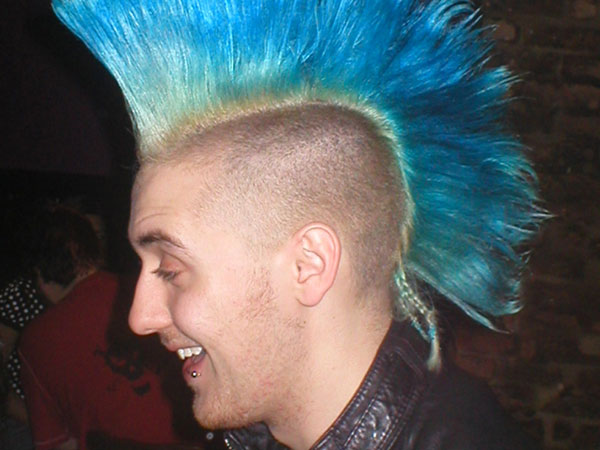
He Used to Have a Mohawk


“Mark is a good man,” the best man said, before raising his glass in a toast, “but he used to have a mohawk.”

The maid of honor echoed the best man’s sentiment, “I like Mark. I found out he used to have a mohawk, and I found out that he even colored it blue at one time. I couldn’t believe it. He seems so nice.”

What odd, seemingly contradictory, things to say, I thought when Mark’s friends finished their toasts. The best man was presumably on Mark’s best friends list, and the maid of honor clearly had a spot in her heart for Mark now, after presumably spending time around him as one of the bride’s best friends. Yet, these two chose to introduce us to Mark in a manner that suggested that there might be something wrong with people who have their hair cut into a mohawk, but not Mark. He’s nice. It was the theme of their intro and they added to it throughout the toast. We found out that not only did Mark have a mohawk at a time in his life, but he also colored it blue for a time and at another time, he spiked it eight inches high. No matter what form his hair took, however, he was always nice, and he would talk to you just like any other feller.

Mark appeared to take this all in stride. Either he agreed with the sentiment of the theme, or he didn’t hear the underlying condescension. Whatever the case, Mark appeared to miss the associations, the looks, and the reactions to his mohawk days.

I attended this ceremony at the behest of my uncle, who was quite fond of the bride. He met the man who used to have a mohawk a couple of times, and he thought Mark was nice, but he did not know him well. As such, he did not know if the haircut was a result of some sort of an identity crisis, or a psychology that chased Mark after he relented to chop it off and begin mingling with common folk again.

Based on the idea that my one conduit into Mark’s mind was almost as unfamiliar with him as I was, I was forced to draw on personal experience with like-minded souls to try and dig into Mark’s essence. The obvious goal of adorning one’s body with an attention-drawing tattoo or a hairstyle, such as a mohawk, is to gain attention, but hearing all that I heard at this wedding reception and watching Mark react to it, I realized that might only be half of it. I thought Mark’s goal might have been to change the perception he had of being a wallflower who sits in the corner of a party and doesn’t know what to do with his hands. My bet, based on my own experience, was that Mark could attend a party, and no one would remember him being there. 

To distinguish themselves, those similar to Mark try to establish some sort of association. They might start by displaying a fiery temper, so others say, “Don’t mess with Jed, he’s insane.” If that display doesn’t work, they feel compelled to provide a visual to promote it with a quick mean-faced punch. I’ve even witnessed some going so far as to say such things about themselves with the hope of kick starting such a reputation. They don’t conclude this with “Tell your friends,” but the end game is obvious to those on the receiving end. If this chain of events does not produce the desired effect, the ornaments of self-expression begin to appear, that take the form of physical shouts of ‘I am here!’ from their otherwise anonymous corners.

I’ve heard some mohawks speak of sitting in front of a mirror, for over an hour to gel those eight-inch spikes up just right, to achieve the perception that is almost exclusive to an eight-inch Mohawk. The unspoken goal is to entice someone, somewhere to look at them. Some might consider them strange, but at least they’re looking. Some might ask questions, but at least they’re asking. Some might even ostracize them, but even that is evidence of concerted effort directed toward them.

“For God’s sakes, Helen, the boy’s got a blue mohawk!” a senior citizen, unfiltered by social graces, might say to his wife. The rest of us whisper it for fear that a mohawk man may hear and feel further estranged, but in my personal experience, they love it all. Mark, we can only speculate, was no different.

“It turns out Mark has a great heart,” the best man said to complete his best man toast, “who would give you the shirt off his back.” At one point in his toast, the best man said that he was, “Attracted to Mark, because Mark used to have a Mohawk. It wasn’t one of those flat, more acceptable Mohawks either. This one was spiky, and eight-inches high. It was even blue at one point. This was a Mohawk!”

The best man laid a deft, joke teller’s emphasis on the words ‘was’ and ‘mohawk’ to punctuate his joke. He received some laughter for the effort, but there was nothing raucous about it because there was nothing raucous, shocking, or rebellious about Mark anymore. The mohawk was gone.

Men with sensible haircuts now felt so comfortable with Mark that they felt free to laugh at him without fear. They thought they were now laughing with him, and he had to sit there and take it, nodding in silent vulnerability from his proverbial corner of the room. His nod had an unspoken “Yep!” to it that suggested either Mark regretted giving up the mohawk, or that he regretted trying it out in the first place. My money was on the former.

In the years since this wedding, I’m betting that Mark still tells people, “I’m an old, married man now, but I used to have a Mohawk, and it was eight inches high, and it was even blue at one time,” when they ask him questions about himself.

The ceremony that preceded those odd, contradictory toasts was also unorthodox, but one look at Mark and his bride Mary, should’ve informed any observer that they were, at the very least, in for something unorthodox. Then again, most of the attendees were unorthodox too. The church was unorthodox, and it appeared to have seen its best days thirty years prior, but unorthodox can be quaint, and quaint can be romantic, and colorful, and the best way for two people to express their unique, and unorthodox love for one another in a quaint, memorable way.

Those of us who put some thought into it found that unorthodox core and appreciated it for what it was. We believed that we grasped the individualistic statement Mark and Mary wanted to make to one another and their friends and family. We thought there was something unique and beautiful about the ceremony, and that something influenced us to think about the ways in which we could make our own individualistic statements in our own ceremonies. I went through all of that, but my appreciation of what Mark and Mary accomplished ended when two singers stepped to the mic stands positioned at the side of the altar.

The songs performed by two teenage girls sang weren’t Gershwin or Schubert. They were as hip and nice as Mark and Mary wanted the congregation to believe they were. The songs were informal, and the best way Mary could find to express her love for this man who used to have a mohawk. The songs were also terrible.

A song can provide a beautiful bridge to any ceremony. In a ceremony as special and meaningful as a wedding, a song can enhance the overall theme, and further personalize the message the bride and groom are trying to establish in their ceremony. The best-case scenario, learned by way of the contrast offered by Mark and Mary’s union, is to condense these songs to a few meaningful lyrics, or a meaningful portion of the song, that the couple hopes will capture the essence of their ceremony.

Wedding organizers should maintain focus on the song’s refrain to establish some familiarity with the audience, but these same organizers should avoid including the entire song. I’ve argued to the contrary. We all have. As an enthusiastic music fan who regards some songs in the devout manner some view religion, I have a list of songs that I regard as unique definitions of who I am. I’ve fantasized about using them in my ceremonies, to provide my friends and family members a window into my soul. Common sense has prevailed upon me though, and logic tells me these moments might not be the time or the place to proselytize on the virtues of the undiscovered, aberrant songs I enjoy.

Mark and Mary obviously did not receive such objective perspectives, and the audience had to endure the songs that these tone deaf, teenage girls sang in a kitschy, wonderfully amateurish, and endearing, and embarrassing manner. I could hear their earnest effort, but it didn’t work for me. I can’t sing, and I do harbor some empathy for anyone attempting to do anything artistic in a public forum, but that display made me cringe.

“But, it was sung from the heart,” a sympathetic listener might have said, in an effort to give this rendition of whatever song they sang endearing qualities. “Fine,” I would say, “Keep it under two minutes.”

“But this was Mark and Mary’s ceremony,” they might have countered, “and even if it was unorthodox, it was unorthodox to your conformist orthodoxy, and who put you in the seat of professional critic. Get over yourself man!”

The duet sang a second song, ten minutes in. The second song was as painful as the first, yet another interruption the flow of the ceremony. It was agony for those of us that didn’t know Mark and Mary, and it altered a moment the bride and groom were supposed to cherish into the introductory segment of one of those singing contest, reality shows in which all of the singers showcased are so bad that we all enjoy condemning them for how bad they are. 

Bereft of Brevity

The groom was so shaken up during the wedding ceremony that he couldn’t maintain his composure while reciting his vows. The evidence that Mark wanted this moment was so palpable that all but the cold-hearted felt it. I was so into this ceremony, and so deep into my effort to understand this man from afar, that his tears moved me. I considered the idea that Mark thought if he could get this one moment in his life right, it might help him move beyond whatever drove him to get a mohawk in the first place. I thought about those precious few moments we all have to rewrite the course we’re on, and I thought about what we do when they arrive. I also thought that if such a moment did exist for Mark, it was gone. In its place were two four-minute songs that the bride selected for this ceremony, to attempt to make the moment even more seminal than it might have otherwise been.

The bride, the groom, and the priest stood up there like jackasses, staring at one another while those two songs dragged out to four minutes each. Four minutes may not seem long, unless you’re the one trying to make more of this moment than it might otherwise have.

Less is more when we’re seeking a moment, I realized, watching as all of the moments failed to accumulate into something seminal. A seminal moment occurs when one is engaged in a moment, and no amount of choreographing will move it there. We can try, and we shouldn’t fall prey to the less-is-more principle to a point that we do nothing, but as we continue to add moments in the hope of achieving the seminal, we encroach upon a tipping point.

That tipping point may never become apparent to those who choreographed their moment. If it does become apparent, that clarity often arrives soon after it’s too late to change, and the only people who learn anything from it are those who witness the fact that brevity allows all participants to define the beauty for us, and with us, through the contrast of our efforts.

When we lose our moments, or see them redefined, we try to take them back. Cheesy, choreographed lyrics about tenderness, togetherness, love, and always being there for one’s partner, appear beautiful and thematic on paper. In reality, they’re show-stopping, moment stealing, and over-wrought ideas that we later come to regret, even if we refuse to admit it. We find ourselves trying to disassemble and reassemble our moment any way we can, until our ability to take it back and relive those seminal moments lead us to ache for the days when we used to have a mohawk.

Fear Bradycardia and the Normalcy Bias


Everybody’s favorite clown, Dougie, ventures out a little too far in the lake.

“Didn’t you hear the old, Native American woman say something evil lurks in that there lake?” one of the great-looking people on the shore screams. Dougie ignores them, apparently unaware of the golden rule of modern cinema: Always listen to Native Americans, especially if they’re old and speak in hallowed tones. “You’ve gone too far, Dougie!” the great-looking people on the shore continue to shriek. “Come back!”

“C’mon, you chickens!” Dougie says, backstroking leisurely. “It’s fun, and there’s nothing out here!”

The music that cues Dougie’s impending doom spills out of our Dolby surround sound. A subtle roar follows, and those of us in the audience tense up. We grip the theater armrests so tight that our forearms flex. We join the gorgeous people on the shore, mentally screaming to Dougie to try to get him out of the water. We then join the collective hysteria that erupts when the water of the lake begins to swirl.

“Dougie, please!” we shout with the great-looking people.

“Aw, shut it!” Dougie says, waving off the warnings. 

The trouble is the actor who plays Dougie is unattractive and chubby, and those of us who have watched thousands of movies know our horror movies, and we know casting. We know unattractive and chubby types are doomed soon after they accept their role in a horror movie. 

The monster roars to an impossible height. Dougie looks up at it, and as his fate becomes apparent, he screams. Is the monster truly evil, or is it just hungry? We don’t know, and we don’t care. It’s going to eat Dougie, the comedic foil in our movie. The monster takes its time, so we can see the full breadth of its horror. It gnashes its teeth a little. It swivels its head about. It looks menacingly at Dougie. Dougie continues to look up, and his screaming continues until the monster lowers onto him and bites Dougie’s head off. The idea that this macabre scene took a full thirty seconds leaves those of us who have watched too many horror movies nonplussed.

“Why didn’t he just move?” we movie screamers have screamed for decades. “Why did he stay in the water, screaming, for thirty seconds? Why didn’t he just swim away?” It might have been pointless, as the monster was aquatic and Dougie is not, but we horror movie aficionados want to see some evidence of the survival instinct from our favorite victims. 

When we learn that actors have to stay on their mark, so directors can get the shot, we are a little less disgusted with the actors who played Dougie roles. We still want them to move, but we know they must obey the director who commands them to stay in a designated spots for the decapitation scene.

This cliché scene may strike horror in some, but I would venture to say that either the terrified are under the age of thirty, or they haven’t watched enough horror movies to know the tropes. For those of us who have crossed both thresholds, we know it’s just plain irrational that a person wouldn’t move or do something to get away from a menacing monster. We certainly wouldn’t just stand in one spot, looking up, screaming, at the person, place, or thing looking to seal our fate.

‘Are you sure?’ author David McRaney asks in his book You Are Not so Smart. “Of course,” we say. “Look at that thing. Look at its teeth. I don’t want to get my head bit off.” How many times have you been confronted with an aquatic sea monster? We all know Dougie is an absolute moron for just standing there, but not only are Dougie’s reactions normal, they are a lot closer to a truth than anything you monster movie screamers might expect. In McRaney’s incredible book, You Are Not so Smart, he suggests that the one detail of this monster scene that might counter how we would actually react in a similar moment of unprecedented horror is Dougie’s screaming.[1]  

Those of us who aren’t students of psychology know what we know. We know there are two basic reactions to catastrophic, chaotic moments: action and non-action, or as we call it acting and choking. Those who act can also be broken down into two subsets: The selfish who fight to save their own lives and the heroes who act to save others. Either way, casual, non-psychology types know there are only two reactions to such situations. Either the individual involved in the situation does something to save their lives, and the lives of those around them, or they choke.

McRaney argues that there is a third reaction, though casual, non-psychology types are more apt to view this course of action as little more than an extension of choking. Psychologists call it fear bradycardia. The difference between fear bradycardia and choking is that a choker will experience an acceleration of their heart rate, and a victim of fear bradycardia experiences a heart deceleration in a traumatic situation. An acceleration of the heart could lead a potential victim to fumble about and select an unfortunate reaction, or choke, but a deceleration might lead the potential victim to freeze up in a manner psychologists call attentive immobility. Fear bradycardia is a reflex, an involuntary, automatic instinct that often occurs in moments of unprecedented chaos and horror, heaped upon the unprepared.

Put succinctly, fear bradycardia is the idea that in our movie not only will Dougie not scream or scramble out of the way, he will reflexively stop moving and simply stay put, hoping beyond reason, for the best possible outcome. If we were watching ourselves in a movie, we would expect that we would unbuckle and exit a plane soon after it crashes. That is the way we imagine that we would react to a plane crash, and we all know that that is what we would do if we were lucky enough to land that role in the movie. We suspect that we might need a moment to deal with the most terrifying thing that has ever happened to us, but after that moment was over, we’d come to our senses and unbuckle and exit. 

“I know that when a plane crashes, it often leaks jet fuel that often leads to an explosion,” we’d say. “So, yeah, I’d unbuckle and exit.We naturally assume that that would be our reaction to surviving a plane crash in real life, but we tend to forget how scary the plane crashing into the ground might be. If a movie monster scares us, we might need a little time to recover, if our child survived a minor tragedy, we had to take a moment–hand on heart–to digest what just happened before we kiss them and hug them and scold them for coming so close to a precarious situation. We need a moment to come down from those emotional extremes, and we might need another moment to internally deal with the euphoria that nothing actually happened. We’re talking minor instances here that could’ve been worse, but even if the worst case scenario happened, they would still be minor compared to surviving a plane crash. How much time would we need to deal a horrific tragedy that we were very lucky to suvive? We suspect that we might need a moment, but we would eventually come to grips with it and exit the plane.  

The concept psychologists are describing, when they talk about the term fear bradycardia, suggests that we will remain frozen beyond what we consider the norm. McRaney, and other psychologists suggest that even if that plane is on fire, and first responders and other survivors are screaming in our faces that the plane could blow, we might need a moment, or some space, to deal with everything that just happened and is now happening, before we act. We might even remain frozen hoping that this moment somehow passes. This fear bradycardia reaction involves an automatic, involuntary instinct that exists in all of us. Some refer to this state as tonic immobility, but no matter the name, it falls under the umbrella of another psychological term, normalcy bias.

McRaney details several incidents in which people experienced fear bradycardia: an F5 tornado in Bridge Creek, Oklahoma, survivors of floods, and even the infamous 9/11 Trade Center terrorist incident.

According to some first responders, the one commonality in most unprecedented tragedies is that most victims wander about in a dreamlike state. These first responders say that their first responsibility is to shake survivors out of this state, so the survivors can hopefully achieve full consciousness and save themselves. For even if their world is falling down around them, most survivors shut down and go to a safe, more normal space in their minds, if no one is around to shake them out of it.

In the aftermath of the 9/11/01 terrorist action, most first responders spoke of the calm that evacuating survivors exhibited. They stated that most of the survivors obediently followed instructions, without any panic, allowing for a safe exit that ultimately saved many lives. The first responders we saw interviewed on news networks stated that this evacuation, led by heroic first responders, provided a model for proper evacuation procedures.

Other first responders agreed with that sentiment, but they later added that it was almost too calm and orderly. They said it was so calm and so orderly, it was almost eerie. Very few survivors were screaming, the responders added, and though there wasn’t room to sprint, there is no record of anyone pushing, shoving, or doing anything out of the ordinary to get out of the burning, soon to be falling buildings. There is no record of survivors complaining about the slow, orderly exit, or attempting to find an alternative exit, if there was one available. When we first heard about this orderly exit, we considered it laudable that they avoided their impulses to get out of the buildings as fast as they could by whatever means necessary, because their actions ended up ensuring a greater number of survivors. Yet, we’re talking about approximately 14,000 to 18,000 of employees and customers who managed to escape before the World Trade Center towers collapsed. That level of decency could be characterized as uncommon.   

McRaney cited some of the accounts first responders of 9/11/01 reported of some survivors taking a couple extra, crucial moments to complete the log-out procedures on their computers. With first responders screaming out instructions, some survivors decided to gather their coats. Other first responders made note of the mundane conversations some survivors shared with their coworkers on the way out of the office. Why would a survivor of one of the nation’s worst tragedies talk about adding marshmallows to a flan cake recipe, or the reason their favorite player missed a dunk last night, on their way out of a burning building? To try to establish some level of normalcy amidst the chaos happening falling down around them.  

Those of us on the outside looking in might view this as absolute lunacy. If I were in that situation, we might think, I’d be running, screaming, and I might be crying. I might even knock an old lady down in my departure, but I would do everything I could to get out. I don’t care what this author says I’m all about survival brutha.

How many of those 14,000 to 18,000 survivors would be screaming at a Dougie to get out of the water? If Dougie were in the exact same scenario as they were, during the terrorist tragedy of 9/11/2001, and he logged out of his computer properly, gathered his coat, or shared his flan cake recipe, how many of them would’ve shouted at him to get out of the collapsing buildings? We’ve all placed ourselves in the shoes of dystopian movie characters, and we know we would do things differently. We’ve all shouted condemnations at our various screens when the Dougies just sit there as a monster nears them, and we all know how we would’ve reacted before the menacing monster bites our head off. If these survivors were shown security cam footage of themselves evacuating in such a nonchalant manner, would they scream “GET OUT!” at themselves while watching themselves in the footage? They would be more shocked than we are at their nonchalance. “I honestly can’t remember what I was thinking,” is something they’d likely say.

“If you haven’t experienced a true tragedy,” McRaney writes, “You can never know how prepared you will be, and you can never know how you’ll react. The ideas we have about how we will react may be lies we’ve told ourselves so often that we might end up not knowing the actual truth until it’s too late to rectify it.”

Shutting down computers, gathering coats, and having mundane conversations are automatic, involuntary responses that occur because of this dream-like, faux normal state we defer to when it becomes clear that no amount of rationalizing will ever render the horrific, unprecedented, chaotic moment normal. We shut down to block out the flood of external stimuli that might cause us further panic if we didn’t.

“The people in the World Trade Centers on 9/11 had a supreme need to feel safe and secure,” McRaney writes. “They had a desire to make everything around them go normal again in the face of something so horrific that their brains couldn’t deal with it in a functional manner.”

As stated previously, most casual, non-psychology types might characterize this as choking in the clutch, but McRaney states that it goes beyond that, because they do not freeze as a response to panic. “It’s a reflexive incredulity,” McRaney writes, –attributing the term to Amanda Ripley– “that causes you to freeze up in a reflexive manner. This reflexive incredulity causes you to wait for normalcy to return beyond the point where it’s reasonable to do so. It’s a tendency that those concerned with evacuation procedures –the travel industry, architects, first responders, and stadium personnel– are well aware of, and they document this in manuals and trade publications.”

Sociologists McRaney cites say, “You are more prone to dawdle if you fail to follow these steps and are not informed of the severity of the issue.” Failing to gain the necessary information leads to speculation and to the inevitable comparisons and contrasts of other more familiar incidents.

Men, in particular, seem to have an almost imbedded desire to rationalize fear away. Fear, by its very nature is irrational, and most men feel it incumbent upon them to keep fear a rationalization away. In the face of a tragedy that alarms most, the rational, no fear, man is prone to say, “This is bad, sure, but it’s not as bad as a previous experience I once had?”

Their preferred culprit for unwarranted fear is the media and politicians. “Fear equals ratings,” we say to tap into cynical truths, “and they want to keep us in a constant state of fear, so we’ll vote for them.” There is an element of truth to that, of course, but it’s also true that the terrorist incident on 9/11/01 was one of the most horrific to ever happen in our country.

“That is true, but there was just so much fear they spread that I smelled politics in it,” some cable news viewers said regarding the coverage of 9/11/01, “and we should all start viewing the hype of politicians and media players as nothing more than that, hype.” Most of us recognize that some media outlets and politicians make their bones on promoting fear, but at times, a bit of fear –an emotion that can ignite awareness– might save our life.

For these reasons and others, it is crucial for a city facing an ensuing crisis to allow the local media to inundate us with reports of that impending storm, because the media needs to help us redefine our norm. It is also a reason for those of us who make fun of our friends for paying attention to the flight attendant’s pre-flight instructions, to drop our macho façades and listen. We may also want to drop the pretense that as frequent flyers we are prepared for anything. We must redefine our sense of normalcy in preparation for the many things that could go wrong in the air or upon our return to ground.

“So, you eggheads are telling me that I’m a Dougie?” we might ask students of psychology.

“We’re saying we don’t know how you would react,” the eggheads would reply, “and either do you.”

We can all see some element of ourselves in McRaney’s findings, but we find it impossible to believe that we’d be a Dougie. If we strive forobjectivity, we might cede that we wouldn’t be as heroic as we imagine, but it’s impossible for us to picture that Dougie’s near-catatonic reactions are closer to the truth than we are about our reaction. We live with idea that a fight or flight survivor’s instinct will kick in if we are facing impending doom. We think of ourselves the badger in our scenario that suggests those dumb enough to corner us will get what they get, and it doesn’t matter if we’re as chubby or as unattractive as Dougie was, we know we’ll do whatever it takes to survive. The difference is the badger knows how he’ll react, because the badger has been cornered so many times before, and he’s honed the fight or flight skills. We’ve all experienced some moments that could be characterized as traumatic, and most of us have a decent batting average when it comes to reacting to them. Will that be enough to avoid experiencing fear bradycardia, tonic immobility, reflexive incredulity, or any of the normal bias tendencies we have in the wake of a horrific incident of unprededented levels? We don’t know, McRaney writes, and we won’t know until the decisive moment reveals if we are so ill prepared that we fall prey to automatic and involuntary instincts that result from lying to ourselves for so long that we end up rationalizing ourselves to death.

[1]McRaney, David. November, 2011. You Are Not So Smart. New York, New York. Penguin Group (USA) Inc.