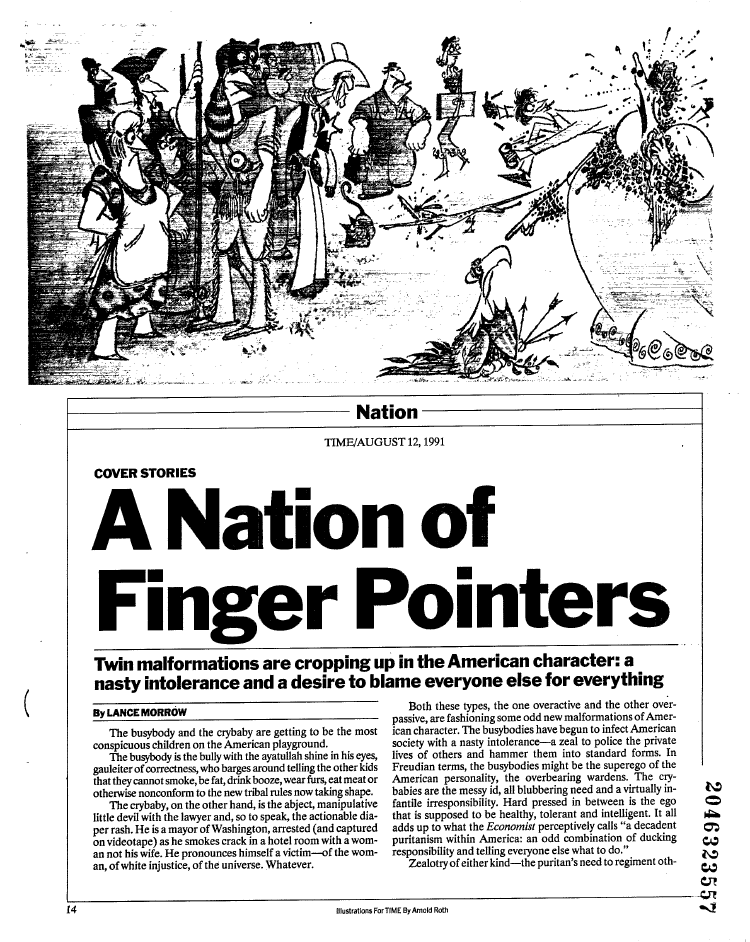
“Busybodies learn to be idlers, going about from house to house, and not only idlers, but also gossips and busybodies, saying what they should not.” – Timothy 5:13, Holy Bible (NES) –
It should’ve and could’ve been an uneventful walk in the park on an otherwise uneventful Tuesday. The weather was uneventful, an occurrence that most from the Midwest will inform you is an event in and of itself. The conversation was pleasant, albeit unmemorable and uneventful, and our walk through a city park should have ended that way, but I decided that I’d had enough.
That’s right, I decided to initiate a public confrontation by permitting my leashed dog another opportunity to chase some ducks at a public park into a man-made lake. It was all my fault, or mostly my fault. I’ll let the reader decide the proportion of blame, but I will admit that it was mostly my fault, because I could’ve walked away from a relatively harmless, old woman who decided to intrude on my otherwise uneventful walk in a park on an otherwise uneventful Tuesday afternoon. I decided, however, that I’d had enough. It all started with a shriek:
 “Don’t do that!” a female voice shrieked from somewhere off in the distance.
After the initial chase of some ducks resting on the shore of a man-made lake, my dog sniffed at the shore where their palmate (AKA webbed feet) stood seconds earlier. My dog looked up and watched them swim away for a couple seconds, then casually walked away, his mission complete.
If my wife asked, “Did you hear that woman warn you not to do that?” I could’ve pled ignorance. I could’ve played dumb and pretended that I had no idea what my wife was talking about. The woman’s shriek was that faint and distant. The park wasn’t densely populated, but it was plausible that any of the other attendees could have earned such a reaction. I could have assumed I was not the subject of the shrieking woman’s scorn, and I could’ve simply walked away from it. I could have pretended that I didn’t hear her, and no one –not even my wife– would’ve known any better. My pride was not on the line, and I had nothing to gain by pursuing confrontation. I considered all of that, while my dog sniffed the shore and my wife spoke of unrelated matters, but I’d had enough.
Some confrontations are necessary and rewarding. If a person’s character is on the line, for instance, they should come out swinging, with the best vocabulary in their arsenal. Sometimes, confrontation breeds the type of definition we should not allow others to define for us. We cannot sit back and allow unwarranted, slanderous accusations go unchallenged. We do make mistakes, however, when we confuse perceived slights with actual, in-your-face accusations, in our quest for definition. This need for respect can be lead some of us to engage in inconsequential confrontations that result in no gains for either party. Sometimes, we engage in confrontation just to feel better about ourselves. We also engage in irrational, unnecessary confrontations for the irrational reason that we’ve allowed so many slights and inconsequential confrontations slip by without response that we reach our threshold, and a breaking point.
Consider is at the base of the word inconsiderate, and both parties of any interaction would do well to remember that before reacting. Most people don’t consider how their actions might affect others. There is a wide chasm between being rude and inconsiderate, in other words, and some of the times our subjective perception drives the two together. When we read into the motivations of the inconsiderate, we see our own. We think everyone carefully considers their actions as carefully as we think we do. We think they choose to violate the unspoken, social contracts we have with one another to the point of being rude.
Most of us know all that, and we simply move on, ignoring perceived slights. On most days, we find a way to walk away from the shriekers, and their prosecuting attorney friends (whom we will discuss later), preferring uneventful, non-confrontational Tuesdays, and we do so without losing one minute of sleep, because we know most confrontations won’t teach the inconsiderate social decorum or the life lessons they should know by now.
Those of us who choose to live peaceful, uneventful, non-confrontational lives often have an outlet most busybodies lack. We have a support group at home who will kiss us and love us after we experience confrontations with the miserable. We can inform our loved ones of the near confrontation, and then boast about how we managed to avoid overreacting. We do this with the knowledge that those who overreact to every perceived slight have something scary percolating beneath the surface, waiting to be unleashed. We even avoid confrontation on those occasions when we know we’re right, because we know that doing otherwise might turn out to be a decision that affects our otherwise uneventful and happy lives in ways that are unalterable, depending on the nature of the recipient of our response. We don’t know who the person on the other end of the confrontation is, on most occasions. We don’t know how miserable they are, and the extent they might go to resolve an otherwise inconsequential confrontation. It isn’t fear that drives our decision to let it go, however, we just prefer to let this inconsiderate person have their way, so we can return home to play with our kids, love our spouse, pet our dog, and move on in our otherwise happy lives. We realize, at some point, that this means far more to them than it does us.
There is a moment when even the most inconsequential and inconsiderate actions of others begin to pile up in even the nicest, most peaceful person on Earth. We call the moment these moments cross an our threshold the tipping point. This moment will not cause the affected to become an irrational person that seeks confrontation, but even the most peaceful reach a point when they believe they need to aid the inconsiderate in reconsidering their definitions.
As silly as it sounds, I chose this moment to boldly stand for those who buckle in the face of the busy bodies sticking their nose in areas where it doesn’t belong. I heard the female voice shriek “Don’t do that!” from somewhere in the distance, and I chose to ignore it. When the ducks regathered on the spot my leashed dog chased them from seconds earlier, I allowed him a second go at them.
“Watch your dog,” a fisherman on a different shoreline called out to initiate the confrontation.
“He’s all right,” I informed the gentleman. “He’s just having a little fun. I keep him on a leash at all times, but I do allow him to chase ducks a little.”
“Be careful,” the man said. “I’m a prosecutor, and people run sting operations in this park all the time.”
Sting operations. Did he just say sting operations? If this alleged prosecutor brought up the sting lie just to intimidate me, it worked. I must admit it put me back a step. My guess is those two words would put just about most law abiding citizens, who’ve never been in trouble with the law, back a step. After mentally ingesting the words sting operation, I thought about how hard my friends in law enforcement would laugh if I asked them if they ever conducted stings to try to get ahold on all the owners allowing their leashed dogs a symbolic rush at wildlife.
When we hear the words sting operations, we think about undercover cops assigned to ensnare perpetrators attempting to buy illegal drugs, stolen goods, or the services of a prostitute. We’ve watched enough Cops and other police dramas to know that most of the activities of law enforcement officials are in response to citizen complaints. Their job is to protect and serve, as we all know. Thus, when the police set up speed traps, it’s a result of the police servicing numerous complaints regarding excessive speed on certain stretches of road. When they sit outside a generally peaceful neighborhood intersection to catch drivers rolling through stop signs, it’s a result of servicing citizen’s numerous complaints. When the police set up the more customary stings to catch drug dealers or prostitutes selling their wares, it’s often in reaction to a volume of complaints regarding alleged illicit activity at a location that they showed up to to investigate, too late, a number of times. So, the typical sting operation is their proactive attempt to tend to those complaints they weren’t able to tend to in the moment. Depending on the nature and volume of such complaints, they set up sting operations.
The typical sting operation involves a subject attempting to lure the unsuspecting into committing an offense, while trying to avoid any elements of entrapment. When law enforcement is involved, they’re often wary of using citizens for legal liability reasons. In this particular scenario, the law enforcement officials probably should consider deputizing the ducks to avoid the liability of something happening to them in this sting operation. They may have floated the idea of using a man-made plastic duck in their sting operation, but they would run the risk of the perpetrator, the dog, not catching the scent, or in some way knowing it’s not real. So, they have to use a real duck. The problem with using a real duck, however, is that the citizen’s complaints never involved the physical harm of the duck but the emotional distress the offense of dogs chasing them. So, to conduct a proper sting operation, the law enforcement officials must figure out a way to prevent the duck from experiencing emotional distress, as the complainers might view this as exacerbating the problem.
The next question, if this sting operations involved law enforcement, is how do they adequately address budgetary concerns when attempting to address these citizens’ complaints. How many law enforcement officials do they put in the park, incognito, or hiding behind trees and bushes? How long do they wait? Then, when they finally have a citizen walk their dog and allow it to chase the ducks into the lake, how do those in charge of this sting operation instruct their officers to address the offense? We have to assume that they would not be able to secure approval from city officials for approaching an alleged perpetrator of such a crime with guns drawn, so do they rush them with loud verbal shrieks, or tickets in hand. Before we say that we think the officer would approach the dog owner in a non-confrontational manner with either a verbal warning or a ticket, we have to consider that one of the goals of those who orchestrate such a sting operation will want to keep the satisfaction of those citizens who complain in mind. These citizens might further complain that there was no show of force by the officers in question, and no sense of intimidation, which they would claim would lead to the perpetrator committing the offense again. Finally, there are no city or state ordinances that address a leashed dog running at or running toward wildlife for the purpose of satisfying whatever drives a dog to do such a thing in the first place. So, if there are, or have been, sting operations set up to prevent dog owners from allowing their dogs to chase city park ducks into the water, what are the logistics of it?
On numerous occasions on these cop shows, we hear the perpetrator say, “I’m a taxpayer. I pay your salary. There are murders, rapes, and other crimes going on right now. Don’t you think your time would be better served ending that, as opposed to arresting me for this petty crime?” I understand this complaint, in general, and there have been occasions when I’ve been sympathetic to it when a friend or family member received a ticket for a rolling stop at a stop sign, but generally speaking, my sympathies go to the officer, because it’s their job. If four to five law enforcement officials rushed me with warning tickets drawn, after I allowed my leashed dog to run toward ducks, however, these words would be the first things out of my mouth, coupled with some sympathy for some of the ridiculous tasks we require of our law enforcement officials.
I didn’t think of all these things in the moment, but I knew the alleged prosecutor was full of it. “We’re just having a little fun,” I informed the alleged prosecutor, “but I do thank you for your concern.” I then offered him a genuine smile and a hearty, good-natured wave that was as confrontational as a genuine smile and a good-natured wave can be.
The “Don’t do that!” shrieker stepped to the fore from her place about twenty yards ahead on the park trail. She waited there, I could only assume, to see how the prosecuting attorney’s threats might affect me. When she determined it had no effect, she began to tremble with absolute, unqualified rage. In a volume much higher than necessary, she informed me, “The ducks are scared, and they cannot fly.” She then added some other gibberish that flew out of her mouth at such a rate that I feared she might be exhibiting the early warning signs of cardiac arrest.
I stopped on the walking trail, for a moment, caught off guard by the intensity of her venom, until I realized the faux pas of remaining frozen in place. She was standing in front of me, blocking my path, but I decided to continue walking forward, toward her. I did my best to make it clear that I was not charging her, or nearing her in any confrontational manner, yet I refused to remain standing back in a manner that might lead her to believe her vitriol paralyzed me in fear.
The woman then developed a scenario for me. “What if a large, menacing dog came after your little pooch there? Wouldn’t you be just as scared as those ducks are?” she asked.
“Not if that dog was leashed,” I said.
“Yes, you would,” she said.

The uninteresting uh-huh-yes-huh portion of the confrontation lasted for another couple seconds, with each party parrying and thrusting, until the shrieking woman decided to turn and walk away. She was still muttering things over her shoulder, but her venom diminished a tad.
Some have accused me of being a last-word person, but I’ve found that those who accuse me of this often have a need for the last word that surpasses mine. They enjoy trapping the recipient in a state of flux, and their last words are typically an accusation that the other is seeking the last word. This has happened to me so often that I’ve thought of accusing people of needing to have the last word before we even begin such an argument, just to take that arrow out of their quiver.
I will concede that if more than five to seven people make such an accusation, there might be something to it. If that is the case, it might have something to do with the fact that draws and defeats don’t settle well in my digestive system. I prefer to think I can accept draws and defeats, as long as the other person has considered my point of view before we go our separate ways, but I admit that I always put some extra effort into making sure the other side hears my words, last or not. I will admit that these characterizations of my point of view are relative to my definition, and that I don’t provide the most objective perspective on me, but I can’t shake the feeling that when you accuse me of being a last word person not only are you saying the last word, but you obviously couldn’t defeat the last portion of my argument.
“It looks like we won’t be coming to this park anymore,” I informed my wife, at high volume, to initiate my last word. “It’s filled with busybodies who don’t know how to mind their own business!”
“Get out of the park!” this woman said, shrieking again, “and don’t come back!” I could hear it in her voice that this woman was testing the maximum capacity of her internal system to handle her rage. She then shrieked something about calling the Humane Society, and she punctuated it with anything and everything she could to defend her position. I allowed her that final word. A friend approached her and took her away from me to presumably calm her down before she reached life-threatening levels of rage.
It was such a meaningless confrontation. I didn’t feel any better or worse when it was over, and neither party proved their point, unless one considers the goal of proving to one member of this busybody nation that I was not going to abide by her edicts in silence. In my own subtle way, I did at least inform one busybody, of the busybody world, that sometimes they overreach.
99.9 percent of the American public would never allow their dog, leashed or not, a second run at the ducks after the initial shriek or the alleged prosecutor’s threat. That would make the perpetrator of such an action a bad guy, and no one wants to be a bad guy. In this particular scenario, the subject was a young man engaging in an unnecessary confrontation with an elderly woman, defending their right to let a thirty-pound dog chase helpless ducks enjoying a leisurely swim in a city lake. It’s a no-win scenario that no male, other than the .1 percent who overreact to every perceived slight, would’ve engaged in. We can probably also guess that if we tried to come up with a percentage of young men who might defend their pro-dog-chase-duck position, we might cut that .1 percentage in half. A person who wants to be a nice guy would view this whole scenario as a no-win proposition.
My only defense –one that I agree borders on the time-honored, political tactic of diversion– is to declare that I am not pro-dog-chase-duck. I’m a man-stop-busybody guy, more focused on informing these people that we would appreciate it if they would take one step back to that time-honored state of mind when people were uncomfortable telling complete strangers how to live their lives. This would be a first step in a movement I would love to spearhead. We would be the “Enough already!” movement that would inform federal, state, and local busybodies of their new limitations.
If they nominated me for this role, I would inform my followers that we must engage in more inconsequential, indefensible arguments such as the one that occurred on that Tuesday in the park. If we are to roll the tide back effectively, we must engage with busybodies who involve themselves in all of the otherwise inconsequential moments of our lives. Our goal would not be to stop busybodies, for that would be impossible. Rather, the objective is to begin a non-violent rebuttal that involves planting proverbial, “Mind your own business!” flags in the terra firma of city parks, just to let the no stress/no conflict/no turmoil busybodies know they’re not going to receive their Righteous-Warrior-of-the-Culture badges on our watch.
“This park is neutral ground for the inconsequential to go on living our inconsequential lives without consequence!” would be our scream as we plant proverbial flags in the confrontation.
To those members of our group who wouldn’t dare commit a so-called crime against nature by allowing their children or dogs, a run at the city ducks, I would challenge them to do so. I would ask them to look back over their shoulder after the purported crime against nature has been committed, to watch the ducks fly right back to the exact same spot on the shoreline that their dog, or child, scared them off ten seconds earlier.
Insecure bullies who experience some joy in scaring innocent, little ducks might perceive this return to the shoreline as a direct challenge to their manhood, and they may do something else to flex their muscle. Our movement would not support that. On the contrary, our goal would be to serve as an information outlet. We would inform our group members that, as in the scenario involving the ducks, that ducks have probably mentally factored these purported crimes committed against them as an acceptable consequence of living among humans. We would state that this happens to the city ducks so often that it doesn’t even ruffle their feathers anymore. If the ducks have conversations, I have to imagine that this process has become so routine for them that they fly away and back without so much as a pause in their sentence.
I should’ve asked the elderly shrieker to detail for me the trauma that our supposed crime against nature caused the ducks. I should’ve said, “If my dog causes them the trauma you suggest, why don’t they live elsewhere? In the wild, they face actual predators stalking them on a daily basis, as opposed to a thirty-pound Puggle giving chase to tweak some instinct the canine has never executed to completion, and he wouldn’t know what to do with it if he did,” I could’ve said.
I also could’ve added, “If the trauma of the Puggle chasing them into the lake is so severe, the ducks would instinctually calculate that the trade off between being chased into a lake and gorging on human largesse to the point of obesity is not worth it. They would rather go hungry for a night than face another child or Puggle chasing them into a lake.”
Of course, I don’t know how advanced or informed the decision-making process of the city lake duck is. I’m guessing the wariness they have for the little beings such as children and pets that tend to accompany larger beings trumps the fear they have for all the other beings that exist in all the areas of the world that mankind has not preserved for their comfort and well-being.
The Pitfalls of the Previous, Private Generation
Even those of us who despise the ways of the modern busybody must acknowledge that their existence sprang from the ashes of the previous generations.
“What a man does in his own home is his business,” declared the previous generations that believed that respecting others’ privacy was, at the very least, a preferred method of dealing with neighbors, if not the honorable one. Thus, even when faced with extreme situations, good and honorable people deemed it the preferred course, if not the honorable one, to do little to nothing.
A concerned citizen might have persuaded a good and honorable person to have a word with the individual perceived to be causing an extreme situation, but if the accused informed the honorable person, “It’s none of your business” good people would back off and say, “I tried, Mildred. I tried.” The next course of action would involve either a physical altercation or a call to the police, and most did not follow up to that extent.
The current generation witnessed the deleterious effects of ignoring extreme situations in which the helpless incurred irreparable harm that would affect them for rest of their life. Good and honorable people realized that there was a call-to-arms to provide defense and comfort for the helpless in ways greater than those symbolic measures put forth by previous generations. They may go a little overboard at times, in the interest of protecting the helpless, but they feel that it is sometimes best to say something early, before a situation escalates. There is also some foggy notion in their head that if they do overreact in some situations, perhaps they might rectify the wrongs of the previous generation who decided to do little to nothing.
The problem with this call-to-arms mindset is that extreme situations don’t come around as often as we believe. This problem of scarcity has given rise to the perception of injustice and the belief that the situation before us is an extreme that requires action.
“I’ll be damned if I’m going to allow them to get away with that,” we say when our child comes home with a real, or imagined, slight. “What’s that principal’s phone number again?”
Even if the situation is not of an extreme nature, it is possible that it could evolve into one. Many of these situations are relative and situational, and who knows how they might progress? Isn’t it better to act now, rather than to allow it to fester? We feel a responsibility to protect the helpless from further mistreatment, even if there was no real, definitive mistreatment in the first place.
“It may be nothing now, but I don’t want to go to bed tonight regretting the fact that I didn’t say anything earlier. If I’m wrong, big deal. My motivations were pure. If I say something when a mother is scolding her child too harshly in a mall, most will regard my intentions as righteous. If the mother is a little more insecure, going forward, correcting her child in public, in a manner that might result in the child being more prone to act up in public, it’s all an acceptable error on my part, right? If I managed to save one helpless child from a true, extreme situation.”
Some carefully intercede on behalf of another in a moment they believe has, in some way, spun out of control. They might say something, and they might move on. They might concede they didn’t know the whole story, but they believed the situation called for a bit of advice from someone who’s been there, done that. Others take great pride in their ability to recognize a situation before it escalates, and they intercede without concession. The difference occurs in the aftermath, when busybodies trumpet their exploits to friends and family. This is what true busybodies do. They’re proud of their busybody nature, as that is precisely how they attain their badges of honor. They love when others deem them righteous warriors, according to their definition of what they think people should say about them.
Every situation is different of course, and some are so severe that they call for some intervention to protect the vulnerable. If, for example, the mother was slapping, or physically harming the child in the mall, the warrior should’ve stepped in and said or did something to protect the child. Most cases are not that severe, and the details the warrior of the mother’s offense are usually kept vague, “I determined that the mother’s actions to correct the child were extreme.”
In most cases, the audience of the righteous warrior’s retelling of the moment know little to nothing of what actually happened during the incident in question. They only know what they are being told, so they unwittingly perpetuate the self-righteousness of the righteous warrior by congratulating them for stepping in. Rarely does a listener prod a righteous warrior for more details on the matter.
“Did you know the totality of what happened before you intervened? Did you make sure you were at least apprised of most of the details involved, or did you make a leap of faith?”
“What do you mean, did I know what happened?” the busybody will ask in their defense. “I saw an adult correcting a child in a manner I deemed unwarranted to the extreme! It’s just a child for gosh sakes! There was no need for that!”
“But how many times have you been wrong though?” a bold questioner may ask. “How many times have you stepped in on a situation of this nature and done more harm than good?”
The honest righteous warrior would admit that they didn’t know all of the details all of the time, and if they were brutally honest and reflective they might admit that they probably don’t know the pertinent details most of the time.
“Look, I’m not going to play this game,” is the more common response from righteous warriors, as most of them act on impulses as opposed to learning the pertinent information. “I may be wrong some of the times, I’ll grant you that, but that’s the price I’m willing to pay to create a more just world where the helpless of our society receive more protection. I see it as doing my part.”
“But you don’t know that to be the case all the time. That’s what I’m saying. I’m saying that some of the times, you should mind your own business, until you know for sure.”
This is why some of us loathe busybodies and why we are willing to go to extremes to roll back the tide. As anyone on the “but” end of a busybody’s complaint will tell you, the escalation of busybodies has reached a point of no return. The sins of the past generation have been well documented on numerous movies and TV shows, and they lead us to believe that extreme situations lurk around every corner, until we’re screaming at the top of our lungs about the emotional distress a duck must experience after being scared into a lake by a leashed dog.
The term busybody derives from the 1520s adjective busy, which they used to describe those who pry, are meddlesome, or are active in that which does not concern them. We have to think that there was some irony involved in the etymological progression from Old English to Middle to Modern English, as busy can be used to describe both the person who is extremely active in life, and the person who is anything but.
If we were to confront a busybody with the idea that if they were more “busy” in life, they might not involve themselves in such inconsequential matters, they might provide a lengthy list of activities, and groups they’re involved in, a list that would likely surpass ours. “It’s obvious that that’s not enough for you,” we might say. “If it was, you wouldn’t have been shrieking at the top of your lungs about the psychological plight of a duck. Not only that, but some past transgression must be eating away at your soul, one that comes barreling out of you when you perceive a slight against some perceived victim.”
If the confrontation that occurred on an otherwise uneventful Tuesday in the park was all about protecting the duck, why did one of them hit me with the threat of possible sting operations with the implied threat of fines and possible prosecution? If the focus was solely on the emotional well-being of the ducks, the shrieking woman could’ve put me in my place with a quick, inside-voice condemnation of my actions. She could’ve undressed me, with a few quick words, “Don’t scare the ducks. You’re a grown man, for gosh sakes. Do you get some kind of perverse joy out of it?” If she expressed her concern with some measure of restraint, in a measured tone, my dog and I would’ve left the park with our tails between our legs. What the two shriekers did, instead, was so over the top that I’m quite sure that woman’s doctor –concerned about her high blood pressure, and her heart valves weakened from years of overreacting to perceived slights and perceived extreme situations– would’ve warned her against future outbursts. I am also sure that if the partners in the second shrieker’s law firm found out what he did, they would’ve cautioned him against throwing his weight around in otherwise meaningless moments. Most busybodies have no authority to do anything they do, and that fact probably frustrates them to a begrudged point that they need to hit the release button on their pressurized valve every once in a while to prevent buildup. We can also guess that it wouldn’t hurt their feelings if they found out that they ruined your day in the manner so many of their days have been ruined.




 Rilaly