Hey You, Get Off My Microbial Cloud!


Have you ever wanted to commit murder? Most of us don’t, but that doesn’t mean we don’t fantasize about it. Most of us don’t have anyone in mind, and we don’t think about it to the point of gauging the ramifications. We just think about how exciting it might be to test our skills against the most brilliant minds of the criminal justice system to see if our attention to detail could match theirs. We would love to see if we could get away with it, just to do it. If we believe what scientists at the University of Oregon, and microbiologists at Argonne National Laboratory suggest might be on the horizon in the science of criminal investigations, you might want to stop procrastinating, and just do it, because getting away with murder could become a lot more complex in the next ten-to-twenty-years.

Getting away with murder is such a common phrase that it doesn’t really mean anything to Americans any more. We toss the phrase around in such a cavalier manner that it confuses foreigners, learning the language and the American culture. They don’t understand how anyone could equate getting away with using a TPC form to complete a CPT request, could be equated to getting away with killing another person. They know that no one in the company is supposed to use this form for a CPT request, they know the dire consequences that await those who do, and they understand that the perpetrator in question didn’t experience any of the proscribed consequences after doing it, but they don’t understand how that is, in anyway, similar to getting away with murder. 

The cavalier use of such phrases may speak to the inability of most to express themselves, or the need we have to exaggerate everything for the purpose of illustrating how strong we feel about a matter. Whatever the case is, we use the phrase getting away with murder, because we deem it one of the most difficult things to do. Even in the days of Sherlock Holmes, when law enforcement officials had little more than their wit, elevated observation skills, the ability to read people, and all of the experience and training that honed those natural attributes, we deemed getting away with murder so difficult that few, if any, could escape a thorough investigation unscathed.

With the first conviction in 1987, by way of DNA evidence, the degree to which science was used in crime scene investigation grew by leaps and bounds. Some have said that jump was a generation-defining leap. Since that point, the FBI has compiled DNA records on more than five million convicted offenders, and around 240 convictions have been overturned because of DNA evidence. In most cases, law enforcement officials are now able to use science to narrow the field of suspects of an investigation with the assistance of DNA evidence. They are able to use it to apprehend suspects, and to build a strong enough case for conviction, as DNA evidence is now recognized by courts and juries alike as a tangible form of evidence. If we are to believe Christopher Cobble’s article for Findlaw Blotter, we’re about to take another huge leap forward with something called a microbial cloud.

Research scientists, and microbiologists, state that they have found that a cloud of bacteria surrounds every living being. This cloud is something they call “microbial miasma”. It is similar, in nature, to the cloud of filth that surrounds the character Pig Pen of the Peanuts comic strip. The cloud that surrounds us every minute of every day is a sort of haze of our microbiome that we emit, comprised of viruses, fungi, yeast, cells, cell parts filth, every piece of bacteria that lives on or around the skin, every piece of skin you shed, and every little, otherwise discreet fart that happened to come from you.

Have you ever encountered a person who had a body odor so strong that you swore you could taste it? Have you ever said something along the lines of, “I know this sounds foolish, but I swear his funk is still crawling on me!” The findings of these microbiologists, and research scientists, suggest that this thought may not have been as far-fetched as once thought.

The BBC summarizes these findings by writing, “When you approach another person’s microbial cloud, their bacteria “rains” down on your skin and is breathed into your lungs.”

Those of us who have a lifelong aversion to close talkers have found it difficult to express our discomfort, for we consider a violation of a norm to break that two-step invisible bubble we all have. It’s a custom of Americans, and some may even call it social protocol, to ask another for some space, but we understand that other cultures have other rules of space. This confusion makes it difficult for us to ask for more space in this regard, but this idea of a microbial cloud might be our saving grace.

“Could you back up a step?” we can now say. “You’re getting your microbial cloud all up in me.”

Reading the various studies of this new information on the net, leads this reader to believe that such hip jargon may not be too far off the mark, for even the customary distance of two-steps may involve the speaker’s microbial miasma going up your nose, in your ears and mouth, and through your immune system. Those of us who have an aversion to close talkers can now state with confidence that a close talker might exacerbate normal bacterial intrusion levels.

This research also gives credence, unfortunately, to the idea germophobes have feared for a generation that they will contract airborne diseases through the simple act of talking to people.

These researchers suggest that the bacteria located in microbial clouds are not just indigenous to every living thing, but they’re also individualistic in their own right. They have their own DNA.

“Researchers ran two trials with participants sitting in sterilized rooms and working on computers while air filters and trays on the ground detected and collected bacterial particles. According to Wired, “[T]he two trials showed that, at least in these 11 people, microbial clouds varied significantly from person to person. They also found that different people shed microbes at different rates.” This means we all have our own, personalized bio-dome following us around, but the DNA is so individualistic that science can now ID it.”

“We expected that we would be able to detect the human microbiome in the air around a person,” a James Meadow of the University of Oregon, said in a news release from the journal PeerJ, “but we were surprised to find that we could identify most of the occupants just by sampling their microbial cloud.”

Those of us who adored the brilliant 70’s television show Columbo, now watch it with a slight cringe and a quaint smile, as we watch the trench coat investigator solve “perfect crimes” by paying an inordinate amount of attention to the details that the average person would’ve missed. “Getting away with murder” back then involved a perpetrator wearing a pair of gloves, paying careful attention to their footprints, and wiping down door handles, lamp switches and telephones to cover any trace of evidence they may have left behind. We also watch the show’s perpetrators attend to the various circumstantial details that might account for the murderer’s whereabouts at the time of the murder, and the warmth of the body that might confuse the coroner’s time of death, and all of the other details that were difficult, but not impossible, to cover up. Those of us in the age of DNA, now watch Columbo with that quaint smile, knowing that if the trench coat investigator had access to the modern technology we have today, most of the “perfect crimes” it appeared that Columbo was the one man to solve, could now be solved by a forensics intern.

The generational differences may not be that stark, and some law enforcement officials will argue that science will probably never replace the basic investigatory tactics, such as knocking on doors, interviewing witnesses, and all of the tactics that Columbo used to solve crimes. The science, as I am sure every law enforcement official would admit, is a nice supplement to help close a case and gain a conviction, but it will never replace the hard work done to solve a murder. I am sure they would also admit that the advent of DNA into criminal investigations, and the depiction of it on shows like C.S.I., might discourage some from indulging in their sick and twisted fantasies with the belief that it’s harder to get away with than ever.

Getting away with murder has never been easy, but with the advent of DNA, and the understanding of it on a level that it could assist law enforcement, as depicted in numerous shows, such as C.S.I., leads those with a lust for blood to dress themselves, and the location of their crime in plastic, in the manner the Dexter would in that Showtime series. How will future assailants account for their microbial cloud? Will we view Dexter and C.S.I., one day, with the same cringes and quaint smiles we now view Columbo?

Jack Gilbert, a microbiologist at Argonne National Laboratory, has been working with crime scene investigators on how to use microbial residue to track down criminals. Mr. Gilbert believes that in the future, we might us microbial clouds, like DNA, to assist law enforcement officials in the future.

“Mr. Gilbert notes that our microbial clouds are not only particular to us, they are particular to where we’ve been, as we add microbes from the surrounding air, soil, and water to our personal Petri dishes. Therefore, an individual’s unique microbial signature could either confirm their alibi or place them at the scene of a crime.

“Solving crime with bacterial vapors remains in its infancy,” writes Christopher Coble. “As with DNA evidence, collection is one thing, but having a large enough database to compare results to it is quite another. But as the technology evolves, it’s yet another reminder to be careful about what you store in the cloud.”

If this research evolves to the point that Mr. Gilbert believes it might, criminal investigations may go beyond the as of yet simple study of skin and the complex collection of DNA, to the study of the DNA of the bacteria that lives on and around the skin. Bacteria, after all, are living organisms with their own DNA signatures.

What will happen in investigations of the future, according to Cosmos Magazine, is that the forensic scientists will get a hold of the bacteria in question and study it using high resolution DNA. In the course of their study of this organism, they will seek out the bacteria’s 16S gene that they say provides their reading a DNA signature equivalent to a grocery store barcode. All bacteria have this gene, but it varies by slight differences between species.

Dexter’s plastic wrap outfit, in essence, would not prevent future forensic specialists from narrowing the field down to him. If they were able to get a hold of the germane bacteria involved, scan it, perform a census on it against the different bacteria communities available, compare it to the 16S genes in their database, and compare it to victim’s bacteria on the alleged assailant or vice versa. If that failed, the forensic team could take soil samples from the area and compare the bacteria in that soil with the bacteria at the bottom of Dexter’s shoes, for example, to build a case against him. 

As Mr. Gilbert says of light switches and door handles, Dexter could be meticulous in his effort to wipe down every inch of the sole of his shoes, so that no milligram of dirt existed on that shoe, but the microbial signature, contained in the 16S genes of bacteria of that sole would be “virtually impossible” to wipe away. Mr. Gilbert even contends that anti-bacterial sanitizers would not be wipe this away entirely.

Dexter had a habit of putting plastic around his shoes, you argue. It’s a decent argument, until we ask the question when he put that plastic on. Did he put that plastic on before he left the car? When he opened the car door, did any of the microbial dust, indigenous to the area, make its way into his car? If he didn’t put them on in the car, did he wait until moments before entering the abandoned rail car? Did he step on any incriminating microbial dust en route to the abandoned railcar? If you watch an episode of Dexter, you’ll notice that his eyes are not covered, and that leaves him susceptible to getting some of the victim’s microbial miasma is his eyes. If investigators are able to get to him quick enough and put him into a sealed chamber, to test his air samples, they might be able to find some 16S genes from the area in question, or the victim. If law enforcement was able to locate and legally confiscate the plastic wrap Dexter used they could scour the outside of the outfit for location, and then they could test the inside of the plasti-wrap to see if his microbial cloud was in it. 

The point is that if you remained calm in the face of the intense interrogations of the Porfiry Petrovichs, the Father Browns, the Sherlock Holmes, and the Columbos of their day, and you were able to weather their psychological games of misdirection and distraction, your ability to get away with murder increased. Getting away with murder  was still so difficult that it became a euphemism for getting away with the impossible, but it was still possible.

The day may never come when the idea of getting away with murder is so impossible that it’s not even worth trying, but there may come a day when a forensic specialist locates some Propionibacterium and Corynebacterium on a clover leaf, in the soil, and around a duck pond where it was alleged that you got your thrill on by killing your neighbor that had belly fat hanging so low below his shirt that you couldn’t stand looking at it anymore. There may come a day when a forensic team is able to determine that those bacteria had a 16S gene, bar code that is specific to you, and there may come a day when they are able to convince a jury of your peers that this alone is enough to have you executed for your crime.

That day is not here yet, however, so it’s not too late for those who want to use all the knowledge they’ve gained from binge watching C.S.I., in the plasti-wrapped basement we’ve told everyone is for our daughter’s third birthday. If these reports are to be believed, however, and the science achieves all that these microbiologists, and research scientists, are projecting, we may want to stop procrastinating, because the forensic science involved in criminal investigations may get so intense that it may become almost impossible for even the most brilliant and meticulous to get away with murder, and that phrase could take on a whole new meaning in the next ten-to-twenty-years.
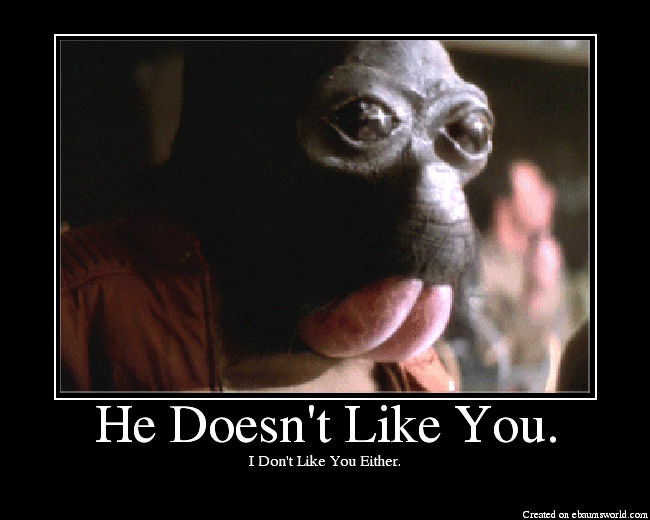
Someone Doesn’t Like You


“Somebody doesn’t like me. Shhh! Don’t tell anyone it might be perceived to be a comment on my character.”

All apologies to Larry David, but robust research suggests that most people like us far more than we think. Anyone who watched David’s brilliant comedy Curb Your Enthusiasm knows that David is pretty, pretty, PRETTY sure nobody likes him. His little secret, one he shares with everyone he encounters, is he doesn’t care.

The rest of us care, but I don’t. “Yes you do, and you know it.” All right, but what did I do or say to cause them to not like me? Am I saying it now? I don’t care. “Yes, you do.” Is my hair in the right place? Are my clothes fashionable? Do I have the correct opinion on this matter, and if I don’t, will they respect me in the morning if I change that opinion to get them to like me more? “Shut up and listen.”

That’s one of the fundamental keys to getting people to like you, if you care. Listen to them, make them feel interesting, and they’ll be more apt to find you interesting. An enthusiast on this topic suggested there are three words to achieving this, “Tell me more.” My personal variation of those three words is “Are you serious?” That drove my dad nuts, “Yes, I’m serious. You think I’d joke about something this serious?” He said that all the time, but most people know that my “Are you serious?” acts as a conjunction, or an active listening prompt, to inform the listener how interested I am in their story. It’s my personal favorite active listening prompt. Whatever yours is, enthusiasts encourage us to use them often in conversation, if we want people to like us, because there’s nothing a person loves more than thinking another someone is interested in what they have to say.  

Even with that, there will always be someone, somewhere (“I see you”) who just doesn’t like us. We would love (and I do mean LOVE!) to hide behind the teenager’s, “I don’t care what anyone thinks!” righteous banner, but we know better now. We know we care, but we don’t know what to do about it?

HeDoesntLikeYouThe first thing to do is nothing, because there is always going to be someone who doesn’t like us for who we are, what we look like, and a number of other superficialities for which we have no control. They are members of a group, and it may not matter to us what group they are in, but it’s vital to those who don’t like us to maintain that for which they stand. It is a fundamental tenet of their personal constitution, and an essential part of their identity. It’s the “I might not have done much with my life, and I’m probably not the type you might call intelligent, successful or happy, but at least I’m not one of you!” group mentality for which they stand. In cases such as these, we should do nothing, because there’s nothing we can do, but we shouldn’t change what we do, who we are, or how we speak, because if we bend to these terrorists, they win. If that sounds like something a teenage, righteous warrior might write on a bathroom wall, it is, but once we get past the best swear words and the exclamation points following their potty prose, we do find a germ of truth in it.

Have you ever heard someone compliment another with a, “She’s so nice that if people don’t like her, there’s probably something wrong with them!” That’s really the nut of it all, as far as I’m concerned. If you’re nice and pleasant, and you manage to avoid the narcissistic tendencies of waiting for a speaker to finish, so you can start talking and actually listen to what they say, and they still don’t like you. There’s probably something wrong with them.  

Humans are hardwired to adjust however. The others in our lives are our critics, and we should be open to their criticism in the sense that some portion of it might be constructive. In our never-ending quest to be liked, however, some adjustments turn out counterproductive, for if this person has a psychological underpinning that causes them to dislike us, they’ll just adjust their reason for not liking us accordingly, and they’ll have less respect for us for adjusting in the first place. If we can clear the fog we created, with the underpinnings of our own insecurities, we might find pleasing nuggets from that robust research that declares most people like us, and there could be something wrong with those who don’t. 

I have often found that upping the ante on the characteristic they dislike not only puts an end to this vicious cycle, but it subverts the prejudicial judgements they’ve made. Most observers subconsciously find that they respect a person more for not adjusting, and not conceding to the hard wiring of human evolution. We call this the “suck it!” strategy.

The “suck it!” strategy relies on the idea that we’ve established the fact that we are already pretty, pretty, PRETTY nice and likable. If we’re not likable, and this person’s judgments are corroborated by others, such that it might form something of a consensus of thought, we may want to consider adjusting. If we are a well-liked person, however, we should be who we are to the people who surround us, and group thought might eventually sway our critic to the idea that their prejudicial notions about us are wrong.

Every situation is different, of course, and there have been times when I’ve gone beyond the complaints the person who dislikes me makes. I don’t do this on purpose, but it excites me when certain people don’t like me, and I consider it a challenge to maintain my stance in the face of the wind they’re trying to blow my way. I’ve made minor changes to complaints about my attitude and personality when those complaints were verified and bolstered by others, but I can’t remember ever changing in a way that I considered an extension beyond my personality to the point that it cannot be maintained over the long haul.

As for the ‘do nothing’ advice, I’ve often found that with the relative nature of taste there’s not a whole lot we can do about someone choosing to dislike us. Most people usually formulate a prejudicial opinion of us before they’ve ever met us. We’ll know this is the case, if the hand we shake is cocked and loaded with a question like: “Is it true that you said (or did) this …?”

The base of the word prejudicial is prejudge, and we are making strides in our society to avoid such judgments. We are trying to avoid prejudging people, but we are selective in our attempts to rid it from our culture. Chances are, if you are a human being, living in the 21st century, you’re being judged, and prejudged as often as any man in any century, but we don’t discuss such things, lest we be judged, or prejudged, for doing so.

If prejudging people is such an anathema, one would think that the simple act of declaring another prejudicial would be enough to diffuse everything that follows. What we see instead, are people who get more upset over a prejudicial opinion than an informed one. As discussed, it’s human nature to care. It’s quite another to obsess over it.

“I know,” they will say, “but how can she form an opinion of me based on …” This sentence is usually concluded with “based on something they heard from a third party” or “based on our very brief encounter.”

“They can’t,” I say. “They do not know you. So, why are you getting so upset about it?” 

This speaker was excessively beautiful, and a number of people despised her for it. “Why do you like her? Why do you talk to her so often?” To which I said, “Why don’t you?” The reply was often something like, “I don’t know, I just don’t like her.” One person suggested that I talked to her because she was so beautiful, and I replied, “Is that why you don’t?” There are no concrete, general answers is the answer, and talking about it is often as pointless as thinking about it, or writing about it, but this happens all the time. The problem for you, is that it’s happening to you now. You catalog everything you said to this person who doesn’t like you, and you come up with nothing. She doesn’t like you because you’re beautiful and anything that comes out of her mouth will only serve her cause. There’s little-to-nothing you can do about it, except be who you are and let her change her mind, if she decides.  

If a person knows us well, and issues an informed opinion, it can be devastating, but the person who makes a snap judgment of us, based on a couple here’s and there’s, should be dismissed to whatever degree we dismiss uninformed opinions. This is hard, because it’s hard to believe that we’re nice and everyone should like us. It’s much easier to believe that we’re flawed, because we all know that there’s something to improve upon. We just don’t know what it is, and maybe she does. 

What we’re talking about here is psychology, both on a macro and macro level. The basis for modern day psychology is about 150 years old. The idea of the study may date back to Ancient Greece, but the incarnation we know today, an in-depth study of the choices that we make, and why –my preferred definition– is relatively new.

“She only says that, because she’s jealous,” is the fallback position for most of us who have to deal with the fact that someone don’t like us. It’s a snap judgment that may have more merit, if we attempt to seek in-depth psychological answers about them.

The extent of our knowledge of psychology often begins and ends with that Psychology 101 course we took in college, and that course likely focused inordinate attention on the study of dots, swirls, circles, and other such tricks of the mind to test perception. There is some ontological value in that study, of course, but it just seems like such a waste of time compared to the far more important study of human interaction, and how we can learn to dot the I’s and cross the T’s of the five W’s of social interaction and psychological warfare. It seems to me that there is a dearth of understanding of psychology in some, which results in very little desire to dig deep into another’s psychology to understand them better.

The study of the swirls and circles have some invaluable traits, as they teach us perception, perspective, depth, and the value of how the human mind perceives visual images. When we view the characteristics of others, for example, the images we see tend to derive from the point of origin, until the motion of the arrows could be said to form an oval between us. This is called psychological projection, or the ability to better see another’s weaknesses through comparative analysis.

Political partisans are often the first to call me a partisan, for example, people who need the last word are often the first to accuse me of being a person who needs to have the last word. Their accusations may be true, but they’re often the first to spot it, because they are viewing us from their perspective.  

If we are going to have some sort of long form engagement with this party, we may want to understand their psychology better. We should be prepared to be wrong in our assessments for we have our own subjective agendas and our own base from which we view others, but we should study them anyway, and adjust our analysis according to our findings.

After our initial analysis of this other person is complete, and all of our adjustments have been made, we may want to focus some of our attention on the third party who was informed by this other person of their decision to dislike you. It’s possible that the third party plays no role in this, other than being a third party, but is it possible that that person played an instrumental role in this other person not liking you. It’s possible that we may be a perceived threat in the relationship they have with this third party, and they have an agenda that this other person fears we may expose. It’s also possible that they’re insecure people and they fear that we’re better. Whatever the case is, it’s possible that we may never be able to entirely figure it out, and their insecurities are such that they’ve overestimated us, but they don’t want to take that chance.

“I don’t know why,” we’ve all heard others say about others. “I just don’t like them.” Perhaps the people who don’t like us are saying these same things about us. Perhaps they can’t put their finger on why they don’t like us. They just don’t.

If they do know why they don’t like us, they’re probably not going to tell anyone, for that might reveal something about them. They may also avoid revealing the exact reason, because they enjoy watching us flop around like a fish on shore, trying to figure it out.

If it’s true that robust research finds that most people like us, why are we bugging with those who don’t? It’s all about us, we do it to ourselves. Is the driver behind our desire to have everyone like us all of the time ego, or is it based on our insecurities? We don’t really know, but it bothers us when one person in the group makes that face whenever we talk. We know that face. Hell, we make that face when that person we don’t like for reasons we cannot articulate speaks. We do it to ourselves. The idea that not everyone is going to like us, is something we probably figured out in second semester of the tenth grade when that one kid told us off for being who we are. We thought there were very specific reasons he didn’t like us, but he would never tell us what they were, and it drove us insane. The one thing we noted in this particular specimen was that he just enjoyed getting under our skin. She was anecdotal evidence for the question why do some people not like us, but it’s possible that she enjoyed being anecdotal evidence. She probably just enjoys being the face on our ceiling, as we fight through the insomnia her words have caused us.

To Worry, or Too Worried?


“God is dead!” might be the most famous phrase German philosopher Friedrich Wilhelm Nietzsche ever wrote, and some believe it might be the most famous philosophical phrase of all time. Nietzsche, an atheist, wrote the phrase in a celebratory manner, as he thought it freed us up to be our own gods, so that we could pursue our own meaning of life. As an atheist throughout his adult life, Nietzsche didn’t believe God was alive in any way, shape or form, so why would he need to make such a public proclamation? He claimed that the Enlightenment killed God in a proverbial manner, and a societal and cultural manner. He basically declared that freedom from God and religion permitted the individual to greatness, unimpeded by religious constraints. As great as Nietzsche considered the moment, he did not write the phrase without caveats.

As often as “God is dead!” is quoted and spray painted on bridges and abutments, most Nietzsche followers, or lovers of the phrase, don’t add the full part of Nietzsche’s thought on the effect he thought the Enlightenment had on man. The thrust of the phrase was that God’s proverbial death in society freed the ubermensch from the shackles they experienced in religious societies and cultures, but it may not portend well for others. Ubermensch is a German term that refers to an ideal, super human who is able to overcome weaknesses, rise above societal norms, and create new values. Americans might call the ubermensch a philosophical Superman.

We do not claim to be experts on Nietzsche, and there is a much better analysis of this quote here, but to summarize the second part of Nietzsche’s idea, the glory of the freedom attained by God’s death in society is almost solely afforded to the supermen. The supermen are the ones who’ve been waiting for God’s proverbial death, so that they could help shape society, the culture, and prepare the people for a God-less existence. They, in Nietzsche’s view, are responsible types who will use their powers for good. He did worry about the rest of man, the common man, the man on whom God’s existence provides meaning. He believed they might lose a sense of morality and fall prey to feelings of hopelessness.

The idea behind freedom is interesting, because we often hear, from both sides, that too much freedom may not be a good thing. The definition of freedom, in these arguments, is often vague, relative, and directed outward in a semi-autobiographical way. They usually make an exception for you, the listener, because at least as long as you’re in the vicinity, the acknowledge that you, too, are a superman. They also make the implicit argument that they are immune, but they worry about others. 

It may seem illogical to argue that we’re too free, in lieu of the legislation and monitoring we’re experiencing from the public and private sectors. Yet, Francis O’Gorman’s Worrying: a Literary and Cultural History is not a study of freedom, but one of the common man worrying about how the people, places, and things around us are affected by too much freedom. Mr. O’Gorman makes this proclamation, in part, by studying the literature of the day, and the themes of that literature. He also marks this with the appearance, and eventual proliferation of self-help guides to suggest that readers reward writers who provide more intimate, more direct answers. Without direct answers, we have empty spaces, and in these empty spaces, we worry. This study leads Mr. O’Gorman to the conclusion that this general sense of worry is a relatively new phenomenon, as compared to even our recent history.

One fascinating concept Mr. O’Gorman introduces to this idea is that the general sense of worry appears to have a direct relation to the secularization of a culture. As we move further and further away from the idea of God, the Christian philosophy, and it’s religious to a more individualistic philosophy, we might feel freer to do what we want to do, but we also worry about a susceptibility we have to unchecked consequences and mortal decision making. How do we fill that gap? Some say that if we select the correct representatives as lawmakers to sign the necessary laws, we’ll be all right. Others say that we can be moral without religion by choosing a philosophy, personal or otherwise, other than religion. We can be out own gods. The philosophy of Christianity teaches that happiness can be found by living a moral life, and it lays out the tenets of its morality. The theme of Mr. O’Gorman thesis is that without a controlling moral authority, humans worry that they and their peers will, by their nature, become more immoral.

If we have an almost inherent need to be led, how do we replace the tenets of religion? Some choose to align their spiritual guide with politicians. They view these leaders as the religious view prophets, and they view opposing views as heretical. As much as secularists believe themselves fully capable of living without leadership, all political thought revolves around the desire to be led.

Reading through the various histories of man, we learn that our ancestors chose the guiding principles found in The Bible. The general theory, among those who preach the tenets of The Bible is that man’s mental stability, and happiness, can be defined in direct correlation to his desire to suborn his will to God’s wishes. God gave us free will, they will further, but in doing so He also gave us guiding principles that we can follow to a greater sense of happiness.

Some argue that Christianity is not a religion but a philosophy. Catholicism, Judaisim, and the Protestant religions all fall under the umbrella of the Christian philosophy. Putting that idea into this argument, it could be said that Christianity provides guiding principles and religion translates and enforces them.

If a man has a poor harvest –an agrarian analogy most preachers use to describe the whole of a man’s life– it is a commentary on how this man lived. The solution they provide is that the man needs to clean up his act and live in a Godlier manner. At this point in the description, the typical secular characterization of the devoutly religious comes to the fore, and their agreed upon truth has it that that these people are unhappier because they are unwilling to try new things, and puritanical in a sense that leads them to be less free. The modern, more secularized man, as defined by the inverse characterization, has escaped such moral trappings, and he is freer, happier, and more willing to accept new ideas and try new things. If the latter is the case, why are they so worried?

We’ve all heard secularists say that they wish they could set aside their mind and just believe in organized religion, or as they say a man in the sky. It would be much easier, they say, to simply set their intelligence aside and believe. What they’re also saying, if Mr. O’Gorman’s thesis can be applied to them, is that it would give them some solace to believe that everything was in God’s hands, so that they wouldn’t have to worry all the time.

Like the child who rebels against authority, but craves the guidance that authority provides, the modern, enlightened man appears to reject the idea of an ultimate authority while secretly craving many of its tenets at the same time. A part of them, like the child, craves the condemnation of immorality, a reason to live morally, and for some greater focus in general. As a rock musicians often complain, “I got nothing to believe in.” The randomness of the universe appears to be their concern.

One other cause for concern –that is not discussed in Mr. O’Gorman’s book– is that the modern man may have less to worry about. If social commentators are to be believed, Americans have never been more prosperous:

“(The) poorest fifth of Americans are now 17 percent richer than they were in 1967,” according to the U.S. Census Bureau

They also suggest that the statistics on crime are down, and teenage pregnancy, and drinking and experimental drug use by young people are all down. If that’s the case, then we have less to worry about than we did even fifteen years ago. It’s a concern. It’s a concern in the same manner that a parent is most concerned when a child is at its quietest. It’s the darkness-before-the-storm concern.

Francis O’Gorman writes that the advent of this general sense worry occurred in the wake of World War I. Historians may give these worriers some points for being prescient about the largely intangible turmoil that occurred in the aftermath the Great War, but World War I ended in 1918 and World War II didn’t begin until 1939, a gap of a generation of concerned citizens worrying about the silence and calm that precedes a storm. This may have propelled future generations into a greater sense of worry, after listening to their parents’ concerns over a generation, only to have them proved right.

The idea that we worry about too much freedom, as in freedom from the guidelines and borders that religion, or God, can be accomplished without consequences, writes The New Republic writer, Josephine Livingstone in her review of Francis O’Gorman’s book:

“The political concept of freedom gets inside our heads. It is a social principle, but it structures our interiority. This liberty worries us; it extends to the realm of culture too, touching the arts as much as it touches the individual human heart and mind.

“In this way, O’Gorman joins the tide of humanities scholars linking their discipline with the history of emotion, sensory experience, and illness. It’s an approach to culture most interested in human interiority and the heuristics that govern the interpretation of experience: Happiness can be studied; sound can be thought through; feeling can be data.”

Ms. Livingstone furthers her contention by writing that the human mind can achieve worry-free independence, in a secular society, by studying select stories, from select authors:

“Worrying also fits into the tradition of breaking down myths and tropes into discrete units, a bit like Mircea Eliade’s Myth and Reality or C. S. Lewis’ Studies in Words. We care about these books because we need stories about the cultural past so that we might have a sense of ourselves in time. The real value of O’Gorman’s book lies, I think, in the way it flags the politics of the stories we tell ourselves. In its attribution of emotional drives to the ideas behind modernist culture and neoliberal politics alike, Worrying shows that their architects –writers, mostly– are as much victims of emotion as masters of thought. If we can see the emotional impulses behind our definitions of rationality, liberty, and literary craftsmanship, we can understand our own moment in cultural time more accurately and more fairly: Perhaps we can become our own gods, after all.”

One contradiction –not covered in the O’Gorman book, or the Livingstone review– is the trope that religious people are miserable in their constraints. This is ostensibly based on the premise that they fear the wrath of God so much that they’re afraid to live the life that the secular man enjoys. Yet, O’Gorman infers that religious people tend to worry less, because they follow the guidelines laid out in The Bible, and they place their destiny, and fate, in the hands of God. The import of this is that for religious minds, there is a plan, a roadmap as it were to a less random universe.

Ms. Livingstone’s review basically says that the secular life doesn’t have to be so random, and it doesn’t have to cause such concern. She basically states that if we study happiness as if it were an algorithm of either physical or aural data points, and incrementally form our thoughts around these findings we can eventually achieve happiness. She also states that through reading literature we can discover our own master plan, through their mastery of emotions of thoughts and ideas. On the latter point, I would stress the point –in a manner Ms. Livingstone doesn’t– that if you want to lead a secular life, there are ways to do so and still be worry free. The key words being if you want to. If you’re on the fence, however, a religious person could argue that all of the characteristics Ms. Livingstone uses to describe the virtues of the stories and the authors she considers masters of thought, could also be applied to the stories, and writers of The Bible, and the many other religious books. If her goal, in other words, is to preach to her choir, she makes an interesting, if somewhat flawed case. (I’m not sure how a living, breathing human being, could study a data sheet on happiness and achieve the complicated and relative emotion, but she could also say the same thing about students of The Bible.) If her goal, on the other hand, is to persuade a fence sitter that secularism is the method to becoming your own god, this reader doesn’t think she made a persuasive case.