Chances are if you were lower middle-class, Irish, and Catholic, and you grew up in a Midwestern city in the late 70’s/early 80’s, you were immersed in a culture of booze. Every man I knew had his drink of choice in the 70’s, and his bar to drink it in. They were hard-working, lifelong Kennedy Democrats who would just as soon knock your block off than engage in a socioeconomic discussion on the differences of the Carter agenda and the Reagan agenda. Drinking was more socially accepted back then, and drinking is what every adult I knew did.
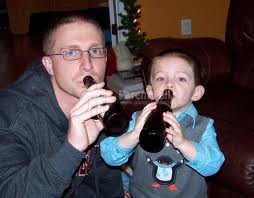 Chances are if you were an adult in this era, your parents inherited a Depression-era mindset from their parents and they had some form of involvement in war, be it World War II, Korea, or even Vietnam. Chances are your parent wasn’t much of a talker, or if the occasional yarn escaped, it had nothing to with anything sentimental, or personal, in the manner a modern day, Facebook testimonial might. Chances are they blanched at the suggestion that they were a hero, or that they were a member of America’s “Greatest Generation”. Chances are they were humble about their heroic efforts to save the world, and they didn’t want their exploits discussed, but they were just as silent about the pain they knew. The idea of psychological trauma, otherwise known as Post-Traumatic Stress Disorder, would be discussed during their era, but most true men poo pooed such discussions in closed quarters. Chances are they dealt with everything they saw, and everything they experienced quietly and internally, and in the only way they could deal with all this without going insane was in the company of some container of alcohol that allowed them to forget what haunted them … if only for a couple hours. Chances are they accidentally passed this legacy on to you.
Chances are if you were an adult in this era, your home came equipped with a fully stocked bar, a mirror around that bar that had some bourbon colored leafs on it, and a wagon wheel table, or some other loud furnishings that distracted the eye from the otherwise lower middle class furnishings of your home.
Chances are if you were a woman, and a wife in this era, your tale of the tape scorecard involved hosting abilities. For a good hostess of this era, the question wasn’t “Do you want a drink?” it was “What do you drink?” or “What can I do you for?,” or “What’s your flavor neighbor?” Those questions were for good hostesses who didn’t know their guests’ drink of choice, but most great hostesses already knew all that. Most great hostesses knew the kids’ names, what type of soda they drank, and the perfect form of entertainment to keep the kids away from the men. I remember one particular hostess, a wife named Jean, had Rondo at her bar. Rondo! How could she know that was my drink of choice? She was an excellent hostess.
Chances are your family had a George somewhere in the outer reaches of your family. Georges were regular pop ins. Pop ins, in the 70’s, were frequent and irregular. Pop ins provided some notice, some of the times, but for the most part a great hostess had to be prepared for a George to pop in at any time. It was a crucial checkmark on a hostesses’ list. Who was George? George was Johnny Walker Black dry. My mother innocently served George Johnny Walker Black on ice once. Once. Some of the times, once is all it takes. It would be the shame that loomed over our family for many a year. George was polite about it. He allowed his drink to sit silently on the table before him while speaking of other, more pressing matters. When he was asked why he wasn’t indulging in the fruits of my father’s labor, George simply said, “I prefer it dry.” My mother scurried about emptying his glass to prepare him a glass that was dry. My dad couldn’t look at George. He saved his scorn for my mother. George, for his part, said nothing. He was polite, and he silently drank it dry, but the damage was done.
George was a World War II and Korean, War Hero. He was a golden gloves boxing champion, and he was the top John Deere salesman in his district so many times that it would be more illustrative to point out how many years he didn’t win the award. He eventually became an independent business owner who carved out a niche in the crowded furniture market of our city, but I wouldn’t know any of that for decades. I only knew him as Johnny Walker Black dry.
Chances are if you were a Catholic, Irish boy of this era, you were not permitted to have an objective view of John F. Kennedy. We had pictures and portraits of two men in my household: Jesus and JFK. One of the first methods through which a young male could get a foothold on an identity in my household, through rebellion, was to criticize JFK. It was the family shame. You could criticize Notre Dame Football in my house, you could criticize the Cornhuskers, and you could even criticize the Catholic Church when Dad was good and loaded, but God help you if you claimed that JFK might not be Mount Rushmore material. There were numerous fights on this topic, in our house, that ended with the concession: “If you insist on popping off in such a manner, keep it in the family.” I wasn’t to embarrass the family with my crazy, heretical ideas about JFK.
I would love to say that I stood proud atop this lonely hill, astride my verbal spears, but I was so young and so outnumbered that I questioned my stance. I questioned it so much that when confronted by a Spanish teacher –who was kind enough to give me a ride to school– with the question of who I thought was the greatest president of all time, I said “Kennedy.” I said this to avoid a fight, the subsequent fights, and all of the arguments that I endured prior to meeting the man. “You know I’m Cuban right?” he asked. I didn’t, and I must confess that I didn’t understand the implications of it, but I lied and said I did know that he was Cuban. “Did you know that I was a Cuban rebel of Castro?” I confessed that I didn’t. “Did you know that I am the oldest grandson of a former Cuban emperor, and that I was in a direct line of secession that Castro wanted obliterated? Did you know that we were abandoned by this man that you call the greatest president of all time in what is called the Bay of Pigs?” I said I didn’t. I was thoroughly humiliated, but I didn’t know why. I was eventually let off the hook, because I was young, and I didn’t know any better. “Pay more attention in History class…” this Spanish teacher told me. I didn’t know it at the time, but I needed a drink after all that. I would come to know that soon. I would come to realize that all of the uncomfortable moments of life could be eased out of sight, and out of mind, with a couple of good belts under my belt. I would learn that fun was always fifteen minutes away.
Chances are that if you grew up in this era, in a manner similar to mine, you learned that adulthood was chaotic and an awful responsibility. You got yourself a job. You hated this job, but every man had a job. You got yourself some kids, but kids were seen but not heard in this era. Every kid learned how to conduct themselves around adults, no matter how chaotically the adults acted. You got your quarters to play Pac-Man or “Rhinestone Cowboy” on the jukebox, and you stayed away from the adults and their imbibing.
You worried about everything that happened if you were an adult in this post-Depression, post WWII era, you developed worry lines, and every piece of advice you offered a kid from the next generation involved the word “awful”. You learned that alcohol was the escape from the awful pains that pained you, the awful life, and you indulged in her pleasures whenever you had the chance to escape it. I saw all of the ABC After School Specials, and their thematic horrors of alcohol abuse, but I rarely saw those horrors in my life. In my real life all the trials and tribulations, of the awful life, were fifteen minutes away– or however long it took you to get a couple of good belts under your belt– from being fun.
Chances are that through all the fun, however, you did see some chaos if you were a kid in this era. Chances are you witnessed some evidence that the lifestyle wasn’t all it was cracked up to be. Chances are you witnessed one of your parents, most likely your Dad, in a compromising position. The women of this era usually comported themselves better. For the most part, all of the adults controlled their alcohol intake in public, but there were days when the awful responsibilities, of the awful job, in their awful life got to them, and they over indulged. Chances are they did something, in the throes of this abuse, that forever changed your perception of them, but chances are that didn’t outweigh the overall joy you saw procured from indulging.
Chances are you were already fully immersed in this lifestyle before any of the consequences of the lifestyle came to call on victims of the WWII generation. My dad’s generation didn’t qualify their love of alcohol. They drank, they got sauced, they got tanked, and they liked it! They got a few belts under their belt, and they felt better about the post WWII, Korea and Vietnam life they lived. It was their way to escape thinking about The Depression that their parents taught them, and the lessons Hitler taught them, and to escape the fact that the U.S. had more issues than they knew growing up. It was their way of creating an alternative universe that escaped all politics– both national and personal. They had never heard of cirrhosis of the liver, no one spoke about the horrors of drunk driving, and they didn’t gauge the chaotic effects alcohol could have on the mind and the family, until we were all already immersed in the provocative folklore that we took from the lifestyle. Chances are they didn’t discuss the horrors of the lifestyle, because they didn’t see them, until it was much too late for most of us.
Chances are you were probably immersed in the lifestyle before you were ready for such discussions anyway. I know I was. I know I took from the examples of what they did, versus what they eventually said. I knew I couldn’t handle my liquor, and I still can’t, but I defined adulthood as one drenched in alcohol and lots of talking. The talk was always uninhibited, slightly loony, jovial and non-stop. If something offensive was said, during this talk, you were to ignore it. “That was the beer talking.” It was a get-out-of-jail free card to say whatever you wanted to say whenever you wanted to say it.
Chances are once you were ready to immerse yourself in that lifestyle, you had that party that defined who you were and what you were about to do in life. Mine occurred at the hands of a guy named Lou. The summary of Lou’s fifteen year old philosophy was, life sucks, life is boring, let’s drink. “I don’t want to hear your philosophies of life,” he said, “I want to get plastered.” When I suggested to Lou that I loved music that was heavily influenced by the strange, complicated chords of Bohemian Rhapsody, he said, “‘F’ that stuff! The stuff you listen to isn’t party rock! If we’re going to get women involved, we got to get the Crue, Kiss, Ratt, and The Beastie Boys involved.” Lou was all about the testosterone. He liked to fight, he liked to have fun, he liked football, and he liked to have relations with women. It was the 4F society of a fifteen-year-old’s world.
Chances are if you drank this early in life, you didn’t have a way for getting alcohol. Chances are you drank anything you could get your hands on. Chances are you drank beer that you wouldn’t touch today, but if you couldn’t get that beer, you found an exotic liquor that you hoped would launch you past all those preparatory stages of adulthood to adulthood. Drinking a high-powered drink, like bourbon, was like stepping onto a high powered escalator that transported one to adulthood. If you were a lot like me, chances are you were an eager student to the specifics on how to drink … If you wanted to know how to enjoy the ride properly. You learned how to hold a drink, when to drink a drink, and how to chase it for minimal damage and maximum effect.
Chances are if you were a naïve, young Irish, Catholic boy from the Midwest, you had a Lou in your life. “We have alcohol,” Lou said. He informed me of this in a somewhat guarded manner that suggested that this wasn’t just any liquor, it was emergency liquor. It was liquor that shouldn’t be approached lightly. But this wasn’t just any ordinary night, this was a night that would have girls in it. If this didn’t qualify as an emergency night, no night would. “Girls don’t want to sit around and talk,” Lou said. “Girls want to get plastered. Girls want to party with guys who know how to party.” If it had been any other, ordinary night, where we couldn’t get alcohol, we would’ve sat in Lou’s basement and watched his Betamax collection of nude scenes from Hollywood’s glitterati.
Chances are you were a raging ball of insecurities and hormones, at fifteen, and you believed massive amounts of alcohol would provide you some cover. I know we did. I know we decided to break the emergency glass on Lou’s parents’ liquor to make something happen on “girls” night. That’s what we wanted, more than anything else, we wanted something to happen. We wanted to be fun, and with our fifteen-year-old, Catholic, and Midwestern mindsets, we feared we didn’t have much of a knowledge base, so we decided that alcohol would provide us some cover. “Okay, but I’m not going to raid the liquor cabinet,” Lou said. “After my cousin raided it a number of times, my parents got hip to the water in the bottle trick to keeping alcohol bottles filled. We do have decanters though.” Lou’s parents were the owners of a liquor store, so there was always plenty of alcohol in their house. The trick was how were we going to get to this alcohol without their knowledge?
Chances are if you were a naïve, young Irish, Catholic boy, born into the lifestyle of alcohol you said, “Decanters?!” with a gleam in your eye. “Let’s see them!” you said.
“I have no idea how old they are, but they’re old,” Lou said. He opened the closet door to reveal an array of elaborate decanters lined up in their own compartments. They had never been opened, and they had never been touched as far as Lou knew. “They’re, at least, as old as we are,” he informed me.
Chances are you saw decanters like these your whole life, and you probably viewed them in the manner Hobbits viewed Gandalf. “What kind of alcohol are they?” I asked believing there was an elixir in those decanters that would reveal things about life to me that my alcoholic forbears knew for a generation. He twisted the bottle around to read the label. “Bourbon!” He cringed. I didn’t know if bourbon was more potent than scotch or whiskey, and to be quite frank I still don’t. I’m sure that it’s all dependent on the brand, the amount of proof listed on the bottle, and the year it was produced. I made a mistake on the latter when I said, “Alcohol doesn’t go bad with age. It gets better. It becomes vintage.”
Chances are you knew as little about alcohol as I did, but you provided cover for this lack of knowledge with such little nuggets of information you had picked up over the years. Plus, you were willing to do whatever you had to do to entertain girls. Lou knew as little about alcohol as I did, but we both knew that an emergency night that called for emergency procedures. Dawn was coming over, after all. Dawn. Dawn was only thirteen, but she had a woman’s body, and she had one of those sultry, horse, Lauren Bacall voices that would melt a man’s loins, not to mention what they did to a fifteen-year-old’s ball of raging hormones. Dawn had a vacant expression above a cut, strong jawline, beneath flowery blonde hair. She loved to wear swimsuits all the time, even though she wasn’t going swimming, or that’s how I remember it anyway.
Chances are if you had a Dawn in your young life, you were willing to flip all of the emergency triggers necessary to entertain her. If you could get her to laugh, just once, you could play with that for a couple months, if not years. If she found something you said intelligent, or provocative, that could be your lone definition throughout your teens. Even having a Dawn look at you, was worth a couple swigs off the worst drink you ever put to my mouth. Lou seemed to gain his mantle effortlessly. I had to drink enough liquid courage to even open my mouth for five seconds. She was that good looking. I wanted to be entertaining in the manner my Dad, and George, and Francis, and Sam were entertaining when they drank. I’m not sure if it was the first time I ever drank, but it was the first time I drank with girls around. It was my first foray into the 4F club, and I was only fifteen minutes away from fun.
Chances are when you took your first drink, it was absolutely awful. Beer was awful and hard liquor was absolutely terrible, but chances are that didn’t matter to you. Chances are you thought that there was something important involved in you taking that drink. Whether it was achieving a different personality, a heightened awareness, or advancing to adulthood in some manner you couldn’t put your finger on, chances are you decided that you would acquire a taste for it, if it killed you. I decided I would be Tommy Lee, downing this whole, fricking bottle before a drum kit if I had to. I would be entertaining and lively. I wouldn’t engage them in my fifteen year old philosophy. I wouldn’t wax nostalgic on the beauty of Queen’s Bohemian Rhapsody. I would rock out and get plastered and be entertaining.
Chances are some girl, at some point in your life, called you boring. Chances are you didn’t know how to be entertaining to girls. If that’s all true with you, and you had the opportunity I did to be entertaining through alcohol, chances are you overdid it. If a girl like Dawn would laugh at something you said after one shot of alcohol, imagine what she would think of you after two, or three, or eleven shots. I got so out of hand, at one point, I began sneaking other people’s drinks. Another girl at the party, a girl named Rhonda, took one girly smidgen and decided that this wasn’t for her. For me, drinking this drink was like diving into an extremely cold pool. It was shocking and breathtakingly bad, but once I got it into my system, I figured my body would acclimate itself. I began sneaking Rhonda’s drink. When it was my turn to drink, if I missed a quarter shot for example, I downed that muther. It would only be revealed to me later that all of the other people in the place, took smidgens and put the drink behind them. Even if I knew this, I doubt it would’ve slowed me. I was there to enter the 4F club, I was there to get tanked, and this was my fifteen minutes of fun. I didn’t care that by some estimates I downed ten to eleven shots in this, my first drinking experience. This was more about entering a spirituality of drink than it was about being responsible or having a polite, responsible time. I was fifteen and I wanted to rock out.
Chances are that if you had a night like this, as your first drinking experience, you don’t remember a whole lot. I remember Dawn did a seductive striptease dance, but I missed most of that(!) Why God(?!) I remember someone being somewhat-sort-of concerned with my well-being. I remember vomiting violently, and I remember waking. I did it all to elevate myself to another sphere of spirituality that I would remember for the rest of my life, and I didn’t remember much of it. I haven’t had a drink of bourbon, or anything and everything that smelled something like bourbon, since. I threw up in my mouth a little just thinking of that smell.
Chances are that you had some sort of confrontation in that first morning after, whether it was internal or not. My experience involved a verbal confrontation with Lou’s Mom. I was in on about half of that discussion, even though she was speaking directly to me. I’ve never done well in situations where someone called my sanity into question. When one looks at me with that look, and speaks to me in that accusatory manner, I usually shut down or leave the room rather than engage. The times when I engaged in such confrontations have never turned out well. “What the hell were you thinking?” was the theme of her questioning. I looked elsewhere. “This is forty year old bourbon,” she said. This caused one of my otherwise, carefree eyebrows to lift.
Chances are that something went through your head that suggested that she was angry because her little baby was growing up faster than she wanted, and she didn’t know how to deal with that fact. Chances are you used one of those few nuggets of information you had about alcohol against her. “Doesn’t alcohol get better with age?” I asked her.
“Better with age?” she asked rhetorically. “Wine does,” she said. “You’re thinking of wine….bourbon ferments,” she said. “Do you know what ferments means?” she asked me from a position that was as close to hysterical as she ever got. “You could’ve, and should’ve, died last night!” Her eyes were boring into me, attempting to wake me to the reality of what I’d just done. “You’re just lucky you threw it all up!” she said. This caused both of my eyebrows to lift before I left the room.
Chances are not all of your drinking experiences were as death-defying. Mine weren’t either, at least not to that level. There was one night, I screamed out the lyrics to Bohemian Rhapsody in the manner Wayne’s World had. I was drunk out of my mind, barely paying attention to the road, with a hot girl, named Adana Moore, in the passenger seat. I think there were five people in my car that night: Me, Lou, Adana, Madonna, and some other girl they jokingly called Donna. When the song ended, I began screaming the next song. I wanted people to know that I knew the entire A Night at the Opera album. I knew every lyric to every song on that album, and probably five other Queen albums. No one cared. They only wanted to feel like Wayne’s World for one night. I remember Adana Moore staring at me like I was a strange character, as I worked my way through the lyrics of the next song, and the next, until I felt I proved that I would continue to do it even with her looking at me. Then, once she looked away, I felt stupid and stopped.
Chances are if you knew a Lou, you knew a guy that had a formula to getting chicks to do things that were totally foreign to you. I envied him for it. He was skilled at talking to women about stupid stuff. He wasn’t a phony guy, but he knew how to turn on the phony factor better than most people I know. He liked to say he had a gift for it, and he did. He liked to call this suave character he created The Louer. The Louer was an alter-ego Lou turned on when the ladies came around, and the ladies loved this self-effacing braggadocious character. I couldn’t compete with Lou on the Louer’s turf, so I decided to go down the opposite road. I decided I would be a complicated, artistic individual, but the problem was I had no artistic talents at the time. I listened to complicated music, or what I thought was complicated music back then, and I brooded. I thought this was artistic. I rarely spoke, unless spoken to. I offered some clipped responses, and I tried to be ironically and sardonically funny. Whatever the case was, I wasn’t into impressing the girls in the ways of the Louer.
If you knew a Lou, chances are you knew a guy who could flip a Louer lever to get the ladies undressed. I would not lower myself to such a point where a girl would dictate to me how I was to act to entertain them. I would remain true to my artistic convictions, even if most people didn’t care one way or another. I would not entertain them in a fashion I considered demeaning. I would be funny, but I would be funny on my terms. I would have fun, but that would be fun that I considered fun. In truth, I couldn’t be entertaining, and fun, in the manner Lou was entertaining and fun, but we made a good team. If the Louer was David Lee Roth, I was Eddie Vedder before anyone had heard of Eddie Vedder. This isn’t to say that I was sad. I was happy and fun, but I didn’t have a whole lot of material back then. Lou didn’t either, but he was much better at concealing this fact than I was when he was the Louer.
Chances are, if you’re anything like me, you reached a point where you realized you could not handle your liquor. I would say this to all of my future co-workers, friends, and family at any social function I attended. At one point, I thought of having a T-shirt made that said this, just to save all the time it took me to convince those around me that it’s not a good idea to give me hard alcohol. “Don’t feed the bear,” I told them in a joking manner that I hoped would address the matter with humor. I knew this made me less of a man, and that “that woman over there can outdrink you.” That’s fine, I said. I’ll bet I have a better jump shot than her, I’ll bet I can conjugate a verb faster than her, and I’ll bet I can name more Civil War generals than she can. I didn’t care that I could do any of these things better than her, just like I didn’t care that she could drink me under the table.
Chances are that such convictions didn’t last throughout your drinking life. Chances are you didn’t care when a fella called you out, but when you hung out with that cute girl you had been dying to hang out with confront you with these facets of your drinking life, you folded like a house of cards. You may have told her of your weakness, but chances are that didn’t matter to her, and chances are that meant a great deal to you. “Do you want me to be fun tonight, or do you want me to drink this one drink that you feel builds some form of symbolic camaraderie?” ‘Drink it!’ she said. “Do you want me to tell half of you I love you and half of you I hate you?” ‘I don’t care drink it!’ “Do you want me to start walking down that hallway over there and fall into that family of six?” ‘Drink the shit!’ “Does it really matter that I put the same thing into my mouth at the same time that you do?” ‘YES! Drink the shit!!’ “At a certain point in the evening, I will become quiet, as I grow embarrassed that everything that comes out of my mouth is twisted and tied up in my alcohol saturated brain. You really want that?” YES! Drink the shit!! She was so cute, and she gave an inkling that she might be willing to get undressed for me at the end of the night, and she was losing patience with me and my stance. She was even becoming a little disgusted by my weakness, so I drank the shit and eventually ruined (like I knew I would!) any chances of seeing her cute, little body naked.
Chances are at some point in your life, you saw the hills of drinking. All drinkers know these hills. One hill can be a momentary, night by night scale of debauchery, that ends at a certain point where you’ve reached maximum altitude. Most drinkers know this hill, and they responsibly know when to say when. They know how to have fun and engage in a little chaos that eases the awful life a little, but they know that slaloming down the backside of a hill at breakneck speed has consequences. Some don’t. Some suspect that there’s an extra bit of fun that looms on the other side of the hill, and it can be achieved with one more drink. If you’re anything like me, you know what they call responsible drinkers who know how to navigate this hill, who know when to say when, because they know their limit: Party poopers.
Chances are if you’re like me, you never sought this hill of life, so much as it was introduced to you. Chances are some of your friends suddenly stopped drinking, or they stopped seeing the necessity of having drink accompany every single get-together. I remember the first one. I remember seeing no beer in anyone’s hands, and thinking how unusual that was. What’s going on, I wondered. I remember the customary conversation that occurred on that occasion that I thought matched that which I had with my relatives at Thanksgiving. I remember thinking what a travesty it was. “We’re just going to sit here and talk?!” It wasn’t the hill for me, not yet, but it was a sign that things were changing among my friends. I was no longer in charge of festivities. I was no longer “respected” as the go-to guy for fun and frivolity. I was becoming a little sad. I was being face-planted into a hill that exposed me as a man who began to rely on a little drink as a Band-Aid to cover my wounds. I was becoming pathetic. I didn’t care. This wasn’t right. This was boring! Who’s in charge here? No one would answer. No one would look at me. It was the changing of the guard.
Chances are if you’re anything like me, you were one of the last to jump on board this ride. Chances are it took you years, if not decades, to realize that you didn’t need alcohol to be fun and exciting, and you chose Thanksgiving style talk as your new course of life. You began to learn about politics and work, and you began to engage in the awful life without it being made all the more awful through chaotic release.
Chances are you began to see all the life you missed at this point. Chances are people learned how to balance checkbooks, and fix their cars, and homes, and their plumbing. Chances are these people made meritorious advances in the workplace while you remained in your entry level position. Chances are they learned how to talk to women without having to have chemical courage involved. Chances are these people all learned things about life that you spent most of your life trying to avoid because they were square, unhip, nonalcoholic pursuits of life. Chances are this was never your intention in life, but it happened progressively night after night, hung-over morning after hung-over morning. Chances are you wasted a certain portion of your life in which you did achieve things, but not as much as you could’ve if you had been a little more focused.
Chances are if you led a life similar to mine, you started to recognize the compulsion you once had to be impulsive. Chances are that you once flew down roads at breakneck speeds to get to an 8pm party, so that you would have plenty of time to get blitzed by the time the heart of the party started. Chances are this started to become such a cyclical pattern of your life that these nights began to lose their fun. You experienced some Mt. McKinley nights of fun that you spent most of your life trying to recapture and top, until you had other Mt. Everest nights of fun. You escaped the pressures of the work life and the doldrums of the home life so often that those nights started to lose that crucial element of escapism. When this started happening, chances are you started to think about going home earlier, until you got there and wished you were out drinking again. You just wanted a fun life, and you were willing to do whatever it took to achieve it. You wanted to avoid reflection and get extremely chaotic for fifteen minutes of fun that helped you deal with the awful life, until you realized that your life was awful because of it. My dad and his friends had a hill, but they knew how to drink. Everyone does, it seems, to a point where it’s good, clean, adult fun. They didn’t know how to live, and either do you, you realize that day you truly face plant into that hill that informs you that you’ve been avoiding life for so long that you don’t know how to live.
Chances are you figured something out, somewhere along the line, and you’re happy now. Chances are something, or someone, happened in your life to clarify matters for you, and you’re no longer in the dark. Chances are you were a little late to the game, but you look back on your lifestyle with some regret and some fondness, but you’ve moved on, and you’re happier than you’ve ever been.

 Bob Hope and Jack Benny told jokes and got paid in their day, but theirs were different jokes, safer jokes, that appealed to fathers and sons alike. Benny and Hope did not seek to break boundaries or expose the culture’s sensitive underbelly. There were no sensibilities brought to their brand of humor. One would think that they would probably have a lot of trouble breaking through the ranks today. Hope told some risky jokes about Raquel Welch and Loni Anderson, but they were never so bold that they would offend a parent. Benny’s self-effacing humor would land him gigs in Omaha and Des Moines, but if he wanted in the upper echelon, he probably would’ve have to do some border stretching today. The difference between a Bob Hope and a Sam Kinison, or an Andrew Dice Clay, shows that humor evolves and changes over time.


 Rilaly